Small Cap Value Report (Thu 29 Sept 2022) - EMAN, XPF, LOOP, NXT, ATQT, LOAD, VLE

Good morning from Paul & Graham!
Mello Results Show - is today, starting at 2pm - full details here. "Our Graham" is doing a spot at 15:00-15:30, so we’ll have to tune in for that! Plus there are several companies which interest me, and it’s so much more relaxing to watch/listen to a company presentation, compared with ploughing through an RNS.
Organiser, my old friend David Stredder says -
“We have a cracking results show tomorrow with about 20 companies being covered and five presenting. Plus David Stevenson from Amati and Peel Hunt talking about REX so worth watching “
I would add that we don’t have to watch the whole thing. I tend to have it on in the background, and zone in & out, depending on what interests me or not, whilst getting on with other things.
Agenda -
Paul's Section:
XP Factory (LON:XPF) (I hold) - a rapid roll-out of the Boom Battle Bars concept is underway, along with the existing Escape Hunt business. Deals from landlords are spectacularly good at the moment, and TripAdvisor shows high customer satisfaction at most sites. Interim figures show positive EBITDA, but a loss before tax. However, forecasts from Shore show profits from 2023 onwards, as the business is rapidly scaling up, helped by franchising many sites on good economics. Good current trading, with no downturn in demand noted. Could be good, once stock markets normalise.
Loopup (LON:LOOP) [no section below] - announces a small, discounted placing - at 5.0p (22% discount), to raise at least £3m. The trouble is, I don’t think that’s enough. LOOP is fond of issuing upbeat updates, but if you look at the results statements & broker forecasts, it’s still a heavily cash-burning business. The last update trumpeted a big contract that was supposed to generate a lot of cash, but here we are just a month later, and it’s trying to dredge up more money from shareholders. Forecasts also show that, whilst it sounds promising, the cloud telephony new business is still tiny, and cash burning. There’s debt as well. I think LOOP could really struggle, now that investors are not keen to continue pouring money into loss-making, speculative ventures. Very high risk now. Even just a small £3m raise will increase the share count from 106m, to 166m. Expect a lot more dilution after that too. It might survive into 2023, but is increasingly looking like this could end up at 0p at some stage in 2023.
Update: £3.5m has been raised (69.5m new shares) in the placing. 25m of those were taken by Andrew Scott, a major shareholder, who heavily backed a previous placing at a much higher price. He now owns 29.4%. So good to see his continued support for LOOP. Maybe he'll take it private next time it runs out of cash? (speculation on my part). A further £1.0m could be raised in a broker offer, which is open until close of play tomorrow. [no section below]
Next (LON:NXT) - Publishes its interim results here. As usual, it gives crystal clear guidance (slightly trimming forecast, but not much). There's also some brilliant commentary on the outlook, and economic factors, which is well worth everyone reading (particularly part II) for read-across to other shares and sectors, so I recommend you take a look. I'll summarise it later here. I've now typed up my notes, see the new section below. The short version is that NEXT says sterling weakness vs the dollar will mean it might need to raise selling prices by more than the current +8% rate, in the second half of 2023. Could this mean inflation remains high for longer than economic forecasts are currently suggesting?
Attraqt (LON:ATQT) [no section below] - receives a 30p cash, recommended takeover bid from US software company Crownpoint. No doubt the strong dollar/weak pound is likely to encourage many more such takeovers. The c.79% bid premium looks great, until you look at the chart (below) and see it’s only recouping the sell-off of recent months. There again, ATQT has never posted a profit or paid any divis since listing on AIM in 2014. Its share count rose from 28m on IPO, to 201m now. This is the trouble with jam tomorrow shares - even if they do eventually succeed, by that point the share count has gone up so much, that there can be little upside (if any) on the original share price, then someone comes along and buys it, as has happened here, so upside is snatched away.

.
Crestchic (LON:LOAD) - I have a look at its excellent interim results, including a review of the balance sheet & cashflows. All looks good to me. The commentary & outlook are dripping with positives, so it seems that the buoyant trading & growth are set to continue. Valaution is still quite reasonable, despite the share price zooming up this year. My main query is whether the high profit margins are sustainable, or might attract competition? Overall though, LOAD gets a thumbs up from me. More detail below. (Also see the comments section below, for excellent additional research from Planetx)
Graham’s Section:
Everyman Media (LON:EMAN) (£89m) - this premium cinema chain reports a decent H1. The company did generate positive cash flow despite making a loss at the operating level. Three big movie releases helped the H1 performance and it looks like movie scheduling will be back to normal from now on. This should be good news for Everyman, as should its growing estate of venues - six new sites are already in the pipeline for next year. I like this stock but must acknowledge that it has failed to generate much cash flow over the years (even pre-Covid) and I lack conviction that it will succeed in doing this by 2024, as predicted by consensus forecasts. For these reasons, the valuation looks top-heavy to me. (more detail below)
Paul's Section
XP Factory (LON:XPF) (I hold)
12.0p
Market cap £18m
XP Factory plc (AIM: XPF), a global leader in the experiential leisure sector, is pleased to announce its unaudited interim results for the six months ended 30 June 2022 ("H1 2022").
This is a very interesting share, being a rapidly expanding “experiential leisure” company. The original business is Escape Hunt (escape rooms, which never madly excited me, and obviously was shut down in the pandemic), but a transformational acquisition was made last year of Boom Battle Bars (this is the bit that excites me). Both concepts are now being rolled out very rapidly, with the key point being that the company is securing highly advantageous deals from landlords, locking in attractive site economics for years to come (i.e. low rents, with big cash subsidies up-front [reverse premiums]). Some sites are company operated, others are franchised (thus being funded by the franchisees).
The best time to expand any leisure/hospitality format, is during recessions, because the deals available from landlords are so good. David Page at Fulham Shore (LON:FUL) has also made this point, that the deals currently being offered are stunningly good, which is why they are also expanding rapidly. Landlords want experiential leisure operators, because they pull in footfall, and favour XPF over over more standard type bars, in agreeing new site lettings.
The Escape Hunt, and Boom Battle Bars formats have an obvious synergy, so leases on some larger sites are being signed which have both operations in the same site, which strikes me as a really good idea, and avoids duplicated costs.
Even in a consumer downturn, concepts that are popular, value for money, and new, still do well - as evidenced in FUL’s last trading update.
H1 figures - it’s early days, so XPF is still loss-making, but see the note from Shore Capital to see how rapid the roll-out of new sites is -
FY 12/2021 actual revenue £7.0m
FY 12/2022 forecast revenue £25.3m
FY 12/2023 forecast revenue £39.8m
H1 2022 revenue is £8.1m. Adj EBITDA is positive at £1,070k, but there are so many costs excluded from that, I’m largely ignoring it. The loss before tax was £(3.3)m.
Shore’s forecasts show that H2 should be profitable though, with a FY 12/2022 adj PBT of £(0.8)m - getting close to breakeven. Then significant profits from 2023 onwards.
Site economics - this is all that matters - do the opened sites make money? We have to take management’s word for it, but the answer seems to be yes - with the Escape Hunt sites achieving a site level EBITDA of 39% of revenue, which looks very good.
Most of the Boom Battle Bar sites are franchised, which looks a terrific arrangement, where the company charges a fee of 10% of revenue. That’s very good business for XPF (but not necessarily for the franchisee!)
TripAdvisor reviews - are excellent for most sites, so clearly this is a popular concept that works well for the vast majority of customers. Although a couple of sites were clearly also having teething problems (especially Cardiff). Note that Cardiff was bought back from the franchisee in Sept 2022, so it looks like there might have been an issue there with the franchisee not running the business properly, hence the bad reviews, which now seem to have stopped.
Balance sheet - NAV is £18.8m, less intangibles of £21.7m, gives NTAV of negative £(2.9)m - not great at first sight. However, bear in mind that a liability of £9.9m for provisions is mostly deferred consideration, payable in shares (not cash), at a much higher fixed share price than the current share price. So we can adjust this off the balance sheet, which takes adj NTAV positive at £7.0m, which looks adequate.
The beauty of its rapid expansion, is that other people are funding most of the capex - namely franchisees, and landlords. So the cash requirement is quite modest, and I think there’s a good chance XPF could reach profits & positive cashflow without needing another placing.
Due to the deferred consideration in shares, and share options schemes, I’m valuing this share on the basis that it might have about 200m shares in issue in due course, as opposed to 150m currently in issue.
Current trading - this reassures, e.g. post period end -
Escape Hunt and Boom currently performing well with pleasing level of sales being achieved…
Recent performance across the estate has been encouraging with no discernible impact from consumer weakness. ..
Notwithstanding the encouraging recent performance, the Group's full year results are heavily weighted to the final quarter's trading and will be influenced by, inter alia, the dates on which sites currently in build are able to open, how quickly the performance at those sites tracks through the maturity curve, and the strength of pre-Christmas trading generally.
My opinion - a very interesting, rapidly growing, differentiated hospitality/leisure concept.
There’s obvious appeal to a bar where you can also do social gaming activities, which really differentiates this from the rest of the bars sector, where people just stand around or sit, and talk and maybe dance. You can do that anywhere. Whereas BBB is a clearly differentiated concept. There are competitors cropping up though, so this is likely to become a more crowded area in time.
However, BBB is locking in some terrific site economics, the CEO explained to me on a call - getting deals now on leases that should provide 10 years profitable trading from each site. So I see it as being a business that is grabbing an opportunity, doing the right things, at the right time.
Note that bowling is currently very popular, which reinforces the point that people want activities, not just sitting around drinking.
This could be a very good share, once the economy is straightened out.
In the meantime, I doubt anyone will be interested, as investors are mostly spending our time hiding in the cellar, or under the kitchen table! But bear markets end, when people start to see recovery potential, and I think XPF could be a good one to add to your watch lists, as something with good potential, once markets start behaving normally again.
I’ve already taken the plunge, and put some in my SIPP, as a long-term hold. Currently down 23%, but that doesn’t matter, because I’m not interested in selling, and the company fundamentals look good to me. So it should recover in price and move into profit in future, providing nothing goes seriously wrong.
If you want to invest in a rapidly expanding hospitality/leisure business, then XPF looks much better to me that say Nightcap (LON:NGHT) . I must look at Brighton Pier (LON:PIER) again, I’ve not got round to reviewing the recent update from them, it was looking promising earlier this year, but must have gone off the boil, judging from the wilting share price.
Crestchic (LON:LOAD)
262p (pre market open)
Market cap £74m
Crestchic plc, the power reliability company, is pleased to announce its unaudited interim results for the six-month period ended 30 June 2022
Strong trading delivers record first half profit
It seems so strange to be reviewing accounts for a company where everything seems to be going really well! LOAD is clearly operating in a lucrative niche, and I’m tremendously impressed with the figures, and the upbeat commentary, dripping with positives.
Here are my notes from the interim results -
H1 revenue up 35% to £21.3m
Gross margin up from 44% LY, to 50% this time, due to better sales mix (more higher margin hire revenues).
Operating profit more than doubled to £4.2m in H1 (LY H1: £1.8m)
PBT £4.0m
Order book at record level.
Expecting strong growth to continue into 2023.
Management expectations are being raised again (4th time this year!) for both 2022 and 2023.
H1 adj EPS 11.3p (big rise on 1.0p H1 LY, but that was partly hampered by exceptional costs, so not like-for-like comparison). Still very good though.
New Equity Development note shows FY 12/2022 raising forecast EPS from 19.5p, to 24.6p - that’s a big upgrade, not reflected in much of a share price move (yet). Revenues forecast at £45.3m this year, and PBT a thumping great £9.0m - that’s a high net profit margin of 20% - but is that sustainable, I wonder? Could attract competition.
Global operations.
Forex benefit possibly, manufacturing in the UK (weak sterling) and exporting? Does anyone know?
Big recovery from pandemic is helping growth this year, might moderate in future.
Divis - very small, at 1.33p (interim), but if strong performance continues then I think LOAD has much greater dividend paying capacity (Paul’s view).
New factory - has helped raise productivity & margins. Now expecting “well above” the original 50-60% growth in production capacity (which constrained growth previously).
Managing macro factors well, e.g. supply chain & inflation.
Balance sheet - looks fine to me, healthy. NAV: £25.6m, less intangibles of £4.4m = NTAV £21.2m. Net debt is only £1.4m, so it looks like the hire fleet is almost owned outright (hire groups usually have a lot of debt, this doesn’t).
Cashflow statement - over half H1 cash generation was absorbed into working capital. Not a problem, as that money hasn’t disappeared, it’s just supporting the growth. Share buybacks of £1.9m, negligible divis, £2.7m cash inflow from disposal of non-core businesses.
Valuation - based on new forecast of 24.6p this year, and 262p share price, the current year PER is a modest 10.7 - and what’s the betting they’ve held a bit back, so actual becomes another beat? Hence maybe the PER could be 10 in reality? That seems good value to me, for a company that is growing so strongly.
My opinion - this all looks marvellous! Based on such strong numbers, repeated forecast upgrades, a sound balance sheet & cash generation, and a PER of 10, this share looks very attractive to me, and well worth readers doing some of your own research - remember we’re only doing a quick overview here, of hundreds of companies, so the detail is up to you!
My only concern here is whether such a strong profit margin is sustainable? What is to stop cheaper competition copying the products, manufacturing them cheaply in say the Far East, and then under-cutting LOAD? A 20% PBT margin is an invitation for competitors to get involved and take away some sales and margin. So key questions to ask management (and independently research) would focus on what moat, or barriers to entry there are?
EDIT: many thanks to subscriber Planetx who has answered this question about competition in the comments section below, really useful, thanks! End of edit.
In the meantime though, LOAD seems to be making hay, in sectors where demand is strong. It’s great to see some good news & figures, in these depressing times! Thumbs up from me.
£NEXT
My notes from interim results macro commentary
Good interims (6m to July 2022) - PBT £401m, up 16% on LY, and up 22% on 2019.
Current trading - Aug 22 below expectations (probably heatwave), improved in Sept 22.
Trimming H2 revenues guidance from +1% to -1.5%
Profit guidance for FY 1/2023 trimmed from £860m to £840m - seems remarkably resilient to me, in the current circumstances.
EPS guidance 545p - gives a PER of only 8.9 (based on current price of 4830p/share)
PART II (this is the most interesting section about macro)
Difficult to forecast, so many variables - so forecasts (generally) are just a “best guess”.
Supply - need to find new sources, to mitigate sterling weakness.
Inflation - caused by supply problems (pandemic, then energy crisis).
Sterling devaluation - likely to prolong inflation, even once factory gate prices ease.
Cost of living crisis, might be 2: supply side caused 2022, currency causing 2023.
NEXT favours these policy measures - radical overhaul of planning laws, relax immigration rules, energy market reform, liberalising trade tariffs, reduce Govt borrowings by scrapping wasteful capex like HS2.
Prices - for Autumn/Winter (A/W) 2022 will be raised by 8% vs LY.
Prices - for Spring/Summer (S/S) 2023 similar increase, by c.8%.
Prices - for A/W 2023 could be higher than 8%, due to sterling devaluation effect, even if factory gate dollar prices are static/falling, and freight costs lower.
Forex hedging - fully hedged for S/S 2023. 30% hedged for A/W 2023 (at materially lower £:$ rate).
Mitigation of currency moves - some is possible, “but probably not enough”.
Key point - producer countries have also devalued against the dollar, so this lowers their domestic costs in US dollar terms.
Dollar costs of commodities & shipping costs may fall further.
BUT, the scale of sterling devaluation vs dollar is too great to fully mitigate - pressure will be worst in A/W 2023.
Positive macro factors - high employment, and vacancies have grown to equal unemployment - best position since 2013 chart starting point. This should mean fewer debt defaults on Next’s consumer receivables book. Household gross savings still high (see graph). External sources for the macro data are provided in footnotes. Govt support measures are likely to help consumer spending this A/W.
Remainder of FY 1/2023, sales guidance lowered from +3% to -2%
Balance sheet - net debt of £862m, is considerably less than customer receivables book of £1,182m. Healthy position.
Self-help measures identified, to improve margins, and become more efficient, I love this quote -
“It is only when the river begins to run dry that the upturned supermarket trolleys become visible” -
which sounds like a nicely anglicised version of Warren Buffett's comment about the tide going out, and lack of bathing costumes!
My view - fascinating stuff, and gives us lots to ponder, and questions to ask other companies about how they’re mitigating inflationary inputs.
The key point is that sterling vs dollar is going to put upward pressure on inflation in 2023. Although remember that there will be plenty of opposing inflationary factors going the other way, as the big energy cost hikes annualise.
This all makes me wonder whether the forecasts for rapidly falling inflation (e.g. from the Bank of England) in 2023 might be too optimistic currently?
Graham’s Section:
Everyman Media (LON:EMAN)
Share price: 98p (+1%)
Market cap: £89m
As anticipated, this premium cinema chain reveals £40.7m of revenue and £7.5m of adjusted EBITDA for H1.
Since depreciation of its equipment and other physical property strikes me as a very real and ongoing cost for a cinema chain, I’m inclined to dump the £7.5m figure entirely and look for the stricter numbers lower down the income statement:
- Operating profit £0.8m
- Loss for the period £0.8m after £1.6m of financial expenses, mostly related to lease liabilities.
Remember that under IFRS 16, lease costs are charged to depreciation and finance expense. This means that if a company needs to lease a lot of equipment or property, that its EBITDA becomes a useless number.
So in summary, the use of EBITDA by Everyman is not something I can agree with.
Performance
Operationally, the company reports admissions up 20% against H1 2019, with increased market share of 4.5%. The growth in these metrics is at least partially due to the opening of new venues.
CEO commentary:
"The first half of the financial year has been a period of progress on all fronts, with healthy admissions growth and robust spend per head, suggesting we are now back on track following the turbulence of recent years. Despite reduced film output due to the effect of low production during the pandemic, we've enjoyed three of the ten highest-ever box office releases in the past twelve months.
The three biggest releases during H1 were Top Gun: Maverick, The Batman and Doctor Strange. (I must admit that The Batman motivated me to get down to my own local cinema earlier this year.)
Film production is now thought to be “back up to full speed”, with good new releases coming over the rest of this year and next year.
H2 is in line with expectations and the outlook for the rest of the year is “promising”. The company should “at least meet expectations for the full year”.
With 38 cinemas currently, it has plans to open a new venue in November and has another six in the pipeline for next year.
Balance sheet - tangible equity is £38.9m. Some of the biggest balance sheet items relate to property, plant and equipment (£85m) and lease liabilities (£80m). This is a seriously capital-intensive business. Several venues have recently been refurbished.
My view
I have mixed views on this. I like the concept and I believe it has more merit than the “mainstream” cinema chains.
On the other hand, Everyman has been around for a while now and its cash flows are leaving me underwhelmed. In H1, the company managed to generate £1.7m and if you annualise that then perhaps the valuation doesn’t look too bad.
But given the permanent competition from streaming services, the exposure to a weakened consumer, its capital intensity, and its failure to deliver meaningful cash flows to date, I think a market cap closer to book value makes sense here.
Analyst forecasts suggest that it will come good in FY 2024. More compelling buying opportunities must be out there today.
.
Volvere (LON:VLE)
Share price: 810p (-10%)
Market cap: £20m
At the time of publication, Graham has a long position in Volvere (VLE).
As some of you may know, this was my largest personal holding for a few years.
That changed, as of earlier this week. Not because I made any trades, however: the Volvere share price has been weak for about two years, and it has finally been overtaken by one of my other holdings:
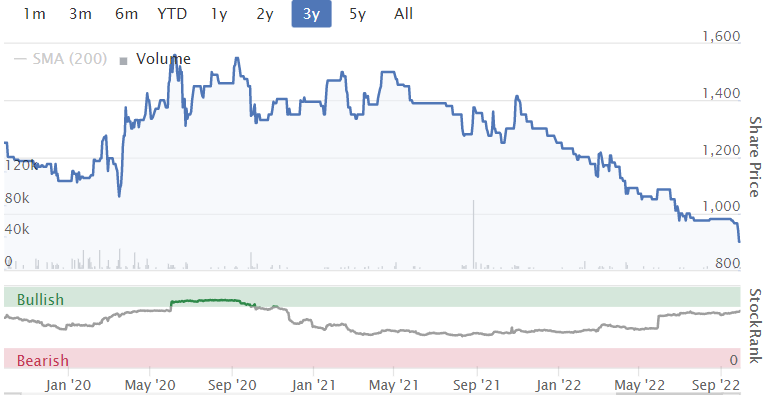
Volvere share price
(The holding in my portfolio that now stands at number one is a little company based out of Omaha, Nebraska.)
Let’s dig into these interim results and see if we can understand the difficulties faced by Volvere at this time.
Overview - Volvere is a company that invests in struggling businesses and turns them around (the Latin verb volvere means to turn or to roll).
It currently owns two food businesses: pastry manufacturer Shire Foods and dessert maker Indulgence Patisserie, its most recent acquisition (Feb 2020). Aside from that, it has a large cash pile and good net asset backing. It is still managed by its founders - the Lander brothers - who collectively retain a c. 15% ownership stake.
H1 results
- Revenue +14% to £17.9m
- Pre-tax loss £1.1m (H1 last year: £0.3m)
- Net assets per share down 1% over the six-month period to £13.33.
- Cash and available-for-sale investments £20.39m
These results are hardly inspiring, but it’s more meaningful when we look at the performance of each of its two businesses separately.
Shire Foods - “acceptable performance”.
Revenues here grew by 13.9% to £15.78m (nearly 90% of Volvere’s total revenues).
Profits were almost unchanged, just below £0.6m.
The lack of profits growth is attributed to:
“...a fall in the materials margin, which reduced by approximately 4.2% compared to the first half of 2021 and by 4.7% compared to the whole of 2021. This was due to the rapid increase in raw materials' costs which were not, in the timescales available, able to be passed on to customers.”
Shire has been raising prices since the end of H1, and “it is hoped that this will ensure a recovery in margins over time. It is, however, difficult to predict given the continuing inflationary pressures across the economy as a whole.”
Shire has been a successful investment for Volvere, but I’ve never thought of it as a particularly high-quality business. Although it is possible that Shire-owned Naughty Vegan could be a valuable brand some day.
I have to agree with management that this H1 performance from Shire is acceptable: it could have easily swung to a loss. It’s worth noting that the company’s energy costs are fixed - hopefully they are fixed for some time to come.
In “normal” times (do they exist?) Shire should be able to generate £2m in pre-tax profit. That’s approximately what it earned in both 2020 and 2021. It comes with freehold property asset backing and I think it could eventually be sold at a modest earnings multiple (although there are no signs of any intention by Volvere to sell it).
Or if the Naughty Vegan brand captured the public’s imagination, perhaps with the help of some marketing investment, then who knows what it could be worth? Brand development doesn’t always work out, though, and not much is being spent on this.
Indulgence Patisserie - “poor performance”.
This is where things don’t look so good.
Volvere bought Indulgence out of administration for £1.25m in Feb 2020.
Since then, it has ploughed money into the company in the form of loans.
Total loans are now £6.83m, a figure which includes the original acquisition price.
But it now looks as if this business may not be viable.
Its energy costs weren’t fixed, and it entered this inflationary period from a position of relative weakness. During H1, it made a loss of £1.5m on revenues of £2.1m.
I would not expect Volvere to put up with a cash bleed like this for long, and indeed it sounds like they might choose to cut their losses soon:
Following the period end, headcount has been reduced and, in order to generate cash, manufacturing has been suspended indefinitely as finished stock levels of £0.60 million are sufficient to satisfy foodservice and existing retail customers for several months. We continue to assess the ongoing viability of the Indulgence business in the light of the future sales opportunities, product margins and overhead costs associated with it.
Currently, “a period of de-stocking of finished goods is now underway”. I don’t know which way it will go, but I think this might be the end of the road for Indulgence.
Other matters
While these trading results aren’t great, there are a few other bits and pieces worth mentioning.
Firstly, Indulgence’s freehold properties “were independently valued in July 2022, resulting in an upwards revaluation of £1.11 million (before a deferred tax liability of £0.28 million).”
This revaluation means that the “net” result for Indulgence, including property ownership, was a lot closer to breakeven.
Volvere also tells us that the properties are owned by a separate entity to the Indulgence trading entity. So legally I guess it would be easy to sell the properties and to put the trading business into voluntary liquidation separately, if that is the decision taken.
Secondly, management have been trading with Volvere’s cash balance, although they don’t tell us what they’ve been buying with it:
During the period the Group invested £4.55 million in available-for-sale investments, the income from which amounted to £86,000. Some of these investments were subsequently sold in the period, realising gains on disposal of £310,000.
I think shareholders should be informed of the nature of these investments - hopefully we will be told more in the full-year results. The balance sheet shows £1.6m of available-for-sale investments still held at the end of June.
My view
When all is said and done, the final reduction in balance sheet equity for Volvere shareholders is less than £0.5m (see the Statement of Comprehensive Income). Not a big hit, in the grand scheme of things.
This includes the positive effect of property revaluations. You might argue that they aren’t reflective of “underlying” performance, but I would counter that by saying that a) the trading losses at Indulgence aren’t reflective of underlying performance either, because that company has stopped manufacturing indefinitely, and b) when Indulgence was purchased, management will have been keenly aware that they were getting freehold property assets that would help to offset any future trading losses.
I now expect that Indulgence will end up costing Volvere several million pounds. The capital poured into it (nearly £7m) is at least offset by the value of its properties and whatever cash it can raise from de-stocking.
The overall group balance sheet is still worth £33.5m and this is fully tangible consisting of freehold properties, working capital, available-for-sale investments and cash.
Volvere’s cash and investments alone are worth 92% of its £22m market cap. Then you also have whatever net cash Indulgence might be able to wring out of its assets. And then you also have whatever cash Shire might be worth - remember that a return to “normal” margins would see it earn pre-tax profits of £2m.
So on valuation grounds, it would be very difficult for me to sell my stake in Volvere today.
Future deals?
I think one of the major issues here is that it’s been quite some time since the company made a successful acquisition. It has made spectacular disposals, but nothing good on the acquisition side for some time.
Management are earning over £650k p.a. (2% of balance sheet equity) and with so many economic sectors struggling, I think shareholders are wondering for how much longer they will continue to sit with cash on the sidelines.
They raised £10m in October 2020, expecting an increase in opportunities. It is nearly two years later and still no acquisition!
The only clue we get on that front today is:
There is a significant degree of instability across the UK economy and consequently we are seeing an increase in potential investment opportunities. Not surprisingly we have reviewed a number of businesses where the continuing uncertainty in relation to energy costs is a particular challenge. Our preference is for investments in companies where we can make a substantive change to effect a turnaround, but high energy costs are not something we can influence. We believe some good opportunities will emerge, but timing is critical and the current macroeconomic and geopolitical situation make that issue very challenging.
So, will we get a deal any time soon? I don’t know. I have great respect for the judgement of management here, and I do think it’s reasonable for them to be wary of investing in anything else where energy costs could be a problem, even if this greatly limits their range of opportunities. But they do need to make a deal at some point.
If they can’t find anything better to do, I still support share buybacks and hope to see more of them. If they could buy back a decent chunk at 850p, for example, that would be a 36% discount to net assets. Since net assets are (in my opinion) a low-ball estimate of the company’s worth, I’d be glad to see repurchases happening right now.
Disclaimer
This is not financial advice. Our content is intended to be used and must be used for information and education purposes only. Please read our disclaimer and terms and conditions to understand our obligations.

111 comments
I've not read all the comments in here today so not aware of what's been said about pensions and LDI. But fwiw I believe this to be a total storm in a teacup that a lot of commentators and 'experts' have latched onto and associated with something like GFC and solvency issues we saw then run in banks and credit markets. Totally bogus analogy, not even educationally useful. A better analogy would be the portfolio insurance of 1987.
Its not even clear that any pension funds that faced stress posting margin variation calls will be net losers over the past month. They may not have got the full liability hedge if they were forced to liquidate near the top in yield before yield came down. BUT THEY HAVE NOT BEEN ON BRINK OF INSOLVENCY
Comments about pensioners being poorer and done by Kamikaze Kwasi are really idiotic. These are final salary schemes. if there was any cost to recent days for a scheme then sponsor will be asked to increase contribution over the next decade. This is not a mark to market thing.
All other pensions are unaffected. They are just lower as markets have been falling. Nothing to do with Mad Liz
I'd hardly call it a storm in a teacup, given that it forced the Bank of England to abandon its plan to do Quantitative Tightening, and instead do up to £65bn in (effectively) QE (emergency buying of Gilts) over a fortnight, to get a grip on gilt yields.
Surely this is a good example of how all the instability that central banks have introduced into the system (starting with the Fed), triggering massive wealth destruction in shares, bonds, and property markets, in a short space of time, has inevitably triggered unforeseen and potentially dangerous consequences.
I see this as being potentially very similar to the start of the 2007-9 GFC actually. Namely a large drop in asset values, which then forces liquidations of assets, triggering further declines. All magnified by gearing and derivatives. Then a key market player (e.g. Bear Sterns, Lehman) goes bust, triggering a crisis of confidence, as nobody knows who has suffered the giant losses & could be next to go bust.
In 2007-8 they let the situation spiral out of control, because far too many people waffled on about "moral hazard". They were totally wrong, you can't just let systemically important organisations go bust, or the whole system shakes itself to pieces. Decisive action is needed, and early, to flood the system with liquidity.
That's why I think we're probably not long away from a reversal of interest rate hikes, and a return to QE. The world is addicted to zero interest rates, and it seems to me we're finding out the hard way what happens when they try to normalise things too quickly.
Regards, Paul.
I suppose I am guilty of dramatic understatement! Clearly there was an acute technical issue in gilts market driven by idiosyncrasies of liability driven investing/hedging. My 'storm in teacup' point was more general in a UK inc sense and the reaction to Kamikaze Kwasi where I think we've seen general hysteria including from people who should be more sober (looking at you Mark Carney). The budget consequences should always have been a repricing of yields and interest rate trajectory in UK and weakening of sterling. Truss and advisors had made it clear that they thought interest rates should be higher.
I'll stick to this is more 1987 portfolio insurance blow up than 2008. 2008 was driven by insolvency (admittedly relative small in scale compared to global markets but there was a lot of leverage connected to it directly... and indirectly eg AIG) and a huge ricochet liquidity transformation and short term funding problem from now on strike eurodollar markets it unhooked in banking. There is no solvency issue in the pension debacle. It is purely a liquidity mismatch driven by rapid moves in long dated bond instruments. These instruments are not liquid enough for the hedging purposes of the pension funds so investment banks have 'kindly' made a market in derivates for them. That lead to variation margin requirements feeding back too quick in less liquid real portfolio and creating the drama. In effect, the investment banks are using their balance sheets to generate liquidity for the pension funds in long dated risks. technically the pensions could default as they didn't generate the liquidity to make margin variation...but they would have made good on the payment with a bit more time as the pension funds had abundant assets. The leverage/liquidity here long predates zero interest rates...but zero interest rates make for outsized moves in long dated bonds due to higher convexity effects at low rates.
I agree we will have liquidity injections coming...I go further and think we will see outright debt monetisation pick up scale (as you point out elsewhere the BoE has done a lot of that). However, I'm unsure re interest rates. I think we might see liquidity injection with higher rates...partly as I think Mad Liz is right that we need growth and for it we need stimulus. Europe inc UK has followed a sort of self harm austerity playbook since 2010. Liz wants stimulus, higher rates....and implicitly imo that means liquidity support ultimately including debt monetisation.
The negative 'expert' and european policy maker response to her is interesting. Its overblown imo...but that is as she has challenged a 'wise person' status quo. If one wished to be geopolitical and paranoid in thinking you could say Liz is trying to hurl a grenade into the EU/EZ as a move to outright stimulus (implicit in embracing deficits as a tool), with higher rates/yields to counter existing and further inflationary pressures but also recompense for the extra risk borne by the sovereign. This policy brew is dynamite to the european debt-fudge system in play since the euro crisis.
IMO the logic behind the Mad Liz strategy is better than the continuation of the austerity, low growth, debt increase road to nowhere...so I think even if Mad Liz is killed off for the affront she has caused her policy redux will live on
Exciting
Paul,
Interesting.
So 'Mad Liz' is not mad and 'Kamikazi Kwarteng' is not a suicide bomber.
They have a plan for growth, a ladder which could lead us out of this post QE / inflation conundrum. And to top it off, her plan kicks the EU in the goaolies.
I agree it could work, although I'm not sure if she is clever enough to plan it quite that well.
Shame these policies were delivered in such a politically decisive fashion, when could have been handled much more sensitively.
Michael
MICHAEL
your post reminds of who's the greater fool. The fool or the fool or the follows her. MAD liz spend £150b on the energy cap and she does not understand its bills can be higher the then the £2500 avg bill. I agree on she's not mad just plain dumb.
Keep the faith the chaos will eventually end.
BSV
I made no comment on their (so far embryonic) plan for growth, never mind the right plan for growth. My simple point is that actively and unabashedly seeking growth is the right orientation. There are then costs on the trade off between higher growth/investment and low growth/austerity
People calling Truss or Kwarteng dumb are being puerile / butt hurt / hysterical / political / frustrated at their circumstance (delete as fits)
I'm happy to elaborate more on my view however some questions first to see whether its worthwhile (all the hysterical commentators on this SCVR feel free to provide answers to these)
1) How much of the coming mortgage payment rise can be pinned on Liz/Kwasi from 23 Sept?
2) Can we have low interest rates like the last 14 years with a healthy economy?
3) In what way did Kwasi cause the the pension fund stramash? (And can you actually explain what happened there rather than repeat hysterical circular fire squad in media)
4) Assuming we have an unavoidable short run energy supply hiatus do we let the market set the price so as consumption adjust accordingly?
There are many more things to question/establish but those 4 are good as scene setters
No pick up on £THG. A large Cap in the Small Cap territory.
Charles Allen, Lord Allen of Kensington CBE, a Non-Executive Director of the Company, has
purchased 1,250,000 ordinary shares at a price of 41p. Around 0.5m.
Probably not some fundamental changes but maybe some buyer interest. I'm tired so not following it.
I hold from IPO 2021 hence burn't which is a shame for the system - but at least Mr Market made hay.
Thanks RDH and timarr. Have to say I’ve been burnt before thinking that I knew better than the market and, after yesterday’s intra-day recovery, I’m more nervous about today’s further declines now that cleverer people than me have had time to think it through and throw together a spreadsheet or two. Was hoping for a reassuring RNS from the affected companies as markets worry in a vacuum.
I see H & T (LON:HAT) is looking to raise £16.9m at 425p to raise funds for expansion. Offer available through primary bid
I see H & T (LON:HAT) is looking to raise £16.9m at 425p to raise funds for expansion. Offer available through primary bid
Placings are Also available directly now through AJ Bell which means no need to use Primary Bid. Main advantage is that you can take part within SIPPs and ISAs, which you can’t with Primary Bid.
According to my extensive research (one Google search) 74% of current UK mortgages are fixed rate, with 94% of new mortgage buyers also choosing fixed rate.
Apparently anyone who had an active mortgage offer which reflected the pre-interest rate rise, has an offer which can't be unwound as rates have increased.
So it will probably cool off demand whilst people assess where we are headed, but whilst it is difficult to be sanguine with so many negative headlines, it is not quite so 'end of world', at least not at the moment.
Considering with some (if not most) lenders you can lock in a rate 6 months prior to the end of your current one and that it was well publicised that inflation was creeping up, I suspect many people renewing now will have done just that earlier in the year.
The coming 12 months could see a significant slowdown plus some risk for those who took out a cheaper 2 year fixed during the last stamp duty freeze seeing a big hike when renewing soon.
Good points Trident.
Also remember that many house buyers are cash buyers now. There was a fascinating chart in the Times recently, showing that the number of owner-occupiers with no mortgage at all has been steadily rising for many years, and is now a majority of all owner occupied households.
Another point to consider, is that I understand why house prices might, or are likely to take a tumble as interest rates rise. However, that could prove temporary, because inflation is forecast to rapidly decline in 2023, and central banks would then be likely to cut interest rates again, particularly if (as seems likely) we're in a recession.
I remember in 2008, house prices initially tumbled, and the confidence fell out of the market, but once interest rates were slashed, it shored things up pretty well.
All guesswork of course, but I suspect higher interest rates could well be a temporary phenomenon for months, rather than years. If I'm right, then property, and housebuilder shares could be a good place to hunt for a recovery in 2023.
Regards, Paul.
Everyman Media (LON:EMAN)
Hi Graham
Thanks for your thoughts on this cinema chain. I remain a big fan, though I agree there are more tempting things out there right now.
One observation I thought worth adding is that I see Everyman Media (LON:EMAN) as more of a night out rather than a trip to the cinema. Accordingly the proportion of revenue derived from ticket sales has dropped from 61% in 2017 to 50% in H1 FY22.
The majority of the difference has come from increased food and beverage sales.
For the same periods noted above this has gone from 33% to 41% of revenue.
Admissions/seat/year looks quite similar vs pre-covid levels, so if they can increase the number of venues AND continue to increase beverage & food spend per head then, all else being equal, one would think that they would do well.
A
This stuck out for me: "we've enjoyed three of the ten highest-ever box office releases in the past twelve months"
Unless they're expecting increasing number of new box office records every year, then the Everyman Media (LON:EMAN) financials with 3 new box office records, doesn't sound very good. And we're about to enter a recession; surely difficult for new box office records to be set?
Well today feels very different from the last year or so...I was hoping for some gimmer of positivity from yesterdays sell off and the positive USA trading last night, or perhaps a nothing day. Again though a very negative day with little or no glimmer of hope around.
I trimmed back into 50% cash with on average a 9% stop loss on my portfolio, and with buying targets being triggered in my watch list, for the first time I have decided to sit on my hands. Below these buying targets and the stop losses on shares I am holding is uncharted territory in the last number of years...resistance that does not exist, and with no crystal ball I will be forced to sit it out and wait till the bounce, which seems a shame, but if you want to employ stop losses of say max 15%, that's all you can do, other than research, and refine my buying lists.
There must be many many private investors in the same boat now, sat on cash, or bombed out share prices with no cash reserves and no point in selling up.
The old saying 'it can't get any cheaper, but it can and does' is ringing truer every day, but for it to be done to good quality companies, with great track records over many years seems brutal, but less so when watching from the side lines.
I hope you guys are all holding up, and good luck with your own strategies.
Paul
Crestchic (LON:LOAD)
I don't hold, but I do regret not buying when Planetx first mentioned them a few months ago.
There are plenty of positives mentioned today so I thought a few negative ones would be good for balance:
There's nothing wrong with this, but it does make me wary of the possibility of accounting funnies in the future. Which indirectly leads me to...
This was partly explained as follows:
"debtor days have also increased slightly with more of this revenue relating to revenue in the Middle
East."
Given the high calibre clients they (presumably) work with, I'm amazed cash collection would ever be an issue.
Sales apparently happened quite late in the period, so everything is probably okay. Nonetheless it would be good to see a table of debtor days to understand this better, as it's almost 3 months since the period end and I would expect all payments from H1 to have been received by now (and for the company to explicitly say this today, which they don't.)
Which leads me to....
---
On competition Crestchic (LON:LOAD) were the #3 player in the market @ December 2021.
There's clearly room for a 3rd player at the moment, but if margins are so good (c20%) and growth so great I'd be surprised if Schneider/Simplex weren't more aggressive in the future.
Cheers
A
Somero Enterprises (LON:SOM)
Somero global headquarters and training centre is based in Fort Myers on the south west coast of Florida. The area has been badly hit by hurricane Ian.
Just wondering if there there may be some adverse impact on ability to trade as a result of any storm damage.
Has anyone heard anything?
I have not heard anything but I have visited their facility I I would not worry. Firstly it is a long way inland ( near Southwest Regional airport ) so there is little chance of flooding. The main production facilities are in Michigan so Florida is primarily Head office and training. They may have lost power for a while but I would be very surprised if thee is any significant interruption to business.
Renewi (LON:RWI)
No profit warnings, last trading statement good (Jack's commentary was reasonably positive) however share price has declined from £8.50 down to nearly £5.50, I appreciate Markets in general everything is falling but unless I am missing something find it hard to understand why such a drastic dropn on relatively low volume. Apart from current market sentiment would anybody have any logical reasons accountancy wise why such a drop should occur in this case?
Renewi (LON:RWI) Just to add the share price decline from £8.50 to £5.50 has occurred in the last month!
Know little about the company but looking at the basic metrics, think it might be linked to the debt to equity ratio, interest costs etc. Director buy just now helps a little maybe. Your note has got it onto my watchlist.
Yes, I recall that Renewi (LON:RWI) had a lot of debt, when I last looked. So the key thing to check, is whether the borrowings are fixed or floating interest rates, and the expiry dates, as they might cost a lot more to refinance when they expire.
The debt structure was unusual, in that at least some of it is "Green bonds", so were quite cheap I recall, because ethical investors were keen to lend money to a recycling company.
Regards, Paul.
Sorry, director buy was different co Renew Holdings (LON:RNWH), ignore me. Still on my research/watch list though. Have started to try to see what their gas consumption looks like, that could be another factor but can’t quickly find an answer.
I’d have thought that energy prices were already “in the price”. The macro issue for Renewi is that recession reduces industrial demand for waste management services. Long term, provided the company survives the coming quarters, demand for recycling and recycled feedstock is likely to be strong. Debt is the other question mark. Sharepad tells me to expect a TU on Monday.
Crestchic (load)
To add on to Paul’s comments
Thankfully this is my biggest holding by far and has just about rescued my portfolio from the oblivion going on around us .
To add further
1/. Barrier to entry
I asked the chairman about this at recent factory visit and my impression was incredibly hard for a new (Chinese) competitor to have any effect .
Firstly the customer base is hard earned and Crestchic have a long established reputation and they also have a lot of IP
The likes of the US navy and MOD just do not switch suppliers, I saw a loadbank just finishing production heading off to San Diego for the US navy and a circa 400k item , there is zero chance of this type of sale going to a new entrant .
Not to mention I think their cost of manufacture is very efficient and lean
1-0
2/ Loadbank rental fleet is understated .
There is large unbidden value off balance sheet for the hire fleet loadbanks .
All loadbanks over 10 years old are written off but they can give a working life of up to 30 years .
That is uplift not stated and probably accounts for some of the margins seeming high as this is clear profit when sold or rented .
2-0
3/ Leadtimes will come down , sales will go up , and costs come down .
Sounds the nirvana for increased profits but Crestchic for the past years have been working inefficiently in a not fit for purpose building causing long leadtimes and inefficient production (eg all staff have to clear the car park to get the US navy loadbank out ). Not to mention leadtimes were 10 months plus which is a big barrier to a lot of sales
They have built (on budget ) a new facility that will galvanise their production
- reduce leadtime which will increase sales
- more efficient production
3-0
4/ US sales
Finally they have been busy in the past year establishing US sales and distribution and setting up regional warehousing and IS offices to improve service to the US market .
Product still made in the UK
4-0
5 / Flexibility and long standing customer relationships
They seem to have ex excellent relationships with customers and are the only support who will buy back their items and put in hire fleet or resell , or lend out their hire fleet for customer support .
In short the hire fleet is a great resource for a customer to have access to and knowing that Crestchic will even buy back is a big plus .
5-0
In terms of not putting a foot wrong it’s all maybe too good to be true , share price has hardly reacted to todays news which is a symptom that no one is buying anything , I’ve added again which puts me somewhat overweight but just can’t fault this and to boot they seem a good bunch of people willing to engage with shareholders .
Thanks for that update and extra background Dave .
Richard
Fantastic, thanks Planetx!
I've edited the main article to point people towards your additional research points. All sounds very positive. If I had any cash, I'd probably be a buyer myself ;-) But I've heard enough to put it on my watch/buy list now. Thanks again!
Regards, Paul.
Thank you Planetx .... you can't beat a company visit and I really appreciate your commentary. I don't hold but Crestchic are on my watch list.
I have been in this for a good 12 months then sold at the top after the last revision, but as the price has at last come back have reinvested my profits, so playing with Mr Markets money. I think when the markets have sorted themselves out, it will move up another level 300p plus.
I would be grateful for a bit of education. Following your reports on Crestchic, i have been a buyer, and that has been successful. Thanks. Today in their upbeat report, they say their Cost of Capital is 12.5% . This seemingly high cost doesn't seem to matter, as their ROI is 18%. But in my ignorance, i can't understand why their cost of capital would be so high in an era when interest rates, even now, are still so low.
I have not read the report, but in the context of accounting/valuation Cost of Capital generally refers to WACC (weighted average cost of capital i.e. the cost of both debt and equity to the company). Here is a decent write up: https://corporatefinanceinstit...
Does that fit with what is being referred to in your specific example?
I know the right-leaning community doesn't like politics here on SCVR, but it is closed related to the markets and shares we may own. So for thoughs who don't like it please read no further.
I do feel we are seeing Britain unchained in action. At first, I was concerned and worried about my wealth and portfolio, but now I see how great it going to be for poor people in Britain and approve of the chaos. Let me explain.
Crash the UK Economy will be excellent for the poor because.
So what I'm doing to protect myself;
Anyway, what I'm really saying is I think the government agenda will probably mean the pain will get a lot worse before it can get better. Possibly holding cash is King at this point in time. (Ideally USD or Swiss FRANC)
Hope you accept & enjoyed the humor as they were intended.
Stay positive and things will improve eventually.
BSV
[deleted]
Stay positive and things will improve eventually.
Can you tell me how long "eventually" will be? This could be a Japan 1989 moment and we'll all be dead before stockmarkets return near to recent highs :)
How Longs a piece of string?
Personally, I have written off 2022 and 2023, hopeful for 2024.
If We die hopefully the children will enjoy the good times.
BSV
A housing crash will make homes more affordable ; but if the fall is accompanied by a 6-8% mortgage rate ( this seems the case we are heading at the moment ) then homes will be even more expensive to buy in real terms.
This doesn’t look like 2008-2010 where prices collapsed together with decreasing interest rates.
Staying positive it is indeed very important.
You've got cause and effect the wrong way around.
House prices will fall because of interest rate rises, not accompany them. The amount of income people are prepared to spend on housing is relatively stable - interest payments go up, house prices go down. People with existing mortgages might end up with more expensive repayments but new buyers won't.
2008 was a weird time, problems were caused by lack of availability of mortgages and interest rates were high. At the same time that there were a lot of repossessions, as the likes of Northern Rock had to clear their bad debts, borrowing was very difficult. Banks were happy to sell repossessed stock to clear the outstanding loan rather than what they could actually get. Those with cash got bargains. I managed to pick up a previously sold for 150k flat, marketed at 120k for 95k as that was the outstanding mortgage on the repossession but my fixed rate deal was 9% which I could only get as I had 15% deposit and a lot of scope to pay more.
I was trying to say that a house of £300000 on a mortgage rate of 4% will cost less ( at the end of the day ) than the same one bought for £225000 but on a mortgage rate of 8% . Prices might drop but it does not necessarily mean you are getting a better deal as rates are going up by the second these days.
I think this is how it works.
Inflation increases, (10% might be the peak).
Interest rates eventually have to catch up with inflation.
So let's say your house price/mortgage today is £240K when interest rates were at 1%. The homeowner would pay £ 2400 a year, about £200 a month, probably quite comfortable.
Let's ramp up the interest rate to inflation and see what happens
Interest rate Monthly payment House value
1% £200 £240K (Comfortable)
2% £400 £239K (Affordable)
3% £600 £238K (let cut back on holidays)
4% £800 £220K (wow this is half my wages)
5% £1000 £180K ( Let turn the heating off)
6% £1200 £140K (Let borrow money and maxi the CC)
7% £1400 £120K (Is worth keeping this house)
8% £1600 £100K (Let just give the key back and moving back with mom and dad.)
It is not the same problem as 2008. It is High-interest rate that is likely to lead to low house prices.
BSV
You seem to have it nailed ….
You are correct on your analysis ( just like Boohoo! ) but we are talking about different assumptions. I was just saying that lower house prices do not necessarily mean new homeowners will be getting a bargain ( based on fixed mortgage rates ).
Theres a book came to mind called 'The Psychology of Money' which has a chapter 'The Seduction of Pessimism'
Optimism sounds like a sales pitch, pessimism sounds like someone trying to help you.
For a moment I thought you were serious, but the "converting all my pounds to rupees" was a giveaway !
Really? This is the only bit I was serious about I'm holding on to all my rupees!!!
I honestly think everyone has lost their sh1t on Kamikaze Kwasi's budget. TBC I don't agree with elements of it...but I welcome the 'growth' focus. What has happened for GBP and yields (with some overshoot and pension fund related pressure) is that they reprice to reflect the policy change.
The degree of bs hyperbole on 'pension crisis' is spectacular from supposedly knowledgeable people - there was zero risk of insolvency and it was nothing like 2008 (some comparison to the 1987 portfolio insurance debacle better)
Some 'out of consensus' views, written Sunday so before this week's shenanigans:
https://mojomogoz.medium.com/k...
Thank you for the link is appreciated
The AGM statement from Coral Products (LON:CRU) today contains a trading update. As it's short, I'll post it below. I hold, thanks to earlier comments from a SCVR subscriber.
AGM Trading Statement
Mr Joe Grimmond, Chairman of Coral Products plc, a specialist in the design, manufacture and supply of plastic products based in Wythenshawe, Manchester, will make the following statement at the Annual General Meeting of the Company which takes place at 12:00 p.m. today at the offices of Tatra Rotalac Limited, Southmoor Road, Wythenshawe, Manchester, M23 9DS.
"I am delighted to report that the Group has enjoyed a very strong start to our current financial period with sales and profits before tax materially ahead of the same period last year and in line with market expectations.
We have successfully integrated the operations of Film and Foil Solutions Limited, (sales of £10.3 million for the year to 31st December 2020) which was acquired in May 2022 and Alma Products Limited, (sales of £12.3 million for the year to 31st December 2021) which was acquired in June 2022. Both these acquisitions had, as forecast, a small negative impact on the Group's profit before tax for the period but the Group's profitability remains robust and both companies were acquired with expectations of improved performance as Coral begins to influence their direction. This was reflected in the price paid for the acquisitions.
On 19th September 2022, the Group announced the completion of the Acquisition of Manplas Holdings Limited ("Manplas"). Manplas will be integrated into our specialist logistics solutions operations centred around Customised Packaging Limited which will allow the Tatra business, located adjacent to Manplas, to expand into the vacated unit. Manplas had sales of £2.7 million in the year to 30th June 2021.
Whilst the short-term macroeconomic outlook remains challenging, the Group will continue to seek opportunities to strengthen and develop our business.
With our strong balance sheet, we are confident of further progress in the current financial period.
In order that our shareholders can share in these improvements, your Board has declared an interim dividend of 0.5 pence per share with an ex-dividend date of 10 November 2022 and record date of 11 November 2022. This interim dividend will be paid on 16 December 2022."
On the subject of orders Chris Farrell wrote, IMO, a rather good synopsis of LON:GMS on Mondays SCVR. He talked about the upside. They have since announced 2 significant contract wins (one today) and the share price also seems to be recovering. Irritatingly Chris' write up does not get referenced on the GMS stock report. I think it should be.
For best results when printing this announcement, please click on link below:
http://newsfile.refinitiv.com/...
Copy the link into Google at it comes out in readable format.
Richard
The quickest way I have found it to:
Good work brad .
I thought there probably was a way to re format it but not clever enough to work it out .
Thank you.
brads13 - formatting of stocko rns reports - thank you! That's a great short cut and it works well.
cheers
Mark
Not sure about the triple mouse click - on mine despite saying 'please click' it is not clickable. I find it easiest to highlight the link and right click then select open link:
Yes, it's a bit annoying isn't it! I've previously asked the team to just make the Refinitiv link a clickable link, surely they can't be too complicated to implement?!
Thanks to Paul and Graham who you will see on the show later today. https://melloevents.com/mellor...
Registration to this Results show is free and will be a wonderful show for spotting the value as so many of the companies covered are on very low ratings...
Here is the full programme for this afternoon .
Results Round Up, Thursday 29th September 2022, 2pm – 6.30pm
Programme
2.00 pm David Stevenson discusses “The Small Cap Discount : Opportunity Knocks” with David Stredder
2.30 pm Company presentation by Fintel
3.00 pm Results Round-up from Graham Neary
3.30 pm Company presentation by Brave Bison
4.00 pm Company presentation by Avation
4.35 pm Introduction to Rex by Kit Atkinson of Peel Hunt
4.50 pm Company presentation by TPFG
5.05 pm Results Round-up from Mark Simpson including the Good, the Bad and the Ugly
5.30 pm Company presentation by S&U
Looking forward to seeing you all
David
I know not small cap but the c. 10% fall in Next (LON:NXT) was too much to resist this morning. Didn’t quite get in at the low at c. 8% down but as long term hold has to be a good opportunity. Accept that fall further over next year or two but long term could be last man standing!
...and it is falling further, down 12.5% and counting. Didn't expect that so soon!
Morning Paul. If you have the opportunity today, I would value your insight in today's results from XLMedia (LON:XLM) Not something I currently hold but have had on my watchlist for a while.
Sorry, I didn't get round to looking at XLMedia (LON:XLM), nor Coral Products (LON:CRU) - both were on the list, but I've done about 9 hours work on today's report (including last night's preparation), so am too tired to do any more! Just going to get a couple of tinnies, and watch Mello next :-)
No apologies needed Paul. Enjoy the Mello event!
Anyone wanting detail and new forecasts on the superb Crescthic interims today can find them in the new ED note with much raised fair value at 360p, click here: https://www.equitydevelopment....
Good morning all. Love this exchange. Any view on Allergy Therapeutics (LON:AGY) ? Allergy Therapeutics. New product testing moving forwards and a funds raise to take that to the next stage. I think this Worthing based pharma is set to break out. Views?
We don't cover biotechs in the main report, but there might be readers interested, so feel free to discuss. I see from the StockReport that Allergy Therapeutics (LON:AGY) has meaningful revenues (biotechs are often zero revenue & big cash burners!). The pipeline sounds interesting, vaccines for allergies, so could be lucrative if they strike oil so to speak. Strangely, it seems to have moved into profit in 2019-2021, but is now forecast to be heavily loss-making again. Not sure why that was.
Results today seem to show a profitable business pre-R&D, which reduces risk, as it could shut down R&D if it runs out of money. So maybe a sum of the parts type valuation method could make sense here?
Raising more cash I see in a separate announcement today. Cash burn was a bit alarming in the year just reported.
I normally dismiss biotechs as too speculative, but this one looks quite interesting actually. Just as a punt for me, as I know nothing about the sector. What do sector experts think? Has it got any notable major shareholders who know what they're doing in the sector?
Regards, Paul.
LDI and BOE.
So we know the elephant in the room for now...one of them anyway ... LDI. I can attempt to explain this in layman's terms having sat in the same building as these chaps.
All defined benefit pensions are a set of assumptions valued by actuaries. Pre 2000-2003 these were matched with a portfolio of assets predominantly equities. The extreme falls in equities left many large funds in deficit. As equities recovered and deficits fell, the opportunity to match the liability better with bonds...and therefore protect the pension from falls in equities(too volatile) presented itself.
All fine and dandy so far....but the problem has always been a shortage of long term assets to invest in .... so index linked bonds ended up being very expensive. So derivatives contracts replaced the assets.... all sounds a little GFC... and with recent moves in bond prices...these derivative contracts have ended up under water. Clearly leverage has been used to synthesise a return and now the margin calls have brought into question the viability of such schemes. The schemes have been trying to sell assets to meet the margin calls and thus you have seen extreme moves in index linked securities. #INXG an index linked ETF went from down 10% to up 15% yesterday on the announcement that the Boe has stepped in.
Im afraid the mini budget poured fuel on the fire. Maybe there are good ideas in there but the reaction of the bond market and sterling means we find ourselves in a dire situation here. Its an obvious concern that the govt has not reacted to this and the Boe had to step in. It goes without saying it takes a lot to smack sterling the way it has been and isn't simply hedge funds messing around or pesky speculators. Mohamed El Erain put it much better than me in yesterday's FT ... the govt should delay tax changes a year ... buy some breathing space and restore confidence. Instead they seem to have gone missing.
Thanks RDHowarth - that is the clearest explanation I have seen.
I agree that our situation is dire.
Credit where credit is due: https://www.zerohedge.com/mark...
Just a few days ago we wrote that "Something Is About To Break" and prompt a capitulation from one or more central banks, which oddly was met with mockery in the comment gallery. Also, a few weeks ago, we said that we are nearing a moment in time when central banks will do QE and rate hikes at the same time.
Thanks R D Howarth. Are there any consequences for Aviva, Phoenix, LGEN, etc which I'm sure feature in many PI portfolios?
Are there any consequences for Aviva, Phoenix, LGEN, etc which I'm sure feature in many PI portfolios?
As we can see from the share price falls, the answer is generally yes.
Legal & General (LON:LGEN) looks like the most exposed - it has direct LDI exposure and has issued collateral calls, apparently. I don''t know if M&G (LON:MNG), Aviva (LON:AV.) and Phoenix group (LON:PHNX) have direct LDI exposure but they will have some liabilities due to interest rate and FX hedging.
But frankly if any of these gets into real financial trouble then the whole market is at risk. The real danger will probably come from the 5,000 or so smaller pension schemes, many of which are likely seriously exposed.
I'd expect to see announcements from all of the above in the next week or so.
timarr
And outside of the life insurers you also need to take into account the likes of BT (LON:BT.A) which has its own LDI pension scheme.
And possibly worth noting that Just (LON:JUST) has a seriously large exposure to junk bonds.
There's an FT article on this, which basically says that the main risk to the big insurers is more likely to come from the regulator getting stroppy about the valuations of the illiquid assets that they're holding (Aviva being the worst offender, with 35% of assets of that class).
But of course, improving gilt yields are generally good for insurers' capital, so calculating the overall impact for the larger companies is nigh on impossible from the outside.
timarr
Actually never made that link - so that’s why maybe BT has been so poor. Although they may have their own scheme it’s unclear who holds the liability. I assume but have no idea That someone does the quant work for them. In answer to above - potential significant issues for any co that has advised on LDI - LGEN are huge - PRU are huge in variable annuities - do t know about Phoenix.
I have just had a look at BT (LON:BT.A) report and accounts - £55bn assets £56bn liabilities... although £1bn is a large number it doesn't strike me as requiring huge leverage. The disclose shows about half the assets in liability matching mix of Gilts and inv grade bonds... a small amount in infrastructure. This doesn't suggest gearing ... and therefore the liabilities and assets should move together - which is the point. Now I don't know how comprehensive disclosure is nor what convention is but from what I have seen.... it looks plain vanilla. The scheme has under half in growth assets incl equity listed and unlisted. A reasonable slug of cash. Best guess is this is reassuring.
Ok - I don't want to overstate my expertise here. Id say the issues are legal and specific to advisory contracts - if you have handed over discretionary management of a scheme to an advisor - then margin shortfalls are an advisor issue, which is why they need to sell scheme assets to meet liabilities - which was causing a negative spiral.
For BT, it is obviously a very large stand alone scheme and although some of it maybe in LDI ... there has remained a deficit that needs funding and this should have fallen. Honestly I don t know how that pans out. BAE, RMG are also of decent size off the top of my head.
Rather than make guesses Id say this. In principal a scheme that was not in deficit should face less problems since the need for any leverage must be lower. The margin call issue must apply to leverage since no scheme would have an issue meeting an unlevered call. My guess would be the early stuff 2010 is probably pretty good and for the later stuff, advisors have become more adventurous in taking on schemes in deficit. Legal & General (LON:LGEN) were late and grew quickly...but it doesn't mean they are in trouble.
I would cross the sector off my list for the time being. Mainly because a misselling type enquiry could unfold. I hold BT however and won't be doing much.... but it will be hope rather than analysis.... I assume that the broker/analysts will be asking all the right questions and information will come out quickly. At smaller scheme level you have to take into account the size of the scheme relative to the size of the company. Obviously the real issues are where the scheme is larger than the company. In most cases this isn't true and therefore should be manageable.
Agree with most of that. As I mentioned before it would be surprising if the major insurers / fund managers had a serious liquidity problem, if pension funds are unable to stand up the collateral, as they benefit from gilt prices rising where they're not hedged. It's the pension funds using LDI I'd be more concerned about - so the likes of BT.
But frankly I don't believe this will be allowed to become a major problem - there's too much at stake. The UK's Pension Protection Fund, i.e. the lifeboat that stands in if pension funds go under without having the assets to meet their liabilities, is a heavy internal user of LDI. The contagion if the PPF was allowed to collapse doesn't bear thinking about.
Nothing is impossible but I am talking my own book here as I own Aviva (LON:AV.), Legal & General (LON:LGEN) and M&G (LON:MNG).
timarr
The charts of all three look like they saw the same ghost.....
The charts of all three look like they saw the same ghost.....
Indeed :-)
You can find many more - Just (LON:JUST) , R&Q Insurance Holdings (LON:RQIH), Phoenix group (LON:PHNX), Saga (LON:SAGA) and that's before you look at other sectors - Rightmove (LON:RMV) and Auto Trader (LON:AUTO) have fallen sharply as well as retailers across the board. Next (LON:NXT) has fallen 12% today on a not particularly bad update.
It's a horror show. Ghosts and ghoulies everywhere.
timarr
This is the thing with financial crisis right? Its often not the first thing that goes bad that causes the collapse, but the knock-on effect; due to the complex derivatives/instruments concocted that were flawed and couldn't stand up when there are abnormal market conditions.
Did the UK's LDIs become the first dominoes for a global worldwide financial crisis? Hmm. We'll see in a few months!
Does anyone follow Synthomer here Synthomer (LON:SYNT) . Now just about in the market cap range. Which is shocking because it's only 5 months ago that it completed a $1bn acquisition of an adhesive company in the US. Today's announcement says nitrile glove destocking issues will last until the end of 2023! And due to other headwinds it sees a 10 to 15% reduction in EBITDA. Directors bought shares in August around £2. It's been a steady share price descent from 530p in August 2021 to 98p today. There must be covenant concerns, it has quite a load of debt from its acquisitions. Stockos figures, without updating for todays announcement had a pe of 4 and a dividend yield of 9%. Oh and big fx exposure debt in $ and euros and reports in £
I hold Synthomer (LON:SYNT) which as you say has been a disaster. But I bought some more this morning because I thought the fall had been over done. A 15% fall in EBITDA is still a profit and a PE of under 5 and a divi over 9% is extraordinary for a profitable business.
I was looking at the interim results which gave eps of 19p. But I think this only included the results for the adhesives business for a quarter, not the half year (ebitda for adhesives was £18.3m).
Hi. I too am a holder in Synthomer (LON:SYNT)
Looking at its financials, whilst the debt is high (I think form purchasing the US company last year) the drop in EBITDA whilst disappointing should hopefully not result in major losses.
I still remain optimistic - the Div Yield is high, but Div cover is 2+ so room for movement here.
I think the biggest issue is the medium term outlook and if we run into a recession and orders take a major tumble then there could be some short-term pain, but again I have confidence in management.
I took a small additional number of shares this morning as I felt the drop was overdone, but who knows in these markets. I am happy to keep this as a long-term buy & hold over the next few years and would hope to see it well above here in 5 years time.
I topped up too. "World leader in many markets"...Interestingly 40m+ shares (nearly 10% of the issued) bought in last couple of months (on price drop?) by big institutions as well as Kuala Lumpur Kepong (which now holds over 26% of the shares) a huge player in the production of natural oil and rubber...
The share price downtrend from December 2021 (480p) to today has been under the 50 day MA , apart from a brief rally in May.
I know lots of people dont like using stop losses but it would have saved lots of grief, any company in a long term downtrend like this has to be treated with caution. Why not wait until its trading above the 50/200 day MA. Wont catch the absolute bottom but will at least have momentum with it.
I watched the classic top of the market video with Richard Leonard from July 2021 again last week, where Synthomer (LON:SYNT) was his biggest holding. He did sell some by December 2021 but said 400p was too low to sell. Its 93p now. Private investors have such a big advantage in being able to trade in/out quickly in things its silly not to use it.
I have it on my list to properly update my analysis later this week.
But I would say the covenant danger is getting too close now for £SYNT
If I remember correctly, the last results showed the covenant level at 2.3x (Debt to EBITDA I think), and that the max point was 3.5x, until early next year when it is 3.2x.
Today's announcement that EBITDA (in GBP) will be 10-15% lower.
Then there is the fact that the debt is in EUR and USD, which has now increased 10-15% in GBP terms since the results date.
So we're probably looking at a live covenant ratio of maybe like 2.8-3.2x currently. Which is very uncomfortable. There is a strong risk that this is not the last profit warning. Nor that the pound will get weaker.
Gemfields (LON:GEM) good H1 results from Ruby and Emerald miner. $193.2m rev, profit after tax $56.6m, $15m dividend, $10m share buyback. Sedibelo a PMG miner which GEM have a estimated $33m stake in to IPO by end of 2022. Stockopedia rank 98. I would appreciate you having a look at GEM, don't think its been covered before.
On a superficial level, I like the look of this company and will be doing some research for myself.
Hi DAZZA64
Interesting share indeed.
Do you happen to know the lifetime of the mines (bit busy at the moment to check) , and if there are any minority interests in this company?
Thanks
Hi
Avon Protection (LON:AVON) news item. (I hold)
Headline is this .....
Avon Protection is pleased to confirm that the Group has received its first
delivery order worth $42.1 million from the U.S. Army under the Next
Generation Integrated Head Protection System (NG IHPS) helmet contract
W91CRB-21-D-0022
Regards
Howard
LON:AVON There was another order for $15m announced on the 7th. The recent share price decline was precipitous but it seems to have found its floor and the chart over the last few weeks is rather encouraging. This is a defence stock, lots of $ revenue, is not going bust, and now has an OK dividend - worse places to park you money in a storm. I hold. Yes I know its is down 70% from its high point, but I am talking about now.
Have to say that the Next (LON:NXT) is a masterpiece of company reporting. The CEO and his Group Finance Director are clear, articulate and have financial controls which are second to none. The economic commentary is brilliant and at the risk of politics intruding into the SCVR these two have a far better grasp of the economic situation than the current incumbents of No. 10/11!
Colefax (LON:CFX) AGM statement is not imo news worthy enough for Paul or Graham to cover, however they remain inline
It’s nice of them to remind us that the US remains their largest market by far (& thus US$ earning):
“The US is our largest market accounting for over 65% of Fabric Division sales”
I hold (FYI it has a wide spread & is illiquid so is a long term holding)
Colefax (LON:CFX) Presumably a lot of their costs are in USD though.
Update on investment idea Surface Transforms Plc Surface Transforms (LON:SCE) fundraising announced yesterday - highlights strong revenue expectations & nicely developing return on capex, but price not ideal. See full update in post:
https://www.upsidedownsidecapital.com/p/surface-transforms-plc-fundraising
Good that Surface Transforms (LON:SCE) got this fundraising away, at an OK discount. They were looking a bit risky if there were any further delays in volumes asked by OEMs for Q4 or next few quarters, or if teething production issues come out.
This at least gives them a good financial buffer, regardless of any possible setbacks next few quarters, as well as the money to ramp up production for further growth.
SCE has been on my watchlist for a while now, I am going to re-evaluate today's announcement more fully soon, but I think it ticks a lot of my boxes now.
McBride (LON:MCB) announces they will release results later today. The rushed announcement means we should have some interesting activity today. Possibly an announcement of fundraising or refinancing. One to add to the list for today?
Having read through the results today, I have reached the conclusion on £MCB that despite the debt now not becoming an issue, this is not investable as all the profits will get eaten up by pension contributions, increased interest, and debt repayments for the next decade.
Unless they can pull out like some solid growth (another 30% revenue in the next year or two) and get net profit margins up to the mid single digits (which they have never done in the near history).
There might be a strategic acquirer that could be a possibility, paying 0.25x EV/Rev. Maybe a contract manufacturer in the USA, looking to geographically expand.
And Angle (LON:AGL) results - online meeting at 1100.
Very positive numbers from HSS today. Interim divi reinstated. All looks to be moving in the right direction. The recovery continues.
Crestchic (LON:LOAD) (was Northbridge Industrial)
From today's interims Peter Harris Exec Chair says:
To date, 2022 has been a record year for Crestchic. The strength of our pipeline makes us confident that Crestchic will continue to grow strongly into 2023. This buoyant performance across all sectors around the world has led the Board to raise expectations for the fourth time this year (and it's only end Sept).
There has been an exceptional change at Crestchic since Peter Harris became Exec Chair -well done Peter.
I invested about 2 years ago as I was particularly attracted by the potential of Crestchic (once Tasman had been sold) and I always look for sector tailwinds when investing. Hoping to hold for a long time.
Investegate |Crestchic PLC Announcements | Crestchic PLC: Unaudited Interim Results Strong Trading Continues
dividend restored too
''This dividend was heralded as the first step of a progressive dividend policy and we are pleased to be able to announce with these results the declaration of an interim dividend of 1.33p per share in respect of the year to 31
December 2022, which will be paid on 3 November 2022 to shareholders on the register on 14 October 2022.''
LON:LOAD
Yes dividend restored and progressive which is a great sign that they care about shareholders.
Peter Harris owns 5.71% of the company so he will be happy to receive dividends too.
Management aligned with shareholders.
Braemar (LON:BMS) is having a stellar year so far - making a bigger operating profit in H122 as per the trading update today than the whole of FY21. Brokers are suggesting 51p EPS in Cenkos' case for this year although expectations for FY24 then fall dramatically - although note I don't think the brokers reflect share-based payments (see below). However, two words of caution about Braemar (LON:BMS):
Paul did a great post previously on SCVR pulling apart the Braemar (LON:BMS) accounts which is worth looking at if you're studying Braemar (LON:BMS)
The loss of Nordstreams 1 and 2 is only the beginning of the divorce from Russian energy, there is no going back any time soon.
I hold Braemar (LON:BMS) and it's been a real dog when I really wanted a money-maker.
Volvere (LON:VLE) (I own) results today… not so good BUT if you are going to warn then having a property revaluation up your sleeve, some investment gains and a balance sheet awash with cash helps mitigate harsh economics of the food business.
They have not had much luck since buying Indulgence … so it looks like a mistake for now but pleasing they are making tough decisions and exiting where they can’t make money. Also sounds like the properties will be sold. Shire did ok all things considered. I remember however Shire also having tough times with margins - mainly due to lack of revenue but never the less - came through this period. The business will be well run but you can only do so much. Even where energy costs have been successfully hedged this only postponed the day of reckoning … and so we must wait for energy solutions to emerge … which they inevitably will.. eventually.
On a positive note, those that thought Lander and Lander were distracted from Volvere (LON:VLE) will no doubt be pleased to see investment gains on the cash. Although no acquisitions yet they are not asleep at the wheel. Also share repurchases combined to make the hit to NAV small.
The shares trade at a substantial discount to NAV which until deployed is mainly cash. I believe the Landers have our back and the scene is set for some nice acquisitions and a strong period to follow. In the meantime the discount narrowing in better markets offers enough return potential for only a small amount of risk.
£VLE
Thanks RDHOWARTH, just my thoughts entirely. The discount to a tangible asset backed NAV is probably around 30% now. Similar discount levels to a number of investment trusts in the PE space which i follow.
I believe this is a big position for Graham, so I very much hope he can comment on this today?
One complaint about the News service on Stockopedia is that is is often almost impossible to read the figures within annual / interim reports as the formatting means that information which is elsewhere presented in a columnar manner (such as today's VLE results: https://www.lse.co.uk/rns/VLE/...) gets presented line by line in an unreadable manner. Please can someone at Stockopedia look at this??
Regarding Stocko's news service, yes the numbers part is usually hopelessly laid out, although there may be a way to re-format it ? but I use it as prompt to look at the reports elsewhere, individual company websites, or here InvestEgate | Company Announcements | Home | FTSE 100, 250, AIM, techMARK or here Vox Markets - Market Investor News, Insights & Analysis
I second that. Often numerical gibberish and have to go another site to find decent formatting
or Investegate ... normally takes a little time so about 0715.
Nice calm update from NWF (LON:NWF) . Trading in the divisions was better than expected, but at this moment they don't want to upgrade full year forecasts. I think this is the right way to do it, don't hold yourself to something you might not be able to do with the economy as it is.
Sorry but I think consumer discretionary shares are a bad idea right now. Markets are short term, looking 3 to 12 months ahead.
My guess is that these shares will be great in about 9 months time.