Small Cap Value Report (Thu 3 Oct 2024) - VP., TFW, GFRD

Good morning from Paul & Graham!
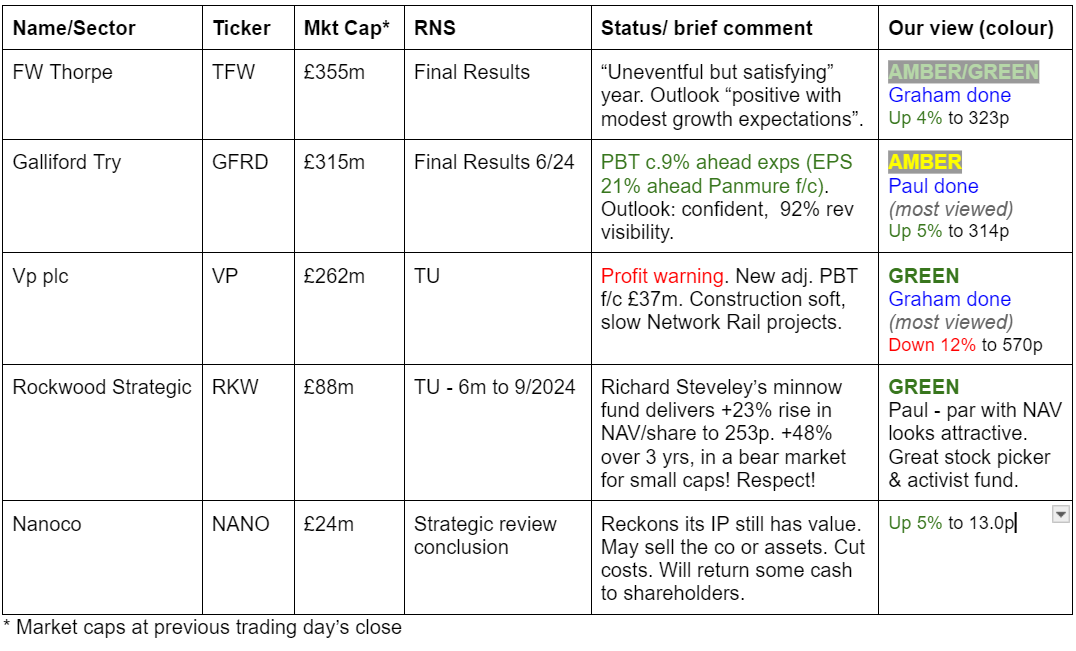
FYI, I've finished off yesterday's SCVR colourful table this morning, with everything now ascribed a colour to represent our view. I had to cut short yesterday, after getting into a complete muddle with WYN (I had a senior moment and started confusing WYN figures with forecasts from similar company NWF), resulting in me needing a lie down to clear my head, and then having to re-write the section from scratch!
Also there was my latest chat with Paul Hill to prepare for, which we recorded yesterday. I think that should go out today, which I hope people find interesting, where I focus on the latest best ideas that have cropped up in these reports, and we discuss other topical issues, such as IHT fears possibly causing some bizarre AIM price movements at the moment.
Explanatory notes -
A quick reminder that we don’t recommend any shares. We aim to review trading updates & results of the day and offer our opinions on them as possible candidates for further research if they interest you. Our opinions will sometimes turn out to be right, and sometimes wrong, because it's anybody's guess what direction market sentiment will take & nobody can predict the future with certainty. We are analysing the company fundamentals, not trying to predict market sentiment.
We stick to companies that have issued news on the day, with market caps (usually) between £10m and £1bn. We usually avoid the smallest, and most speculative companies, and also avoid a few specialist sectors (e.g. natural resources, pharma/biotech, investment cos). Although if something is newsworthy and interesting, we'll try to comment on it. Please bear in mind the "list of companies reporting" is precisely that - it's not a to do list. We typically cover c.5 companies per day, with a particular emphasis on under/over expectations updates, and we follow the "most viewed" list of readers, so if you're collectively interested in a company, we'll try to cover it. Obviously with the resources available, we can't cover everything! Add you own comments if you see something interesting, and feel free to discuss anything shares-related in the comments.
A key assumption is that readers DYOR (do your own research), and make your own investment decisions. Reader comments are welcomed - please be civil, rational, and include the company name/ticker, otherwise people won't necessarily know what company you are referring to, if they are using unthreaded viewing of comments.
What does our colour-coding mean? Will it guarantee instant, easy riches? Sadly not! Share prices move up or down for many reasons, and can often detach from the company fundamentals. So we're not making any predictions about what share prices will do.
Green (thumbs up) - means in our opinion, a company is well-financed (so low risk of dilution/insolvency), is trading well, and has a reasonably good outlook, with the shares reasonably priced. And/or it's such deep value that we see a good chance of a turnaround, and think that the share price might have overshot on the downside.
Amber - means we don't have a strong view either way, and can see some positives, and some negatives. Often companies like this are good, but expensive.
Red (thumbs down) - means we see significant, or serious problems, so anyone looking at the share needs to be aware of the high risk. Sometimes risky shares can produce high returns, if they survive/recover. So again, we're not saying the share price will necessarily under-perform, we're just flagging the high risk.
Others: PINK = takeover approach, BLACK = profit warning, GREY = possible de-listing.
Links:
Paul & Graham's 2024 share ideas - live price-tracking spreadsheet (2 separate tabs at bottom), Video update of results so far, June 2024.
** New SCVR summary spreadsheet for calendar 2024 ** This is the live one! (updated 6/9/2024)
Archive - SCVR summary spreadsheet for calendar 2023.
Paul's podcasts (weekly summary of SCVRs & macro views) - or search on any podcast provider for "Paul Scott small caps" - eg Apple, Spotify.
Phil Hanson's data analysis measuring performance of our colour-coding system in the SCVRs, from July 2023- Mar 2024 (with live prices). My video explaining/reviewing it.
My other video (June 2024) - How to screen for broker upgrades on Stockopedia. More stock screening strategies here (possible bargains?) - 21/9/2024.
Companies Reporting
Summaries
VP (LON:VP.). - down 14% to 559.2p (£225m) - Trading Update - Graham - GREEN
It’s a profit warning as subdued house building/construction markets, and slower activity at Network Rail combine to shave more than 10% off the adj. PBT forecast for the current year. Perhaps it’s not such a big surprise in these economic circumstances; we maintain our overall positive view of VP.
FW Thorpe (LON:TFW) - down 1% to 308p (£361m) - Final Results - Graham - AMBER/GREEN
Nudging up the position on this to AMBER/GREEN after the company posts solid results: no change in revenues, but profits are higher by c. 10% and there’s a nice bounce in the cash pile. PER is about 16x but management are highly credible and may be worth it.
Galliford Try Holdings (LON:GFRD) - up 4% to 313p (£324m) - Launch of £10m Buyback & Final Results [ahead exps] - Paul - AMBER
Ahead of expectations results for FY 6/2024 are pleasing, together with a £10m share buyback (funded by a corporation tax rebate). GFRD is enjoying a good patch, but the profit margin remains wafer thin, and I think there's considerable risk here - eking out a tiny profit on large, complex contracts. Shares have had an amazing run, but I don't think the business is as good as they imagine. Also the cash pile comes from favourable timing, there's almost nothing on the balance sheet overall in NTAV. So I'm not keen, but good luck to holders!
Paul’s Section:
Galliford Try Holdings (LON:GFRD) - up 4% to 313p (£324m) - Launch of £10m Buyback & Final Results [ahead exps] - Paul - AMBER
£10m Buyback - which should shrink the share count by about 3%. There’s a nice clear explanation below. The main benefit of buybacks is to enhance EPS & DPS in future -
“The Group's capital allocation priorities, which remain unchanged, are designed to maintain a strong balance sheet provide confidence to the Group's clients and supply chain, support disciplined approach to project selection and mitigate against adverse market conditions. In order of priority, the Group will reinvest in the business, operate a sustainable dividend policy and any excess cash will be returned to shareholders. The Buyback reflects both the receipt of a corporation tax refund, of £9.6m, and our confidence in the ongoing future cash generation of the Group, whilst maintaining flexibility for growth related investments, including acquisitions.”
Note that this shareholder return is on top of a forecast 4.2% dividend yield. Not bad!
Moving on to results out today -
ANNUAL RESULTS STATEMENT FOR THE YEAR ENDED 30 JUNE 2024
“Strong Performance and Confident Outlook
Delivering Sustainable Growth”
Highlights -
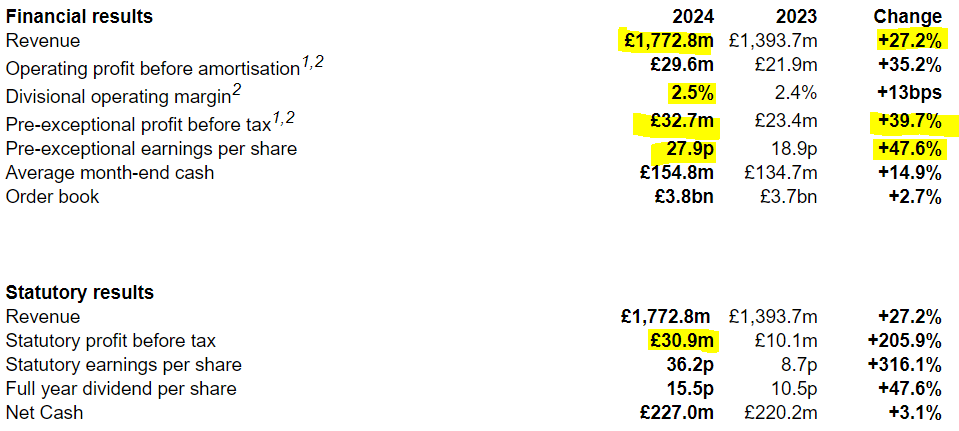
My comments on highlights -
Massive revenue, but tiny operating profit margin. So there’s no buffer there for when inevitably some contracts go wrong. So this type of share is arguably just an accident waiting to happen. Can bulls really be so sure of perfect contract execution for ever more?!
Statutory profit is close to adjusted, a good thing.
Good net cash position is excellent.
I particularly like that GFRD provides a monthly average cash figure (well below the year end snapshot), although a much better disclosure (that all companies should routinely provide) is average daily cash/debt. Anything else is not necessarily telling us the full or accurate picture, due to timing of large in & outflows (eg payroll & supplier payment runs).
Large order book gives good visibility (it has 92% of FY 6/2025 revenue visibility).
Balance sheet - GFRD has favourable working capital flows, which mean it gets paid some cash up-front. It does mention holding average daily net cash, but declines to give us the number! That would be a good webinar question, to ask for this number. I bet you it's lower than average month end cash, but that's a guess.
“The Group has no debt or defined benefit pension obligations, and at 30 June 2024 had a cash balance of £227.0m (2023: £220.2m). The Group operates with daily net cash and the average month-end cash balance in the year was £154.8m (2023: £134.7m) demonstrating the Group's continued robust cash performance. We anticipate similar levels of average cash in FY25. “
No debt and no pension issues, that’s a very good start!
NAV overall is £122m. I take off all intangible assets of £98m, giving NTAV of a tiny £24m.
How come it’s loaded with cash then? It’s partly down to timing differences. Look at working capital overall (middle section of the balance sheet below, showing assets and liabilities that will turn into in or out flows of cash in the next 12 months) - it's a deficit! -
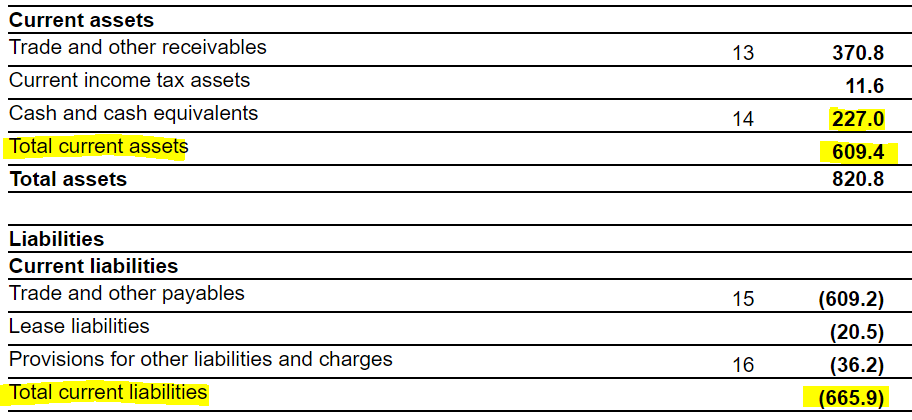
As you can see, there’s actually a deficit of £56.5m, with current liabilities of £665.9m exceeding current assets of £609.4m.
Also note there’s nothing in inventories. If GFRD was instead a manufacturer or distributor of physical goods, then it would have inventories of probably c.£200m. I’m presuming that GFRD possibly structures things so that sub-contractors buy & hold any inventories needed, and then invoice GFRD in stage payments, or as they are used. Hence all the inventories are off balance sheet for GFRD. That’s a nice setup. Also as a building contractor, GFRD probably wouldn’t need much inventories anyway, just getting building materials in as they’re needed probably.
Look at the size of “trade and other payables”, which is huge at £609.2m. That looks stretched to me, but the commentary suggests it pays suppliers on time, at an average 26 days, which sounds fine.
Drilling down into the large £609.2m of trade payables (money that has to be paid out within 12 months), note 15 shows that the bulk of it is "Accruals". These are usually costs incurred but not yet invoiced by suppliers. This seems a huge number at £307m, I don’t understand how it can be so large here -
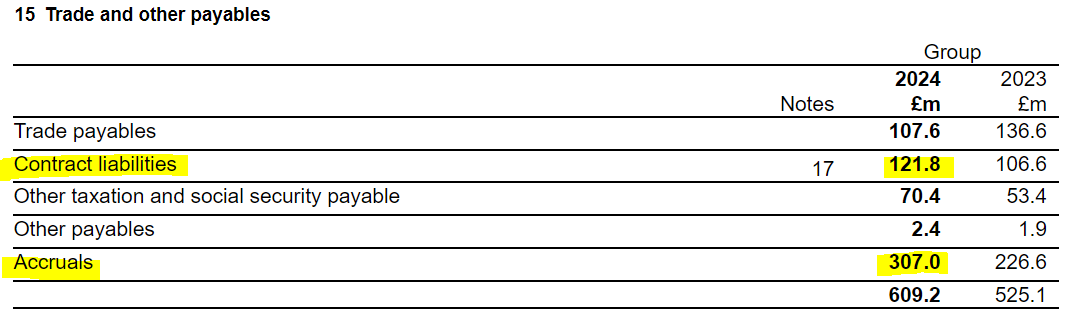
When do these large liabilities have to be paid I wonder? Or maybe they just permanently rotate?
Receivables is similar, with very large “Contract assets” - ie work that is judged to have been done, but has not yet been invoiced. This is one of the things I dislike about these low margin contracting businesses, in that there are very large moving parts, often subject to estimates and assessments. Profit can swing considerably, just according to what estimates and judgements have been made, and prior year adjustments, etc, so profits are just not very transparent or predictable in my view -
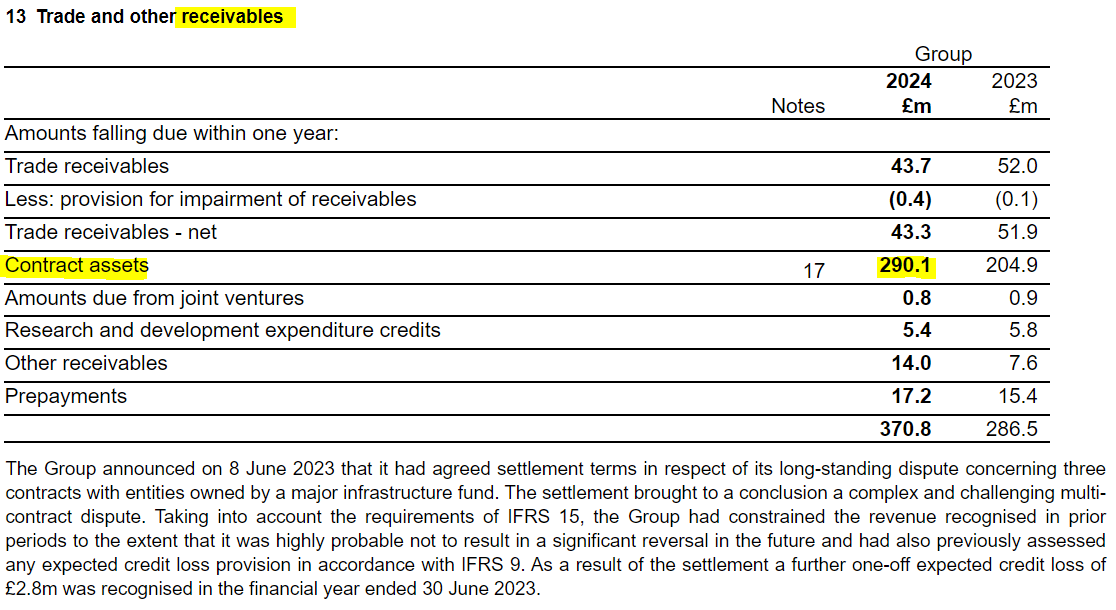
I’ve left in the text in note 13 above, just to flag the point that even smallish disputes with customers can be material to profit. So this £2.8m provision is almost 10% of adj PBT of £32.7m. What’s my conclusion then? It’s that we cannot rely on this type of company making reliable, repeatable profits. If they do, it’s probably good luck. With these huge numbers above, and only a 2.5% operating margin, it’s only a matter of time before you’re clobbered with a profit warning because something big has gone wrong, as seems to happen so often with UK infrastructure work. It may not happen for a while, but sooner or later, I think it almost certainly will. It's a major risk anyway.
Hence valuing GFRD shares on an profit measure, be it EBITDA or PBT, etc, is problematic, as we don’t know (and cannot know) how reliable future profit forecasts will be. Whereas some of the other higher margin sectors we prefer, with recurring revenues at high margins, are so much more dependable, that’s why investors pay higher multiples for them.
Outlook - as things stand, I don’t like this share, as it’s a low quality business, making a tiny margin, with large and complicated accounts.
What about the future then? Contracting/infrastructure companies have done well recently because they’re pushing up margins, which could transform things for the better.
Some excerpts -
“Confident outlook with a high quality £3.8bn order book (2023: £3.7bn) positioned across our chosen sectors and 92% of FY25 revenue already secured.”
“...contract awards reflecting recognition of our differentiated quality offering, supporting delivery of our Sustainable Growth Strategy target of in excess of £2.2bn of revenue by 2030.”
Revenue was £1.78bn in FY 6/2024, so a target of £2.2bn by 2030 seems rather pedestrian to me.
Some other companies are delivering and targeting better growth than that. Costain (LON:COST) for example is targeting an increase in operating margin from 2.5% (same as GFRD) to 5.0%+.
Yes, GFRD is also planning to raise its tiny operating margin, from 2.5% to 4.0%, so a less ambitious target than COST, although at such small numbers, and these only being aspirations, maybe that’s splitting hairs? -

Paul’s opinion - as you’ve probably already gathered, going through these numbers is a reminder of why I rarely, if ever invest in low margin contractors. I cannot rely on the business producing reliable profits, because it’s a tiny number at the end of enormous in and outflows - both profit and cash. Its contracts are large and complex, and it’s inevitable things will go wrong, you just have to hope that any problems are contained within contingency reserves baked into contracts.
It’s difficult to think of a worse business model for investors. That said, GFRD shares have produced a stunning return for investors since 2019, look at this! - the sector is certainly back in fashion, with investors seemingly ignoring risk, and instead focused on the margin growth aspirations. Plus favourable Govt emphasis on improving infrastructure, and contracts for preferred bidder type companies perhaps having scope for higher margins in future?
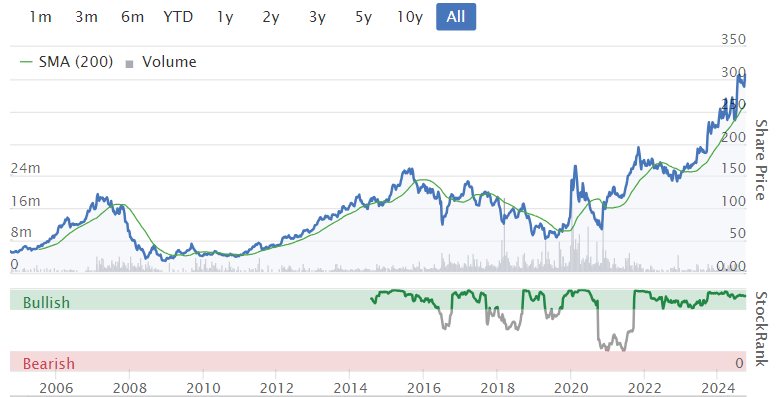
Yet it’s still only producing a delicate profit of £33m on £1.77bn revenues, so a significant contract slip-up in future could wipe out those profits and send this share plummeting.
Hence why I think bulls should resist the urge to get complacent.
The balance sheet has negligible net tangible assets, but benefits from favourable timing of cash inflows.
Divis and buybacks are good.
I think people are maybe taking a lot more risk here than they realise. Hence despite ahead of expectations trading, I struggle to get above AMBER, in fact it’s only just amber in my view, due to the considerable underlying risk.
For balance, bulls might look at the 4% operating margin ambition, and believe management can deliver that, without anything going wrong. IF that plays out as hoped for, then the share price bull run could continue, who knows, it’s all unknown because nobody knows for sure what the future holds - hence "might" and "could" being much more sensible than the ubiquitous "will"!
For me though risk:reward actually looks quite poor. Don’t bite my head off, it’s just a personal opinion! Feel welcome to post your views in the comments, we like to hear a range of opinions.
Stockopedia likes it a lot, although it's interesting to see this is skewed more towards momentum than quality.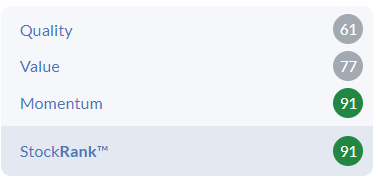
Graham’s Section:
FW Thorpe (LON:TFW)
Down 1% to 308p (£361m) - Final Results - Graham - AMBER/GREEN
FW Thorpe Plc - a group of companies that design, manufacture and supply professional lighting systems - is pleased to announce its preliminary results for the year ended 30 June 2024.
The Chairman says that the year was “largely uneventful but nevertheless satisfying”. In numbers:
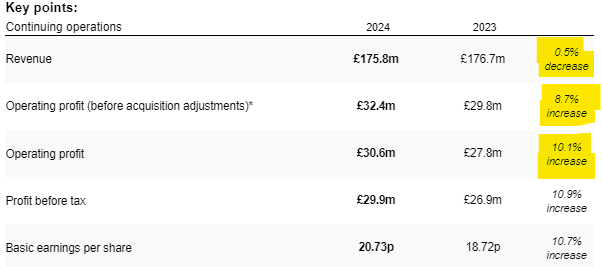
In summary: revenues are about flat, but profits are up by 9-10% (depending on how you measure it). This is attributed to “improved internal efficiencies” - good job!
Dividends are up 5% to 6.78p in total and there is also a special dividend of 2.5p.
Net cash reached nearly £53m by year-end (previous year: £35m). New acquisitions are mentioned as a possibility.
Within the group, the large companies are performing well, but the Board wants more from its smaller companies.
The list of group companies (link):

Street lighting manufacturer TRT Lighting is mentioned as loss-making, after suffering a revenue decline of 15%. A new sales director and sales team are in place.
Management: Chairman Mike Allcock is the former CEO and has been employed by TFW for 40 years. He became Chairman in July.
Outlook is fine:
All Group companies are charged with growth; as ever, this is their target. With so many companies in the Group, there will be inevitable ups and downs in various locations. All the larger companies are in good shape with stable and experienced leadership teams with good order books at the start of the new financial year. Costs are generally under control, although people cost pressures remain and the companies need to keep working hard to find efficiency improvements.
The smaller companies have all struggled somewhat to get themselves back on a plan for growth in recent years. Changes have been made and each company has a plan to grow.
The change in governments in various Group locations raises a few questions about the future, but the Group setup gives good resilience overall.
Consolidated as a whole, the outlook is positive with modest growth expectations.
Graham’s view
I like the reporting style here - it strikes me as straightforward and honest, which is what you expect from a business owned by insiders and family members.
Here’s the complete list from Stockopedia of individuals with a notifiable interest, including many of these insiders and family members:
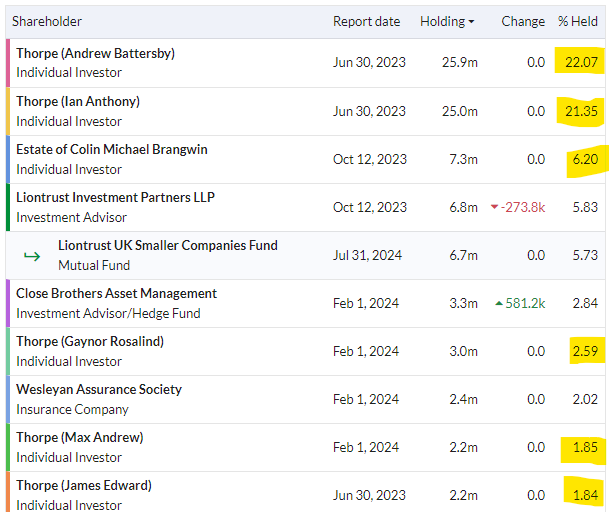
The financial statements show a business with healthy profit margins (operating margin >17%) and a nice cushion of tangible equity. Tangible NAV is £110m and as noted above the company has a large cash balance. The cash covers more than 10% of the market cap.
There’s very little to dislike here, so what about the price?
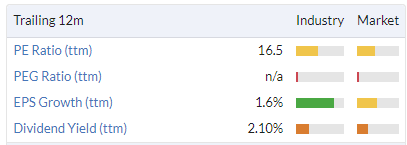
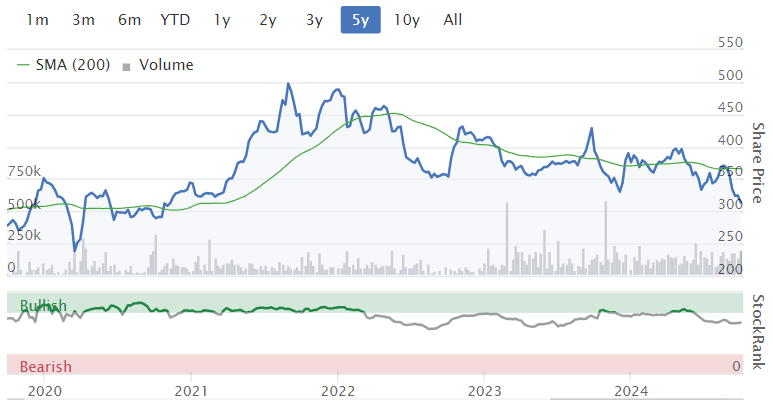
Paul was neutral on this stock last year (October 2023) at a share price of 380p and an earnings multiple of 20x
A year later, with the share price down at 308p and with profits and the cash balance having increased, I think I can justifiably nudge up the position to AMBER/GREEN.
It’s still not cheap, and lighting is a tricky sector, but maybe this is about as cheap as it will get?
VP (LON:VP.).
Down 14% to 559.2p (£225m) - Trading Update - Graham - GREEN
Vp plc, the specialist equipment rental business, today provides a trading update for the six months ended 30 September 2024.
This update amounts to a profit warning. Some of the key points from each segment:
Infrastructure: strong demand in power transmission, water and civil engineering, but there has been a “slower than anticipated rollout of projects following the beginning of the new Network Rail Control Period”.
Non-residential construction: remains subdued. Additionally, Brandon Hire Station has seen performance improvements that are “slower than anticipated”.
Housebuilding: continued short-term softness. VP “is encouraged by the UK Government's push for rapid progress in this area”.
Energy: market remains positive.
Turning briefly to the acquisition announced this morning, which is material to VP:
Acquisition: VP buys 90% of Charleville Plant Hire, described on its website as “Ireland’s largest construction services company”. The initial cash cost is €12m but there’s potentially another €22m to be paid over the next 2-3 years. So the total cost equates to c. €34m/£29m.
CPH generated a pre-tax profit of €2.3m in 2023, and VP are paying a multiple of up to 15 times that amount for the business. So it’s not cheap from the point of view of earnings and VP are also paying a big premium to the balance sheet value: CPH had gross assets of only €14m as of Dec 2023.
Outlook
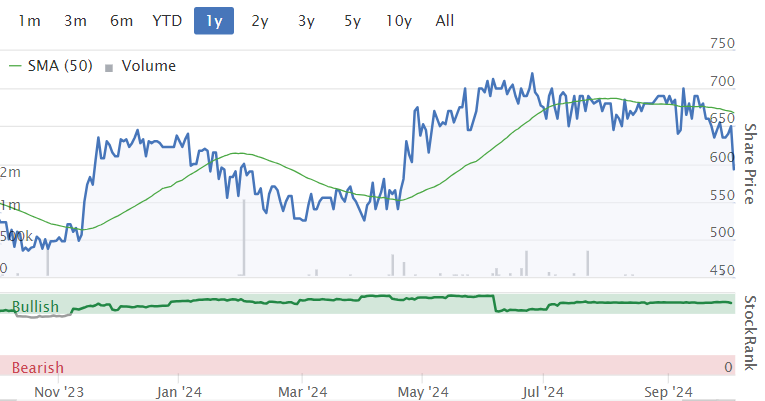
Underpinned by a robust balance sheet, the Group remains in a strong financial position with an excellent track record of delivery. However, as a result of current market headwinds in Construction and Housebuilding, alongside a slower start to CP7, Vp now expects to report a profit* for the current financial year of c.£37 million.
Estimates
A note published by Equity Development in July this year suggested that the company was aiming for an adjusted PBT of £41.8m.
New guidance is more than 10% below that level, so I can agree with the 10%+ hit to VP’s share price this morning.
Graham’s view
Paul covered many of the details here in June, pointing out the company’s terrific record of paying dividends under the stewardship of the majority shareholder, who is also the Chairman.
I share Paul’s generally positive impression of the business although personally I’m on the fence between GREEN and AMBER/GREEN, my main reason being that this is an economically exposed and competitive sector in which VP has struggled to generate above-average quality metrics in recent years. And who can predict when the construction and house building sectors will be firing on all cylinders again?
For the sake of continuity I’ll leave the GREEN stance unchanged. Fingers crossed that next year is the year when demand picks up again.

Disclaimer
This is not financial advice. Our content is intended to be used and must be used for information and education purposes only. Please read our disclaimer and terms and conditions to understand our obligations.

108 comments
Dunno about anyone else but I'm moving towards 100% cash - cant quite get there for structural reasons - but close.
Why?
Budget on 30/10/24 - so much uncertainty around this! Labour has certainly not helped by creating a wall of fear.
War in Ukraine
War in Middle East
US election - promises get more and more bizarre
So for me:-.
Sit on the sidelines and pile in after things have become more clear. Or not if its looking bad.
Lets see.
Hello Paul
Just a quick word to say how much I enjoyed your recent chat with Paul Hill.
Particularly enjoyed your jousting with him on a few points ( like AIM IHT merits and impact - PH “I take a more broader view “ !!!
But great to hear alternative views and that really helps when one is trying to find ones way through this tricky maze
Thanks again. Hope to meet you in Derby next month
A quick 'heads up' for investors in MPAC (LON:MPAC) . I have just tried to participate in the 'retail offer' that accompanied Tuesday's institutional placing and been told by Barclays Stockbrokers that they don't do retail offers and it is in their terms and conditions, so tough luck! How are other Stocko holders of MPAC (LON:MPAC) getting on?
No problems with Interactive Investor. I did mine yesterday
Just to add to yesterday's discussion on broker interest payments - they pay monthly
Getting in a bid Ok via AJ Bell ....but no guarantees that we will be lucky enough to get any. Expect it to be well oversubscribed.
The MPAC (LON:MPAC) retail offer splits shareholders into different categories - those who hold their shares with one of the participating brokers and those who do not. This inequality cannot be justified when the open offer route should have been available.
Popular brokers -
Retail offer in - ii, HL, A J Bell
Out - Barclays, Lloyds incl. Halifax and iWeb, Jarvis incl. xo
MPAC (LON:MPAC)
whats the score here is there a limit i can choose to spend ?
MPAC (LON:MPAC)
whats the score here is there a limit i can choose to spend ?
I applied through HL. You can specify as much as you like. And with shares a handy 20% higher it kind of makes sense to do just that. But I’m quite close to a full-size position anyway, plus I expect they only dole at a small proportion to each bidder, so I doubled what I needed and went for that, expecting my allocation to be cut down to size.
Seems a bit of a shambles can’t understand why it wouldn’t be % of shares one has - could easily see people getting only small % if some request very high amounts which they will likely do
Requested mine through Interactive Investor and the request was processed. No idea if I will get all I requested though.
is this available through t212?
MPAC (LON:MPAC) retail offer
The full list of participating intermediaries is here: https://www.bookbuild.live/dea...
Also note: "Orders can only be submitted to participating intermediaries from existing shareholders".
Just saw this and thought might be of interest hedge funds now have a net short on US treasuries in excess of a trillion dollars, worries that this could lead to something like the carry trade plunge if something unexpected caused yields to go up.
This raises a lot of questions:
Does the market think interest rates will rise.
Why has the position increased so much?
This size of derivative position adds a lot of risk to the system.
There is a potential short squeeze if interest rates are cut sharply.
All this is above my pay grade. Anyone know the answers?
I'm not surprised to see AIM shares getting hit ahead of the budget. There are likely to be redemption requests from IHT funds as investors run scared of what Reeves will do.
I know that IHT exemption requires a holding period of 2 years and only applies once you die. However investors can cash in now and gift the cash thus triggering the 7 year rule.
I'm holding a decent amount of cash having sold out/ taken part profits on AIM shares recently. Will look to reinvest post budget if the situation is not as dire as some are predicting.
I have also requested the 25% tax free cash from my SIPP with Hargreaves. They are inundated with requests and are currently working on 15 working days turnaround. Other providers are deluged too. Aegon quoted me upto 8 weeks to get the cash.
Hi eParo
Your post presumably explains the weakness in Volex (LON:VLX) shares unless I have missed something. I haven't counted but at least half of my 23 share portfolio is in AIM. I try to focus on the company, its prospects and management, whether it is main or AIM listed is not an investment consideration for me.
As for the budget who knows I certainly don't and unless there is some sleight of hand, I doubt anyone else does, even the Government whom I suspect hasn't yet finalised its sums!
Hi jonno,
Agree with this - the majority of my individual shares are also on AIM. Have recently gone through the PF to ask a) is the business currently trading well, i.e. at least in line per last update, and b) are the future prospects/investment case still intact? If it's yes to both then I'm going to hold as it shouldn't make any difference looking several years out....IF the investment case plays out. It has never been my plan to trade in and out (whether it be IHT changes or anything else) as I simply don't think I have that skillset.
IHT funds are probably forced selling many AIM shares including Volex (LON:VLX). I can't see anything company specific in so many cases.
There's a buyer's strike now on AIM with all the budget uncertainties imo. I decided to preserve capital. Let's see what the 30th brings.
Just thought this would be a little interesting to some ...
I was wondering whether growth or value outperformed over the last 20 years. and noticed that Stocko had an FTSE350 low and high yield index. It turns out that the lower yield index (a proxy for "growth") had a capital growth of 4.8% pa, the higher yield (a proxy for "value") 1.2% pa, and the index itself 3.4% pa.
The first observation is that the returns are pretty dire when compared to something like the S&P500. Growth seems to "win", but it's not so obvious. You need to add in dividend yield to get to the total return. I don't have those yields throughout the 20 years, so I'll just use the latest ones. Sure, it's a simplifying assumption, but I don't know of any other way.
The div yield for the lower yld index is 2.2%, 5.1% for the higher, and 3.1% for the whole index.
If you add the capital return to the dividend yield, you get a total return figure of: lower yield 7.0%pa, higher yield 6.3% pa, whole index 6.5%.
So there doesn't seem to be much in it. Any difference is likely to be spurious. The market seems to fairly efficiently smooth out the returns.
Fascinating. Thanks Mark.
Though they have built more, Chinese coal powered station capacity factor (use) has dropped from around 70% to 50% over the past few years, in many ways mirroring the world beating solar panel installation they've been undertaking, close to 50% of global solar installation last year, increasingly being in use to cover periods of low solar generation. China are working towards reducing their CO2 emissions, while coping with increased energy demands. We have to play our part too. Trying to wash our hands and say "we only produce x%" is the pathway to disaster. And the evidence that net zero is "crippling the UK exconomy" is pretty sparse.
Really. We have never been more indebted and China's economy is tanking. It seems there is a direct correlation between rising poverty and increased Nut Zero policies.
I think the £2.7 trillion we now owe where the interest payments now consume 10% of the total UK tax with higher rates is finally starting to cause the UK problems, all the easy tax rises, allowance cuts have now been had in my opinion.
Ideally the powers that be need rates back down to near zero but I can't see that happening anytime soon.
I'll not re-open our debate on Galliford Try Holdings (LON:GFRD) from last time Paul! You make very valid points as always. For me the key to contracting (which is pretty much always low margin), is how quickly you can turn your cash over and improve on both the margin and the cash turn. This very much depends on the nature and type of contracts you get into. Yes - these can go bad and very much depends on the type of contract and how keenly it was priced to win the work so a diversified portfolio of pipeline is essential. Currently the Water Industry Frameworks being bid for and won under AMP8 (which as an industry is anticipated to be more than double that spent under AMP7) lasting for 5 years from April 2025 and potentially extendable beyond that) offer opportunity for growth and margin improvement. The macro bull case is the UK infrastructure - its a mess, needs expansion, renewal and maintenance which offers massive growth prospects. Bear case - potential spend cuts being mooted in the forthcoming budget which ultimately is only delaying the inevitable spend. Galliford Try Holdings (LON:GFRD) has had a great run and I see this continuing for the time being at least. I see them as having the potential to be the next Renew Holdings (LON:RNWH) or Morgan Sindall (LON:MGNS) (both of which I hold) along with Costain (LON:COST) for the reasons above.
GFRD Thanks for your views, Paul. I've heard a few fund managers on YT vids that seem to be keen on GFRD. Gervais Williams was talking about it back in July with Paul Hill, for example. https://www.voxmarkets.co.uk/a... Some points he raises: the new contract arrangements don't have open-ended risks, good balance sheet, and he likes the acquisitions they made.
Journeo (LON:JNEO)
Not mentioned today, but the Danish subsidiary has won a contract with Umove, the largest privately owned public transport operator in Denmark. Not earth shattering, but perhaps paves the way for bigger things.
"The initial contract period runs for 6-years through to 2031, but this may be extended by two 4-year optional extensions to 2039.
Trafikselskabet Movia is the public transport agency responsible for buses and local railways in Zealand. It does not own any buses and trains itself, but pays fleet operator subcontractors, such as Umove to run them.
Umove was founded in 2013 and has grown to become Denmark's largest privately owned public transport operator with 650 buses and 1,600 employees. Umove won Movia's A23 tender and will operate over 230,000 timetable hours.
Journeo will deliver a range of Intelligent Transport Systems and services on 58 buses including fleet management software, Voice over IP communications, real-time destination signage and passenger infotainment software.
Engineering and installation works worth approximately £0.5m in revenues will be completed next year, prior to the buses entering revenue service in October 2025. The software licenses and recurring monthly SaaS revenues are expected to generate a further £0.4m during the initial contract period."
Card Factory (LON:CARD) If the forecasts are in the right ball park, the shares at under 100p looked too tempting, so have bought back a modest holding in one of the family ISAs, having exited after the results at around 118p.
Markets and portfolio activity: UK small caps are all over the place at present. It is difficult to know what to make of it, especially AIM. October has traditionally been a grim month for equities and there are undoubtedly some fabulous bargains on offer, but there have also been several profit warnings of late. For me VP (LON:VP.) and Flowtech Fluidpower (LON:FLO), the latter which I have sold. Clearly the rumours regarding the forthcoming budget has been a factor and the sad events in the middle east and Ukraine have also weighed on sentiment.
As for me I try to focus on the fundamentals and have recently bought back into Card Factory (LON:CARD) , added to Ramsdens Holdings (LON:RFX) with the gold price above £2000 per ounce and purchased a holding in Restore (LON:RST) having seen the price come back 15% or so from where the CEO and CFO made significant purchases between 270p and 280p. I also bought back into Facilities by ADF (LON:ADF) post the recent acquisition having sold sometime ago at around the same price. Interesting to see that Rockwood Strategic (LON:RKW) have also taken a position. Finally I added to Kitwave (LON:KITW) post the acquisition of Creed Foods.
Forgot to mention that I hold Journeo (LON:JNEO)
This post is as much for my benefit as anyone else as it helps me to articulate why I have invested where I have.
All the best
Journeo (LON:JNEO)
cheers jonno - i am newer holder here and i am happy with progressbeing made - i would say contract is very non material in the scheme of things bearing in mind their customer size (Denmark is surprisingly small country ) and how long they revenue is spread over. However i would say every time they do sign up top tier customer thats exactly what we are looking for so that they have the finger in as many pies as possible - if their stuff is sticky there is some logic for doing anything to get in the door and then work from their ref profits . also the more fingers they have in pies the easier it should be able to copy and paste some of the stuff on the next contract. Must admit though i hate companies that chase turnover at any cost and cant provide constant proven margins that will see them through the tough times. One slight worry would be if there is downward pressure on pricing if competitors are doing stuff dirt cheap - so hopefully no dwindling of margins.
Software companies make long term income out of support fees and upgrades once the software is embedded and becomes sticky, the number of customers is more important than initial contract values, it also keeps the competition out
Thanks Jonno. I have also bought back into Card Factory (LON:CARD) . The divi is a tasty 5% so even a ninimal 5% growth in the price returns 10% over a year.
RNS today that the SID at Card Factory (LON:CARD) has bought shares, investing almost £5,000!
Always a good sign as you would expect the company to know where the trading is headed. It's almost like a trading statement.
Not when it's £5000 though! If that's the best they can do it doesn't fill me with a lot of confidence.
Hi Paul - just a quick note to say thank you for all that you do for the investment community. I have just watched your most recent chat with Paul Hill - as always, so articulate & entertaining. These interviews are excellent (hat tip to Paul H) and I especially look forward to both yours and Cockney Rebels - lots of brilliant insight for amateur investors like myself. Keep up the outstanding work - you are highly appreciated!
How kind, thanks Dulpesh, much appreciated! :-)
Sharp decline in Sterling after Bailey exclusive in The Guardian
https://www.theguardian.com/bu...
Perhaps i'm pessimistic but don't most stocks end up down in the long run!? How can you compete against:
1. insider trader.
2. self-serving directors taking big salaries and huge options packages.
3. salaries continuing going up making it more expensive for businesses? Could this be the reason companies like Flowtech Fluidpower and Headlam Group are underperforming?
4. On top of all that if a company is lucky to make a profit it is taxed at 25%!
Are we just suckers!? Looking at my watchlist of UK stocks (I have over 500 listed in it) most of the companies are down. It is partly due to many of them being AIM companies but it makes for miserable following.
Im not sure what time frame you are looking at but a Quick Look at the FTSE All share Index ...a decent proxy for any portfolio shows clearly that you should not be down on average over any sensible time period. By comparison an equally quick Look at the Aim chart should be enough to persuade you how to allocate your time and resources.
Oh boy! Allocation and timing really are the be all and ends all of successful investment. I spend a lot of time playing with virtual scenarios. One of them is up over the last year by 51.75% in Capital Gains, it's in AIM. Regarding this one, with deep regret I have to report that I sold the wife's System1 (LON:SYS1) holding before the share price went stratospheric. RTC (LON:RTC), NAHL (LON:NAH) and Time Finance (LON:TIME) similarly, in my own portfolio where the gains would have been most welcome. Below is the illustation that proves my point, where I started this exercise at £1000 in each share. In reality I recently sold Petards (LON:PEG) and Van Elle Holdings (LON:VANL), Titon Holdings (LON:TON) and Ra International (LON:RAI) in a kennel clear-out, all at losses. I'm hanging on to Ariana Resources (LON:AAU) , KEFI Gold and Copper (LON:KEFI) while hoping they will turn out to be successful in the end.
Silver
It is a challenge my unrealised losses have grown since I decided to realise profits. Hope I can redeploy cash profitably?
Perfect summary of if you mainly invest through index tracking ETF's how to work out where you should be fishing in 15-30 minutes RD.
Sobering thought. However some traders do manage to exploit the market and make profits. You just have to find a trading style that suits your emotional and intellectual profile. Then sell the losers and stick with the winners.
Hello intuitive6191
Just in response to your question in inertia projects to stabilise the grid. NG let 5 off 6 year contracts in Jan 2020 to develop these technologies. Winners were Statkraft for project at Liverpool and Keith in Scotland, Triton Power to repurpose two gas turbines at Deeside power station, Drax for a project at its Cruachan hydro plant, Unipar for projects at Killingholme and the Isle of Grain and finally Quinbrook / Welsh Power for a project at Rassau in Ebbw Vale.
I haven't read the Daily Telegraph article but my understanding is that all these projects essentially provide inertia and stability to the grid, they are not going to keep the lights on when the wind doesn't blow. So I think it is only Drax that is listed. Not sure who owns Unipar now but I think this was rescued by the German Government.
So difficult to access this as an investment. Hope that helps.
AndrewLeach
Many thanks for the informative response.
https://www.bloomberg.com/news...
The French economy according to this Bloomberg article is in a worse state than the UK.
Quelle surprise.
A little off topic but might be of interest for those who follow energy transition from fossil fuels.....
Interesting article in the Telegraph yesterday about balancing the load on the National Grid when the UK transitions to variable wind and solar and moves away from base load fossil power stations.
The main thrust of the article was not a battery solution (as I would have expected) but the use of giant flywheels weighing hundreds of tonnes and spinning at thousands of revolutions per minute in a frictionless vacuum.
Apparently these have been quite successful in trials ( Liverpool and Scotland) and it would seem that the company that has been used in these trials is in pole position to benefit from the role out.
Unfortunately it is a company called Statkraft which appears to be owned by the Norwegian Government. Has anyone heard of this flywheel project and possibly know of any quoted competitors to Statkraft?
They must need a protective shell as thick as a nuclear reactor to protect that amount of kinetic energy if anything breaks! I'd love to see their risk analysis and I wouldn't want to live within a few miles! I wonder whether they are classified as a COMAH site.
Yes FREeng Iwould agree. It did not say in the article, but I assumed that they would be underground.
Flywheels for energy storage - not a new idea by any means.
This article is from 2021 and talks about the previous decade (note the reference to Beacon Power filing for bankruptcy in 2011)
https://spectrum.ieee.org/superconducting-flywheel-grid-energy-storage
Even 30+ years ago I was aware of a large Japanese utility looking into superconducting flywheel technologies.
And from a safety perspective, I wonder if it is any worse than some of the compressed air energy storage technologies if the welder had an off day.....if you've ever been scuba diving and seen a valve go....(and that is low pressure!)
Interesting article Monty Carlo.
I would not want to be in pole position when that thing rolls out
Here's Shares Magazine's check-list of possible investor tax changes wrt the upcoming Budget on 30th October.
https://www.sharesmagazine.co....
If I were Chancellor, I'd consider introducing a "gift tax with benefits" like this: a tax rate on gifts over (say) £5k set well below the 40% rate of IHT and with the benefit that the gift is immediately free of IHT so long as the donor pays the tax within 6 months. I'd allow existing PETs to be converted, so long as the tax is paid. The Boomer generation are said to have £Tn of assets that their heirs will inherit, so this might bring forward a percentage of the future IHT on those assets and put the cash to immediate use in the economy.
How do you expect HMRC to know about the gifts if they are not reported?
"Potaticians calling the kettle black"
Many politicians, not just 'Free gear Kier' and his mates get lots of benefits in kind, including money! But they don't have to pay tax on them. In fact some (Angela Raynor) even go out of their way to dodge the tax! So why is what's good for the Goose not good for the Gander?
They need to listen to Warren Buffet, when he says he's 'proud to pay his taxes' (which by the way are not extortionate like ours) when his trusts and investments do well. He sees it as his duty to support those who are less fortunate, like most of us do, but there comes a time when All governments who imply 'Do as I say, don't do as I do' is too much to take.
Why is it that no governments or politicians ever abide by the 'Seven Nolan Principles of public life'? If you've never heard of them? They are below:
The Nolan 7 values, also known as the Seven Principles of Public Life, are:
The Nolan Principles were established in 1995 by the UK government after a Committee on Standards in Public Life was established in 1994. The principles apply to anyone in public office, including elected and appointed officials, Civil Service employees, and those working in local government, the police, and other public services. The principles are also influential in other sectors that deliver public services. The principles are enshrined in codes of conduct across the UK public sector and are also adhered to by many local authorities, charities, and educational and healthcare bodies.
Apologies for the off topic rant!
Graham.
The other move that's been suggested is removal of pension relief on employer NI contributions. This would be more of a hidden cut that wouldn't immediately be felt in pay packets, so perhaps less likely to generate negative headlines. But it would hit employers quite hard and the impcat would be felt one way or another (whether lowering profits or salaries to compensate)
It is an obvious anomoly - sole trader loses 8% or whatever class4ni rate is that company owner doesnt lose. ditto for employees not lucky enough to have the option of salary sacrafice or direct employers contributions. Its a shame as people kind of need the ni saving as an incentive to save for their future - so i see the current system as postive - but if it is skewed in favour of the haves rather than the have nots then its very high chance on hit list - hey ho the well to do are all leaving the country anyway so (yeah thats toungue in cheek) probably little different. Gordon Brown mark 2 here we come.
Rockwood Strategic (LON:RKW) trading update today. Outstanding Investment Trust. It has way outperformed all the others in the UK Smaller Companies sector over 1 and 5 years.
Performance details of all the Trusts in the sector here:-
https://www.theaic.co.uk/aic/f...
Note that Rockwood Strategic (LON:RKW) is up 43% in 1 year and 192% over 5 years. Next best performer over 5 years is Oryx International Growth Fund (LON:OIG) which is up 92%.
Rockwood Strategic (LON:RKW) has a concentrated portfolio with 68% in their top 10 holdings and AIM holdings represent 33% of their portfolio. Unfortunately this outstanding performance means that while so many Investment Trusts are on unusually big discounts. Rockwood is at a deserved small premium to NAV.
Plenty more on Investment Trusts on the Investment Trust threads on Stockopedia. Here’s the link for the latest October thread:-
https://www.stockopedia.com/co...
Personally I think this in large part reflects their participation in the investment market at all levels including with small investors where they are very generous with their time. I believe the main KSP is their ability and interest in getting involved with the underlying companies. Great Investment Trust!! Great guys.
Atrato Onsite Energy (LON:ROOF) jus seen this pop on the leader board... I don't know it at all but it looks like an NAV sale of assets and therefore has implications for renewable assets that trade at decent discounts to NAV ... so Gore Street Energy Storage Fund (LON:GSF) which I do own springs to mind.
Atrato Onsite Energy (LON:ROOF) has a nice simple portfolio of cash-generating solar assets, with income locked in through long-term agreements (giving low exposure to power prices). Can see why it would attract interest on a c30% discount. The battery storage funds look a bit more complex and unpredictable in my view, so not sure if there's much of a read across with those, although I do think there are other discounted, subs-scale renewable funds that could attract bids.
Pretty fed up with this, as I had identified it as a great business model (sell solar energy direct to commercial user on 10-year indexed PPAs, cheaper than they can buy it from the grid). The opportunity is huge and they will scale up to many £00millions over the next 5 years. This was a shoe-in for the grandchildren's JISAs and our pension accounts. Buy and forget on those multiples. Not seeking multibagging, just 12-15% TR a year total for years. And that is precisely why PE is jumping on these. UK investors are so timorous, this had declined to 30% discount to NAV. This is the third IT capitulation in our portfolios in a year (just as I was about to buy more this morning!).
The message is: these ITs on severe NAV discounts will close or be bought out if PIs (who seems to set the prices more than I thought), keep thinking they understand Lloyds Banking (LON:LLOY) because they've heard of it, and otherwise go passive. So I have to find another like this before their Boards capitulate too, or enough people wake up next year to the idea of a bond-like (but rising) yield of c. 9% against interest rates back down to the 3%s.
On the other hand:
1. Maybe some of you would like to buy into this, less speculative universe?
2. If you have any other ideas for me, outside Chenavari Toro Income Fund (LON:TORO) ,Volta Finance (LON:VTA) ,SDCL Energy Efficiency Income Trust (LON:SEIT),Gore Street Energy Storage Fund (LON:GSF) , NextEnergy Solar Fund (LON:NESF) , Triple Point Social Housing REIT (LON:SOHO) and GCP Infrastructure Investments (LON:GCP) , do say.
3. Some of the PE Trusts are looking high value too. Try Apax Global Alpha (LON:APAX) at over 8% yield and 34% discount to NAV. And it's not tiny.
Thank u - excellent post.
Some good suggestions there, but none quite offer the same low risk, predictable and fully covered 9% yield that Atrato Onsite Energy (LON:ROOF) provided so a bit of a shame this one's going.
Share your disappointment raggedtp. I had the same intention of moving Tritax EuroBox (LON:EBOX) proceeds across to Atrato Onsite Energy (LON:ROOF) . Have to say I'm I pressed with Brookfield (NYQ:BN) shopping list. They should take out EBOX too. Still not too late.
Appreciate your list of alternatives to consider.
BBC, Sky and others reporting: The Bank of England could be a “bit more aggressive” on cutting interest rates, according to its governor.
VP (LON:VP.)
I hold and on the initial reading of this morning’s update will continue to do so, having bought around the low of 550p. The acquisition of an Irish rental company looks a good purchase and at some point the demand in construction and house building will start to improve. The only constant is change and there will be an inflection point.
The shares still remain cheap on several metrics and the founder owns 50% of the equity and at some point will I believe look to sell, having failed to attract an acceptable offer previously.
In my view it remains the best of the listed hire companies serving a broad range of industries. It will be interesting to see the markets reaction.
All the best
VP (LON:VP.) If I still held, I wouldn’t consider selling at today’s reduced price - absent a need for the funds. It remains a good company and will likely recover in due course.
I am mystified by the bearish comments by VP (LON:VP.) on the 'non-residential construction' market. It clashes with Galliford Try Holdings (LON:GFRD) (banging results today) and Costain (LON:COST) (also on a roll), both of which I hold. Is there anyone here in the construction industry who can explain these nuances? Or is it just a case of these two companies securing good profits growth from being more selective in what contracts they tender for? ( I acknowledge that it is difficult at the moment to discern the current Government's actual likely spending plans regarding individual large infrastructure projects).
Hi Grumpy
Galliford Try Holdings (LON:GFRD) and its peer group, Kier (LON:KIE) and Costain (LON:COST) are very much focussed on government infrastructure spend, prisons, schools etc and regulated industries, especially water. VP (LON:VP.) is much more diverse in the activities it services. This may perhaps explain the divergence.
Profit warning from VP (LON:VP.) with profit apparently down 10% on forecasts. But the footnote describes profit as before tax, amortisation and impairments, so that number is heavily adjusted. Parallel earnings-accretive acquisition in Eire is a sweetener to not dump shares. I like the company and had benefited from its rise off the bottom last year, then sold when I saw it run out of gas under 700p. It’s only a trading name for me. I’d be tempted back in around 550p.
I’m still onboard having bought not far from its bottom.
This must be the 4th profit warning in my portfolio in two weeks.
- is there a clear trend?
Morning BnB & TheJayman.
"This must be the 4th profit warning in my portfolio in two weeks.
- is there a clear trend?"
Funny you should say that, Graham and I briefly discussed the same thing this morning. For an economy that supposed to be in an early stage recovery, it certainly doesn't feel like it from company announcements. We're seeing an increase in profit warnings, and little to no sign of recovery in cyclical sectors like building supplies, and staffing cos. Probably all we're seeing is a slowing of downtrends, but not really any green shoots yet.
Which is all making me wonder if this cyclical recovery might be slower & shallower than we might have been expecting. Or maybe it always feels like this at the start of economic recoveries? I remember from previous decades going right back to the 1980s, that things still feel bad for quite a while, even when it later transpires that GDP was actually recovering. I think someone said that it's only when economic growth gets to about +2% pa that people start to notice the improvements.
That said, stock markets are usually good at getting ahead of the curve, which is why many shares look expensive at a turning point on high PERs, but then go on to deliver forecast-busting profit recoveries in the next few years.
Also I'm thinking that lots of companies have stripped out tons of costs in recent years, so in their recovery cycle, they could be much leaner & more profitable, maybe as operational gearing might deliver unexpectedly good performance? Brokers don't tend to forecast much profit growth from the lows either, so there can be a big opportunity there too. All takes nerves of steel though, in present conditions!
Regards, Paul.
Wrt recent profit warnings, what appears to be slightly more encouraging - is that the share prices of those stocks cutting guidance don't now seem to be getting totally wood-shedded.
Indeed rather than getting cut literally in half, many are only falling by 10%-20% on the RNS. Implying to me at least - that a lot of bad news is already in the price, and maybe we've reached a bottom?
Albeit am I wearing my rose-tinted spectacles again?
We all must have felt ”surely we’re at the bottom” many times in 2022/1H 2023!
Much of the share declines were sentiment and liquidity driven, often in the slightest slip.
It might also help if the government talked up the economy and business/investor confidence. This is verging shameful and a bit dangerous.
I do think the current jitters in the market are a response to inane commentary from the labour government and the seeming capitulation to the trade union movement. Its going to be an uncomfortably ride for some time
It's a stockpicker's market, as Paul, Graham and Rockwood Strategic (LON:RKW) have demonstrated over the past two years.
Apart from Card Factory (LON:CARD) Paul H - where it was not a profit warning and still fell 33% !!! ;-D
Card Factory (LON:CARD) probably back in buy territory now. For those of us that held on after the non-warning that may be limited consolation!!
Interesting thoughts Paul
Like you I once worked in insolvency and was close to the coal face, particularly in the early 90s recession. The sequencing works: bottom of various economic cycles, cost bases pared right back, then re-stocking working its way through the supply chain and firming/incremental improvements in revenue lines, other economic lag indicators start to reflect, revenue growth and then profitability recovery, reflected in economic growth and output, but years later for sentiment.
Remember also that in the early 90s recession there was a robust bounce-back from 1993 helped by weakened sterling (ERM exit etc) with vigorous export growth which massively improved the balance of payments with a deficit massively narrowed.
The other feature of this time was that as late as the May 97 election a lack of the “feel good factor”, despite steady recovery, contributed to Tory woes.
Of course by 1998 the mood was of boom, the first since early 1989. I think most people would agree that setting aside asset price bubbles fuelled by low interest rates we haven’t felt anything like boom conditions since 2007?
According to the Great Demographic Reversal by Charles Goodhart and Manoj Pradhan, it might not be appropriate to look at recoveries from the 1990s (when demographics and globalisation were favourable backdrops to economic growth) to the 2020s.
The market insight column in this mornings FT online gives reasons for a European consumer recovery. The head of UBS equity strategy and global derivatives is particularly bullish on UK small caps Paul. Stockopedia subscribers will hope he's right!
I personally feel the UK and EU have been held back by a number of factors that haven't hampered the US as much. So we have had Brexit, Covid, China and the Ukraine / Energy crisis which have all contributed negatively and thwarted growth one way or another. The bull case is the investment required to strengthen infrastructure and supply chain resilience will be positive for growth but it takes time. The lack of progress has revealed the weakness particularly on Energy which may well increase the urgency that ultimately puts the entire region in a better position. This trend got a real boost with LNG investment say last year.... but with a subsequent hangover this year. So it's not as simple as expecting a recovery per se ... as there is also a transition embedded in this ... and some companies are making the wrong bets relative to others ( at the moment). VP (LON:VP.) may miss today but then Renew Holdings (LON:RNWH) were doing quite well in similar (ish) areas. So Id be careful jumping to negative macro conclusions based on corporate results. And of course the much anticipated increase in housebuilding volumes has yet to materialise.
So slower and shallower could well be what we see for now because not all the ducks are in a row.... but that isn't necessarily negative . The Capex investment required will gather momentum over time and we are really at the beginning. The numbers are so huge... we haven't scratched the surface on Energy... so it isn't filtering through yet... which is why say, Renew Holdings (LON:RNWH) are actually winning business yet others aren't.
The positive would be that this outlook favours companies that the UK/EU have less of a structural disadvantage in... say compared to Tech... yet this is not reflected in valuations... we do need nerves of steel for sure.... but at least the big picture has our back... I would argue. Whilst the VP (LON:VP.) news is disappointing it's far from an absolute shocker so not all is lost.
Net Net policy moves are supportive and with so much runway ahead we should remain positive.
I agree Paul, this has been a feeble effort effort so far by the markets after a 2 year bear market. Worst I can remember.
From the October lows AIM is up 9% and FTSE 250 23%.
2009- after the same 11 months from the low -AIM was up 90%, ftse250 65%. 2003 AIM was up 68%
Political interference from both sides with taxes, some of the most expensive energy in the world, interest rates etc don't help growth. As the kids say these days, *uck around and find out.
Since the election was called (blue arrow) sentiment has nosedived. Who wants to buy AIM shares before the budget? Maybe institutions will as it'll be too late if no changes are made or they just tinker with IHT. Could see a good rally if that's the case. Can fully understand people not bothering until there's clarity tho or just giving up on UK and concentrating on growing US companies.... cheap energy, low taxes, huge internal market and the most liquid market in the world has its appeal. There's still some good opportunities in UK markets, I'm doing OK this year as many others are, but it's like wading through treacle at times.
For the Inheritance Tax Business Relief - if you hold qualifying AIM shares on passing you'll save a guaranteed 40% on the Inheritance Tax so it's a significant tax break. As I see it the government options are 1) Do nothing (holders breath a sigh of relief 2) Reduce the tax break to 20 % (holders grumble but keep the shares and new investors are still attracted to the 20 % tax break 3) Keep BR for existing holders but abolish it for new investors (Existing holders don't liquidate their qualifying holdings and new investors buy AIM shares solely on their merit and not for the tax break 4) Abolish the BR completely (existing holders throw a tantrum and sell their shares in a fit of pique (this will be a bad outcome for them but will create opportunities for the patient to but shares at a reduced price,,,So for the nimble footed, cash rich investor there could be opportunities on Budget day
I think the most likely scenarios are:
1. either a phased reduction in AIM BPR over, say, 3-5 years - this would allow investors to recycle into forestry or EIS/VCT which will still qualify;
or
2. BPR being capped at a maximum per estate whether this is for AIM or even more broadly.
But the key question here is just how much more tax revenue would these steps really raise and what might be the likely damage done to the AIM market and the ability of companies to list at an earlier stage of their development?
I think IHT and CGT are more ideologically attractive than they are useful for raising tax revenues. The easiest and most reliable way of raising revenue quickly is VAT. Sure it’s regressive and people take a hit but what’s the money tumble in from the main and black economies.
Jayman, VCT doesn't qualify for BR. Never has.
Let's not forget that to pay IHT the holders first need to die, so very little initial benefit for the government.
Like all recent administrations, they will focus on what will deliver cash now, rather than some long tail which will have very little benefit in this parliament. Think Gordon Brown (ACT), George Osborne (landlords), and recent cuts in dividend and CGT thresholds - unlikely to touch these after winter fuel payment backlash and they are so low next cut would be abolition.
It is far more likely that they will go for the flat rate pension relief
"if you hold qualifying AIM shares on passing you'll save a guaranteed 40% on the Inheritance Tax"
No, you won't. You'll be dead!
As I see it the government options are 1) Do nothing (holders breath a sigh of relief 2) Reduce the tax break to 20 % (holders grumble but keep the shares and new investors are still attracted to the 20 % tax break 3) Keep BR for existing holders but abolish it for new investors (Existing holders don't liquidate their qualifying holdings and new investors buy AIM shares solely on their merit and not for the tax break 4) Abolish the BR completely (existing holders throw a tantrum and sell their shares in a fit of pique (this will be a bad outcome for them but will create opportunities for the patient to but shares at a reduced price
My money is on number 4 Colin. You just have to look at what this government is doing to our energy policy (no more North Sea licenses, no more Nuclear, shutting down our emergency coal generator) to see that they are more interested in headlines than consequences. They do not seem to give two hoots about the latter and let’s face it, folk avoiding IHT or even those actively investing in the stock market are not exactly part of their core support.
At the risk of annoying some, may I suggest that the Green policy of Sustainability being pushed relentlessly by all parties is destructive of commercial enterprise and is anti-business. I think we are seeing the effect of this universally. If you believe human endeavour is a threat to the environment then the effects on the commercial world will be devastating. I think it is now a question of how low will it go before people wake up to the dire effects of these policies.
Renewables are the key to lower energy costs in the UK and the benefit will show in 6 years +.
Ao the propaganda says but we are in an ideological war which is anti- business.
any business that depends on subsidies destroys value, effectively stealing from the taxpayer. Until we are able to store electricity the green agenda will continue to lower living standards of the poor, which I have seen first hand in Africa where the green agenda is denying affordable energy to the poorest.
Re: Renewables: What happens when the sun doesn't shine and the wind doesn't blow? We'll still need baseload, and therefore renewables are not cheaper. And if we need the baseload power-gen anyway then why do we need the renewables? (Answer: we need nuclear.) And if we only have renewables in the UK we're not near-net zero, we just export our pollution to China, where a tyrannical regime that sees our liberal society as an existential threat to its own burns coal to make all the stuff we consume, whilst using the cash proceeds to build a military force we cannot resist. We're deluding ourselves.
You are absolutely right ed. And I would just add one more point that often seems to get missed by everyone - renewables have a finite working life like all physical assets. Even ignoring the crucial baseload and intermittency of Renewables headwind many seem to think if we can just build X Turbines and Y solar panels we are done. Not so. Wind turbines have an at best 30 year working life. Even less in a hostile offshore saline environment. Ditto solar panels. btw. There is a reason China dominates production of the latter because you need massively high temperatures to make them, which can only really be done by burning coal. So there is a massive upfront cost to instal them, a massive cost to rejig the grid. And then you have to do it all over again to build assets that only generate intermittently. There is a reason the UK now has the highest energy prices in the Developed World. If you really believe as another poster says that this has no discernible impact on the economy I have a lovely used car I would like to sell you. The only low carbon technology path that makes sense at scale is nuclear. Precisely the one we are not following.
"There is a reason the UK now has the highest energy prices in the Developed World"
Indeed - the reason is that UK electricity prices are set by the final/highest bidder, which is usually gas (sometimes coal, in which case prices go off the charts).
The Drax power station, which imports wood pellets from North America, shipped over via diesel powered ships, costs the taxpayer £1m per day in subsidies. Yet I suppose many people would call this a renewable way of producing energy because trees are renewable. My problem is that nobody looks at the complete picture, the same with EVs.
I don't think many people regard Drax as "sustainable". Its a handy subsidy scam.
I agree, net zero is pie in the sky while China and others build coal fired power stations. To cripple the UK economy in this fruitless exercise is pointless.
The UK shutdown, it's last coal-fired power station, on Monday.
The UK's share of the world's emissions is less than 1%. Why are our leaders so adamant that we should be the first country to reach net zero?
>>The UK's share of the world's emissions is less than 1%.>>
Emissions less than 1%, yes, but something like 2% of consumption due to off-shoring of heavy industry.
At the risk of annoying some, may I suggest that the Green policy of Sustainability being pushed relentlessly by all parties is destructive of commercial enterprise and is anti-business. I think we are seeing the effect of this universally
Its tricky - i am a huge fan of renewables and we have made brilliant strides in this country ref wind generation electric car uptake and reducing co2 output etc. But i would 100% agree its lunacy to take things too far - yes incentives and the like where stuff can clearly get to scale. But we should never be writing blank cheques out end of - and in tough times the more dubious stuff should be the stuff top of the chopping block. Personally i am very proud of how much we have cut c02 - but if offshore wind is double then price of gas then there is a limit at which we should be saying we need unfortunately for now need to tone it back a bit.
I would say clearly some of these politicians with their "fake promises" dont live in eth real world. Heck we have already cut by over 50% perhaps we should be more proud of that rather than fake promises we perhaps cant meet.
couldn't agree with you more, the job and skills destruction will be huge, the trade union movement no longer represents the workforce their leaders have joined the champagne charlies turning a blind eye to climate fanatics
I think the the main dangerous area at present is anything retail - if we look back at boohoo and how they have had ability to make profits squeezed by shein and others (ok they were victims of their own downfall wasting money on head office and expansion related stupid items and new vanity projects ). I see a continual trend to people buying from oline sources like ticktock shop for cheap as chip prices - this must affect ability of retailers to keep selling their "high margin main earners". Heck even nike has had ridiculously bad update this week (ok they may stupidly have thought cutting out their trusted partners that delivered the majority of their sales was agood idea). So to me anything directly retail facing at present and we should expect tough times. Perhaps some stuff works best via a shop - eg perhaps topp tiles might have quirky enough stuff not to be affected.
I am more positive ref other stuff - eg its very quiet with regard to construction/diy sector - i do expect that to come back strobly - If the powers taht can be start forcing housebuilders to build at the rates tehy have promised (that seems to have gone quiet quickly - when i would like to see continual good news they are delivering on their election promises!)
So perhaps the fisrt thing to do is look at company and say how strong is their ability to keep the margin they have faced with competition that may be of the newere variety - it doesnt just have to be cheap online imports though - it could be throught competitors being more efficient or wanting to enter an area.
Overall though there are some decent companies keeping the lights on though in the tough times - so also trusted management helps.
Yesterday's announcement by eBay that they will no longer charge private seller fees supports your first point.
Can't agree P.o.T, did you ever eBay? In fact, this act is a recovery play after the HMRC threw a spanner in the works with rules which will send many items of interest to landfill. I would like to have a clear-out of scores of souvenirs and historic artifacts before down-sizing to a smaller home but cannot contemplate being taxed in such a manner.