Small Cap Value Report (Thu 5 Mar 2020) - IND, AIEA, HYVE, FRAN, HSW

Good morning, it's Paul here with the SCVR for Thursday.
(As usual, this is initially a placeholder post, for readers to add your comments from 7am, as I write the article section by section throughout the morning/afternoon. We aim to get most of the report done by 1pm.)
Estimated completion time today - 4pm (as I don't have anything else on today, I'll spend most of the day on this).
Edit at 16:55 - I've been delayed, due to feeling tired & stressed, probably like many of you too. It's not much fun watching our portfolios tumble. So I'm re-starting now, with 2 more companies to add. Revised finish time is 7pm.
Edit at 19:12 - today's report is now finished.
My thinking on coronavirus has, if anything become even more bearish. I've been watching quite a lot of CNBC this week, for views from across the pond. It strikes me that financial people seem incredibly complacent about the impending pandemic of coronavirus. One commentator even said he thought this could all be over (as in no longer an issue) in a fortnight! When you think through the consequences, of even a few months disruption, it's actually very serious. Lots of smaller businesses could fold, contract wins could be delayed or cancelled in many sectors, and the inevitable cost-cutting would result in higher unemployment, hence weaker consumer spending, hence recession. I think it's a big mistake to imagine this as a short term blip. Once things start to snowball downhill in a recession, it's difficult to stop.
That said, Governments can borrow at historically cheap rates (e.g. US 10 year is only 1% - which seems crazy for a country that is already borrowing at an alarming level).So maybe they can keep throwing money around like confetti, and keep it all propped up? I think we're globally building up conditions for another massive credit crunch, and major recession, once this credit bubble pops. Subjectively, to me conditions seem even more extreme than before the 2008 Great Financial Crisis.
I think things look poised for coronavirus to trigger recession, in the UK, USA, and many other countries. That's only my opinion, based on the evidence we currently have, and could of course, as with any opinion, turn out to be wrong. Let's hope I am wrong.
As such, I think we can tear up broker forecasts for 2020, and I'm very reluctant to buy anything right now - because we don't know what earnings are going to be, hence they're impossible to value. Remember that after the 2008 GFC, earnings didn't snap straight back. Generally they take years to gradually re-build back to pre-crisis levels. Therefore I'm not at all convinced that riding out this crisis is a good strategy. Although that's what I'm doing with my ungeared SIPP, because the individual stocks are things that I think should out-perform. Remember that a low forward PER often means that earnings forecasts are too optimistic.
I remember in 2007, small caps did really badly, and I decided to just ride it out. That turned out to be a disastrous decision, as my (geared) portfolio was wiped out completely, and became negative in 2008. Therefore I'm paranoid about gearing now. The most successful investors I know had generally moved into cash in 2008, and that's the best way to ride-out major market downturns. I certainly think the big rebounds we're seeing intermittently now, could be good opportunities to sell.
Flybe - a sad postscript, with Flybe falling into administration overnight. It's been struggling for years, with never-ending turnaround plans, which we followed closely here, never seeming to deliver the goods. I hope that the administrators are able to sell off some viable parts of Flybe, because some of the UK's regional airports are almost entirely reliant on Flybe (e.g. 95% of flights from Southampton). I wonder if the Govt took into account all the knock-on impact of allowing Flybe to fail, in terms of indirect job losses?
Indigovision (LON:IND)
Share price: 232p (up 20% today, at 08:55)
No. shares: 7.34m
Market cap: £17.0m
An old friend, this share (I used to own 8% of the company, back in 2004!) - a Scottish based digital CCTV specialist.
Results today look good (as was previously flagged in a positive trading update);
- Revenues up 9.2% to $50.2m
- Adj EPS 31.5 cents - a huge improvement on last year's -4.1p loss
- Good gross margin of 57.7% - hence this business has lovely operational gearing, when sales rise
- High R&D spend - also a positive thing
- Net cash $2.2m
- Dividend reinstated at 2.0p
- Cashflow also good, mainly spent on a small acquisition
- Balance sheet looks quite strong overall, although both receivables and inventories seem high
- Outlook - nothing specific, just says they're confident
.
My opinion - it's great to see a decent turnaround here.
How to value it? Very difficult. If we're heading into a recession, then projects could dry-up again, and profits plunge. That's what happened previously, in 2004-2008 it 30-bagged on the upside, then gave back most of that in the recession.
.
Airea (LON:AIEA)
Share price: 43p (up 12% today, at 10:54)
No. shares: 41.4m
Market cap: £17.8m
The group remains focused on the design, manufacture, marketing and distribution of floor coverings.
Today's results announcement covers the year ended 31 Dec 2019.
I'm rather under-whelmed by these figures, and am surprised the share price is up today.
- Revenue flat at £19.2m
- Pre-exceptional operating profit down 28% to £2.17m. The company blames about half this fall on Brexit preparations.
- EPS not comparable, as LY had a P&L tax credit.
- EPS of 3.8p = PER of 11.3
- Balance sheet - includes £3.6m investment property (nice to have), £3.0m cash, strong current ratio, and £1.5m pension deficit
- Pension deficit of £1.5m, but deficit recovery payments of £400k p.a., so under-stated liability really. I would offset rental income on investment property against the pension deficit recovery payments, thus easiest to ignore both for valuation purposes
.
My opinion - looks priced about right.
.
Hyve (LON:HYVE)
Share price: 63p (down 11% today, at 10:54)
No. shares: 815.8m
Market cap: £514.0m
Hyve Group plc is a next generation global events business whose purpose is to create unmissable events, where customers from all corners of the globe share extraordinary moments and shape industry innovation. Hyve Group plc was announced as the new brand name of ITE Group plc in September 2019...
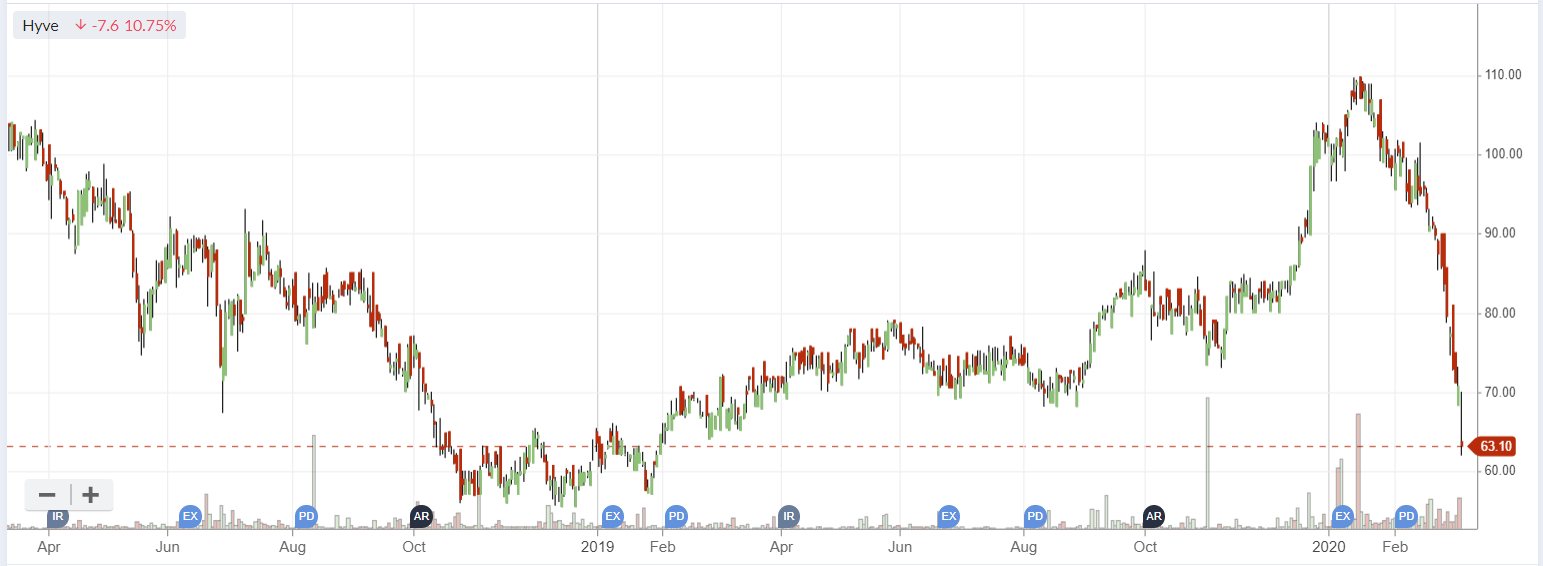
I was only thinking to myself yesterday, I wonder how ITE is getting on - presumably very badly, since exhibitions are likely to be cancelled. Coincidentally, it's popped up here under its new name Hyve. The share price is already heavily down, as you would expect. Although as with so many other shares, the recent plunge has only given back fairly recent gains (in the last year, in this case, but many other shares have only given back 6 months gains);
.
My summary of today's update -
- Significant disruption - many events cancelled or postponed
- Management acting to mitigate
- Travel & large gatherings restrictions from Govts having an impact
- £16-18m profit hit in 2020, seen as one-off
- Situation could change
- Refinanced in Dec 2019, operating within covenants & has headroom
To put this into context, the last reported full year accounts show profit of £55.8m, but most of the was created from large adjustments. Hence more work would be needed to clarify what all those adjustments are, and if they are fair. I'm not considering a purchase, so can't justify spending the time on it.
The last reported balance sheet was pretty horrendous actually, with NTAV heavily negative, at about -£158m.
Since the year end, it has (with terribly unlucky timing) acquired some other events, part-funded with a placing.
My opinion - more work needed, but my initial review leads me to believe that the financial position here looks precarious.
The problem is that it has a very weak balance sheet. As the deferred income unwinds, and cashflow dries up from cancelled events, that's likely to put a lot of strain on a weak balance sheet. The key thing to investigate would be the terms of the bank facilities, and covenants.
If coronavirus blows over fairly soon (say by the summer), then I could see this company/share recover. However, if it's worse than that, or comes back again in the autumn, then this company looks badly exposed, due to its weak balance sheet.
Franchise Brands (LON:FRAN)
Share price: 130p (up c.4% today, at 11:55)
No. shares: 79.5m
Market cap: £103.4m
Franchise Brands plc (AIM: FRAN), a multi-brand franchise business, is pleased to announce its full year audited results for the year ended 31 December 2019.
I've reviewed the figures, but not read all the commentary. Here are my notes;
- Adjusted profit before tax up 27% at £4.07m
- Nicely presented figures, clearly showing the adjustments, which look OK, and are not excessive
- Adj EPS up 29% to 4.34p - a PER of 30.0 - looks high to me
- Balance sheet - a bit thin, at negative NTAV of -£7.1m - although this could be justified due to having a strong stream of monthly recurring revenues from franchisees
.
My opinion - due to the macro picture, I'm now looking at every share with a view to what the downside scenarion might, be if we go into recession.
I imagine a lot of FRAN's services should hold up well in a recession (e.g. a blocked drain would still need to be cleared). Downside risks might include increased bad debts from franchisees going bust? Possibly lower sales of new franchises, which generated about £2.0m of (probably high margin) revenues in 2019 - representing a sizeable proportion of total profits. Thin balance sheet not ideal if we're going into a downturn.
Overall, I have to say that, in the current circumstances, I think the share looks priced a bit too aggressively for me. That said, if it can meet forecast of 6.0 EPS for 2020, then the PER would come down from 30 to about 22, which looks a bit more bearable.
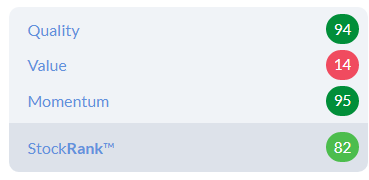
Stockopedia shares my concern about valuation, but rates the business highly for quality & momentum;
.
Hostelworld (LON:HSW)
Share price: 80.5p (down 16% today, at market close)
No. shares: 95.6m
Market cap: £77.0m
Hostelworld, a leading global OTA focussed on the hostel market, is pleased to announce its preliminary results for the year ended 31 December 2019
OTA - what's that? Must be online travel agency. What is gained by using an abbreviation that may not be familiar to everyone? Good announcements should be as jargon & abbreviation-free as possible. Or at least if you must use them, then explain them in the first instance.
I'm interested in looking at travel companies at the moment, because some may be nice opportunities to catch a rebound, when coronavirus starts to retreat. Others may be basket cases, if they're not able to absorb the financial pain of maybe a whole season of drastically reduced customer activity.
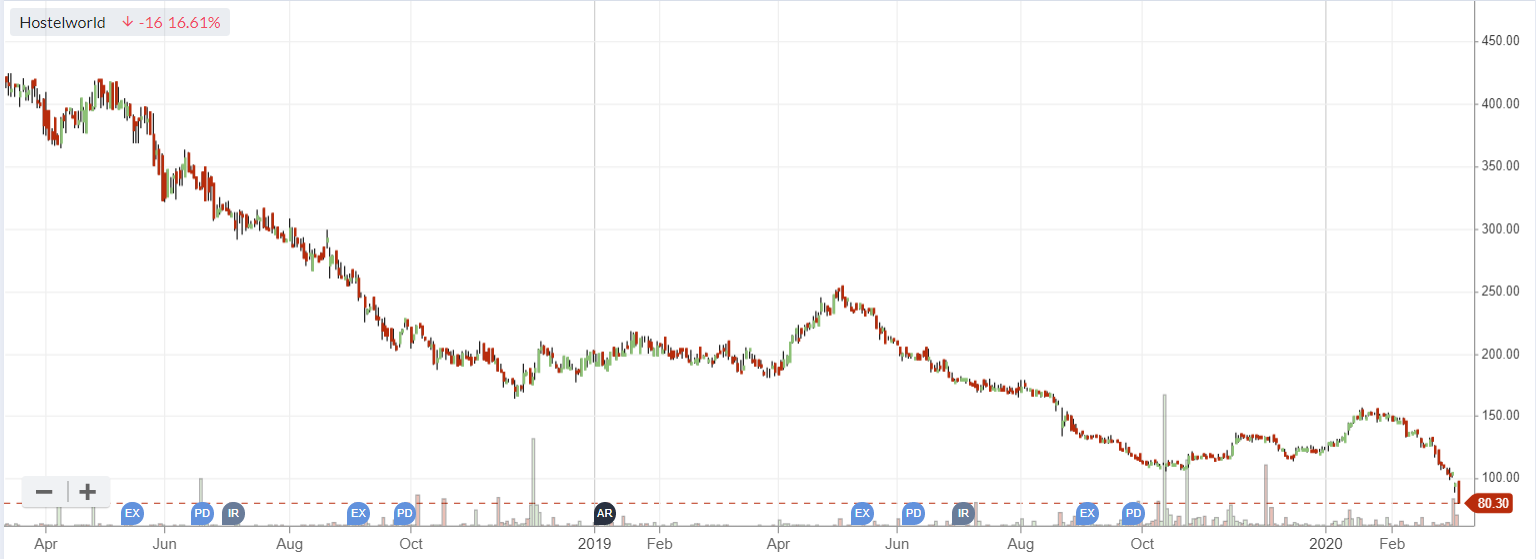
Checking my notes from last year, here, I see that HSW has published its 2019 results today, about a month more quickly than last year. I wasn't impressed with its 2018 results, coming to the conclusion that it had gone ex-growth, and was in a very competitive market. Good job, as the shares have more than halved in the last year, and were in a clear downward trend even before coronavirus came along recently to accelerate the downturn;
.
The optimistic PR-speak at the top of the announcement (yesterday) of 2019 results, trumpets;
EBITDA in line with guidance, underpinned by a return to net bookings growth during the latter part of H2 2019; and significant opportunities for future growth identified
I'm sure coronavirus will have nullified that, let's see what we can find. I'll do CTRL+F for "coronavirus". Here it is;
Outlook -
While we entered 2020 with positive momentum, trading since late-January has been challenged by the outbreak of the COVID-19 virus which is having a significant impact on global travel demand, within Asian markets and more recently within the European market.
As the Coronavirus has spread from region to region, we have observed a material reduction in bookings and an increase in marketing cost as a percentage of net revenue. This has been driven by a significant reduction of bookings from free channels, an increase in longer lead time cancellations across all channels and an increase in investment in paid channels to partially offset the bookings decline in free channels.
Given that the depth and duration of the virus outbreak is impossible to forecast at this time, we are unable to calibrate its effect for the balance of the year; however, if near term trends were to persist to the end of March we estimate the impact to EBITDA to be in the range €3m to €4m for Q1'20.
With continued tight cost control and our strong cash generative characteristics, the Group remains resilient in volatile market conditions.
This does beg the question of whether it is worth spending on marketing, at a time when customers are unlikely to want to travel?
To put the E3-4m Q1 profit hit in context, if we assume that would reflect a new, lower run-rate, then we're looking at a range of £12-16m reduced profits for 2020. The actualt adjusted profit before tax for 2019 was £16.0m. Therefore, to my mind, this implies that the company is effectively now operating around breakeven (I've ignored seasonality there).
There's no point in me analysing the 2019 numbers any more, as they've gone out of the window, due to coronavirus. The only thing that matters is;
Is it going to go bust? - for all travel companies, this boils down to two things;
1. To what extent can costs be reduced? Airlines/Cruiselines are in the worst situation, with high fixed costs. But online platforms are probably in the best situation, since many costs (e.g. marketing is the biggest one) are variable, at short notice.
2. Can the balance sheet withstand at least several months of drastically reduced custom? So ideally here we're looking for net cash, and bank facilities with plenty of headroom, and light, or no covenants, and a supportive attitude from the bank.
Looking at those in turn, re costs, note 4 discloses that marketing spending was £32.4m in 2019. Staff costs made up the second highest category of spending, at £16.9m. Put those variable costs together, and the £49.3m total makes up nearly 78% of all administrative expenses. This is excellent news - i.e. HSW has a largely variable cost base, and hence should be able to reduce its outgoings rapidly & considerably, to suit reduced customer activity.
What about the balance sheet? That's in good shape too, with no interest-bearing debt, and a £19.4m cash pile. Therefore, providing costs are cut back, and there's loads of marketing spend to be reduced if needs be, then I don't see any risk of the company going bust.
My opinion - the main problem with HSW, is that it was struggling against lots of competition to begin with, and seemingly losing market share.
Therefore, even though I am confident it should survive pretty much any level of downturn in travel, by cost-cutting, I don't think it's ultimately a very good business, even when things do get back to normal. So why would I want to buy it? Only if the share price got so low, that it was practically being given away. I'm thinking maybe 20p per share. Then it would be a steal. But with the price in freefall, and the newsflow re travel sector getting worse by the day, I can't see any rush to get involved here now, if at all.
That's it for today. See you tomorrow!
Best wishes, Paul.
Disclaimer
This is not financial advice. Our content is intended to be used and must be used for information and education purposes only. Please read our disclaimer and terms and conditions to understand our obligations.

59 comments
This was a very timely article and made me think better through my strategy for a possible downturn. Very good call . Thank you Paul
Sorry about typos today, I've been having computer problems all day.
My thoughts stimulated by Paul Scott's musings on Coronavirus and the Stock Market - please excuse the bulleted style.
Balance of risks appears to be on the downside
How could I be wrong?
Is it best to remain invested or to ride it out?
Initial conclusions (these could change)
It sounds like Covid-19 is going to sweep across the globe over the next year, and over for the UK over the next few months. And it is very serious for the elderly and anyone in poor health, but for everyone else it is usually relatively mild.
Given that the plan seems to be to slow down the spread, by limiting social contact such as big group events, there's bound to be a sharp recession, followed by a rapid recovery. The UK and election-year USA will apply Keynsian stimulus to ensure the recovery stage isn't delayed. Unfortunately the disfunctional Eurozone will be unable to stage an appropriate fiscal response. As a result, I'd expect the recovery in Europe to be slower than it needs to be.
It's hard to know what to do about my shareholdings. Markets are still close to record highs in the US. So perhaps out of nothing more than receiving the trigger of the short recesssion perhaps they could temporarily correct far more than they have already. 30% from peak? As Paul points out, with UK small caps, the price can be really impacted from just a few sellers.
My current plan is to keep most my portfolio intact. Maybe sell a small percentage to raise a little cash. The thinking is that world interest rates (and maybe more QE) mean equities will continue to be relatively attractive. And I don't feel a clever enough trader to know when to sell,and when to buy back in. So could end up with a lot of disruption for hardly any benefit.
This whinge isn't directed at anyone in particular, but wouldn't it be helpful if people posting about the technicalities of mortality rates etc could somewhere indicate their qualifications in statistics, multi-state modelling etc? Ditto for those talking about the medical aspects of virus spreading? I say this because mortality rates estimation from incomplete data is by no means a straightforward exercise. There's a risk that people re-interpret statements made by learned bodies (or worse, after politcos/journos have themselves re-interpreted!) leading to naive statements and conclusions at best. Leading perhaps to a case of the blind misleading the blind! Bear in mind few journos will have studied stats even at 1st degree level :)
To my mind the only regular poster with a proper grasp of these things is Nick Ray.
As an expert in statistics, I can categorically confirm that human beings have a 100% lifetime mortality rate.
I beg to differ ;)
Hello Paul. Regarding your comments on Flybe (LON:FLYB), especially the final one on the effect on regional airports, I would think that Grant Chapps' comment this morning that there was nothing they could do reflected not only the rules of the EU but also the issue of throwing good money after bad. If maintaining interconnectivity within the British Isles is the key objective of the government, then there are probably better ways of doing that than propping up the company especially in the context of extemporaneous factors- so well put by you in the preceding paras about the effect of COVID-19 . I understand that Loganair has already said this morning that it will take over 14 of the routes (hopefully some from the IOM where I live, 45% of the traffic from here is/was £FLYB.) Eastern Airways has a role; I think that it is Blue Island in the Channel Islands too; British Airways/IAG? In the past, they certainly stuffed the IOM to grab the precious LHR slots, as didi Easyjet to get LGW slots. BA have one flight a day IOM to and from City, and they can now take over the mantle of No 1 for unreliability here from the now defunct Flay-Maybe! Someone on the news today also mentioned Ryanair, and certainly our most reliable airline is Easyjet - Liverpool and Gatwick principally, though seasonally Bristol, Luton and Stanstead and2 x pw Belfast could do more, perhaps with less frequency but better payloads with the bigger aircraft. Dont understand why they don't use Manchester much at all in their whole flight programme, not just the IOM. Maybe they will expand to incude Manchester. So there are strands of hope of infill with the right structure and number of aircraft, something Flybe (LON:FLYB) have struggled with for many years. All IMHO of course.
Paul, any chance of your thoughts on Kier (LON:KIE) ? Results for the six months ended 31 December 2019 out this morning and the share price is up 41% at time of writting.
The words ‘hiring freeze’ are no doubt being spoken in board rooms across all parts of the world. Stopping hiring is one of the first actions that companies take when costs need to be controlled as they obviously do now. No recruiters that I can see are reporting today but the recruiting firms are going to see revenues dry up as quickly as the travel sector companies. I recommend selling the recruiters now as any trading updates from those companies are going to be ugly.
Thank for all your invaluable insights. Small investors with limited knowledge, like me, find them very useful.
I sold everything last week in the early stages of the initial drop. I am now sitting on a chunk of cash waiting for the next drop. I think it is inevitable, will be global and affect virtually all sectors and companies.
I might have considered shorting but that is a step to far for me.
Coronavirus
Whilst the current death rate, as calculated by the WHO, based on reported cases is 3.4% this is a bit of a misleading and slightly alarmist figure as it doesn't take into account the expected unreported mild cases, of which it is believed there are many. Over 80% of cases are mild. Hence the UK medical officer statistical model that believes true death rate is somewhere between 5 & 14 in 1000, and expected at sub 0.9% and max 1%.
This needs to be further broken down into age categories, where the over 80's make up a large proportion of that number. This is why many compare it to flu, because for most healthy and younger people that appears to be the case. As with most events headlines and statistics can be misleading in all directions.
Next is impact : Government estimate that the virus will have have a short but intense infection rate - something like 50% of cases over a 2 week week period and 90% over a 6 week window. Estimates suggest it is likely to have largely burnt itself out by May/June.
Interestingly scientists are also in the process of finalising a retrospective testing kit. I.e. one that determines whether you have had the virus, not whether you have just got it. That will be interesting. If that shows it's been around and infecting people longer than the last few weeks people will stop panicking almost overnight. I'm not saying that will be the case but it could be, and investors should consider the implications for the fear to reverse suddenly.
So in my view what we should be doing as investors, rather than viewing this as an end of world event which some people seem to be intent on, is considering how businesses will cope over a window of around 3-4 months plus the potential for a permanent sizeable drop (at least in real terms) in the aged population over 80. Can businesses cope with deferred contract revenue on uncertainty, short term sales drops etc for this window. Ie do they have that buffer. Those that don't could easily go bust. Demand should recover in 2nd half, not least because central banks and governments will also coordinate their action. On the supply side China is closing in on the resumption at full industrial scale - we can already see this in the satellite images of pollution build up around cities compared to pre virus. (when the virus hit there was no air pollution!) rather than relying purely on what Chinese officials say.
Clearly this is a nasty event, one the shows in stark reality the inter-connectedness of the global economy, irrespective of countries attempts at nationalism, but we should neither be glib over the impact nor too pessimistic.
Interesting thoughts again to ponder on from todays posts - thanks to everyone for their take on things.
I have just come across my first signs of supply chain issues when trying to book Sky Q Multiroom only to be told that there is "such demand for the mini boxes that none will be available until April the 17th", almost 6 weeks ahead. I asked the operator if it really was excessive demand for a service that has already been around for a while or supply chain issues getting hold of the boxes from china. He said he couldn't comment but other people had made the same connection.
I have no idea where this will all end up, nor the path it will take to get there and can only position my portfolio in ways that feel comfortable (ish) for me as an individual. I am sitting heavily in cash (60% cash/40% equities) but am nibbling away a little each day taking some small positions in stocks which I would like to hold for the long term and which I will add to depending upon how things pan out. I imagine it's early days and there will be more blood on the streets to come, hence the small starter positions and the long term view, which isn't especially easy at present.
For anyone who didn't see it yesterday Mammyoko posted the latest excellent article from Howard Marks at Oaktree Capital giving his views on the situation. Very well worth a read if you haven't seen it:
The link is : https://www.oaktreecapital.com...
Richard
So in my view what we should be doing as investors, rather than viewing this as an end of world event which some people seem to be intent on, is considering how businesses will cope over a window of around 3-4 months
At last an attempt to bring SCVR back to investing! With this sensible prism (and other commentary to the effect that this could be a trigger to a recession that was probably overdue anyway), what are we left with:
We need to think: is Itv (LON:ITV) really worth 11% less today than yesterday after reporting decent strategic progress but an expected drop in profitability - or was it doomed by a tag-on that April could be 10% down and May unknowable due to travel advertisements being postponed (more likely cancelled IMHO)
In another instance, Shell is down >20% since Xmas or 47Bn ......of which half is in the last 2-3 (Coronavirus ) weeks.! This is about a company whose projects measure themselves in decades!
Maybe we should expect the total market to drop/show volatility - but these will be most exciting times for traders. LT investors (unless they change strategy become short term traders !!) should mostly hold their nerve.
If we assume (best scientific guess for now!) that infection peak in say May, when do we think a moment of maximum pessimism is likely to occur? Is there learning from the past?
Is the worst now (small chance it could be catastrophic), in 4 weeks (likely to be bad but most likely limiting measures in place/end point in view to reasonable investors), 6 months from now (reasonable chance a recession has been triggered and is in play).
This could affect our investing decisions if we are willing to trade.
Hi David, Really interesting insights - thanks. One thing to add to the model is the impact on the NHS and related services in the short and post medium term should the scenario play out as you outlined.
Its not the death rate or anything like that thats important, its the government response, china quarantined 50-80 m! Italy making most sports closed door events, the local toshiba factory to me is planning to lay off 80 people because of parts shortage. 100s companies are reporting impacts, real earnings & profit impacts. I am not saying sell or hold but referring to this in a way that compares it to the flu misses the point entirely!
Past recessions tend to start with an event, that spreads, currency defaults, credit reduction etc, this has the possibility of a trigger happening globally at about the same time. Thats pretty much unprecedented.
Markets operate to a very great degree on confidence. We see this time and time again. I discussed it at length with senior folk from the ECB just a few years ago when the european crisis was in full flow. The Fed cut rates to send a message and promote confidence that they can manage the impacts, smooth the economic path and act swiftly, not because 50bps is really going to do very much. It's about restoring some confidence.
The death rate is important because it is the trigger you talk about. Without a debt rate exceeding normal flu there is no fear and no subsequent panic or drop of confidence. If someone told you today that you might catch flu if you go to Italy, would that stop you going skiing? No, because we do that every time we travel. Because this is described as a new deadly potential pandemic no-one travels and everyone self quarantines and that creates the negative confidence trigger that impacts everything else.
Why I’m not panicking about coronavirus.
Coronvirus is basically (edit: like a) flu virus.
We do not even think about flu let alone panic about it.
Flu has a “season”. Outbreaks are confined to winter months. The science is unclear/inconclusive as to why this happens – but it does.
The Government publishes flu stats weekly here:
https://www.gov.uk/government/statistics/weekly-national-flu-reports-2019-to-2020-season
There is also a flu survey website with a “heat map” here:
https://flusurvey.net/
Coronvirus has an incubation period of 1-14 days (estimated by WHO to average 5 days).
Coronavirus sufferers infect about 2 other people (source WHO). Although the R0 (official contagion stat) must fall at some point on flu outbreaks or they would always last forever.
I haven't seen any stats/evidence to show this is rising. There are 7 billion people on the planet, living in close proximity and sharing bodily fluids every day. The Italians can't stop snogging each other. The total number of Coronvirus infections is statistically insignificant.
Perspective: there is not enough time for Coronavirus to become a pandemic before summer, which due to global warming, is scheduled to start by around April 9th this year (Source: I made that up)
Vaccine:
Mankind knows how to make flu vaccines. In time a Coronavirus vaccine will be developed. Possibly in around 18 months. Probably not in time for next winter’s flu season, but likely to be in place by winter 2021/2022.
There may or may not be another outbreak of Coronavirus next Winter.
If there is, we will not panic about it, as we will all remember this outbreak wasn’t that bad in the end.
Even if the outbreak is worse next winter, we will not think about it anymore than we do about the current flu outbreaks that affect us.
Government reaction:
Governments do not want an outbreak of another strain of flu that fills up hospitals with old/ill people.
This particularly affects our government as the NHS is over stretched and can’t really cope with any excess demand. I read somewhere we have 1 bed / 1000 head of population? This is apparently the worst in Europe.
There was already a 10 fold spike in hospital flu admissions in January this year.
https://www.telegraph.co.uk/news/2020/01/03/hospitalisations-flu-10-fold-higher-last-year-official-figures/
I wonder if this could have been down to Coronavirus? Could it have already been here?
Anyway, my view is this is over reaction, based on what can be rationally determined from available resources. Occam’s razor applies. DYOR
Firstly Coronavirus is not flu.
The death rate for Coronavirus is currently around 3.4%, flu is about 0.1%, I think you can see there is a substantial difference and that is why Govts are trying to contain it, if this spreads like flu then millions will die. The government are moving to stage 2 which could cause some disruption to work.
As you mentioned the Telegraph maybe you also read this: https://www.telegraph.co.uk/science/2020/03/05/live-coronavirus-qa-covid-19-has-mutated-happens-now-put-questions/
The death rate for Coronavirus is currently around 3.4%
Whilst I don't want to get involved in this debate - this is not true unless the UK Chief Medical Officer is a liar. I clearly heard him say it was 1% yesterday morning on the Today program. For people over 80 years old it is 20%.
The death rate Herbie quoted may be correct for the elderly and/or
those with underlying medical conditions but yes, Prof Chris Whitty Chief
Medical Adviser speaking to a parliamentary committee this morning - and
sounding very much on top of his brief - was saying that the overall
death rate was less than 1%, largely because many people who had caught
the virus had no symptoms or relatively insignificant symptoms which
they did not report. I also thought he said that the rate was about 9% for those over 80 but perhaps I misheard.
The death rate for elderly is much higher around 15% for over 80s. Read the WHO latest figures.
Concerniing as they are, let's not exaggerate the figures. I have just looked at what Chris Whitty said this morning - it's all on Youtube. Firstly he says that the death rate for over 80s based on what has been happening in Hubei is about 8 or 9% but he pointed out that that is a particularly stretched health service. Secondly, he specifically addressed the 3.4% death rate figure and was convincing in suggesting that from the modelling they have done the true rate is not more than about 1% - as Timarr says above the 3.4% figure being based only reported cases and most cases are not being reported.
For the UK it is far too early to say as we have had no deaths yet, I'm talking about worldwide rate.
3.4% Mortality Rate estimate by the World Health Organization (WHO) as of March 3
Whilst I don't want to get involved in this debate - this is not true unless the UK Chief Medical Officer is a liar. I clearly heard him say it was 1% yesterday morning on the Today program. For people over 80 years old it is 20%.
Well, the 3.4% figure is sort of accurate if you all you do is read the headline rather than going to the primary source. It comes from a press briefing from the Director General of the WHO on 3rd March who said:
Globally, about 3.4% of reported COVID-19 cases have died. By comparison, seasonal flu generally kills far fewer than 1% of those infected.
So - the death rate is 3.4% - yes?
Well, no - that figure is calculated by dividing the number of deaths by the number of confirmed cases. As many of those confirmed cases will be resolved without death the actual rate as it stands is virtually bound to be lower.
The statement from the WHO is worth reading in full - Covid-19 is not flu :
https://www.stockopedia.com/co...
Overall, though, I think we've moved into the beauty parade stage of market development. The FTSE All Share is hovering around its long term average. As yet there's no real deep value out there with the kind of margin of safety needed in the event that everyone plumps for the option of panicking.But, we can hope ...
timarr
Not necessarily the death rate in China is going up, as few new cases but still around 35 deaths a day. Today new cases 160, deaths 32, so 32/160 = 20%. The rate will fall as the virus weakens and dies out but at the moment if you catch it it is around 3.4% chance.
The rate will fall as the virus weakens and dies out but at the moment if you catch it it is around 3.4% chance.
No it isn't:
“In an unfolding epidemic it can be misleading to look at the naïve estimate of deaths so far divided by cases so far. Earlier this naïve estimate gave a roughly 2% case fatality ratio. Now it is 3.4%. This increase is due to the delay from the time it takes for individuals to progress from being diagnosed as cases to dying. When we make a robust statistical estimate of the case fatality ratio, we adjust for this diagnosis-to-death interval and the adjustment can substantially increase the naïve estimate. If the case mix of those being diagnosed stays the same, then it is likely that the 3.4% figure will increase further. Our analyses have included estimates of the case fatality ratio, but also the infection fatality ratio. The infection fatality ratio is the proportion of infections (including those with no symptoms or mild symptoms) that die of the disease. Our estimate for this is 1%. This is lower than the observed 3.4% figure because asymptomatic and mildly symptomatic cases are included in the denominator.”
Prof Christl Donnelly, University of Oxford, and WHO Collaborating Centre for Infectious Disease Modelling, Imperial College London
More on this at https://www.sciencemediacentre...
timarr
“In an unfolding epidemic it can be misleading to look at the naïve estimate of deaths so far divided by cases so far. Earlier this naïve estimate gave a roughly 2% case fatality ratio. Now it is 3.4%. This increase is due to the delay from the time it takes for individuals to progress from being diagnosed as cases to dying. When we make a robust statistical estimate of the case fatality ratio, we adjust for this diagnosis-to-death interval and the adjustment can substantially increase the naïve estimate. If the case mix of those being diagnosed stays the same, then it is likely that the 3.4% figure will increase further. Our analyses have included estimates of the case fatality ratio, but also the infection fatality ratio. The infection fatality ratio is the proportion of infections (including those with no symptoms or mild symptoms) that die of the disease. Our estimate for this is 1%. This is lower than the observed 3.4% figure because asymptomatic and mildly symptomatic cases are included in the denominator.”
Hurrah! Some common sense from someone who can do the maths. Seems I'm not alone in thinking our in-house commentators here are being incredibly naive.
So if there are no more cases in China what will be the death rate? There are still 5,952 cases that are serious or critical.
Yes 3.4% is on reported cases, so if you test positive you are a reported case, so what are your chances then?
I'm still seeing 14.8% rate for 80+ and 8% for 70-79, men are higher risk than women.
Im not sure where to come into this debate with a comment. I am late at the party. However, it seems to me that the technical element - death rates etc - are only part of the story and in a sense the least important part as far as the markets are concerned. The key facts are the effects on trade, the steps that are taken by governments etc in these circumstances. We accept flu figures each year, but we dont take the economically disruptive steps that we are currently taking. They are the factors that are affecting the markets, trade etc
Bang on RI. Economic disruption is not, and will not, be caused by the virus. The precautions and countermeasures taken by governments will create huge problems though. At the same time events are not being driven by the actualities of the current situation, but by the beliefs, assumptions and projections of individuals.
I am under 80 so I am likely to survive this. I have therefore bought a small number of what I consider to be quality companies that are currently available to reduced prices. Good luck to all, especially to those over 80, and even those aged 73 or so!
Overall, though, I think we've moved into the beauty parade stage of market development. The FTSE All Share is hovering around its long term average. As yet there's no real deep value out there with the kind of margin of safety needed in the event that everyone plumps for the option of panicking.
But, we can hope ...
Well, Unilever (LON:ULVR) is still up 2.4% YTD. So my "all in" measuring stick is well above the threshold. I'll get interested if it hits £38...
Tbh I'm more worried about the health of friends and elderly family members than I am in investing currently.
All the best, Si
It from The WHO.
It from The WHO.
Yes, no doubt largely based on data coming out of China. If the WHO believe the Chinese government then more fool them! I would not trust any numbers from China. And therein lies the problem and why reading anything into them is a waste of time.
Coronvirus is basically (edit: like a) flu virus.
In some respects, but not in others.
One critical difference is that flu has been around for ever. It mutates and keeps coming back, but in most years (1918 probably an exception) it is still fundamentally similar enough to previous outbreaks that nearly everyone has some degree of immunity.
That is not true of Coronvirus.
Yes, this may turn out to be a lot less serious than some fears, but that isn't inevitable, and it makes a lot of sense to take it seriously. And as someone over 60 with both respiratory and cardiac issues I would be foolish not to. My son and my nephew, both in their 30s, can probably quite reasonably continue to lead their active social lives, attend large gatherings, travel on the Tube or the Metro, and not worry too much about the risks, but I will be taking a much more cautious approach.
agreed . Whilst many are selling and panicking,it’s time to buy. At least it is for me with a long term outlook . Selectively of course :)
Bebuffett I think you are much closer to where it is headed in terms of the virus and I think the media (particularly the BBC) and social media have created, in effect, mass hysteria. SARS is the one everybody compares this to and the iPhone wasn’t invented in 2003 let alone Twitter, Facebook et al.
In terms of economic impact I think a recession is really quite likely and the consequent knock on effect on share prices. We were due one and a lot of indicators were saying that one had to come sooner rather than later, though Trump would have done everything to postpone it until after his re-election. The virus has just brought it forward and it is probably a necessary think. Flybe is a prime example of a company that should not have been around for as long as it was.
I am ungeared as are all my companies with the exception of Xp Power (LON:XPP) which has £40m of debt, all have very high quality ranks (except Rockrose Energy (LON:RRE) which is trading below cash).
That said I am tempted to raise a bit more cash but I am struggling to decide which companies to sell.
Paul
Your comment of in effect facing probable reality and selling your portfolio in the face of the unknown re the Coronavirus seems sensible. The only caveat I have is that the Budget next week is likely in my view to deliver a substantial infrastructure boost to the Economy .
Boris has to deliver tangible results especially to the collapsed red wall voters who switched to blue and a boost to the NHS reinforced by the virus threat and infrastructure (roads especially) is likely. If the government does not seize the opportunity now when there is 5 years for the impact to become visible and interest rates are at record lows and a possible recession beckons then when ?
Taxes are likely to rise in view of the "extenuating circumstances" which negate the election commitment". We will see.
Of course I can be wrong and often am.
Some points about selling your portfolio:
1 Can you replace the lost income or will the market fall enough to compensate you for that at the post-tax rate ?
2 If you have substantial gains then the requirement may be for a very substantial price drop before you can get in at a price adjusted for the CGT you pay. Warren Buffett has about a 600%+ gain (my estimate) on his American Express shares. Selling them would imply a substantial drop in the asset value represented by these shares since a tax expense is triggered. It may not be worth it.
I agree with Paul about Coronavirus, I think the US is going to catch more than a cold and it won't be over in 2 weeks. I see the Government are now moving into Phase 2 which is delay which could mean schools are closed and large meetings of people are cancelled such as football matches, concerts etc. This could have a knock effect on people work, who will look after the children if off school? I'm wondering about public transport will people still be using the trains and underground? If someone at your work tests positive they could close it down for a while, I see Facebook closed it's Seattle office for a week. Not everyone can work from home.
Re the USA, I see that Carnival (LON:CCL) have a third Princess cruise liner in problems. We all know about the Japan one. The was a second, costly but not dangerous NORO virus (my caps) recently had to cut short the W Indies cruise; and now the one held off California after a coronavirus case on board. Cruise lines specifically and holiday companies generally not a good investent at this point or for the foreseeable future. Cant even think where thir 'bottom' might be.
A growth in 'staycations' in the UK has been mentioned. I wonder if we might even see much more of a 'stay-at -home-cation' situation, with parents having to take time off to look after children if we see widespread school closures etc. Worries about travel even in the UK; no money - sick pay not a cash builder;
Thank you Paul for sharing your views on the potential impact of the virus.I agree with your bleak scenario and decided last week to sell everything-I have been a DIY investor for many years pre dating 2008 and in all other crisis I have “done nothing”- this time I sold everything last week as I really believe the virus is/ will be creating massive disruption to businesses and the global markets.The uncertainty of the outcome of Brexit negotiations adds an extra layer of potential disruption for UK companies.I am waiting until I feel that they have control of the spread of the virus which I don’t think will be measured in weeks-more likely months! I would also like to take this opportunity to thank you for your daily analysis-I am not a small cap investor but I find you comments and analysis essential daily reading -Many thanks.
Hi Paul. In your experience of previous recessions, was there more M&A activity, when prices were depressed, or did it reduce in line with the general mood? Thanks for your macro insights.
Hi Stocks123456 - difficult to say, as I don't have any statistics on it, and wouldn't want to just make up an answer. Generally-speaking though, M&A tends to happen more when businesses are feeling confident, and banks prepared to lend loosely. Would be worth googling it, I'm sure there is plenty of info out there. Totals can also be heavily skewed by the occasional mega-sized deals.
Apparently private equity & VC funds are absolutely swimming in money right now. So I imagine tech deals could continue for a while, but who knows?
Whilst I agree that things like share buyback and M&A is generally pro-cyclical rather than contra-cyclical, it's not always the case. In the early 2000's, when value shares were astoundingly cheap, a lot of companies were bought out. I held a lot of value shares at the time and I was surprised by the number of offers being made.
I don't remember the year, but this should date it ... I bought Amstrad shares on a cheap valuation. I seem to recall that cash amounted to about a thrid of the value. A couple of months later the company was taken over.
It seems that governments "solved" the problem of too much debt in 2008 by lowering interest rates. Some countries have had the lowest rates on a record which stretches back hundreds of years. Something to think about (!), although very few did.
It will be difficult to lower interest rates this time. There has been talk of having negative rates. Won't that be fun!
I don't know the debt figures for China offhand, but my impression is that they've ratchetted up mightily since 2008. I'm sure we've seen many vids where China has built unocupied cities. Maybe the virus will precipitate a collapse.
China boasted of its handling of the 2008 credit crunch compared to the West. I've always been suspicious of the Chinese "economic miracle". It seems pretty much in the same playbook as any developing country: borrow heavily and pursue growth at any price. It usually ends badly.
We might ask ourselves: "how does a company grow?" The answer I like best was given by Aswath Damodaran: companies grow when their return on capital exceeds their cost of capital. Bad answers include "earnings growth". We all know of companies that have had plenty of earnings growth; and then suddenly collapse. What's often behind it is the agressive pursuit of earning growth coupled with escalating debt and overpriced aquisitions.
I have often wondered if the Chinese growth story is predicated on expansion at any cost. When you think about it, it's perfectly logical for places like the US to outsource production to China. If the Chinese cost of capital was unsustainably cheap, then it will turn out that the US has actually been quite canny.
So a suggested scenario is that if China collapses, it will become a broken country, sink back into poverty, and West countires will once again as manufacturing centres.
Having said all that, I'm not yet expecting a doomsday scenario. I'm bearish, but I'm not expecting the virus to be a "worst-case" scenario.
I am surprised that Arcontech (LON:ARC) has not suffered more this morning. Despite the sunny tone of the announcement a company on a P/e of 22 is not consistent with a 3% growth in recurring income. I am afraid that Arcontech is at the mercy of lumpy one off sales, and as management suggests such announcements may be delayed. The Coronavirus turmoil and continuing uncertainty about how the City gets hurt by Brexit could well upset the flow of new deals.
I am hoping someone can allay my pessimism
Is Next really the right channel for the Walker Greenbank (LON:WGB) designs? And vice versa. Not a holder, but I have been considering a purchase at current prices.
What I didn't realise before is that Next (and other stores such as John Lewis) already sell Scion homeware, you can search for it on their website.
Scion are not uber-premium, and brand positioning I think sits well with Next who occupy the same price point in clothes. A tie-up with Primark for instance would have been incongruous even though it might have shifted more in terms of number of items.
So I'd guess that Next are already pretty happy with Scion and the deal allows them to get exclusive designs that won't appear anywhere else.
RE Walker Greenbank (LON:WGB) and tie up with NEXT. I hope this proves substantial but CEO/RNS comments were interesting and interpretable as both both good and great.
As an ex economist, on the one hand....
The collaboration is structured in part as a licensing deal and in part as a wholesale supply agreement. ....So no only no financial numbers given but licencing vs wholesaling reflect 2 different levels of closeness/shared risk.
..but on the other..
She said: "We are delighted to be working with NEXT and to be collaborating on our shared vision for the homewares market. Scion marks the first Walker Greenbank brand to jointly develop bespoke design solutions to appeal to NEXT consumers and we look forward to the commercial launch of the range in July this year." ...........So does this imply other tie-ups.
As a burnt 'Value' buyer since it crashed to <100p, here's hoping the positives win out.....although even this only launches in July so no impact for 6-9months at least.
A cracking set of results this morning from Indigovision (LON:IND) - back in profit and dividend reinstated:
https://www.investegate.co.uk/indigovision-group--ind-/rns/final-results/202003050700060685F/
I'm almost tempted to buy a few but they have had so many false dawns for so long now that I'm wondering if this one is going to be any different.
The BOD has changed from being accountant dominated to being commercial and importantly, the RNS also refers to appointments at senior management level.
Very interested to hear Paul's take on Indigovision (LON:IND) in view of his past involvement with the company.
Arcontech (LON:ARC) posted their Interim results today which are in line with expectations
Cash is now up to 4.4 million (17% of Market Cap!)
Looks like Gross Margin is improving to 37% from 32%
They don't see any impact from Corona Virus unless slower decisions from new customers
Great news for Walker Greenbank (LON:WGB) IMO (I have a long position).
I have downloaded the images off their link - 56MB for 3 images, don't know if I have missed anything.
Not really my cup of tea - the cynic in me thinks that the designs are fairly easy to copy at short notice, if not the quality.
But to be fair it sounds like a much bigger opportunity than the previous licensing opportunities seen before - many more products with much greater exposure, and with a potential bigger basket size. Looking on Next's website a pair of curtains may run to £100 and it may be easier to upsell related items than it would be for clothes (ie matching designs for cushions, etc).
A wholesale agreement benefits the company if the lines end up selling well, the licensing agreement gives some benefit if it bombs.
It's surely going to be material to profits.
Hi Snoo
Good news indeed. I have been buying Walker Greenbank (LON:WGB) after the recent update that indicated trading had stabilised after a torrid few years. The main reason for buying is that the share price in my view fails to reflect the value of the the company's brands. Also new management have set out what appears to be a sound strategy for growth, although it is still very early days and markets remain challenging, which is not likely to change any time soon.
There is of course the possibility given the depressed share price of an opportunistic bid
Apart from current market conditions other negatives are the large pension scheme which is funded by an annual contribution of £2m and small share holdings of the new management team. However the balance sheet is 'unstressed' (net funds of around £1m at the year end) which according to Edison make the current pension deficit of £5m manageable.
One that has previously been looked at on this site is Airea which reported finals today. Results don't show much improvement but the write up is quite positive showing improved cash, working capital and a reduced pension deficit (next review to July 2020). Rev "broadly same" £19.2m. Op profit dec from £3m to £2.2m. The difference seems to be broadly loss on currency and build and sale of inventory due to Brexit. They have found better supply lines and removed need for outside warehousing which is a good win. They have an inc in investment property val of £200k which is handy. Basic eps well down. Future prospects don't give too much away but final div of 1.3p, final last April was 2p, perhaps not a good sign? Personally I like the business and the management and the share seems a little on the cheap side to me. But very interested in your thoughts Paul.
Morning Paul. Would be interested to hear your opinion of Franchise Brands finals:
https://www.investegate.co.uk/…
Gresham House (LON:GHE) FY19 results. AUM +23%. Doubled revenues. Dividend 50% up. To grow through organic growth and acquisition. Post year end, they are to acquire TradeRisks Ltd, the housing fund management, corporate finance and advisory business.
Here's the 2019 overview: https://www.piworld.co.uk/2020/03/05/gresham-house-ghe-fy19-results-and-review/
My morning smallcap tweet: Events, dear, boy, events *
Mycelx Technologies (LON:MYX) Aeorema Communications (LON:AEO) Amigo Holdings (LON:AMGO) Hyve (LON:HYVE) Zoetic International (LON:ZOE) Purecircle (LON:PURE) Indigovision (LON:IND)
MyCelx (MYX) FY trading: slight rev miss at $11.9m vs $12.5m. Loss in line. Q1'20 - 3 orders worth over $2.4m. Guides rev at least level.
Aeorema Communications (AEO) Events co hit by covir-19. Events being delayed or cancelled. Guides FY below current market expectations.
Amigo (AMGO) schoolyard flight with a NED over formal sale process. "Notwithstanding the potential disruption to the Company's formal sale process and strategic review, the Company intends to continue with the process"
Hyve (HYVE) another events co takes covir-19 hit. Guides £16-18m profit hit due to postponements. F/C was £74m.
Zoetic (ZOE) new UK rules for ingestible CBD from next year may place co at an advantage to many of our competitors.
PureCircle (PURE) accounts investigation finds overstated stock value as expects but also overstated sales of $5.9m in 2018 and $2.2m in 2017.
IndigoVision (IND) FY rev up 9% to $50.2m, adj EPS 31.5c (-4.1c). Resumes div: 2p. Rev F/C was $52m though. Confident outlook.
* Harold Macmillan