Small Cap Value Report (Thu 7 April 2022) - RWA, TRCS, DLAR, ANX, ATQT, ADT

Good morning, it's Paul & Jack here with Thursday's SCVR. Today's report is now finished.
Agenda -
Paul's Section:
De La Rue (LON:DLAR) (I hold) - I have a good dig into this bank note & authentication group. Trading update for FY 3/2022 is in line with (lowered in Jan 2022) expectations. The pension scheme is a reduced, but still large drain on cashflow. Facilities are being upgraded, so heavy capex too. It's not the easiest share to analyse, but I think there's possibly good long-term risk:reward here.
Anexo (LON:ANX) - an in line update from this credit hire, and legal services group. PER is low, but that's usual for this sector, which can be quite high risk, due to regulatory changes, and danger of bad debts building up on the balance sheet. Today's update does sound positive though, with all parts of the business seemingly doing well. Why are the divis so small?
Attraqt (LON:ATQT) - 2021 results show continued losses, and cash is getting low. Outlook seems more positive though, with a strong Q1 2022 for new orders. This looks an interesting SaaS business, with potential, but it needs to scale up faster. In the meantime, £60m market cap looks too high. It's going on my watchlist.
Adept Technology (LON:ADT) - a broadly in line trading update. Positive-sounding commentary, but for me the weak, overly-indebted balance sheet rules it out.
Jack's section:
Robert Walters (LON:RWA) - strong trading continues in Q1, with group net fee income up 30% and growth across geographic regions and all forms of recruitment. Headcount has increased by 9% since the end of FY21. Wider market conditions might change at some point, but this continues to be one of the better picks in this space and the valuation remains fairly undemanding.
Tracsis (LON:TRCS) - remains an interesting prospect with growth opportunities in its existing UK market and a post-period acquisition opening up the US. This is transport software with potentially long sales cycles, but if Tracsis can keep building momentum and winning contracts (as it is doing) then that same market inertia could prove to be a barrier to entry.
Explanatory notes -
A quick reminder that we don’t recommend any stocks. We aim to review trading updates & results of the day and offer our opinions on them as possible candidates for further research if they interest you. Our opinions will sometimes turn out to be right, and sometimes wrong, because it's anybody's guess what direction market sentiment will take & nobody can predict the future with certainty. We are analysing the company fundamentals, not trying to predict market sentiment.
We stick to companies that have issued news on the day, with market caps up to about £700m. We avoid the smallest, and most speculative companies, and also avoid a few specialist sectors (e.g. natural resources, pharma/biotech).
A key assumption is that readers DYOR (do your own research), and make your own investment decisions. Reader comments are welcomed - please be civil, rational, and include the company name/ticker, otherwise people won't necessarily know what company you are referring to.
Paul’s Section:
De La Rue (LON:DLAR) (I hold)
107p (up 2% at 09:57)
Market cap £208m
This is a strikingly brief trading update, it doesn’t even give a description of the group’s activities, so let me remedy that. Here’s a description & my potted recent history of DLAR -
DLAR’s main activity is printing banknotes, its currency division, which supplies -
“over half the central banks and issuing authorities around the world”.
The smaller authentication division provides -
“modular software solutions, physical security labels and documents for a wide variety of commercial and government applications.”
Examples are cigarettes, and other goods that need to be carefully traced & authenticated, to collect taxes and avoid counterfeit goods.
DLAR previously held the contract for printing UK passports, but lost that a while ago.
My immediate thought is that this business must have strategic value to an acquirer.
Historically a highly profitable business, DLAR ran into trouble in 2018/19, and had to do an emergency fundraising early in the pandemic, in June-July 2020, which resulted in dilution - share count rising from c.114m shares, to 195m shares now.
New management were brought in, have stripped out £36m of annualised costs (per FY 3/2021 results), and restored good levels of profitability, so a decent turnaround so far.
More recently, Jack reported here on the Jan 2022 profit warning - profit guidance reduced by 20% (to £36-40m operating profit, still pretty good), due to cost headwinds, supply chain & covid disruption. That's understandably put a cloud over the share price.
In March 2022 there was excellent news on a big reduction in pension scheme funding requirements of £57m from 2023 to 2029. Amazingly, the stock market completely ignored this positive development, which was the trigger for me to buy a small opening position in DLAR shares.
Good that’s brought us up to speed.
Today’s update for FY 3/2022 -
De La Rue plc (LSE: DLAR) ("De La Rue", the "Group" or the "Company") today announces a trading update on the Financial Year ending 26 March 2022.
The Company expects full year adjusted operating profits to be in line with market expectations(1).
(1). Market expectations are based on the average of published notes from Investec and Numis Securities.
Net debt is expected to be slightly better than the market expectations of £75 million.
De La Rue plans to announce its results for the full year ending 26 March 2022 on 25 May 2022.
The problem with that, is Investec & Numis tend to largely ignore the private investor segment of the market, which is a problem because DLAR is now a small cap - so PIs are absolutely key to creating the market liquidity, and it’s our frequent, smaller trades that set the share price. Maybe time for DLAR to forget its delusions of grandeur, and switch to a broker that will address the market for its shares - us!
It’s all the more annoying that Numis & Investec withhold forecasts & research notes from private investors, despite being paid by DLAR to produce research, which is then only selectively distributed, e.g. to their own clients and institutions. No wonder the share price is on the floor, because the people who would pull the price up (PI buyers) are haughtily excluded from seeing any research by the brokers! DLAR needs to kick some broker ass, and get research out to PIs, where it’s needed.
Net debt at c.£75m is up from £43.9m at H1 period end. The group has been spending heavily on capex, which is probably the reason for the rise in net debt, and it was clearly a planned increase, so no cause for alarm. Production facilities in Malta are being doubled in size, for example. A snippet about this from the last interim results -
The new facility will be larger, more modern and more energy efficient than our current facility, while improving the capability, flexibility and efficiency of De La Rue's overall footprint. In line with the growth expectations of the Turnaround Plan and beyond, it will double the capacity for tax stamps and Brand protection labels for the Group's Authentication division and grow our capability and production capacity for the Group's Currency division. It will also enable De La Rue's manufacturing to be fully integrated with the Company's traceability software platforms.
Balance sheet - I’ve double-checked the last reported balance sheet, as at Sept 2021, and it’s fine overall. Although note that under the ridiculous accounting rules for pension schemes, a pension surplus is reported at £0.3m asset, yet the actuarial deficit of £119.5m is sucking out £15m p.a. in cashflows to repair the real world deficit! Yet the actuarial deficit is not shown on the balance sheet at all! This really is scandalous - a blatant mismatch between reality, and what accounting standards require. It’s not DLAR’s fault, as its accounts follow accounting standards. But do bear in mind, that a real world liability of £119.5m (actuarial deficit on pension scheme as reported in RNS on 3 March 2022) is completely missing from the balance sheet.
Even adjusting for that, I think the balance sheet looks OK, so dilution/insolvency risks look low, or negligible probably.
Valuation - the broker consensus numbers on Stockopedia do seem to have picked up some forecasts, and as you can see, consensus was lowered in Jan 2022 when the profit warning was issued -

.
This results in a forward PER of only 7.7, per the StockReport.
We need to adjust this figure for the £15m annual pension cash outflows, which (again maddeningly) are not taken into account in profits/EPS. Pension contributions come out of after-tax earnings, like dividends, rather than being charged as a cost in the P&L - a very important point to remember. This is why companies with big pension scheme deficits tend to be rated on a low PER.
For example, the StockReport shows “Net Profit” (i.e. profit after corp tax) for DLAR as £22.8m for FY 3/2022, but of that, £15m is going into the pension scheme, that’s two thirds of the earnings consumed by the pension scheme. Which if we adjust for that in the PER, would take the PER from 7.7 to 23.1 - not cheap after all!
However, the hope is that pension deficits may continue shrinking, as bond yields rise. Although higher inflation/wages presumably would increase scheme liabilities? There are lots of moving parts, and pension scheme revaluations can be surprising, unless you’re an expert actuary, and understand how all the moving parts work for each individual scheme. As I’m not an expert, I tend to regard pension deficits as increasing my risk, and would rather avoid companies altogether with pension schemes, making a few exceptions if the investment case looks compelling enough.
My opinion - confused! Trying to simplify it, the share price is bombed out despite a reasonably successful turnaround having happened (with a minor setback in Jan 2022). Also the financial position is solid, with no need for another placing. The big capex should bring increased production capacity, and greater efficiency.
There’s limited competition in banknote printing, because it’s so security critical, as a result the margins are pretty good.
Taking a high level, long-term overview, it seems to me that a chequered past has been sorted out by new management. I’m not buying the past, I’m buying the future.
This seems a lot of company, in a very specialised area, for just £208m market cap.
Therefore, I’ll probably be adding to my position in DLAR shares, risk:reward strikes me as pretty good at 107p per share. As always, just one person’s opinion, based on the facts available today - I’ve got no idea what the future holds for any company.
What do the non-emotional StockRank computers think? This looks rather encouraging, all it needs is some momentum to build (share price and profitability feed into that score), and we could end up with a high StockRank in future maybe? -

.
Below, note the high volume (grey bars along the X-axis) recently - are sellers being cleared out? That might set the scene for a share price recovery, if buyers outweigh the sellers maybe? Impossible to know at this stage.

Anexo (LON:ANX)
Up 2% to 139p
Market cap £162m
This is a credit hire, legal services business - a bit like a smaller version of Redde Northgate (LON:REDD) (but without its van hire division).
Trading update today says that it continues to trade in line with expectations.
Focusing on higher quality cases, hence reduced fleet size recently, of 1,955 vehicles.
Legal division - cash collections at record levels.
“Very positive” prospects for new Housing Disrepair division.
ANX is involved in the class action against VW over emissions.
Bank facilities are being increased.
My opinion - I’m not keen on the sector, so it’s not for me.
However, the profit margins are very high, and the forward PER of 7.0 looks cheap, albeit in a sector that usually has low PERs, due to all the risks.
I would go for Redde Northgate (LON:REDD) in preference to this, because it pays out great divis, and is larger and lower risk, also half that business is white van hire, the merged Northgate business.
ANX only pays out 1.7% divi yield in comparison, and being smaller, is higher risk.
Historically there have been some blow-ups in this area, e.g. I got caught on Accident Exchange years ago. Plus other ambulance-chasing type companies have fallen foul of regulatory changes, and fraudulent accounting (e.g. Quindell) with dubious characters sometimes being attracted to these type of activities.
In terms of numbers, the main risk in uncollectable debtors, so investors need to watch the receivables line on the balance sheet like a hawk.
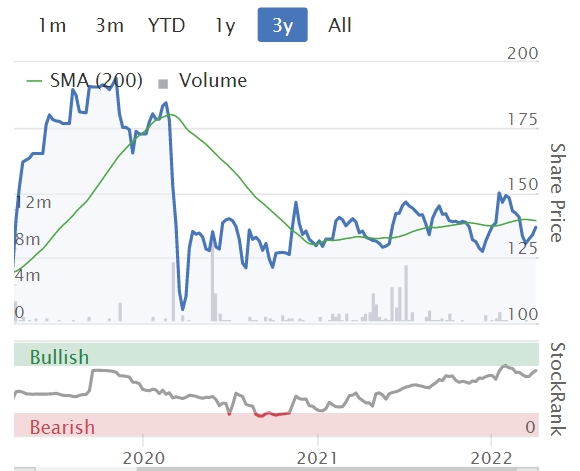
I'm no expert, but this chart looks quite good to me - seems to be building a base, despite very bearish market conditions -
.
.
Attraqt (LON:ATQT)
30p (down 2% at 11:02)
Market cap £60m
This is a software company which specialises in an add-on for eCommerce businesses, which improves customer search results, hence converting more web visits into sales. It is used by some big name eCommerce businesses, so the product clearly works.
I’ve had a quick skim of the FY 12/2021 numbers, here are my notes -
Bull points
- Growing (but not stellar, at 9% revenue growth to £22.9m, for 2021)
- Mostly recurring, SaaS revenues of £20.9m - should provide good visibility & lower risk of profit warnings than a software company that relies on licence wins
- Interesting niche software (improves search results for online retailers)
- Impressive client list
- Positive outlook comments, including “strong” new bookings in Q1 2022
- Tax losses will help, if it does achieve profitability
Bear points
- Loss-making £3.5m after tax (negative tax charge)
- EBITDA needs to be adjusted for £2.0m capitalised development spend
- Cash of £3.5m doesn’t look comfortable - another placing likely I’d say, but company reckons it’s on track to be cash neutral in 2022
- Balance sheet not the best, with negative NTAV
- Hasn’t yet achieved scale.
- Valuation - it’s too expensive for a small, loss-making, sub-scale business.
My opinion - quite an interesting business, which I’ve tended to dismiss in the past, but which could develop into something more interesting, if management is able to accelerate growth.
For the moment though, in a bear market for small caps, £60m market cap is way too high for something that’s still losing significant amounts of money, and may need another placing.
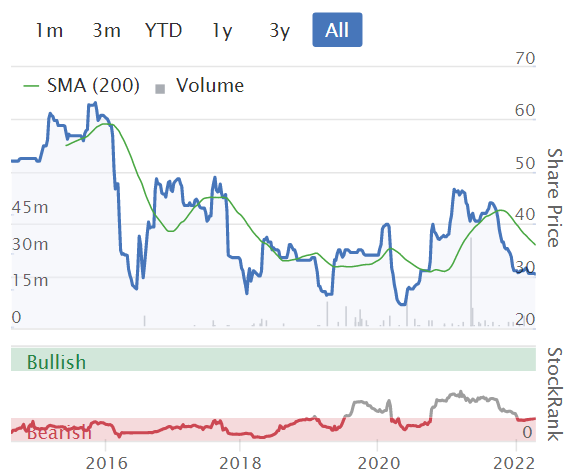
I’ll add ATQT to my watchlist though. What I’m looking for is a tipping point, where new orders start rapidly accelerating because customers are beating down the door, trying to buy a product or service that meets their needs. ATQT doesn’t seem to be there yet, but I’ll read all future trading updates for any signs that growth is taking off. Until then, it’s a bit of an uncertain punt, so £60m market cap doesn’t seem justified to me. Drop that by two thirds, and I’d start to get interested!
.
.
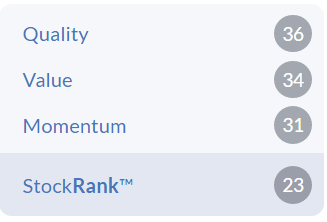
The low StockRank is a useful reminder that this type of jam tomorrow share usually make bad investments, but the odd one can be a multibagger, hence why we look at them! Also ATQT is a proper business, with decent recurring revenues. It just hasn't yet reached sufficient scale to make any profit.
.
.
Adept Technology (LON:ADT)
165p (unchaned at 13:26)
Market cap £41m
AdEPT (AIM: ADT), one of the UK's leading independent providers of managed services for cloud, digital platforms, unified communications, and connectivity solutions, is pleased to announce a trading and strategy update.
It finished FY 3/2022 slightly behind forecasts -
The Board is pleased to report a strong finish to the financial year ended 31 March 2022 ("FY22" or the "Period"), in terms of order intake, and that it expects the Group revenue and adjusted EBITDA for the Period to be broadly in line with current market forecasts.
There’s a lot more detail in this update, about its markets & strategy, which I won’t repeat here.
Supply chain shortages - this is the second IT company in a week which has said that chip shortages are creating much longer lead times. So whilst container freight charges might be reducing, it seems that supply bottlenecks (in particular chips, and new China covid shutdowns) are not improving, maybe even getting worse? That could impact a lot of manufacturers, and distributors/retailers that sell electronics maybe?
One IT company (Beeks) told me that lead times on some networking products & servers were extending out to a year, hence why they’re now stockpiling in advance of expected orders, hence the £15m placing being necessary.
The commentary sounds quite upbeat at Adept.
New customer wins sound impressive.
However, I’ve looked back at the last results (interims), and the weak balance sheet rules out this share for me - it’s got too much debt (£29.3m net debt at 31 March), and when you write off intangible assets, there’s a large deficit on NTAV.
An earn-out of £4 -4.8m is yet to be paid, which would worsen net debt further.
With the macro picture looking difficult & uncertain, I definitely don’t want to own highly indebted companies with a negative NTAV base.
For that reason, it’s not of any interest to me. One for risk-takers only.
Form your own view of the company on a forthcoming webinar, on IMC - 13:30 on 11 April.
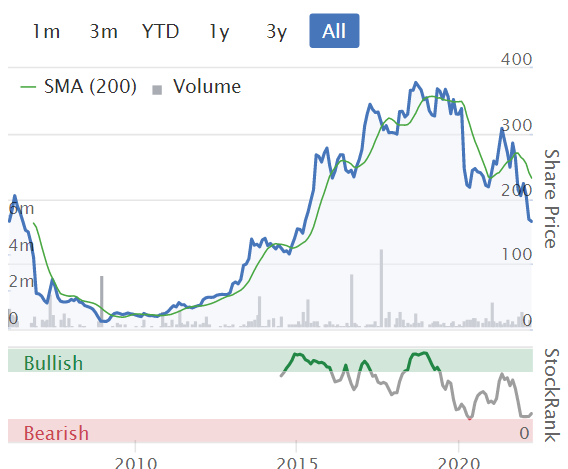
An interesting long-term chart!
.
Stockopedia isn't impressed either -
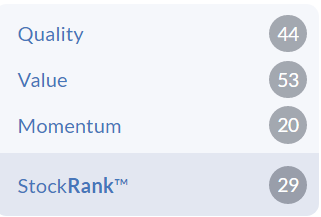
.
Jack's section
Robert Walters (LON:RWA)
Share price: 716p (+5.6%)
Shares in issue: 76,871,360
Market cap: £550.4m
Q1 trading update for the three months to 31 March 2022
It looks like another strong quarter for Robert Walters, with net fee income up across all regions and up 30% for the group. Asia Pacific is up 37% to £43.9m, Europe +40% to £29.5m, UK +4% to £17.9m, and Other International +30% to £7.1m. Encouragingly, the quarter ended strongly, with a ‘record March performance’.
CEO Robert Walters comments:
We have continued to invest in additional headcount to ensure we are able to take advantage of the demand for talent that exists across all of our markets and specialist disciplines with staff numbers increasing by a further 9% since the end of 2021. Current trading remains in line with Board expectations.
The Q2 update will be published on 6 July 2022.
Conclusion
Just a short Q1 update today, but one that confirms positive trading momentum. With some recruiters, the durability of earnings growth is a concern but RWA continues to come across as one of the better operators in the space, with a founder/CEO and growing international operations.
The shares have recovered slightly from the Q1 AIM sell off but still represent reasonable value, in my view.

A 12.2x forecast PER is probably anticipating some kind of deterioration in trading conditions at some point. If RWA can continue along its current trajectory though, investing in headcount and growing not just due to a strong market but due to market share gains and growth investment, then the shares continue to be of interest.
Tracsis (LON:TRCS)
Share price: 1,013 (+0.8%)
Shares in issue: 29,496,802
Market cap: £298.8m
Interim results for the six months to 31 January 2022
This is a provider of software, hardware, data analytics/GIS and services for the rail, traffic data and wider transport industries. It spun out from Leeds University in 2004, listed in 2007, and has grown materially since, acquiring other businesses and growing organically.

Today, half of the business is software for the railway industry (expected to grow double digits over the long term with plenty of opportunities) and the other half is transport-related data analysis to do with traffic etc.
- Revenue +31% to £29.2m,
- Adjusted EBITDA +14% to £6.2m,
- Profit before tax +16% to £1.3m,
Here’s the reconciliation between adjusted and reported results. Around £2.1m of the c£5m difference between adjusted EBITDA and PBT comes from amortisation, with roughly the same amount coming from share-based payments, exceptional items, and depreciation.

Tracsis won several multi-year contracts in the period, including its first in the rail freight sector for TRACS enterprise. The Events and Traffic Data businesses have responded quickly to a recovery in post-Covid demand, and some large TRACS Enterprise contracts won in previous years are set to go live in summer 2022. The group also completed an acquisition: Icon GEO, a geoscience company.
Post-period end has seen another acquisition, this time RailComm, which is a US based rail technology software and services provider, ‘giving direct access to the large and growing North American market’.
Back in November I talked with management here and had this in my notes:
They have looked at more than 200 companies in the US to analyse the competitive landscape there. Nobody is doing what Tracsis does. That’s good as it’s a market share opp but means they can’t buy like for like. Instead they will look to acquire someone with a different product but the right routes to market. This is perhaps the kind of acquisition we can expect - not another Tracsis, but something that opens the door in a new geography.
Current trading - Encouraging start to Q3 trading with high activity levels across large parts of the Group; Well positioned to deliver further growth in H2 and beyond.
Chris Barnes, Chief Executive Officer, comments:
The recent acquisition of RailComm is an important strategic development for Tracsis, providing a platform onto which we can start to internationally expand the Group and its rail product portfolio via direct access to the significant and growing North American rail technology market. We have received a very positive reaction across RailComm's North American client base… We are confident that there are strong growth prospects for all parts of our Group and therefore remain committed to implementing our overall strategic growth and investment plans. We will continue to pursue organic and acquisitive growth supported by a strong balance sheet.
Presentation here on Friday the 8th (tomorrow).
Conclusion
RailComm provides Tracsis with additional opportunities in its core markets of rail yard automation and computer aided dispatching, but it also gives direct access to an established sales network that can target a significant number of rail clients in North America. Beyond that, there have been additional contract wins, which suggests organic growth continues.
The sales cycle could be an issue in the short term, as Tracsis has to prove itself to large transport operators, which can be a bit ‘chicken and egg’ - like all those entry level jobs out there requiring three years of experience. Again, from my notes back in November:
The UK rail market is very political with a lot of apathy. It’s not like the car market for example, which is much more commercial. That means procurement cycles are longer but, on the flip side, there are switching costs once you’re in.
I wonder if the US is more commercial? Either way, I see Tracsis as the kind of business that could become an overnight success ten years in the making, with some kind of inflection point in the sales cycle if it can sufficiently de-risk itself in the eyes of customers. It probably does require a deeper level of research though, beyond the scope of the SCVR. For those with the time to spare, I would flag it as an intriguing growth candidate.
In terms of valuation, it seems at first like there is a lot of growth priced in with interim EPS of 2.61p against a share price of 1,013p. FinnCap gives a much higher FY22 adjusted estimate of 33.2p though, significantly higher than its forecast stated EPS of 11.8p, again suggesting more time is required in order to understand the nuances.
The balance sheet is fine, asset light as you would expect. No debt and £25m of cash, and £5.8m of net tangible assets after subtracting £53.2m of intangibles. Intangibles are harder to value and require a view on the long term cash generation ability of the group’s software. But there are attractions to the business model and RailComm provides that sought after step into the US market.
There are some signs of potential, and the group has proven its revenue growth credentials. Encouragingly, there’s been minimal equity dilution and there’s no debt, so it’s all self-funded.
I think this one comes down to long term growth prospects and Tracsis’ ability to generate high quality, durable earnings. That’s the real decider of value, beyond single-year PE multiples.
Disclaimer
This is not financial advice. Our content is intended to be used and must be used for information and education purposes only. Please read our disclaimer and terms and conditions to understand our obligations.

44 comments
The potential game changer for Tracsis (LON:TRCS) is the US. It has been for the whole 10 years I've been a holder!
It does feel like this time is different though with an easier route to market now?
De La Rue (LON:DLAR) The Crystal Amber Crystal Amber Fund (LON:CRS) holding of 9.9% is either a negative feature, as CRS is in the process of running down, or the catalyst for a potential acquisition.
On De La Rue (LON:DLAR)
Companies like this (119m actuarial deficit, 15m pa payments) can be seen as a punt on interest rates rising.
The deficit is the gap between 2 v. big numbers. A small change in interest rates makes a big difference in the deficit.
Tracsis (LON:TRCS) (I hold)
I don't have much to add here, but sharing my (rough) notes for any interested.
FY22 Interims
-ve
Apparently this is cyclical - company hoping to change this with move into US.
Also large contracts signed post-period end
Hoping to see signs of this improving by now - perhaps picture will be clearer/better at YE?
+ve
£TRCS (I hold) The potential game changer is the move into US. As noted, this is likely to be slow in generating sales and PBT; but I am comforted by the proven strategy of growth through acquisition but with no share issuance at all. It would be so easy to follow the US entry with a long string of further acquisitions- they must have many files full of notes on other potential candidates. On Tracsis previous record in the UK, any further acquisitions will be funded from cash flow.
Not wanting to clutter up here with a Boohoo (LON:BOO) post I have posted one over on the General Discussion Boohoo thread about Shein’s latest valuation in case anybody is interested. It can be found at:
https://www.stockopedia.com/content/boohoo-boo-general-discussion-846980/comments/945904
Regards
Michael
Hi
Yesterday Gresham House Energy Storage Fund (LON:GRID) presented results up to 31 Dec 2021. Just within the SCVR space £643m cap.
In these tough times in the market Gresham House Energy Storage Fund (LON:GRID) might interest some. It seems to offer an 'uncorrelated' (to the extent it can in a full market down turn) investment. In a sector whereby energy prices are rising strongly, thus opportunities for The Grid, businesses and energy traders to seek out value in additional electricity resources seem to me to quite a driver for Gresham House Energy Storage Fund (LON:GRID) .
SP up over +4% this AM as I type, up over +10% past 5 days, over +19% past month, over +325 one year (stats from Google chart).
A major holder has made substantial purchases over recent days (Sarsin Partners - I have not researched them yet), they now hold 10%.
Points from the RNS ......
Gresham House Energy Storage Fund plc (LSE: GRID), the UK's largest utility-scale battery energy storage fund, is pleased to announce its third set of annual results since the IPO in November 2018. This covers the 12 months ended 31 December 2021.
Performance highlights during the year
· Underlying Operational Portfolio revenues up 170% to £51.4mn (FY20: £19.0mn)
· Underlying Operational Portfolio EBITDA up 172% to £42.5mn (FY20: £15.6mn)
· Dividends of 7.0p per share paid for the year, with Operational Dividend Cover 1 at 1.32x
· Net Asset Value (NAV) up 42.6% to £511.7mn (FY20: £358.9mn)
· NAV per share up 13.5% to 116.86p (FY20:102.96p) and NAV total return of 20.3%
· Share price total return of 23.0% versus FTSE All-Share Index total return of 18.3%
· Share price total return since IPO of 51.5% versus FTSE All-Share Index total return of 21.4%
· Weighted average discount rate of 10.8% as of 31 December 2021 (FY20:10.8%)
RNS here .... https://www.investegate.co.uk/...
For those interested PiWorld/Mello have an informative vid from Jun 2019, here .....
;t=1132s(if this link does not work go to PiWorld site direct and search for the vid).
Also this vid Oct 2018 is the CEO explaining the offering, so a useful background perspective.
Disclosure I bought a starter position this AM.
Regards
Howard
RE: Gresham House Energy Storage Fund (LON:GRID)
I think the fact it's trading at a premium to NAV of about 60% is a bit of a concern - although that NAV is itself subject to all sorts of assumptions and shouldn't be taken at face value.
There's an interesting interview between David Stevenson (who's a non-exec) and Ben Guest, the manager of GRID here (it's about half way down): https://davidstevenson.substac...
As the article notes GRID is in the middle of a transformation towards merchant revenue streams. Although such is the uncertainty in energy markets at the moment I'd imagine that could change.
Interesting company, I hold a few.
timarr
Hi timarr
Many thanks for the link to the David Stevenson piece. I recall Stevenson wrote about Gresham House Energy Storage Fund (LON:GRID) in MoneyWeek quite a while ago and it caught my attention then, but it slipped off my radar.
Regards
Howard
Re Gresham House Energy Storage Fund (LON:GRID) - (Up to 24 hour) Electrical storage is highly likely to boom over the next 10 years as renewables scale up and their costs fall (as an aside, why o why is the govt ignoring cheap onshore wind and energy efficiency in favour of expensive, risky mega-nuclear plants that wont deliver for 10 years, other than the obvious hi-vis photo opp stories)
There is a very literal landgrab by Gresham House Energy Storage Fund (LON:GRID) and a few competitors to own the best sites that supply/protect at the critical points of the grid network. Once they have the best sites that supply these chokepoints, I think they will be in a very strong position - like having the first and best sited pub or supermarket in town.
My only concerns were that i) the batteries they are putting in is relatively small scale and the cost of much bigger capacity batteries is falling so fast. They may have to replace / double stack them within a few years (but this seems to be doable and worth it) ii) I am not sure they have the best suppliers. Tesla seem to lead here and the software / battery management is critical. The underlying battery technolgy could transform. Finally, there is unpredictable regulatory risk - the govt just announced it is buying out part of the national grid. On what basis /price / underliying economic rationale I don't really know. Could the same happen here?
I tried to buy, got rebuffed as a non-professional investor (I answered the qualifying Qs honestly, a mistake) and have not got back.
Gresham House Energy Storage Fund (LON:GRID)
"I think the fact it's trading at a premium to NAV of about 60% is a bit of a concern - although that NAV is itself subject to all sorts of assumptions and shouldn't be taken at face value."
I'm still trying to make myself comfortable with this but did add some yesterday based on:-
"Taking these statements together, the Investment Manager currently expects NAV per share to increase to at least 124p by 31 March 2022 and in the range of 140-145p by 30 June 2022 2 ."
I'm going to look at in more detail but this seems to relate to the assets becoming operational and generating revenues when they switch from a cost basis to "fair" value.
Phil
Gresham House Energy Storage Fund (LON:GRID) said yesterday that their NAV per share is 117p, so I make that "just" a 32.5% premium.
Hi
I see my links to two Gresham House Energy Storage Fund (LON:GRID) vids have disappeared from my initial post??
Here is the PiWorld/Mello one (I hope) May 2019
https://www.piworld.co.uk/
I hope this is the vid itself
https://www.piworld.co.uk/comp...
Here is Ben Guest CEO vid Oct 2018.
Its on this site.
https://www.youtube.com/channe...
But the link to the vid does not stick in this Stocko comment box, just use the site's search to find it. This is the caption ...
Gresham House Energy Storage Fund leveraged to evolving energy markets
1,589 viewsOct 30, 2018
Regards
Howard
May also consider investing in the asset manager itself Gresham House (LON:GHE) which I think provides a very good way to get exposure to a range of sustainable strategies (energy storage, forestry, social housing, etc). They seem to be firing on all cylinders and seeing strong AUM growth. I hold.
Another alternative is Gore Street Energy Storage Fund (LON:GSF) which was presented at the StockSlam last night.
Gore Street Energy Storage Fund (LON:GSF) & Gresham House Energy Storage Fund (LON:GRID) are the two major investment trusts in the Energy Storage space so this thread is of interest given the rapid shift to intermittent renewable energy. This has perhaps been given another push by the European aim to eliminate Russian oil and gas in favour of more renewables. Gresham House Energy Storage Fund (LON:GRID) has significantly outperformed Gore Street Energy Storage Fund (LON:GSF) since August 2021 and in share price terms is up 17% YTD and trades at a premium of 25.66% to NAV at last close (Source: AJ Bell/Morningstar). This compares with Gore Street Energy Storage Fund (LON:GSF) where the share price is down 2.4% and the premium to NAV is 8.22%. Interestingly Gore Street Energy Storage Fund (LON:GSF) is in the process of issuing additional shares, including to retail investors, through the likes of AJ Bell. A possible reason for the discrepancy in performance between the two, aside from the underlying business performance, is the respective ongoing costs of the Trusts. Gresham House Energy Storage Fund (LON:GRID) ongoing costs are 1.52% compared to 2.24% for Gore Street Energy Storage Fund (LON:GSF) These are both pretty steep and in the top half dozen in terms of fee levels in the Infrastructure Direct Category (Morningstar). As someone interested in investing in this space this presents a bit of a dilemma! Pay a hefty premium to NAV for Gresham House Energy Storage Fund (LON:GRID) and incur lower (but still high fees) as this is clearly investors preference in the last 9 months. Alternatively go for a lower premium to NAV and incur the highest costs in the sector with Gore Street Energy Storage Fund (LON:GSF) in the anticipation that the share price will 'catch up' and the premium to NAV will widen thereby offsetting some of the extra ongoing cost .
Note: For income seekers target yields are c. 5% for Gresham House Energy Storage Fund (LON:GRID) & c. 7% for Gore Street Energy Storage Fund (LON:GSF) - though of course these are not guaranteed.
Thanks that’s very useful, I’m only just starting to look at these 2, feel I have rather missed the boat on Gresham House Energy Storage Fund (LON:GRID) but will keep an eye on it. Did not realise the fees were so high. Energy storage going in demand as we switch away from fossil fuels.
As a read-across from Robert Walters (LON:RWA), Sthree (LON:STEM) looks bafflingly oversold. I have a high level of confidence that the latter’s operational performance and prospects are at least as good, if not better. The shares appear to be held back by two concerns:
Recession in Europe, which is SThree’s biggest market.
CEO limbo since the departure of Mark Dolan.
The former might be a legitimate concern because no recruiter is completely non-cyclical. However, the shortage of specialised technical staff is so acute that it would take a serious withdrawal of demand to make an impact on billings. A pullback to a Goldilocks balance of demand and supply in which recruiters actually thrive, would be the more likely scenario.
The interim CEO, having built and run the company’s DACH business, is actually more of a proven recruitment lifer than the previous CEO, who was a City-friendly communicator but by no means an accomplished recruiter himself. It may be that Timo gets the big job permanently, and no doubt he is under consideration, and that would likely satisfy investors. Or the firm may find a big-hitter from elsewhere. Does it matter? Not really. Front line recruiters pay little attention to their bosses and a lot to their personal billing. They are profit centres in their own right and largely unmoved by corporate shifts. Although the right boss always makes a difference in the long term, short to medium term revenues are CEO-agnostic.
What always seems to put me off recruiters is their small profit margins. I know they have very few cost input pressures, but they do look vulnerable to reductions in revenue, and I guess staff wage increases....or both which could well be on the horizon?
What always seems to put me off recruiters is their small profit margins.
Good recruiter's margins are fine. It's the presentation of the data that confuses. The vast majority of the the costs are pass-through in the form of sub-contractor wages. And a high proportion of SG&A costs are commissions to salespersons that are simply a cost of sale (no sales = no commissions).
If you reverse these out by placing sub-contractor wages and sales commissions (but not basic salaries) as a COS and express operating margin as the relationship between GP and EBIT you get margins easily higher than 50% at the best run firms.
The most profitable businesses have a mix of contract and perm, with a 60/40 to 70/30 split optimal for sustained profitability and cashflow management. Contract is less cyclical, stickier and offers better visibility while perm promotes positive cashflow.
Hi BnB,
That's an excellent explanation on pass-through nature of most revenues for staffing companies, thanks & well done!
That's why I tend to use Net Fee Income (NFI) as the revenue number, when looking at staffing companies.
Similar sort of situation to car dealers - the huge revenue number is pretty meaningless, as what matters is the gross profit made on each unit, not the screen price.
Regards, Paul.
That's why I tend to use Net Fee Income (NFI) as the revenue number, when looking at staffing companies.
That’s very astute Paul. Unfortunately, if you try to burrow down too far, you reach significant obstacles such as trying to calculate what proportion of wages are floating (commissions) rather than fixed (basic salaries). Wage models vary greatly from company to company. I would suggest somewhere between and 10% and 20% of gross margin/NFI is appropriate for calculating commissions and the more profitable companies are probably paying out towards the higher end.
Good morning, firstly thank you to Paul and all the other 'Slammers' who put the time and effort into their tremendous pitches for the Stockopedia/PIWORLD StockSlam yesterday. It was another great evening of stock pitches. Always interesting to hear another's view on what they value in a company and their chosen pick. We will have the recording as soon as we can.
Today, two results overview videos. Both rather good, though I say so myself. First, Attraqt (LON:ATQT) in an interesting space they provide highly effective search facility for ecommerce using lots of clever stuff including AI. In this overview there's a software demo which explains far better than I can. Some huge clients including Puma and other great names they can't speak about publicly! After a lot of investment it sounds as though it's coming together Rev+9% £22.9m. Adj EBITDA 0.7m. GM71%. Strong sales growth. Pipeline bigger than ever. Video & podcast.
Next Tracsis (LON:TRCS) interim results overview here, video & podcast. They are in line for full year. Revenue +31% £29.2. Adj EBITDA +14% £6.2m. PTP +16% £1.3m. Lots of cash £25.1m. Restored dividend. The Rail Comm acquisition gives a sales conduit into the US for rail. Traffic and events returning to pre-pandemic levels by end H2. They have a record sales pipeline across group and a strong M&A pipeline. Management are presenting in a webinar tomorrow 8.4.22 at 1pm followed by a live Q&A Join us by registering here.
Good news on Rockwood Realisations (RKW).
Whilst self praise is no praise of course I did say in January Christopher Milks was not going to follow the Gresham script of a wind down and return of capital and he has gradually built his stake.
Seems a formality now with Richard Staveley and Christopher Mills over 30%.
That’s a very impressive combination with excellent track record and they are big holders of sone great small caps especially Northbridge where Mil'ls son has joined the board .
Worth watching what they invest in , Richard Staveley a very good small cap manager who rarely puts a foot wrong .
,
Good morning Paul and Jack would you be able to have a look at Mast Energy Mast Energy Developments (LON:MAST) who have issued a general update today following financial results on 31/3/22. I have been following the stock for a while and although it’s a tiddler in market cap, it has significant opportunities within the energy sector, providing gas peaker services within the UK energy services industry. The financial results are looking good to me and. The management are keen to expand with additional peaker facilities. I think it provides a great opportunity but I would really appreciate you running your slide rule against it from a financial performance and valuation perspective. Many thanks! Bristol.
what are peaker facilities?
I wondered what a gas peaker was too. Wikipedia says
Peaking power plants, also known as peaker plants, and occasionally just "peakers", are power plants that generally run only when there is a high demand, known as peak demand, for electricity. Because they supply power only occasionally, the power supplied commands a much higher price per kilowatt hour than base load power.
https://en.wikipedia.org/wiki/...
Hi both, apologies as I have only just seen your messages. John has it spot on. In my view these gas peaker facilities are only going to be in greater demand in the coming years to ensure national capacity. Price announced by government earlier this year is already considerably higher than previously. I hope Paul or Jack have time to look at it if not today then perhaps on a quieter Friday. Many thanks!
Hi Bristolian,
I've had a quick look at Mast Energy Developments (LON:MAST) - unfortunately it's little more than a startup, so there are no historic numbers for me to work from. We're mainly reporting on more mature companies here, with a track record, and historic figures to work from.
With MAST you would need to run your own calculations, to guess at what future performance might be like, which is not my area (and there isn't time to do that anyway).
I see there's a research note out from WH Ireland today.
There was another small cap in this space, called Alkane Energy, which did well from "peaker" power generation, and attracted a takeover bid in the end. I remember meeting the company at WHI offices, and buying a few shares in it, a few years ago.
This type of share is all about management. So the main thing to research with MAST, I would guess, is find out (independently) what they've done in the past, what their track records are actually like (not always what they tell you!!). If they've succeeded in the past in this sector, then they're probably safe hands to do a good job again. If they're chancers, latching onto a trendy area, then I would steer clear.
I would also worry about capex & maintenance, for buying power stations. If it's a lucrative asset, why is someone else selling it? The seller probably knows the asset better than the buyer, which would worry me. It could be fine - a bigger company selling off non-core assets, etc, but always worth doing some digging.
I'm happy to look at MAST figures once it's got established, in maybe a year or two time, but for now it's too small & lacks a track record, for inclusion in the SCVRs. Good luck!
Regards, Paul.
Thanks Paul - that’s absolutely fine and much appreciated.
What I would describe as in line from Tracsis (LON:TRCS) this morning.
RE: Tracsis (LON:TRCS)
Big increase in cost of sale
It's only just above where it was pre-pandemic, so that doesn't look out of line. A lot of that will come from the rapid scaling back up of the Events business, which is people intensive.
It's an acquisitive group - 17 in total so far - and the amortisation associated with that also doesn't look particularly unusual.
The move into North America carries risks, obviously, but is an obvious next step for the group to diversify away UK specific risk.
Overall, looks fine, although the devil is always in the detail.
timarr
Ref - Vertu motors / motor dealers .
Been talking to the ex sales director of one of the top regional motor dealers .
This is the guy who first started selling cars below cost just to generate huge volume and claw back his profits on finance charges and rebates .
Traditionsally motor industry is huge turnover wafer thin margins .
I think people are calling it wrong on motor industry results going backwards , I think the medium term 0-3 years very positive now due to the ability and new mindset amongst motor trade that they can run a business that makes full margin on products .
As an FD I am sure Paul will confirm the startling effects that happens to a companies profits when it increases margin, from mememory a fagpacket 10% increase in margin is 100% increase in profits .
The actual negative for motor trade would be if we reverted back to full supply and low margin trading so I just think people are calling it wrong and the motor trade is much stronger with a more limited supply .
Absolutely true planetx re wafer thin margins historically, Note Lookers impressive £2,300 profit per used car in yesterday's results. I'm hoping to see similar when Vertu's results are out in May. You make a good point about a change on margins for the better.
The trouble is, they are like sheep and when one starts buying business like your friend did, the others will follow, which is what happened when your friend did it. The manufacturers push for volume traditionally; they have to to keep their mega factories flowing and cost effective. This causes 'do it for unit' sales at near zero margin. Sorry.
Against that the car manufacturers are also realising how much profit they can make. BMW and Mercedes have both said they are keeping their supply limited. Mercedes say they will consciously undersupply demand.
They need all the profit they can get while they are paying two sets of costs for ICE cars and electric during the transition.
https://www.ft.com/content/f55...
Re car dealers, thanks to all included JohnEustace for your thoughts.
Why do you think that the car dealer shares have taken such a hit in the last few days? Vertu Motors (LON:VTU) down over NINE % yesterday, and another FOUR% today; Lookers (LON:LOOK) down nearly TEN % today.
What do you think is the base SP figure for these very profitable companies, though clearly not making as much as in 2021.?
Still, as Paul has said many times, the excess profit falls all the way to the bottom line and the strengthening of the balance sheet.
Additionally, there is the opportunity for some rationalization of companies, and of course sites (sell and lease back (an example came up recently with one of the dealers which Paul pointed out) and which took another company in another sector into a totally new SP level when they did it company wide a little while ago - Caretech Holdings (LON:CTH) in the care sector.)
I guess more people agree with the view that the car dealers are a Covid play that has run its' course. Lookers highlighted their gains from the mark up in their used car stock which is unlikely to repeat even if it doesn't quickly reverse.
I'm less optimistic about the supply chains reverting to normal or the car companies going back to shifting all the metal they can at the expense of profits. I think the manufacturers and dealers like the new paradigm fine. They are now price setters, not takers.
Currently the European manufacturers are constrained by lack of wiring harnesses that were being heavily sourced from Ukraine. I heard yesterday of someone who bought a new BMW for £40k and was phoned back by the dealer two weeks later offering to buy it back for £42k. He declined.
I smiled a bit at the FT article making it clear that BMW and Mercedes had independently decided to limit volumes and push their premium products. I'm sure the German makers know what happens if they are seen to be colluding to keep prices high. But they do have form. High prices for premium names gives more headroom for the mid market brands.
One thing that may undo their plans will be the anticipated volume launches of cheap Chinese EV's in a couple of years. They are already selling into Norway. Though they must be shipping by train across Russia so that may be an issue. The Germans have perhaps a year or two to maximise profits in my view.
On the same theme I see in the FT today that VW are axing dozens of models.
“The key target is not growth,” said Arno Antlitz, chief financial officer, in a reversal of the stance taken by former VW executives. “We are more focused on quality and on margins, rather than on volume and market share.”
https://www.ft.com/content/431...
Uls Technology (LON:ULS) lol
And there was me thinking that Uls Technology (LON:ULS) was short for Useless!
lol...Mr Contrarian, a happy island in a sea of diarrhea...always makes me smile!
EPICs are funny things. Whenever I see BONH (whose CEO has scarpered) I can't help but think of Led Zeppelin's late drummer.