Small Cap Value Report (Thu 8 Aug 2019) - BUR, ZTF, WATR, ELCO, BUR (rebuttal), VTC

Good evening/morning, it's Paul here.
To manage expectations today, I'm on the afternoon shift, so estimated completion time of this report is c.6 pm. As usual, I'll update it in sections as I go along. It's a quiet day for small caps news anyway. All done now (17:36)
Burford Capital (LON:BUR)
Yesterday was so dominated by BUR that I didn't get round to looking at many other things. Hence today's reports starts with some catch up items, written by me late on Weds night. Incidentally, I really liked Graham's coverage of Burford on his own website, here.
Another thought occurs to me. It might be that the share price could bounce from here, but will it get back to previous levels? I doubt that, because now it appears (according to MW) that profit is mainly coming from aggressively anticipating the future cashflows from only 4 big cases, then that casts considerable doubt over the sustainability of future profits. That in turn means that a much lower multiple of earnings should be used in valuing the company.
Taking that into account, means that I suspect Burford shares could eventually settle permanently at a lower level - maybe 500-1000p? As Graham points out in his article, given that Burford appears to recognise future profits aggressively, then we should possibly be valuing it at a discount to published NAV, not a premium? It depends on how you look at it.
Interestingly, the Stockopedia computers were negative on Burford, before the recent share price collapse. On 4 Aug 2019, when the share price was 1425p, the StockRank here was very low for a (at that date) £3.1bn company;

That has since dropped to 18, as the momentum has obviously dropped this week.
Nobody is claiming that the StockRank system is infallible - it couldn't possibly be, as no system can predict the future. However, I've noticed that ignoring low StockRanks is often a costly mistake - many of my low StockRank personal holdings have done really badly in the last year. With hindsight, if I'd played it safe, and stuck to higher StockRank positions, I'd probably be a lot happier and wealthier than I actually am now. Ho hum, we live & learn. Or maybe that should be: live and make the same mistakes repeatedly?! Anyhow, there's no point in crying over spilt milk.
Zotefoams (LON:ZTF)
Share price: 556p
No. shares: 48.3m
Market cap: £268.5m
These figures came out on Tuesday.
Zotefoams plc ("Zotefoams", "the Company" or "the Group"), a world leader in cellular materials technology, today announces its interim results for the six months ended 30 June 2019.
These figures look solid.
- H1 revenues up 12% to £42.3m - driven by strong growth (+40%) in high performance products. The other 2 categories only delivered 3% growth each
- Profit before tax up 7% to £4.93m - note the decent profit margin there, of 11.7% - so clearly the company has some pricing power, so its products must be good
- Capacity expansion has been in the pipeline for some time. Says this is "on schedule". That's the main interesting thing about this share - as increased production capacity should drive future profits higher
- Outlook comments say it's in line to meet market expectations for FY 12/2019, but notes difficult market conditions in Europe
Balance sheet - note that both fixed assets, and debt are rising strongly - to fund the factory expansions.
Net debt has risen from £13.0m at end Dec 2018, to £23.4m at 30 Jun 2019, to fund capex.
I don't see that as a problem, relative to the profits/cashflow, and the good surplus of working capital. Although of course, increasing bank debt when there may be a recession on the horizon, does increase risk.
My opinion - a good company, I think.
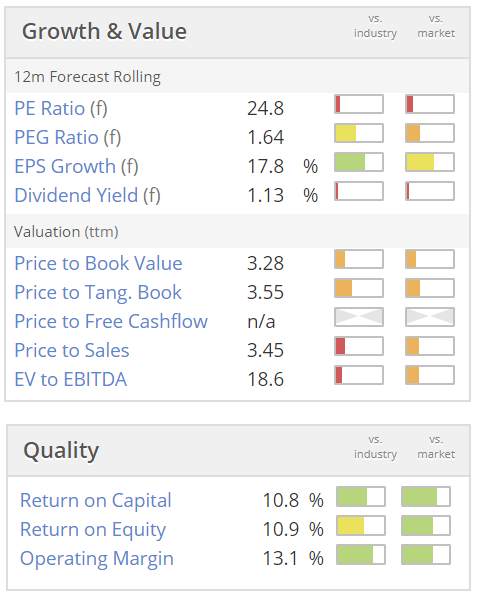
In terms of valuation, I'd only be interested if the price were around say 15 times forward earnings. As it is, this valuation of nearly 25 times forward earnings, seems too rich, given the wobbly nature of the global economy right now, and the macro risks, hence I'll decline to invest here, purely on valuation grounds;
Water Intelligence (LON:WATR)
Share price: 333p
No. shares: 16.9m
Market cap: £56.3m
Water Intelligence plc (AIM: WATR.L) ("Water Intelligence" or "Company"), a leading multinational provider of precision, minimally-invasive leak detection and remediation solutions for both potable and non-potable water is pleased to provide a trading update for the first half of 2019. Interim Results for 1H 2019 will be published in mid-September.
[potable means safe to drink - I had to google it!]
Things seem to be going well;
Results are ahead of market expectations for revenue [$15.9m, up 34%] and comfortably in-line with expectations for profits before taxes. The Company continues to perform strongly with its multinational growth plan. Global demand for water infrastructure products and services remains strong.
I haven't highlighted that revenues are ahead of expectations, because profit is far more important than revenues.
As some activities are franchised, the revenue number is lower than the underlying transactional value with end customers.
Adjusted profit before tax for H1 of $2.0m, up 29% - pretty good going.
My opinion - very similar to Zotefoams above - this looks a good company, with decent growth going on. However, the valuation appears toppy to me, at 23.8 times forward PER.
If you think it can beat earnings forecasts, then that might justify paying a high price. But the valuation rules it out for me, and I'm not really interested in buying any new positions at the moment, due to macro uncertainty, unless they are really compelling, which this isn't.
Mostly dollar earnings protects from weak sterling, and Brexit issues.
Elecosoft (LON:ELCO)
Share price: 76.5p (down c.1% yesterday, at market close)
No. shares: 82.1m
Market cap: £62.8m
Elecosoft is a specialist international provider of software and related services to the Architectural, Engineering, Construction and Owner-Operator industries and digital marketing industries... its software solutions cover project management, construction site management, estimating, timber engineering, 3D design and visualisation, and cloud based digital marketing solutions.
The Board of Elecosoft announces a trading update for the six months ended 30 June 2019, based on unaudited management accounts for the period.
Things seem to be going well;
Unaudited revenue for the period increased by 20 per cent compared with revenue for the same period last year. At constant rates of exchange, unaudited revenue would have increased by 22 per cent.
Trading margins for the period were consistent with the prior year and preliminary results for the half year based on unaudited management accounts indicate that the outlook for the full year remains in line with market expectations.
The revenue growth looks to have been flattered by two acquisitions, in H2 of last year. Therefore these are contributing to sales & profit this year in H1, against prior year comparatives which would not have included them.
I feel this should have been mentioned in today's trading update, and the organic growth figure should have been presented, but wasn't. That feels a bit underhand. Anyone unfamiliar with the company might have wrongly assumed that the 20% revenue growth was all organic, when actually it isn't.
Net debt - reduced from £2.1m at 31 Dec 2018, to £0.6m at 30 June 2019 - looks good, and a very modest level of debt.
My opinion - this looks an interesting software group, at a fair price - forward PER of 16.4.
I quite like it.
Bellway (LON:BWY)
Trading update - a large cap builder. I often glance at updates from builders, as they're a good barometer of the health of the economy.
- Trading in line with market expectations
- Operating margin "continuing to moderate towards a more normalised level"
- Ungeared balance sheet, with net cash
Outlook comments sound positive -
Trading conditions remain stable and customer confidence is resilient. There continues to be a strong underlying demand for good quality new homes, supported by the ongoing availability of Help to Buy and an environment of low interest rates.
Customer confidence was resilient and despite the evolving political backdrop, trading in the second half of the financial year was more robust, benefitting from site openings and the usual increase in demand throughout the spring selling season. The cancellation rate for the year remained low, at just 12% (2018 – 11%).
How interesting! From watching the TV news every day, we could be forgiven for thinking that the country is in dire straits. Whereas in reality, we have close to full employment, rising real wages, and I think people are just getting on with their lives instead of worrying about Brexit.
Furthermore, if you look at the ONS statistics, consumer spending is in rude health also;
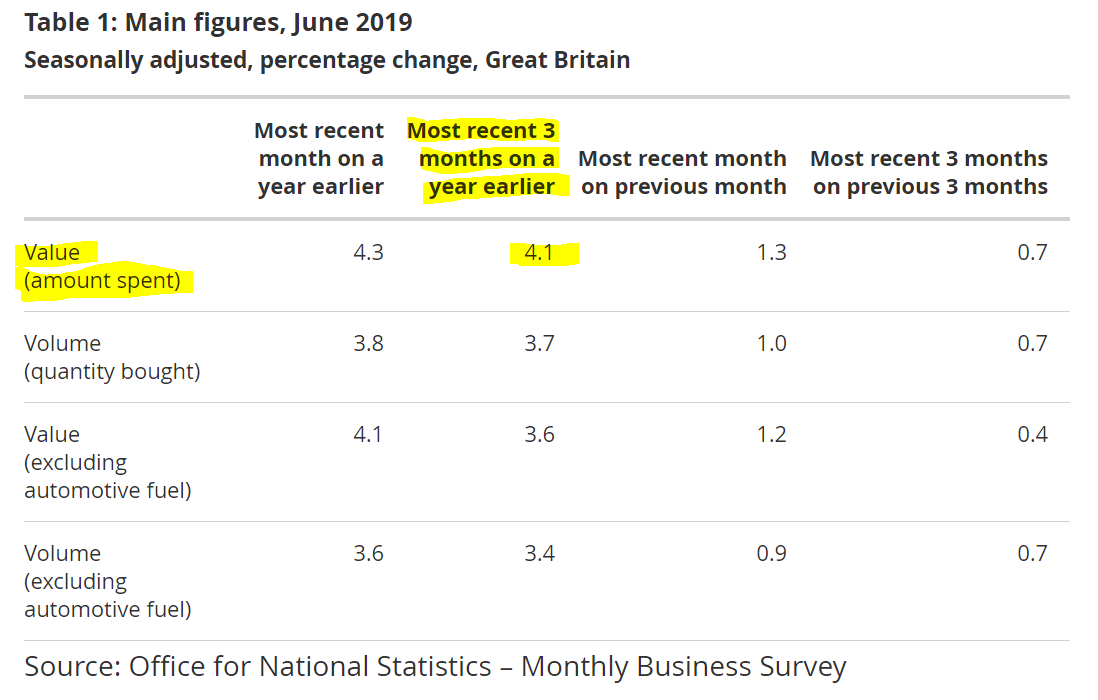
So why is the TV news full of bad news every night? Basically because they like to report negative things, and ignore positive things. Also, with retailing in particular, there's a massive shift going on, from physical stores to online (now about 20% of all retail spending in the UK). So the news is filled with items about struggling physical retailers & job losses, whilst the growth & job creation up & down the country from online retailers, is ignored.
My opinion - back to housebuilders, my main worry (and the reason I don't own any) is that they're so dependent on Help To Buy. This scheme probably should have been wound down a long time ago. It was needed to kick start the market after 2008. Since then it's boosted prices of new homes, thereby providing windfall profits & dividends for shareholders in housebuilders, at the taxpayer expense.
Remember also the scandalous, obscene, £75m bonus that the boss of Persimmon skulked off with? That was a great example of how Govt action can distort markets, and create unintended consequences. The golden rule should be that all bonus schemes have a cap on the maximum payout, to take into account unknown future distorting factors. I'm generally not a fan of bonus schemes for Directors. They're well paid to start with, and so-called incentive schemes often seem to encourage reckless behaviour, and short-term thinking.
Housebuilders are making ridiculously high profit margins at the moment (c. 20% in some cases), whereas normal margins are about half that. Therefore a PER of 6 might look cheap, but could move to 12 as profits normalise over the next few years. Therefore valuing housebuilders on a PER basis is not really appropriate. I prefer the "build out" method.
Bellway does look quite interesting on valuation grounds, with only a modest premium to NTAV. So it might be worth a look.
Burford Capital (LON:BUR)
Their detailed rebuttal document has just been published, so I'm currently reading through this.
Point 1 - Napo/Jaguar
The explanation given by Burford sounds reasonable. It says that the initial profit booked was for other litigation, and not the Napo vs Salix matter, which Napo (Burford's side) ultimately lost.
It refutes the alleged conspiracy with Invesco, the key point being that at the time of the alleged conspiracy, Burford had no relationship with Mark Barnett, and that his fund did not hold any Burford equity.
This sounds a reasonable explanation to me. One-nil to Burford at this stage.
Point 2 - Gray and delayed recoveries
Burford explains why it took commercial decisions to defer receiving a settlement, which do sound sensible. The ultimate outcome on the Gray case was very profitable for Burford, it says.
It refutes the $200m damages counter-claim, saying there is no counter-claim.
Non-cash settlements are very small, but are occasionally used for sound commercial reasons.
Again, all sounds reasonable, so I make this Two-nil to Burford so far.
Point 3 - Acquisition cost in acquired investments
The accusation here from MW was that profits are over-stated, by not apportioning the cost of acquired cases.
Burford says the accusations are all wrong in this section. It says the acquisitions were for the fund manager businesses, not the actual cases.
I don't follow this point, so can't work out who sounds right on this.
Point 4 - Computation of partially-concluded investments
Burford says that it addressed this point on page 13 of its 2019 interim report.
It claims to allocate costs pro rata for partially settled cases, which sounds reasonable.
Although Burford doesn't seem to answer MW's point that it doesn't properly accrue for ongoing future costs.
Point 5 - Progas
MW claimed that Burford delayed reporting a loss. The rebuttal document says this was because the client lodged an appeal. However, Burford had previously said that the appeal was unlikely to succeed. Therefore, it seems to me that Burford's accounting for this was not prudent - if something is likely to be a loss, then it should be fully provided for & reported as such.
I'd say this sounds like a win for MW over Burford. Two-one to Burford. Although my scoring system is flawed here, as there are too many points where I don't know which side is more persuasive.
Point 6 - Treatment of "trial losses"
Burford says this whole section is incorrect. This could be read to imply that other sections contain partial truths?!
It says that unable to comment further on active cases.
I can't judge who is right here, as it's too complicated, and would involve a lot of work to dig deeper. That's MW's job, so let's wait to see what their rebuttal rebuttal says about the detail.
Point 7 - Deducting costs from recoveries
This is by far the longest section of MW's report, which Burford dismissively describes as;
... Burford believes this final point in the report is basically a long, convoluted morass of text cobbled together, riddled with errors and without much of an organising principle. We address below the key arguments we can discern...
Burford defends its accounting policy of reversing previous unrealised gains, when a gain becomes realised. This policy sounds unreasonable when described by MW, but reasonable when described by Burford! So I'm not sure what to make of this.
Re. MW accusation that only 4 cases produce the bulk of Burford's profits. Burford's document today more-or-less admits this, but says it previously disclosed the general principle (of outsized returns on some cases) in its last interim report.
Burford says that removing (nonsensically) its top 4 cases, returns would still be 33%. MW re-worked the figures, and came up with 19%, so still some difference there. Although the key point MW makes, that Burford has relied on 4 big cases to report the bulk of its profits, does seem to be a valid point.
Financial stress - this was always a weak point in the MW case, which I didn't believe at the time. Burford swats away this accusation easily today, as it should.
Expenses - Burford says it expenses all costs, and doesn't capitalise anything (as some competitors do). Whilst that may be true, Burford does revalue cases upwards before they're settled. So it's booking profits ahead of settlement, which achieves a similar effect to capitalising costs - boosting profits ahead of cashflow.
Concluding remark [from Burford]
Attacks shorting dossiers as a "fundamental menace" to an orderly market.
Threatens to pursue "market manipulators" legally - I think that's fine. If short sellers smash a share price on baseless grounds, then they should be pursued in the Courts, because that would be market manipulation.
Burford seems to imply there are a few valid points in the MW report (without specifically saying so), e.g.
In virtually every instance, Burford has already addressed publicly the points raised by the report, often repeatedly for many years, or has shown them here to be simply erroneous...
Burford points out that the main source for the MW attack, was Burford's own additional disclosures, which it voluntarily began publishing in March 2019. Fair point.
My opinion - please bear in mind that I'm only giving my personal impression, as a potential investor, and am not claiming to be an expert in this sector.
Overall, I think this Burford rebuttal comes across very well. The market clearly agrees, with the shares having shot up to 855p at the time of writing, up 41%. So well done to investors who held their nerve, or bought at the bottom (it's more than doubled from the low point yesterday).
One friend described shorting dossiers as "throwing as much mud as possible at a company, and hoping that some of it sticks".
My impression is that Burford seems to have successfully rebutted most of the claims in the MW report. However, a couple of things do seem to have stuck, namely;
1) The bulk of the profits do seem to come from just 4 cases. Were all investors aware of this? This means the total profits are higher risk than some investors might have realised, in terms of not necessarily being sustainable at such a high level once the 4 blockbuster cases have ended. How would it replace those big profit earners? The company says it has been open about this in its detailed reports, but it doesn't seem to have given prominence to this key point.
2) There does seem to be some validity in the criticism of Burford's accounting, that it might not be prudent enough in providing for likely losses, in cases that are still technically ongoing (but likely to be a loss).
There's been a terrific bounce from the lows, on a spirited defence by the company, addressing specifics, which is good. That said, some of the criticisms have stuck, and I wouldn't want to be long of this share from this point on. The halo has clearly slipped a bit, and it might struggle to regain previous levels.
Shorting attacks generally - this brings me on to the issue of the morality, and legality of shorting dossiers. On the one hand, all shares should be subject to scrutiny. We don't get anywhere near enough negative commentary on companies, because the City is full of people (brokers, PRs, etc) who are paid to almost exclusively talk share prices up! Having some balance from bears is a good thing in principle, to help keep share prices grounded.
On the other hand, the technique of opening a short position, and then publishing an apparently explosive & damning negative report on a company, in order to make profit from triggering a (sometimes temporary) collapse in share price, doesn't seem right, does it?
My feeling is that short sellers should be required to submit such a dossier to the target company, and give them say 7-days to respond privately. This would allow companies to point out the mistakes in the draft report. It does appear that the MW report might have misinterpreted some of the cases it comments on. Or at least, Burford seems to have provided reasonable explanations in most cases.
The bottom line, is that if you attack a litigation specialist, expect to end up in Court, as I suspect is now looking rather likely here.
This kind of extreme volatility is really tough for private investors. Some might have stop losses in place, and others might have panic sold, and missed the bounce. You certainly don't expect such extreme volatility with a share valued in billions rather than millions.
No doubt we'll get a part 2 report from MW fairly soon, so the saga is likely to continue.
I've just signed in to the Burford conference call, should be interesting.
(about 45 mins later) I think management are coming across well on the conference call. They're giving full answers to some detailed questions. It all sounds open - subjectively, it doesn't feel like they're hiding anything, or making things up.
Director purchases - the CEO & CIO have both bought shares today at 663.77p pence per share, a total of 474,390 shares, costing £3.15m. To my mind, this type of orchestrated buying at a time of crisis, is largely irrelevant, as it's done for show.
There again, they're damned if they do, and damned if they don't.
Vitec (LON:VTC)
Share price: 1085p (down c.3% today, at 15:18)
No. shares: 45.3m
Market cap: £491.5m
The Vitec Group plc ("Vitec" or "the Group"), the international provider of premium branded products and solutions to the fast moving and growing "image capture and content creation" market, announces its results for the half year ended 30 June 2019.
- Revenues are flat, and adjusted PBT is down 4.1%
- Net debt has shot up, from £43.0m a year earlier, to £108.4m at 30 June 2019 - due to acquisitions.
- Cyclicality - the company mentions this being a "non-Olympic year"
- H2-weighting expected this year
Outlook seems confident -
We are pleased to confirm that our outlook for the current year is unchanged, whilst we remain mindful of geopolitical challenges and FX movements.
Notwithstanding these uncertainties, we continue to expect a strong 2020, benefitting from the summer Olympics, US Presidential elections and the targeted growth initiatives already underway."
Balance sheet - I think debt is getting a little bit too high for my personal taste.
NTAV of £27.3m doesn't seem much for the size of the group.
Cashflow statement - looks very good. Decent, genuine cashflows by the looks of it.
Note that £5.3m of development costs were capitalised in H1 this year, up sharply from £2.4m in H1 LY. Nothing wrong in that, but it boosts profits compared with companies that write off all development spending.
It looks to me as if the group has the capacity to reduce debt from cashflows, so perhaps a break on further acquisitions might be a good idea?
My opinion - I like the look of this share. It's a favourite of Lord Lee, and he's always worth listening to.
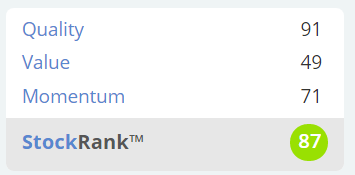
Stockopedia likes it too - quality scores are high, and the forward PER of 11.4 seems good value. It pays a 3.67% dividend - worth having.
Today's update is reassuring, and it reiterates that 2020 should be a good year too. Therefore this share gets a thumbs up from me too!
That's all for today, I hope you found it interesting.
As always, I encourage reader participating by sharing your thoughts in the comments section below.
Best wishes, Paul.
Disclaimer
This is not financial advice. Our content is intended to be used and must be used for information and education purposes only. Please read our disclaimer and terms and conditions to understand our obligations.

77 comments
'The short tracker reporting reveals that Carson Block closed out his short (at least below the dis-closable level if not to zero - although I suspect the latter) on Wednesday. Yes that's right the day that he published his document. It was a bit rude of him not to wait for Burford's rebuttal before "changing his mind".'
In view of that, I think Burford have a strong case for claiming market manipulation if they take Block to court.
What strikes me about the movements in the Burford Capital (LON:BUR) share price this week is that they clearly indicate the widespread and almost complete lack of understanding of how a set of consolidated statutory accounts are constructed. Block has been able to create pandemonium in the market by suggesting that Burford's accounts are fraudulent to people who clearly haven't the faintest idea of how to assess whether his claims are true. If they were able to do so they would have been able to identify how amateurish his accusations of accounting irregularities were. Instead, in a febrile atmosphere where investors have been duped by previous sets of fraudulent accounts, he has been able to string together a series of innuendos, misrepresentations and preposterous claims of accounting irregularity without providing a single credible example of one. It is clear from the document that Block and his team have a very low level of understanding of the double-entry involved in creating the cashflow statement in Burford's accounts. I rarely listen to management speaking, as I have mentioned here before, because I am a bad (over-generous) judge of character. However, I did listen to the whole two hours of conference call yesterday. I would like to say I was shocked at the naivete of the questions from the analysts but, frankly, it was as I expected. I would hazard a guess that none of the questioners have ever been responsible for preparing a set of group accounts. In my experience (ex Group FC for a couple of FTSE 100 companies and subsequently employed as forensic accountant by PE houses to analyse financial statements) analysts often have an ACA qualification but, like a driving licence, this teaches you only the most basic of information about a set of accounts. Most of the people I qualified with at PwC were absolutely appalling at what was then called Financial Accounting - it was regularly the exam that tripped up people who thought they were intelligent and didn't have to work to pass the exams. Most of these dunces left PwC as soon as they were qualified and, with an ACA qualification were lapped up by the financial industry as analysts. Yesterday's conference call did nothing to convince me that the financial accounting calibre of analysts is any better now than it was when I worked in the industry 30 years ago.
What is also patently obvious to me from Block's document is that there is absolutely nobody on his team who has any genuine financial accounting experience either - certainly not someone who has ever prepared a set of complex group accounts. The document demonstrates a pitiful understanding of the double-entry for the cashflow statement. Not wishing to offend any lawyers on this site, but I am afraid that I assume this to be because, as a lawyer, he has surrounded himself with other lawyers. Frankly, i haven't met a lawyer in my career who had a good grasp of the fundamentals of double-entry book-keeping (or one who wanted to) and all of those I worked with extensively on many acquisitions were quite happy to admit it. The skill-sets are simply different. And as i mentioned above, most chartered accountants (all the way up to Partner level) are not comfortable with financial accounting. Audit Partners are good at auditing, not at understanding how complex accounts are constructed. It really takes a certain type of person to understand how a set of accounts are put together - not one that usually makes FD and certainly not one who leaves after qualification to work as an analyst in the financial industry.
So why my spleen? Because I can see quite clearly what is going on here. Block is an ignoramus when it comes to financial accounting. He doesn't have anybody of any quality to forensically deconstruct Burford's accounts or, if he does, they are on holiday. So he feeds on the fear that exists among people making the investment decisions who are bright enough to know he limits of their own understanding of Burford's accounts. These are complex, to be sure. But I have prepared group accounts for groups with 400 subsidiaries. What has happened to the teaching of financial accounting that we are in a situation where a financial ignoramus can spook a bunch of investors who aren't able to see through his incompetence? And, in the process, billions get wiped off a company's market value.
In the meantime, the real questions about the fair value of Peterson and what it will eventually be worth are easily sidestepped by the Board. And what prospects they have of generating similar high value cases.
No doubt Block will come back with further utterly piffling comments about Burford's rebuttal and comments that were made on the teleconference. But it is quite clear to me that he is intellectually incapable of landing a killer blow that proves beyond reasonable doubt that the accounts are materially manipulated. As an observer, I found Burford management far more credible than Block - just a completely different calibre. But, as i said, I am a very poor judge of character.
So, unless Block has clear and uncontestable evidence of fraud (and there is absolutely no evidence that he has), I suspect that there will be diminishing returns to his amateurish accusations about Burford's accounts. He might just be able to bring them down if he can cause sufficient loss of trust that they lose access to the retail bond market but even that isn't guaranteed if there really is a SWF in the background - I seem to recall that there is £800m undrawn on that although I could be wrong.
Anyway, I will go away and have a cold shower now. But I remain simply amazed at the collective stupidity of both Block and the markets who took the content of his report seriously enough to react in the way they did. I have no real idea how to value Burford but it does seem to me to be similar to the PE model. The question is what premium to ascribe to success. As people have recently discovered with Lindsell Train Investment Trust (LON:LTI) there is a limit to what is reasonable to ascribe to the mean-avoidance of certain humans.
No position but mystified by why anybody would believe in the efficient market hypothesis if they have followed events here. I do fear that the number of incidents like this and Patisserie Holdings (LON:CAKE) will increase in inverse proportion to the financial accounting ability of the people making investment decisions.
I pretty much agree with what you say although IMO the CFO did not come over very well on the conference call, she should have been all over every number and in control of the discussion with the analysts but sounded quite hesitant and unclear on the detail on some questions. A CFO who had had a long career preparing financials and answering to superiors on the details would probably have come over better.
Reminds me of the non accountant CFO Lehman had just at the point in its history when it needed a highly confident knowledgeable person to handle the analysts, disastrous.
As a career Group FC of about 20 years, I never had a Group FD who understood the financial accounting any better than the audit partner. As I have posted elsewhere, the skill set required by a Group FD is completely different to that of a Group FC. What you have is varying degrees of being able to field questions about the accounts. This doesn't, in my experience, require the FD to actually understand how the accounts have been put together or the double-entry for the transactions, just to be able to provide a plausible explanation for what has been asked. Sometimes this is a simplified version of the truth and sometimes it isn't but it is plausible. A Group FD's key skill is in being convincing and commercial not in being excellent at financial accounting. Sometimes a Group FD has been a Group FC but really good Group FCs don't generally make good Group FDs. A really good career Group FC is worth their weight in gold and can easily command £150k to £250k in a £1bn turnover group. It's a good solid job with none of the risk of being fired or having to suck up to the CEO that is entailed by being a Group FD.
I listened to the whole teleconference yesterday. In terms of financial accounting understanding, the CFO did not seem to me to be much different to any other that I have worked for. But I wouldn't expect her to be able to answer every question about financial accounting and would be somewhat concerned if she could as it would indicate that she might not have the commercial skills that her role requires. There was one point where I said to myself 'you really ought to know that' but it was only once and i am sure that would be the case if I listened to more of these things. As I say, I am a very poor judge of character and so tend to avoid them.
Well just call me Mystic Meg.
The short tracker reporting reveals that Carson Block closed out his short (at least below the dis-closable level if not to zero - although I suspect the latter) on Wednesday. Yes that's right the day that he published his document. It was a bit rude of him not to wait for Burford's rebuttal before "changing his mind".
I found myself nodding along to mammyoko's 'rant' about financial literacy.
I do though disagree on one point.
Block's analysis was demonstrably as convincing as it needed to be.
I suspect that he actually had a pretty good feel for how superficial some of the claims were. However, had he employed skilled resource to test some of the claims (or even heaven-forbid raised them with the company) then he would probably not have been able to make those claims and inferences.
It will perhaps be interesting to see whether he puts up the pretence of disputing the rebuttal, but I wouldn't expect much more than a token effort. It seems to me that effectively "his work here is done".
Yes, you can't argue with the money.
But I have never really agreed with money as the scorecard and detest those that do. Block isn't just a financial accounting ignoramus he is also a pretty pathetic specimen if this is all he can find to do with his time given that he presumably doesn't need to do so. But, then again, there are plenty in that position.
He is really only a more successful version of Tom Winnifrith or Evil Knievel (or, in a different way ZeroHedge). Don't get me wrong, I find all those hugely amusing (not the racist, misogynistic, homophobic ramblings of the loons who follow them) and think that there is a valid place for pricking the conceit of the pompous. But I wouldn't ever want to be like that!
Luthrin - your schedule suggests an invested cost of under $600m too, so little growth in the size of investments at cost over the last 3 years.
Shipoffrogs,
I suspect the main reason for the lack of growth (at cost) of direct balance sheet investments from 2017 is due to the agreement with the sovereign wealth fund. The SWF consists of a separate pool of capital of 1 billion where Burford has contributed 333m and the sovereign wealth fund 666m.
From 2018 funding for investments were allocated between Burford's balance sheet and the sovereign wealth fund, therefore slowing the growth of direct balance sheet investments.
Burford are compensated for this arrangement by receiving 60% of any investment proceeds due to the SWF, whilst only having contributed 33% of the capital.
Eahriman,
I think you might be in the right area - but if so, shouldn't this be a lot clearer in the accounts?
And how is it that fair value has grown so much (up over threefold since 2016)?
If the fair value mark ups have trebled since 2016 its probably simply Peterson case + a massive increase in investments since 2016.
Remember fair value of a case normally only increases one year before conclusion, you should be seeing this as a positive as it points to superb realisations over the next year or so.
Fair value is a red herring, ignore it, just look to realisations for the real profit figure & use fair value increases as a pointer to future (probably next years) realisations.
If it's any help, the following table gives a breakdown of all Burford's concluded investments together with the concluded element of those investments which BUR classes as 'partially realised'.
The table is a filtered version of a spreadsheet that I compile from Burford's published investment data, which is available on the company's website. The table is sorted by size of gain, high to low.
The totals match those in the highlighted 'Total Investment Recoveries' field on page 9 of Burford's 2019 Interim Report (with minor differences due to rounding).
The status of 'Ongoing' means that the investment has only been partially realised. For example, the investment at the top of the list is Petersen, which is still active in the courts. However, Burford has disposed of part of its stake in Petersen via secondary market sales, and that element of the investment is now regarded as concluded.
On a personal note of trust, who would you trust dating your daughter or with your life savings :-
Someone call Carson Block (you know he's got to be a tool with a name like that) that makes money from confusing investors out of their money & was educated at Chicago-Kent college of Law (no I hadn't heard of it either)
or
Johnathon Molot who is Professor of law at Georgetown University (consistently ranks among the top law schools in the United States and the world).
&
Christopher Bogart who as Executive Vice President & General Counsel of Time Warner Inc., managed one of the largest legal functions in the world.
Just watch videos of the guy he has untrustworthy written all over him.
On short attacks (sorry if this has been said already) with specific reference to £BUR :
In theory private investors should be able to:
1. understand the companies in which they are invested
2. assess the details included in a short report
3. make an informed judgement on whether the report contains a smoking gun
4. sell, hold or buy more based on that assessment
In practice (taking £BUR as an example)
1. the share price fell 20% even before the details were published
2. the share price collapsed as soon as the document was published
3. these huge price falls leave investors with no time to read, let alone assess the allegations in the document
So lots of investors have no choice but to decide almost instantaneously and then analyse later. And this of course exacerbates the fall in the share price
On balance, I like Paul's suggestion (or a version of it) best
1. shorter's to give the company 7 days notice of their document
2. both the short document and the company's rebuttal to be published at the same time
This would make shorters more cautious. They would not want to take out short positions only to find that the company's rebuttal was enough to stabilise the share price
I have been an investor in Burford for a number of years & I like I'm surprised that it seems many investors have not taken the time to read their annual reports, especially Burfords as it is so well written as to actually be an entertaining read.
I can’t believe many investors that knew the company well were taken in by MWs Bear Raid for the following reasons :-
1.) MWs claim they are reliant on a very small number of investments for the majority of their profit & they have a large tail of losses.
This is factually incorrect - of course by cherry picking years as MWs did it looks as if that is the case.
I think from memory their win rate is approx. 75-80%.
They do have a few cases that have added a significant minority to Burfords profit.
However and this is the key point here, these 4 investments were made many years ago when Burford were commiting less than $100m per year to investments.
They are now commiting between 15-20 times more per year than they were when those investments were made & therefore future wins will be spread across many more investments.
Burford was a much smaller company & had a much more concentrated portfolio when these commitments were made.
The future will not be like that - although I’m sure as they have said they will have the occasional “home run !”
2.) They are aggresivley marking up their fair value investments.
The vast majority approx. 2/3rds of their investments are held at cost.
Of those that are marked up the vast majority are only done so in the year prior to conclusion (presumably a number of these will be when there has been a ruling in their favour but where an appeal has been lodged).
The proof is in the pudding, I quote from thier 2017 annual report :-
“ it is rare for us to increase the carrying value of an asset and then later have a result that causes us to need to write down that value. Indeed, we have only twice ever written up an investment that later turned to a loss, amounting to 0.2% of our total write-ups by dollar value. “
They are clearly very, very conservativley marking up the fair value of their cases.
3.) Thier accounting / annual reports are complex & misleading.
This couldn’t be further from the truth.
They are the clearest & best presented reports I have ever read & I think if people took the time to read them before investing then they would not have been taken in by MW’s Bear Raid.
4.) Taking their total profits including Fair Value adjustments as their true profit each year is misleading.
I completley agree - so do Burford. They have to file them incl Fair Value adjustments
That is why they are at pains to break it down in their annual report.
As an invester, it is very simple just take their realised gain as their profit - it really coudln’t be simpler & this is marked so clearly in their annual reports.
Doing so roughly halves their profit, but still makes them a screaming buy as the rapidly growing market leader in a very exciting industry.
5.) They are including "Concluded Cases" as "Recoverd".
This was an initial concern for me, but was firmly squashed in Burfords rebuttal.
Saying that only 4% of concluded cases are yet to be recovered, presumably the vast majority of this 4% are the ones that have just concluded.
All in all I thought the MWs document was ammeturish & I am very surprised & disappointed how many investors gave it credence.
Read Burfords annual reports, they couldn't be clearer or more conservative.
Steve
An excellent and detailed analysis. And actually I find your analysis clearer and more to the point than Burford's own rebuttal. Burford should employ you as their new RNS writer
In Burford Capital (LON:BUR) accounts there is a table disclosing how much they have invested in ongoing investments, which shows:
2016 $378m
2017 $629m
2018 $647m
2019 1H $654m
So, from 2017 the cost of ongoing investments has been quite stable. But from 2016 the fair value of litigation assets has more than trebled (up from $560m to $1,768m).
This mismatch in growth seems surprising.
Hello Shipoffrogs (nice name by the way)
There are several possible reasons why fair value has grown faster than investments
1. as cases draw to their conclusion it becomes easier to assess fair value
2. Burford have sold on parts of their existing cases (specifically Petersen) giving them a clear mark to market value for the remaining portion that they still hold
3. if you are cynical, you might think that BUR may be trying to manipulate fair values in order to show the business in the best light
Hi Julianh, you wrote:
"There are several possible reasons why fair value has grown faster than investments
1. as cases draw to their conclusion it becomes easier to assess fair value
2. Burford have sold on parts of their existing cases (specifically Petersen) giving them a clear mark to market value for the remaining portion that they still hold
3. if you are cynical, you might think that BUR may be trying to manipulate fair values in order to show the business in the best light"
I'm not sure whether this provides evidence for your point 3, but I'll repeat what I wrote in a previous post:
A poster called Boris wrote on the FT website: "What also surprises me is how many things Muddy Waters haven't even mentioned but which should be red flags from a first read of the annual report: for example that the company realised an investment by selling it in the secondary market for 100m, but they wrote a put option on it to the buyer, effectively retaining all of the risk. This is accounting gimmickery and significantly inflates profitability and returns."
I found the following note in Burford's 2018 annual report: "Included in net realised gains for the year is $87,197,000 relating to a sale transaction where the Group has written a put option relating to the investment that was sold and derecognised in the financial statements. The fair value of the option at 31 December 2018 is $7,000,000 (2017: $nil) and is included in derivative financial liabilities in the consolidated statement of financial position. There has been no subsequent income or expense following the recognition of the option. The option is only exercisable based on contingent future events and, in the event it is exercised, the Group would recover the underlying entitlement and become entitled to its future value. The cash outflow required to repurchase the asset if the put option becomes exerciseable and was exercised would be $100,000,000 and the maximum exposure to loss for the Group assuming a recovery of zero proceeds would be $100,000,000. The put option expires on the resolution of the contingent event, which could be expected within 12 months."
If you read the RNS that relates to this put it was a very sensible thing to do.
Do you have a link to that RNS?
https://www.investegate.co.uk/burford-capital--bur-/rns/burford-sells-teinver-investment-for--107-million/201803130700064879H/
This has since been completely concluded / paid.
Hi Julian
I suppose it just comes down to an almost negligible growth in the cost of investments over the last 3 years - suggests that operationally there is no growth.
Housebuilders are heavily dependent on help to buy but we should also consider the ever increasingly negative yield world we live in. Europe is only going one way - with high unemployment, weak productivity, and increasingly weak inflation - and Danish banks just issued their first negative 10y mortgage at -0.5% and their 20y is at 0%. Europe is starting to look more and more like Japan of the 80s.
"Here please take my money and I will pay you for it, please buy a house". - it does sound like a potential bubble will be created again but it is going to be good for housebuilders over the next 5 years or so.
If companies are allowed to pay brokers to write favourable research reports, then it follows that shorters should be permitted to write their own material. No one is forced to act upon the information.
The sophisticated investor should be capable of interpreting all of this and in the long run, each stock should earn the return that the underlying business justifies.
I don't understand why there should be a problem with shorters producing reports, though it's much more common in the US. Company brokers produce reports, arguably with the aid of inside info. The shorter's points are either good or they're not. If they don't add information to the market then they will have no impact. If a wrong report halves a share price (it generally won't) then that is a superb opportunity for holders to buy more at a very attractive price.
My experience of short reports is that they are usually much better researched than buy side reports Sometimes they're not very good but those rarely affect the market. As a shareholder, I find them the most useful reports because they usually give me information or perspectives that I didn't have.
A couple of comments on Paul's coverage of the rebuttal from Burford Capital (LON:BUR)
On point 2:
That's not quite what Burford said. The case cited by Muddy Waters does exist (Epicenter Partners LLC et al v. Burford Capital Limited et al) and is still (only just) ongoing. The plaintiff brought the case in Arizona and Burford successfully argued that the London Court of International Arbitration was the correct venue for the case to be heard, which is why the Arizona case was stayed.
The plaintiff has not filed the case in London apparently due to not being able to find a litigation financing partner (oh the irony!). Its counsel then withdrew from the case in Arizona and they were required to appoint new counsel before the end of July, which they did not do. The judge then set them a final deadline of today to appoint new counsel, which at the time of writing they had not done, so I imagine the judge will now proceed to throw out the case, perhaps as soon as tomorrow.
On point 5:
Burford did write down the investment, a point they confirmed in today's conference call and is in keeping with how they account for adverse litigation events. But they did not treat it as concluded because the appeal was still ongoing. That is consistent with their frequently stated explanation that investments are not treated as concluded until there is no further litigation ongoing, and if there are outstanding receivables once the litigation is concluded, they are derecognised as investments and accounted for as receivables.
It seems to me that several of Muddy Waters' points fall away if you can grasp that last point.
On fair value accounting:
This comes up so frequently as a criticism of Burford, but it seems to me it is a criticism of the IFRS 9 accounting standard rather than a criticism of Burford itself. The relevant question in my mind is why does Burford apply IFRS 9 for its investments whereas IMF Bentham apply the Australian equivalent of IFRS38 (intangible assets) and Litigation Capital Management (LON:LIT) applies IFRS 15 (contracts with customers)?
Having looked through the relevant accounting standards (there's an hour of my life I won't get back!) I think it is arguable that Burford's choice of IFRS 9 is more in keeping with the spirit of what the accounting standard setters intended, even though that results in a less conservative form of accounting.
Hi bestace,
Great comments, thanks!
Sounds like you've been through things with a fine toothcomb, and you've got great credibility here too, given your excellent track record of posting top notch comments on many companies, over the last few years.
Many thanks for your input, as always.
Best wishes, Paul.
That's very kind of you to say so Paul.
A few more comments: I don't think the Burford response has fully addressed all of MW's points, so there are still some questions that need resolving in my mind.
Firstly, if there was no interaction between Burford and Invesco on the Napo recapitalisation, why was the £3m Invesco equity investment specifically directed to paying down Napo's debt to Burford? It feels to me like there is more to this investment than Burford has disclosed, particularly as the Napo/Jaguar merger announced in March 2017 (which allowed Burford to extract its £8m in cash) is subject to an ongoing class action lawsuit.
Secondly they did not really address the whole net vs gross realised gains argument.
Thirdly they conflated insolvency with illiquidity in their response. Clearly those things are linked and most of the commentary around this point is making the same mistake. MW could argue that the existence of negative net assets (on their calculation) is the very definition of technical insolvency, which would apply irrespective of the cash on hand or the company's ability to trade out of that situation or the maturity profile of the liabilities versus that of the assets.
Finally, since I wrote the comments above on the Epicenter/Gray litigation, I see they did manage to appoint counsel just before the deadline for doing so. Which means that particular case against Burford isn't quite dead.
There is other litigation against Burford that MW could have led on if they wanted to perpetrate the general aura of dodginess - the Novoship case for example. I wonder if MW will raise that in round 2.
Quite bizarre that with all the excitement over Burford Capital (LON:BUR), its interim results are still to be loaded on Stockopedia and, despite chasing it, I am still to receive credible explanation for why this is the case. indeed on one of the BUR threads, Ed posted that the delay is not due to Reuters because AIUI they just scan in some numbers from the results RNS and leave Stockopedia to work through the results and make whatever adjustments are necessary.
It would be nice to fully understand the results loading process in terms of who does what, in what order.
Burford Capital (LON:BUR) is one of my larger holdings so I am naturally disappointed with what has gone on this week. But two things come to my mind as this continues to play out:
1) Although I have suffered, I am now thankful for the principle of diversification. You never know when something like this will come along. Bad news can come out of the blue without too much warning. Investing is risk, and if you did your research, were happy with the view then you should go easy on yourself. Learn what you can, move on.
2) From Paul above: "My feeling is that short sellers should be required to submit such a dossier to the target company, and give them say 7-days to respond privately"
If Burford is genuinely a victim of mis-informed slander here, and successfully prove it (whatever that looks like) - then it does call for a bit of a regulatory shake up. Specifically, I think research firms with clout who are going to publish a shorting dossier must disclose the document to the target in good time AND be excluded from participating in shorting activity for a time (eg, 7 days after publication). In other circles, what MW did this week could be contrued as market abuse, market rumour and even front-running. All very serious things.
Or put another way, if MW absolutely had conviction Burford Capital (LON:BUR) is mispriced and cooking the books, they could have just put a short on without publishing a document. I wonder how successful they would be ...
@ Gromely you should have laid a wager ..MW's short was limited to 0.57%
Gladstone did increase its to 0.77% but the net short yesterday was 1.34% ....
while there may have been numerous smaller shorters and derivatives via spreadbetters (assuming you could get a position) , much of the move was sentiment driven ..another part of the MW targeting - go for a name with a high retail investor ownership
Yes I just spotted that the Muddy Waters short was reduced on Tuesday the very day the report was rumoured, causing the initial share-price fall.
We could well learn tomorrow that it was closed out completely on Wednesday.
No doubt that Carson Block knows how to play the game.
It seems to me that taking out a short position on a stock in advance of releasing a shorting report which is likely to cause that stock's share price to fall is very similar to insider trading. Why is the latter banned by law but the former allowed?
I guess it's just the flip of posting something positive one here about a company in which you hold shares.
Burford Capital (LON:BUR) / Carson Block
I agree shipoffrogs, whilst I am somewhat concerned [guarded language] by the ethics of people like Carson Block and I do think that there is scope for better regulation, I cannot see that a blanket ban on taking a position before posting an opinion can be the answer.
Suppose that Block had actually found a smoking gun in the Burford accounts, would it not be justifiable for him to benefit from this?
I personally have little doubt that he is seeking to exploit the share-price movement that his report is creating and if he can be shown to have wilfully represented facts, there might be a case to be had against him.
But actually I think his MO is somewhat more subtle than that - he (mostly) deploys innuendo and questions on matters that do not appear to be obvious from the company's public information.
Burford's response I though was quite good, but it frequently makes the effective point that "we told everyone about about this already on several occasions and the explanation is ...." . If that is really the case then why did the market fall for it?
I can think of three reasons :
1. The company accounts are not a transparent as they could be
When Graham explain the point about Fair Value adjustments vs Realised gains, I immediately felt that the Burford's reporting made sense (I still do) but I also felt that it would be easy to verify the impacts from the accounts, but it was not.
A simple summary of Fair Value adjustments applied (where the carrying value of a case has been reassessed) , Fair Value adjustments realised (Where a previously revalued case has been monetised and therefore recognised as realised) would not be commercially sensitive but would provide so much more clarity to investors.
2. The "analysts" are not up to the job.
Maybe because this is an AIM stock?
If Burford's assertion that the dossier addresses nothing that hasn't been discussed before, then why were the analysts not immediately rebuffing the claims (easier for them to do it quickly than it is for the company) and advising their clients to buy the dip? I part I suspect it is because the analysts deployed on this company may not be the best. It may also be in part because Block makes his report deliberately a little obtuse, so it's hard to really establish what he is alleging, I loved a passage from the rebuttal :
Brilliant3. Because the market swoons at his apparent track-record.
Carson Block apparently (single-handedly) uncovered several frauds amongst Chinese companies which earned him super-star status.
However, it seems to me that his online history is carefully managed and probably redacted. He has had false calls as well as correct calls, but it does not seem easy to find a comprehensive view of his track record. I have been able to find some details of calls he made that were false, but it is not exactly easy to find. Paul referred in a post somewhere to either Block's or Muddy Waters' Wikipedia page, but having looked into both I would just say that if you think wikipedia is a source of independent truth, then think again.
Burford have intimated that if they can find an actionable case against Block then they will pursue it, if they can I wish them well.
They should also though imho consider how they can better communicate information that they believe they have already told us so that it can be unequivocally understood,
As an investor though I am also prompted to think that if I see something unclear but am "sure" that I know what it means I should probably seek confirmation from the company (and perhaps encourage them to make it clear to the wider market).
Still no position in Burford Capital (LON:BUR) but watching carefully.
Hi pka,
It seems to me that taking out a short position on a stock in advance of releasing a shorting report which is likely to cause that stock's share price to fall is very similar to insider trading. Why is the latter banned by law but the former allowed?
That's a really good point. Since a shorting dossier from Muddy Waters is going to be price sensitive, then immediately taking out a short position before its publication, does indeed look like insider trading. I agree.
Regards, Paul.
How can it be insider trading if there are no corporate insiders?
I think that it's more like the "City Slickers" case where journalists bought shares prior to publishing tips in The Mirror newspaper. They were found guilty of market manipulation and one of them spent time inside.
Inside information is anything that is price sensitive, as I understand it. You cannot buy or sell a share, if you are in possession of some price sensitive information. That's what my broker told me years ago anyway.
The imminent release of a shorting dossier, from a well-known shorter, is clearly price-sensitive.
Look at what happened to the share price.
Regards, Paul.
re Insider trading: having worked in companies and had "red status" information that is incorrect
From UK Law
None of the information used by MW was confidential, it was within the public domain.
FWIW, Carson Block is a lawyer by training
Hi dscollard, you wrote:
"From UK Law
Insider dealing. ... Under the Criminal Justice Act 1993, dealing in securities on the basis of inside information, that is, information that is not yet publicly known and which would affect the price of the securities if it were made public. It is a criminal offence in the UK.
None of the information used by MW was confidential, it was within the public domain."
However, Muddy Waters knew when it took out its shorts that it was soon going to publish a shorting report which was very likely to reduce the price of Burford's shares. That information wasn't in the public domain at the time.
However, Muddy Waters knew when it took out its shorts that it was soon going to publish a shorting report which was very likely to reduce the price of Burford's shares. That information wasn't in the public domain at the time.
That only matters if the report contains information that wasn't already in the public domain. As the report relies on the information published by Burford Capital (LON:BUR) that doesn't appear to be true. If buying or shorting in advance of publishing analysis of company data was categorised as inside information then half the market's participants, including a lot of PI's, would be guilty.
Arguably it could fall foul of the market manipulation rules, if the MW analysis is unreasonable. Again that's likely to be hard to prove unless the analysis is incredibly poor. Given that - for possibly good reasons - Burford's accounts are opaque it's going to be hard to make that stick.
Broadly, having people analyse company data and produce reports is a good thing, as it improves information flow. Sometimes that information isn't favourable to existing shareholders, but that doesn't make it an offence.
There are various civil remedies that Burford could go after MW for, but I don't think there's much chance of making a criminal charge stick. The only completely dubious thing is the conclusion that the company may be technically insolvent. You'd really have to be one-eyed to agree with that, but even that statement is sufficiently caveated to be relatively safe.
FWIW I'm a shareholder here, and I regard the entire affair as a good learning experience. Given the complexity of the business model and its heavy reliance on future earnings I'm tending to think that the price needs to be baselined against book value: the only question is how to arrive at a value that provides a reasonable margin of safety.
In particular, I'm concerned about the corporate governance issues raised by MW - I had no idea that the CFO was the wife of the CEO, and I'm not aware that it was announced anywhere. Generally,the turnover of CFO's and the lack of independence and longevity of board members is a serious concern. To allay this Burford Capital (LON:BUR) needs to move to the main market, appoint a new CFO and adopt standard good governance policies asap.
timarr
@Tim, our replies crossed ..... more eloquently put than my response.
@Tim, our replies crossed ..... more eloquently put than my response.
Well, more longwinded, at least :)
timarr
MW didn't have "inside" information and therefore cannot have acted on that basis. They did have information on their own intended action which is a very different thing: I am sure arguments could be made about "market manipulation" but that is a different kettle of piranha and I'd imagine Block is well used to the legal arguments around that. They cite public information and make inferences based on that : one would have to prove there are deliberate or misleading falsehoods in their dossier.
No its not. Warren Buffett saying he likes a stock and/or declaring a long position is going to move the market but its not price sensitive and does not preclude him from buying. Or Carl Icahn loading up on Apple and saying he likes it etc...
All the MW information is in the public domain and is not inside information etc.
Burford was a sitting duck for a very well timed attack. Perhaps if the company had listened to investors re the AIM listing, the strange board composition, weak corporate governance and accounting policies etc this would never have happened?
It seems to me that's key to the success of this strategy. You wouldn't get anywhere trying it on a well researched company with clear accounting practices and transparent income streams. Try it on an aim comany with accounts that are not crystal clear, that is clearly dependent on a few big winning cases covering a lot of losers and who appear to have been at the least generous in the way they've done their accounting, and which is highly rated and it's a very different story.
The reaction was overdone, but some of it will stick and many people will look with more caution at BUR in the future before investing - which is perhaps a good thing.
If Burford had been on the main market this would not have happened? What difference would that have made? Carillion was on the main market and it's accounts turned out to be unrealistically overoptimistic. And again one of the problems was the valuation of work in progress.
Re Rosenblatt (LON:RBGP), a recently floated law firm funding some contingent liability cases, floated no doubt on the back of the following wind from the Burford Capital (LON:BUR) model announced as below in its recent trading statement, just before the Burford Capital (LON:BUR) debacle broke out:
'The Group continues to make progress in terms of establishing its litigation funding arm. There are currently four cases under consideration for funding and seven in progress. The Group has started to successfully realise revenues from the sale of partial participation rights in its litigation assets to third parties as part of the Board's policy of generating returns from these assets while limiting its risk exposure to individual cases.
At the interim results, the Group expects to update investors on the accounting methodology that will be used to account for these cases on the balance sheet.'
Some interesting parallels?
Unless of course you are a shorter by profession in which case taking a share from £14 to £4 in 24 hours is a good day's work done pretty professionally.
MW are ruthless in execution, targeted a share where sentiment had started to turn negative, with the fingerprints of an investment guru gone bad (Woodford) on an index that was struggling (AIM) in the wake of a now infamous fraud (Patisserie Valerie) and during a period of high market volatility.
To echo the Spanish Inquisition sketch their two chief weapons are timing and execution, and a flexible relationship with the truth , and, and
Burford Capital (LON:BUR)
MW are ruthless in execution, targeted a share where sentiment had started to turn negative, with the fingerprints of an investment guru gone bad (Woodford) on an index that was struggling (AIM) in the wake of a now infamous fraud (Patisserie Valerie) and during a period of high market volatility.
...and the CFO was on vacation. My understanding is that the management team spend most of their time in New York, so when MW published, it would have been c. 3am.
Burford Capital (LON:BUR) rebuttal is a class document. The MW report was based on weight rather than significance. Some of the items were old, most were immaterial. Much was innuendo and parts were already well-known.
The real questions are what value is Peterson in the books at and how realistic is it? They sold 10% for $100m but what is their remaining share valued at? Burford Capital (LON:BUR) know, MW does not. Will Burford Capital (LON:BUR) divulge this information?
In any contest of words (let's face it, the valuation of Burford Capital (LON:BUR) will be determined by trust in management which depends on words) between Burford Capital (LON:BUR) and Carson Block, my money is on Burford Capital (LON:BUR) from what I have seen. MW's analysis looked shrill and amateurish to me.
Hi mammyoko, you wrote:
"The real questions are what value is Peterson in the books at and how realistic is it? They sold 10% for $100m but what is their remaining share valued at? Burford Capital (LON:BUR) know, MW does not. Will Burford Capital (LON:BUR) divulge this information?"
Although this doesn't directly answer your question, a poster called Boris wrote on the FT website: "What also surprises me is how many things Muddy Waters haven't even mentioned but which should be red flags from a first read of the annual report: for example that the company realised an investment by selling it in the secondary market for 100m, but they wrote a put option on it to the buyer, effectively retaining all of the risk. This is accounting gimmickery and significantly inflates profitability and returns."
I found the following note in Burford's 2018 annual report: "Included in net realised gains for the year is $87,197,000 relating to a sale transaction where the Group has written a put option relating to the investment that was sold and derecognised in the financial statements. The fair value of the option at 31 December 2018 is $7,000,000 (2017: $nil) and is included in derivative financial liabilities in the consolidated statement of financial position. There has been no subsequent income or expense following the recognition of the option. The option is only exercisable based on contingent future events and, in the event it is exercised, the Group would recover the underlying entitlement and become entitled to its future value. The cash outflow required to repurchase the asset if the put option becomes exerciseable and was exercised would be $100,000,000 and the maximum exposure to loss for the Group assuming a recovery of zero proceeds would be $100,000,000. The put option expires on the resolution of the contingent event, which could be expected within 12 months."
Burford Capital (LON:BUR)
This put option was dealt with in an RNS on 30 May 2019, part of which reads as follows
30 May 2019
BURFORD CAPITAL ANNOUNCES SUCCESSFUL CONCLUSION TO TEINVER ANNULMENT APPLICATION
Burford Capital Limited ("Burford Capital" or "Burford" or "the Company"), the leading global finance and investment management firm focused on law, announced today that the World Bank arbitration panel considering the Republic of Argentina's annulment application in the Teinver matter unanimously dismissed the application and upheld the original tribunal's decision in full.
As previously reported, Burford sold its entire interest in the Teinver matter for $107 million in 2018. The transaction included the ability of the purchasers to put the investment back to Burford should annulment be granted whereupon Burford would have had to return $100 million of the purchase price (and Burford would have regained the investment to relitigate the matter). With the decision on annulment, the put has now expired.
Burford previously recognised $87 million of income associated with the Teinver sale ($100 million of the sale price less Burford's $13 million investment) and treated the incremental $7 million as the premium for the put, which was then carried at fair value on Burford's balance sheet. With the put now expiring, the $7 million will be recognised as income in Burford's financial results for the six-month period ending 30 June 2019.
...
All looks reasonable to me.
Ricardo
Hi rwalford, thanks for the information about Burford's put option. I agree that it looks reasonable, so I am no longer concerned by it.
As Theo Paphides used to rather crassly say, poor trading trading is like a a cancer. You get some time to sort things out, and get treatment. Cash crises are like a heart attack. they can kill you in minutes.
A realistic shareprice grading for Burford Capital (LON:BUR) stock could mean having to go to finance markets at the worst time, or ask shareholders to double down at the worst time.
Not a particularly good place to be.
Burford has issued a response to the Muddy Water dossier:
https://www.investegate.co.uk/burford-capital-ltd--bur-/rns/response-to-short-attack/201908081245314390I/
The Stock Rank rating of Burford Capital (LON:BUR) is interesting. Its low Quality Rank is largely due to its low Piotroski F score (the other Quality factors are reasonably good) and the low F score is mainly because it has very poor free cash flow. It is showing good ROE but not actually generating any cash. (This is a key part of the MW report but was not exactly a secret.)
What is interesting is the difference between "playing it safe" and being aggressive. If you look at only stocks which have made better returns than 80% of their peers over the last year you find that the F score is not very important in finding these over-performers. Short-term momentum is one of the best metrics for this.But if you ask what is important to avoid the 20% of stocks with the worst returns over the last year then the F score becomes one of the strongest discriminators, and short-term momentum tells you not very much.
The problem of course is that the "playing safe" screens also tend to avoid really aggressive out-performers. If markets are efficient then my best bet is to play it safe - I would get the same returns but with much less volatility. If markets are not efficient - or I believe that I can find inefficiencies - then I can gain a benefit. But if I cannot do this consistently then I am likely to get similar returns to the "play it safe" strategy but with greater volatility (good years and bad years.)
Nick
Please will you remind me how to display the component values that make up a rank for a specific company?
On the old site you need to put BUR (or the stock of interest) into a portfolio and then view its ranks. You can then click on a rank and you will get a pop-up showing the make-up of the rank.
Alternatively view the stock report. Then use the "breadcrumb" at the top to get a view of the stock in a list of the stocks in the same sector and again click on the rank. What doesn't work is to click on the rank info from the stock report itself.
Not sure how this has changed on the new site. Last time I tried it wasn't working at all.
Or if you are really desperate you can cheat by typing in an HTML path explicitly, but you lose the pretty formatting.
So for Burford Capital (LON:BUR) you could use:
https://www.stockopedia.com/ajax/composite_rank/ratios._QualityScore_zz/LON:BUR/
to get the Quality Rank components. It looks ugly and loses the little bar graphs but contains the data.
Agree - access to Stockranks (and then their components) should be easier and more intuitive. This is a key differentiator of Stockopedia after all. I have suggested (via green tab in bottom RHS) direct click through from the QVR scores on each companies page - but would take any better solution from the boffins
Thanks, Nick. It seems to be unavailable on the new site. I agree with Zipmanpeter's comment
The problem with Burford Capital (LON:BUR) solvency is that with the high rate of expansion what is solvent now may not be solvent in 2 or 3 years. And that's irrespective of the accounting practices.
Fair point re Buford Capital xcity. Its a worry for sure. Plus why they seam to keep asking for money. Those days must be gone now..........Don't like how they are so big Cap wise and still on AIM.
"Don't like how they are so big Cap wise and still on AIM"
Like a shiny roller on the forecourt at Dodgy Dick's
I too am coming round to making sure there is a high Stockopedia ranking being a necessity or certainly very wary if its not.
Thanks Paul for the additional comment today on BURFORD , it would appear to be solvent which is my main worry as Im a holder of the fixed interest bonds. Believe it or not I hold a fair bit of cash due to global uncertaintly and wanted some where SAFE and interest bearing to park my money! lol How I missed that the CFO is the wife of the CEO is beyond me.
We'll know more once the company issues its report, but surely if we think its solvent and its a big IF.......then the fixed interest stock must be a BUY at current levels?
You can buy the 5% maturing in 2026 for £81.
The 6.5% maturing in 2022 at £85. Not long to wait!
IMHO
(Im talking my own book up here!)
Morning Paul
Understandably Burford Capital (LON:BUR) is the big news story at present, but the interim results from Vitec (LON:VTC) look interesting. Trading in line with expectations but it appears in a period of transition with a 2nd half weighting that was flagged up at the last prelims. However debt at £108m appears high. Next year with the summer Olympics and US Presidential elections is anticipated to provide significant growth although Mr Market usually has trouble looking beyond today let alone 12 months ahead.
The excellent coverage of small caps by you and Graham is thoroughly appreciated. The Burford Capital (LON:BUR) situation is compelling. I have much sympathy with those that hold the stock having bought at much higher levels and have to deal with the current conundrum.
I would welcome a view on £VTC too. It was a recent purchase by Lord Lee, written up in the FT a couple of weeks ago, and he seems to do pretty thorough due diligence.
re Burford. I am not surprised at accounting issues coming to the fore but in rather large spades. This type of opaque accounting is meat and drink to the shorters. I have always taken the view that this type of company depends on success in larger and larger cases and one bad outcome would upset the Apple cart. To me the rating has always been way ahead of where the specific corporate risks imply. It should be. This is a sector that is vastly overrated to me and a definite no go
Paul, I would argue that Water Intelligence (LON:WATR) deserves its 'toppy valuation' rather more than Zotefoams (LON:ZTF) where the latter is showing considerably more pedestrian growth.
Hi andrea34l,
Paul, I would argue that Water Intelligence (LON:WATR) deserves its 'toppy valuation' rather more than Zotefoams (LON:ZTF) where the latter is showing considerably more pedestrian growth.
Not necessarily, because ZTF is currently investing heavily in capex for new factories. So once production from the new factories starts, then growth could shoot up. Existing forecasts for ZTF seem to only be factoring in a small increase in revenues & profits, which could be exceeded - maybe that's why the fwd PER appears high at the moment?
Regards, Paul.
Agreed Paul, it does seem to me that the forward forecasts for Zotefoams (LON:ZTF) seem a little conservative.
Also there is a c. 20% profits uplift available if they can fix or close their beloved MuCell division - the update here was encouraging but I'm not holding my breath.
On the other side of the equation the governance amber flags on Water Intelligence (LON:WATR) probably should earn it a bit of a discount in valuation.
(Long ZTF, no position currently in WATR)
Morning Paul,
Arrow Global (LON:ARW) announces interims this morning. Good progress all round is how I would superficially summarise. They used to be one of the most shorted stocks on the whole market but this seems to have fallen from 12.4% to 7.9% now, and the SP has moved from lows of 167 (roughly at the short interest peak) to 266p now (pre-opening).
With the Burford Capital (LON:BUR) story at the forefront of many investors minds, this could be an interesting one to follow. There was never a big splash of a short dossier but the short interest was huge (higher than the currently leader Kier (LON:KIE) at 11.9%) and the funds involved in Arrow Global (LON:ARW) considered very serious players. Will the shorters renew their interest or is this the end of this short attack? Will Arrow Global (LON:ARW) continue to deliver? My sense is that the shorts are unwinding slowly but surely, trying to avoid a squeeze.
Management themselves expressed frustration at the short interest when questioned at a capital markets day I attended (because I hold and was worried and wanted to see and hear from management in person), but their response was rather along the lines of "it's frustrating but it is what it is and we're going to just get on with delivering real results and a growing dividend". It seems (to me at least) that this is working. By contrast, from my reading of some of the excellent commentary on Burford Capital (LON:BUR) so far (here and elsewhere), Burford Capital (LON:BUR) has some legitimate and serious questions to answer and it will be interesting to see if it's response is similar to Arrow Global (LON:ARW), or defensive, sniffy and possibly litigious. I'm worried that it may be the latter.
I'm not sure what the catalyst was (if any) that saw the Arrow Global (LON:ARW) short interest peak and then start to decline. Maybe they just achieved their aim - to profit from an overvaluation as they saw it at the time. 460p to 167p is a result - mission accomplished.
Arrow Global (LON:ARW) is now commanding a StockRank of 69 and yields 5.1% on 2019(f) dividend of 13.8p. This will be it's 6th year as a dividend payer, with increases every year. I'm continuing to hold.
Good morning Frederick
I have been also long £ARW and have been following the slow unwinding of the short positions. On 07 August CPMG Inc took out a new (or additional) short position (information from the FCA short positions daily update). Maybe that accounts for the sharp fall in the share price over the last three days. I have not yet had a chance to take an in depth look at Thursdays results. But when I do it might still not be possible to assess the long and short cases. Businesses (like ARW and BUR) where the real profits on a purchase can take years to crystallise are inherently more difficult to value.
For me, I think I will watch ARW with caution and re-enter when the trend becomes clearer or when I can make enough sense of the results to be confident in the long case.
My morning smallcap tweet: Xeros washes hands of legacy laundry biz
Xeros Technology (LON:XSG), Intelligent Ultrasound (LON:MED), S&U (LON:SUS)
Xeros Technology Group (XSG) gets shot of most of lossmaking legacy US laundry business. Sells majority of its Hydrofinity US commercial laundry customer portfolio of leased machines for $109k. Already written down to nil.
Intelligent Ultrasound (MED) £6.25m placing and token open offer at 10p (a nil discount) for ScanNav dev and marketing.
S & U (SUS) H1 trading: "Transaction volumes and quality improvement, particularly in our motor finance business, are expected to be reflected in the pace of profits growth over the full year." In line? Who knows?
One other thing struck me when reading your Burford Capital (LON:BUR) comment is that the impact of aggressive accounting of future profits on top of substantial expansion creates an interaction which makes things look much, much better than they really are. How will the numbers look when the music stop?
I don't remember MW addressing this and it's too late for me to attempt to work it out (not sure I have enough understanding of the way they work it anyway), but I think I'd need to attempt to model this if I were considering an investment here.
From conversations yesterday, the base assumption on the stock seems to have been that Burford needed cash only to fund new cases and that in steady state mode i.e. not taking on new business it would be cash generative.
We really don't know what the position is if it's been aggressive in taking profits and case success has a low batting average but with the potential for "jackpot" returns on a small % of those taken on. Could be the equivalent of a bad bank impaired loan book run off and not the steady stream of cash realisations. Need to see what Burford has to say in relation to the specific points raised. Too much uncertainty at the moment.