Small Cap Value Report (Thur 29 Mar 2018) - CVR, RM2, SOS, CMCX, QRT, DX.

Good morning folks.
Stories on the radar today:
- Conviviality (LON:CVR) - Notice of intention to appoint administrators
- Sosandar (LON:SOS) - Interim Results
- Quarto Inc (LON:QRT) - Final Results
- DX (Group) (LON:DX.) - Interim Results
- CMC Markets (LON:CMCX) - Trading Update
- RM2 - Conditional Placing
Conviviality (LON:CVR) (suspended)
It is game over at Conviviality.
Last night, the company revealed there was insufficient demand to raise £125 million in new equity. It was looking at its options, but the dreaded phrase was used:
The Board believe that shareholders in the Company will receive little-to-nil value.
Today:
Unless circumstances change, and in accordance with statutory requirements, the Board intend to appoint administrators within 10 business days. The secured creditors can, however, appoint administrators without the requirement for notice.
It's amazing how quickly things can unravel.
Up until March 14, we didn't know about the surprise tax payment due to HMRC. We were expecting another weak financial performance this year after receiving another profit warning, but insolvency did not appear to be imminent.
Then, the shares were promptly suspended on March 14 as the company scrambled to find the £30 million due to HMRC.
But it turns out that £30 million would not have been enough. It said yesterday that £125 million was "the minimum amount required to adequately recapitalise the business." This is what the wheels falling off, looks like.
I've written about Conviviality plenty of times, covering it in 2016 and early 2017 on other websites (here and here and here), and also covering it in this report.
Despite being consistently sceptical towards it, I take no pleasure in seeing it fail. Hopefully, most employees will retain their jobs, or find similar jobs with whoever buys up their units.
It's certainly unhelpful news for the drinks industry. Matthew Clark is a structurally important wholesaler, and many suppliers and customers would much prefer for it to survive. It's only fitting that they, to the extent that they are creditors to Conviviality, will find that they are now effectively its new owners. There is a risk of disruption to bars and restaurants, who might need to find new distributors.
Shareholders had ploughed very large sums into Conviviality, including £30 million as recently as December for yet another acquisition.
If anything, this saga reinforces my determination to hunt for organic growth above all else.
The management bonus scheme at Conviviality had the classic error of rewarding EBITDA growth, rewarding balance sheet expansion via acquisitive growth, rather than improving margins and returns in the existing businesses.
As Chris Boxall at Investors Champion has pointed out, the strategy they pursued bore little resemblance to the one they signaled at IPO.
It was dripping in red flags, and is a great example for all of us of what to avoid.
RM2
- Share price: 1.75p (-46%)
- No. of shares: 407 million
- Market cap: £7 million
Another lesson in what to avoid, although I suspected the outcome would be even worse for existing shareholders than what is proposed today.
RM2 has been close to running out of money for a couple of months now, and the moment of truth has arrived.
It is seeking authority to raise $36 million at 1p. If this is successful, it will then give shareholders the chance to take part in an open offer for up to €5 million (the maximum allowed under EU rules).
I personally doubted that it would be refinanced, but a certain well-known fund manager continues to want to plough client money into it. His percentage holding in RM2 will increase from 34% to 68% if this deal goes ahead.
The number of shares outstanding will increase from 407 million to 6.1 billion, and if my maths is right that would imply a market capitalisation of £61 million at the placing price of 1p.
The placing will generate net proceeds of £25 million, so it would be trading at a significant premium to net cash even if the share price resets to 1p (which I think it should). The latest share price of 1.75p only shows that there is still a lot of speculative interest in the company, which still has no material revenues.
Existing shares will represent less than 7% of the enlarged share capital in the new structure, if this deal goes ahead. It could have been much worse.
Sosandar (LON:SOS)
- Share price: 12.75p (-10%)
- No. of shares: 106.8 million
- Market cap: £14 million
There has been plenty of interest in this online fashion retailer since it reversed onto AIM in November 2017.
9-month comparative figures are provided as follows:
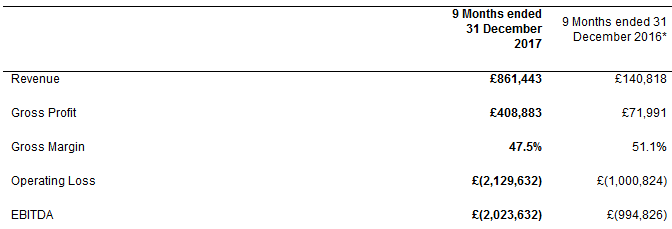
Since the website only went live in September 2016, we might be better off ignoring the column on the right, and treating the left-hand column as the maiden result.
As might be expected, it's in a period of heavy cash burn.
Let's take a look at the most recent KPIs:
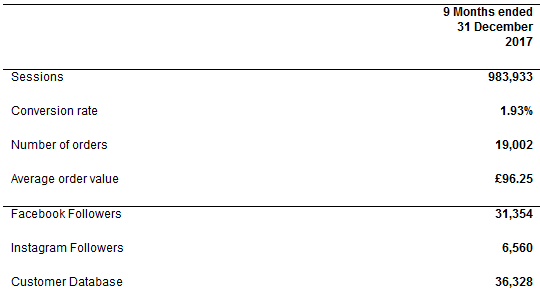
For context, average basket value at ASOS (LON:ASC) is about £72, so Sosandar's £96.25 average basket is significantly bigger, perhaps reflecting the mature client base.
If I crudely divide the revenue from the first table by the number of orders in the second table, I'm left with revenue per order of £45.33, much lower than average order value of £96.25.
This implies that 47% of each order is being booked as revenue. VAT at 20% is probably included within the average order value (and would not be counted within revenue), and the rest of the difference would then be customer returns.
If the ex-VAT value of the order is £80.21, then 56.5% of this is being translated into revenue, i.e. returns are 43.5%. This chimes with the returns rate previously cited by Paul as "almost 44%".
The other KPIs look ok to me. Facebook followers at 31k is impressive. Instagram at 6.5k is less so - there are plenty of Instagram accounts with hundreds of thousands or even millions of followers. Asos has 7 million followers there, while Boohoo has 3.2 million. I suppose this could also be a demographic issue, as mature women are more likely to be on Facebook than Instagram!
Outlook sounds good
...increased momentum has delivered new customers, repeat orders and total revenues ahead of forecast, in particular November 2017 and December 2017 were very strong and this momentum has continued into the first three months of this year. We will continue to invest in our marketing and digital strategy and look forward to further substantial growth."
So why are the shares lower today?
One reason might be the lack of hard numbers in terms of forecasts.
Another more pressing reason might be the escalating costs.
In Dec 2017, Paul shared some broker forecasts with us:
The only forecasts I have are a detailed note from Turner Pope from Aug 2017, which is the broker that floated Sosandar. This shows forecast revs of £1.0m this year 03/2018, rising to £3.3m 03/2019, and £9.4m 03/2020.
PBT is forecast at -£1.9m this year, followed by -£1.4m 03/2019, and a small maiden profit of £0.1m in 03/2020.
Today's nine-month figures show revenue at £861k, well on track to beat £1 million for the 12-month period finishing at the end of this month.
On the other hand, the operating loss after nine months is minus £2.1 million, worse than the £1.9 million pre-tax loss forecast for the full year. So it looks like the full-year result is heading for a significant miss against the original broker forecasts.
The company's cash balance was at £5.3 million at December 2017. It is funded for the short-term, but not indefinitely. If losses continued at the same rate as they have over the past nine months, and assuming the losses fed straight through to cash outflows, the company would run out of funds before the end of calendar year 2019.
Cash needs might be accelerating, however, since presumably the need for additional inventory is only going to grow, along with the marketing spend.
It might succeed in funding its pathway to growth, but this remains to be seen. Gross profits only covered 16% of the overhead expenses during this 9-month period, so a huge amount of additional top-line growth is needed.
Putting it all together, I don't think I'd want to hold this unless I was happy to take part in any additional fundraisings which might be needed to get it to profitability, to avoid the risk of getting diluted. More shareholder support could be needed to see it through to success.
CMC Markets (LON:CMCX)
- Share price: 170.7p (+10%)
- No. of shares: 289 million
- Market cap: £493 million
This is of particular interest to me as I own shares in IG Group (LON:IGG).
Our strong year to date performance has been maintained throughout the final quarter of the year. Net operating income for the second half will be moderately above the first half and significantly above the prior year.
Just like IG, CMC is now oriented towards higher-value clients, and doesn't mind if total active client numbers have to drift lower in order to achieve this.
I'm happy to stay invested in this sector, as most of the revenues are generated by small numbers of active and wealthy clients. These can likely be categorised as "elective professionals" and continue to trade with very little restriction under CFD rules being imposed by the EU's securities regulator.
The small trader will find that he can't trade as before, and it will make it that much harder for new CFD brokers to break into the industry. The competitive position of those firms already established, and I think particularly of IG's position, will only be enhanced.
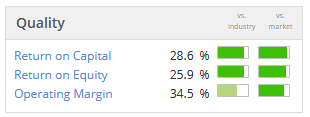
CMC might be a nice investment in its own right, with a StockRank of 88 and superb quality statistics:
Quarto Inc (LON:QRT)
- Share price: 148.5p (-11%)
- No. of shares: 20.4 million
- Market cap: £30 million
This is a US-domiciled publishing company, which qualifies for the same financial risk warning as DFS Furniture (LON:DFS) did yesterday:

Headline annual results are as follows. The company ended the year with $64 million of net debt:
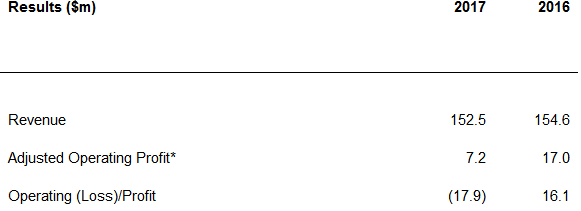
Within 2017, H2 was the better half, revenues up 5.8% versus H2 2016. Carrying this momentum through into 2018 is mentioned as one of the objectives this year, along with strengthening its balance sheet. Dividends have been suspended for the time being, in keeping with this latter objective.
Indeed, the company is very clear about the need to strength its balance sheet. leading me to believe that it will come up with a solution in due course:
It has become clear that the competing pressures of servicing debt, paying dividends, and investing in the core business currently inhibit Quarto's ability to grow by acquisition. The Group is therefore looking at all options to strengthen the balance sheet and will keep all stakeholders updated with its progress.
"All options" must include an equity raise. Shareholders haven't been diluted much in over a decade, so Quarto would still have a much better record in this regard than many other companies.
The going concern statement is very detailed, and includes the disclosure that amendments to the loan covenants have been agreed, to give Quarto extra headroom. This implies a great deal of concern that the covenants at their original levels could be broken.
This part of the report concludes as follows:
"...the Directors continue to adopt the going concern basis in preparing the financial statements. In doing so, it is recognised that such future assessments are subject to a level of uncertainty that increases with time and, therefore, future outcomes cannot be guaranteed or predicted with certainty."
Overall, it's an unusual going concern statement, and it says to me that those who prepared it are very concerned about the company's financial position. Risk of distress may not be imminent, but the position as it stands is unsatisfactory.
Leaving the debt issue to one side for a moment, the overall outlook is mixed. One-third of revenues are from Children's products - children's books are doing well, but other categories are weak. Adult publishing revenues declined by 9%.
I suppose it's also worth mentioning that with more than half of revenues deriving from the US, the recovery in the pound has dented the attraction of USD-denominated income.
Balance sheet - the balance sheet has suffered very large non-cash impairments, so that balance sheet equity has fallen to just $24 million. Liabilities are $159 million.
If you exclude the remaining goodwill and other intangibles not related to the company's standard pre-publication costs, tangible book value is now about zero.
Cash flow - The impairments of intangibles don't affect cash flow, of course. Quarto's cash flow for the year wasn't too bad: $37 million generated from operations before working capital movements, and about $37 million used in investing activities, by my calculations, if you exclude the acquisitions and disposals made in the year.
So I reckon that underlying cash flow is about breakeven, before you consider the effect of interest and taxes.
Conclusion - it looks like quite a good business. It just needs to do an equity raise to eliminate a decent chunk of the debt, focus on its core operations and minimise exceptional costs for the next few years.
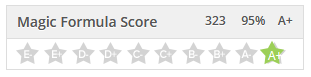
Greenblatt's Magic Formula agrees that this is a fine company and also thinks it is priced cheaply. The only major blind spot this formula has in relation to solvency:
DX (Group) (LON:DX.)
- Share price: 8.33p (+12%)
- No. of shares: 200.5 million
- Market cap: £17 million
A quick word on this logistics business I covered many times last year, at it attempts to stage a turnaround. The senior management team has been entirely refreshed.
It managed to stay afloat in H1 (the six months to December 2017) by issuing £24 million in 8% convertible loan notes to its major shareholder and new directors.
To put the company on a sounder financial footing it proposes to issue 335 million shares at 7.41p, enabling it to redeem these loan notes.
That's a lot of dilution, but existing shareholders were already very vulnerable to dilution, as the loan notes were convertible at 10p (i.e. they could have been converted into an additional 240 million shares).
To further boost the company, it wants to issue another 54 million shares on top, raising £4 million.
So I reckon that the company is headed for about 590 million shares in total, which at the placing price of 7.41p would produce a market cap of £44 million, for a debt-free reincarnation of the company.
Hopefully, this will give the new executives a chance to implement their turnaround plans.
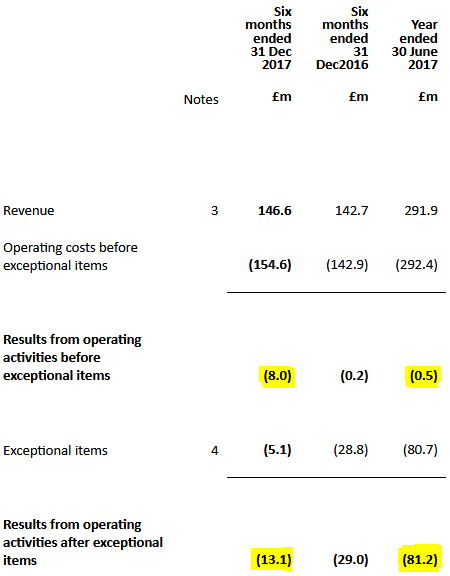
As you can see, the results to this point are highly discouraging. The company has made operating losses for the past eighteen months, even if you exclude exceptional items:
I have no idea if the turnaround will succeed, but hopefully they have a chance:
Trading conditions remain challenging, but we are already seeing encouraging signs that our turnaround plans are gaining traction. Net new business in the past two months at DX Freight has been at a higher monthly level than at any point in the last 12 months. We expect the benefits of our turnaround initiatives to continue to build through the year and into 2019.My consistent stance has been that this stock was uninvestable until it was recapitalised. Assuming that recapitalisation goes ahead, it will become investable again and we can perhaps start to look at it in a more positive light. It might be worth interviewing management to get a better feel for how they plan to fix it.
That's it from me for Q1. Tomorrow afternoon, I fly to Cyprus - less than 200 miles from the Syrian coastline. How exciting.
Paul has been having fun in San Francisco, and will hopefully be back next week with some interesting anecdotes.
Markets are closed tomorrow and on Monday. Have a great Easter weekend.
All the best,
Graham
Disclaimer
This is not financial advice. Our content is intended to be used and must be used for information and education purposes only. Please read our disclaimer and terms and conditions to understand our obligations.

50 comments
After hours announcement from DX (Group) (LON:DX.) confirming they’re raising c.£4.8m gross from a placement of shares at 8.5p (compared to previously indicated 7.41p and market close today of about 9.6p) and cancelling an outstanding loan note issue.
https://www.investegate.co.uk/dx--group--plc/dx-/fundraising-and-loan-note-cancellation/201805031832240982N/?fe=1&utm_source=FE%20Investegate%20Alerts&utm_medium=Email&utm_content=Announcement%20Alert%20Mail&utm_campaign=DX%20(Group)%20PLC%20Alert
Placement and note conversion will take the Gatemore holding to about 36% requiring a waiver from the TOP avoiding the need to make a full offer for the company and also increases the new management team’s skin in the game. Proceeds to strengthen the balance sheet and finance business restructuring. Heavy dilution for legacy shareholders but not much of an alternative. Time will tell if the management can turn it around.
Gus.
Thanks to everyone for all their thoughts on this issue.
RM2 £RM2 I remember looking at this and classing it as a story too far and an ‘other people’s money’ investment, and sure enough Woodford is heading for 68 %, wow. He seems to be in so many bad news stocks at the moment.
Hi - If we were to reverse the clock and look at Conviviality's Stockopedia reports earlier this year what were the warning signs that this train wreck was just around the corner?
Lots of indications that things weren't going well, but none that I can see about the train wreck coming just round the corner.
It will be interesting to looks back once we actually know what happened. We know what they were saying cannot have been true, but don't, I think, yet know what the truth was. Or whether they knew. How easy is it for any company to 'forget' an imminent payment to HMRC that's about half the size of annual profit?
The reports can only go so far - if the company's finance department and its auditors can't spot an incoming £30 million tax bill there's not much chance that anyone external can. When this type of mess happens there's an understandable interest in trying to figure out what the warning signs are but sometimes stuff just happens. We have to rely on a certain level of competence in the managements of listed companies.
For what it's worth the company was close to its leverage covenants and was still paying out dividends which is always a bit of a concern, and would be something I'd regard as a red flag - although I wouldn't invest in any business with this low level of operating margin anyway. And the Z-score indicated caution.
Graham has been consistently bearish on this, too. Too many exceptionals, too much of the profit going to management rather than shareholders - that's usually an indication that the management have a vested interested in boosting the share price.
But was there any indication of the possibility of a total loss of capital? No, I don't think so.
timarr
Timarr
Re Conviviality (LON:CVR) I don't think that monitoring tax payment dates during the course of the year is really part of the audit process. This is fairly an squarely a company finance matter.
Difficult to disagree with anything else you say though
Hi Timarr
I was just wondering if theres any chance of you giving us less experienced investors a brief overview on the stats you look at on Stocko when viewing a new stock for first time, one of the first things I view is average shares in issue if that number is increasing like confetti that ends it for me.
Be interesting to get your take if you have time as get impression your someone who knows his way round some red flag quick wins.
Thanks in advance no worries if its to much of a ball ache.
Hi Clarea
The first thing is to decide what sort of investor you are. I want to hold long term and so I’m looking for quality companies, preferably at a reasonable price. If I were looking for something else then I’d probably look at other metrics. So, firstly, I want profitable companies – I don’t invest in anything loss making. Obviously, I miss out on some wonder stocks at an early stage, but the chances of finding them are tiny and more importantly I miss out on a lot of rubbish.
I don’t want to pay huge amounts so I first look at P/E and P/FCF. Other people prefer PEG or P/S, but generally the aim to figure out whether a share is expensive or not. I don’t want to pay stupid multiples, but as I’m buying good companies I rarely expect them to be cheap. For instance, I bought Softcat (LON:SCT) in October 2016 on a P/E of 16.5 (moderately expensive) and a P/FCF of 11.7 (cheap). Now we’re looking at 27.6 and 33.3 – expensive.
Then, given my focus, my next port of call is the quality metrics – Return on Capital, Return on Equity and Operating Margin (or ROCE). Ideally I want a minimum 10% on all of these - companies with these sorts of figures have some kind of competitive advantage, which should allow them to continue to make similar figures. If you’re a long term holder this is where your research pays off, to figure out whether their moat is temporary or permanent. Again, looking at Softcat, their ROC and ROE were outstanding in October 2016 (54% and 40%) but Op margin was under 6%. I decided to invest anyway because they clearly have outstanding account management and are riding a technology refresh wave, but I don’t see any long term moat.
I then look at free cashflow and compare it to operating cashflow, and scan back across the years. Cashflow is hard to fiddle with and good companies throw off cash. FCF can vary for many reasons but it should be positive and, on average, a decent percentage of operating cashflow. Another way of putting that is that I dislike companies with large capex – it suggests they have to spend a lot to stand still. All things being equal you want a company that can make money without spending much – one reason why franchise operations are always worth considering. Again, with Softcat nearly all the operating cashflow drops through to FCF – their capex is low primarily because they’re hosting their customers’ technology or using cloud based platforms rather than paying for it themselves. Unsurprisingly they keep popping out special dividends, which is nice.
I then look at gearing – debt is always interesting. A company with net cash is safer, but potentially isn’t investing or returning as much as it could. However, I don’t want massive amounts of debt, so I generally want gearing to be well below 50%. In fact most of my holdings have net cash. Obviously Softcat does. Some companies with lots of cash tend to look for acquisitions but all things being equal organic growth is preferred, acquisitions can and do go wrong.
If the above stacks up then I’m definitely interested. You’re right that the average number of shares in issue is an interesting metric. I can’t say I ever look at it but I probably should. Generally companies that issue equity are diluting their existing shareholders, which isn’t usually a good thing unless the deals they’re doing are extremely good. Equally if the shares in issue are reducing then that implies a buyback – and that needs to be looked at carefully, because most companies exercise buybacks in the interest of the management, not in favour of shareholders.
You should also glance at the F-Score and the Z-Score. Given the metrics above these are very rarely concerning, to the point I usually neglect to look at them. But they’re good measures of company sustainability. Above all we want to avoid a total loss of capital of the type that’s afflicted Conviviality. No matter how far a share has fallen it can still fall another 100% (I still have my Marconi share certificate to remind me ...).
Other types of investor would look at other stuff – value investors would be interested in book value and yield for instance. It’s not something I generally care about unless we’re in a massive bear market, and then opportunities crop up to invest in near quality stocks at bargain prices. In 2008 I remember buying Fyffes at a stonking discount to net current assets and getting a huge return over the next 5 years. And momentum investors would be interesting in relative strength, etc.
Oh, and I usually try and find out who the major shareholders are. If there’s a major stake held by a single, non-institutional party then I want to find out something about them. Having management with real money in the game is good but you do find companies controlled by external parties and quite often they’re run for the benefit of those parties, not for shareholders.
I can and do invest initially based on the above approach. I often need the kick of ownership to investigate further – and sometimes when I do I decide I don’t like what I see and divest. So I actually buy and sell quite a lot for someone who is a buy and hold investor. But the things I like I usually end up holding for a long time and with quality companies good things tend to happen - I've seen bids for Fidessa (LON:FDSA) and NEX (LON:NXG) both held since 2012, in the last few weeks.
I’m also intolerant of surprises on the downside – unexpected profit warnings usually trigger an immediate sale. But I don’t do stop losses, I’d rather lose a bit more by handling a sale manually than be stopped out of a great company due to a technical blip. And above all, if you’re convinced you want to own a stake don’t be put off for a few pence one way or another. If you’re right then that’ll end up as noise and if you’re wrong then it’ll hardly matter.
But investing and risk is always a personal thing, and people should develop their own processes and tolerances based upon their stage of life, assets and ability to accept risk. Following other people thoughtlessly is a one way ticket to some very bad investing experiences, because we’re all different.
Good luck!
timarr
Excellent post timarr. Many similarities with my own approach and some useful checks for any fundamental investor.
Timar - Yes a great investing summary on one page of A4! I am reminded of Frank Sinatra's song, "I did it my way".
I am sure there is a huge body of collective wisdom and successful styles in the Stockopedia membership, from which young beginners and old owls would benefit greatly. Its a shame that there is no mechanism to disseminate this I did it my way information more easily. Ian
Great stuff Timaar
Out of interest how many stocks do you hold in your portfolio on average and do you obtain your entire line at the start or scale in as the price moves up ?
Kind Regards
Hi clarea
Out of interest how many stocks do you hold in your portfolio on average and do you obtain your entire line at the start or scale in as the price moves up ?
Currently I hold about 95 positions - and, yes, I know all about diworsification ... On the other hand I've beaten the market, however you define it, in 16 out of the last 17 years, so it works for me. Stockopedia is a boon, however, as it allows me to set automated alerts.As for average position size, well as you'd imagine it's probably a lot smaller than many around here take: I'm highly risk adverse, and regard diversification as the only free lunch the market offers. Given the relatively small positions I take I normally buy a full tranche at the outset but occasionally increasing familiarity with a company will prompt me to add to the position - I did this with Burford Capital (LON:BUR) and Bioventix (LON:BVXP) which worked out rather nicely :)
However, the broad diversification also allows me to ride out the dips with relative equanimity. No big company ever got big without blips along the way. Psychologically it's much easier to keep on holding a stock when it's only a relatively small part of your total capital.
Also in the event of a general market downturn I'll quite often top-up existing positions where I think they're offering value. Buying more of what you know when uncertainty is rife is a relatively safe thing to do.
timarr
Thanks again Timarr,
Blimey 95 positions do you trade full time and hold things such as OEICS and Investment Trusts within your portfolio ?
Also with reference to the price to free cash flow ratio what figure would you put at the top end of this ratio before you would be put off investing into a stock, I've noticed a few other sharp posters mention the ratio on here and its not one i've paid to much attention to in the past but clearly need to.
Again thanks for taking the time out to answer.
There is a great community on here and it seems to be one of the few sites where it would appear sharp operators outnumber the novices which doesn't happen on the likes of advfn.
Its good to learn at a higher level from some really top level posters such as,yourself, Orange Tree, Damion, Gus, Mr Contrarion and Matylada to name but a few.
Kind Regards
Andy
Hi Andy
Blimey 95 positions do you trade full time and hold things such as OEICS and Investment Trusts within your portfolio ?
Nope, I have a very full time job and equally full time life. It helps to have a buy and hold mentality, and I normally only get active during a market downturn. I hold a couple of mining IT's, a few PE funds and a couple of preference shares, but otherwise it's just normal shares. I skim the RNS's most mornings and do a few hours research most weekends, but that's about it.
P/FCF I treat like exactly like P/E. The thing to really look for is a big discrepancy between P/FCF and P/E - and then you need to figure out why FCF is hugely different than earnings. Remember: earnings are fiction, cashflow is fact :)
timarr
Thanks again, I will stop badgering you now and let you enjoy what's left of the bank hol weekend truly awful weather this part of the country seems to have been six months of snow and rain.
Appreciate you sharing some really good information.
Regards
Andy
I don't think I've ever seen anything escalate this quickly before.
A £30m tax bill to a company of this size should not have been fatal, however the key words in the company's statements a couple of weeks back were: "the Company is fully drawn under its term loans and revolving credit facility". No wiggle space. That with the very short time frame involved, March 30th, ( HMRC are not known for their patience), meant a drama rapidly became a crisis.
It's still unclear has this then escalated to a requirement for £125m. £125m!! for 'overdue payments to creditors and additional capital' - this does not give sufficient explanation, no wonder shareholders were not forthcoming, what chance have you got of of raising that in a hurry just before Easter and the directors risk prosecution if they continue to trade while insolvent.The almost immediate suspension also left no exit for shareholders, the final insult. As Paul says total incompetency, but not just in overlooking the £30m tax bill, but sailing the company so close to the wind in terms of cash liquidity that it was wide open to what Rummy would call ' a known unknown'.
It's no consolation to shareholders but the vultures will probably do quite well picking over the remnants. There may however be some pressing issues for Revolution Bars to resolve too.
I haven't looked at Quarto Inc (LON:QRT) before (and based on Graham's useful as ever write up I don't feel an urgent need) , but was interested in comments on the balance sheet - which clearly is an issue.
Graham said :
[My bolding]
Which sounds quite sensible, but what the company said was slightly different :
[Again my bolding].
Given the mention of significant impairments of intangibles, I'm not sure I would be too impressed with a fund raise primarily focused around allowing them to acquire more overpriced companies. They didn't offer the pretence of replacing "grow by acquisition" with "add value through strategic acquisitions".
Not for me on this reading and that's useful research time saved, thanks again Graham.
Enjoy your holiday Graham.Well deserved after your quality hard work this week.
Sosandar (LON:SOS)
Can one of you more experienced balance sheet readers explain this to a simpleton? 19000 customers spend 96.25 ea.
£1.828M in sales.
Revenues are 860K.
What happened to nearly £1M?
Is it all returns, or is the £860K pre-vat (which would mean there's still a lot of returns ~ 45%). If it is all returns that's over 50% return rate - is that sustainable?!
£860k over 9 months, so it looks like full year will exceed management expectations of £1m.
I noticed that too. If it is returns then, wow.
Regards your question about Sosandar (LON:SOS) I think its something like
£1.828M incl. VAT
£1.46M excl. VAT
£0.86M revenue (excl. VAT)
implies returns of about 41% which for online fashion returns is quite normal, I think Paul mentioned that on average its about 40% for others (boo, asos etc)
Hi IGPJ, re: Sosandar (LON:SOS)
I had a crack at figuring that out, before I saw your comment - very important question.
G
I think this is symptomatic of a growing online trend towards buying clothes, trying them on (your bedroom is the fitting room!), then sending back anything that doesn't fit/look right. My wife has done exactly this on the Sosandar (LON:SOS) website. It kind of makes sense, companies like Sosandar (LON:SOS) don't have stores, and being so new customers have no idea what the pictured item will actually look like on them. Sosandar (LON:SOS) also made it very easy with free delivery and free return - a sure fire way to encourage people to do this!
My view is that we will see high return rates like this for online companies that have no stores or a shrinking estate. Really its how well these companies turn their stock around to limit the time spend in transit/storage before it is available to be bought by the next customer. IMHO this will be the emerging challenge for online retailers, with the ones that cope best succeeding in this brave new world.
Thanks for replying.
What’s your wife’s verdict on the clothes? :)
On the basis of the old adages 'every cloud has a silver lining' or 'never waste a good crisis' there must be some companies set to benefit from the Conviviality (LON:CVR) debacle, but none spring immediately to mind.
jonno,
Majestic Wine (LON:WINE) should benefit from Conviviality (LON:CVR) 's collapse, at least at the margins. I bought £EZY immediately after the collapse of Monarch etc. and the shares / business did well with this subsequently being explained by less competition. However, when I looked into it Majestic Wine (LON:WINE) didn't really appeal to me.
Majestic Wine (LON:WINE) could be a big winner from Conviviality (LON:CVR) administration.
They have a (small) commercial distribution arm.
Their retail footprint will benefit from less competition on the high street.
Plus they could very well pick up a few bits of CVR that are cheap.
A pity that Majestic were already on what I considered a punchy PE ratio, otherwise I would jump in and buy a few shares today.
Quarto Inc (LON:QRT)
Simple view: either there’s a bid at this price or the shares are heading towards zero.
There are now two large holders of equity that have historic connections to business. If one is particularly keen maybe they bid here. If they are cold eye rational they wait for the price to fall precipitously and buy close to zero saving the rest of their money for debt repayment. Even better, wait for adminstrators and bid for what they like and not make whole the debt.
The tells that this is endgame time
1) big write down of US intangibles means back book free cash flows much less going forward
2) Adjusting for working capital op cash flows are negative (ie before servicing debt)
3) company must invest more in prepublication costs particularly given children’s books are more front year biased but it’s down a little this year (a hint that struggling to find enough of it)
Foretold here: https://www.stockopedia.com/content/updated-quarto-financial-noose-chokes-good-operational-advances-in-publishing-188339/
Conviviality (LON:CVR) a case of proper p1$$up at the brewery
wow what a staggering fall from grace for conviviality, from 4 pounds to suspension, to administration and little or no value for the share holders, incredible incompetence by the management. It's clear now that it wasn't just the tax bill, surely, the company could have come to an arrangement with the tax man about this ? paying some interest, but to need £125M to continue ? Surely this will end up in legal cases against the directors, who knew what when I wonder ?
K
Conviviality (LON:CVR)
Surely this will end up in legal cases against the directors, who knew what when I wonder ?
Not us, yet, that's for sure
Another impressive RNS from ITM Power (LON:ITM) this for those interested in the hydrogen sector.
Whilst not a commitment, an order off the back of the study could double current opportunity pipeline.
Sosandar (LON:SOS)
My take on the figures
Disappointed with the widening operating losses - from £1m to £2m. More than I expected. However, it does have almost 2 years of cash if the burn rate remains the same.
The revenue growth is good, but I feel management talked it up in previous RNSs. They should beat the £1m revenue by March that they forecast but maybe not by as much as I thought they would.
KPI metrics are pretty good.
Conversion rate is slightly low at 1.9% but is heading in the right direction (was 0.8%, BooHoo is between 3.5% and 4.5%). I think this will improve as the product lines widen and the online marketing is refined.
Avg. basket size is good at £96. BooHoo is about £35.
Margin 47%, BooHoo is 54%
It seems like the market is disappointed. I get that because of the widening losses, but for what is a total start-up I feel they are showing some traction and have bought more this morning.
In reality they will need to raise money ahead of cash falling to a low level. So in a year's time we could be down £4m and have £1m left. So they will probably need to raise more cash in less than a year.
Sosandar (LON:SOS) is just very very early stage. Yes this is a startup and we should reflect on that. However, £801k revenue in six months is pathetic. It is a startup with an incredible long distance to go. I was suspicious that they bought this to the market despite its very early stage of development.
I think the concept may be flawed. The demographic they are targeting is probably content to buy online clothes from the major retailers. They may not have a need for an online only retailer. They are also probably more likely to shop in the stores. I am just not sure whether Sosandar (LON:SOS) can make this work. We shall see.
The figures are for 9 months not 6.... so this means the costs are better than you are thinking, but the revenue is worse!
Burning through £4m would take a year and a half and assumes no revenue growth to offset it.
I am heartened by the basket size and improved conversion rate and 10 fold increase in the customer database which leads me to believe the concept is sound, but agree it's very early stage so it can still go either way.
Re Sosandar
It feels to me like the company has listed too early, probably on the advice of its NOMAD in order to capitalise on.BooHoos pretty astronomic valuation at the time (75x PE). The trouble with comparing Sosandar with Boo is that Boo was profitable at time of IPO. The management had been in the retail industry, albeit as a supplier, for a long time prior to establishing BOO. So they had a track record and profits. Sosandars website only went live on Oct 16. So they are newbies. Also cash burn looks heavy at £2m in H1. With £5m in the bank that gives just over a years runway. These fashion businesses are all about marketing and so I can’t see profitability soon. Therefore another fund raise seems very likely in my opinion.
Someone made the connection between DPP and Sosandar. Fair point. I am still waiting for my DPP to break into profitability and although I have made money on the investment I would have done better by investing in a cash generative small cap. So it’s oppotunity cost. My lesson here is to stand aside until it starts to generate profits.
Extensive announcement from DX (Group) (LON:DX.) this morning accompanying their interims.
https://www.investegate.co.uk/dx--group--plc--dx--/rns/interim-results/201803290700083285J/
Results themselves are pretty lack lustre, but for any residual long suffering holders (I tried to catch the falling knife a few years back and am still bleeding), I wonder if there is perhaps the first sprout of a possible green shoot in sight under the re-vamped management. They appear to be getting a workable strategy in place to deal with numerous legacy issues and the capital restructuring announced today with the support (and probable engineering by) principal shareholder Hargreaves Hale makes sense. Indeed, given the bind the company has been in, it makes a pleasant change that the equity placement is being done at the current market price rather than on a more typical heavily discounted and dilutive basis. A very long journey still ahead and much of the upside of any recovery has already been ransomed to the new management but for the first time in a while there might be grounds for some muted optimism .... maybe.
Gus.
Hi Gus,
I am an ex-holder in £DX I didn't come out with too bad of a capital loss, and got a chunky interim dividend to compensate.
Whilst this site is all about DYOR, your last sentence above tells you all you need to know about your continued investment in the company. If that is the most positive spin that can be put on the near future of the company, you have to seriously consider just getting rid of it and moving on. There are countless other good companies out there on which you can make a start recouping this loss.
I started to cut losing shares after reading the Naked Trader's first book, and then going to one of his seminars, and I haven't looked back since. It's saved me from getting properly burnt on some shares which just continue to go down, including £DX , improved my overall returns materially, but best of all is that you don't have that dispiriting experience of looking at these whopping great big red percentage losses each morning when you check your portfolio. For that alone it's worth doing.
I hope this comes across as friendly advice, rather than anything else, as that's the spirit in which it's intended.
Have a great Easter weekend everyone.
Chris
Hi Chris.
Thanks for your comments. Received very much in the helpful spirit in which they were intended.
I have a “special” home in my investments for fallen angels that I keep as a reminder to exercise discipline with the rest of my portfolio. Most, like DX (Group) (LON:DX.) , are dogs and will probably remain dogs although one or two have multi bagged sufficient to keep the (small) value in this mad money section at about breakeven. A bit like the occasional “fat Friday”, I find this relatively small indulgence helps keep everything else on the straight and narrow.
All the best,
Gus.
(p.s. edit to the original post, the principal shareholder backing the equity placement in DX (Group) (LON:DX.) is Gatemore not Hargreaves Hale. Mixing my DX (Group) (LON:DX.) up with my Satellite Solutions Worldwide (LON:SAT) !)
DX (Group) (LON:DX.)
Best of luck with it Gus, it's too early to tell but where there is hope.... that was a nice reply by Chris, too.
Graham
I don't know if you would be interested in looking at £C4XD Graham. It announced a deal with Indivior (LON:INDV) this morning with an initial up-front payment of £10m and potential milestones of £284m. Not bad for a company with a market value of £25m prior to the announcement! The £10m only adds around 25p to the shares which are up 150% this morning. But this looks to be a genuine opportunity in the area of addiction treatment.
Thanks for highlighting C4XD mammyoko. Those payments are in $ not £ but it still seems like enormous potential.
Re £C4XD . Thanks JohnEustace, I hadn't spotted that!
Graham (et all) - I know it's a reasonably busy day but if you get a chance, perhaps over the long weekend to give any kind of input here - https://www.stockopedia.com/content/statutory-reported-basic-underlying-and-adjusted-347043/
It would be much appreciated.
Wishing you and all others who celebrate, a great Easter.
Sosandar (LON:SOS)
Don't suppose Paul would forgive if this wasn't mentioned today.
Looks like they'll beat their FY 31/3/18 sales forecast of £1m and are making positive noises. Not really qualified to comment further.
Phil
Sosandar (LON:SOS) I think they will of course highlight revenue growth. Looking at the numbers though and this is a massively loss making business. £2m loss in six months and £5m cash left. In my view, this just listed too early on. Probably they had no other sources of funding. This looks like it could be a DP Poland given the likely need to constantly raise money.
It is not clear if Sosandar (LON:SOS) will find a niche in fashion retail for its demographic. I just can't see how the risk/reward ratio stacks up here.
Hi Phil - yep, I'm taking a look at Sosandar (LON:SOS) now. Thanks for the suggestion.
My morning smallcap tweet:
Aukett Swanke (LON:AUK), Intercede (LON:IGP)
Aukett Swanke Group (AUK) AGM stmt "...we continue to anticipate that 2018 overall will be loss making, particularly in the UK. We expect a larger loss in the first half compared to last year, followed by a profit in the second half." In Jan they said unlikely to be profitable in the 2018.
Intercede Group (IGP) Founder resigns as Chairman & CEO, becomes NED with immediate effect.