Small Cap Value Report (Tue 12 Oct 2021) - CLX, OTMP, MNO, FCCN, DLAR

Good morning, it's Paul & Jack here, with the SCVR for Tuesday.
Today's report is now finished.
Agenda -
Paul's Section:
Onthemarket (LON:OTMP) (I hold) - solid interims, although the profit comes mainly from adjustments. Balance sheet, and cash position look fine. Good recovery from last year's downturn, with H1 revenues up 46%, and profits ahead of expectations. I see speculative upside here. It's a bit of a special situation, not a value share.
French Connection (LON:FCCN) - a final look at this company, now the recommended bid at 30p looks likely to happen. I've sold out at 29p, since in my view a higher competing bid is unlikely. Figures are academic now, but aren't too bad - a small underlying loss, helped by taxpayer support measures. FRC investigation is unhelpful, but doesn't seem to have put off the bidders. I wouldn't want to hold for 1p more, with that risk hanging over me.
De La Rue (LON:DLAR) - in line with expectations trading update, for both profits and net debt. Looks cheap, but beware the enormous agreed cash outflows to address the pension scheme deficit.
Jack's section:
Calnex Solutions (LON:CLX) - comes across as a classy operator with a sustainable growth opportunity supported by several underlying trends. The valuation looks high in the short term, but it is worth considering the longer term growth prospects here.
Maestrano (LON:MNO) - provides rail networks with an automated railway inspection solution. The company is winning new clients but has still yet to turn a profit. Management expects to reach cash flow breakeven in the next six months, so it could be worth monitoring, but it's still early days for this risky micro cap.
Explanatory notes -
A quick reminder that we don’t recommend any stocks. We aim to cover trading updates & results of the day and offer our opinions on them as possible candidates for further research if they interest you. Our opinions will sometimes turn out to be right, and sometimes wrong, because it's anybody's guess what direction market sentiment will take & nobody can predict the future with certainty. We are analysing the company fundamentals, not trying to predict market sentiment.
We stick to companies that have issued news on the day, with market caps up to about £700m. We avoid the smallest, and most speculative companies, and also avoid a few specialist sectors (e.g. natural resources, pharma/biotech).
A key assumption is that readers DYOR (do your own research), and make your own investment decisions. Reader comments are welcomed - please be civil, rational, and include the company name/ticker, otherwise people won't necessarily know what company you are referring to.
Paul’s Section:
Onthemarket (LON:OTMP) (I hold)
92p (pre market open) - mkt cap £68m
OnTheMarket plc (AIM: OTMP), the majority agent-owned company which operates the OnTheMarket.com property portal, today announces its unaudited interim results for the six months ended 31 July 2021
STRONG GROWTH AND STRATEGIC PROGRESS DRIVING PERFORMANCE AHEAD OF EXPECTATIONS
This is the UK’s 3rd residential property portal, behind market leader Rightmove (LON:RMV) and privately owned Zoopla (bought out in a £2.2bn deal in 2018, by some crazy Yanks, Silver Lake - venture capitalists).
At this early stage, I’ve only quickly skimmed through the numbers, and the outlook comments, I’ll read all the detailed commentary later, on the train up to London (assuming the train’s wifi works, which it usually doesn’t, and nothing works [not even normal phone calls] between the New Forest and Winchester, apart from a brief burst of connectivity in Southampton. What sort of backwater is this country, as I keep demanding from my MP via the handy WriteToThem website?!).
Key points -
H1 revenue up 46% to £14.9m - helped by soft prior year comparative, but it’s a strong rebound.
Impressive adj operating profit of £2.1m, although this strips out £1.2m of share-based recruitment charges (free shares for estate agents that sign long-term contracts, with a lock-in on the shares)
Net cash of £9.9m, down a little from £10.7m a year earlier - no risk of insolvency in my view, especially as we saw during the pandemic how OTMP can slash its mostly variable costs in a downturn.
Statutory (i.e. not adjusted) profit before tax is breakeven, at £45k. There’s a tax credit though, so PAT (profit after tax) is £485k. That’s fine, it’s a growth company, so I don’t expect, or particularly want, profits at this stage.
Zeus note - useful, many thanks. Zeus tends to be supportive, and provides the upside case.
Balance sheet - is OK, with NTAV at £7.7m. Note there is £2.1m in deferred consideration, which could dent the £9.9m cash pile.
Dilution risk as things stand is low. However, there could be dilution if the company decides to accelerate marketing spending in future.
Outlook - this is encouraging, and I’m relieved the new CEO is not blowing the cash pile on more lousy TV ads, which is what happened in the past -
After a positive first 6 months, the Board now anticipates revenues to be slightly ahead of expectations and adjusted operating profit to be substantially ahead of expectations for the full year to 31 January 2022.
Although instructions are subdued, which sounds like it might have read-across to other property related businesses, like estate agents, possibly?
Demand for residential properties in the UK has remained at very high levels, however sales and lettings instructions remain subdued.
Marketing spend is being increased in H2, so breakeven for H2 -
Full-year advertising expenditure is expected to be H2 21/22 weighted, with the rollout of a refreshed brand and website...
This increased marketing investment is expected to result in H2 21/22 adjusted operating profit being approximately breakeven.
“Encouraging pipeline” of new commercial arrangements - vague, but sounds interesting.
Webinar - on InvestorMeetCompany at 18:00 on 19 October. I thought the unfeasibly young-looking CEO came across very well on the last webinar. He’s spent his whole career in estate agency, so knows his stuff. I think the strategy is sensible. It’s working so far too, in that the company is not generating losses, or significant cash burn, which is the main battle with challenger companies like this.
My opinion - I see OTMP as a special situation. It’s difficult to value on current performance, but the potential upside could be seriously large if it achieves a step change in growth, and becomes a serious challenger to Rightmove and Zoopla. It’s already got a lot of agents signed up, initially on free, but now mostly paying contracts. OTMP is very much cheaper than price-gouging Rightmove (LON:RMV)
The key challenge, not yet achieved, is for OTMP to work out how to drive enough customer traffic to its website.
Remember that overheads are flexible, so to some extent the company can dial up whatever profit/loss it wants, within a range, by flexing marketing spend. Therefore I’m happy as long as it’s at breakeven or better.
I like OTMP as an each-way bet. It’s profitable, and not burning cash to speak of. Therefore, the downside is quite well protected. Meanwhile, the potential upside could be very large, if the upside case plays out. Or it might be modest, if the company grows more slowly. Or it could fizzle out slowly over time. Time will tell, nobody knows what the future holds.
Hence risk:reward looks intriguing to me, at £68m market cap, because the upside case could be a serious multibagger, but I don't know how likely that is.
In terms of investor sentiment, ignoring the pandemic blip below, it’s established a base around 100p, which has held for about 3 years now, with a backdrop of improving fundamentals. That might attract momentum buyers, if it breaks out to the upside, possibly?
.

.
French Connection (LON:FCCN) (I do not hold any more)
29p (unchanged today) - mkt cap £28m
French Connection Group PLC ("French Connection", the "Company" or the "Group") today announces results for the six-month period ending 31 July 2021.
I’ll keep this brief, because there’s a recommended 30p cash bid currently in progress.
I sold my shares recently, and was required to issue a form 8.3, because I’d accidentally gone just over 1% before bid talks were announced. The Takeover Panel, and the RNS service were incredibly helpful in holding my hand through the process of issuing the forms required. So if you end up in that situation, it’s nothing to worry about, just ring them up and ask for help, which is readily forthcoming I found. It’s rather amusing, seeing my name on the list of company announcements!
It seemed to me that, with the share price at 29p, there’s only 1p extra upside to be had. I was happy to give that to someone else, because I reckon the chances of a higher competing bid are probably between very unlikely, and zero. The company’s been up for sale for such a long time, then surely anyone interested would have got involved by now?
Also, recent news of an FRC investigation into its accounts could increase the risk of the takeover bid falling through, so risk:reward looks negative to me now at 29p.
The interim numbers don’t look too bad at all, although remember business rates relief is a really big benefit to multi-site companies at the moment. You have to add that back in, when doing estimates of future performance.
Wholesale & licensing look OK (that’s the value in the business).
Balance sheet - is still OK, despite many years of losses, plus the chaos of the pandemic. This is a really important point to reinforce. The reason FCCN survived, and is giving shareholders a solvent exit, is because it had such a strong balance sheet. This enabled the company to keep trading, slowly dispose of loss-making sites on lease expiry, and come out the other side of the pandemic. Many supposedly better competitors (e.g. Topshop, Debenhams, etc) went bust. Why? Ruinous lease liabilities, and weak balance sheets, plundered by greedy owners in the good times (Philip Green & private equity, respectively).
Also of course, the shift online has killed off a lot of the High Street, and often ignored is the stellar growth of Primark - under-cutting the higher margin competition.
The 30p take out price is not great, but it’s adequate in the circumstances. It would have been a lot higher, if it hadn’t been for the damage done by the pandemic, so I think that does partially vindicate the original bull argument on this share (at least in the last couple of years anyway). Anyway, bottom line, I made a nice profit on FCCN, which has helped mop up some of the paper losses on Boohoo (LON:BOO) and Asos (LON:ASC) (both of which I hold).
There’s not really a lot else to say. Would I kick myself if a higher competing bid does come along? No, because I’ve made a rational decision to sell at 29p, based on risk:reward carefully thought through. If a surprise happens that could not have been foreseen, then that doesn’t in any way undermine the decision. We have to just act logically at all times, based on our assessment of the situation, and then accept the consequences, whatever they are.
I can’t tell you what a relief it is, to draw a line under FCCN, with a fairly decent outcome too. I’m sure readers will also be relieved to not have to read effectively the same article about FCCN from me, every time it reports numbers! Good luck to the new owners, I hope they make a success of the business, now the founder is finally retiring, after a stint of almost 50 years. Hopefully he'll write his memoirs, which I'm sure would be an interesting yarn.
.
De La Rue (LON:DLAR)
168p (up 1% at 12:26) - mkt cap £329m
Here’s the whole thing, as it’s concise -
De La Rue plc (LSE: DLAR) ("De La Rue", or "the Company") today announces a trading update for the six months ended 25 September 2021.
Trading in both our Currency and Authentication divisions for the first half has been positive, with our Turnaround Plan and cost reduction activities continuing to strengthen the Company's performance versus the similar period in financial years 2019/20 and 2020/21. The outlook for the financial year 2021/22 continues to be in line with the Board's expectations.
Net debt at the half year was lower than expected, and less than at the end of the financial year 2020/21. This was as a result of both the phasing of capital expenditure and strong cash collections. The outlook for net debt for the full year is in line with the Board's expectations.
De La Rue expects to announce its results for the six months ended 25 September 2021 on 24 November 2021.
There’s not really much to say about that. In line with expectations for both trading, and net debt.
Here are my notes on the accounts for FY 03/2021.
To recap, DLAR is an excellent turnaround situation, but the agreed pension scheme cash outflows are absolutely huge. Therefore, this is why the shares look good value, on a forward PER of just 9.2 - it’s because a lot of the cashflows will be sucked out into the pension scheme. That’s the biggest issue in terms of valuing the share. It also means divis are not likely to be as large as you would expect from a low PER company, because the pension scheme has priority for free cashflow.
I don’t have a strong view either way. Given that the turnaround is proceeding as planned, at some stage there could be more upside on the share price, who knows? The upside case would be if pension scheme recovery payments are able to be renegotiated downwards in some way.
A PER sub-10 does seem to factor in a lot of downside, so it could be worth a deeper dive, if you understand pension scheme accounting properly. On balance therefore, I'm tilting towards being more positive than negative on DLAR shares.
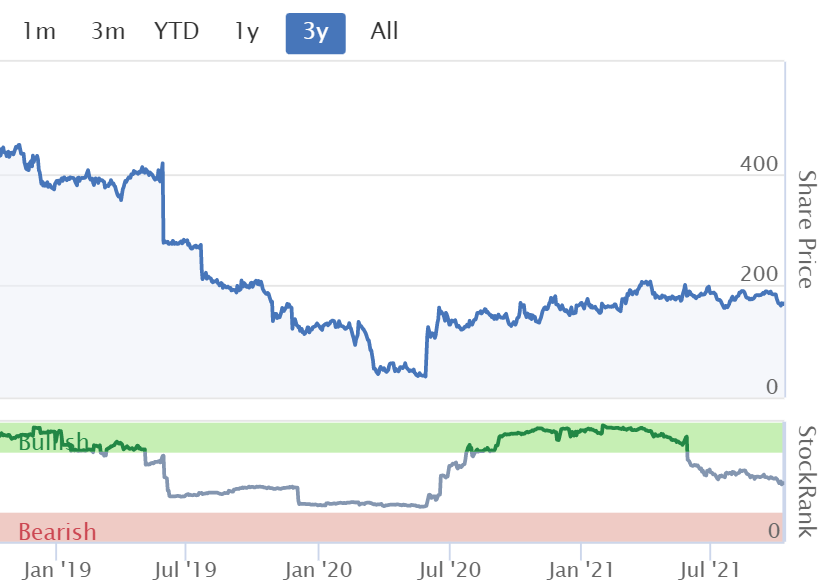
Note also that the share count rose a lot in the refinancing, increasing from 114m to 195m, which has to be taken into account when looking at the chart - i.e. it's not likely to recover fully to the previous highs per share, as there are many more in issue now.
.
Jack’s section
Calnex Solutions (LON:CLX)
Share price: 127p (+10.92%)
Shares in issue: 87,500,000
Market cap: £111.1m
Calnex makes hardware and software solutions that test the performance of critical telecoms and data network infrastructure. This is an essential task for telecoms operators and there is increasing demand for it, with major drivers including 5G, the Internet of Things, and cloud computing. Calnex is well placed with a good reputation and a strong market position.
The shares rerated strongly after IPO, more than doubling in short order. Performance since then has been more muted just above the 100p level, but it’s interesting to note that the StockRank has recently been improving at these elevated levels.

The Board is pleased to report that the Group has experienced continued strong levels of trading in the first half of the year and expects this trend to continue through the second half of the year. As a result of the strong performance the Board anticipates that revenue and profits for the full year will be materially ahead of previous expectations.
A strong cash position has allowed Calnex to bring forward planned investment in the team to increase operational capability, in line with order growth.
The group has seen a return to pre-COVID customer spending patterns in all regions, except for China where demand has been in line with the previous year. There has been ‘a sustained positive response to the launch of the enhanced Paragon-Neo’, which is Calnex's Lab Sync Platform. This is being adopted both by existing customers and new customers looking to deliver products addressing the new O-RAN standards.
The new version of Sentinel has also seen strong uptake from hyperscale enterprise customers who are investing in their datacentre operations.
Calnex has not experienced any negative impact from the ongoing global semiconductor shortage to date on the ability to manufacture and ship product, ‘although the Board continues to monitor the situation closely.’
Tommy Cook, Chief Executive Officer and founder of Calnex, said:
Whilst we remain cautious with regards to the ongoing global semiconductor shortages, the strength in customer orders in the first half of the year provides us with confidence that the full year revenue and profits will exceed that of the record prior year and mark another considerable step forward for Calnex, as we continue to capitalise on the industry's transitions to 5G and the growth of cloud computing.
Conclusion
Calnex is successfully delivering on its growth strategy and it is supported by several long term market growth drivers in the telecoms market. It has a strong position in this market and an opportunity for sustainable, profitable growth with its founder at the helm.
There’s no doubt the shares look expensive at present but a premium is probably justified owing to the positives above and the current trading.

Gross margins are high and the company has the cash generation to invest in growth initiatives. Meanwhile, its relationships with customers mean it is well placed to anticipate future needs, which should further entrench its market position over time.
A key short term risk is potential future disruption resulting from the semiconductor shortage, but this has so far been avoided. And at these levels, there is always scope for the share price to drift downwards should some investors be tempted to take short term profits. If there are any pauses in year-on-year growth over the medium term, that could also lead to some selling due to the high earnings multiple.
The dynamics are favourable here though so it’s probably worth thinking more in terms of where the company might be in five years’ time than, rather than today’s P/E ratio.
More detail will be provided in the group's results for the six months ended 30 September 2021 on 23 November 2021.
Maestrano (LON:MNO)
Share price: 13.8p (-3.16%)
Shares in issue: 170,177,186
Market cap: £23.5m
This is a serial loss maker that has burning cash for many years now, with losses forecast to continue.


These kinds of speculative companies that require ongoing funding can make it big, but I suspect this is statistically less likely than the alternative (losses for longer than expected and additional equity dilution, potentially at lower share prices), and so caution is required.
So far, Maestrano’s share count since listing has increased from 80m to 170m, with all of the dilution occurring from 2019 onwards. So that’s a compound annual growth rate (CAGR) of about 28.6% in share count over a three-year period. Over the same timeframe, revenue has increased from £0.95m to £1.7m so we are not yet seeing the levels of growth that shareholders must be hoping for (although the company says its forecast 4Y revenue CAGR is a potentially transformational 104%).
The company offers an ‘automated railway inspection solution’ that lowers costs and improves efficiency for rail networks. Its cloud-based platform allows for the capture and analysis of large datasets within the transport sector, with the use of artificial intelligence algorithms.
This is a $30bn global market, but the fact remains that Maestrano is an illiquid, volatile, loss-making micro cap, so clearly it’s high risk. The group is changing its name to Cordel Group and will use the ticker CRDL, so that’s how I’ll refer to it going forwards.
Highlights:
- Revenue +94% to £1.69m,
- Total expenses +50% to £2.93m,
- Loss before tax has increased by 26% from £0.97m to £1.22m (up by 12% on a constant currency basis)
- Cash at 30 June 2021 of £1.54m.
The group has won its first US Contract with Union Pacific Railroad, the second largest Class 1 Railroad in the US. This could be a big win after a period of investment and cash burn in the US, potentially making future wins easier as well. The US is an extremely careful and conservative market and customers conduct detailed evaluations on the type of product that Cordel offers. It now has a foot in the door with a Class 1 customer and management expects the US business to quickly become profitable.
In the UK, Network Rail awarded Cordel a 12-month gauging automation contract and the group will provide analytics on HS1, the UK's fastest railway.
This has been a year of international expansion. The next year will see more resources dedicated to customer acquisition in its key markets, as well as increasing both miles scanned and the range of analytical products delivered to existing customers.
If this happens, it would translate into organic revenue growth and margin expansion. A higher number of scanners running continuously upon a greater number of trains would result in a greater proportion of future revenues being recurring.
Cordel is currently investing in increasing the scale of the business, hiring additional people to process more customer data and set the platform for future revenue growth, but it still expects to reach cash flow breakeven within the next six months.
Nick Smith, CEO of Maestrano, commented:
We are confident of continuing our current growth trend in FY22, acquiring new customers for Cordel and providing greater levels of service to our existing customer base. The market is becoming increasingly receptive to our Cordel solutions and their ability to help rail operators minimise accidents and delays while significantly reducing costs and emissions. In addition, we are developing our distribution network to drive increased Nextcore unit sales. We look forward to delivering further growth in value for our shareholders.
Conclusion
I can see why some might be tempted by the prospects, but it’s still early days and so I’m waiting for further developments. If everything plays out as management says, then the company should be a much less risky proposition in a year’s time.
There’s a big market here and Cordel is building up proprietary AI and machine learning solutions capturing and processing data. That means its solutions can become increasingly valuable to risk-averse rail operators. The company is winning contracts too, so it does suggest the situation is worth monitoring.
Its FY22 should be cash breakeven with a smaller loss than FY21. It’s possible that large contract wins could lead to larger overheads but right now the plan is to wind back the cash burn and be cash flow positive by the end of the year. If all goes to plan, FY22 could be a transformational year. I would want to see confirmation of that before seriously considering the shares. Why invest today if the company might be substantially de-risked in twelve months’ time?
Disclaimer
This is not financial advice. Our content is intended to be used and must be used for information and education purposes only. Please read our disclaimer and terms and conditions to understand our obligations.

69 comments
Diversified Energy (LON:DEC) in line trading statement released this morning for QE 30/9 (commendably prompt).
https://www.investegate.co.uk/....
Record production and a lot of focus on their good ESG corporate citizenship in the commentary, no doubt still sore from the recent Bloomberg article. Not sure they’ll ever be on Greta’s Christmas card list but they’re in a seemingly profitable niche of monetising and hopefully clearing up other people’s cast offs. Shares now back up to about 117p, within touching distance of the level pre-Bloomberg hatchet job.
Gus.
De La Rue (LON:DLAR) - Paul, thanks for sharing your thoughts on the company, but I was struck by the repeated use of the, "in line with the Board's expectations" terminology.
What are those expectations? They are unstated and I could not immediately see them from previous announcements. Are the boards expectations the same as market expectations? Whichever way, the conpany could and should do far more to be clear in its communications with company owners and potential investors.
Hi James,
Are the boards expectations the same as market expectations?
Every time I've asked companies this question, the reply is always yes (not specific to DLAR, just generally). So I think we can usually view mgt & market expectations as the same.
I think the reason can sometimes be that brokers don't usually provide half year forecasts, so it's not technically correct to refer to market expectations for a half year, since there aren't any. Although personally, I don't see why companies can't say something like this -
"Performance in H1 is consistent with full year market expectations, which we expect to meet"
(and then include a footnote to stipulate what market expectations are, including revenue, adj PBT, and adj EPS. Plus EBITDA if they must. All too often I find companies quote EBITDA, but miss out market expectations for EPS, which for me is the most useful number).
The lack of consistency is really annoying actually. We shouldn't need to pick through trading updates trying to work out what's actually going on, what they've omitted, etc.
Regards, Paul.
Thanks Paul for your reply and I agree entirely. Perhaps its a topic for a future Sharesoc campaign...
Detailed response from Diversified Energy (LON:DEC) to the Bloomberg article suggesting (a) they knew it was coming; and (b) that when it did come it would be pretty bad so they had something prepared.
https://www.stockopedia.com/sh....
Haven’t seen the Bloomberg article but presumably it’s pretty damning of their ESG credentials. Either way shares are now down about 25% - I picked a few up at 95.6p and we could well see them lower. (Although at 96p your getting about a 17% dividend yield).
Gus.
Re Diversified Energy (LON:DEC)
The article's here. I got out when it was 10% down. Been falling like a stone - I'll start rebuilding when it seems to have found a floor.
"Old oil and gas sites are a climate menace. Meet the company that owns more of America’s decaying wells than any other.
There are hundreds of thousands of such decrepit oil and gas wells across the U.S., and for a long time few people paid them much mind. That changed over the past decade as scientists discovered the surprisingly large role they play in the climate crisis. Old wells tend to leak, and raw natural gas consists mostly of methane, which has far more planet-warming power than carbon dioxide. That morning in Ohio we pointed our camera at busted pipes, rusted joints, and broken valves, and we saw the otherwise invisible greenhouse gas jetting out. A sour smell lingered in the air.
To Rusty Hutson, it smells like money.
Hutson is the founder and chief executive officer of one of the strangest companies ever to hit the American oil patch and the reason for our four-day visit to the Appalachian region. While other oilmen focus on drilling the next gusher, Hutson buys used wells that generate just a trickle or nothing at all. Over the past four years his Diversified Energy Co. has amassed about 69,000 wells, eclipsing Exxon Mobil Corp. to become the largest well owner in the country. Investors love him. Since listing shares in 2017, Hutson’s company has outperformed almost every other U.S. oil and gas stock, swelling his personal stake to more than $30 million."
Hi JohnEustace.
Thanks for the link to the Diversified Energy (LON:DEC) article. The cynic in me suggests much of it was written to an agenda rather than as an objective piece of investigative journalism but can’t argue with a quarter of a billion pounds being knocked off the company’s market cap for impact. Shares finished at about 102p (about 20% down) so well off the day’s lows of about 94.5p and what look like a few biggish buys going through towards the close (not mine LoL!). One positive I did pick out from the article was that Diversified Energy (LON:DEC) appear to be on the right side of the local state regulators in terms of fulfilling their decommissioning obligations but they’re definitely in the cigar butt end of the oil business so it’s never going to be pretty.
Gus.
I was out all morning and came back mid--afternoon to a 20-25% fall in my Diversified Energy (LON:DEC) holdings. I read the RNS and comments here and was close to making a top-up in the late 90's. Then I read the full Bloomberg story and decided against and may trim if there's a meaningful bounce. What influenced me was:-
1. Bloomberg is one of the most respected and influential financial reporters, not a shady shorting outfit like Muddy Waters. I'd say that 75% of the article is targeted at the company and the rest at ''the system''.
2. Clearly the company has been in discussion with Bloomberg for some time, yet they still produced this highly disturbing article.
3. Some 25-30% of equity is held by blue-chip UK institutions - AXA, M&G, Schroder, Blackrock, Aberdeen. In this increasingly ESG-conscious world I just can't see them, or their end-clients, being happy about these revelations. The 28m shares traded today is just a small part of their collective holdings. It wouldn't surprise me to see bale outs by one or more of these holders over the next few weeks.
4. The rate of well retirements/cappings, although meeting contractual undertakings, looks far below what is really required. Surely if a well is never going to produce at a commercial level it should be retired sooner rather than later? Comments on ADVFN suggest the financial retirement reserving policy (''financial engineering'') may be inadequate, particularly if states tighten up their requirements.
5. ''If something seems too good to be true, it probably is!'' In hindsight, MPT tells us it's cloud-cuckoo land to expect an 11% annual dividend without substantial risks to capital somewhere down the line.
6. The concept of a company operating in the biggest financial market globally, with US management, choosing to list in the UK has always seemed a something of a red flag.
It's weird, but whenever I've allowed a quoted company to creep above 2x annual expenditure it tends to come crashing down following some ''unknown unknown'' (aka poor DD). BUR, DTG, DNA, IQE and now DEC all fall into that category. Indeed just at the weekend I was beginning to think about top-slicing DEC but I'm a terribly slow learner!
PS Just caught up with Cathie Wood's epistle from 2 October. Somewhere around the middle she mentioned (no specific reference to DEC of course) that US banks and institutions are already reducing their lending to fracking companies and similar 'dirty' industries. I wouldn't underestimate the influence of the ESG movement.
Indeed, in the UK there's a new requirement for larger pension funds to report annually on their climate-related risks, all of which is likely to hasten disinvestment from these sectors https://www.willistowerswatson... The direction of travel seems pretty clear to me.
Hi Wilbraham.
Fair comment on the Diversified Energy (LON:DEC) situation. The ESG trend is certainly gathering pace, growing from a fringe of specialist ethical funds a few years ago into the mainstream and Diversified Energy (LON:DEC) is an obvious potential casualty of this trend. The counter case, of course, is that by bringing a large group of old wells under a single umbrella the problem is arguably better managed and supervised than it might otherwise be if left in the hands of a large number of independent operators. Oil industry spokesman Malcolm Graham Wood makes this point in his commentary today:-
https://www.malcysblog.com/202...
Interesting to see how this plays out.
Gus.
Diversified Energy (LON:DEC) appears to be clawing back some of its losses after last week’s Bloomberg article. Currently 112.4/.8p about 19% up from last week’s low.
Gus.
I mean, Bloomberg knocking an oil company, who'd a thought it?
Environment | Bloomberg Philanthropies
A Bloomberg article attacked Diversified Energy Company PLC this morning - its down 20% - used it as an opportunity to grab some. Is all their production hedged? If not they should be having a good time this being a gas play.
Diversified Energy (LON:DEC) hedge about a year out.
Tharisa (LON:THS)
Really impressive results today and I am so pleased that I continued to hold in spite of the large sell off in last 6 months . I am based in South Africa and this company has an outstanding safety and production record with very good staff relations .
Yep, Tharisa (LON:THS) seem really solid to me. Wish I had bought more in the recent dip! Net cash of $48m now and internally funded growth coming. Can't see why it's not back to 150p yet.
Onthemarket (LON:OTMP) : I Simply don't get why they should succeed. As an end user of property websites and of agents who subscribe to them, I want to be exposed to the whole market or at least the majority of it from one website visit, not have to go to another challenger who represents only a few agents . Similarly if I'm selling a property I want maximum exposure to my prospective buyers. Sorry to estate agents, but it's not rocket science, it's merely gaining maximum exposure and occasionally knowing how to nudge a buyer / seller over the edge.
Yes Rightmove (LON:RMV) is stupidly expensive to its agents...because it can. Likewise it can also afford to drop it's prices when it wants to, should Onthemarket (LON:OTMP) become too successful. I've used the example of Coca-Cola before...quite simply RMV is Coke, and OTMP is something else.
Rightmove (LON:RMV) could buy Onthemarket (LON:OTMP) with cash. I know Onthemarket (LON:OTMP) has much of it's ownership by agencies. Stock shows 82% in "other" ownership....I wonder how much of those other's are agencies. It would be easy enough for Rightmove (LON:RMV) to offer discount to Onthemarket (LON:OTMP) shareholders to make a acquisition attractive. Agents after all do deals.
So impressive results yes,....but
but that's what the naysayers have been saying for ages. Why would anyone go.....etc etc but they do and they are succeeding! Primarily because they offer not dissimilar enquiry rates at a much cheaper cost. My guess is that's why the major house builders are doing exclusives with them as they are very margin focused.
Onthemarket (LON:OTMP) have 13,300 advertisers, Rightmove (LON:RMV) is 19,000 so actually the difference in terms of agents and listings is not that big
For me Rightmove (LON:RMV) is there to be competed against. If you look at ARPA Rightmove (LON:RMV) takes about 8* what Onthemarket (LON:OTMP) does. So the reality is they are a great cashcow that agents dislike. The equilibrium price will be somewhere in the middle. That's ultimately potentially bad for Rightmove (LON:RMV) and good for £OTMP.
You might not get why they are starting to succeed but once a business is able to double marketing spend and still make operating profits which Onthemarket (LON:OTMP) are then you have a major competitor player in your space if you are £RMV. Of course Onthemarket (LON:OTMP) still have to continue executing but medium term I would rather own them than Rightmove (LON:RMV)
why? - because prices will come down so Rightmove (LON:RMV) look primed for falling revenues over the medium term given market dynamics and at 38* earnings it won't take much for a chunky fall. Whereas if Onthemarket (LON:OTMP) continue along current lines they can raise volumes, revenues and re-rate. Risk/reward looks far better to my lens. Of course you may just choose to avoid the sector entirely.
Hi all, Treasury are looking at relaxing rules on rights issues (cutting red tape) and making them accessible to retail direct. Positive for retail in terms of moving toward a level playing field.
'Calnex Solutions designs, produces and markets test instrumentation and
solutions for network synchronization and network emulation, enabling
our customers to validate the performance of the critical infrastructure
associated with the telecoms networks.' (website intro)
In laymans' terms, they make test equipment for telecom netwoks.
I bought this share because I am very bullish on 5G and I liked the CEO - he is on the Investormeet platform archive - there is also a shorter webinar on pi world - and there should be another presentation after the interims are out in the final full week of November. I believe they do a large part of their selling through distributiors, notably Spirent, and sub-contract much of the manufacture. I also believe that this trading update is MUCH better than expected - the company, from memory, had prepared us for a rather weaker H1 after a good H2 last year in response to the slowdown in world economies in H1 2020. Companies like this - small, tech based, may not be the flavour of the month nor indeed of this year or next. But they are not well followed by brokers, have a pretty smashing growth record and a small but decent institutional following. And they are very rare in the UK market.
Mr Contrarian noticeable by his absence unless I have overlooked him...... I am suffering withdrawal symptoms
I'm having a short break in Bucharest. Back on Thursday, probably.
Calnex CLX
Focusrite (LON:TUNE) is really getting hammered right now, day after day.
I presume it's just correcting from a very high peak to a more reasonable valuation? Has anyone got any further insight?
This, from the 202o annual report?
'The manufacturing process is a mixture of contract manufacturers in China and Malaysia, and in-house manufacturing'
',Focusrite Pro, Novation and Ampify) hardware and software products are all designed in the
UK and assembled in China and Malaysia.'
'The Group relies on a small supplier base, concentrated in China and Malaysia, to deliver products on time and to the Group’s required quality and ethical standards'
Fears that shipping costs are going to reduce profits in the same way as Gear4music Holdings (LON:G4M) .
Nat Rothchild bought 60,000 shares in Volex (LON:VLX) at £4.18
https://irpages2.equitystory.c...
Hi CamRaid (&GN100 for earlier post)
Volex (LON:VLX) did a trading update 15th Oct 2020 and the price made steady gains from that point. Their website Financial Calender does not specify the next TU. Do you or others know if one is due soon?
(I hold)
Regards
Howard
Muse for the day....
After my retail musings yesterday and following on from my weekend trip I was thinking about corporate resilience and in particular the news surrounding the industry travails on gas prices. On the one hand I have sympathy - high energy use businesses such as steel makers are currently seeing gas at 4* the prices they have been paying and this is leading some to the brink of collapse.....therefore the industry heads come with the bail out cap in hand to the government (ie us as taxpayers) using the main stream media as a conduit.
But, and it's a big "but", these businesses should be hedged well into the future. Corporate resilience is about management considering the risks to their business and ensuring they can withstand a prolonged downturn. In the case of Steel the price of energy is a critical risk. So why aren't they hedged at least a year out? You can hedge on futures 6 months plus which is very easy but investment banks will hedge you via the use of puts and swaps out for 2-3 years. It has a cost, that its true, but if it is key to your businesses survival then surely you need to factor it into your margins. To not do so is negligent right?
We see that in stark example in the smaller energy firms going bust because they didn't hedge their customer exposure and now we see it with large corporates. What this surely tells us is that these businesses aren't really viable....they skimp on insurance to protect thin margins and make profitability but then roll out the "public bailout" card on the basis of protecting jobs or consumers when a key input goes against them.........hmm I am rapidly losing sympathy.
In 2008 the key issue for banks was over leverage and liquidity. They relied on shorter dated funding whilst operating at leverage ratios of circa 3% or less (ie 33 * leveraged). This caused some of them to collapse and bankers were vilified for such incompetence at managing their risk profile leading to government bailouts. The public and media outcry was, as we know enormous, but when we see effectively the same thing happening in other industries it seems it is now acceptable...... I'm not sure that's a good thing.
So as an investor - my muse of the day is to assess my investments for corporate resilience. what is their biggest risk and how do they mitigate it so they can come out the other side of a black swan type event intact. All management should be thinking about this and if they are not then they are asleep at the wheel and we should not be investing.
EDIT : I think at every investor presentation we should be asking management what their key risk is and how they hedge against it. Eg what is your most critical input cost etc. If nothing else it forces management to address it.
How does a CEO hedge 4x price increases 'well into the future' and still make a profit/survive first shareholder board meeting?
It's fascinating that all of sudden investors are demanding 'resilience' instead of 'efficiency', now that the black swan has left the enclosure.
I recommend following Peter Atwater (@Peter_Atwater - Prof. at William & Mary in US) and his work on how confidence affects decision-making:
"Our actions fall into two broad categories; we act to retain confidence once it has been achieved, and we act to regain it once it has been lost."
??? If you were sitting at 50p per therm a year ago a half decent FD could have quite easily hedged energy requirements out for 2-3 years. So the fact they didn't was either because it made their business unprofitable or they were overly focused on margins. (As the big energy companies have shown - they did exactly that (big tick to them) whereas the newcomers were cutting prices in the hope that prices would stay stable. ie the business was long term not viable.
Same for large energy industrial users. An FD can quite easily hedge but my guess is they chose not to because it impacted margins and of course because Gas had very low volatility over quite a long period of time. ironically you can hedge cheaply in times of low volatility and very expensively in times of high volatility. Reality is that the companies that chose not to hedge gambled with the company (wittingly or unwittingly).
And that is the point about corporate resilience.......as investors we should prefer companies that are not going after every last drop of margin at the expense of resilience and management should be incentivised to prioritise resilience over short term profitability. A well run company will do that and those that don't we should avoid as investors, because at any given point they might well wipe out our capital.
An example of a company that learnt its lesson well in that regard was Somero Enterprises Inc (LON:SOM) which over-leveraged and nearly went bust in recession. Now they retain a strong cash buffer so they can ride out recessions but also give money back to shareholders when they exceed it. As a consequence they have performed well and are resilient. Holding cash is the same as hedging really (it is an insurance). It doesn't generate any return but it protects the business long term.
What we shouldn't accept are companies asking for bailouts based on their focus on margins over resilience. Covid was a bit different - that was a forced government closure but inflation, interest rates, commodity prices etc are all part of the common cycle of the economy.
"What sort of backwater is this country"
Love it :)
4 phone calls yesterday. no successes, doctors (try self diagnosis via e-consult- useless!) ,dentist (our message inbox is currently full so ring back later), solicitors (live switchboard but lawyer was "on a break" and no ringback), driving instructor for grandson (full),. Felt like nothing works.,. Also another miserable underperforming day for me on the markets. Grumpy! Bring back the predictability of Lockdown.
The country is falling apart for sure. Shortage of everything.
Hi Marigold - I think the start of GB PLC going to the dogs was Concorde's last flight!
Volex (LON:VLX) Nat Rothschild buys 60,000 shares. He sees value in his Company at these recently reduced price levels.
https://www.investegate.co.uk/...
I am suprised there isn't more discussion around Brighton Pier (LON:PIER) - the shares are really taking off now after Friday's upbeat trading statement. £5m of business interruption payouts from their insurer also complete now. New acquisition of a theme park. Onwards and upwards!
I noticed that Brighton Pier (LON:PIER) is perking up on good news, but it's so tiny & illiquid that we didn't think it would be worth looking at it here. I might take a look when time permits. Although I think we've got to be a bit careful about getting too excited about the pent-up demand being enjoyed in hospitality right now. Once VAT goes back up, business rates relief ends, and demand normalises, then the figures won't look so good.
P.
Positive news this morning from Pci- Pal (LON:PCIP) re strategic expansion with Amazon Connect
Thing is i don't feel comfortable buying back in until the lawsuit is over. Does anyone have a different view?
Hi joshwood, I must of missed something, what lawsuit are you referring to ?
regards
Neville
he is referring to a 3rd party IP infringement claim against Pci- Pal (LON:PCIP) that was issued recently and has been the main driver of the drop from 100p
Pls can you guys cover Revolution Beauty (LON:REVB) ? The stock ranks page is so slow to get info up. Saw a note on Research Tree about them but hard to distinguish between good analysis and marketing in some of those notes. Read the IPO docs but interested in a write up here.
paul has mentioned them in the past, but I'm guessing there's not enough trading updates yet to make a firm opinion.
Hi,
Revolution Beauty (LON:REVB) is on my list of things to properly look at, at some stage, maybe when the next results statement comes out. As it's a new float, I wouldn't want to rely on the last trading update, since I need to see full figures (which are often presented in a massaged way in Admission Documents).
I did have a quick look a few weeks ago, but thought it looked rather expensive (like all IPOs). Also, bear in mind eCommerce is seeing a big crunch at the moment, with stock market sentiment turning very negative.
My makeup guru (one of my nieces LOL!) tells me that REVB products are very cheap, and mostly good. So repeat purchasing seems a key positive. I think they cut out the middlemen, and formulate their own beauty products, and sell direct. Looks an interesting company.
Note that over-hyped Thg (LON:THG) has been crashing in price too. That one's a complete joke, in terms of the ludicrous valuation it achieved a while back.
I don't think there's any rush to buy anything new at the moment.
Regards, Paul.
Thanks - also THG was of interest so note the remark!!!!
Onthemarket (LON:OTMP)
scratching my head as to why these guys are so lowly valued. Looks to me like they will be around £5m adjusted PBT this year with a market cap of just £74m which given cash pile of £10m is around 13*
All metrics up strongly - revenue + 46%
ARPA +52% to £188
traffic visits up +36%
period end advertisers up +5%
Generated £2.6m of cash
So even with a boosted marketing spend of 105% and the acquisition of Glanty they have ended the period with similar net cash after paying back CJRS loans during lockdown)
Revenues ahead of expectations and operating profit well ahead.
Surely given the progress and growth we are seeing here this business should be double its current value or more?
I see material upgrades from house broker from 3.1p to 4.3p of EPS as well.
Onthemarket (LON:OTMP) (no position)
I thought today's results looked excellent and the stock does indeed look cheap.
There's lots to like, but I did have some concerns:
There are 1,000 Free of Charge advertisers right now.
Even if these all converted to paying £220 per month ex VAT (my estimate for average paying advertisers based on today's numbers) that's still only a £2.6m increase in annualised revenues.
It's not bad, but aside from price increases, where is growth going to come from?
£12.0m was spent in the FY pre-covid.
The company just spent £4.5m in H1, which seems low.
If marketing spend returns to pre-covid levels, then this will wipe out the adjusted operating profit.
---
I've been a keen follower of this company since Mello last year (recommended to anyone who has not attended) and I do still think it's cheap.
As Paul mentioned, the downside here seems limited, so it could be a nice safe holding to buy and tuck away and hopefully benefit from any upside that comes its way. For me personally I think that I will wait for more of the dust to settle first before deciding whether to buy in or not.
Cheers
A
Agreed - the CEO is on Investormeet next week so will check in on that. I believe the growth primarily comes from an increased ARPA as agents take more product. Rightmove (LON:RMV) is around £1200 and Onthemarket (LON:OTMP) is £188 so there is plenty of space for Onthemarket (LON:OTMP) to double revenues and still be much cheaper to agents.
There seems to be an issue accessing commentary on previous articles ?
Seems to be working on my system.
Have you report it to the helpdesk?
In line announcement from £DLAR. It is beginning to look increasingly attractive with reducing debt and rising bond yields, the latter which should ease the pension burden.
Hi jonno,
I get that higher bond yields should reduce pension scheme liabilities.
However, wouldn't there also be an issue from higher inflation, which would increase the amount paid out to pensioners in future? Inflation rising to say 5%, could prove quite nasty, in enlarging liabilities I imagine?
Therefore, I'm not sure how to view pension schemes at the moment, and am generally continuing my strategy of just avoiding all companies with large pension schemes.
Do we have any actuaries in the house, who could give us an overview on this topic?
Regards, Paul.
Perhaps the best measure for gauging pension liabilities is real yields (actual yields less expected inflation) - if yields rise faster than inflation expectations then that should be good for pension schemes, although each scheme will be completely different and may use different hedging strategies to reduce interest rate risk so can get very complicated!
Paul,
Not an actuary but for info, in my company pension scheme:
For pension accrued prior to April 1997: Pension goes up by two thirds of CPI or 3%, whichever is lower.
For pension accrued between April 1997 and April 2006: Pension goes up by CPI or 5%, whichever is lower.
For pension accrued after April 2006: Pension goes up by CPI or 2.5%, whichever is lower.
So for the pensioners inflation above 2.5% is bad and above 5% is really bad.
And of course that CPI indexation used to be RPI.
Paul - most Asset Managers who look after pension funds take into account inflation when they liability match. They will buy inflation swaps in large size to protect against it. So in theory higher inflation might increase a schemes pension liability but in practice is likely to be by far less than any headline number.
Also as John mentions below pension schemes often cap inflation related increases (in his case at 5%) which makes hedging against inflation relatively cheap.
At the moment in the UK you have a reduction in life expectancy which will reduce a pensions liabilities, a slightly rising bond yield which will do likewise and inflation which will increase them. Given hedging techniques I'd say you are probably looking at a slightly favourable environment for pension schemes but every scheme will be different.
Thanks for the replies, david, john & Bouden - very interesting.
Best wishes, Paul.
In simple terms real yields work....but only IF a scheme is fully hedged. Not all were - the Universities Superannuation Scheme being a prominent example.
In reality, hedging of rates and inflation may be at different levels, and some trustees have more confidence than others in the Bank of England meeting the inflation target over the long run.
The good news is that De La Rue (LON:DLAR) is currently about 75% hedged.
In more complex terms the key ingredients are:
1. Interest rates over the long run
2. Inflation over the long run
3. Projected investment returns/yields
4. What the scheme has promised members (RPI or CPI increases, caps & floors, dependants benefits, with variations as it became more evidently unaffordable)
5. Longevity - this was cresting even before COVID, will be interesting to see what happens to the mortality tables
6. Any pension equalisation hangover (due to the arcane workings of GMP, a legacy of the convoluted mess that pensions have become )
7. The Finance Director's infuence over the pension trustees!
The end result can be mind-boggling complexity.
Note 26 of the De La Rue (LON:DLAR) accounts starting page 153 is where to go:
"The £190m deficit is addressed by payments of £15m per annum (payable quarterly in arrears) under the Recovery Plan payable from 1 April 2020 until 31 March 2023 and then payments of £24.5m per annum (payable quarterly in arrears) from 1 April 2023 until 31 March 2029."
Contrast that to £21m of capex in the 2021 cashflow (or the c. £25m in divis paid annually over 2016-2019) and you get how significant this is.
Have fun!
And no, I'm not an actuary....I've just met far too many of them.
Hi Paul, does that mean you have sold out of your position in Renold (LON:RNO) ?
Hi cwatson,
Hi Paul, does that mean you have sold out of your position in Renold (LON:RNO) ?
No, I'm very keen on Renold (LON:RNO) and topped up on recent weakness. So as you imply, that does break my usual rule of avoiding big pension schemes. With Renold, it seems fairly steady at about £5m p.a. cash contributions into the pension scheme, which it's managed to pay in without needing to raise any fresh equity (dilution).
In this case, the big pension scheme provides leverage for equity. So I see the pension deficit as quite helpful, in that it suppresses the market cap to such a low level, that further improvements in trading would feed through entirely to equity, thus giving a bigger % share price rise than if there were no pension deficit.
That's completely inconsistent with what I wrote above about avoiding pension schemes! lol. I think Renold is the only exception though.
Regards, Paul.
Not directly SCVR related, but interesting RNS picked up just now about a criminal prosecution being filed in Germany against Fraser Perry/Viceroy Research for its alleged “short and distort” attack on European real estate company Adler SA whose shares were down 33% following a recent research piece that claimed Adler was a basket case. Several precedents for similar attacks on U.K. stocks such as Burford Capital (LON:BUR) and Iqe (LON:IQE) which have caused quite a bit of grief to shareholders but no formal judicial process I’m aware of.
https://www.investegate.co.uk/...
German authorities don’t have much time for Johnny Foreigner messing up their capital markets (I’ve worked for German banks in the past and the Bundesbank/ BAKred /BaFin doesn’t have much of a sense of humour) so it will be interesting to see whether the due process has any teeth.
Gus.
The Germans also have a history of shooting the messenger, Wirecard springs to mind.
Indeed. Just because shareholders don’t like being shorted and the company howls doesn’t necessarily mean there is no substance to to the shorters’ claims, as Wirecard demonstrated.
Gus.
Barron’s ran an interesting article on Perring and Viceroy in August.
https://www.google.co.uk/amp/s...
Excellent news from Hummingbird (LON:HUM) https://investegate.co.uk/humm...
Morning
I’ve been really enjoying the Stocko ‘Stock Pitches’ series, so I took a stab at one for £nah which can be found here: https://www.stockopedia.com/co...
Nice ‘materially ahead’ update from Calnex Solutions (LON:CLX) (I hold). Good to hear no semi conductor supply issues and order book back to pre COVID order levels.
I would feel more confident about buying Calnex Solutions (LON:CLX) if I understood what they do, and what their market is. But good write up, Jack.
Richard
Hi Richard,
I think this might be a good place to start: https://www.stockopedia.com/co...
(I hold)
Thank you, Cal. That is another of Jack's good write ups, and sheds more light on Calnex Solutions (LON:CLX) than its own publicity does. My interest is growing.
Richard