Small Cap Value Report (Tue 15 August 2023) - SRAD, 888, UPGS

Good morning! Graham and Paul here. Today's report is finished - thanks for reading! (11.40am).
Explanatory notes -
A quick reminder that we don’t recommend any stocks. We aim to review trading updates & results of the day and offer our opinions on them as possible candidates for further research if they interest you. Our opinions will sometimes turn out to be right, and sometimes wrong, because it's anybody's guess what direction market sentiment will take & nobody can predict the future with certainty. We are analysing the company fundamentals, not trying to predict market sentiment.
We stick to companies that have issued news on the day, with market caps up to about £1bn. We avoid the smallest, and most speculative companies, and also avoid a few specialist sectors (e.g. natural resources, pharma/biotech).
A key assumption is that readers DYOR (do your own research), and make your own investment decisions. Reader comments are welcomed - please be civil, rational, and include the company name/ticker, otherwise people won't necessarily know what company you are referring to.
What does our colour-coding mean? Will it guarantee instant, easy riches? Sadly not! Share prices move up or down for many reasons, and can often detach from the company fundamentals. So we're not making any predictions about what share prices will do.
Green (thumbs up) - means in our opinion, a company is well-financed (so low risk of dilution/insolvency), is trading well, and has a reasonably good outlook, with the shares reasonably priced.
Amber - means we don't have a strong view either way, and can see some positives, and some negatives. Often companies like this are good, but expensive.
Red (thumbs down) - means we see significant, or serious problems, so anyone looking at the share needs to be aware of the high risk.
Summaries of Main Sections
Stelrad (LON:SRAD) - Up 4% to 118p (£150m) y’day - Interim Results - Paul - AMBER
H1 profit is down on 2022, and there’s too much bank debt for me to consider this a safe investment. PER and divis are superficially attractive, but how will it pay down all the bank debt? It’s not for me. Also, what will happen to radiators, as gas boilers are phased out?
888 Holdings (LON:888) - down 2.5% to 106.8p (£479m) - Interim Results - Graham - AMBER (Graham holds)
This is a special situation involving lots of debt (over £1.6 billion), a large acquisition, a new CEO, and an uncertain future. I provide some comments on the usefulness of EBITDA in this situation and the company's prospects for survival. I'm hopeful that the leverage multiple can continue to drift lower from here.
Quick Comment
UP Global Sourcing Holdings (LON:UPGS) - up 4% to 129p (£115m) - Trading update - Graham - GREEN
I gave this household goods company the thumbs up in July, when it announced that its year-end net debt was lower than expected.
Today we have a brief full-year trading update. Profits are in line with expectations:
Revenues +8% to £166.3m (exceeding expectations of 6% growth from Equity Development).
EBITDA +8% to £20.2m.
Adjusted PBT +6% to £16.8m.
Net debt finishes the year at £14.8m, as anticipated, so the leverage multiple here is comfortable.
Current trading is in line with expectations.
CEO comment:
"We are delighted that our brands continue to resonate so well with our customers, enabling us to deliver strong revenue growth with no overall price inflation. In achieving this, we are making good on our purpose of providing beautiful and competitively priced products to every home."
Graham’s view
There’s little reason to change your prior view on this, given that results are in line with expectations, and so is current trading.
One interesting snippet is the company’s statement that its current performance is based on “no overall price inflation”, meaning that its products are sold at “attractive and affordable prices” in this inflationary environment.
It’s great news for consumers, of course, but in general I’m looking for companies that can at least keep pace with inflation. It seems that UPGS is maintaining its revenue growth through volume increases, rather than pricing. Again, it's great news for customers, but what does it mean for owners of the company?
For me, it highlights that the company’s brands do not stand out in terms of their pricing power. There’s nothing wrong with that - not every brand can be special - but it probably does put a cap on the valuation of the company.
I’m going to retain my positive view on these shares for the reasons previously mentioned: a solid track record, good managerial performance throughout Covid, and a discounted valuation:

Paul's Section
Up 4% yesterday to 118p (£150m) - Interim Results - Paul - AMBER
Stelrad floated in the cursed year of 2021, when many floats were timed (and over-priced) to exploit the short-lived lockdown internet & home improvement booms. No wonder fund managers are seeing client redemptions of funds, and the new issues market is now almost dead - this is what happens when people get too greedy.
We’ve only looked at this manufacturer/distributor of heating radiators once on 27 Jan 2023, noting the strong FY 12/2022 results, and a trading update that said it was expecting 2023 to be challenging.
Then on 22 May 2023 there was a trading update, in line with management expectations YTD.
So it’s about time I have a proper look at some up-to-date figures.
Stelrad Group plc ("Stelrad" or "the Group" or "the Company", LSE: SRAD), a leading specialist manufacturer and distributor of steel panel radiators in the UK, Europe and Turkey, today announces its unaudited interim results for the six months ended 30 June 2023.
Strategy continuing to deliver with outlook for the full year unchanged
It’s a good thing that they got that line in first, as the H1 numbers look soft -
Revenue is OK, up 5% to £157m in H1, so over £300m annualised, a fair sized business.
Adj operating profit is down 26% to £14.0m - and this is an unreliable figure anyway, due to the size of finance charges of £3.5m, which come below operating profit.
PBT and PAT are not comparable with H1 LY due to an unusual LY cost of £5.4m (relating to high inflation/forex issues in Turkey), and also an unusually high tax charge last year. All a bit complicated.
It’s probably easiest to focus on adj EPS, which is down 42% to 6.4p (LY H1: 11.0p)
Adjustments seem reasonable, and mainly apply to last year’s numbers anyway.
Interim divi is held flat at 2.92p, so more than twice covered by H1 earnings, seems OK.
Net bank debt is £70.4m, which seems high to me.
Balance sheet - although NTAV is positive at about £45m, this includes a large fixed asset base of £89m. This leaves working capital, and some of the fixed assets, financed by excessive bank net debt of £70m.
I think that’s probably a deal-breaker for me. The company isn’t generating much free cashflow after capex and finance charges, so it’s difficult to see how that debt will be paid off.
My opinion - I don’t want to be investing in companies which are heavily reliant on bank debt right now. Especially when they describe market conditions as “extremely challenging”. With finance charges now so much higher, we’re increasingly seeing how geared up companies are paying out considerable amounts in interest. And what if the bank gets jittery and wants to reduce its exposure? Then we might see a discounted placing, with the limited number of people prepared to (or able to) fund placings, demanding their pound of flesh with some hideous discounts demanded of late.
Also, I’ve got to flag up the obvious question over how long traditional steel radiators will be around? Are we going to be pushed into installing electric heat pumps, or some other greener electric heaters (as opposed to gas boilers heating traditional radiators) in future? There’s a risk that Stelrad’s products might have a limited life before they become completely redundant maybe? I don’t know, but it’s an important question. If Stelrad has to completely switch to newer technologies, that might render a lot of its hefty fixed assets redundant perhaps?
So although the PER and dividend yield look attractive to value investors, it’s not so good once you factor in all that much more expensive bank debt.
For that reason, I can’t go above AMBER I’m afraid. I think there are probably better options in bombed out building supplies shares, with better balance sheets, and lower risk.
Graham's Section
888 Holdings (LON:888) 888
- Share price: 106.8p (-2.5%)
- Market cap: £479m
888 (LSE: 888), one of the world's leading betting and gaming companies with internationally renowned brands including William Hill, 888 and Mr Green, today announces its financial results for the six months ended 30 June 2023 ("H1-23" or the "Period").
(Graham has a long position in 888.)
This is a guilty holding of mine - I’m fully aware that it’s not investment-grade, and that it might end up being worth very little.
How did I end up in this position? Well, I bought into it back when it was cash-rich.
It then, during the Covid crisis, agreed to buy William Hill. The enormous financial risk created by this deal weighs heavily on the shares now:
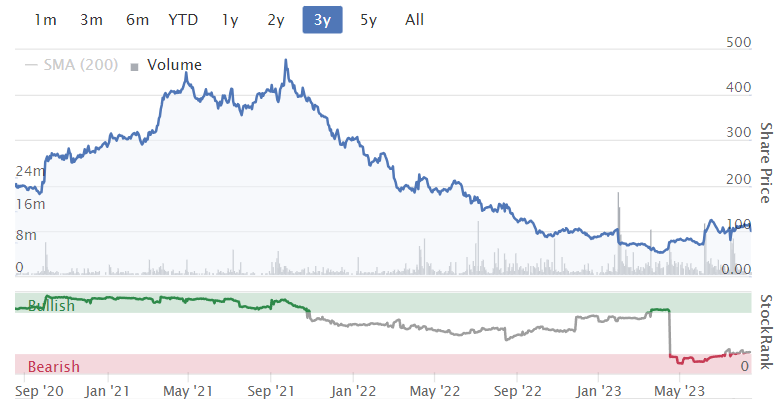
Paul covered it negatively in April, saying the “balance sheet is one of the worst I’ve ever seen”.
I gave it a neutral rating back in January, when it lost the CEO who presided over the William Hill deal, and was forced to suspend VIP customer accounts in the Middle East.
Today’s interim results are as follows:
Revenue £882m, adjusted EBITDA £156m (both numbers have ballooned thanks to the acquisition).
After-tax loss £33m
“Pro forma” revenue is down 7% due to “compliance changes in dotcom markets together with refined marketing approach and market focus”.
Worries about unregulated operations were a longstanding feature of this share, but 95% of recent revenues were “locally regulated or taxed”. This says to me that 888 can no longer be considered an offshore, unregulated operator.
Deal synergies: for the William Hill deal to work, it must result in cost savings that enable the debt to be paid down. The headline here is:
Accelerated synergy delivery with £66m of cash synergies delivered in H1-23 and full £150m target benefit now expected to be achieved in 2024 (a year earlier than prior expectations)
As for the debt itself, net debt reduces by £68m to £1660m.
The leverage multiple (net debt / adjusted EBITDA) reduces from 5.6x to 5.1x. This is still an extreme level, of course.
Year-end leverage is expected to be “slightly below 5x”.
I’d love to see this multiple get to 4x, which would almost start to feel reasonable!
EBITDA
There is an important point about EBITDA which I think it’s important to explain here.
The reason value investors tend to sniff at EBITDA is that it doesn’t include lots of important costs. These are costs that do show up in the long-run. Depreciation and amortisation, in particular: these represent the wearing out of tangible or intangible assets which were paid for in the past and will likely need to be replaced in the future, if company performance is to be sustained. Long-term equity investors can’t ignore these costs.
So why does EBITDA remain in use among investment bankers and private equity investors? The reason is that it can be used as a proxy for short-term operating cash flow. If you want to know whether or not a company in a leveraged buyout can survive the next few years, EBITDA can help. If you want to know whether or not a debt-ridden IPO can survive the next few years, EBITDA can help.
In short, if your timeframe is “a few years”, and your concern is company survival, then EBITDA is relevant. It provides an insight into its immediate cash flow generating possibilities.
In the case of 888, for example, it reports an adjusted EBITDA of £156m.
If I go to the cash flow statement myself and calculate an EBITDA figure that I’d be comfortable with, I get £133m (take the pre-tax loss and add back depreciation, amortisation and interest expenses).
For me, this is the short-term cash flow that 888 is able to play with: from this amount it has to pay taxes, pay interest, make investments in its own businesses, pay leases, and hopefully pay down debt.
It may be possible for a company to reduce internal investments for a period of time, in order to prioritise interest and debt payments. That would be bad for long-term earnings, but it could ensure short-term survival! So I hope you can see why a company’s reported EBITDA figure (or an EBITDA figure you might calculate for yourself) can provide some insight into its short-term survival prospects.
Going concern statement - notes that the majority of the company’s debt is repayable in 2027/2028, with the next due date in 2026. So there is time to organise a refinancing. The company’s revolving credit facility has a net leverage covenant, but it’s currently undrawn, and “the remainder of the Group’s debt does not contain any financial covenants”.
“Severe but plausible” downside scenarios have been considered, and have “enabled the Directors to conclude that the Group has adequate resources to continue to operate for the foreseeable future”. They say that they could withstand “a decrease in forecast EBITDA of 64.1%”!
For a company in severe financial straits, this going concern statement is about as bullish as a shareholder could hope for.
Outlook
Overall, this has been a good first half, reflecting our really strong financial discipline and delivering on our targets to increase profitability and deleverage…
…we remain on track for our full year revenue guidance of a low to mid single digit decline on a pro forma basis, with the decline likely to be at the mid single digit end of the range, reflecting the pace of recovery in the Middle East, which has been slower than we anticipated.
We also remain on track to deliver an Adjusted EBITDA margin of 20% this year… with the phasing of marketing investments and synergies, we have good visibility on this reaching 20% for the full year.
New CEO - before wrapping this up, I should mention that 888’s new CEO from October will be Per Widerstrom (this was announced last month). He was previously CEO at Fortuna, “the leading omni-channel betting and gaming operator in Central and Eastern Europe”.
Graham’s view - this is the riskiest share in my portfolio by a long way, but it’s also my smallest position (3%). If it sinks under the weight of its debt, I will be fine.
I do regret not selling it back when the William Hill deal was announced, but I also still think that there is a chance it pulls through or survives long enough to be acquired at an attractive price by someone else in the industry.
I note that the company’s €450 million secured bond is not trading at a distressed price. It trades on the Frankfurt Exchange with a yield of 11%:
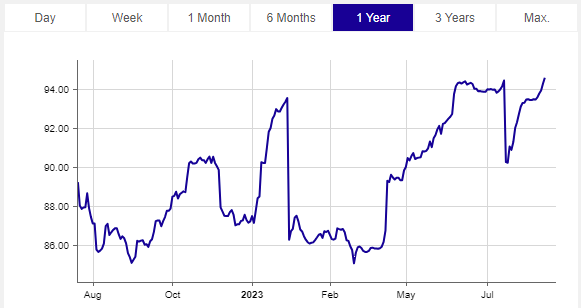
Honestly, I’m surprised to see the bonds trading so strongly. You can see from the above chart that they were trading much lower in February. That’s around the time that Moody’s gave 888’s credit rating a negative outlook, on top of its “B1” speculative-grade rating.
But the news flow since then has been ok, and the 888 share price doubled from the low it reached earlier this year.
One final point: there is no equity analyst coverage of this share, so we are on our own researching it!
Disclaimer
This is not financial advice. Our content is intended to be used and must be used for information and education purposes only. Please read our disclaimer and terms and conditions to understand our obligations.

66 comments
Stelrad (LON:SRAD) used to be a leading brand when I worked in the industry circa 20 years ago.
And in today's report the company said, " In the countries reported by BRG Building Solutions in 2023 to date, Stelrad moved into a market leadership position, with 18.5% share by volume of the combined UK, European and Turkish steel panel radiator market."
However, the stock does not appear on my radar right now for several reasons:
1) The market cap is below £200m. My own preference is for £200m or above because my investing history shows me that I've enjoyed the greatest success with companies of that minimum size.
2) The stock does not have high one-year relative strength. My history shows that my biggest winners have had.
3) The company has too much debt, and that's never a good look, particularly for a business in a cyclical industry.
4) The stock is in a downtrend. I personally only ever invest in uptrending stocks.
5) The stock has yet to establish a believable primary base (or consolidation) since IPO. All my personal investments involve entering positions in stocks breaking up from a base.
7) There isn't a green stockopedia Quality or Value rank. I prefer to have one or the other when entering a position and ideally both.
However, Stelrad is in an attractive market, I feel.
The push towards domestic heat pumps is a push to replace gas and oil boilers with heat pumps. So the wet system with radiators remains, even if used in conjunction with underfloor piped wet systems -- such as for upstairs rooms where radiators work better. And the engineer just takes the old boiler away and retrofits a heat pump.
Or, with a brand new installation, a wet system is installed from scratch and powered by a heat pump. Indeed, heat pumps work by transferring heat from the air or the ground to water (and most ordinary domestics ones are air-sourced). So we need a wet system with radiators to make it work.
It is possible to transfer heat from a heat pump direct to air, but that would involve building a duct system into homes from new. And in the past, we used to have such air systems powered by electricaire heaters, which were big boxes of thermal bricks heated with electrical elements. They were rubbish, expensive and inefficient systems, so my guess is we won't see mass forward adoption of anything similar.
So it's probably back to heat pumps with wet systems (and radiators). However, heat pumps are rubbish and inefficient compared to gas and oil boilers. So, as other posters have mentioned, radiators need to be bigger to accommodate them. And that's after decades of shrinking radiator sizes because of improving home isulation levels. But this may be an opportunity for Stelrad and other similar players.
My view is that Stelrad is one to watch. And there's more info on how heat pumps work here and in other places: https://www.kensaheatpumps.com....
And here for air-source heat pumps: https://energysavingtrust.org....
How interesting, thanks Kevin!
YouGov (LON:YOU) - a report yesterday in the FT suggested they were investigating the possibility of a US listing.
Forgive my ignorance, but what would happen to UK shares if this happened?
Thanks
PS according to The Times today, the listing is not being considered 'in the near term'.
They will still be trading here.
Many companies have a dual listing or even listed in more than two exchanges.
Thanks
UP Global Sourcing Holdings (LON:UPGS)
HI Graham,
Though I completely agree with your comments about pricing power for UPGS's products they obviously have some room with regard to selling price to either maximise profits or increase market share. About a year ago Simon Showman was showing some enthusiasm for passing efficiency savings across to customers via lower prices to increase market share while maintaining profitability, thus squeezing the competition. I think we are now seeing that in action, or at least I hope so!
Agree with Peter Wyatt comments but add...
IMO pricing power in the context of UP Global Sourcing Holdings (LON:UPGS) is persistently misunderstood and/or placed in the wrong priority analytically.
Clearly UPGS are not selling luxury so they don't have that sort of pricing power. Neither are they selling tat so they are not competing purely on price. Plus they are not price takers from their retailer customers as they don't have tied forward supply agreements - both sides can walk away if the price isn't right. I've long thought this is plus for UPGS as means they are not directly eating their margin to satisfy Tesco, Sainsbury, etc - I wouldn't invest if they were tied even if it drove volume as IMO would be low quality growth.
Price counts but not exclusively. Brand power provides some cache and value and they help place products with retailers and make customers return and/or flip from maybe to yes in their buy decisions. It keeps customers coming back for UPGS products and perhaps paying a little more for the 'trust' or name etc. What really counts at UPGS is their ability to continually outcompete other options in terms of brand + style + product capability/currentness + price and doing that in a super efficient way with retailers as the very difficult environment of covid illustrated. Giving retailers an all round service and experience they find very hard to find elsewhere.
This means that UPGS continually 'land and expand' with customers. Its retail so there's going to be some volatility. I can't tell you if the headwinds are truly less severe now (my guess, see note, is they are) and we move into a calmer environment with some tailwinds that can help potentially reboot them to a higher growth trajectory. But the UPGS machine works and any pull back as retail gets tougher is your opp to buy.
Amazing chart on Yu (LON:YU.) Up around 450% in less than a year. This is one I should have just bought and held from first purchase at £1.85 instead of trading it but thats life. Still done remarkably well considering the dire market. Looks to be going into a real parabolic move so Ive sold the last scrap. Hopefully theres a couple more of these around in the next year or two.
No idea how they're achieving such large profit growth, and was always worried it would quickly grind to a halt, but if you smash forecasts long enough the market will eventually take notice.
Just sold half of my Yu (LON:YU.) by far the best UK holding this year, not daying much, was hoping for £10, but don't want to get too greedy. Looking a bit peaky now, hope to buy back if it falls, like before.
The Naked Trader had a fair size holding, I think.
Yes, looking at that chart, may be time to topslice some.
Volex (LON:VLX) has anyone seen the HSBC report released yesterday where they raised their PT to 510p vs 400p previously? I wonder if they raised their forecasts / provided numbers in response to the Tesla announcement last week
UP Global Sourcing Holdings (LON:UPGS)
https://www.stockopedia.com/co...
H & T (LON:HAT) H123 presentation given by management last week with Q&A. Video & podcast. In summary:
There was an increase in FY23 Revenue forecasts but aPTP & aEPS forecasts were dropped 9% and 7% notwithstanding aPTP and aEPS forecasts are still up 55% and 44% respectively! On an aEPS of 53.7p it leaves HAT trading on a PE 7.6, PEG 0.6 and a divi yield of 5.5% in a market where there is reduced competition and increased demand. There were articles by Midas and the FT at the weekend which are worth a read.
Anyone else following Chapel Down (OFEX:CDGP) ?
The sp has risen from <30p to ~44p (and the spread has narrowed considerably) in the last month or so.
I note there's been quite a high profile social media campaign recently.
Last week I was in Blaye (across the river from Medoc in the Bordeaux region and a famous wine producing area itself) and all of the wine bar owners I spoke with, whilst enjoying their local wine, had heard of English wine (not the case a few years ago) - and not one disparaging comment either!
I hold - living in Kent, not far from their top vineyard Kit's Coty.
Chapel Down (OFEX:CDGP)
https://www.stockopedia.com/co...
Chapel Down have been extremely active in their Social Media and targeted advertising campaigns recently and it seems to be working, this is on top of the general climate tailwinds for wine production in the South East of England and, so far so good, this spring and summer's weather have been excellent to produce another bumper harvest. I am not a big drinker, especially not wine, but I have an extremely knowledgeable friend in the industry who first alerted me to Chapel Downs prospects at the beginning of January when I first bought in.
Shareholders also get a substantial discount (33% I believe) on their wine, gin etc as well as a few other perks, bringing a bottle of white or rosé to about £10 & the cheapest sparkling to about £12...and it is very drinkable stuff!
But as has been said, as with producers elsewhere, the weather is a huge factor...long may the sun shine!
FWIW I really like Chapel Down (OFEX:CDGP) and was a former holder until earlier this year. Sold out c38-39p earlier, as I thought (correctly) there would be an opportunity to buy in at a lower price. Saw it drift to c30p, but surprised its now back to the 40p range.
For me, weather is the key concern. Thought this summer wasn't looking too good for yields and quality?
However, they had a bumper crop last year (volume and quality) so this year's sales volumes of their still wines should be spectacular, and the new few years of sparkling wine good.
They're building out a good brand IMO (albeit there are many competing brands, and no clear leader in brand, so we will see which ones succeed long-term).
Hi Boon,
There have been a couple of articles in Times and Guardian very recently ( I think) reporting on this spring and summer being ideal growing weather for wine producers i.e. early sun, then some rain in June July and (if we get the forecast) sun in mid to late August. I think they were behind paywalls so no point in posting.
EDIT - just seen mjfgs has linked one of the articles , thank you.
WineGB-Industry-Report-2022-23-FINAL-4.pdf
I missed this on my initial scan of the Guardian report that mjfgs linked.
Worth a read IMO.
Much more a business document, Its what I read in detail when I skimmed this article in 90 seconds (it is linked within the article TBF). Yes good UK wine growing data
https://www.theguardian.com/bu...
Not specific to Chapel Down, but a bumper year being predicted at the moment - accounting for some of the positive movement in share price I'd imagine...Apparently we need some decent spells of sun over the next 6 weeks, the wet weather having arrived at the perfect moment in July & August ☀️
I was in on the eis raise so saw it rise to over 100 then fall to 19 as a fund manager was a forced seller.
Cockneyrebel spotted that and got in around 20 with a lot of that board.
Since then it has bounced around 25 to 40 .
Note that there are a lot of long term holders who like the wine and hold for the discount. Their upmarket kits coty (expensive) wine is v. good but not cheap at all.
Going upmarket is a good strategy as eu wine gets eu subsidies and eu land prices are cheaper but everyone is doing that.
They also sell the 12.99 fizz, and this may work out but it is hard to ride two horses.
The tailwind is still climate change. Not just that champagne will not be as fizzy but that southern French and Spanish wine is facing rapidly growing challenges.
But that is a *very* long term thing
I hold but recognise risks
It's the warm breeze from passing HS1 trains which makes Kits Coty such a great area for grape growing!
Amidst all the gloom in the markets it's worth remembering that there's still a very bullish scenario that might play out. Firstly that we avoid a significant recession, as indicated by some positive June GDP numbers, and secondly that inflation begins to fall rapidly towards the 2% target and we return to the lowish growth low interest rate environment of the 2010s. Mean while 2019 revenues have been redenominated 25% higher from the inflation/growth of the last few years. We have seen the first positive inflation surprise in the Uk already and we may see another one tomorrow as we begin to lap the effects of the energy price cap rise /food inflation which took a few months after the beginning of the war to kick in . The producer price index is already in outright deflation and the delayed effect of interest rate rises should soon kick in . One can only imagine how bullish stock market investors are going to feel if the narrative changes to seeing the pandemic as a brief interruption to the new world of ultra low interest rates
https://www.investorschronicle...
This is free to read.
An interesting write up on Housebuilder and land banking.
It is an interesting read!
I feel like this problem will sort itself out shortly.
Cost of capital has increased, so the opportunity cost is higher to buy and sit on land for years.
The other is that house prices are no longer rising with certainty, so there is less incentive to sit on the land either.
However, the one thing the government can control, planning permission timelines, is still going to be the key hindrance. With planning permission taking so long, and so many ways for local interests to oppose developments, housebuilders are forced to hold many year's worth of landbank with permission, so they can continue to build reliably year after year.
HELP! I feel like the OAPs who have had to pay over £100 to get their Ryanair tickets printed at the airport because they made a mistake printing out their tickets at home. I am being left behind by technology - or am I?
I have a PC, I have the lap top on which I am typing this. I use Firefox. I have a smart phone - Samsung/Android which I don't use for such things - print too small, eyes not good -- and so as a result of Paul's change to some Swedish company which I don't understand, I cant get to his podcasts any more - or so it seems. I don't have Apple and don't belong to any of the other routes he has mentioned either.
I dropped him an email via his podcast page, but he is very busy...and so I thought other readers/contributors here would have a solution I could use.
Thanks, in anticipation.
Go to Google and type Listennotes.com
Should add type "Small caps with paul scott"
https://shows.acast.com/paulsc...
does this work?
General thanks to everyone's suggestions for Paul''s podcasts.
No Laurie, but found something else from Dextro below that did on my phone. google podcast app for android, then subscribe/install/open and then type in small caps podcast with Paul Scott. Havent tried it yet, but promises to work!
On your phone go to the Google Play Store and search for the Google podcast app. Download it and sign in with your Google email address and password. Once your signed in to the app search for Paul Scott or Small Caps and it should appear.
Thanks Dextro. worked a treat.
Hi ridavies - Some sympathy of keeping up as you get older - I need to use DM with colleagues whilst keeping on top of emails and virtual meetings and my actual work, I am in my 60's
Small point claimed by a certain airline in response to the OAP's "error" - They claim that their system automatically emailed the couple pointing out the error of checking in for the return flight not the outward one. Advising them they needed to rectify the situation or there would be a (hefty) charge at the airport. so that's buyer beware then. Probably an AI response?
Hope the same couple didn't try and get into watch Arsenal at the w/e with a smartphone at the turnstiles
Don't you love the increasingly connected world
If anyone is interested, MTI Wireless Edge (LON:MWE) announced fairly flat interins this morning and there's an IMC presentation starting at 10. Not one I'm invested in right now but am quietly following. I'd be interested in any views on the Co.
Re: Views on MTI Wireless Edge (LON:MWE)
I reckon its much larger competitors must be eating quite a lot of its lunch. FX & inflation headwinds aside, MWE has three businesses in what we all agree are (or should be) fabulous growth areas, but with MWE, it's perpetually a case of hurry up and wait for decent growth. Set against that, I'm reassured that the company is profitable and run by the founding family for the long haul. (I hold.)
thanks ed.
Georgia Capital (LON:CGEO) fine set of results with NAV now at £22 versus a £9 share price. Trading on a 60% discount to NAV and given most of the market cap is in listed securities the private portfolio is more or less in for free despite most of it being high quality utility type businesses. Ie nothing arbitrarily valued like high growth tech.
Odd not to see an uptick - would think a 30% discount is more reasonable which would put it on £15-16 p/share. Only thing I’d like to see are some dividends. If I have to wait for value to out I prefer regular divis to soften the wait.
Since the half year results, Bank of Geogia shares have increased further so the NAV of Georgia Capital (LON:CGEO) is now up to £22.63 per share. Bank of Georgia is now its only listed investement accounting for 30.8% of the NAV. Agreed. The shares look far too cheap. It would be nice to see a dividend but it makes sense to buy in shares at the massive discount to NAV which the company is doing. This is enhancing the NAV for the remaining shares and should help to further improve the share price.
Georgia Capital
Agree this is the wrong price
Too much previous negativity regarding “geopolitical risk” and in fact the Georgian economy is I believe the fastest growing in Europe due to the outflux of Russian wealth into Georgia .
Bank of Georgia shares have almost tripled since their lows following the invasion but Georgia capital has not followed .
I’ve a decent chunk but wish I had this as one of my top holdings .
This is one of my five “sleep well at night” shares that never causes any concern .
"outflux" good word!
I know that Georgia Capital (LON:CGEO) use independent 3rd party valuations but when you see that Bank of Georgia (LON:BGEO) , a large listed bank consistently growing at 20% + a year with fantastic returns on equity, trades on less than 5 times forward earnings you have to question the higher valuations given to some of the private companies with less attractive characteristics. For example the hospitals business is given a 12x EV/EBITDA valuation and the insurance business a 11 x PE valuation . I'm aware that they managed to sell one private utility business around book recently however , and even applying a 50% haircut to the private valuations still offers a reasonable margin of safety
Which is my point on Georgia Capital (LON:CGEO)
The Bank of Georgia (LON:BGEO) stake is worth circa £7
The private portfolio is not richly valued at £15.50 but apply a 50% discount and you come out with a share price in the region of £15
The hospitals business has a lot of tangible property value, is recovering from covid fallout and has a great long term revenue growth profile given Georgian population demographics, so the valuation is far from punchy.
Banks trade on lower values around the world and not just Georgia so I don’t think you can apply that against other businesses. They are just not comparable.
Nonetheless I really like Bank of Georgia (LON:BGEO) too from a valuation perspective. It is saddled with none of the baggage of the large western banks such as dodgy illiquid asset values, low gdp, rising default rates or low liquidity ratios etc and instead operates in a country with a strong GDP, so growth can continue even as NIM deflates as rates drop. The dividend is great too.
Granted there is geopolitical risk but this is heavily factored in to valuations. Anyway results out on Thursday I think so maybe I will look stupid but hopefully not!! I hold both
Very good results from TBC Bank (LON:TBCG) a few days ago augurs well for Bank of Georgia (LON:BGEO) . Apart from the very low valuation for Georgia Capital (LON:CGEO) , it has the added attraction of operating in defensive areas.
There is always going to be a need for medication. Georgia Capital operates 383 pharmacies in addition to having a wholesale pharmacy business. It operates 16 hospitals with a total of 22524 beds. Complimenting this is a medical insurance business.
Renewable enegy is an ever more important sector and Georgia Capital has invested in hydro and windpower plants.
Education is always gong to be important and Georgia operated 4 private schools.
Most of its water utility business was sold off but it still has a 20% interest here.
Georgia Capital is my largest holding and given the heavy discount to NAV and their focus on safe defensive businesses I feel very comfortable with this investment, irrespective of its close proximity to Russia.
Is Mr Contrarian on holiday? Taking a well earned rest?
yes!
Have a good one!
Hi Paul, with ref to Stelrad (LON:SRAD) and central heating radiators, I've renewed our radiators and had the latest technology in oil-fired fitted in my semi-detached. Just before the announcement that the government will be banning this too. I predict that we will all be on nuclear electricity in approximately 50 years time but who's to care?
Post Script: my radiators were made by CenterRad, owned by Wolseley in turn owned by Ferguson (LON:FERG) , well, well, I can't see this company being affected by UK politics.
Wolseley UK isn’t owned by Ferguson plc anymore. It was bought by VC a couple of years ago.
China to stop producing youth unemployment figures n June, China's jobless rate for 16 to 24 year olds in urban areas hit a record high of more than 20%. Big red flag for me to stop civil unrest?
While admitting that employment matters might not be perfect in China, do any other countries include 16 year old students in their data? Including only Chinese 16-24 year olds looking for full-time jobs in the statistics does seem more reasonable to me.
https://www.reuters.com/world/china/china-stop-releasing-youth-jobless-rate-data-aug-says-stats-bureau-2023-08-15/
Many young Chinese people who have acquired degrees etc are now delivery riders for online businesses/products. Delivering in 30 degree+ heat with high humidity in the South China cities is no joke. So its bloomin' hard work with long hours. Apparently there is a reluctance of young people to go into factory work, and those types of business are finding it harder to recruit. They are probably paying quite low wages and are less City centred.
Academic inflation is still a thing in China where education from a young age is generally not paid for by the State, but by the parents. So having children is an expensive business and many young people either don't want many children, or any! I would say with limited knowledge that young and approaching middle-age professional women who live in the Cities are generally reluctant to have children having invested in their careers. There aren't many safety nets if you are not earning unless you meet a well off Mr Right.
All these issues seem to be coming together quite quickly in China. But people are enjoying restaurants and eating generally-as the Chinese are great food lovers. Indeed one of the changes over the years is seeing more fatter Chinese children and many pot bellied middle-aged men.
Also, what will happen to radiators, as gas boilers are phased out?
Not a holder of Stelrad (LON:SRAD) but my understanding was that to retrofit an air heat source heat pump as a replacement for a gas boiler radiators need to be 10-15% bigger to provide similar levels of heat output. Might be different in new builds as can put in underfloor heating but very difficult to retrofit that in existing property. Consequently could move to heat pumps be good for a radiator manufacturer?
Yes heat pumps still use radiators and they are often are replaced because they need to be larger, because the water temperature is lower.
Stelrad (LON:SRAD) In march I upgraded to a solar and heat pump system. I couldn't afford to replace the radiators for underfloor heating. This wasn't a problem as the solution was simply to upgrade 1/2 of my radiators to low heat efficient Stelrad ones; at a fraction of the cost. The radiators do have to be appx 50% bigger, but if space is an issue, then they have triple panel radiators to help. Stelrad could do very well with a move to Head Pumps.
Stelrad (LON:SRAD) - yes, there is going to be an enormous amount of radiator replacement going on in the next decade versus what has been happening - we have replaced 1 radiator in our house in 25 years!
I agree with Paul's comments though that there are a few dark clouds on the horizon to navigate first and the balance sheet looks a tad over leveraged with the DL acquisition, albeit not excessively so.
I do wonder whether there is a potential overhang with the PE owner as well, very similar to TI Fluid Systems (LON:TIFS) when they floated. Anyway, for me its a definite contender for a buy at some point, being a #1 in the UK, Netherlands. Belgium, Denmark and #2 in France and Sweden. Very impressive!
I personally just think cyclicals haven't bottomed yet until recession hits. Maybe something to look at again after the full year results?
Paul,
Stelrad's Stelrad (LON:SRAD) radiators work with gas boilers, heat pumps, solar heaters etc and that they are positioning themselves towards supposedly greener lower temperature electric radiators (as used for more often in Europe) with their purchase of DeLonghi radiators for E28m last year so I think that some of your fears are unfounded.
It might be worth you looking through their website & press releases - they appear to be positioning themselves precisely to take advantage of the 'green home revolution'.....
This link explains their strategy a bit: https://stelradplc.com/sustain...
(I bought an entry position a few days' ago on the price drop - I like companies who design and make things with a decent moat and an eye on future trends...)
Best wishes,
Matt
Another good update from UP Global Sourcing Holdings (LON:UPGS) which is one of my favourite small caps. This company still isn't really valued as a brand owner: one day it will be! It has a fantastic business model, in my view, with a slimline balance sheet and a very strong management team. Only concern that I have this year is over the relatively late switch of auditors, after a surprise competitive tender, probably caused by BDO pushing the fee up excessively. Audited results are due on 31 October, but always some risk of delay in year one. Anyway, I continue to hold long-term.
UP Global Sourcing Holdings (LON:UPGS) looks very solid results and cheaply valued. Would perhaps question whether it should be valued as a brand owner (high teens multiple) - not sure people would pay a premium for their brands, which look quite generic, so they probably don't have the pricing power you'd associate with leading brands. Nevertheless, a PE ratio of 12-13 certainly looks justified, so decent upside from here.
Castings Castings (LON:CGS) slipped in a gently positive trading update under the guise of an AGM statement.
'We previously reported in June that demand from our commercial vehicle customers (75% of group revenue) was strong; it is pleasing to note that these higher levels have been maintained in the year to date. With such elevated demand and an element of order backlogs, the OEMs have been restricting the number of new orders being accepted. The forward demand schedules are beginning to suggest that these order backlogs are reducing and therefore schedules are starting to reflect the underlying demand in the market' . No figures given so just for info
LON:CGS - I like this stock. Have held for a while - Low P/E , Ok dividend, money in the bank, Decent Stockrank amongst other favourable indicators. I will hold
UP Global Sourcing Holdings (LON:UPGS) comfortably beat full year FY2023 expectations for sales revenue in a trading update released today, as H2 sales accelerated sharply to show 15% growth compared with 2% in the first half of the year. Importantly, this growth was achieved despite no overall price inflation as the group sought to sell its branded homeware products at prices that would be affordable to consumers. In our view, the ability of a consumer goods company to generate sales volume growth in the relatively mature economies of the UK and Continental Europe should be valued highly. Profits were in line with expectations. Online revenues were notably strong and increased by 64% in FY2023. With robust finances and a clear message that the UPGS brands are delivering brisk sales growth, we reiterate our 250p fair value for the shares. Our new note is here: https://www.equitydevelopment....