Small Cap Value Report (Tue 16 Aug 2022) - TED, SPE, SMRT, HARL, TRB, TRMR, CGS

Good morning! Paul & Graham are here with you today. Today's report is now finished.
Agenda -
Paul's Section:
Ted Baker (LON:TED) - an agreed cash takeover bid is announced at 110p, only an 18% premium. The 3 biggest shareholders (including the founder) have agreed it, so the company's trading and outlook can't be much good. This was not a convincing turnaround, so maybe this is a lucky escape for shareholders?
Sopheon (LON:SPE) (up 5% at c.550p - mkt cap £58m) [no section below] - announces a $11.2m, 5-year contract, with the US Navy’s submarines. It “will help to underpin financial goals for current and future years”, so forecasts not being raised at this stage. Sopheon always looks promising, but its profits have reduced every year since 2019, and only $0.8m PBT is forecast for FY 12/2022. So it’s certainly not a value share. Although longer-term, this could be an interesting company. Today’s contract win certainly sounds impressive as a reference for winning other business. If you like the company, then you can buy this share at half the price it was a year ago.
Smartspace Software (LON:SMRT) - H1 trading update today is in line with expectations. Still loss-making, but it seems to have enough cash (just), and cost control is mentioned. For such a tiny company, it seems to have lots of moving parts - different divisions/products, and operating in various countries. Despite some reservations, I think the share price shedding c.75% of last year's peak valuation, has brought it down to a more reasonable valuation which might be worth a little dabble at some point. Acceleration in growth is now key - if that happens, then the shares could do well. If it doesn't, then they might continue drifting down.
Tribal (LON:TRB) - interim results don't impress me at all. Too many adjustments that seem to recur each year, so genuine profit doesn't look much for the high market cap. Also I dislike the weak balance sheet, poor cash generation, and wobbly-sounding outlook statement. Risk:reward looks poor to me. Although sticky customers, with recurring revenues, could be attractive to a bidder - software companies often attract perplexingly high takeover bids. Or did anyway, in the latest tech boom.
Castings (LON:CGS) - a reassuring trading update today, shows that CGS is coping well with supply chain, higher costs, and passing on price rises to customers. It's a cracking value/income share, in my opinion.
Graham's Section:
Harland & Wolff group (LON:HARL) (£19m) - after delays with a gas storage project, Infrastrata (re-named Harland & Wolff Group Holdings plc) acquired a shipyard with a storied past from its administrators. Other yards have been acquired and Harland & Wolff is now a significant player in the bids for major Navy projects. Revenue aspirations are huge and make the HARL market cap look modest in comparison, but shareholder returns (for example in the form of dividends) are a long way off. I would treat these shares with the utmost caution.
Tremor International (LON:TRMR) (£545m) - H1 results and a Q2 update from this Israeli video ad technology company. The results are difficult to process but look OK at first glance, albeit with a weakening from Q1 to Q2. There’s a large acquisition coming down the tracks and my back-of-the-envelope calculations suggest that if the acquisition price is fair, then Tremor’s current market capitalisation is cheap. However, there are ongoing legal proceedings with an LG-controlled former strategic partner, which should be of interest to investors and may also provide an insight into the weakening performance. From my point of view, there are amber and red flags warning investors of danger here.
Explanatory notes -
A quick reminder that we don’t recommend any stocks. We aim to review trading updates & results of the day and offer our opinions on them as possible candidates for further research if they interest you. Our opinions will sometimes turn out to be right, and sometimes wrong, because it's anybody's guess what direction market sentiment will take & nobody can predict the future with certainty. We are analysing the company fundamentals, not trying to predict market sentiment.
We stick to companies that have issued news on the day, with market caps up to about £700m. We avoid the smallest, and most speculative companies, and also avoid a few specialist sectors (e.g. natural resources, pharma/biotech).
A key assumption is that readers DYOR (do your own research), and make your own investment decisions. Reader comments are welcomed - please be civil, rational, and include the company name/ticker, otherwise people won't necessarily know what company you are referring to.
Paul’s Section:
Ted Baker (LON:TED)
93p (pre market open)
Market cap £172m
Sky news reported this last night -
* REEBOK-OWNER ABG SEALS CUT-PRICE 200 MILLION STG TED BAKER TAKEOVER - SKY NEWS
It’s confirmed this morning with an announcement from Authentic Brands Group LLC, which says it has agreed with the Board of TED to take it over with a 110p cash bid. That’s only an 18.2% premium to last night’s price, and certainly not generous in terms of where the share price has traded in the last couple of years -

.
My initial reaction is why has the Board of TED agreed a takeover, at such a modest premium?
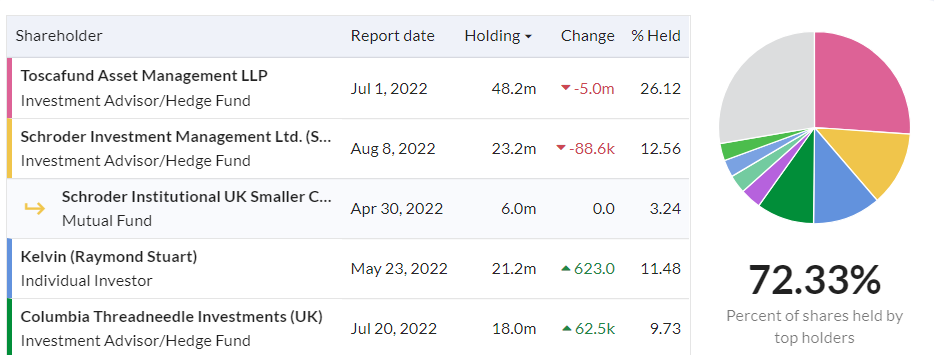
The shareholder register is concentrated, as you can see below, with the top 4 holders holding 60% - so there would be little point in agreeing a takeover bid unless these big shareholders had given the deal their blessing, I imagine.
ABG says it has agreement from holders of 50.7% of the company, and appendix 3 gives the details, which do indeed include agreement of the top 3 shareholders, Toscafund, founder Ray Kelvin, and Schroders. So this looks like a done deal. They clearly don’t have much confidence in the company’s turnaround, to be selling at this price.
.
.
ABG says it will not improve on the offer, it’s final (unless someone else makes a counter-bid).
My opinion - TED has been unconvincing as a turnaround so far. Reading between the lines of today’s announcement, it strikes me that maybe the major shareholders could be worried about the outlook, and are hence happy to cash in their investment, rather than have to pump in more cash to keep it going in a recession, e.g. -
the Acquisition provides an opportunity for Ted Baker Shareholders to crystallise, in cash, their investment in Ted Baker at a valuation that the Ted Baker Board considers fair in view of the significant recent deterioration of the macro-economic environment and outlook as well as the potential for an extended period of recession in the UK;
If the major shareholders, and the Board, think it’s a fair price, then it probably is. So I don’t think small shareholders have much to complain about here. The chances of a higher competing bid are probably slim, as the company has been for sale for a while. With the macro environment worsening, I’d be inclined to bank my profits in the market if the share price is close to the 110p bid, just in case the bid falls through for any reason. Or sometimes with takeover bids, I sell half in the market, and let the balance run, but it depends on price. Giving away say 1p to an arbitrageur is a small price to pay for the certainty of a deal, and having fresh funds to put into something else that’s cheaper.
.
Smartspace Software (LON:SMRT)
43p (down 8% at 08:22)
Market cap £12m
Very small, so I’ll keep this brief.
My notes are here from Feb 2022, where I remained unconvinced about this company. Results for FY 1/2022 were poor, with another heavy loss chalked up, and cash starting to look a little tight. The bull story is that it’s growing good quality, recurring revenues, and might become profitable in future. People returning to offices could also be a tailwind for performance, previously restricted by lockdowns & work from home.
Here’s the latest -
SmartSpace Software plc, (AIM:SMRT) the leading provider of 'Integrated Space Management Software' for smart buildings and commercial spaces, is pleased to announce a trading update for the six month period ending 31 July 2022.
H1 revenues £3.6m (up 46%)
Two thirds of revenues are recurring in nature.
Net cash £2.0m, and the rate of decline has slowed (only down £0.4m in the last 6 months), which I find reassuring, as cash was worrying me a bit - because this is clearly not a good time to be asking investors for more money.
There’s plenty more detail in today’s update. It seems to have 3 divisions or products - SwipedOn, Space Connect, and Anders & Kern.
SwipedOn looks to be growing well, and makes up 56% of group revenues.
Space Connect - this seems to be struggling to grow, and is tiny at £0.3m revenues. Worth pursuing? Depends on what the costs are.
Anders & Kern has recovered to pre-pandemic revenue, and H2 outlook is positive.
Outlook - sounds OK, in line with expectations -
We finished the period with strong revenue growth, and £2.3m of cash, the same level disclosed at the end of April 2022. This was helped by the increase in cash inflows from Naso, as sales grew and continued cash generation within SwipedOn. We remain focused on continuing this momentum over the next period both in terms of sales growth and cost control as we implement our plans to transition into a profitable and cash generative business.
The Board expects to deliver revenue and profitability results in-line with current market expectations for the full year, whilst ARR is expected to be lower than market expectations reflecting the updated ARR calculation methodology and performance to date.
There is a footnote explaining that ARR (annual recurring revenue, a key measure for software companies) is being recalculated on what looks a more prudent basis.
My opinion - there are some positive things going on at SMRT, but it’s a tiny business, in what must be a crowded sector. Also, it seems to have a mix of different products/services, and operates in several countries. Surely it would be better to keep the overheads more lean, and focus on deepening sales in one niche? It seems a bit of a scattergun approach at the moment.
Current forecasts show it having just about enough cash, but forecast cash burn seems a lot lower than losses on the P&L, which implies maybe creditors are being stretched to conserve cash? Hence I’d like to see the interim accounts to get the full picture.
The market cap of £12m looks a lot more realistic to me, better reflecting risk:reward than the peak last year of about £50m.
It all now hinges on the potential to accelerate growth, as offices return to more normal operating conditions, as staff are dragged back into offices, from “pretending to work from home” (as Elon Musk put it!)
Overall, I think SMRT shares could be worth a little dabble at £12m market cap, or at least adding to the watch list for when more bullish market conditions return. If growth does accelerate, and breakeven comes into view, then I could see this share maybe doubling or tripling? In the meantime though, it could continue drifting down, so maybe no immediate rush to get involved? Timing the buys & sells is up to you though, I just look at the company fundamentals here.
It’s not a blue sky company, but more a loss-making company that needs to grow quite fast to achieve breakeven & then profits. Bear in mind that the payroll will be costing a good bit more each year, as software companies main cost is expensive & scarce skilled staff.
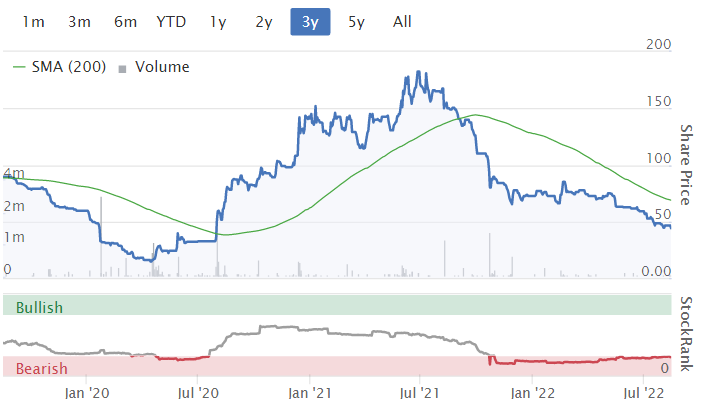
Stockopedia tends to be brutal with loss-making companies (a useful wake-up call, that most shares like this do badly, other than in the euphoric phase of bull markets), as you can see from the poor StockRank, in the red -
.
Tribal (LON:TRB)
81.5p (down 6%, at 10:29)
Market cap £172m
Tribal (AIM: TRB), a leading provider of software and services to the international education market, is pleased to announce its interim results for the six months ended 30 June 2022.
I covered TRB here in June 2022, when it issued a mild profit warning for H1, due to increased costs on a major customer project implementation (in Singapore). Although it did confirm full year expectations.
A few numbers -
H1 revenue up 7.9% to £42.4m
“Adjusted Operating Profit (EBITDA)” is down 23% to £7.1m
Adjusted PBT is £5.7m, down 28% vs H1 LY.
Statutory PBT is only £3.1m, down 47% on H1 LY.
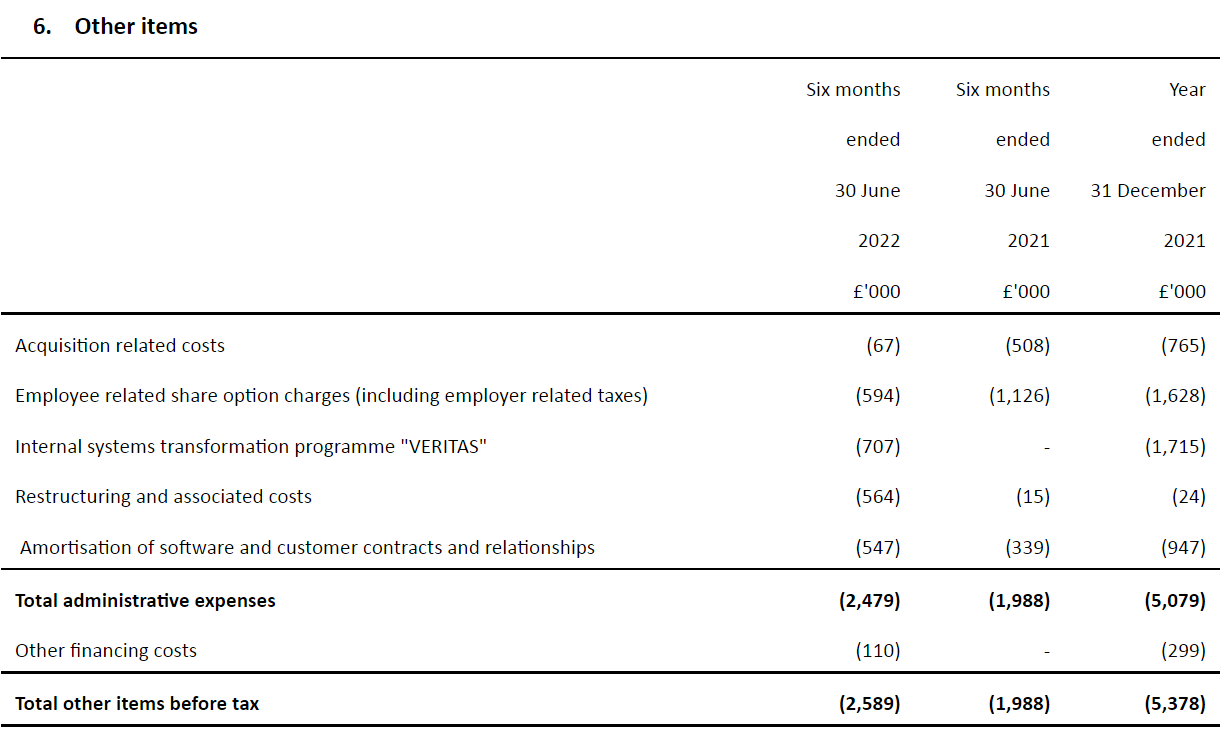
Adjustments flatter profit by £2.6m - are the adjustments reasonable, and one-offs? Not really, no. Note 6 details the adjustments, which seem to have a habit of being repeated -
.
Development spend is being capitalised at a high level, £5.6m in H1 (£10.2m in FY 12/2021), hence EBITDA is meaningless here.
Cash generation is poor - particularly in H1 this year, but it was also poor last full year - this is why the divis are so small, because it’s not really a cash generative business, once you take into account development spending.
Balance sheet - is horrible. NAV of £49.6m turns negative £(20.2)m NTAV, once intangible assets have been written off. Does this matter? Maybe not, because software companies often get paid up-front, and have little fixed assets, so they don’t need strong balance sheets. Bank debt is not excessive at TRB, so I’m not ringing alarm bells here, just pointing out that it doesn’t have any asset-backing to fall back on in hard times, which you may or may not be comfortable with, that’s up to you. Recurring revenues, and sticky long-term contracts probably protect the downside pretty well.
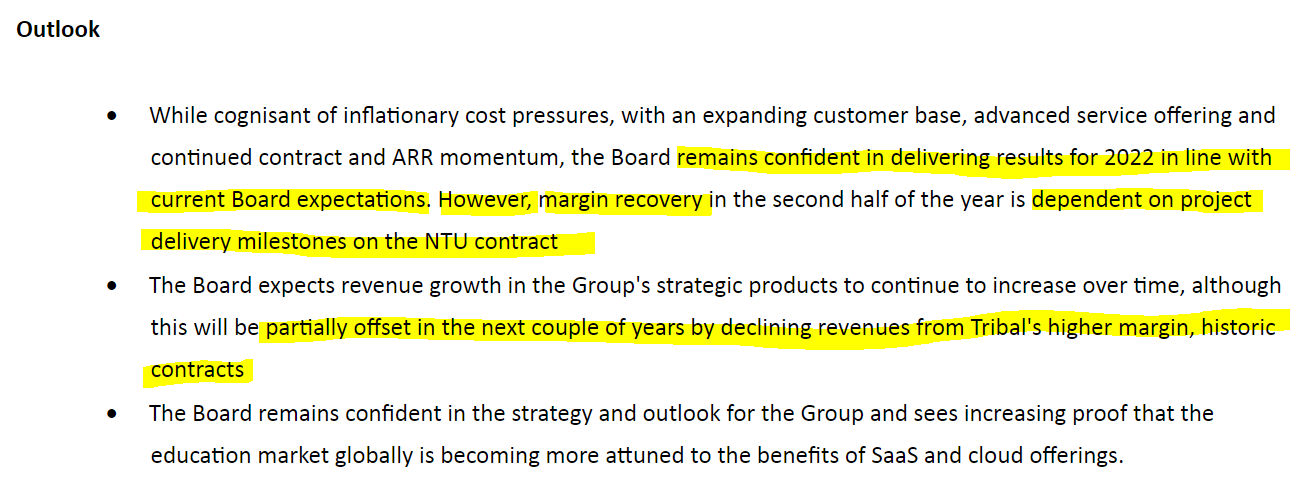
Outlook - this sounds quite wobbly to me, and I’d probably be hitting the sell button if I held this share, as it sounds to me as if there’s ample scope for another profit warning later this year. TRB has been prone to things going wrong in the past too.
.
.
My opinion - to summarise then, it’s got a weak balance sheet, poor cash generation, capitalises a ton of the payroll onto the balance sheet, pays a small divi, and has a wobbly-sounding outlook section, so the risk of another profit warning looks high.
Also I think the adjusted profit numbers look inflated.
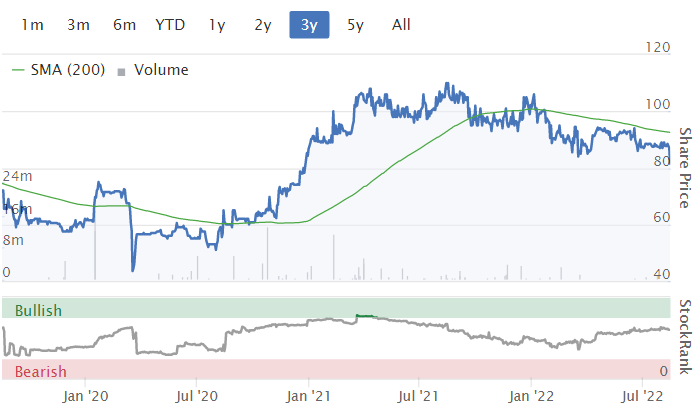
It’s not even cheap either. The forward PER is about 17 times, which doesn’t look at all attractive to me. So a thumbs down I’m afraid.
For balance, bulls might point to good recurring revenues, and growth potential overseas.
.
Castings (LON:CGS)
309p (flat at 12:38)
Market cap £134m
AGM Statement (trading update)
Graham did a nice review here of the FY 3/2022 results, which I’ve just read to get up to speed.
Today’s update looks good to me, and covers the main topics of concern at present (cost inflation, supply chains, and pricing power). Here it is in full -
We previously reported in June that demand from our commercial vehicle customers (70% of group revenue) was increasing; it is pleasing to note that these higher levels have been maintained with relatively little disruption resulting from supply chain issues.
The forward demand schedules continue to reflect the higher build rates that the heavy truck OEMs require to satisfy their orderbooks. The group will see the benefit of the greater content won on the new customer platforms as these are now in production.
Input prices have continued to rise in the current financial year and are being passed onto our customers. The most significant increase will be on 1 October 2022 following the end of our fixed price electricity contract. The higher unit cost for power will be surcharged to our customers immediately and will therefore increase revenue in the second half of the year. Whilst this should not adversely affect group profit as it is a pass-through of a direct cost increase, there will be a dilutionary impact on the margin percentage.
We continue to invest in automation technologies to improve our productivity and profitability as evidenced by the commissioning of a partially automated pouring process on one of our largest production lines.
Broker update - many thanks to Zeus for updating us today.
Forecast EPS is 28.2p for this year, FY 3/2023.
The share price of 309p is a PER of 11.0x. That looks very reasonable to me. Maybe the market is worried about the long-term, with turbochargers (a key product CGS makes for trucks) likely to become redundant if electrification takes hold?
Also bear in mind CGS has a fabulous balance sheet, with mountains of surplus capital in there, net cash, and no debt.
This enables it to pay remarkably consistent divis, even during the pandemic, and it sometimes pays special divis too.
My opinion - for cautious investors, and maybe income seekers, this share is top notch I think. Not only can you lock in a lovely flow of future divis, but it’s also bulletproof financially. It’s clear from today’s update that inflation, and supply chain are being handled well, and price rises passed on to customers.
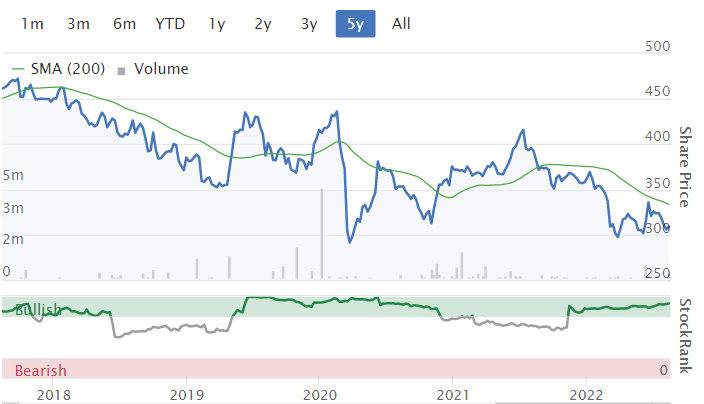
Despite all these positives, you can buy today at close to a 5-year low. That doesn’t make sense to me, so I see this as a buying opportunity.
.
Graham’s Section:
Harland & Wolff group (LON:HARL)
Share price: 11.6p (pre-market)
Market cap: £19m
On a day with few announcements, I get to look at companies that I have never or only very rarely studied before. Harland & Wolff is one of these.
Previously known as Infrastrata, this company was focused on the proposed gas storage facility at Islandmagee in County Antrim. This project promises to hold up to 25% of the UK’s natural gas storage capacity, but is still held up in legal limbo. A hearing is scheduled to take place some time in “winter 2022”.
While the gas storage project slowly moves toward construction, Infrastrata has used its public listing to raise money and purchase Harland & Wolff, and then other shipyards.
The H&W purchase was announced in October 2019, as a “strategic acquisition” that would “bring in-house a large part of the fabrication requirements for the Company's Islandmagee Gas Storage Project and proposed FSRU project” (I think the FSRU project has since been abandoned).
H&W was up for sale after collapsing into administration in August 2019.
I wrote yesterday in very positive terms about the deals which are possible when a company falls into administration. But this is a complicated and special case: H&W was already up for sale for a year prior to administration, and there were major legacy issues to do with pensions and worker contracts (the union wanted the company to be nationalised).
It looks to me like the Pension Protection Fund is now paying H&W’s legacy pensions, and the new pensions are all “defined contribution” in nature.
All of which helps to bring us up to the present, where Infrastrata has been renamed as Harland & Wolff, and has acquired multiple shipyards across England and Scotland.
You might not be surprised to learn that investors have been diluted to smithereens during this process. If you invested in this company several years ago, your stake in the company has been reduced to almost nothing:

Let’s take a look at today’s trading update (emphasis added throughout):
Harland & Wolff Group Holdings plc (AIM: HARL), the UK-quoted company focused on strategic infrastructure projects and physical asset lifecycle management, is pleased to provide a business and trading update for the year ended 31 December 2022 and an outline of management's aspirations for financial year 2023 ("FY23") and financial year 2024 ("FY24"). Given the many variables which need to be considered, these aspirations should not be construed as forecasts but as management's framework for the direction of the business.
I wouldn’t go too hard on a business admitting that it’s unable to make forecasts. After all: it’s much better to know that predicting the future is impossible, than to rely on bad forecasts.
FY22: three large contracts have been won, including a huge £55m contract relating to an ex-Navy mine-hunting vessel.
Combine that with a steady stream of small, regular work and “management maintains that it remains comfortable with market guidance of revenues between £65 million - £75 million for FY22.”
FY23/FY24: there’s a £40m backlog relating to FY23, thanks to recent contract wins.
In addition, there are “opportunities amounting to approximately £1.2 billion, across the Company's five key markets; cruise & ferry, commercial fabrication, energy, defence and renewables.”
I wouldn’t pay too much attention to the £1.2 billion figure; this is just the size of the addressable market, in the view of management. The challenge is to win a small fraction of this business as profitably as possible, not to win as much of it as it can, at all costs.
There is, however, an interesting comment in relation to the massive Fleet Solid Support shipbuilding programme:
The UK continues to suffer from insufficient fabrication capacity to take on all the fabrication work that is due to commence from 2023/24. Harland & Wolff retains one of the largest fabrication footprints in the country and has enormous flexibility and optionality across the yards to offer optimum fabrication solutions, particularly for its defence and renewables clients. In summary, the Board believes that the Company is well placed to play an important part in the FSS Programme.
The revenue “aspiration” for FY23 is £100m - £115m, rising to £200m - £230m for FY24, and the target gross margin is 24%-27%. Take these numbers with a pinch of salt.
As for profitability?
At turnover levels of £200 million and above, the Company would expect to be in a position to generate sufficient cashflow to initiate returns to shareholders… The Company believes that annualised cashflow break-even is achievable on revenues of between £80 million - £100 million depending on the mix of contract wins.
My view
I’ve enjoyed reading about the evolution of this company from a gas storage proposal to a collection of shipyards hoping to take part in the construction of major Navy vessels.
In March 2022, the company entered into an agreement for a large (up to $70m) debt facility, with the funds being used “primarily” for offshore wind development.
As I often do, I’ve studied the terms of this deal - because if I know how risky the debt of a company is, that’s a big clue for figuring out how risky the equity is!
The debt has the following features:
- Interest of 9% plus the overnight financing rate.
- Expires September 2023; H&W may extend it but must pay even higher interest to do so.
- The lender also gets 10 million warrants over HARL shares.
- The deal is “securitised against substantially all the assets of the Company, including land, property, plant and machinery and receivables.”
What does this tell me? In a nutshell, it tells me that the equity is extremely high risk. I would have guessed that anyway, but this gives it to me in black and white.
Putting it another way, I would be much happier to be this lender than to be an equity holder. The lender gets equity-like investment returns of over 9%, also gets free shares in the company, and will end up owning the company outright, if things don’t work out.
In summary: I wouldn’t be fooled by H&W’s low market cap, relative to the revenues it might generate. The company itself says that there won’t be shareholder returns until revenues are over £200m, and the deal with lenders demonstrates what professionals think of the risk profile. This is a share of the most speculative nature.
Tremor International (LON:TRMR)
Share price: 368p (-16%)
Market cap: £545m ($654m)
This one rebranded from Taptica (TAP) in back 2019. The explanation was as follows:
Tremor International Ltd (AIM: TRMR), a global leader in advertising technologies, today announced that it has rebranded… positioning itself as one of the leading independent video advertising companies in the U.S… ‘The new branding and structure better reflect our stronghold in the video advertising space,’ said Ofer Druker, CEO of Tremor International. ‘It also reinforces our ability to address the significant opportunity in Advanced TV, bringing increased scale, audience targeting and ad formats to clients.’
I have to be honest and admit that I never felt like I properly understood what Taptica did, and how it made money.
With the change to Tremor, things haven’t got much easier.
For example, Tremor uses something called “Contribution ex-TAC” as a major KPI. Many other companies in the online advertising sector use this too, but it takes some getting used to. The idea is to show gross profits excluding the impact of traffic acquisition costs. It’s an indicator of the size of the company, but is a very long distance from the bottom line net profits.
Let’s see what’s happening with these H1 results:
- Revenues +3% to $157m
- Contribution ex-TAC +4% to $142m
- Gross profit +10% to $120m
- Operating profit minus 18% to $30m
Q2 numbers are shown and they are worse than Q1. The reason given for the weak performance of Contribution ex-TAC is “challenging macroeconomic conditions”.
Also, the H1 tax charge comes in very large at $10m and I can’t see any explanation for why it is so much bigger than last year.
Acquisition
There is a $239m acquisition coming: Tremor is buying another Isreali company Amobee. You can read about the transaction in the Israeli press.
Tremor should easily afford this: it claims to have a $360m cash position as of the end of June, and also expects to have a $150m debt facility (not sure why it needs to have any debt facility at all, given the cash balance?).
Amobee is said to have generated Contribution ex-TAC of $150m over the past 12 months. So it’s only being bought for 1.6x its Contribution ex-TAC (without making any adjustment for cash or debts that Amobee might have).
If we valued Tremor on the same basis (i.e. 1.6x its trailing Contribution ex-TAC), we’d get a value of $454m (using twice the H1 figure, not allowing for any seasonality).
Add the $360m cash balance on, and we get a possible market cap in the region of $800m.
The actual market cap after today’s share price fall is $654m, which also does not provide for any synergies from the combination of the two companies.
This means that if the Amobee valuation makes sense, then the Tremor valuation looks cheap (assuming that the two companies are of similar quality - but some people think that Tremor is a higher-quality business, which would make Tremor even more undervalued).
Legal issues?
There’s a comment below by Malcolmbell, talking about a dispute between Tremor and Alphonso, which is controlled by the TV manufacturer LG. Malcolm suggests that this dispute is at the heart of Tremor’s weak recent performance.
Indeed, there’s a lawsuit classified as “pending” in the New York County Courts with Tremor as plaintiff and Alphonso as defendant. The dispute is not mentioned in today’s RNS, but it was described in the results filed by Tremor in February 2022.
Alphonso also counter-sued Tremor:
On May 24, 2021, Alphonso filed a complaint against the Company in the Supreme Court of the State of New York, County of New York, asserting claims for breach of contract, unfair competition, and tortious interference with business relations.
My view
Tremor (or Taptica) is a classic example of an Israeli stock: claiming to be cash-rich and to be doing very innovative things online, but perceived as having some issues (perhaps legal or ethical in nature), and isn’t fully trusted by investors in other parts of the world. Think of the histories of XLMedia (LON:XLM) and Plus500 (LON:PLUS) .
If Tremor was trusted, it wouldn’t have value statistics like this:
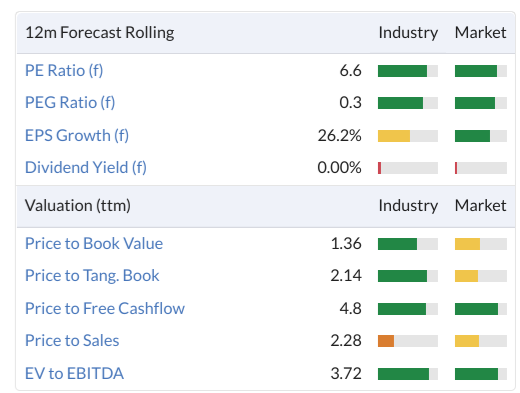
Maybe I just need to spend more time studying it, but Tremor International (LON:TRMR) hasn’t yet convinced me that it makes its money in a sustainable and predictable way. I like it when companies speak plainly, but I don’t believe that Tremor does this. For this reason, it’s not something I could consider investing in at this point.
Disclaimer
This is not financial advice. Our content is intended to be used and must be used for information and education purposes only. Please read our disclaimer and terms and conditions to understand our obligations.

66 comments
Re Tremor International (LON:TRMR)
I agree there's much that is uncertain in that we don't know what the 'true' run rate of business is currently (as much about how much they've grown over 2 years as is about short term headwinds) nor can we know what its durable growth rate is going to be (again due to change...and now the large acquisition).
However, the character assassination of CEO and hints at fraud are the worst sort of bs drive by banalysis. By all means identify fraudulent behaviour if you can...but if we want to call management names then there's a long list of oddballs and lacking in social skills. Plus most firms on AIM ain't very clear/realistic about what their business plan is or how they will really get there. Many have clear narratives obvs and a lot of us are suckers for that. By comparison...whatever the presentational flaws of Ofer Drucker are (he's defo got them...one being language/cultural...his problem to overcomes given UK listing tbc) the reality of what he says and does is pretty clear and comes with pretty good cash flow too and past impressive implementation on acquisitions...I would like a cleaner game on capital management but do note that the high share comp is partly a function of great success under Drucker who took over during a multifaceted hiatus in management direction and the comp was struck then at something much more like £1 per share. (This too is when I bought as my deep dive on the civil fraud case against old CEO made me believe it was a nothing-burger...and then the product/ growth and other issues were heavily discounted such that I got good value and an uncertain but potentially high growth option...and under Drucker that growth option has proven much better than I could ever see forward to...actions speak much louder than halting words)
...some dark brooding that the cash ain't real as they raised in US IPO and they are using part debt for Amobee acquisition. That's just silly and not a smoking gun. I was miffed at size of IPO raise but that is not uncommon...and quite a few would say that it was a good raise for 'dry powder' done at higher price if it was one of their narrative positive stocks given stated acquisitiveness. The accounts are tough reading (like other in the space in US too...lots of working capital) but comb through them and find evidence before shouting fraud if you want to be credible...of course feel free to shout what you like based on whatever you consider passes for analysis.
I rarely tip stocks and with Tremor I'd advise people not to get involved unless they do some work as there's a load of volatility and uncertainty in this for some good fundamental reasons and many poor/dodgy sentiment ones. However, I feel comfortable holding (I accept high risk) as I think the odds are high that I have durable value (even with some slowdown) and very high optionality on growth and future pricing. Low anxiety and looking through the noise required. I'm not telling you Tremor are saints and I'd change some things
A number of you on thread are now in my little black book of banalytical fools...you know who you are ;)
If you are lucky/unlucky (delete as appropriate) I will try put some detailed fundamental thoughts together on Tremor. But don't have time until next week earliest...
mojo out x
A number of you on thread are now in my little black book of banalytical fools...you know who you are
Mojo. I love your work. And I’m happy to be sat at the front of the banalysis class. However, I would not so lightly dismiss a dissatisfaction with a CEO’s presentational skills or his apparent motivations. When you buy shares in a company, certainly if it is with a long-term, buy and hold perspective, you inherit a hiring agreement with the board of directors. You have to be happy that the board, and CEO in particular, have the decades-long interests of shareholders at the forefront of their concerns. And that they are motivated by legacy - they want to build something that will endure beyond their passing for the benefit of the employees and the evolving owners. They should be motivated by their own enrichment of course. But that should not crowd out other more altruistic aims.
When I bought shares in Tremor International (LON:TRMR) I was swayed by the valuation and position in CTV. But my subsequent engagement with the company, including but not confined to their online presentation, persuaded me that the BoD did not pass my “hiring test”. I sold last autumn. The recent results, precipitating a 22% fall, are in stark contrast to my other adtech holdings, Trade Desk (up 37%) and Pubmatic (up 30%) and do nothing to change my perspective.
I wish you great investing success and look forward to your next exasperated attempt to educate us all :-)
Hi Graham,
Thank you for your and Paul's work and coverage for the SCVR which I try to read daily.
Just a short comment regarding the brief valuation/multiple you gave for Tremor International Tremor International (LON:TRMR) (I hold). While I do think there are various reasons that the valuation muliple of Tremor International should be higher than the multiple applied to Amobee, not least because it is a larger business whose scale and focus also provides higher margins and apparently profitability whereas we are advised that Amobee is not profitable (the part that Tremor International has agreed to acquire taken as a stand alone entity) - the main point is it appears that only H1 figures were used to come to the valuation of $587m. Even on the low multiple used, the valuation based on trailing twelve months contribution ex-TAC should be approx. $850m. This is substantially higher than the current Mkt cap excluding any benefit from further scale and synergies etc as you mentioned. Sorry if I’ve missed something here.
Thanks and kind regards,
Michael
Hi Michael, thank you so much for the correction. We need readers like you to help us out, when we make mistakes. The article has been amended.
Best regards
Graham
You're welcome Graham. Thanks for your reply. Yes that seems a very important point since you're covering large amounts of news and data and readers will often know many of the companies they invest in quite well.
I'm not sure if there is a sort of notification system for readers when articles are amended though if not it might be worth adding a note on the current day's report if something material has been revised - in this case half year figures to full year do make a sizeable difference - as the write ups do have a bearing on people's thoughts and perceptions of companies and their valuations.
In any case thanks again and all the best,
Michael
Hi Paul ,
Any idea why the CEO of Anexo plc has just bought almost 10% of Ince plc?
I know that you do not like this stock ( I didn’t as well but I am more positive now ) , but the new CEO has just bought around 10% , Crux asset management bought also around 10%.
Maybe the restart of Ince?
Maybe the restart of Ince?
Surely it needs an overhaul of the management team before it can be considered for investment. At the moment it’s just the same people that have driven the SP into the ground.
Well I have asked Paul if he knows why the CEO of Anexo bought 10% of the company , a new CEO 10% and the well established Crux asset management another 10%.
Don’t just take 3 words out of the 50 or so that I have written and just write about past performances and events. We all know the past. It’s the future that matters.
Not mentioned in any of the Tremor International (LON:TRMR) analysis or comments so far today is their $75 million buyback programme. It started on 2nd March with the first buyback at 564p and the share price today is nearly 40% lower at 353p.
Buybacks seem very popular with commentators and many investors, yet time and again there doesn’t seem to be any real reward for shareholders. And intriguingly whenever share price falls are subsequently high, analysis rarely, if ever, even mentions the buybacks.
Next (LON:NXT) buyback policy has been effective but Next is one of the rare exceptions, and Next will only go for them when confident their share price is good value . Many Companies buyback regardless of whether the share looks good value or not. AND buybacks nearly always peak at market peaks too.
Time and again subsequent share price falls show they were a waste of money. Tremor are due to review their buyback policy again at the end of this month. Wonder what their conclusions will be?
Just 2 of many more examples:-
Abrdn (LON:ABDN) started their eventual £1 billion buyback policy in 2018. The first one was at about £5. By 2019 the share had fallen about 50% and stayed in the mi£ to high £2 range through 2020 and 2021. Share is now around £1.65 and down 65% since the start of their buybacks.
£WTB spent the vast majority of their excellent sale price (around £3 million from memory) for Costa “rewarding” their shareholders by returning that cash via buybacks. The Whitbread share price has never again reached anywhere near the price of their early buybacks and the share price is way lower now. In the real world away from the convincing buyback theory Whitbread investors got no reward at all.
OK. None of us knew that covid was coming and Whitbread was in a sector hit hard and continuing to be hit hard by cost of living crisis/price pressures etc etc now. But that’s another thing not considered by buyback supporters and commentators. Subsequent events can render those buybacks being a costly mistake.
Some reading this will likely be thinking “what an idiot. ”He’s clueless about the reasoning behind buybacks. That’s what Lunimar the night clubs operator Management told me years ago when I bemoaned their stupidity in borrowing to pay for their buybacks. Their balance sheet was iffy but they ridiculed my suggestion that if they continued with their buyback policy they could well go bust. They did. I emailed and needless to add it wasn’t answered.
I MUCH prefer to see spare cash returned to shareholders via special dividends. A few Companies have switched to those. e.g RIO TINTO and other big Miners after the hundreds of £Billions they spent on them ahead of huge sector price falls saw their shares prices subsequently fall as much as 80%. RIO paid out about 20% in dividends and specials last year. Isn’t that a real reward unlike the examples in this post along with multiple others when those Companies opt for buybacks?
Apple’s buybacks have offered an amazing return for shareholders , and I can name at least another 100 companies that have rewarded their shareholders through buybacks over the years and probably another 1000 that have paid fat dividends but their price has never recovered , for example BT. Most of the buybacks in the US have been successful over the years ( they know what they are doing ).
You just chose some companies that their share price has fallen , in order to validate your argument , and this is misleading .
But I have to say that Tremor’s buyback program seems to be a bit dodgy ; always has been , and makes no sense at all.
yiannos
I wasn’t being misleading. There are many many similar examples where buybacks have failed to reward shareholders. Indeed years ago Morgan Stanley did very detailed research on buybacks and subsequent share price performance and remarkably found that Companies buying back subsequently performed better (i.e subsequent share price) than Companies in the same sector that didn’t buyback.
Whereas it’s possible to give examples (e.g Tremor today)where buybacks clearly were a waste of money, we can’t when the share price subsequently did very well, know how much of that was thanks to upbeat trading news etc or mainly the effects of fewer shares in issue thanks to buybacks.
One thing is for sure though. No account is taken of previous buybacks or the amount spent on them when a share is priced either after a bad update as with Tremor International (LON:TRMR) today, nor after better than expected updates.
From my experience, in the US they use the buybacks in a more effective way that benefits the shareholders. But we are talking about real growth companies being advised by the best bankers out there.
Thanks
IMO buybacks are essentially disguised tax evasion on return-of-capital to shareholders, and should be taxed at the same rate as dividends.
Ignoring the above, personally I'm happy to see buybacks from financial companies priced at a discount to TNAV, but beyond that give me the dividend and let me decide if I want to buy more of your stock, or maybe someone else's.
Interesting update for anyone who follows ASOS - Mike Ashley, through his investment vehicle MASH Holdings has increased his stake in ASOS over the past month from 1% to 2.91% of the company, just below the threshold for announcing I believe.
Interesting to see how he is expanding his investments into ecommerce more recently with the acquisition of misguided and now taking a larger position in ASOS. just to note, he doesn't have any holdings in boohoo.
I wonder if Paul or Graham have any thoughts on James Fisher And Sons (LON:FSJ) which has shown some movement off the bottom in the last couple of days. I notice too that Odyssean and Aberforth have both bought a couple of million shares each in the last few weeks.
Moreover, although the shares have fallen 60% or so from their high in the last 12 months, the Stocko line has been moving up steadily from above the bearish line to just below the bullish line now. The SP has moved above the 50 SMA recently (as have a lot of shares of course!) and the PE is modest. The Stocko Q, V and Overall figures are all in the 70s so fairly well thought of here.
It is a very complex company with many moving parts. A new CEO joins from Schlumberger next month, and one scenario is that he could clear the decks with a consequent further fall in SP before he shows his metal and transforms the business!!
The company does have a number of segments which could do well in the areas of current fuel sources on the one hand and in renewables on the other. I am reviewing my position, but would be interested to hear you thoughts - and others on this board. Thank you.
I have held James Fisher And Sons (LON:FSJ) on 2 or 3 occasions since about 2000 and done well out of my holdings It has always been a complex company with many parts that do not work well even before the last 3 years financial fun and games in world markets In my vey humble opinion the company needs a new simplified strategy to retain the parts of the company that can be run profitablely and with a chance of growth in turnover and profitability going forward and to get rid of the rest
I am not a fan of the present management but I have bought this company before on a change of management and done well
We live in interesting times!
ridavies - thank you for mentioning James Fisher And Sons (LON:FSJ) (I hold). It's been an interesting ride.
I too have wondered what is behind the recent share price strength. Though perhaps its fair to also consider why the shareprice has been so weak previously?
It's not the only share in my folio that has changed price behaviour in the last few weeks. I have a feeling that these shares have swapped from longterm sellers in the market with few buyers - to longterm buyers in the market with few sellers? To add a little more colour - traders and short term holders probably sold prior to the summer break, whilst longterm selling down of positions finished or got bought up by the new 'value' holders recently appearing on the register. Leaving new buyers interested with few sellers around.
Note also - that the largest holder is the Sir John Fisher Foundation (charitable trust in and around Barrow) with around 25% with the next few longterm holding institutions taking it to over 50%. Which is also probably why there has been no shareholder dilution and why the shares are now quite tightly held.
I don't expect the H1 results to be very good. I do expect them to be reasonable and in-line with some positives and some negatives as the turn around is still work in progress. And as you say the new CEO is about to come on board.
A new CEO is a concern. But the FD and Chairman joined in mid 2021, there have been two extensive rounds of write downs already and the current CEO has only been in post for 3 years so I'm not expecting there to be a large new round of write downs. Maybe a tidying up exercise at the most and balanced by improvements . But really I don't think the management team will want to disrupt the currently improving sentiment? The new CEO appears to be more of a deal-maker - so perhaps he will be keen to forge new deals and set the future direction, taking the credit for future progress now that the bottom has been set? Whereas the current CEO is more a 'business improver' and in my opinion has been doing an excellent job under the covers. It's been a difficult balance to stabilise the ship, manage the heavy load of debt, lighten it a bit, keep the cash flowing, avoid selling off the crown jewels, and all without shareholder dilution under very difficult circumstances.
I note that the current CEO is staying with the company for a further 9 months until june 23 after the new CEO joins in September. They don't seem keen for him to depart swiftly and perhaps thats an indicator of the importance of the business improvement work thats underway across the company?
I've been adding recently at between 275p and 300p. The move upto 400p is welcome, but mainly reflects that it overshot on the downside at 260p. For me this is a Very-LTBH - I first purchased in 2001 at around 70p, rode it all the way up to 2200p. Failed to sell. Rode it all the way back down to 260p. Failed to sell. Bought more. No longer a more-than-thirty-bagger. A mere 5 bagger (or 27% a year on my initial purchase) for me. That ignoring the substantial dividends along the way.
But its the future that interests me most. At the moment this is one of my most risky holdings - because of the debt. They have some excellent businesses, technology and reputation, market leaders in their niches, and stand to gain hugely from multiple tailwinds across energy transition and security, renewables, oil and gas, decommissioning, nuclear, defence and national security. Provided of course that they can continue to juggle their way towards these future prospects.
James Fisher And Sons (LON:FSJ) was covered by jack in the 10th March SCVR ( and a note from me on what went wrong and how they are putting it right in the comments)
https://www.stockopedia.com/co...
cheers
Mark
James Fisher And Sons (LON:FSJ) was tipped in SCSW over the weekend.
Nanoco (LON:NANO)
Interesting broker note fromTurner Pope 6/6 suggesting that £Nano could be due £200m to £300m for US patent infringement. This is only 30 pct of sales so ultimate award could be much higher and numbers are only on sales to 2021 and not projected to end of patents. £Nano seem to have a strong case having won all points in dispute so far
The note can be accessed on their website for free
Market Cap is currently 150m and they have a developing business moving slowly along. Patent costs are partly funded from outside and any awards will be shared accordingly.
Looks worth a gamble - I hold at a loss so far
Rob
Two articles that caught my eye over lunchtime:
1. 'Discounters Aldi and Lidl both increased sales by double-digit percentages in the three months to 7 August as shoppers sought ways to reduce their bills...Waitrose, Morrisons and independent stores all saw sales fall back, as the overall grocery market rose 2.2% in the three months.' <- I sometimes think company commentary about 'trading down' during an inflationary and recessionary environment is wishful thinking, but perhaps not (at least for essential items)? https://www.theguardian.com/bu...
2. More on Purplebricks (LON:PURP) woes: '“Since the start of the year we [Strike] have listed 60% of Purplebricks volume but over the last two weeks it has been closer to 80%.' https://thenegotiator.co.uk/pu...
l'm not surprised, I shop in both Aldi and Morrisons but some of the price rises in Morrisons have been excessive in my opinion. For example rice went up from 45p to 71p, wholemeal bread from 59p to 75p then 2 weeks later to 85p. Aldi similar rice is still 45p, cheap wholemeal bread is 36p. I hardly buy anything in Morrisons now, just a few loose carrots and bananas. Morrisons much larger store but hardly any customers probably less than Aldi.
Graeme
TBH, even though I hold Tremor International (LON:TRMR), I do think you are spot on.
I have exited a third of my position this morning on little research (not currently placed to do it) on the basis that this TU and the note from finnCap obfuscates rather gives clarity to their operations. I think there are a lot of cognitive biases effecting my decision making here along with wishful thinking.
I recently read Games Workshop (LON:GAW) (I hold) report and accounts and for this is how all accounts and companies should report to their owners. 90 pages of information with IMO no hyperbole, not a picture in sight and I love the phrase they use to describe their purpose as a company “We intend to do this forever.” And this from the UK’s 152nd largest company.
Regards
Michael
You're very welcome Michael, and I wish you the best of luck with this one and with your other investments. Best regards, G.
Thx Graeme.
Big insider purchases from CEO at Integrated Diagnostics Holdings (LON:IDHC) totalling nearly USD 6m. Now that’s putting money where your mouth is. I have topped up in less spectacular volumes.
same
Tremor International (LON:TRMR) (I hold and have done since Dec 2017 except for a ‘short’ hiatus in 2020) reports today and currently marked down 16%. malcolmbell’s comment bellow makes me think that even though I have analysed the … out of this company I don’t really understand it and should not be holding it.
I will look at the figures in more detail when I have the time (currently sitting on a lake in France watching my son wake board) but do wonder if I’m “the patsy” here. i.e. the market can see something that I cannot/am blind to.
Do I rely on broker notes for false re-assurance? FinnCap has been saying for ages, it seems like years:
“We reiterate our Tremor target price of 1,700p based on 15x FY23 EBITDA, and after Microsoft acquired CTV-focused ad tech platform Xandr in December 2021, we do not expect that Tremor will continue to trade at a discount due to market or external interest”
And yet it does (continue to trade at a discount). I wonder who is right finnCap or the market? And yet a PE of 6 or 7 does seem to low for the company.
I look forward to Graham’s taken on the figures.
Regards
Michael
re Tremor International (LON:TRMR)
All I can add is I watched an investor podcast and thought they looked and sounded like a bunch of crooks. Anyone analysing their SBC might agree with that unscientific view.
BnB do you have a link by any chance?
Thank you.
Regards
Michael Broom Smith
Hi Michael
It was Investor Meet 16/11/21. It was easy to find because that was the day I exited my position!
I find that comment odd. Drucker (the CEO) has a good track record having previously built and sold similar ad businesses. No hint of any wrongdoing in those transactions from the buyers.
Would seem strange that he would risk his reputation / freedom on that basis. It’s not like he doesn’t have a mass of money from previous ventures.
People have questioned the cash for at least 6 or 7 years yet it does appear to exist. The company has been through several periods of external due diligence too where that cash evidence would need to be shown. Not infallible of course but I considered on balance that the evidence pointed to it not being a fraud.
Graham misses that the Amobee deal is for a loss making business so valuation metrics aren’t directly comparable. Assuming Tremor International (LON:TRMR) achieve the $50m of cost synergies then it will be decently profitable. Also Tremor has a lot of depreciation that masks the true cash generation of the business, so you need to unpack that to compare.
Guidance is $200m for next year which if hit puts this on 1* EV/EBITDA so irrespective of views as to how good the business is compared to peers looks like an anomaly.
As we know perception is reality though, and they are clearly disliked and not trusted. Peers in US are on multiples of that so also says that investors aren’t warming to the story. I don’t like the exec pay as I think it is excessive yet it isn’t that out of whack with US norms either (which I also consider way too excessive). So that doesn’t explain the valuation difference either.
Bit of a head scratcher for me.
I find that comment odd
It really isn’t. They look and sound like a bunch of crooks (to me). That isn’t a forensic analysis or a reasoned critique. It’s an emotional response. As I think was clear in my post.
Just watch the video and listen to Drucker, looking for all the world like a minor actor in a TV gangster series, fail to explain why investors should take a ride with him while his goon, or is it a NED, looms menacingly at his side “you should be proud to be part of this business!” I honestly thought he might say “but you can never leave!”
And that strikes at the heart of my aversion. This is not a business I would be proud to own, no matter how attractive the opportunity for a profitable trade.
Others might take a different approach, hopefully to their, and your, considerable benefit.
The alarm bells were loud and clear on Tremor. Last year they have raised around $130m ( during their US listing ) money that according to their accounts and statements , they simply did not need.
You simply do not raise $130m when you claim you have double that in cash. I believe that this will eventually follow the same trend as XLMedia.
at around £6.50 good call.
Thx.
Some nice things happening at Bank of Georgia (BGEO) I hold .
Have to admit Im not clever enough or patient enough to do a full analysis of banking shares, I bought quite heavy into BGEO when it plummeted after the Ukraine invasion on the basis Georgia isn't Ukraine .
Interesting that Georgia Capital (CGEO) who own 20% of BGEO is not keeping pace.
20% of BGEO is say 180 million.
CGEO is 302 million market cap at 669p
I was invested in both as I figured the CGEO was too hard for a thick Northerner to understand with a lot of unlisted stuff in their portfolio.
But if Bank of Georgia goes higher there might be a bit of long term upside in CGEO who will be receiving the chunky BGEO dividend every year .
All a bit complicated but also bear in mind the currency gain .
Just ramblings really ,
The NAV of Georgia Capital (LON:CGEO) is now 1692p. It is my biggest holding
Pretty much my situation - another (adopted) northerner.
Hi Paul. Thanks for the pod cast. A good way to catch up from the beach!
WRT state intervention on energy, I am doubtful they can do much more than make sure low income people don’t freeze this winter (which is a moral duty).
However, any significant attempt to create a false market will most likely end up pouring tax payers cash into market makers pockets and kicking the problem down the line. I feel a very difficult winter is ahead of us so I am being very defensive at the moment.
I’m also wary that the recent bounce in the American markets is the (“it’s going to be alright”) phase in a multi year boom bust cycle. I’ll be happy to be wrong but not taking any risks at the moment.
Re your first point to Paul, Revs8, unfortunately the nation does not seem to have the systems (and they would be massively complicated anyway) to isolate the needy and not reward us all. Moreover, it would be based largely on historic data and we know that individual circumstances can change, for the worse as well as the better over a short period of time - losing your job, health change etc
As a result, less can be given to the needy at an affordable level to the country as a whole. I wish I could come up with some thoughts, but other than personal morality leading those of us who don't need it or so much passing it on through other channels which would benefit the needy in our areas, I cant.
Perhaps there is the seed of an idea there. Listings of food banks and other routes to help could be set up by trustworthy organizations and quickly, because there is no time to lose.
Smartspace Software (LON:SMRT) I don't know the company well but I suspect that the reasonably healthy current cash position has been helped by better than expected Evoko Naso sales. From what I remember, Smartspace provide the software for the Evoko Naso room booking system (manufactured by a Scandinavian co I think) and sales were impacted by covid but are presumably starting to pick up again now. I would think that the license fees for this software will be pretty much pure profit (minus amortisation of capitalised software development) & go straight to bottom line. I'd be interested to see detailed sales figures for Evoko Naso. I held briefly a while back but lost patience & sold.
A miss on consensus turnover and adjusted ebitda for Tremor International (LON:TRMR) and downgraded forecasts. The RNS does give forecasted figures should the Amobee acquisition complete in quarter 3 (full year adjusted ebitda of $200m, against $155m without). Its peers in the US almost all posted good levels of revenue growth so these results are disappointing. Finncap still banging the drum and retains its £17 target. Down 13% at the moment at 388p.
Everytime I see the stock based compensation here I have a little bit of sick in my mouth. $15m for the last quarter. Forecast over $50m for the year. (adjusted ebitda for the quarter was $39m).
From the invaluable Mr C's factory of 1-liners (whether this one is a typo or not!), I loved this mental image for a positive, mutual deal building trust and co-operation: "the Invinity Energy Systems (IES)► sings MoU with U.S. Vanadium..."
A tiddler in the recruitment market, Norman Broadbent (LON:NBB) gives an Interims update today. Interesting that headcount increase at 50% is significantly higher than revenue increase of 28%. They are even expanding into Scotland with a new office in Aberdeen imminent. There seems to be room for everyone, including this self-styled 'leading London quoted Executive Search and Interim Management firm offering a diversified portfolio of
integrated Leadership Acquisition & Advisory Services'. No significant ripple in the market. SP unchanged, down over 40% from this year 'high',
A tiddler in the recruitment market, Norman Broadbent (LON:NBB) gives an Interims update today. Interesting that headcount increase at 50% is significantly higher than revenue increase of 28%. They are even expanding into Scotland with a new office in Aberdeen imminent. Interesting that headcount increase at 50% is significantly higher than revenue increase of 28%.
This business has been undergoing a painful and, so far, fruitless turnaround for more than a decade. The latest abrupt lurch sees them replacing the CEO with one whose background is in recruiting for oil and gas, which explains the Aberdeen focus and probably also the hiring of new consultants - some of them possibly former colleagues of the CEO.
That the revenue growth lags the headcount increase is not a red flag. This is completely normal. It takes time to build relationships and sales pipeline. What they will do when the current oil and gas hiring feast turns into the inevitable cyclical famine is a more important question. As is understanding how many of the new hires are proven fee earners rather than higher risk “graduate appointments” where attrition runs high.
Ultimately this is a business that lately has made little sense to me. By positioning themselves as high end headhunters they find themselves committed to ruinous remuneration packages for their consultants. Some employees are doubtless worth their pay, but the high threshold this strategy imposes on the achievement of profit has been a disaster. Meanwhile the trajectory of revenues since 2019 suggests a flight from the business of its most productive fee earners.
I do know that prior to the pandemic the business was heavily reliant on Fintech for its fees. The drying up of investment liquidity and the fall in valuations for this sector will have had a devastating effect on hiring plans. So the shift embodied in the new CEO towards other industries may well be a sensible move in the short term. He at least brings new energies, which I know through my own channels had become exhausted in his predecessor.
Would I buy today were the market cap and free float above levels where I can achieve an optimal position size? Not today, but I think it is worth looking for signs of progress in the numbers to follow today’s hopeful narrative. I would also look for the CEO to simplify the company’s offerings. Is it a recruitment business or a management consultancy? Where is the focus? Do all the add-on services improve performance or simply bloat the cost base? Good luck to the new management team.
Well BnB, your assessment of Norman Broadbent (LON:NBB) is excellent (as are the vast majority of your insights here) and saves me a lot of research, even if the company was that interesting to me. Thumbs up to you.
PS my comment on the hiring vs revenue increase was more a matter of the difference in scale than the existence of the difference itself. 'Hope springs eternal' came to mind.
You’re welcome. Good luck in your research. Valuation of £NBB is still a challenge, not just mathematically owing to the excessive gearing, but due to the lack of profits and the mass dilution of the last decade. SThree (LON:STEM) and Robert Walters (LON:RWA) are both well-focused operators with a better risk/reward. And offering great value.
"Giving away say 1p is a small price to pay for the certainty of a deal" may not be a bad plan when time is so precious. One can wait months before resolution and that's if there is one. I don't hold Ted Baker (LON:TED) but find the EMIS (LON:EMIS) I do hold in more or less the same boat.
Watches of Switzerland (LON:WOSG) forgive me I know this is not a small cap, but I find this a fascinating update with high priced watches and jewellery being one, you would think is a discretionary spend and under pressure, has delivered a pretty amazing set of Q1 results.
Group revenue £391 million (Q1 FY22: £297 million), +25% at
constant currency, +31% at reported rates
Luxury watches +32% to £342 million, representing 87% of revenue (Q1
FY22: 87%)
Luxury jewellery performing well +36% to £27 million
Continued strength in group ecommerce sales +14%
I appreciate Watches of Switzerland (LON:WOSG) are a growing company, operating in a niche(ish) area of a market, but just goes to show the minefield of making investments ATM, with well organised businesses still able to give decent updates in what we (or I) would perceive is a challenging market area.
They have reiterated previous guidance of a more challenging environment for second HY23, but these three months to 31st July 2022, for me, have been fascinating.
(I don't hold)
Yes very interesting, and I have held Watches of Switzerland (LON:WOSG) for a while. I think these difficult times do not exist for people who can afford luxury watches. The waiting list especially for Rolex is unreal, and the right model will probably make money.
There was an interesting article in the Money section of Yesterdays Telegraph. It claims that the demand for new luxury watches is so high that the waiting list is now in years rather than weeks. It says gone are the days when you can wander into a jewelers and buy a Rolex
https://www.telegraph.co.uk/mo...
It is true, you need to develop a strong relationship with the approved dealer, and almost be willing to leave your wedding day for when they have one available. Some models you can't get unless you have already bought a Rolex in the past. Second hand market is very busy.
I wonder if an element of these sales has been driven by people trying to protect the real value of their liquid savings by converting a portion into physical assets i.e. would you rather keep £xk in the bank and see it ravaged by inflation or buy a Rolex in the hope this gives you greater inflation protection. Just a theory.
All that being said I would be very nervous of this stock. As you say Watches of Switzerland (LON:WOSG) markets the ultimate discretionary goods. And unlike, say, Ferrari I had always understood they don't just rely on the 0.1 of the 0.1 of the 1% i.e. not just the Ultra high net worth, but (upper) middle class consumers who will ultimately be feeling the pinch of higher electricity prices, career uncertainty (see the increasing stories about upcoming City redundancies, or at the very least far diminished bonuses), etc.. If it's a choice this Autumn between that 3rd IWC or keeping the lights on I don't think the former wins.
Anecdotally I read a story the other day about panicked Chinese consumers liquidating large luxury watch (and hand bag) collections as recession there bites. The point being that even luxury is not immune from the general economic environment. Could it be that it was just another sector temporarily turbocharged by easy monetary policy and the accumulated savings produced for the fortunate professional class in lockdown? As all this unwinds a reckoning is due...
serving the rich has been a good business to be in over the last five years.
Look at LVMH, L’Oreal.
TheFloatingInvestor I think that it is important to remember that there is not cost of living crisis if your income is above say £200k (or if you have a couple of children at private school £300k). For various reasons I know a number of quite wealthy people and it, the COLC, is not even on their radar. If they want a £15k watch they will just go and buy it. If, as I do, you tend to get the news from the dear old BBC and The Guardian it is easy to get the impression that the whole of the western world is living in one room because it cannot afford to heat the whole of the home where as in fact it is about 10% to 15% of the population. At an individual level horrendous but for many companies not the end of the world. Well that is my take on it.
I know little about Watches of Switzerland (LON:WOSG) and it is probably not bomb proof but I suspect it is quite resilient in the face of recession.
I own LVMH in my son’s JISA and this is up 4% since the invasion of Ukraine (!) by Russia and only 8.43% off its all time high.
In current times Watches of Switzerland (LON:WOSG) and LVHM are good companies to hold.
Regards
Michael
Thank you as always Mr C. I note you hold Spectra Systems (LON:SPSY) as did I before I thought I could find better use for the money, which proved to be the case since the SP has fallen further since selling.
The future - not very near - seems always brighter for this company. I have seen it much vaunted by a certain pundit on Mello on several occasions. Since then it has continued to lose me money on SP. I trust you are going to live longer than I because this is a medium term investment return at best.
Harland & Wolff group (LON:HARL) have a business and trading update out today. This one has been on my watchlist for a while and seem to be making steady progress with contract wins. Would you be able to have a look at this one please chaps? Many thanks, Bris.
Morning Bristolian!
Here's today's agenda FYI -
thanks Paul (and Graham)
Thanks for the write up on Harland & Wolff group (LON:HARL) Graham, much appreciated. Your analysis keeps my feet on the ground. It's great to be able to cut through the hype and indeed nostalgia with this share.
Very welcome, Bristolian. G
Looking forward to the write up on £TRMR. Both a revenue and profit miss in the trading update today but guidance for the future still seems very strong. I hold but continue to scratch my head why this isn't significantly higher than it is. Debating whether to add more today with the declines.
My private note on Tremor International (LON:TRMR) last 21 May was "700 today and forecast to go to 1200 by Finncap. Ed Crofts and Jack Brumby support it and the Stockopedia club just voted 70/30 to buy. But it's an Israeli company, quoted on AIM and major shareholders sold q a lot recently ...".
Is the Stockopedia employee share club still active? I haven't noticed any updates for a while.
Tremor International (LON:TRMR)
I continue to scratch my head just trying to understand the numbers they have announced. (I hold.) The big drop in six month profit, compared with last year, is accounted for by a big rise in the tax charge, and a huge rise in share-based payments. There is no explanation of either, but they both look like real costs to me. A bit more explanation would have been sensible.
Tremor is the only video ad tech to have lost sales in the quarter in a market growing 25% pa. The underlying reason is they fell out with their key data supplier Alphonso allowing it to be bought by LG and then Tremor was locked out of the data (it acquired for small $ and sold to customers for $$$) thereby prompting dozens of clients to leave the Tremor platform and hence the decline in revenue. Magnite took up the contract with LG/Alphonso and reported 30% revenue growth as a result. Tremor has attempted to replace Alphonso with Hisense smart tv operating system but this is inferior in low net worth households who buy hisense and toshiba tvs and to top it all hisense is replacing the operating system tremor bought with adroids! So once again Tremor management did not do the honest thing and release a profits warning to let people know and tried to hide all of this. On top of it all it is buying a giant lossmaking business amobee which is also losing customers.
Tremor’s announcements and numbers for the last 9 months or so do not make any sense at all.
I strongly believe that the share price will drop further in the near future.