Small Cap Value Report (Tue 18 Feb 2020) - Apple, CNKS, ANG, TGP, TON, BLTG,

Good morning, it’s Paul here with Tuesday’s SCVR. Please see the header above for the running order.
We reached a pleasant milestone today - the first day of the year when I drew back the curtains at 06:47, and it was daylight! Only just, but I'm a glass half full person. So that's put a bit of a spring in my step today.
Estimated time of completion today - 1 pm.
EDIT at12:41 - I'm taking a break for lunch now, but will add some more sections after lunch. So revised finish time is 4pm.
NB this is extra work, not a delay! So thumbs-downers, keep your greasy mitts away from that button!
EDIT at 16:28 - today's report is now finished.
I've been doing some planning for my telephone interview this Thursday, with Andrew Gossage of Up Global Sourcing Holdings (LON:UPGS) . I've asked UPGS to talk to us about China, because the company is a specialist importer of branded consumer goods from China. The company was receptive to my request for an interview, and suggested we talk towards the end of this week, so that they will have a better handle on how the situation is developing in China, a few days after the usual Chinese New Year shutdown has ended.
I see that overnight, Apple indicated it would see a greater than anticipated hit to revenues, due to coronavirus. Apparently it usually sells about 10% of its product in China, and makes most iPhones in China, so a double hit in the short term anyway, to both sales and production.
Talking of which, I've just seen that Iqe (LON:IQE) (a supplier of chip wafers for semiconductors) is down about 5% today, presumably in response to Apple's predictable warning. IQE's share price is down to only 58p. I remember doing very well, trading this share, a couple of years ago, on positive newsflow. As it's turned out, the optimism & expectations of big profits, looks to have been hot air. IQE's broker forecasts look dismal now;
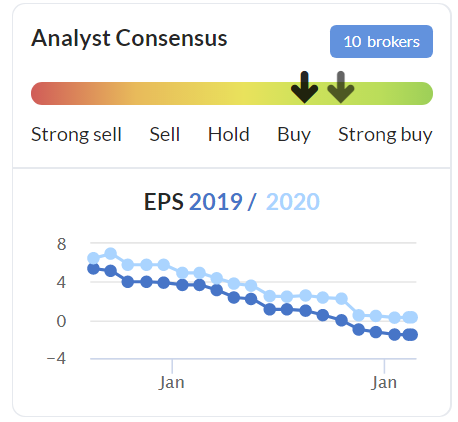
.
IQE's share price chart looks similar to something out of the TMT (technology, media & telecoms) boom/bust of 1998-2002;
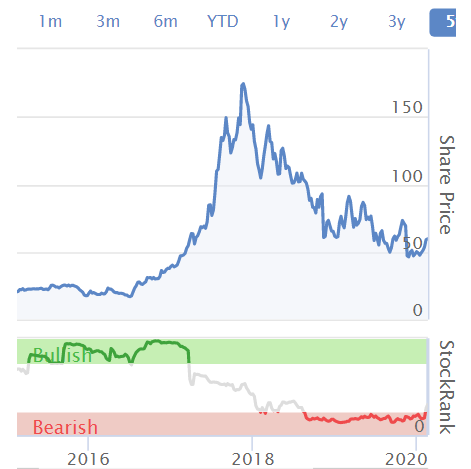
.
What's interesting about this picture, is that the StockRank (see above, it's embedded within the share price graph on the new Stocko site) began falling sharply well before the share price peaked. It had turned negative in early 2018, when the share price was still near its highs. I wonder what the StockRank system picked up on, which foresaw the downturn? Possibly reduced broker forecasts, and/or poor value perhaps? Do remember that the StockRank system is very clever, but not infallible. If it was infallible, we'd all be billionaires. It's proven to work on a portfolio basis, but not necessarily for every stock within that portfolio, so please always bear that in mind. Still, in this case, the falling StockRank was flagging that something was going wrong, well before the share price peaked. Therefore, I'll certainly keep an eye on the StockRank movements for shares I hold, for possible early warnings.
I think this situation is also a reminder that, whilst we like to delude ourselves that we're geniuses during good patches of portfolio performance, the reality is often that we just got lucky in spotting a speculative wave, and riding it. Getting off a speculative wave at the right point is probably a more important money-making skill than any detailed analysis (much of which often turns out to be wrong, as was the case with IQE!). A sobering thought.
There's a lot more luck in this game than most people like to admit - a lot of successful investors have told me this, as well as my own observation. Getting lucky occasionally, and then successfully hanging on to the profits, is what it's all about really. I haven't quite mastered the second part yet!
Cenkos Securities (LON:CNKS)
Share price: 66p (up 8% at 08:16)
No. shares: 56.7m
Market cap: £37.4m
(at the time of writing, I hold a long position in this share)
Cenkos is today issuing an update on trading for the financial year ended 31 December 2019.
2019 was tough, as expected.
Profitable in H2, and FY 12/2019. It made a loss of -£0.2m in H1, which implies a profit of at least £0.2m in H2. Although, as MrContrarian points out in the comments section, this wording is a little ambiguous;
The Company is pleased to announce that, subject to audit, after taking account of the non-recurring restructuring costs of approximately £1.4m that took place in 2019, the Company has been profitable for the second half of 2019 and expects to be profitable for the year ended 31 December 2019.
The way I read that, it seems to be saying that underlying profitability is at least £1.6m (i.e. enough to turn in a FY profit after the £1.4m restructuring costs, and the -£0.2m H1 loss). Why couldn't they just have said that?
It would be much clearer if Cenkos had just put the figures in a table, with columns for statutory, adjustments, and underlying profit, with prior year comparatives. I find that numbers are better than words, to explain numbers! It's a little concerning that a broker which is advising its clients on how to communicate with the market, doesn't display enough clarity with its own announcement.
Cost-cutting - fixed cost base today is £3.0m lower than in 2019. Incurred restructuring costs of £1.4m. Note that at its H1 2019 results, staff costs halved vs H1 2018, to £6.5m (from £13.0m). So it's noteworthy that Cenkos has a highly flexible cost structure -with staff getting lavish bonuses in the good times, but taking the pain in the bad times. The fixed cost base being cut is in addition to the effect of reduced bonuses.
Outlook - encouraging;
Whilst still early in the year, the Company is encouraged with the strength of its pipeline and is pleased to report that the momentum that took place in the fourth quarter in 2019 is continuing into the new year.
The confidence in our pipeline is reflected in the Board's expectation of announcing a final dividend when it releases its results for the year ended 31 December 2019, in late March 2020...
Market conditions may still be impacted by factors outside our control but we have started 2020 well and we look forward to the year ahead."
A dividend, but not stated how much.
My opinion - as mentioned before here, the valuation on CNKS looks very low, being largely backed by cash and near-cash.
The glory days of making tons of profit on Woodford-based IPOs may be gone, but I like the way the business has flexibility to sharply reduce costs in leaner years. Therefore, it can not only survive, but remains financially strong, even in a downturn for IPOs and fundraisings.
An improving outlook in 2020 augurs well I think. Simon Thompson's recent tip of this share could turn out to be more than a short-lived spike. Overall, I think risk:reward here looks good - a very strong balance sheet, combined with a flexible cost base, and improving outlook, sits together nicely. Plus divis whilst we wait for a re-rating.
Angling Direct (LON:ANG)
Share price: 62p (down 9.5%, at 09:29)
No. shares: 64.6m
Market cap: £40.1m
Trading update (profit warning)
Angling Direct plc (AIM: ANG.L), the largest specialist fishing tackle and equipment retailer in the UK, announces the following pre-close trading update ahead of the publication of its financial results for the 12 months ended 31 January 2020.
The company has missed its FY 01/2020 forecasts, as follows;
Revenues actual: £53.1m, forecast: £54.8m (3.1% below)
Online revenues - up 13.3% against last year, at £25.2m, a healthy 47% of total revenues. Of which, 20% are international sales - encouraging.
Physical stores - strikingly good LFL sales, up 12%. Plus 10 new stores opened.
Adj EBITDA - too confusing, because the company reports pre-IFRS 16 (c.-£0.5m EBITDA loss), but the house broker reports the same number post-IFRS 16 (£0.6m positive adj EBITDA). In my view, post-IFRS 16 EBITDA is too distorted to be useful (because some property rental costs are stripped out, and shoved into finance costs, lower down the P&L, thus artificially inflating EBITDA). Surely it would make sense for the FD, and the house broker, to compare notes and report figures on the same basis?
Adj profit before tax - in my view, this is the most meaningful number to measure performance. This should come out at a -£1.4m loss for FY 01/2020, according to a broker update note out this morning, available on Research Tree. This is £1.0m worse than the previous forecast.
Despite the upbeat commentary, this company doesn't actually make any money! Although that is not unusual for smaller, growing (partially) online businesses - they usually need to reach decent scale before meaningful profits start to flow.
Reasons given for lacklustre end to FY 01/2020;
- Weather - flooding post Xmas, impacted fishing activity
- Stock clearance at lower margin, related to acquisitions
- More prudent approach to some legacy costs
1 and 2 sound credible, but I'm a little worried by point 3. FDs should always be prudent, that's a key accounting principle. I'd like more detail on this. What costs, and why weren't they provided for before?
Cash - reported at £5.9m as at 31 Jan 2020. That is down a lot from £13.3m reported at 31 July 2019. This must be funding capex for new stores, and inventories (which tend to be quite high in this niche, due to the requirement to hold large numbers of stock lines, some of which might be slow-moving, but necessary to have a complete range).
Capex - given that existing stores & online are not currently generating any meaningful cashflows, then the question has to be asked whether it is appropriate to keep spending heavily on expansion capex?
My opinion - to drop £1m of extra losses, in the last few weeks of the financial year, is not good.
It's loss-making overall now, and is not demonstrating that the heavy expansion capex is delivering any return.
Given that the previous forecasts have been revised down heavily, and then missed, why would I rely on next year's forecasts?
Therefore, I think the jury is out on this one. Based on the numbers above, ANG has a lot to prove, before I'll be convinced that there's a decent business here.
Tekmar (LON:TGP)
Share price: 103p (down 33%, at 10:31)
No. shares: 51.3m
Market cap: £52.8m
Trading statement & impact of corona virus (profit warning)
Several readers have flagged up this announcement as being interesting. It's come up on the list of top share price falls today too, which I always consult in the mornings, to pick up on profit warnings & out-performers on the upside. This is down 33% today, indicative of a medium-severity profit warning (which are typically marked down by about 30% initially, and then the market makers move the price up or down further depending on buying or selling activity).
Tekmar Group (AIM: TGP), a leading technology provider of subsea protection systems for the global offshore energy markets, announces a trading update, which reflects the foreseeable impact of the outbreak of the coronavirus on the Group's performance in the year ending 31 March 2020 ("FY20").
This company floated in June 2018, and I must confess to knowing nothing about it. Hence my first port of call is the Stockopedia graphical history, which shows a lovely growth in revenues & profits, and a high profit margin. So far, so good;
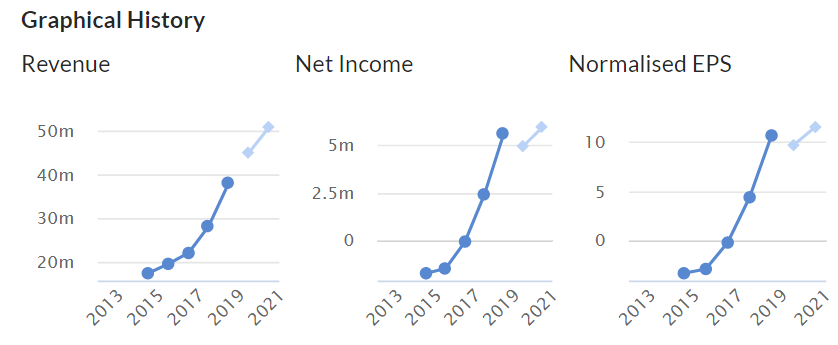
.
Its AIM Admission Document is here, and I note it has a picture of an offshore wind farm on the cover - which would explain the growth story, given the UK's rapid growth in wind energy (which amazingly, generates 30-40% of all our electricity already, having all but replaced coal-fired power stations).
Here are my notes from a quick skim of the Admission Document;
It floated at 130p, raising £61.8m, of which only £9.4m net proceeds retained by the company - so looks like the fundraise was to make acquisitions, and pay off debt, probably from private equity owners at a guess (who load up investee companies with debt, to avoid corporation tax).
See page 77 for a table showing before & after net assets, which explains where the IPO money went. Here it is, with my highlighting of the key numbers;
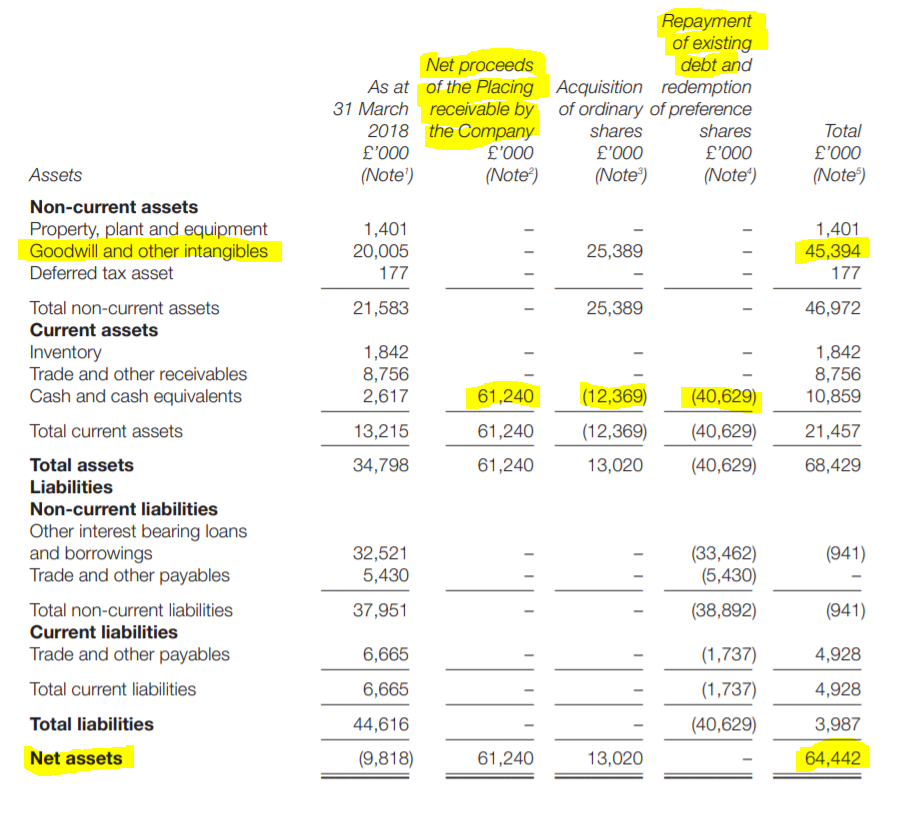
.
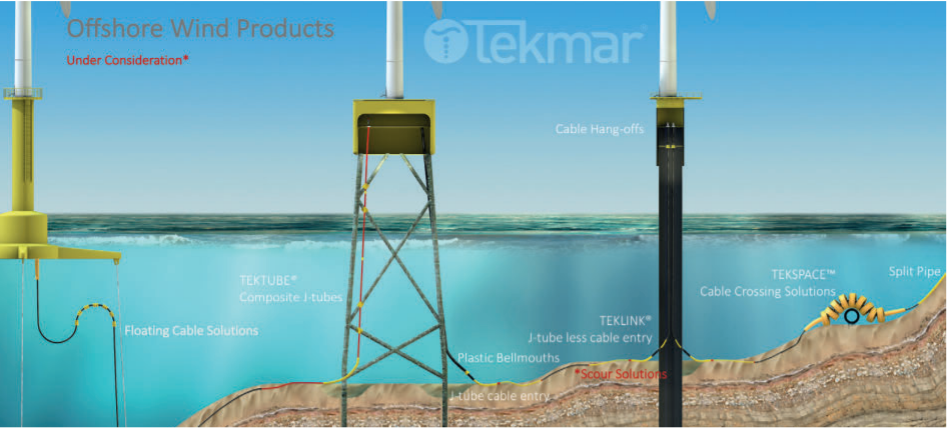
- Claims to be market leader globally in this niche (for wind farms, 83% of revenue at IPO time)
- Founded by 2 commercial divers in 1985, in Norway
- Typical contract value is c.£2m
- It says cable protection is a no-brainer, costing 0.1% of the cost of a wind-farm, but protecting & prolonging life of cables & preventing expensive outages/repairs
.
.
- High margins are defended with patents, know-how, trade secrets (Part 1, section 4)
- Balance sheet pre-IPO was indeed loaded with £32.5m debt [see page 42]
- Good historic cashflow generation [see page 44]
- Controlling party, pre IPO is Elysian Capital I LP - as I thought, a private equity company. PE fingerprints are all over the accounts!
Risk factors - China is not mentioned as a risk, and is only mentioned in passing 3 times in the whole admission document. The disclosure on suppliers is more generic;
Reliance on third-party suppliers
A limited number of third-party suppliers may be contracted for the supply of certain materials or
components. These suppliers may not be able to meet agreed minimum levels of supply. Failure to obtain
a continued supply of components on competitive terms or at all could severely harm the ability of the
Group to develop and realise projects and, consequently, the Group’s financial condition and results. [page 32]
The force majeure risk disclosure probably covers the company's backside against any legal claims from shareholders that the China risk was not adequately disclosed at IPO;
Force majeure
The Group’s operations now or in the future may be adversely affected by risks outside the control or
anticipation of the Group including labour unrest, civil disorder, war, subversive activities or sabotage, fires,
floods, explosions or other catastrophes, epidemics or quarantine restrictions. [page 36]
OK, I think that's enough from the admission document for me to conclude that this looks like a high quality float. That is confirmed by the major shareholder list, which includes luminaries such as Hargreave Hale, BlackRock, Henderson, and Miton. I like seeing those names on a shareholder list, as they know what they're doing. Although HH are known for smashing share prices down when they decide to unceremoniously exit positions that have gone wrong. So a double-edged thing with them on board sometimes.
Directors only hold 3.4% of the equity, according to Tekmar's website here.
.
What's gone wrong today? - disruption re China, both from Chinese suppliers, and Chinese customers.
Overview;
China's necessary and prudent response to the outbreak of the coronavirus, including the restriction of travel in the country, is affecting the Group's performance materially in a number of ways. The Board now expects that the Group's earnings in FY20 will be broadly in line with those achieved in FY19, as a result of the following factors...
I would have preferred more open disclosure of the financial impact. This partially obscures it, by forcing me to look up both last year's results, and current forecasts, and compare them to work out the financial impact. What a waste of time, when the company has that information to hand, but has declined to provide it. I can't find any broker notes either.
Working from the broker consensus numbers on Stockopedia (from Thomson Reuters), this looks a big miss. Tekmar did 4.35p normalised EPS in FY 03/2019, and we've got a forecast of 9.67p for FY 03/2020. So if the numbers are now going to be similar, then that implies a miss of about 55% against forecast. Ouch. If that figure is wrong, then it's the company & its advisers fault, for not providing us with more detailed information! They really do need to get some proper forecasts out to the market, for everyone to see, not just a privileged few - who could then arguably be accused of insider dealing, if they're using information that has been denied to the rest of the market.
Anyway, don't get me started on that again.
Actually, I've just discovered another complicating factor. The Thomson Reuters normalised EPS figure for FY 03/2019 of 4.35p doesn't tie in with the company's adjusted EPS for last year, of 6.21p. The problem here is that TR makes adjustments to earnings figures, to make them comparable between different shares, but not necessarily comparable with the company's own definition of adjusted EPS, and I don't have any reconciliation of the difference. This is turning into a nightmare, which I cannot exactly quantify due to not having enough information.
Anyway, we've got enough information to work out that this looks like a big miss against forecast. Q4 was a key seasonal quarter for profits, and it's been badly disrupted because of China/coronavirus.
Reasons for profit shortfall -
Travel restrictions - shipments to China by Tekmar, have all been delayed, due to travel restrictions.
... all of the Group's projects scheduled for shipment to China have been delayed and there is little visibility as to when travel restrictions will be lifted
Whilst obviously that's bad news for the current financial year, this presumably is just a delay. So revenues & profits should just shift from FY 03/2020 into FY 03/2021. The goods are not perishable presumably, and the customer presumably would be unlikely to cancel the order. An important point might be any penalty clauses for late delivery in the contracts. Do these include a force majeure clause, to protect Tekmar? I'd be very surprised if they don't, as that's bog standard in all contracts.
This particular reason should therefore not be a concern to long-term investors, as it should over time, get resolved.
Supplies from China - again this looks disruptive, but something that can be worked around, and is temporary in nature;
... the supply of components from China has ceased pending further notice. The Group has the ability to source replacement components from Europe and any resulting delay will not affect contractual delivery schedules for clients, but does affect the timing of revenue recognition and margins on affected projects
I think that being able to source product from Europe instead, is very important, and clearly positive. Even if there is a hit to profit margins in the short term, this should be recovered longer term, so shouldn't overly concern long-term investors.
Office closure - this looks likely to dent the pipeline/order book, at least in the short term;
... the Group's office in Shanghai, which services the whole of APAC, has been placed on official shutdown, as have many of our clients' and suppliers' offices in the region.
China accounted for circa 10% of our revenue forecast in FY20 and represented 20% of our outstanding supply-chain commitments.
And another thing - it's not clear if this is China related or not. Sounds as if it isn't;
Increased costs relating to one project within Subsea Innovation, which have arisen since December, are also affecting the Group's performance in FY20 to a lesser extent. Mitigating measures are being implemented to minimise the impact of these additional costs.
Directorspeak - reinforces that we still don't know how this China/coronavirus situation is going to pan out;
Alasdair MacDonald, Chairman of Tekmar Group, said: "The disruption caused by the outbreak of the coronavirus on the Group's activities and performance has been unpredictable and rapid, impacting the Group materially in our crucial, heavily weighted Q4 period.
With the situation in China and the surrounding APAC countries evolving, we are not yet able to evaluate the full impact of the virus on FY21 and will provide further updates as necessary."
My opinion - this is a very useful update, as others have mentioned, for wider read-across.
What is worrying for investors, is that the company's dependence on China wasn't flagged previously. I wonder how many other companies have similar exposure? Although Tekmar does seem a bit unlucky, in that this has coincided with its busiest seasonal trading period.
The savage market reaction to Tekmar's share price today, looks over-the-top to me, given that it's temporary & an external force majeure factor, rather than anything specifically the company has done wrong.
Importantly, Tekmar has a strong balance sheet, so I don't see any solvency worries at all here. That may not necessarily be the case with other companies though, with weaker balance sheets. This issue is a great demonstration of why companies need to have balance sheet strength, in order to be able to cope with the unexpected.
Overall, this looks like a long-term buying opportunity to me. Although anyone brave enough to buy in the current circumstances, needs to be prepared for the possibility of another profit warning, and incurring possibly heavy short-term losses, if the situation gets worse before it gets better, as is a distinct possibility.
If the market is going to punish China-related profit warnings this hard, then I think it might well pay to exit positions with likely exposure to China now, rather than waiting for the profit warnings later. Particularly with small caps, as it doesn't take much to move the prices. As a friend said to me recently, "if you're going to panic, make sure you panic first".
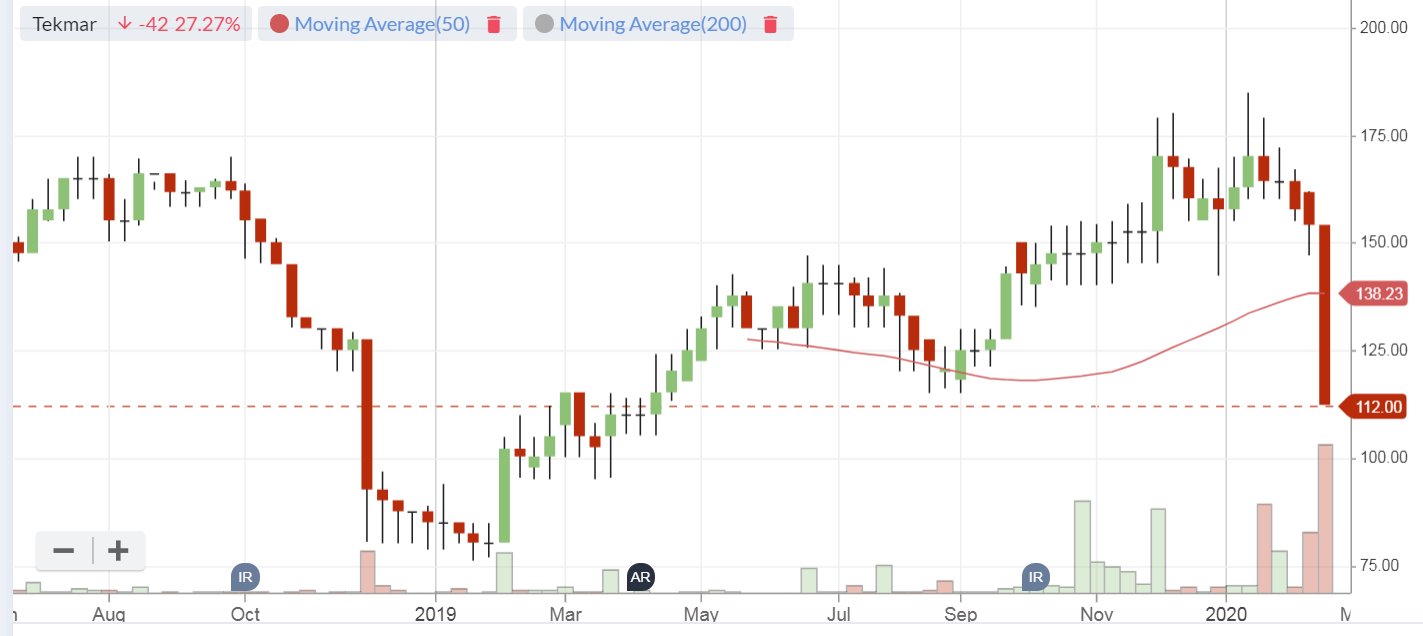
I've only just spotted that the company seems to have warned on profits previously too, see the chart below. I should probably look into that next, and add another section below;
.
Previous big moves - we've got nothing in the discussion archive here about Tekmar, hence why I'm taking a look back, to fill in the gaps.
Key dates seem to be 4 Dec 2018 - triggering a downturn, and 4 Feb 2019 triggering a recovery. (Tip - adding "crosshairs" under chart settings, then saving the format, using the blue button at the bottom, is a useful feature);
4 Dec 2018 - interim results - contained a profit warning, which is very bad form so soon after listing. Blamed on "short term delay" in contract awards, and a change in product mix. The share price took 2 months to bottom out.
26 Feb 2019 - Contract win for remedial work - this was the next trading announcement, so it's not clear what triggered a strong recovery in share price from 4-25 Feb 2019? It's a £3m new contract (quite big) in a new market, of remedial work on an existing wind farm, as opposed to previous work as part of the original build of wind farms.
28 Mar 2019 - acquisition - immaterial size
29 April 2019 - in line trading update
Therefore we can see from this that TGP had already demonstrated its vulnerability to large, lumpy contract wins/delays, before today's news on China. That's just the nature of the business. It helps reinforce my impression that big falls here caused by temporary factors, and contract delays, are more likely to be buying opportunities than anything more worrisome.
Titon Holdings (LON:TON)
Share price: 92.5p (down 16%, at 15:43)
No. shares: 11.1m
Market cap: £10.3m
AGM Statement (profit warning)
Titon Holdings Plc ("Titon", the "Group" or the "Company"), a leading international manufacturer and supplier of ventilation systems, and window and door hardware, is today holding its Annual General Meeting at which Keith Ritchie, Executive Chairman, will make the following statement...
Difficult trading has continued;
"As I noted in the 2019 preliminary results announcement on 12 December 2019, we continued to face political and economic uncertainties into our 2020 financial year, which made for a challenging first two months. These trends have continued and trading conditions across our geographies in the first four months of the year have been tougher than we anticipated; as a result, we anticipate that underlying profit before tax for the year ending 30 September 2020 will be materially below management's expectations.
Some other companies seem to be reporting an upturn since the decisive general election result in mid-Dec 2019, but not in this case - which makes me wonder if there might possibly be other factors in play here, e.g. competitive pressures?
Despite reduced political uncertainty, we have not yet seen any uplift in trading in 2020 following the 2019 General Election and the UK leaving the EU on 31st January 2020.
Sales in South Korea are down by 10%, so who does Titon blame? The Government!
European sales are weaker due to - Brexit, and a weak German economy. At least they didn't blame it (directly) on Angela Merkel!
USA hardware business is also trading below expected levels, let's blame Donald Trump! (no they didn't really, no reason is given).
Net cash looks good, at £4m (end Jan 2020), nearly 40% of the market cap.
Costs are being cut, in light of weaker trading.
My opinion - there's something odd about this share, but I cannot remember what it is. Do any readers know?
It's got a well-covered dividend yield of 4.4%, although if trading continues to be poor, then I wouldn't necessarily rely on that. Also, this type of micro cap often means that you have to hold for a year or two, just to allow the divis to cover your bid/offer spread, so what's the point?!
Note that there is quite a big non-controlling interest, where the group doesn't own 100% of all subsidiaries, it seems.
The balance sheet is strikingly good, and Titon does have a track record of being solidly profitable, and paying growing divis.
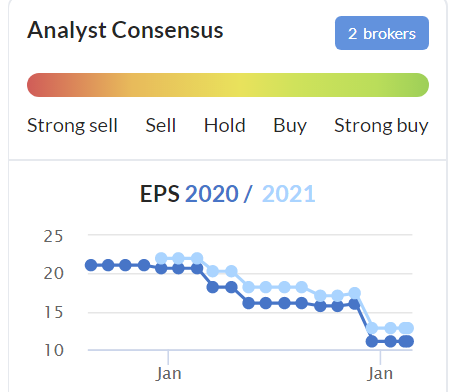
Overall then, despite a poor update today, and broker forecasts in a steep downward trend, it looks a lot better than most UK listed companies with a c.£10m mkt cap. Bear in mind this graph below will be taking another leg down, once the data has been updated for today's profit warning. So investors really need to get to the bottom of what's going wrong here. It can't all be down to unfavourable politics & economics, there must be some internal problems too.
.
Blancco Technology (LON:BLTG)
Share price: 202p (up 7%, at 16:06)
No. shares: 75.4m
Market cap: £152.3m
Blancco Technology Group plc (AIM: BLTG, "Blancco", the "Company" or the "Group"), the industry standard in data erasure and mobile device diagnostics, is pleased to announce its unaudited interim results for the six months ended 31 December 2019.
That's a very bold description of itself as "industry standard". I'd be very interested to hear from any readers who know the sector, and can verify, or dismiss, this claim.
Headline figures look good;
H1 revenues up 19% to £17.4m
Balance sheet - has been repaired with an equity fundraising, and looks OK now. Although NTAV is only just positive, at £1.1m.
Cashflow - this would be worth checking out, when the full year results come out;
The conversion of profits into cash is depressed in the first half of the year when bonus payments are made to staff in relation to the prior financial year. In this reporting period, cash conversion was further reduced by the payment of costs relating to the acquisition and fund raising in July. These seasonal effects on cash generation will even out across the twelve month period with cash generation anticipated to be in line with market expectations at the end of the financial year.
Development spending - note that it capitalised £2.2m into intangibles in H1, consistent with £4.2m in the last full year. Those are big numbers.
Outlook - in line & confident-sounding;
We are trading in line with our expectations for the financial year ending 30 June 2020 and look forward to the coming periods with great confidence.
My opinion - I get an uneasy feeling from these numbers. Combined with lots of adjustments, and a complicated cashflow statement, I'm not convinced that this is a genuinely profitable/cash generative business.
That's reinforced by the fact that divis stopped a few years ago.
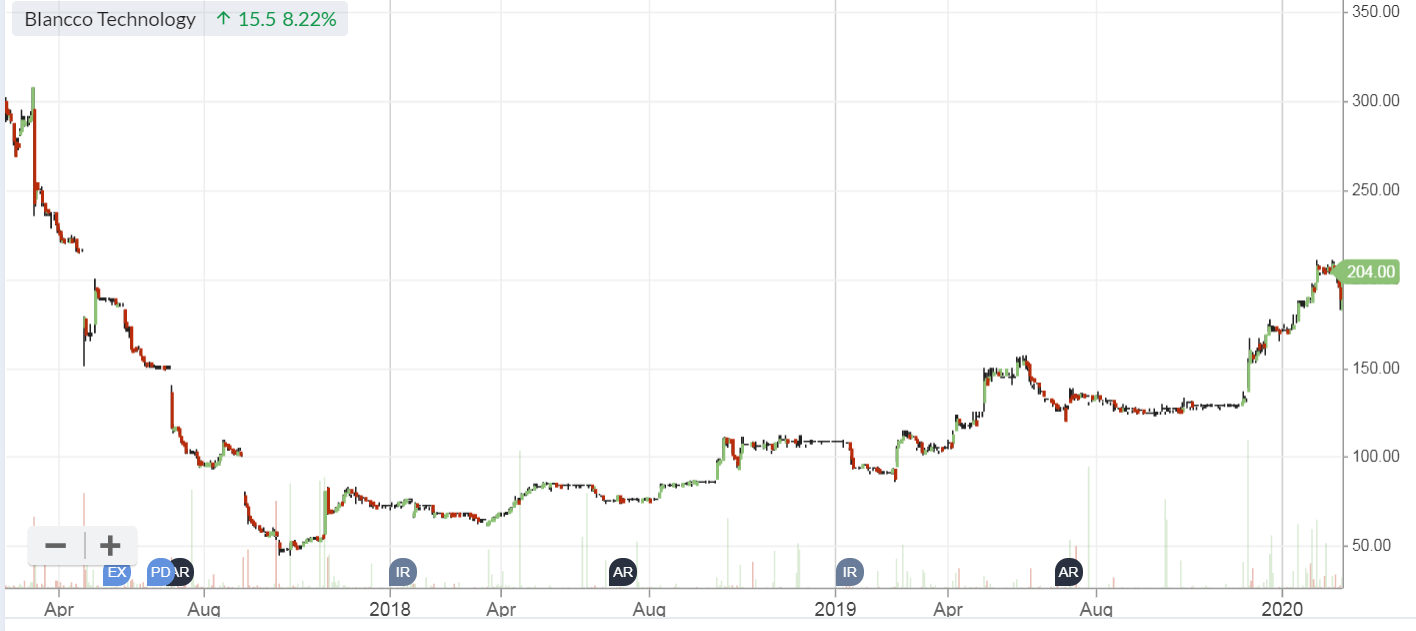
It's had a chequered past, but new management seem to have convinced the market that things are going well now. A fantastic share price performance has seen it 4-bag since the low in Oct 2017.
Overall, it doesn't convince me, but it's possible that I'm tainted by all the false promises made in the past, by previous management here?
It's difficult to argue with the share price though;
Good, that's it from me today. Thanks for dropping by, and see you tomorrow!
Best wishes, Paul.
Disclaimer
This is not financial advice. Our content is intended to be used and must be used for information and education purposes only. Please read our disclaimer and terms and conditions to understand our obligations.

38 comments
IQE - went to 750 shortly after listing. I dropped this one with an unpleasant loss when there was some pretty obvious dodgy accounting between the parent and the Singaporean sub after which the share proceeded to rally strongly. Murphy's law. Chip companies are poorly understood in the UK but as a general rule margins are tight and return on capital poor. But in upcycles they can do well if the products have a price or technical advantage as the earnings upticks can be huge. But really tough to get a grip on end markets and technology. You need jolly clean water and jolly clever science to succeed.
"I can't squander my life savings on small caps
I wouldn't want to be 100% invested in small caps either. If I look at my own portfolio it's about 1/3 small, 1/2 mid and the balance as large caps. But looking back it is the small caps that have produced my greatest alpha, so I wouldn't be without them. As Jim Slater noted, "Elephants don't gallop".
- these are punts at the end of the day!!!!"
Amongst the small cap dross there are some very high quality small cap companies whose return ratios smash their bigger brothers. So in my my view its best to screen for these type of quality companies. Simple screening criteria are high scoring Q Ranks, or ROIC% above 15%.
re: IQE
"As it's turned out, the optimism & expectations of big profits, looks to have been hot air."
I did try to caution people to my direct experience of the over confident statement from the Chair in Jun 2017 on this thread https://www.stockopedia.com/content/iqe-doing-what-minervini-predicts-195215?order=createdAt&sort=asc&mode=threaded
I thought I would just add a brief further note about IQE (LON:IQE) and the P/FCF ratio. Here is the same data but zoomed into just the 2016-2017 period and showing P/FCF and P/E in their raw form and as "ranked" ratios (the ones with a # prefix) showing the values as a percentile (= "how many percent of stocks is this value bigger than?")
Looking at the raw data you might think that P/FCF jumps up a bit in March-2017 and then creeps up further until about Sept-2017 when it disappears. But looking at the ranked data (#P/FCF) you see a different story. In fact it had been creeping up from 40% to 70% and that jump in March takes it to nearly 100%. The remaining time it just creeps even closer to 100% but the ranked move is very small. This is because even a P/FCF of 100 is huge.
By contrast the #P/E creeps up to 62%-ish and then makes a more gentle rise towards 100%.
Because the Stocko Value Rank ranks these metrics high → low you need to calculate 100-"rank" to find out the Value Rank equivalents. (e.g. a #P/FCF of 70% in this plot represents a pseudo-Value-Rank of 30%). Value Rank is just the average of the ranks of (P/E P/B P/S P/FCF Yield% and Earnings Yield%).
The big benefit of using ranking with a metric (which you can do in the screener) is that you can directly talk in terms of where a stock is positioned relative to the market (or the sector) rather than needing to know exactly what kind of values a given metric typically takes.
A fascinating insight into the StockRank evolution for IQE (LON:IQE) Nick.
I would have to check the detailed timeline better to be sure, but the fact that Share-Price momentum was the first factor to fall suggests to me that Carson Block's controversial short report was a trigger for the slide.
This was shortly after the share-price went somewhat stratospheric on the back of an apparently imminent market break through.
Block's main contention was that extremely high margin royalty payments from a JV were 'dodgy' did not really prove to be true.
However those payments were clearly one offs and allowed investors to charecterise IQE as an already healthily profitable business with the potental to break through into the sunny uplands.
In fact it was a moderately profitable business about to enter a phase of huge but (still) unproven potential that would require substantial further investment at risk.
When a pre-profitability story stock reaches such a phase, the share-price will often disappoint on the basis that the most likely outcome is that the opportunity ; may not fully arise / will cost more to address / will be further away than the companies available cash reserves support. In the case of IQE, before the Block report the market had taken a different view with IQE, perhaps blinded by the established existing profitability.
Whilst I am still of the view that Block is a charlatan (and possibly much worse) he is clearly not an idiot and I think his 'reports' should be taken by investors as a signal to at least review the investment thesis through a different prism.
Burford Capital (LON:BUR) is a more recent example, whilst the more powerful of Block's claims look to be little more than smoke and mirrors - they did precede an announcement where Burford Capital (LON:BUR) had to report reduced profits. The profits warning I think was really just a reflection of the fact that Burford's business can be lumpy in terms of when the gains occur. Even if the bull case for Burford is absolutely correct, such fluctuations are going to occur. However there timing relative to Block's publication allows the market to give significant weight to the idea that he was perhaps on to something.
For me perhaps the investment message is certainly not to accept what such short reports say, but neither to focus on the demonstrable errors and misleading statements in their claims ; but rather to look at the underlying uncertainties that allow these claims to be made and review whether there are in fact legitimate risks that should be reconsidered.
In my view IQE (LON:IQE) has been serially unlucky in the way things have panned out (and may well still come out good) but such things happen all the time and I think that investors (at one stage myself included) made the mistake of considering their success inevitable.
Burford Capital (LON:BUR) on the other-hand have suffered one episode of predictable lumpiness in timing of recognitions, which appears to strongly support the bear case - but actually does not really convince me at this stage,
For the record I have a small long position in Burford Capital (LON:BUR) - a what I thought was a bargain price of £7.40/share (but 20% underwater at this stage) and no current position in IQE (LON:IQE) (probably would not buy before 2 consecutive positive 6 month results statements)
I've actually sold out on the strength in Cenkos Securities (LON:CNKS) this morning. As above, profit is likely to be small for 2019 - and market will probably not like it when it sees the full numbers so I think there may be a buying opportunity post results, especially as I am not quite convinced 2020 will be an awful lot better at this stage. You can see how many transactions it is involved in through info on its website (https://www.cenkos.com/transactions). Nothing posted for 2020 so far although perhaps they are slow to update the website? Plus with EU trade negotiations coming up I think there'll be market nervousness later this year.
I appreciate one year earnings aren't the way to value this share - I just think there might be another better entry point over the next 2 months than c.65p.
Hi Paul
First class analysis and style - as is mostly the case - but as I've said before, pls can we have a mid cap report b/c I can't squander my life savings on small caps - these are punts at the end of the day!!!!
Honestly think we need much more mid and large cap analysis here, in place of the small caps b/c that is what most of the audience will be serious about putting serious money in.
Susan,
I've been a professional small caps investor for 18 years, so this is what I write about.
If you're not interested in small caps, then don't read my small caps reports.
Paul.
Interesting question. About half my portfolio must be in mid caps (plus a couple of large caps). But I am not sure I should have any money at all in stocks with a cap larger than about a billion - I certainly have more success overall with the smaller cap stocks. As Paul will say, there are other places to go for discussion of larger companies.
Susan- the clue is in the title.
Hi Susan,
Firstly I think it's a bit harsh for you to have received so many thumbs down for a polite statement - even if I can see why people consider it to off piste - I've given you a thumbs up just to counter the balance.
There is a vast amount of Large cap coverage elsewhere and these are such a major focus of the "professionals" that it is unlikely that Paul or Graham could add much new in the majority of cases.
The same is largely true of mid-caps.I should though note that one of the Stocko team did say that they are considering a Mid-Cap report and also that Graham does also produce a Mid-Cap report on another site.
I do though, feel a need to challenge your statement :
Certainly small caps are individually more risky than mid/large caps, but even without significant selection skill, with sufficient diversification history tells us that they are likely to be a better investment prospect than their large peers.
To suggest that there are "punts" is something of an exaggeration in my view and Stocko helps to increase your risk factors too.
Smallcaps in my view absolutely do not have to be exceptionally risky in my view and with sensible selection and sufficient diversification I think it is actually highly sensible to squander [I prefer the term sensibly-deploy] your life savings on small caps.
Of course everyone's investment objectives and approach will be different but the small-cap pool does not have to be a casino.
A final reason why the SCVR can be so valuable is that the "big funds" simply cannot invest a meaningful amount is these companies hence why the often do not look at them, whereas most of us private investors can. Hence there is a greater chance that switched on analysts (such as Paul & Graaham) can get - and provide us with - something of edge.
Weather you choose to embrace small-caps or not, good luck with your investments and don't feel discouraged by the red tumbers to contribute to the boards.
Regards,
Tony
(AKAGromley)
"I can't squander my life savings on small caps - these are punts at the end of the day!!!!"
The issue here is volatility. Yes, a small cap can surprise with a profit warning and bamm... share price down 40%+ on the day. Large caps generally don't do this.
But, small caps have an interesting ability to rise 40%+ over a few short months on good news. Large caps generally don't do this either.
In addition, main funds can't invest in small caps due to insufficient liquidity, so they are not well researched. So that makes the happy hunting ground for private investors. Small caps have been a successful domain for a few notable ISA millionaires such as Lord Lee, Robbie Burns, Leon Boros.
Agree totally share trading can be punting, but I have found from my own results - when I read carefully about a company in an industry I know about, which I believe has growth potential, a strong balance sheet, low debt, pay a dividend, generate cash, decent management, positive Chairman's statement, mgt has a % of ownership and the price is not too high - these have worked for me nicely.
My purchases on more spec stocks, turnarounds, chasing momentum, beaten up bargains, have been punts for sure and their performance more spotty, at best!
But these days, I think large caps are no longer as safe as they would appear. The FTSE100 is full of energy stocks (trapped hydrocarbons) Banks (zero growth subject to fintech displacement) miners (cyclical). The USA has great large cap tech growth stocks, but their PERs are 30+.
So there is always risk, but for me small caps is an area where the information value is not fully expressed in the price, leaving more room for us to pick through. Otherwise, I hold the Nasdaq to track the tech momentum and don't fret over selection.
There are other websites out there there that provide very good mid-cap analysis so rather than another -ve feedback cross suggest you look some of them up and sign up. This does what it says on the tin just like a well known brand of wood sealant.
Hi Susan Roland Head's blog on here well worth reading for more cap bias
given the issues outlined today by Tekmar (LON:TGP) I wonder if people here consider it prudent to contact IR depts about implications of supply and sales disruptions in China, or indeed if the proper thing to do it await any RNS disclosure that addresses the issue?
What are people here doing
What's interesting is that Apple is down 2.5% on the back of this warning. So either it has already been partly priced in and Apple shares would have been much higher without Coronavirus, or the strength of Apple and its balance sheet means the temporary nature of a virus is discounted to be short term. I suspect it is the former. In the WSJ today there is an interesting chart that shows the S&P performance up 4% since turn of the year whereas US firms with high China exposure are down 6% on average! Therefore whilst Apple has actually risen it clearly has been tempered by the current situation.
On the virus itself another interesting stat came up today. Whilst Hubei cases are static the numbers being contracted globally (exc Hubei) have fallen from 450 to 115. Ie infection rates have quartered, which suggests that the containment measures "may" be working. Many of those new cases have been on that cruise ship as well. Whilst obviously pretty horrid for those trapped inside Hubei, in the context of the world the loss of GDP from a 12m population is unlikely to have a long lasting impact for a juggernaut of a managed economy like China. As long as the containment lasts then factories in the rest of China will come on line again and peoples habits will return more to normal.
From an observational/qualitative perspective : being in London I noted that just a week ago when I went to one of my favourite street stalls in Spitalfields for lunch (Chinese street food run by Chinese nationals) everyone was wearing masks......by today they had disappeared.
Clearly we shouldn't be complacent but I think we need to be careful with knee jerk investment reactions.....a sell all approach is expensive. Perhaps an Option strangle strategy on certain indices may be a cheaper way. If this peters out the stock markets may well rally sharply and you'd make money and if it gets horrid the markets would tank and you'd make money. In the middle you'd lose but that would be status quo for stocks?
Another highly informative musings on luck Paul , reminds me of a quote from Warren Buffet if you got an IQ of 130 you'd be advised to think it's lower than that".or something like that",reminds me of your humble self.
IQE (LON:IQE)
This piqued my interest so I had a quick look through my historical data for IQE. (I really hope that the Stocko team are working on features to allow this kind of drill-down through the rank system on the new site.)
The individual QVM ranks look like this:
The Value Rank and the Quality Rank cause the initial start to the fall in early 2017 and the fall in the Momentum Rank in early 2018 then pushes the Stock Rank into bearish territory.
A quick look at some of the Quality Rank components suggests that the trading update in March 2017 caused a drop in the Piotroski F score which was the main driver of the Quality Rank fall:
The Value Rank changes are largely driven by price:
But I notice that the P/FCF trace stops in late 2017. That basically means that the FCF went negative somewhere thereabouts and has not recovered since. [As a personal observation I have found that P/FCF in the range 15-30 seems to be the sweet spot.]
Finally what caused the Momentum Rank to fall in early 2018?
It turns out it wasn't caused by downgraded broker forecasts. They came much later in 2019 onwards. It was simply the collapse of simple moving average metrics like "RS 6m" as the price fell below its value from about six months earlier. ["% 50dMA / 200 dMA" effectively compares the price 25 days ago to the price 100 days ago. "RS 6m" looks back 6 months. "RS 1y" and "% vs 52w High" look back 52 weeks.]
Hi NickRay,
Fantastic analysis, thank you very much for posting that!
I've never seen those charts of what makes up the StockRanks, where are these found on Stocko please?
Best wishes, Paul.
Paul - they are not available on Stocko. I keep records of a range of metrics myself. (The graphs are produced using a tool called R.)
The main reason I started keeping these records was because I had absolutely no idea what was a good value for (say) ROCE or P/FCF so I couldn't work out how to build meaningful screens! Anyway, now I have a decent body of data which helps immensely.
And I do hope that Stocko will eventually make their own data available (which will be a lot more comprehensive than what I have) and in ways that can be used to inform choices when building screens or trying to do a bit of digital archaeology as in this case.
Nick those are great charts an dI really hope Ed and the team can get to a point (soon) where they can deliver charts like this
Tekmar (LON:TGP) was on my watchlist so I bought a small initial position today. 30% off seems a decent discount for the risks. I'll wait and see what happens before my next move.
One consideration is how well the business will be able to protect its position. It's interesting that it holds some patents but:
"...a key constituent of Tekmar’s products is the unique polymer blends that make up substantially all of the Group’s products. The formulation of the polymer blend, TekThane, is protected by trade secret..."
In other words the magic ingredient is protected by keeping it secert, rather than a patent. It is not the only company to adopt this approach. The reasoning is often that this is a better approach simply because the Chinese will use the patent documentation to steal the technology and this will be difficult to detect or prove. In the case of Tekmar, the offending stolen technology would be on the sea bed off the coast of China. This kind of issue is significant enough to be a major cause of Donald Trump's trade war with China.
However, if there is no patent, it does make me wonder how well the company will be able to protect its IP and so generate decent margins. Secrets have a way of becoming well known. It's not enough to put me off entirely but it is a concern.
Edit: Just seen Paul's view that anyone buying today "needs to be prepared for the possibility of another profit warning, and incurring possibly heavy short-term losses". I totally agree with that, that's why I will only go in with a small position. I'm thinking about what this share will look like in 5 years time but the shorter term could easily provide more disappointment - or buying opportunities depending on how heavily invested you are at that stage.
Edit 2: I know that Coca Cola and others seem to protect trade secrest pretty well, but it doesn't always work.
Might be too small for Paul, but an interesting update today from £R4E. It has issued a “significantly ahead” statement, with net cash of £2.75m. Historically has issued shares for fun, but in its own words the turnaround strategy does seem to be bearing fruit. £80m+ annual turnover, and a market cap of £11m ( EV just over £8m). If they can eek out even a small profit margin of 5%, that puts it on a PE of under 3 and an even lower EV/EBITDA.
Certainly I know a foreign based company in Shanghai many of their staff are continuing to work from home (remote working) after the end of the Chinese New year extension.
Shanghai is a huge City, but has been like a ghost town apparently. People aren't allowed into shops unless they have masks.
It seems to have been successful at having relatively few cases of the CoronaVirus, hence why the Shanghai mayor has been put in charge of the Hubei province as a temporary replacement for the incumbent official.
So many issues at IQE (LON:IQE) seemed to be linked to corporate hubris. The ever rising share price to around 180p left them vulnerable to attacks by shorters (there are still sizeable disclosed short positions) and they also had to contend with a Muddy Waters attack on their accounts. So much of the carnage was self inflicted by a complete failure to manage the story and obviously the failure to meet bloated earnings expectations. An edifice built on sand.
I've added both Tekmar and Titon to my list of things to cover today.
Thanks Paul, appreciated.
One thing that concerns me is contractual liability for many of these businesses that have supply chains impacted by events in China. If company X has a contract with company Y to buy 10,000 items a month, and company Y is dependent upon sourcing those from company Z, who uses widgets produced by company A in China, its may be hard to argue force majeure or act of God. The general legal principle is that if you agree a contract you are bound to perform it if it can be performed, and just because the performance is more expensive than you anticipated does not mean the contract is invalid.
So you could see a whole chain of liability, with X suing Y, Y suing Z, and Z seeking to sue A, who may be able to claim force majeure. But that won't extend to Y and Z unless their contracts are very carefully drafted. Unless China springs back into action, things could become very messy very quickly.
Interested in your thoughts on Titon Holdings after todays news.
As a shareholder, I think the Titon Holdings (LON:TON) AGM update is very disappointing. Every part of the business (except UK ventilation) seems to be doing materially worse. Also there appears to have been a £500,000 cash outflow in the first four months of the year (and the dividend has not yet been paid)
The UK business is the steady part of this business. The hope is that Korea recovers. We have been told before that the new mechanical ventilation units will start selling in H2 FY20 - but today there is no update on this.
Obviously, we have to wait until we see how far brokers (Shore, Hardman) reduce their numbers. Maybe management will say more at the AGM.
I have no intention to sell though, with the share price well below TBV.
thank you
Paul
Thank you for your write up of Titon plc. You ask in your write-up if readers remember what is "odd" about the company. I don't think there is anything "odd" about the company, although you may be referring the Korean structure.
What investors have to get their head around is the Korean structure, where there are two Korean JVs, one Titon Korea (which is 51% owned and therefore fully consolidated, with a minority interest) and the other BTS (which is 49% owned and therefore treated as an associate in the accounts). Titon Korea manufactures the ventilation vents and sells them to BTS which is the distributor/ reseller. The different accounting treatment of the two businesses (where the economic reality of ownership is almost identical) does cause a bit of complication, which you can argue is not worth the headache for a small illiquid microcap.
There is a large family ownership (split between different members of the family) and after decades of being on the main LSE board, just over a year ago it moved to AIM. I don't think the company has issued new shares for years - and most of the family members have not been selling shares - so you could argue that the management is not overly concerned about the share price. This can be viewed as a positive ("management does not try to sugar coat bad news") or a negative ("shares could stay cheap for years").
The shares are trading well below book value. The biggest reasons, apart from the illiquidity and convoluted JV structure is I believe, the low pricing power Titon Holdings (LON:TON) has in its 100% owned UK, Europe and US businesses on it products. It has historically enjoyed a much higher margin and market share in Korea - but maybe there too pricing power is being eroded as the Korean housing market stays in a severe slump (indicated by today's update). Historically, one of the Korean JVs decided to invest in speculative Seoul property deals at the wrong time in the cycle and now capital is tied up in property.
For those wondering, Titon Holdings (LON:TON) released an AGM statement today that contains a profit warning.
Very interesting details re coronavirus impacts on trading from Tekmar (LON:TGP) :
https://www.investegate.co.uk/tekmar-group-plc/rns/trading-statement-and-the-impact-of-corona-virus/202002180700052699D/
Impacts are both on supply chain and end users. Interestingly they are unable, or unwilling, to provide any time frame.
Thanks for the link to Tekmar (LON:TGP) . The company has been very open and the market reaction seems savage. I'm seriously considering catching this knife.
I agree that, while undoubtedly delayed, the Tekmar (LON:TGP) business of undersea cable connectors is not going to go away and today’s reaction seems way overdone. It may be an indication of how little followed this company is and maybe they can get out more in future to get a better known profile .
The company only floated last year, so this is a little early stage for me. Also the Stocko briefing on profit warnings warned against getting in too early. But the business is in a potentially growth area, and management seem very experienced.
My morning smallcap tweet: Coronavirus hits Tekmar
Cenkos Securities (LON:CNKS) Angling Direct (LON:ANG) Tekmar (LON:TGP) Ocean Outdoor (LON:OOUT) £R4E 4D Pharma (LON:DDDD) Craven House Capital (LON:CRV) Crimson Tide (LON:TIDE) ITM Power (LON:ITM), Essensys (LON:ESYS), Blancco Technology (LON:BLTG)
Cenkos Securities (CNKS) guides FY profit, after taking account of the non-recurring restructuring costs of approximately £1.4m. Ambiguous. FY20 started well.
Angling Direct (ANG) post Xmas trading hit by flooding, guides pre-IFRS 16, EBITDA loss of no more than £0.5.
Tekmar Group (TGP) coronavirus slams FY profit, will be only broadly in line with FY19, poor visibility for FY21. "China accounted for circa 10% of our revenue forecast in FY20 and represented 20% of our outstanding supply-chain commitments."
Ocean Outdoor (OOUT) guides FY rev up 13.5%, adj EBITDA up 10.5%. In line?
Reach4Entertainment (R4E) guides FY adj EBITDA and rev significantly ahead of market expectations. Board "particularly pleased with the improved efficiencies and greater level of collaboration across the Group."
4d Pharma (DDDD) £18m (min) placing at 50p, an 18% discount. Cash will be used for ongoing clinical studies in IBS and oncology, funding operations to at least two clinical study readouts and for working capital.
Craven House Capital (CRV) $2m (min) placing at $10, a 117% premium. This follows similar last week at a 237% premium. The SP has risen 50% since.
Crimson Tide (TIDE) wins £600k of long term contracted revenue from the rail sector. Barrie Whipp gushes that "mpro5 has a very real opportunity of becoming an industry standard tool, and from the feedback we are getting from our clients, it should be".
ITM Power (ITM) £7.5m grant secured for phase two of Gigastack - hydrogen from offshore wind turbines
In line: Essensys (LON:ESYS) Blancco Technology (LON:BLTG)