Small Cap Value Report (Tue 19 Jan 2021) - BOOT, APTD, COG, QTX, SDRY, WJG

Good morning, and welcome to Tuesday's SCVR, written by Paul & extra sections from Jack, since it's too busy for me to handle everything on my own.
Inflation & interest rates again
What an interesting discussion yesterday about the risk of inflation returning. Everyone seems to be commenting on that at the moment, I saw a very good article in the Telegraph this morning on the same topic, and thought to myself, oh dear I hope the Stockopedia subscribers don't think I plagiarised it. That's unavoidable though, when you're covering current topical themes. I remember a city broker friend once wrongly accusing Graham of plagiarising his blog, because they both happened to comment on bond yields on the same day! I had to gently intervene and point out that nobody had ownership of any macro topic, and we're far too busy to read other peoples' blogs, when we're frantically trying to prepare content to a deadline for our own! We're all friends again now, I'm pleased to say.
I enjoy thinking about macro topics, but just for the avoidance of doubt, see myself as an enthusiastic amateur on that topic, not any kind of opinion leader! It's interesting trying to work out how the world around us works, especially at times like this, when strange stuff like QE is happening. Also, I feel having a general overview of macro economics is vital to put share prices into context - are they cheap, or expensive? That depends on what's likely to happen next to the economy.
Russell Napier
My thanks go to subscriber Michael Prince who added a comment yesterday pointing us towards a podcast by Grant Williams, called The End Game Ep.5 - Russell Napier (you can find it by searching for the title or the name, on whatever podcast system you use). I was gripped by this long podcast, and concluded that Russell Napier is a brilliant commentator/economist.
I also found a more recent podcast from MoneyWeek where Merryn Somerset-Webb interviewed him badly - constantly interrupting & talking over the end of his sentences. Pity, as she's usually very good, but should have just kept quiet to let the interviewee speak, who after all, knows a lot more than she does, and has more interesting things to say. Pity, as she usually talks sense, and I normally respect what she has to say.
Indeed, as interviewer Grant Williams above noted at the end of his own podcast, when you get a great guest on, you should just shut up & let them talk! Merryn needs to take note. It's a key thing I always do in my CEO interviews - never interrupt, just let them talk. People appreciate that so much, and I always get favourable feedback from listeners. Tamzin is the same in her interviews - never interrupting. It just makes for a more pleasing listening experience, and after all, an interview is about the interviewee, not the interviewer trying to demonstrate how clever they are!
It's different maybe when dealing with some slippery politician that's trying to dodge the questions though. But personally I stopped waking up to the Today Programme on my clock/radio a long time ago, as I found the journalists so obnoxious. What could be worse than waking up to some people rowing about politics? It starts the day off with a headache.
Anyway, Russell Napier's stuff makes a lot of sense, so well worth seeking out. He's one of several commentators who have previously been relaxed about inflation not being a threat, now changing their minds, and saying we're entering a period of higher inflation. That matters a lot, as it could be bad news for shares on high PERs., and could be seriously bad news for bonds, as yields could rise (thus pushing down capital values). If inflation rises a lot, and stays high, then of course property values would also probably fall, depending on what interest rates do.
A key question being whether Govts will be able/willing to keep interest rates below inflation? Stephanie Kelton (MMT supporter) says interest rates can be anything the Govt wants, whereas Russell Napier points out some flaws in her arguments. Fascinating stuff!
OK, on to some small cap news...
Timing - I've started early, so will keep writing until I get tired. Update at 13:09 - time for lunch now. I'll be back later to look at WJG, and possible some others. Update at 17:02 - today's report is now finished.
Agenda - this is what caught our eyes today -
Jack's Section:
Henry Boot (LON:BOOT) - Trading update
Aptitude Software (LON:APTD) - Trading update
Paul's Section:
Cambridge Cognition Holdings (LON:COG) (I hold) - Trading update, board change & notice of results
Quartix Holdings (LON:QTX) - Substantial Director sale in secondary placing at 401p
Superdry (LON:SDRY) - Half-year Report
Watkin Jones (LON:WJG) (I hold) - Full year results
.
Jack’s section
Henry Boot (LON:BOOT)
Share price: 277.65 (+7.2%)
Shares in issue: 133,181,537
Market cap: £370m
Henry Boot (LON:BOOT) acquires land, obtains planning permission, develops sites, and maintains its property investment portfolio.
It’s a family affair, with a couple of Boots and family trusts popping up in the Major Shareholders list. Chairman Jamie Boot has been with the company since 1979 and has run all four of the group’s main operating subsidiaries during his career. Director Dealings have been mixed over the past year, but it’s interesting to note the most recent spate of buying activity at 241-247p.
The group qualifies for the Benjamin Graham Defensive Investor Screen, a Bargain screen that looks for reasonably priced earnings growth, along with dividend growth, manageable debt, and solid liquidity ratios. Glancing at some of the quick checks on the StockReport, BOOT comfortably passes some Quality checks including an F-Score of 5, a Z-score of 8 or so, a net cash position. There is a small pension deficit to bear in mind - about £36m at the last interim date - but the liquidity ratios and free cash flow generation look pretty solid.
Top line and profit growth has faltered at BOOT and, while margins and returns on capital appear reasonably solid, it is worth noting that the direction of travel across all of these metrics has been down since 2017. However, with a Quality Rank of 85, this is a contrarian stock, so is likely worth monitoring for a rebound in construction.
The update reads well: “The Group has ended the year materially ahead of the Board's revised expectations for 2020, due primarily to land disposals and a resilient performance from the development, construction and house building businesses, in Henry Boot's target industrial and residential markets.”
Net cash is level at c.£27m, just under 10% of yesterday’s market cap, and promisingly BOOT has also “generated significant levels of cash which has allowed for reinvestment within the Group's focused three long-term key markets: industrial & logistics, residential and urban development.”
Activity has been steadily increasing and government guidelines have allowed BOOT to continue serving its customers over lockdown.
Conclusion
This is a reassuring update from BOOT, in which the company has managed to maintain its robust balance sheet and also invest in strategic growth opportunities. As a longer term quality hold with a potential sector rerating on the cards, it is worth investigating in more detail. The family orientation suggests a shareholder-minded culture - an important consideration in times of uncertainty.
The group has strong forward sales and a growing store of opportunities. The one blot is the more general decline in revenue and profits since 2017. While the group is materially ahead, this is based on much-reduced expectations.

Note the date of incorporation was back in November 1919, though - so that alongside the net cash balance sheet and improving prospects does suggest BOOT can ride out Covid and ultimately benefit from a recovery.
.
Aptitude Software (LON:APTD)
Share price: 594p (+9.96%)
Shares in issue: 56,428,967
Market cap: £335m
Aptitude Software (LON:APTD) provides financial management software applications to large global businesses. The software is developed on the Aptitude technology platform, which facilitates the processing of business event-driven transactions and calculations.
Its products add value by taking data from complex systems, typically with unique and siloed data sources across multiple business entities, to create a unified view of finance. Recurring revenue is growing, and it’s a capital-light, cash-generative SaaS business model with around $40m of net cash on the balance sheet.
It’s high quality stuff, and as you might expect, Aptitude now attracts some premium relative valuation metrics:

With some share price momentum and potential earnings upgrades, it has all the makings of another High Flyer tech stock.
Note the Momentum Rank is up 16 places over the past 30 days, the shares are up this morning, and the overall StockRank is steadily improving.

Aptitude reports that a strong final quarter's new business performance “provides the business with greater revenue visibility for 2021.”
Annual Recurring Revenue was up 11% in the year to £31.2m, driven by new customer wins and the expansion of existing relationships. There’s £44.8m of cash on the balance sheet (up from £33m), with no loans. That net cash position brings the group’s enterprise value below the £300m mark.
The final quarter saw a particularly strong performance in the North American technology and insurance sectors. Key developments include:
- A new multi-year SaaS agreements with two North American insurers; and
- A new business SaaS agreement with a leading global medical technology company for its Revenue Management and Lease Accounting Engine products, “further demonstrating the value realisable by clients of using more than one of the Group's tightly integrated and complementary applications.”
These new business successes have been complemented by the increasing use of Aptitude’s applications by existing clients including one of the largest North American telecommunications companies and a European financial services organisation.
Conclusion
The improved revenue visibility and encouraging quarterly trajectory into the new year is clearly a positive and has been received warmly by the market.
Interestingly, Aptitude says that these successes “have strengthened the demand for implementation services from Aptitude Software and its partner network,” so it looks like the success is spurring further opportunities. Services revenue for the coming year is now anticipated to be slightly ahead of earlier expectations.
Looking forward, growth initiatives include:
- Continued development of the partner network; and
- The launch of Aptitude Accounting Hub and Aptitude Insurance Calculation Engine as SaaS-offerings, designed to capitalise on the “accelerated move to cloud experienced in 2020.”
The direction of travel here is firmly positive, but the share price has also gone up by about 50% over the past couple of weeks.
As with a lot of growing, net cash tech stocks, it’s a premium relative valuation - but we are really paying for all discounted future cash flows, so if a company like Aptitude on a forecast PE of 45.4x can continue to grow ahead of the market for many years, then such a premium can be justified.
On that point though, Aptitude has actually struggled to generate the required rates of revenue growth and earnings growth.

That aside, the 2021 outlook is undeniably positive and this is a classic low-capital, cash-generative, recurring revenue software company. So it ticks a lot of boxes for a lot of people.
But at this price I would want to be sure there is plenty of runway for growth, as growth is what the present valuation demands, and broker forecasts are surprisingly lacklustre.

If these forecasts are simply behind the curve, then that could be an opportunity.
.
Paul's Section
Cambridge Cognition Holdings (LON:COG)
(I hold)
73.7p (up 9% at 08:20) - mkt cap £23m
An illiquid tiddler.
Cambridge Cognition Holdings plc (AIM: COG), which develops and markets digital solutions to assess brain health, is pleased to announce a positive trading update and notice of results for the year ended 31 December 2020, together with details of a forthcoming change to the Company's board.
This headline looks good -
Strong financial performance with growth in revenues of 34% and increase in order backlog of 96%
- Revenues up 34% to £6.74m
- Loss for the year narrowed to £(0.44)m (2019: £(2.9)m loss)
- Cash risen to £3.05m (end 2019: £0.9m)
Order intake - looks very good indeed -
The Company had a successful year in 2020, delivering significant growth in revenues from digital solutions for clinical trials by executing its strategy of increased focus on commercialisation. Order intake for the year closed at a record £12.70 million, up 158% on the previous year's order intake of £4.93 million.
This maintains the growth trajectory reported in the interim results. The contracted order backlog was £11.17 million at 31 December 2020 (£5.69 million at 31 December 2019) of which at least £6.0 million is expected to be recognised as revenue in 2021 subject to customer delivery schedules and COVID-19 impacts.
To put that into context, broker consensus was £7.2m revenues forecast for 2021. So having “at least” £6.0m of that already contracted for, looks very encouraging - i.e. a beat against forecast seems lined up for 2021. Finncap has this morning raised forecast revenue to £8.5m - hopefully still conservative)
Two large, one-off orders totalling £3.1m flatter the 2020 results, and may not be repeated. Nice transparency there, in revealing this to investors. The fact that the company got those big orders at all, is a positive to me.
Covid impact - delayed some orders, but also created opportunities.
Outlook -
The substantial contracted order backlog provides the Company with a solid foundation for 2021. While there remains some uncertainty relating to timing of customers' clinical trials due to the COVID-19 pandemic, the Company is well positioned for continued growth in the dynamic, expanding market for digital solutions for clinical trials.
CFO departure -
Nick Walters has resigned as CFO after 7 years.
Remains a Director until AGM in May 2021, so it sounds like an orderly handover, particularly as a new CFO has been appointed, Mick Holton -who seems to have relevant experience from “senior finance roles at Alliance Boots”.
Online Q&A session today at 12:30 -
Matthew Stork, Cambridge Cognition's CEO, will be hosting an online Q&A session regarding the latest developments with the Company at 12.30 p.m. GMT today. This session is open to all existing and prospective shareholders, and equity analysts. Those wishing to attend should email COG@investor-focus.co.uk for access details. Participants will have the opportunity to submit questions during the session, but questions are welcomed in advance and may be submitted to COG@investor-focus.co.uk.
My opinion - the track record of this company has been rather disappointing, since it floated in 2013. However, it looks to me as if things might be coming together nicely now.
The cash burn has stopped, so there shouldn’t be any need for another placing.
The order book is brimming, with out-performance for 2021 likely, given low forecasts.
It’s operating in a sexy sector - cloud-based medical (mental) testing, where it has decades of experience & data, so a niche that should be high margin and protected to some extent maybe? Maybe this could conceptually be another Bioventix (LON:BVXP) in the making? i.e. high margin, niche specialism, barriers to entry, etc.
Finncap has raised 2021 revenue forecast by 18% today, to £8.5m, which would result in a small profit. The gross margin is nearly 80%, so there is big operational gearing with this company - if sales really take off, then it could quickly become highly profitable, which in turn would trigger a big re-rating of the shares.
This is starting to look interesting. I’m sitting tight on my (smallish) position, as it looks as if things might be coming together at long last.
.
Quartix Holdings (LON:QTX)
401p (unchanged at 09:49) - mkt cap £192m
The CEO & family are selling almost 7.2m shares at 401p per share (no discount, indicating good demand from institutional buyers), raising £28.9m. Good luck to him, he's built up a very good company. That’s a whacking great sale, of 15% of the company, hence why I’m flagging it. On the upside, the family still retains 22.2% of the company.
The usual, ridiculous line is trotted out in the RNS saying that the sale is;
... in order to satisfy strong investor demand.
No it isn't! This is codswallop, and everyone knows it. The sale is happening because the seller wants to sell. Strong institutional demand is positive, in that it helps the sale happen at a decent price, but it’s not what drives the process.
Please can we consign this ridiculous phrase to the dustbin of history? All the RNS needs to say is this, my amended, more truthful version of it below;
Quartix, a leading supplier of vehicle tracking systems, announces that it has been informed by Andrew Walters, Chief Executive Officer, his wife and PCA, Dominie Walters, and A J Walters Trust, a trust established by Andrew Walters for the benefit of his family, and includes Andrew Walters and his wife as trustees (together the "Sellers") of the intention to sell an aggregate of 7,194,377 ordinary shares of 1 pence each ("Ordinary Shares") in the capital of Company (the "Placing Shares") at a price of 401 pence per Placing Share (the "Placing") in order to satisfy strong investor demand. There was strong institutional demand for these shares.
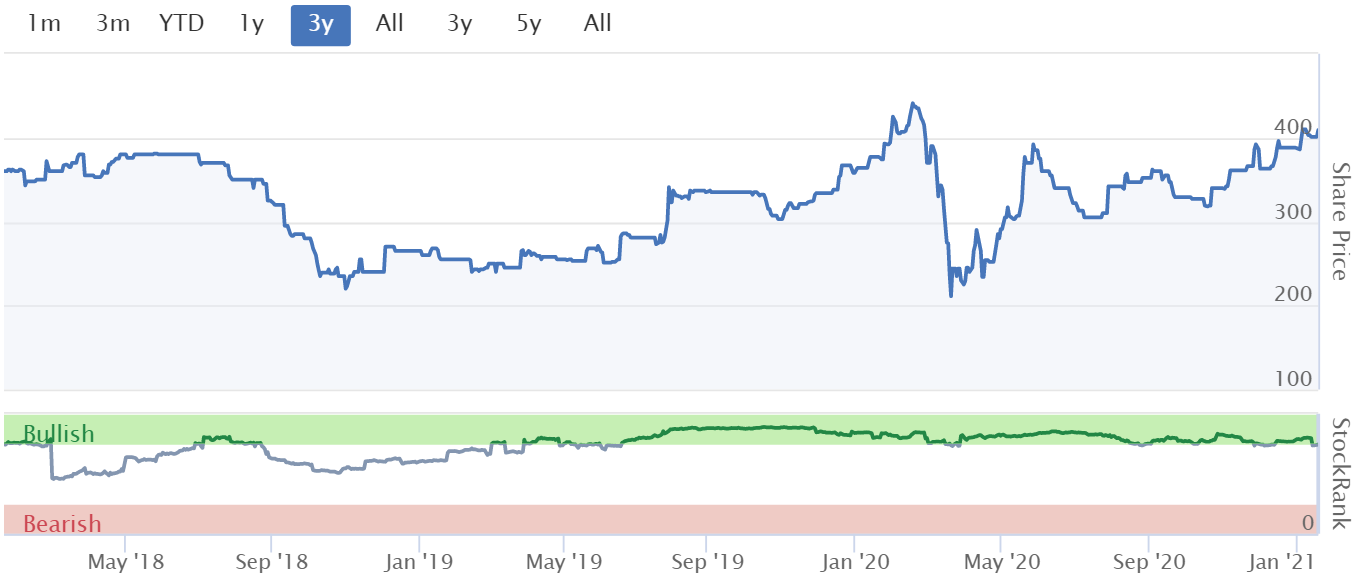
My opinion - I reviewed QTX’s last trading update here on 13 Jan 2021, concluding that it’s a nice company, but the valuation looks full. A large Director sale today rather reinforces that view.
.
.
Superdry (LON:SDRY)
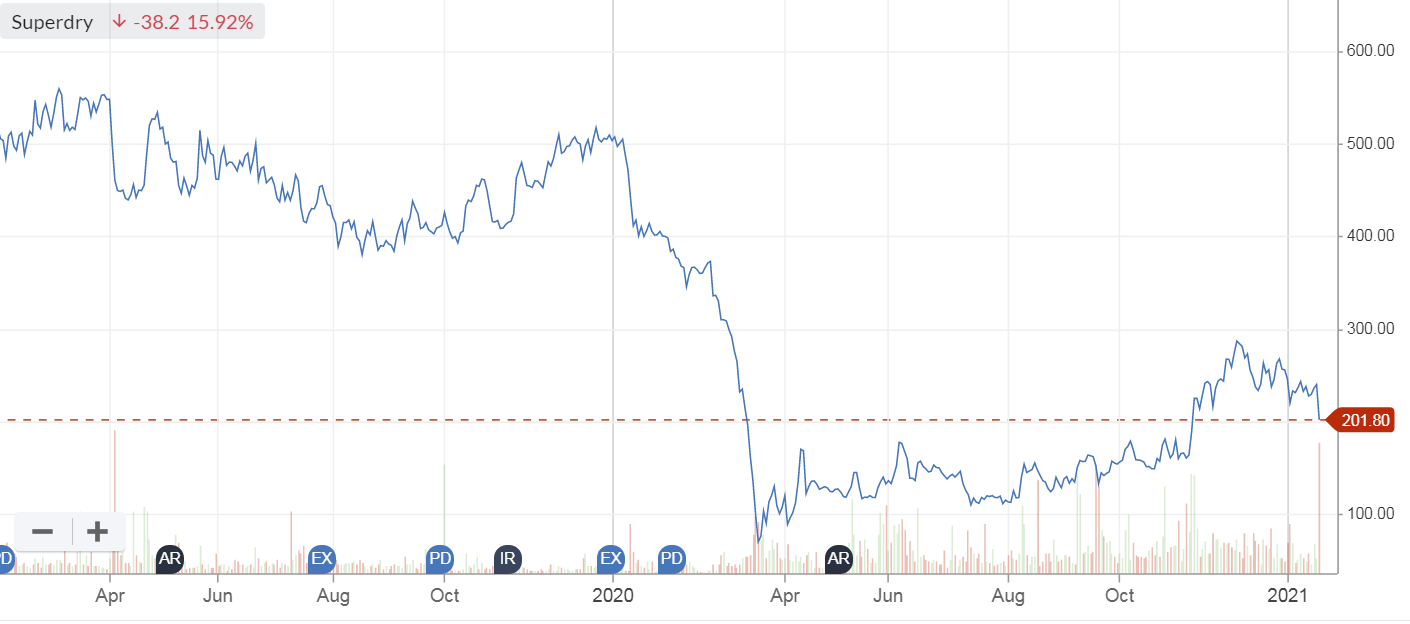
201p (down 16%, at 11:43) - mkt cap £165m
Brand reset journey continues; robust balance sheet despite Covid-19 disruption …
Interim results for the 26-week period to 24 October 2020
“Brand reset” is just a slogan, there’s no evidence of any tangible progress in the figures, nor the outlook, in my opinion, being hard nosed about it. I like turnarounds, so am keeping an open mind on SDRY. However, I need facts, not aspirations to convince me.
My initial impression is that today’s interim numbers are nowhere near as bad as I was expecting. Although covering May-Oct 2020, the shops would have been open for most of that period, apart from the first few weeks.

.
- Sales are down, although in the circumstances (23.4)% isn’t a disaster by any means, and ties in exactly with the loss of 23% of trading days in the period.
- Strong eCommerce sales, +50%. This represented half of all retail sales - very encouraging indeed.
- Gross margin also well down, but again as I would expect - retailers have to clear stock at whatever price they can get for it, to clear the space for new ranges. So if trading is disrupted, that means more markdowns.
- Net cash looks healthy.
Underlying profit - this figure of £(10.6)m loss looks too good to be true. Consider this;
Underlying loss before tax of £(10.6)m driven by trading disruption, net of cost saving actions (£13.5m) and government support (£12.3m), and is after the impact of reduced depreciation arising from prior impairments and the utilisation of the onerous lease provision (net £31.6m benefit).
The item that stands out for me is the last one. If I’m reading that right, then it sounds like a £31.6m onerous lease provision has been released into the P&L, which would boost profit by that amount. Hence doesn’t that mean the underlying profits are £(10.6)m + £(31.6)m = £(42.2)m in H1? This is a key point which needs clarifying.
Cash position - is good, and has improved further since the period end -
As at 9 January net cash is £54.8m, and our refinanced ABL facility undrawn. Net cash remained positive throughout 2020.
That’s encouraging, but I don’t think this is sustainable, because;
Favourable working capital movements flatter cash - both inventories & receivables are well down on a year earlier, which makes sense given reduced revenues. However, trade payables is sharply up - when it should also be down in line with reduced inventories. This is clear evidence that the company is stretching its trade creditors, in order to maximise cash. At some stage working capital will have to normalise, and that’s when the company would need to use its borrowing facilities. Plus remember that we need to factor in another 6 months of heavy trading losses, in H2.
Can wholesale customers pay their bills? There must be a risk of future bad debts lurking in the receivables book.
Hence my conclusion is that the underlying cash position, once working capital normalises, is not good. Not an immediate concern though. Longer term, I reckon SDRY is likely to need to do a placing to rebuild cash when trading normalises.
I think it can get through the covid crisis, into mid-2021 without going bust.
Outlook - confirms that there’s no immediate liquidity problem (providing lenders co-operate by loosening covenants, which seems to be happening);
In the balance of the year we anticipate:
· Prolonged store closures and subdued footfall in early 2021 to negatively impact revenues year-on-year, even after considering the six weeks of lockdown in late FY20. These shortfalls will be partially offset by rent waivers and furlough support.
· Given the elevated levels of clearance activity throughout the 2020 calendar year, and as we adopt a more balanced promotional stance in 2021, Ecommerce growth will decelerate in Q4 21.
· Wholesale revenues to end the year broadly in line with current market expectations.
The Company's liquidity remains strong with net cash of £54.8m at 9 January 2021, through continued cash preservation measures, including accessing government support initiatives across the UK and internationally, reduction and rephasing of stock intake, rent deferrals and associated Covid-19 waivers, rigorous cost control and cash management. Consequently, we currently expect to remain in a net cash position for the remainder of FY21.
We continue to have a total of over £130m of available liquidity at hand. Our £70m Asset Backed Lending Facility remains available, having not been used in the year to date, and is currently still undrawn. Given the continued volatility caused by Covid-19, we have agreed with our existing lenders to reprofile the profit related covenant tests for the period ended April 2022.
Going concern notes are essential reading. Covenant headroom sounds tight-
Under the reverse stress test, which management considers to be more than a remote possibility, liquidity headroom remains adequate, though the covenants would be under pressure over the 12 month going concern period in this scenario. Consequently, they are most sensitive to the macroeconomic recovery and performance over the next 12 months, since all covenants are on a trailing 12 month basis.
In conclusion, there’s a material uncertainty over going concern - not good at all. This share should be seen as high risk for this reason.
The Group directors noted that the risks set out above indicate that a material uncertainty exists and may cast significant doubt on the Group's ability to continue as a going concern and, therefore, that it may be unable to realise its assets and discharge its liabilities in the normal course of business.
The material uncertainty relates to:
• the duration and impact of the second-wave of national lockdowns and subsequent recovery in consumer demand, and the Group's ability to capture this in future trading; and,
• the ability of the Group to meet its covenants from debt providers
This uncertainty relates specifically to the covenant tests over the 12 month going concern period; the Group directors have assessed the liquidity requirements of the group under these downside scenarios and believe them to be adequate.
In practice, lenders are usually accommodating. However, it does raise the question, with lending facilities currently undrawn, why would lenders want to take on the risk of seeing the company start drawing down those borrowings? Especially if poor trading continues. Trade creditors are currently taking the strain, and at some point that is likely to shift to the bank.
My opinion - I don’t like it. There’s not any evidence that the brand reset is working. If it were, then the company would be telling us about it!
There’s no guidance given for the full year, again reinforcing that things are clearly not going well.
I like the shift to online though, that’s encouraging.
The figures confirm to me that this business is going to probably need recapitalising when the crisis is over, and working capital normalises.
A key issue is what happens if/when business rates kick back in? It’s difficult to see how SDRY can become genuinely profitable again, without something stellar happening on product.
Looking at its website, who is SDRY trying to sell clothing to? The models seem young, so a yoof market. But anecdotally, a lot of the customers are pot-bellied middle-aged men, so my friends tell me. So how does it make sense to have models that look about 17 years old?
Overall then, I maintain my sceptical stance. That said, online growth is good, and the mkt cap of £165m could be seen as cheap, if the brand can return to former glories. How likely is that though? Lease liabilities are still a millstone, despite some renegotiation.
Going concern & bank facilities are an area of risk.
Note how the indiscriminate vaccine-related surge in late 2020 has mostly, and rapidly evaporated here.
.
.
Watkin Jones (LON:WJG)
(I hold)
203p (up 9%, at 16:22) - mkt cap £520m
This is a niche developer of build to rent, and student accommodation.
For background, I reported here on 6 Nov 2020 on its trading update for FY 09/2020. At the time I liked the look of it, but questioned how we should value it.
Diary date - 4 Feb 2021, 16:00 - investor presentation, details here.
Watkin Jones plc (AIM:WJG), the UK's leading developer and manager of residential for rent with a focus on the build to rent ('BtR') and purpose built student accommodation ('PBSA') sectors, announces its annual results for the year ended 30 September 2020 ('FY20').
Adj operating profit has come in at £51.7m (a bit above guidance given on 6 Nov 2020, at £48-50m)
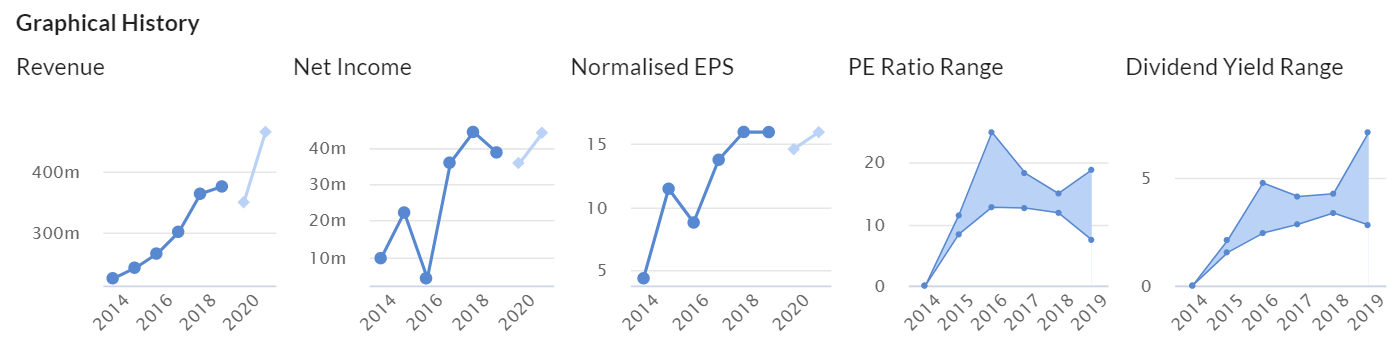
It’s striking from the highlights table, how little WJG seems to have been impacted by covid/lockdown, with the various profit measures only down about 7-9% on LY (last year).
Dividends - down 12% at 7.35p, a useful yield of 3.6% - not bad in a year when many companies cancelled divis.
Net cash strong, at £94.8m
Exceptional costs of £20.5m (cladding & covid), previously announced, so nothing new there.
Outlook comments sound positive -
"COVID-19 undoubtedly caused delays to investment activity in the period, however I am pleased to report that the resumption in forward sales that we have seen, coupled with the increase in the number of student beds for delivery in FY21 and the scheduled completion of four BtR developments, should see Watkin Jones return to growth in the coming year, assuming there is no further significant disruption to our activities. We are pleased with our progress in growing our BtR and PBSA development pipelines and remain very confident in the long term prospects for these markets.
Results presentation slides can be viewed on the company’s website here.
There’s also an audio/visual presentation, click on “audio” on this page. Very helpful, thank you to the company for providing this for PIs.
Commissioned research is available here.
Balance sheet - is strong, with NTAV of £154.5m, and holding substantial net cash of £94.8m.
My opinion - I’m warming to this share, and bought a starter size position late last year. Even though I’m not entirely sure how to value it. If we use PER, then that’s 206p/ 14.7p adj EPS = 14.0, which seems reasonable. It looks as if earnings are sustainable, since we’re given chapter & verse in the commentary about the development pipeline.
I very much like the business model here. WJG forward-sells its building projects to investors. Then bags a lucrative development profit of 21.4% gross margin, on completion of each project. There's a project nearby to where I live, in Bournemouth, so I'm hoping they'll do a public viewing when it opens, which looks imminent. It's remarkable how quickly large buildings go up these days.
WJG has demonstrated in 2020 that the business model is robust, even in a highly disrupted year.
It gets a thumbs up from me. It's the type of share that I'm happy to now keep my small-medium sized position for years to come, collect in the divis, and possibly add to it on market dips. Build to rent seems a very good thing to be doing, as we clearly need much more plentiful, reasonably-priced, good quality accommodation for people to rent.
.
.
That's all for today. See you in the morning!
Regards, Paul & Jack.
Disclaimer
This is not financial advice. Our content is intended to be used and must be used for information and education purposes only. Please read our disclaimer and terms and conditions to understand our obligations.

103 comments
Paul - ref your comments on deficits and Stefanie Kelton's book
From the London Sschool of Economics blog on its website: "In The Deficit Myth: Modern Monetary Theory and the Birth of the People’s Economy, Stephanie Kelton dispels six key myths that have shaped the conventional understanding of deficits as inherently bad, instead arguing that deficits can strengthen economies and lead to faster growth. This book is a triumph, writes Professor Hans G. Despain, shifting normative grounds of government spending away from the false and unproductive idea that deficits are irresponsible and ruinous towards the productive political activity of deciding which spending programmes should be prioritised"
This book is claptrap. Don't be fooled Paul! The BoE can "create" money as long as investor ascribe value to the money created. When that value falls, the BoE has to create more, and more, and more....
I lived in Latin America for many and saw the tragedy of the Kelton attitude play out many times over.
It a superficially alluring option. Just "create" money out of thin air! But ultimately a road to ruin.
Is it just me or did you not addLON:WJG to this report?
It's probably just you :-) currently it is showing as the last section of the report, just after Superdry - you could try doing a refresh <F5>
Paul,
I find it hard to get my head around the large number of companies that are over valued given that they show no proof of profits and on the converse Boohoo and ASOS who both produced excellent results last week have dropped circa 10%+ in a week.
Great buying opportunities but didn’t make sense to me.
“Amazing when you think about it - all Govt debt is basically a policy choice! It's not necessary at all. The BoE could just fund the Treasury directly, by money printing, and cutting out Gilts altogether. I'm not advocating that, just pointing out that it's possible”
Not only possible but baked in as the BOE recirculates Gilt interest payments back to the Treasury. So, other than when Gilts come up for maturity a shadow write off has implicitly occurred.
The inflation indices that the central banks use to measure their inflationary targets are stuffed full of consumables where the retail and manufacturing sectors have been obsessive in grinding down of prices. Meanwhile, we have seen assets boom - stocks, bonds and property. This has become the accepted norm.
This suits governments nicely and the printing presses go burrrrr. Besides, what central bank governor is going to raise rates and go down in history as triggering an epic stock and bond market crash on their watch. They’re totally boxed in to continue the narrative.
In this situation how pensions are going to meet future liabilities in a low-yield environment, baffles me. Perhaps that’s the risk, not CB’s rising rates to combat inflation, but uneven wealth distribution and subsequent unrest leading to governments enacting asset taxes.
The other angle is rising Asia. With 4.6B people in Asia (China and India with 1.4B people each plus Indonesia etc.) and growing economies, their sheer size and buying power surely will bring about change. I see this playing out in commodities as they hover up raw materials. Miners have been through a cycle bottom and constrained supply.
This macro stuff is blurry and difficult to action. I’m long stocks, commodities and avoid all bonds. While cash provides a strong option value, it will erode one way or another. I don’t know how, only that it must. You can’t double the quantity of money and expect it to hold its value. Don’t see central banks raising rates, at least not voluntarily.
I read an article in the FT this morning about how shipping times and costs have more than tripled (from around $2,000 per 40ft container to more than $9,000) from the far east to Europe. We have heard this before over the past year but what caught my eye is it also said that the shipping container imbalance/ disruption of routes is likely to intensify over the coming months rather than ease.
It got me wondering about companies like Boohoo (LON:BOO) who produce goods in the UK and I wondered if Paul or any other knowledgeable people had a view. Is this:
Net positive - competitors shipments delayed, can control costs and pricing better than them
Net negative - still need to import raw materials for Leicester, still need to export to large percentage of customers
Not a big factor either way
It also got me thinking about what other industries could benefit as shippers must be desperate to fill containers going the other way - I think I remember reading when this imbalance happened after 2008 that simply shipping empty containers the other way is difficult as modern ships require some amount of ballast from the goods.
The only thing I came up with was Scotch Whisky as an example of a product produced in the UK from local ingredients for which there is a demand in the far east but there must be others...
"I don’t like it". Well I did. The analysis of Superdry (LON:SDRY) is excellent. I bought some of these when the price was really bombed out, sold out and was wondering whether to buy back in. Perhaps the advisers to the company can explain the onerous lease provision? Many seem to read this report.
Re your comment4 on Superdry "Hence doesn’t that mean the underlying profits are £(10.6)m + £(31.6)m = £(42.2)m in H1?" - shouldn't that be £(10.6)m - £(31.6)m = £21m?
Hi underhill,
Re Superdry (LON:SDRY)
Re your comment4 on Superdry "Hence doesn’t that mean the underlying profits are £(10.6)m + £(31.6)m = £(42.2)m in H1?" - shouldn't that be £(10.6)m - £(31.6)m = £21m?
No, because what I think it's saying is the £10.6m loss is after the P&L has benefited from the release of a £31.6m onerous lease provision, i.e. credited to the P&L. Therefore if the lease provision release is reversed out (as it's a one-off), then the true loss would have been much worse, at £(42.2)m.
That's how I read it anyway, but I could be wrong. Am c.90% sure I'm right though.
Any other accountants have a view on this?
Regards, Paul.
Presumably they have renegotiated the leases which has resulted in a reduction of the provision by £30m. Quite a significant result, even if one off. £sdry
Superdry (LON:SDRY)
No I don't believe they have renegotiated the leases; the balance sheet shows :
Rights of use assets (LT) £110.7m
Lease Liabilities (LT) : £216m + Lease Liabilities (ST) : £80.9m
So in other words they are on the hook for future lease payments of nearly £300m but they only see the economic value they can extract from those leases of £110m.
The balance sheet confirms that they took the hit on these in H2 last FY; so having already booked that loss, there is no ongoing P&L impact - but there will be a cashflow impact.
Just to try to make that clearer :
Ordinarily, when they pay the rent (c. £80m pa) they would
1. Reduce the lease liability by £80m
2. Reduce he balancing right of use asset by the same amount.
3. Book the cash outflow
4. Charge the £80m payment to the P&L.
Having taken this provision (just to make it simple I'll assume they have cut the value they ascribe to the leases in half - not the true figure.)
1. Reduce the lease liability by £80m (beacause they have paid that much off).
2. Reduce the RoU asset by £40m
3. Book the cash outflow (£80m)
4. Charge £40m to the P&L (£80m cash offset by £40m balance sheet improvement)
Hi Gromley
So how do we end up with a credit to the P&L (not a charge)?
Thanks
So how do we end up with a credit to the P&L (not a charge)?
Because last year - they wrote down the "rights of use" asset - the asset that balances out the rents that have to be paid in the future against the profits they might make from those assets.
So that loss (taken last year gets reversed in the current year)
It can be confusing, until you get your mind aligned to how it flows. Maybe this will help?
Essentially in FY20 they 'booked' some of their future rental costs as an exceptional loss. in recognition of the expectation that the stores in question cannot deliver the gross profits required to cover the rent.
So they took a loss in FY20, "pre-booking" the losses they will make in future years.
It's "kinda" okay so long as they can cover the negative cashflow.
Not sure if that makes it clearer?
Thanks Gromley for taking the time to set this out so clearly. I need to get up to date with lease accounting! So in summary are you saying that it is the increased expectations of future economic growth that has changed here (and therefore the ROU asset), not the lease liabilities? So its a double benefit for investors ie a positive outlook and a reduction in losses now.
Sorry - limited time to respond right now, so I'll try to expand on this in due course.
But essentially I think you've read my comments the wrong way around (possibly because I - or the topic - was unclear).
In very short form - they booked some losses that are proper to this year in last year's accounts.
So they are now presenting results that make them seem more profitable than they really are - cashflow will be worse than the P&L.
I have probably left that unclear, but I'll be back.
To be, somewhat incorrect, but concise : they are (legitimately) overstating their profits.
No, I understand you, it's an accounting adjustment therefore the cashflow will be worse than the profit. Thanks!
Yes that bit's right.
I don't think it is a double benefit for investors however - unless perhaps - they can renegotiate the rents down to meet what they can now make from the leases.
Just from a very quick read on Superdry (LON:SDRY) (it's not greatly of interest to me) I think what they are saying is that they took the large onerous lease provision Last FY (ending Apr-20).
So the £31.6m "benefit" is a benefit if you are comparing FY21 with FY20. However, these "benefits" will continue to be felt in FY22 and beyond so it seems to me some what spurious of them even to mention it.
To be clear though that was from a very quick read, so anyone considering investing here should check this for themselves.
The release of the onerous lease provision takes it off the company's balance sheet and is an income source in the P&L, so without this being included, profit would've been 31.6m lower
Hi joshwood976,
Yes that's what i thought too. So actually the underlying picture is far worse than the £(10.6)m loss that SDRY calls underlying. Looks like I was right about that.
Regards, Paul.
Good point joshwood976 & Paul,
it occurs to me that what they have done (last year) is the same as something that got me hot under the collar a couple of years ago when Stagecoach (LON:SGC) did the same (although via a different mechanism).
in FY 2020 they pre-booked (as an exceptional) losses that the real business will make over the next few years.
The trap for investors is that you ignore the exceptional as a "one-off" and then believe the lie that the business is profitable (or less loss making) in the following years.
It's a kind of mis-representation, but one that is actively encouraged by accounting standards. And no, this is not a rant against IFRS16 (on this occasion) because they would have impaired their leases under the old model too.
There are probably more lessons here than I could shake a stick at (not sure what that would achieve actually), but probably the simplest is - never read a P&L without reconciling it to cashflow.
It's something investors should be very wary of. In strong trading years, companies may create "extra" provisions on their balance sheet for potential future liabilities that often never arise.
It then means that in poorer trading years they can release these provisions and artificially inflate their profits.
Of course, they're not doing anything that's not by the book as provisions are a judgemental area of the balance sheet, but it is a way of smoothing profits and avoiding large swings in future trading
Re Quartix Holdings (LON:QTX) sale by Andy Walters. This may also have been inspired by speculation that the Chancellor may raise CGT. As has been discussed many times before, the reasons for a Director sale are often personal and not always driven by price. Given that the Walters family still beneficially owns 22% after the ABB and that institutions were happy to buy in at 401p I am happy to continue to hold. Of course, not to dispute that Quartix Holdings (LON:QTX) , like many other quality companies, looks expensive on a forward PER relative to forecast growth.
Re. QTX selling, could have been influenced by locking in a favourable rate of CGT.
Great point, well made, mammyoko.
It's quite a good wheeze by Rishi Sunak actually - threaten to raise CGT, then watch the tax receipts roll in, as people liquidate holdings to trigger a lower tax bill!
Thanks, Paul.
The QTX block was sold to a single investor, the Buffetology Fund. The company stated that they were approached by the fund in December. Finncap suggests this might be equivalent to an historic (Dec 2020) p/e of around x30 and a forward p/e of closer to x50 (there are apparently additonal costs in the US this year expected to crimp profits). The history has been of very high returns on capital which may go some way to explaining what looks like a very expensive deal for the buyer and a very good one for the seller?
Hi Paul, I always enjoy perusing your preambles in a morning whilst you study the Regulatory News Service (RNS) and you start to compose your company reports. Should you have any spare time in the future for more preambles I would welcome your thoughts on 'Perpetual Loans' which I believe were last used by the government during WWII (but they were called 'war loans') and before that in the Napoleonic wars.
With the UK's national debt now just over £2 trillion and interest rates at near zero levels (good time to take advantage of 'Perpetual Loans') but will no doubt rise at some point in the future, I would be interested to learn how you perceive these type of loans may possibly affect the stock market and ultimately share prices should the government go down this route to fund the national debt.
Hi Logical David,
With the UK's national debt now just over £2 trillion
It's not. The Bank of England (part of Government) owns £895bn of the total. So the national debt is really only about £1.2 trillion, which is fine at about 60% of GDP. Very cheap to service too, and getting cheaper as old Gilts are rolled.
The Bank of England has bought ALL Gilt issuance since March. 2020. All of it! Amazing but true. (source Bank of England website).
A lot of people have trouble getting their head around this issue. Public debt is not a problem at all, at this stage anyway. As my new guru, Russell Napier points out, Govts which issue debt in their own currency, do not have a problem usually. Very much emphasised in Stephanie Kelton's book too, but she's even more certain on this point - pointing out that the national debt could be extinguished instantly & in its entirity, through more QE. She argues that national debt is just money - so Gilts are an extension of the money supply, which can be swapped for cash any time the Govt wants, by printing it.
Amazing when you think about it - all Govt debt is basically a policy choice! It's not necessary at all. The BoE could just fund the Treasury directly, by money printing, and cutting out Gilts altogether. I'm not advocating that, just pointing out that it's possible.
Regards, Paul.
Hi Paul
Just a question to you or anyway else on QE (which I admit I looked into many years ago and never revisited).
I've heard it said that all major economies are printing vast sums right now, but buying back and cancelling their own debt.
What I don't understand is what is South Korea doing? From my understanding the virus has had minimal impact over there, so presumably the SK government - which I class as a major economy - hasn't needed to rely on QE?
And if that's true there must be others out there. New Zealand is perhaps too small to be considered a major economy. Life is normal over in Taiwan, which I would classify as a fairly large economy. Surely these countries are therefore at an advantage vs "major" economies.
What am I missing? Should we be expect amazing growth in SK, NZ and Taiwan in the near future? Or are we saying that poverty could be eradicated overnight with QE in the UK/USA/EU without any real repercussions?
Thoughts from anyone on this appreciated.
A
Hi Paul,
As the Economics & accountancy I studied back in the late 1970s & in the 1980s (inflation accounting - Sir Bryan Carsberg anyone?) I find this intriguing or should that be perplexing! Looking at the BoE website there is a graph that indicates Gilt purchases amounting to £230bn (plus £20bn of corporate bonds) since March 2020 taking the total to £895bn. However, the Debt Management Office information on issuance in the same period indicates c £50bn (if I have totalled it correctly) so the balance must be gilts bought back in the open market I assume. I couldn’t find any direct reference to the actual balance of issuance and purchase by the BofE on their site. Any chance of a link so I can see the BoE calculations. Thanks
I certainly have trouble getting my head around this. My problem is, where did the Bank of England get £895m to buy gilts? If it borrowed £895m to do so then, as it is part of Government, we would have to add that £895m it borrowed to the £1.2 trillion direct Government liability to third parties, to get back to over £2 trillion of total Government debt.
"I certainly have trouble getting my head around this. My problem is, where did the Bank of England get £895m to buy gilts?"
The BOE is the only entity authorised to create money (although commercial banks so as well when they issue loans). The BOE has its own bank account which they can literally key in the deposit value as they see fit, up or down. So they key in a higher value, thus 'printing' money and then spend it buying Gilts.
Thanks, but I don't think that is the answer. I have now looked at the Bank of England's accounts which I have to say are a model of obfuscation - The Asset Purchase Facility is a subsidiary of the Bank but the Bank does not publish consolidated accounts, nor accounts for the APF. However the accounts of the Banking Department disclose that as at 31 December 2019 it had lent some £440billion to the APF. (Not sure about how APF funds the other £455 bn but no doubt the 2020 accounts of the Banking Department will show an increase in the funding it has provided.) This is the major asset on the Banking Department's Balance sheet and on the liability side it is funded by borrowings from banks. So all the gilt purchases have done is replace direct gilt borrowing by the treasury with borrowing from banks by the BoE , so it seems to me that national debt remains the same - it's just smoke and mirrors.
The ONS keep stats on this
https://www.ons.gov.uk/economy/governmentpublicsectorandtaxes/publicsectorfinance/timeseries/mex2/pusf
BOE holdings of gilts £602 billion
The BOE gilt buying has hoovered up new debt issued by the Treasury plus purchased from commercial banks and insurance companies.
Any thought's on Polar Capital Holdings (LON:POLR) from last week Jack? I presume when your club buys it's for the long term, or not short term anyway?
Good results but it's fallen back since.
There was quite a large sale by a non-exec director announced yesterday. I sold immediately around 686 based on the fact that I had made a good gain and the value of Polar is related to what it earns on its investment funds and they are strongly biased towards the Nasdaq. I'm not saying the Nasdaq is going to fall but it seems to be at risk of at least a rotation away towards the other indices. Richard Leonard, whose comment made me buy in the first instance, suggested it could go up to 900 so who knows. At the moment I am looking more short term but in its favour it does pay a high dividend of 5.9% according to Stockopedia so that should be strong support for what has been a growing business. If it falls further I may look for a re-entry point.
Agree with Jack's summary of Aptitude Software (LON:APTD) fully but would point out 2 things:
U And I (LON:UAI), business has indeed been challenging as contained in todays interims and reflected in the continuing weak share price. Current trading is in large part due to the pandemic, but also perhaps the company's slowness in reacting to the changing retail environment; however it has certainly shaken things up and galvanised management.
There is a lot of detail in the interims and I have just listened to the webcast, credit to the company for making it available to all investors. The salient points are:
It is the smallest position in my portfolio and I should have sold earlier, but the discount to NAV kept me invested. Current NAV is stated at 193p with a share price of around 67p.
I think the decisive action outlined today will stabilise the share price. My inclination is to retain what is a relatively small position and wait to see how the situation evolves over the coming months to the May prelims.
I think this is the right decision? Thoughts and views, if any welcome
All the best
I was in and out when UandI was well over 200 and I was nearly tempted to buy yesterday afternoon in advance of the results. I think what put me off was the fact that at one time Richard Upton was buying shares left, right and centre but that ended at the beginning of 2020 (perhaps he had used all his money!) although he hasn't sold. Also, I was trying to trace the planning situation regarding 8 Albert Embankment which they had mentioned in the past and which I take to be a major development if it came off. It seems to have been turned down by the council, then reviewed by the Mayor's office and now sent back to the council to make their decision. It may be unfair of me to say so but they seemed happy to be announcing successful applications but at a glance I couldn't see they had said much about this application. It is referred to this morning where they say they are awaiting a decision. There seems to be too much to put right for me to buy at this stage although it may well turn out to be cheap.
U and I (LON:UAI)
I hold U and I have done for some time - its been an unmitigated disaster if i am being honest. Very poor decision to buy and i am not convinced my decision to not sell and cut my losses is any better.
As you i am simply hanging around in faint hope that the NAV is real and tangible - certainly nothing seems to have gone right for quite some time and really economic conditions have been quite benign. I can only hope we get lucky - i remember i did get luckily with QED back in the day who did a similar thing but i really can't find anything positive to add here. I think the main thing with companies like this is they shoudl be savvy enough not be be losing our money each year adn they seem to be rewally ineffetive at that - the stocky future expectations profit number look like they should be contained in a nice jackanory story.
Apologies that my above itching probably doesn't really add anything useful unfortunately :(
Hi rmillaree
I have all in all been fortunate regarding the impact of the pandemic both from a family perspective and less importantly from an investment perspective. There are many who sadly have not been so lucky.
Regarding the latter my biggest mistake for the learning was not to sell those stocks that were likely to be impacted by the pandemic when the pricing opportunity presented itself, Hollywood Bowl (LON:BOWL), for example. However with the exception of three shares where I felt I could see value based on assets and/or brand they have all been sold. One of these is £UAI. I am currently down around 40% on my holding. Fortunately it is the smallest holding in the portfolio.
So the conundrum is whether to sell, hold or twist. I will need to see Richard Upton delivering on the turnaround before I am tempted to add. Clearly he is incentivised to do so, given his holding in the company. which stood at over 3.5 million shares as at 31 March last year, according to the annual report, close to 4% of the company. In the meantime there is the time value of continuing to hold. It is likely that the proceeds from a sale of U And I (LON:UAI) could be more profitably invested elsewhere.
Decisions, decisions!
Premier Foods (LON:PFD) - further to Timarr's earlier post and my positive reaction, I'm left scratching my head at Mr Market's downbeat reaction (down over 3% last I checked). I can only assume that there is concern that the COVID induced out performance is temporary and that sluggish growth will resume in due course.
Hi John
Sorry a late comment, it would seem at the moment that things all move up ahead of the results, we get the results which read well to me considering all going on, especially the continued buying back of debt and reducing interest costs, and the SP goes down.
This for me is a long term hold, so as I am up on the original price even after the drop today I find it frustrating, but at the same time I was not looking for a trade exit, or even to admit that I have the ability to buy/sell quickly on temporary peaks, as this is the second time in a few months that Premier Foods (LON:PFD) has done this, gone up and come back down that is.
Tommy
Hi all,
I have been a silent lurker all this while but, the mention of Grant Williams podcast got me writing today, my first post.
I heard of this podcast via a 'financial advisor' friend of mine, who's way more knowledgable than me, and he's been talking about inflation for some time now.
So the theory is that governments around the world have too much debt and it is next to imposisble, even if they wanted to pay it back. Which means, either the show carries on with imbalace in the books or they do something to write off the debt over years.
The only possible way is to erode the debt by higher inflation than interest rates, something known as financial repression, effectively borrowers being rewarded and savers being punished.
Cash Savers have been punished in the UK ever since A.Blair and G. Brown's time in Office, which is when I became a stock market gambler.
On a lighter note, especially reading Paul's comment in first para today, I wonder who's read who's mind and plagiarised the exact thought and words (financial repression) at the same time ... look at time of my comment and Paul's comment down below ( https://www.stockopedia.com/co... ) ha ha ..
Financial repression is a well known concept.
I though I would mention (as it's not mage the Mr C cut) that has been an excellent TA from Alumasc (LON:ALU) (I hold) this morning, which the market really seems to like. Revs, PBT, cash generation all up, net debt almost eliminated. Outlook positive sounding.
SR is 87 and there was repeat though not huge director buying last year. As it moves to net cash, this is looking cheap even with today's rise.
Cambridge Cognition (#COG).
Morning Paul,
Thanks for your write-up on #COG. I have been a holder since April and have been adding since. Today's update read very well to me and it seems that there is good potential for this to continue. The change of CEO in early 2019 with a more commercial focus seems to be working well. Matthew Stork has rationalised the sales team since he arrived If more contracts are won for 2021 on top of the 6m already booked, 2021 is likely to beat expectations. And there is also 5m of rev booked for 2022 and beyond.
I have considered #COG to be an early stage Ixico.
I am hoping that liquidity improves as the company grows.
Michael
If inflation rises a lot, and stays high, then of course property values would also probably fall, depending on what interest rates do.
Hey Paul, I'd like to agree that yesterday's discussion on SCVR about inflation was fascinating. It's important to remember that inflation at it's core is a psychological problem - money is after all only worth what we all collectively agree it's worth - therefore it's incredibly useful for me to see what the views of a selected group of keen investors (who are obviously interested and informed by definition) are. The key role the SCVR played for me over the last year (besides the excellent commentary by Jack and yourself) is almost like a real time continuous focus group.
I'd like to just clear up one point that I feel was missed yesterday caused by the use of language. We talk about inflation in a homogenous way but really there are many types and the use of one word frustrates me greatly.
As a result of the massive expansion in the money supply over the last couple of decades, we have seen large price inflation in assets like stocks, fine wine, art and specific types of real estate. We have seen limited inflation in consumer goods prices or wages (either because of increases in technology lowering production costs, macro deflationary pressures, the way government chooses to measure it or a hundred other suggested reasons).
Real estate serves two purposes - both as a store of wealth and somewhere for people to live. Inflationary pressures should cause flats in Mayfair to rise in value (as they serve as stores of wealth as much as homes) but pricing of houses across the UK will be much more influenced by wage inflation/ deflation, local supply and specifically unemployment than increases in the money supply. Logically, if the result of inflation is higher interest rates that will affect house prices because of affordability of mortgages but interest rates have a long way to move before we see that problem.
Good morning all,
Excellent update from Kape Technologies (LON:KAPE) this morning, will you cover?
Regards.
R: Boohoo (LON:BOO)
I think Brexit is only one factor that has negatively affected the SP. Today's news of a possible 2% sales tax on online purchases in the next budget is material although it will take a while to work out what impact it will have (assuming the story is true).
cheers
Francis
There is also a potential environmental tax aimed at online clothes retailers.
Are there any other frustrated holders of Mountfield (LON:MOGP) wondering what they mean by "The Board is considering making structural changes to the Group to improve shareholder value.". I hope this is ruling out a delisting as this would knock shareholder value for six.
He's one of several commentators who have previously been relaxed about inflation not being a threat, now changing their minds, and saying we're entering a period of higher inflation. That matters a lot, as it could be bad news for shares on high PERs.
Paul,
I'm not sure what the relevance of a high PER is? Surely many of the companies it will be best to hold if inflation moves higher are those already on high ratings? Of course, in itself a high PER des not tell you much, but generally companies on high ratings have the type of business characteristics you should be looking to hold through an inflationary period: low capex needs (intangible assets rather than fixed assets), high returns on capital, high conversion of earnings into free cashflow, and most importantly in an inflationary environment, pricing power.
FWLIW I have no view on inflation (above my pay grade) but all commentators need to recognise that "this time it really is different" and history does not help because we have never been exposed to inflation at the same time as having zero interest rates, not to mention QE. I am happy to admit I have no idea what will happen but I don't see much alternative to continue holding quality companies with the characteristics mentioned.
All the best, Si
Just following on from this, can I just ask why it would be the case that "If inflation rises a lot, and stays high, then of course property values would also probably fall"? Sorry if a dumb question, not my area of expertise at all!
The way it's supposed to work is: If inflation stays high, there will be pressure on BoE to raise rates, which will push up mortgage rates, which will in turn push down what buyers can pay for property purchases, which will cause the equilibrium at which property transactions occur to fall. But at the moment economics isn't working how it's classically worked, so who knows...
Ah I see, thank you! But if interest rates dont rise, and mortgages stay cheap, it could increase house prices - and getting a longish term fixed rate cheap mortgage and buying property with it could potentially be a decent investment (if Im thinking about it right?!).
gwilli, myself, I get confused over the terms 'value and price', however, my experience in paying for my mortgage from 1968 to 1987 which were those glorious decades of inflation leads me to believe that house prices follow inflation as a dog follows its master and sometimes gets in front. I can't really say that about property in general but the British Land (LON:BLND) shares I bought in 2011 at around 450 pence are priced at the same today, value is minus the inflation incurred and dividends to add. I hold British Land (LON:BLND) and Barratt Developments (LON:BDEV) along with Persimmon (LON:PSN) to help spread the risk.
Silver
Hi simoan,
Russell Napier was saying (in the Merryn S-W podcast) that in the first few years, inflation could be good for investors. It depends what inflation does to interest rates. Rising interest rates are generally seen as bad for equities, because it means there's an alternative again to owning shares - getting a decent yield on cash or bonds, and maybe safer short term if equity markets are plunging?
His key comments which I noted down were; " Negative real interest rates are nirvana for equity investors... But financial institutions could be forced (by Govt) to liquidate equities" (i.e. financial repression, forcing them into buying Govt bonds, under the guise of regulatory requirements... I'm very bullish on equities [in Dec 2020] at the moment... economic boom coming in 2021, so plenty of upside in equities".
Paul.
Russell Napier was saying (in the Merryn S-W podcast) that in the first few years, inflation could be good for investors. It depends what inflation does to interest rates. Rising interest rates are generally seen as bad for equities, because it means there's an alternative again to owning shares - getting a decent yield on cash or bonds, and maybe safer short term if equity markets are plunging?
Yes, I totally agree with this but it's a much more general point i.e. it will be bad for all equities if interest rates rise, not just those with high PER's. You don't have to be a rocket scientist to know that rising interest rates are bad for equites. I still don't see why interest rates would only effect companies with a high PER though, particularly if they have no debt? Surely the worst affected would be those with high fixed costs and lots of debt, just the type of companies that are on low PER's currently.
I'd much rather own Bioventix (LON:BVXP) than Saga (LON:SAGA) for instance.
All the best, Si
You don't have to be a rocket scientist to know that rising interest rates are bad for equites. I still don't see why interest rates would only effect companies with a high PER though, particularly if they have no debt?
Yep. Inflation particularly impacts companies with high capital costs and lots of depreciation because replacing assets requires them to spend inflation adjusted cash. It becomes a game of chase the tail as they raise prices to cover costs, which rise ... and so on. Heavily indebted companies, ditto.
On high PER companies it depends on why they have a high PER. If it reflects the fact that they have high expected returns regardless of interest rates - which in some cases is true, because the move to a fully connected, digital economy is radically reshaping business models - then it shouldn't make much difference.
If, on the other hand, the high PER reflects an expansion of multiples as a result of low interest rates then you'd expect prices to fall as interest rates rise. Accepting a PER of 30 isn't, in my experience, normal but it's now common for a lot of companies.
My loose observation is that not so long ago a high PE was only awarded to companies with exceptional business models with a track record of success. Now it seems to be normalised and some companies are being valued at that level on the basis of hope rather than cashflow.
timarr
My loose observation is that not so long ago a high PE was only awarded to companies with exceptional business models with a track record of success. Now it seems to be normalised and some companies are being valued at that level on the basis of hope rather than cashflow.
Hi timarr,
Completely agree that the PER tells you little in itself, which was the point I was making. However, if it's backed up with good profitability and free cash generation with low capex needs and no debt, you can make a case that the higher PER is justified. However, we should not kid ourselves that share prices of all companies will not get hit should interest rates start an upward trajectory - risk will be repriced appropriately!
Of course, we can all see companies which are "all fur coat..." i.e. on a high PER for no good reason other than hype and hot air, and I presume these are maybe the companies that Paul was referring to in the main article.
All the best, Si
I see that 'giant' Chinese clothing firm Shein is now the favourite for Arcadia /Topshop carve up.
I presume that DM, and related media will be holding them to the same high standards of ESG as Boohoo (LON:BOO) - not!
"Surely the worst affected would be those with high fixed costs and lots of debt, just the type of companies that are on low PER's currently."
No.
As with all investing, it depends - 3 generic cases:
a)
Co has asset that makes money (long term fixed price contracts)
that is financed by fixed interest loan (same term as contracts)
b)
Co has asset that makes money (long term RPI based contracts)
that is financed by fixed interest loan (same term as contracts)
c)
Co has asset that makes money (long term fixed price contracts)
that is financed by LIBOR+x interest loan (same term as contracts)
At time 0, the costs of a,b,c are the same - as are the revenues
If rates rise:
a - Falls with general market
b - Rises
c - Can go to 0.00 v. easily
My core message:
Profitability of a Co often depends on sales revenue - finance costs.
(payroll costs etc are controllable in the short term)
= the (small) difference between 2 very big numbers
If / when this happens, there is money to be made.
True, of course, but I doubt I would be invested in a company whose Finance Director was as significantly mismatched as to interest rate risk between the assets and liabilities on the Balance Sheet.
Guess that means I would be in a) rising and falling in general.
I see that James Cropper (LON:CRPR) has announced that it's subsidiary Technical Fibre Products is acquiring PV3 Technologies to strengthen their positioning in fuel cell materials. It hadn't occured to me that a paper maker dating back to 1845 would be part of the hydrogen economy. Looks like time to correct my thinking.
Superdry (LON:SDRY) Superdry. The big question for me is can the brand get ever it's 'mojo' back? It seems to a bit of a faded 'dads' brand at the moment. My children, 13 and 14 have heard of the brand but no interest in it.
More fundamentally some worrying commentary on covenants today...
The Group directors noted that the risks set out above indicate that a material uncertainty exists and may cast significant doubt on the Group's ability to continue as a going concern and, therefore, that it may be unable to realise its assets and discharge its liabilities in the normal course of business.
The material uncertainty relates to:
•the duration and impact of the second-wave of national lockdowns and subsequent recovery in consumer demand, and the Group's ability to capture this in future trading; and,
• the ability of the Group to meet its covenants from debt providers
This uncertainty relates specifically to the covenant tests over the 12 month going concern period; the Group directors have assessed the liquidity requirements of the group under these downside scenarios and believe them to be adequate.
After considering the forecasts, sensitivities and mitigating actions available to management and having regard to the risks and uncertainties to which the Group is exposed (including the material uncertainty referred to above), the Group directors have a reasonable expectation that the Group have adequate resources to continue in operational existence for the foreseeable future, and operate within its borrowing facilities and covenants for a period of at least 12 months from the date of signing the financial statements, taking into account the working capital troughs in FY22. Accordingly, the financial statements continue to be prepared on the going concern basis.
I would happily have bought some of their children's clothes as retro look presents for my grandchildren but Dunkerton ditched all that when he came back in.
13-14 year olds don't have any money.
It might be a "dad's brand" but dads (and mums) hold the purse strings. Something Dunkerton knew all along which is why the clothes were expensive but high quality, not throwaway fast fashion, imo, your view may be different :)
But most Dad's spend far more on their kids clothes than their own leisurewear.
Or is that just me?
.
Downbeat update from Superdry (LON:SDRY) today. I don’t hold or follow closely any more as even when they were open their flashy, noisy and claustrophobic Stores were always devoid of customers whenever I went in one.
Superdry share price is down but BOO and ASOS have also been falling in recent days, and BOO was down another 13p just now.. Could those falls be linked to this section in the Superdry update today or is this likely to be a bigger concern for Superdry than for BOO?
“Although a Brexit deal was finally agreed in late December, which should make the transition smoother than if there were no-deal, the UK has still left the EU and there are many impacts on our business relating to tariffs, trade, logistics, product standard regulations, currency fluctuations, and the impact on people within our organisation. While we have minimised the direct costs of these changes by optimising our inventory management and intake processes ahead of 31 December, we anticipate that it will be some time before we have better visibility on both the financial and operational implications that Brexit will have on our business.
Our internal working group have implemented plans covering all critical legal risks and operational challenges with particular focus on reducing the long-term movement of product cross-region, unless required, to reduce the impact of additional duty/tariffs, and to avoid potential delays. This group will be monitoring the key areas of impact in the coming weeks and months to ensure processes and plans are updated as required to best mitigate the impact of Brexit on our business.
Superdry is a global business with corporate and operational capability both in the UK and mainland Europe, which means that we are well-equipped to deal with the challenges of Brexit, as we can service EU customers from within the EU and not as a UK-only organisation. However, though this diversified distribution centre network has allowed us to mitigate many of the potential costs, there are now additional considerations and frictional costs of relocating inventory once it has been received into the business.“
Presumably even if this is a concern for BOO it’s a temporary problem. Or isn’t it? Could it impact their profit margins permanently or can BOO easily find a way around possible Brexit negatives? . No way btw is this restarting the Brexit debate which has been decided, so this is just a question about the possible hopefully short term impact on BOO’s business.
Presumably even if this is a concern for BOO it’s a temporary problem. Or isn’t it? Could it impact their profit margins permanently or can BOO easily find a way around possible Brexit negatives?
If Superdry (LON:SDRY) can't figure out the full impact I don't think there's much chance that we can. Everyone will have an opinion, mind.
There's a lot of heat and noise around this topic at the moment because the lack of time to prepare means that a lot of smaller companies are having a nightmare. For those this is existential - a couple of months major disruption will put them out of business. It certainly seems like a lot of the government's IT systems aren't fit for purpose and companies coming new to them are having lots of problems.
For companies like Boohoo and Superdry this may be painful but they're likely to already have experience of import / export outside the EU and will be able to find ways of overcoming the issues over the next few months. Broadly, it looks like most big companies won't be seriously impacted. Further down the foodchain I'd be more concerned.
The one overriding issue that would hurt all companies would be serious customs delays. Most companies that could stockpile ahead of time did so so it'll be a while before we see whether this is a major problem.
timarrI can't help wondering to what extent brexit is the current easy excuse, for international businesses who perform poorly. An excuse which will of course be readily believed by many remain/rejoin shareholders. Would the excuse previously have been the weather?
Apologies to the non Boohoo (LON:BOO) holders.
Boohoo rocked by Covid backlash: Online giant under fire AGAIN as it hosts Dubai business conference at height of pandemic
https://www.thisismoney.co.uk/...
Yes, and I note it is down again this morning. I could give a list of reasons why Boohoo's shares may fall but organising an event in Dubai should not be one of them. A total irrelevance as far as sales are concerned. I think the only people rocked by this news would be politicians and journalists.
Seems a bit of an own goal.
Boohoo (LON:BOO) I hold
“Seems a bit of an own goal.” By Boohoo (LON:BOO) I assume you mean Paul? That was my first thought on reading the article this morning but:
Of course there may have been other ways to achieve what was achieved by the conference, maybe it was just a jolly and should not have happened etc.
Whatever the whys and wherefores I don’t believe the fallout from this news story will reduce the discounted future cash flows that will accrue to the company and therefore it should not have affected the share price but of course it does give traders an opportunity. :-)
Regards
Michael.
I took this as an opportunity to ADD. However, I do wonder who is advising them
Re Boohoo (LON:BOO) in Dubai, I agree with your brief, succinct and,dare, I say it sounding disappointed comment? I think that reasonably the wider British public deserves a bit more of the spirit, we're all in this together, behaviour. We have had loads of occasions in the last 10 months where examples of public behaviour have been perhaps just within the law, or the detailed guidelines, but always trying to find a way to get round them. Was this meeting necessary? Well the world doesnt stop; China among others is growing away; and we want the economic damage to be minimised. All local meeting health observance criteria seem to have been adhered to, but the fact remains - it clearly was a jolly too, and that can leave a bad taste when so many back home are suffering in another lockdown. It also gives the media yet another opportunity to find something 'dramatic' to satisfy their drooling readers. Those on the receiving end are, among others.....yes, we the shareholders. Your biggest holding, Paul. Mine too.
Well said! after all the press comments. Im sure it was clear, that this trip would come back and bite them.
Things obviously going reasonably well in Construction. Alumasc and Henry Boot out with positive news today.
In response to the update from Funding Circle yesterday.
As a business they create a lot of hot air.
Historically Funding Circle Holdings (LON:FCH) have spent 50% of revenue on marketing. The global expansion has pretty much been a failure and I believe some of their overseas offices are working as brokers rather than actual lenders.
They do have an automated approval process which is slick if the deal goes through without touching sides. If there are any questions that is where the problem starts. The quality of the front line staff is dreadful. I am not sure whether they just can't pay enough or that the training is poor.
My issue with the business is the tech like valuation. There is arguably no repeat income. The loan belongs to the investor and FCH charge a platform fee for arranging the loan. The argument that customers return for another loan is somewhat unproven. Insurance companies, etc.. talk about rates of renewal. Why don't Funding Circle? The loans in the main are 3 - 5 years and historically interest rates charged have been high (up to 20%).
So why are loans unlikely to renew?
Loans are typically for a specific purpose which is often one off and does not suit other finance products. A refurb of an office would be a good example. Cars and plant and machinery are renewed more often but are better suited to HP where the asset is used as security rather than directors guarantees.
Also don't forget that returning clients still have to go through the same underwriting process. If a client does want a new loan then due to financial performance or affordability criteria they may not qualify. If financial performance has improved and debts have reduced the business may well qualify for cheaper funding via the banks.
So in short there are 2 issues with renewals. Will the client need funding and if so will they need Funding Circle, and will Funding Circle approve the new application?
Demand is another issue. CBILS is an opportunity for them to shout about improved performance but this is a one off. I would suggest most businesses that qualified have taken a CBILS or Bounce Back loan from a bank, Funding Circle or another provider. This will mean for the foreseeable future they won't need a loan. The opportunity to refinance those loans will be minimal because in most cases the rates we so low compared to normal rates.
Let's assume a business does need a loan. It is likely due to ongoing distress caused by lockdowns. The actual criteria for CBILS has not changed so they are limited to 25% of turnover or 2 X wages. They are likely capped out. Their distressed financials and existing loans will also mean they don't meet the underwriting criteria.
Beyond CBILs the same issues apply and without the government offer FC an 80% guarantee. Underwriting loans will be tough. Demand will be lower and underwriting approvals will be lower.
The next issue is investors. FC have fallen out with retail investors like us and moved towards institutional investors. Read Trustpilot. FC only send review requests to client so by that they mean people they have approved and provided a loan to. As such the reviews are skewed in their favour. However, investors have found their way there and are unhappy as are those that have been declined.
Of the existing loans prior to Covid, what will the performance be? If bad debts are high will institutional investors want to continue supplying funds? Funding Circle sold some loans to a hedge fund recently. I think bad debts will increase and investment will be harder to come by. This may means institutional investors want a higher return forcing rates even higher than they were before. This will reduce demand.
Overall I think the model is flawed. There is no repeat income to talk about and the likelihood of renewal is not the same as with revolving credit facilities, log term loans like mortgages or insurance products.
This business was overvalued on hype and hot air. The business remains full of hot air although the hype has arguably dies down.
2021 will show it's true capabilities. Income will drop significantly from 2020.
Totally (LON:TLY) Totally Healthcare contract extensions and Covid-19 clinical service pilot funding will only reinforce the breakout in progress highlighted by Michael Taylor in his article here:
https://www.stockopedia.com/co...
Totally was one of his 3 trend trades for 2021.
Funding Circle Holdings (LON:FCH) (no position)
Hi CamRaid
Thanks for continuing the discussion.
I thought I'd throw in some comments:
"The global expansion has pretty much been a failure"
I couldn't agree more!
---
"There is arguably no repeat income. The loan belongs to the investor and FCH charge a platform fee for arranging the loan."
In addition to the c.5% arrangement fee for setting up the loan, Funding Circle Holdings (LON:FCH) also take a servicing fee. From memory it's c1% per year for the life of the loan - so a recurring income is there, which is always a good thing.
--
"The argument that customers return for another loan is somewhat unproven. Insurance companies, etc.. talk about rates of renewal. Why don't Funding Circle? The loans in the main are 3 - 5 years and historically interest rates charged have been high (up to 20%)."
I don't think it's fair to compare a loan book to an insurance company. Insurance is usually annual and often compulsory.
All additional comments on loans being one-offs (for refurbishments, machinery, CBILS, etc...), no-one going back to the institution that originally lent to them and having to go through the under-writing process for all additional loans, applies to ALL lending institutions.
I think it's unfair to say the current situation only applies to Funding Circle Holdings (LON:FCH) .
---
"FC have fallen out with retail investors like us and moved towards institutional investors."
I've heard this anecdotally from a friend, who wanted to sell his loans back in March. Unsurprisingly he couldn't, but therein lies the risk with lending for high returns.
---
"Funding Circle sold some loans to a hedge fund recently. I think bad debts will increase and investment will be harder to come by. This may means institutional investors want a higher return forcing rates even higher than they were before. This will reduce demand."
I've heard that Funding Circle Holdings (LON:FCH) only sold investors the good loans in their ABS' and took on any losses themselves. I'm waiting to see for myself when the full year results are published.
---
I personally remain divided.
I think they're onto something with what they offer, but I also think management are crap. Not only was 2020 their golden opportunity to issue significant government-backed loans, but I have found their updates misleading.
As you say, 2021 will be interesting not only for them, but for all lending institutions.
Cheers
A
Hi Abtan,
I always like a good discussion and a differing opinion so please don't think I am trying to convert you or convince you that I am right. I am just sharing my opinion.
Yes you are right that there is a 1% management fee but compared to the overheads required to service this and the high interest rates enjoyed by investors the fee is negligible. To be a financial success they need to keep pedalling.
"All additional comments on loans being one-offs (for refurbishments, machinery, CBILS, etc...), no-one going back to the institution that originally lent to them and having to go through the under-writing process for all additional loans, applies to ALL lending institutions."
Yes I agree that this applies to all lending institutions. However, not all lending institutions were floated as a multiple of revenue claiming to be a technology company. The issue is the product is transactional and not necessarily a repeat product by the nature of it's structure and it's term.
Take a look at Ally Financial in the US. They roll out high volume products to a mass market. Car loans, mortgages, etc.. The renewal rates will be high. What is even better is that they fuel this in the main by low cost deposits from savers. Look at their share price graph and there are tips they will hit $90. Take a look at https://www.dataroma.com/m/comm.php
Funding Circle is a bad idea that is badly run. I can't see it making money. If anything short it.
Put your money in Ally and thank me in 12 - 24 months. :-)
Funding Circle Holdings (LON:FCH)
Hi Camraid
No offense taken at all. I'm enjoying hearing a different view to be honest. And just to reiterate, I don't hold, though I remain curious.
Ally Financial - I just took a quick look. Everything does indeed seem to be going in the right direction. I never look at tips (ever since owning Avanti Communication in a past life) + it seems like a mammoth company to research, so sadly I think I will pass. Best of luck with it.
Back to Funding Circle Holdings (LON:FCH) ...
If they do indeed have a phantom net cash position - i.e more cash on their balance sheet than their market cap, and they are EBITDA positive going forward, then the valuation is completely incorrect and it is undervalued. We shall see.
Cheers again
A
That is interesting. Can you explain where the phantom cash is likely to come from?
Funding Circle Holdings (LON:FCH)
Hi Camraid
In the last annual report (link here, page 35) there is a section on SPVs - Special Purpose Vehicles.
These have been set up to allow institutions access to blocks of Funding Circle Loans.
Before institutions can buy these:
However, there is a short period between Funding Circle Holdings (LON:FCH) buying those loans (step 1.) and then selling them onto the institutions (step 4)...which is when covid happened.
As far as I know:
You might have noticed in the Trading Update a few days ago that the company only referenced "Income" not "Revenues". It's because the latter includes the loss on these FV adjustments. Sneaky.
To summarise:
Note the £319m net equity position above and that the market cap today is £318m.
I hope the above is clear.
If it's true and a large £300m net cash position does appear on its balance sheet in the near future (i.e. they have more cash than their current market cap) AND they are EBITDA positive, then I'm more likely to be interested.
Until then, I'll just need to wait.
Cheers
A
That is really interesting. Thanks for sharing.
Abtan,
Thanks very much for this. You have really got me thinking about this.
I invest in Naked Wines and one of the factors I liked about it (I got in at 220p) was the marketing could be stopped at anytime and reduced to a level that serviced existing customers rather than trying to acquire new ones. It is a subscription model with more frequent and lower value purchases but a similar principle could apply to £FCH. This would make the business instantly profitable.
Your concept of this hidden cash amazes me. There have been rumours that Starling bank could buy FC but the rumours had scorn poured on them due to the market cap of FC. This could make the transaction achievable.
Do you have more thoughts on this?
CamRaid
Funding Circle Holdings (LON:FCH)
Hi Camtab
It is indeed an interesting scenario.
First, sorry I'm not sure I fully understood the Naked Wines (LON:WINE) comparison.
Second, I didn't know that Starling Bank were looking for a company to buy - interesting.
From a very quick read, it looks like their focus is on European expansion. Given the recent closures of the French and Dutch Funding Circle offices, I'm not sure the company would therefore appeal to Starling.
Also keep in mind that £FCH might now be EBITDA positive. Let's say EBITDA for FY21 comes in at £10m and let's use a reasonably low x10 multiple = £100m
+ at least £200m cash if those SPV's have indeed been removed from the balance sheet and we prudently assume some write-downs
= £300m
This seems like a low end estimate.
From a look at the last Companies House records, it doesn't look like Starling has this sort of money lying around. FY20 was a good year for them though, so maybe they might be able to raise funds for a cheeky bid, I've honestly no idea.
It will certainly be interesting to see how this pans out though.
Cheers and have a nice weekend.
A
My morning smallcap tweet: 16 companies this morning
Totally (LON:TLY) TruFin (LON:TRU) Telit Communications (LON:TCM) Microsaic Systems (LON:MSYS) Corero Network Security (LON:CNS) Dekel Agri-Vision (LON:DKL) Kier (LON:KIE) Mountfield (LON:MOGP) Eleco (LON:ELCO) Audioboom (LON:BOOM) Iofina (LON:IOF) Kape Technologies (LON:KAPE) Cambridge Cognition Holdings (LON:COG) TT electronics (LON:TTG) Pebble (LON:PEBB), Crossword Cybersecurity (LON:CCS)
Totally (TLY) wins contract extensions and continued pilot funding worth a total of c. £7.2m. [SP=27.3 Cap=50m]
TruFin (TRU) guides FY(Dec) rev £14.6m (£7.3m), significantly ahead of market expectations. and adj pretax loss £8.4m (£9.3m), ahead of market expectations. Cites strong performance from the console division of Playstack. Looking at sale of Oxygen and / or Vertus and further return of capital to shareholders. [SP=67.5 Cap=55m]
Telit Communications (TCM) guides FY(Dec) rev down 10.4% and adj EBITDA $38-$41m. 'Profit in cash' is expected to be in line with the Board's expectations. [SP=205 Cap=275m]
Microsaic Systems (MSYS) £5m placing at 0.1p, a 50% discount. Chmn replaced. Funds for "the commercialisation of Microsaic's current miniaturised products and services, provide funds to further develop Microsaic's product and service portfolio and fund general working capital" ie keep the lights on. H2 trading: "although two unit sales were made, revenues continued to be focussed on the continuing sales of consumables, spare parts and service and support". [SP=0.22 Cap=1m]
Corero Network Security (CNS) guides FY(Dec) rev up c.73%, ahead of market expectations. EBITDA only in line. [SP=11.5 Cap=57m]
Dekel Agri-Vision (DKL) New €15.2m bond facility at 7.75%. as part of long-term refinance programme to extend maturity of debt profile. "First approximately €5 million tranche of seven-year bond issued to replace short term debt and provide funding support." [SP=5.58 Cap=26m]
Kier (KIE) guides H1(Dec) slightly above the Board's expectations with positive adjusted operating cash flow. No numbers! Wins 8-year maintenance contract worth c. £200m with Transport for London. Order book 'gives confidence'. [SP=75.1 Cap=122m]
Mountfield (MOGP) grim. H2 profit below H1 with 'trading performance' (rev?) not improved. "Board is considering making structural changes to the Group to improve shareholder value." [SP=0.53 Cap=1m]
Eleco (ELCO) expects FY(Dec) rev flat and pretax up at least 10%. H2 rev up 6%. Is this in line? [SP=83.6 Cap=69m]
Audioboom (BOOM) guides FY(Dec) rev up 20% in $. Adj EBITDA loss $1.8m ($2.9m), ahead of market expectations. Guides FY21 EBITDA positive. [SP=276.25 Cap=43m]
Iofina (IOF) H2 production of 325.5MT but guides H1 2021 285-305MT even though "Iofina and its partners expect more drilling and workover activity throughout 2021 versus 2020, which is likely to provide more brine water to produce iodine." odine prices peaked in early 2020 and have since come off their highs but remained stable. [SP=14.5 Cap=28m]
Kape Technologies (KAPE) guides FY(Dec) rev c.$122.2m up 85% and at the upper end of management's forecasted range. Adj EBITDA ahead of management's expectations at c. $39m. [SP=204 Cap=430m]
Cambridge Cognition (COG) guides FY(Dec) rev up 34%, lightly ahead of market expectations. Loss £0.44m (£2.9m). Rev was boosted by two large one-off orders total £3.1m. CFO scarpers. He is wished success but is not thanked. [SP=69 Cap=22m]
TT Electronics (TTG) guides FY(Dec) rev down 9% or 12% organic. Nov-Dec organic rev down 4% lower. Adj pretax in line. Expects continued revenue recovery and good profit growth. No concrete news on the wonder Virolens ultra-fast covid detector: "Operational trials and validation testing are continuing and applications for regulatory approvals of the Virolens® rapid COVID-19 screening device are progressing. There is a wide range of possible outcomes." [SP=215 Cap=375m]
Pebble (PEBB) guides FY(Dec) ahead of market expectations with Adjusted EBITDA not less than £9.5m. [SP=123.45 Cap=207m]
In line: Crossword Cybersecurity (LON:CCS)
In response to the update from Funding Circle Holdings (LON:FCH) yesterday.
As a business they create a lot of hot air. Compare their results and what your returns would be as an investor to £ALLY I know where I would rather be invested.
Historically Funding Circle have spent 50% of revenue on marketing. The global expansion has pretty much been a failure and I believe some of their overseas offices are working as brokers rather than actual lenders.
They do have an automated approval process which is slick if the deal goes through without touching sides. If there are any questions that is where the problem starts. The quality of the front line staff is dreadful. I am not sure whether they just can't pay enough or that the training is poor.
My issue with the business is the tech like valuation. Remember this is a loan origination platform and FCH get a fee for putting borrowers and lenders together. That is it. Just a one off fee. They don't earn ongoing interest. There is arguably no repeat income. The loan belongs to the investor and FCH charge a platform fee for arranging the loan. The argument that customers return for another loan is somewhat unproven. Insurance companies, etc.. talk about rates of renewal. Why don't Funding Circle? The loans in the main are 3 - 5 years and historically interest rates charged have been high (up to 20%).
So why are loans unlikely to renew?
Loans are typically for a specific purpose which is often one off and does not suit other finance products. A refurb of an office would be a good example. Cars and plant and machinery are renewed more often but are better suited to HP where the asset is used as security rather than directors guarantees.
Also don't forget that returning clients still have to go through the same underwriting process. If a client does want a new loan then due to financial performance or affordability criteria they may not qualify. If financial performance has improved and debts have reduced the business may well qualify for cheaper funding via the banks.
So in short there are 2 issues with renewals. Will the client need funding and if so will they need Funding Circle, and will Funding Circle approve the new application?
Demand is another issue.
CBILS is an opportunity for them to shout about improved performance but this is a one off. I would suggest most businesses that qualified have taken a CBILS or Bounce Back loan from a bank, Funding Circle or another provider. This will mean for the foreseeable future most businesses won't need a loan. The opportunity to refinance those loans will be minimal because in most cases the rates we so low compared to normal rates.
Let's assume a business does need a loan. It is likely due to ongoing distress caused by lockdowns. The actual criteria for CBILS has not changed so they are limited to 25% of turnover or 2 X wages. They are likely capped out. Their distressed financials and existing loans will also mean they don't meet the underwriting criteria.
Beyond CBILs the same issues apply and without the government offer FC an 80% guarantee. Underwriting loans will be tough. Demand will be lower and underwriting approvals will be lower. This is not an upward trend. This is a spike.
Investment is a key factor to success.
The next issue is investors. FC have fallen out with retail investors like us and moved towards institutional investors. Read Trustpilot. FC only send review requests to clients so by that they mean people they have approved and provided a loan to. As such the reviews are skewed in their favour. However, investors have found their way there and are unhappy as are those that have been declined.
Of the existing loans prior to Covid, what will the performance be? If bad debts are high will institutional investors want to continue supplying funds? Funding Circle sold some loans to a hedge fund recently. I think bad debts will increase and investment will be harder to come by. This may means institutional investors want a higher return forcing rates even higher than they were before. This will reduce demand.
Overall I think the model is flawed. There is no repeat income to talk about and the likelihood of renewal is not the same as with revolving credit facilities, log term loans like mortgages or insurance products.
This business was overvalued on hype and hot air. The business remains full of hot air although the hype has arguably dies down.
2021 will show it's true capabilities. Income will drop significantly from 2020.
In comparison £ALLY focus on high demand products with mass market appeal and secure their funding via an increasing level of low cost deposits.
Trading update from Premier Foods (LON:PFD) today neatly encapsulates the nature of success during the pandemic. They're obviously benefitting significantly from people staying at home and cooking rather than going out. This is obviously a benefit that will fade at some point.
Yet it's transformed their finances - following today's announcement they'll have paid off £160 million out of £210 million of floating rate notes this year - this from a business that generated £13 million in cashflow last year. This is a lasting benefit, not a transitory one, along with growth in online (90%+) and overseas (40%+).
https://www.londonstockexchang...
You have Premier on a PE of around 10 and Greggs (LON:GRG) on one of around 40. The former looks low and the latter high, but who really knows? Maybe in 3 months time we'll all be flocking back to the High Street and munching on vegan sausage rolls? Or maybe some of the changed behaviours will stick?
Investing is always a bit like peering through a smeary windscreen, but it's all particularly blurry at the moment.
timarr
I was pleased too by today's update from Premier Foods (LON:PFD) and would like to tip my hat to Jack for his great analysis back in July (https://www.stockopedia.com/co...) which alerted me to the potential here. This really looks like a great value, boring company of the kind that I feel safest holding in advance of any forthcoming corrections to the strange pandemic boom we've seen.
We may get some short term inflation but I can’t see it medium term. We have too much indebtedness , will be entering the worst recession in living memory and I just can’t see inflation being sustainable.
Inflation is your friend when it comes to indebtedness. It is one of the best tools to reduce indebtedness - you quite literally inflate the problem away. The trick is to keep inflation under control so it doesn't send the economy crashing down.
I'm convinced that the real rate of inflation is much higher than reported by CPI, so this is already happening to a certain extent. This is supported by the value of the pound which has fallen against most major currencies over the past decade. Many other countries are taking a similar approach, so they are all reducing their relative debt through inflation, just some more than others.
Is inflation really your friend to reduce indebtedness? In terms of household debt it’s going to very much depend on what interest rates and pay increases are relative to that inflation.
The consensus seemed to be from the 70’s onwards that high inflation is a road to nowhere good.
Agree - it's all about controlling the inflation. In the 70s we lost control of inflation with all of the negative consequences that flowed from that.
The real thing that drove inflation in the 70s was the much stronger power of workers to demand pay rises (trade unions, nationalised industries). Workers today are in a much weaker position due to technology/automation and globalisation (zero hour contracts, amazon warehouse workers, Uber drivers, etc). Unless this changes I don't see a sustained return to the high inflation of the 70s (perhaps a one-off increase due to higher commodity prices or pent up demand).
That was my experience and would like to add company pensions and enhanced hourly pay-rates for overtime worked. to your list of weaknesses. Maybe the only thing which will cause inflation now is demand exceeding supply, which in turn means we must roll up our sleeves to dig our way out of the hole.
My memory of the 1970's along with that of many of my clients was buying properties, enduring much higher interest rates than at present, but finding ourselves in the early 1980's with properties that had more than doubled in value with the loans remaining the same and much easier to repay as interest rates dropped. I didn't do it myself but those who I thought had taken out ridiculously large loans often finished up much wealthier than I did.