Small Cap Value Report (Tue 21 Mar 2023) - ABDP, REAT, WYN, STEM, TRST, QXT, ZTF

Good morning from Paul & Graham.
Today's report is now finished. I'll put catch up items into tomorrow's report, so am working away on that now.
Banking problems are rumbling on, with the latest contagion risk apparently over who owns the bank bonds that are seemingly being potentially wiped out in refinancings/takeovers. That topic is beyond my pay grade, so if any of our banking experts have a view on it, do post a reader comment below. I might reach out to my network of experts and see what they say, so if I pick up anything useful, I'll pass it on.
Rail strikes - it seems that a settlement has been reached. So I'm wondering if any of the companies (especially in hospitality) which blamed the strikes for poor trading, will now start issuing ahead of expectations updates instead?! To be fair though, it should help the sector at least somewhat, for companies which operate in city centres anyway. (EDIT: readers are saying in the comments below that the rail strikes are not yet fully resolved, so looks like I jumped the gun here, apologies!)
Explanatory notes -
A quick reminder that we don’t recommend any stocks. We aim to review trading updates & results of the day and offer our opinions on them as possible candidates for further research if they interest you. Our opinions will sometimes turn out to be right, and sometimes wrong, because it's anybody's guess what direction market sentiment will take & nobody can predict the future with certainty. We are analysing the company fundamentals, not trying to predict market sentiment.
We stick to companies that have issued news on the day, with market caps up to about £700m. We avoid the smallest, and most speculative companies, and also avoid a few specialist sectors (e.g. natural resources, pharma/biotech).
A key assumption is that readers DYOR (do your own research), and make your own investment decisions. Reader comments are welcomed - please be civil, rational, and include the company name/ticker, otherwise people won't necessarily know what company you are referring to.
Agenda
Masses of results are out this morning, so we'll work through as many as we can - we'll be doing mainly shorter sections today, to cope with the volume -
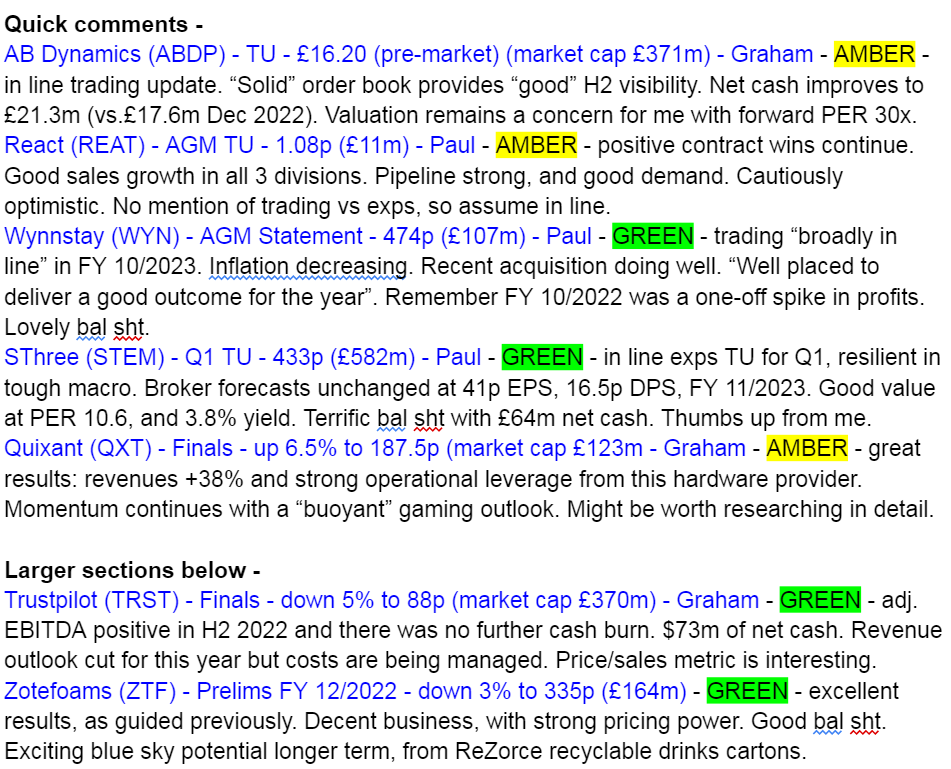
It's getting too big, so I've had to split this into two. Here's my remaining to do list, not sure how many of these I'll manage to cover today - oh dear, this overwhelmed me for today's report I'm afraid. I'll see what I can prepare this afternoon, for inclusion in tomorrow's SCVR.
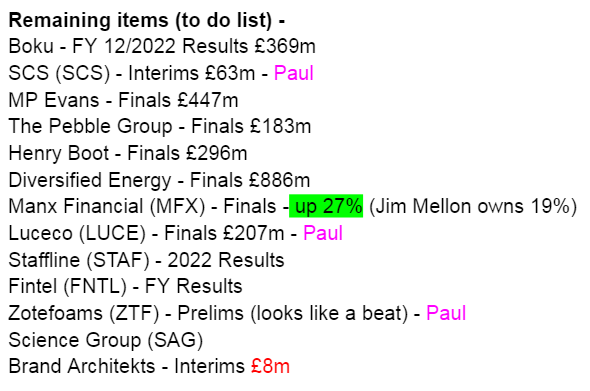
.
Paul’s Section:
Zotefoams (LON:ZTF)
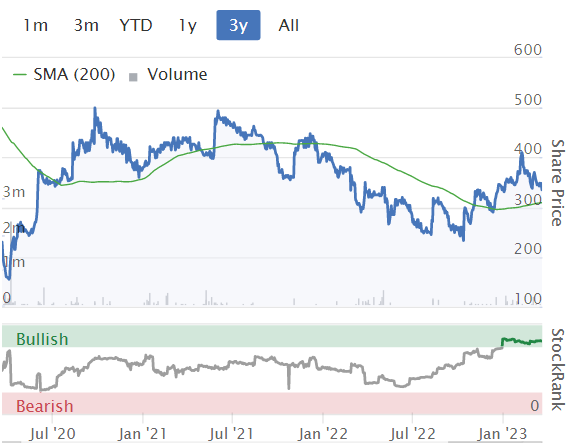
335p (down 3% at 11:18)
Market cap £164m
I’ve written a lot about this specialist foams company in the last year, and it’s one of my top watchlist shares ideas - just to clarify, these are not short-term trading ideas, but good solid, value/GARP companies that I think should do well long-term, and are priced sensibly in the meantime. There’s also an emphasis on good balance sheets, and decent divis, to reduce risk. Some will work, and some won’t, as is always the case with shares - nobody can predict the future with 100% success. I deliberately picked things that could weather a profit warning without becoming high risk too, given that we came into 2023 with a very wobbly macro backdrop. So far both the main tabs on my watchlist are fanning out into winners & losers (short-term), much as I would expect, and are slightly above breakeven YTD, so pretty similar to the market as a whole so far (very early days).
Getting back to ZTF, I reviewed its FY 12/2022 trading update here on 19 Jan 2023. It was another in a series of ahead of expectations updates, so the company has been on a roll for some time. Indications were for £127.4m revenues (up 26% on 2021), and PBT at least £12.0m, up 70%.
For more background, see my transcript here from Oct 2021, when I did an audio interview with the CEO, David Stirling.
Zotefoams plc ("Zotefoams" or "the Company" or "the Group"), a world leader in cellular material technology, today announces its unaudited preliminary results for the year ended 31 December 2022.
Revenue - exactly as guided, at £127.4m (up 26%) - importantly, a lot of the increase is a result of higher prices - so ZTF has demonstrated very well that it can cope with higher input inflation, and pass it on to customers, protecting profits. A very important strength. Think of the many companies where profit margins have collapsed in 2022, due to higher input costs. So for me, ZTF firmly sits in the category of companies that have demonstrated strong management, and pricing power, hence a quality company. Within the StockRank, Stockopedia recognises this too, with a decent Q score of 82.
Profit before tax (PBT) of £12.2m, slightly ahead of guidance, and up 74% on 2021. So a very successful year, as expected & previously guided, hence not price sensitive today.
Footnote 1 says this is after £258k of amortisation, which I think most companies would adjust out. So on a comparable basis to other companies, I would use PBT of £12.5m.
Basic EPS is up a whopping 129% to 20.6p, helped by a tax charge that the CFO says has normalised this year (after being unusually high last year). It’s expected to stay around 18% due to the ongoing benefit of R&D tax credits.
Diluted EPS is 20.2p, giving us a PER of 16.3x at 335p per share - that looks reasonable to me, provided that level of profitability is sustainable of course.
Comparing the basic, and diluted EPS is always useful, as it’s a quick way to see how much dilution there is from share options. It’s only about 2% here, which is fine by me. I personally don’t like to see share options exceeding about 5% dilution, and 10% is generally seen as a hard stop - anything above that is just out of control management greed.
There was a mix of headwinds & tailwinds in the 2022 results - e.g. energy obviously a headwind, as were raw materials prices. Forex (strong dollar) was a favourable tailwind, adding £2.5m to profit.
Profit margins now back up to pre-covid level, thanks to selling price rises/surcharges.
ROCE has risen to 10.1% (2021: 6.1%) which is looking better, I know this has been challenged by some investors. Personally I like stronger balance sheets, like this one where ZTF owns the freeholds for its main factories. That depresses ROCE, but makes it a much better, safer company to me, hence why I put less emphasis on ROCE than many other investors. Everyone’s got their own way of doing things, and there’s no strict right or wrong.
Broker forecasts for FY 12/2023 are about 19p EPS, near enough the same as 2022 - so a flat year, following an outstandingly good year.
Bear in mind also that ZTF is currently absorbing the startup/developments costs of its exciting ReZorce new product (fully recyclable drinks cartons), which were £1.9m in 2022. So I think this could be adjusted out as a separate activity, which would lower the PER by maybe 15% (there would probably need to be a partially offsetting tax adjustment, for R&D tax credits)
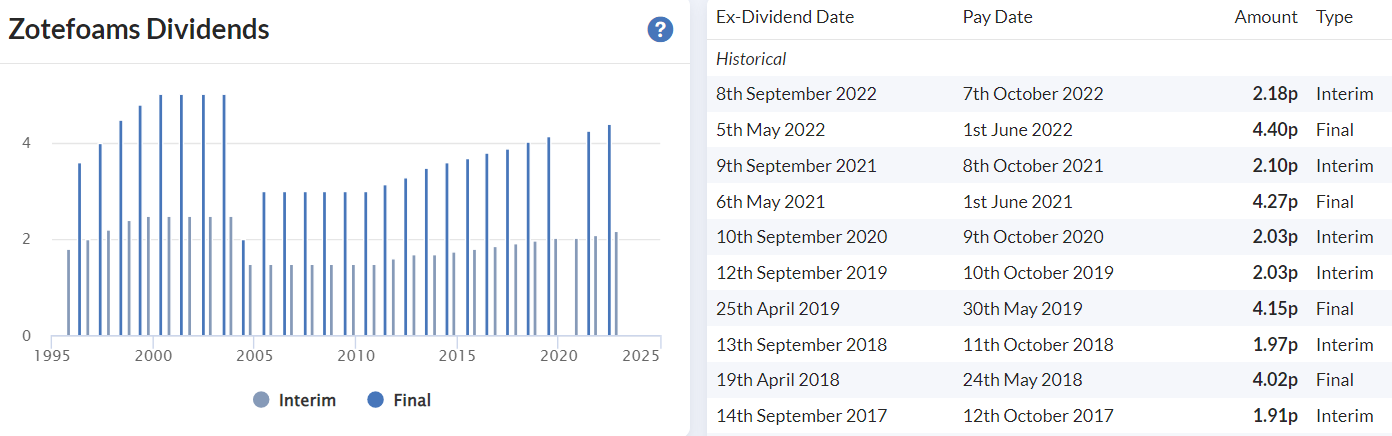
Dividends - quite modest, with a yield of just over 2%, but as you can see below, it’s been a reliable payer, with just one gap during the pandemic -
Balance sheet - is excellent in my view. £110m NAV, with very little intangibles, is more than enough, and as mentioned, includes the freeholds to its factories.
There’s a small pension deficit, but not material.
Net debt is £27.8m, (2021: £34.3m), which is more than covered by freehold property, so doesn’t concern me in the least. Also the bank offered extremely cheap interest rates (reduced) when it was last renewed, which tells us that the bank is also relaxed, as they tend to be when there’s rock solid security in the form of freeholds. The key multiple of EBITDA is also now much lower.
The factories have already been modernised in a previous multi-year capex programme.
So that’s all fine. So there shouldn’t be a huge capex requirement in future.
Outlook - this sounds fine to me, and seems consistent with the broker forecast of profitability in 2023 flat vs 2022. Hopefully with some surprise upside to come, which is what happened in 2022, with several upgrades throughout the year -
2023 has started well, with demand for our AZOTE polyolefin foam products in line with the previous year but with higher revenue from price increases implemented over the past twelve months. Sales of high-performance products are showing strong growth in the first few months, mainly due to the timing of shipments compared to the prior period. Sales across both businesses continue to benefit from a stronger US dollar.
The environment for input costs is less acute, with both energy and polyolefin polymer prices reduced from the peaks seen last year but remaining well above their long-term average. Prices for energy and energy-intensive commodities such as nitrogen remain uncertain, with forward-market pricing at a significant risk premium to spot. We are closely monitoring input costs and our pricing in the polyolefin foams business in particular.
Whilst uncertainty persists, we currently expect that, for the year as a whole, polyolefin foams volumes will be at a similar level to last year, with more challenging conditions in the UK and continental Europe offset by growth in North America and other geographies. Our High-Performance Products business should see further growth in footwear and continued strong growth in both our ZOTEK F and T-FIT insulation products.
Within our MEL business unit, focus has progressed to commercialisation trials for ReZorce cartons.
Overall, the Board remains confident about the future prospects for our business.
ReZorce - this is the exciting blue sky project, which is thrown in for free, the way I look at it. Latest comments today indicate that it’s about a year until full scale trials start. Small scale trials (about 1,000 cartons) have been successfully filled with water, but CEO commented, “It’s not perfect yet”.
The market size is mind-blowing, over $10bn globally pa, just for the materials for making drinks cartons (so think cartons of fruit juice, etc), although that figure might include other food & drink packaging too? It’s massive anyway, and ZTF claims to have something unique, that is fully recyclable, with IP protection. Existing drinks cartons are composite, so cannot be fully recycled.
It’s very interesting anyway, and the sort of thing that we usually see as a standalone AIM company that would run out of money every couple of years, dilute private investors down to dust, and eventually delist for a 99% loss for PIs.
The beauty of having a blue sky project within a successful company like ZTF, is that you’ve got high calibre management who can steer the project to success. Plus it can be done without any dilution, and funded by the existing business.
ZTF is seeking partners for the potential big scaling up of this project, which I suppose looks likely to be 2024 or 2025 onwards? I hope they don’t give away too much of the upside. If the project is a barnstormer, then there’s a lot to be said for ZTF itself doing a placing from a position of strength in due course, and keeping all the upside. Placings are not always bad. If it’s to fund something big, on the cusp of major commercial success, then it should be welcomed. Which ReZorce might be, but it’s too early to be sure.
My opinion - I’ve spent far too long on this, and haven’t even read the full RNS yet, just skimmed the key numbers.
I remain of the view that this looks a really interesting, buy and forget type of share, that should do well from the core business. Plus there could be exciting upside (in for free) from the ReZorce project. Hence a thumbs up from me. In terms of share price, it looks reasonable to me, probably priced about right for now in a wobbly macro environment, but with nice longer-term upside I reckon. Hence a thumbs up from me.
Stockopedia approves too, with a good StockRank of 81.
Graham’s Section:
Trustpilot (LON:TRST)
Share price: 88p (-5%)
Market cap: £370m (=$454m)
I will again refer readers back to our September 2022 SCVR where I laid out an investment thesis for this stock.
Time for an update this morning as the company has issued full-year results for 2022. This statement does include a revenue warning for the current year.
Financial highlights for 2022:
Revenue +23% at constant currency to $149m (very important to note that Trustpilot reports in US dollars, although 40% of revenues are from the UK)
Annual recurring revenue +20% at constant currency to $162m
Loss for the year $15m (2021: loss of $26m)
Year-end net cash $73.5m (2021: $93.2m)
I was curious to see the H1/H2 split of losses and cash burn, so I’ve had a quick look back at the most recent interim results.
In H1 of this year, the company suffered a loss of $9m. This implies that the loss in H2 was only $6m.
Additionally, the net cash position had already fallen to $73m by the end of H1. So there was no further deterioration in cash in H2.
Therefore, H2 looks like a significant improvement over H1.
For what it’s worth, Trustpilot’s founder-CEO confirms that the company achieved positive adjusted EBITDA in H2 (versus a loss of $5m in H1).
Let’s move on to the strategic highlights:
46 million new reviews added, bringing the total to 213 million
Active domains rose from 84k to 100k
11% increase in annual views of the “Trustbox” (the Trustpilot logo showing a company’s Trustpilot score) to over 100 billion.
Fewer fake reviews needed to be removed due to additional measures implemented in 2022.
All of this sounds good to me.
Current trading and outlook
As our business expands, we are expecting to move to adjusted EBITDA profitability and positive adjusted free cash flow in FY23. Our focus on sustainable growth, plus the impact of the investments we have made, give the Board the confidence that the business will deliver margin expansion in FY23, and it remains confident of the significant and growing long-term market opportunity.
As with one or two other companies I’ve covered recently, bottom-line profitability is still some distance away here. Positive adjusted EBITDA and “adjusted free cash flow” are not the same thing as profitability, although they may sometimes be treated as substitutes for the real thing.
In my previous coverage of this stock, I’ve acknowledged the ongoing losses here. But my suggestion has been that the enormous cash pile provides a long runway for profitability to be achieved.
Unfortunately, we also get a revenue warning in today’s outlook statement:
In the current year, we have felt the effects of the uncertain macro environment on new business and retention bookings in Q1, which will result in lower revenues from in-period bookings in FY23, and consequently we are more cautious in our outlook and expect a mid-teens percentage constant currency revenue growth rate in the current year, albeit with greater operating leverage and higher adjusted EBITDA than previously expected.
This sounds strikingly similar to what happened with the expectations for 2022. Trustpilot’s revenues didn’t quite hit expectations, but they “actively managed our business” to control costs and boost their profitability. So 2023 is shaping up to be similar.
International performance
In the UK, Trustpilot enjoys “highly attractive unit economics”, because it is here that (in Trustpilot’s words) “the viral network effort has taken hold”.
The question is whether Trustpilot can turn this into long-term international success.
Revenue growth in North America was only 10% for 2022, but it was a much more interesting 28% in the “Europe and Rest of World” segment. I thought this piece of commentary was worth mentioning here:
Whilst we do not need to invest in marketing in order to enter and grow within markets, during the year we chose the Italian market to test the potential for marketing as a means of accelerating our growth and have seen promising early results.
The campaign significantly increased Italian consumer's awareness of Trustpilot, rising from 18 per cent to 25 per cent at the end of November - and 28 per cent amongst the business audience. We look forward to tracking the longer-term benefits to our brand in Italy.
Management plan - in a separate RNS, we learn that the founder-CEO “wishes to transition into the role of founder and non-executive director where he will be an evangelist and brand ambassador”. The Board will look for a new CEO and an “orderly handover” will be arranged.
My view
Overall, there is slightly more bad than good in today’s update. The revenue warning perhaps shouldn’t come as a huge surprise, and the news on profitability offers some consolation. But it would be more satisfying to see the company’s profits improving through revenue growth rather than through cost management.
The news regarding the founder-CEO also requires some pause for thought. Is he looking to gradually move on from the business so that he can spend more time doing other things? Or is he simply looking for someone else to do the dirty work of day-to-day management, while he continues to work hard for the company’s big-picture success? I hope it is more of the latter than the former.
Valuation is also clearly still in the speculative end of the spectrum. But if I check the price/sales metric (using ARR for sales), I get a Price/Sales ratio of 2.8x. This is not expensive relative to what high-flying tech companies with quality earnings streams can achieve.
If I deduct the cash balance from the market cap to get Enterprise Value/sales, using the same method, I get a ratio of 2.3x. Again, this is not expensive for high-quality recurring subscription revenues.
Therefore, I’m going to continue to give the share the thumbs up. It’s much riskier than the companies I usually like, but I think it’s a genuinely unique business.
Disclaimer
This is not financial advice. Our content is intended to be used and must be used for information and education purposes only. Please read our disclaimer and terms and conditions to understand our obligations.

63 comments
SThree (LON:STEM) FY23 Q1 Trading Update given to analysts this morning video & podcast. Net fees are up 4%, in line with expectations. Contract net fees are up 8% to £82.7m, which is 81% of Group net fees. Permanent fees are down 12% this is only £19.9m revenue and reflects the trend toward Contract. In territories, Germany and The Netherlands grew 7% and 4% respectively, and represent 73% of net fees. USA was down 6%. Technology was up 8% and Engineering up 19%, while Life Sciences -15%, showing the reversal following the Covid spike. Cash is now £64m (Feb 22: £41m, Nov 22: £65m). The CEO led the success of the DACH region before he was promoted to CEO, he seems top class.
Pebble (LON:PEBB) FY22 results today, they are a provider to the promotional products industry, a much smaller 4imprint (LON:FOUR.
Management will present at a webinar with Q&A this Thursday, 23 March, 1.30pm. Register here.
Not all Bank investments are bad - one shouldn't assume they are safer/riskier than any other investment but an investor should understand those risks.
I do invest in banks but I look for a couple of things to mitigate certain risks.
(1) The key for me is liquidity - ie the liquidity ratio. In Europe/UK there are tight rules around the liquidity ratio which mitigate risks of a run on a bank. In the US the use of this liquidity ratio is not mandatory. So I avoid US banks and others where a liquidity ratio is tight to 100%. I want to see 140-200% ideally. Then I want to see the make up of funding. I don't want to see lots of commercial funding as this can get pulled in a heartbeat. I do want to see lots of retail deposits and strong term deposits and I want to know the proportion under the government guarantee. A run on the bank is far less likely if the deposit base is covered and the liquidity ratio is high.
2) I want a strong capital coverage that is well in excess of the regulatory minimum and really 15-18%+ and then I also want to know that these "own funds" are in cash and mainly liquid assets like t-bills where interest rate risk is minimal.
If I am comfortable with both of those I then look at business model - ie who they serve and why. The more complicated the business the more risk that the assets may be subject to revaluation concerns, so I avoid.
So for me the US banking crisis that started at SVB and rolled into the regionals appeared to follow a pattern of non adherence to a strong liquidity ratio and a high weighting of uninsured and commercial deposits at risk of flight, with little industry weighting diversification. This was compounded by a very risky hunt for yield. ie buying long dated treasury bonds at cycle low interest rates; bonds which, by their very nature, are highly sensitive to IR changes.
The spillover to the CS debacle in Switzerland though was (at least in my opinion) bank specific that had been years in the making. Poor financial controls for a systemic bank is unforgivable. As a depositor why would you keep your money in a bank that admits to having poor controls? Banks are about confidence - once trust ebbs it is a runaway train that can be very difficult to stop.
Reach (LON:RCH) Interesting announcement - I will give the CEO some credit for waiving his LTIP that should have vested in March at 43% of original full award. To be clear he has done very well out of the business whilst overseeing a disaster for shareholders but nonetheless does appear to have recognised that a vesting LTIP in his favour really wasn't appropriate. A lot of directors would not do that irrespective of how it might look.
Thanks for the heads up I hadn't noticed this
Not to do with any of the shares listed - but only read today that India has opened up its legal system to foreign lawyers. Reported in FT and others. Wonder if that holds any opportunities for the relatively newly listed UK-listed legal firms, Knights etc...???
Literacy Capital (LON:BOOK) Investment Trust will release results for FY22, 9 months to 31.12.22 tomorrow. We are hosting a webinar at 2pm, register here.
Somero Enterprises (LON:SOM) Here's the full year 2022 results presentation given by management last week with extensive questions from investors video & podcast. There's been much discussion here whether this is oversold. Stocko has a PE of 8 and a dividend yield of 12%! Management tell us all their customers are busy and they have good forward visibility. They've increased capacity at Houghton by 35%. Europe and Australia are growing nicely.
The 12% was last year with the special div...Stocko has div of 6.73% for Somero Enterprises (LON:SOM) for 2023 ...
Credit Suisse AT1 bonds
The issue with these bonds is how they have been treated relative to equity shareholders. AT1 bonds always had the ability to be wiped out, they are the most subordinated of debt within the capital structure and can be converted to equity in extreme distress. However, they were still deemed to sit above equity.
Both the ECB and Bank of England have come out against the actions of the Swiss Central Bank because it potentially jeopardises a potential source of funding for banks. Both ECB and BoE are effectively saying normal rules will apply for any banks within the eurozone with regards to the pecking order in the capital structure.
There will almost certainly be some tremendous opportunities in the bond market. Unfortunately, no one in my view ever knows what is under the hood in a bank, let alone an investment bank.
MH1 - if you read the article posted by RDHOWARTH you will see that the particular bonds which were wiped out in the Credit Suisse rescue were specifically designed to rank behind equity. Here is the most relevant passage:
'Oh, fine, I understand the position a little. The position is “bonds are senior to stock.” The AT1s are bonds, so people bought them expecting them to get paid ahead of the stock in every scenario. They ignored the fact that it was crystal clear from the terms of the AT1 contract and even from the name that there were scenarios where the stock would have value and the AT1s would get zeroed, because they had the simple heuristic that bonds are always senior to stock.'
So it appears that some of the holders of the CS bonds had not read the term sheets, or if they had read them they did not understand the terms. There are other examples of people not reading term sheets. I know a man who made enormous profits during the crisis in Greece some years ago because he knew that some of the failing bonds were subject to "London terms" which meant they would be redeemed at par when the inevitable bailout happened. In Michael Lewis's book The Big Short he quotes Michael Burry as saying that he thought that nobody except himself and the people who drafted them had read the term sheets for the instruments he used to short sub-prime mortgages. In my professional life dealing with real estate I found that I was often the only person who actually read leases - most people (landlords and tenants alike) just signed them. Most people do not read insurance policies and sometimes they get nasty shocks when they make a claim. People don't find it easy to read complex documents. But one might have hoped that professional bond brokers and investors would have read and understood the term sheets for the CS AT1s.
Most "investors" don't read the annual reports of the companies they own. My mind boggles over that. I wonder if reading is becoming a rare skill. :-)
The design was for AT1 bonds to be converted into equity if a bank breached capital buffers, not for them to be wiped out under a regulator enforced takeover, and then the equity given value.
edit: though to be clear that was the original design/intention for AT1s. I'm not referring to CS issuance specifically as I haven't looked at their prospectus in any detail and it seems these may have been a little different.
davidjhill - My entire point is that it is the actual terms of the specific instrument that matter. Yes the 'original design intention' for AT1s may have been for them to be converted to equity in certain circumstances but those weren't the terms for the AT1s that have been zeroed and judging by the howls of pain and rage yesterday and today it seems that the owners of these instruments had not read the terms even though they were almost certainly professional bond investors buying from professional bond brokers!
Most "investors" don't read the annual reports of the companies they own. My mind boggles over that.
I think a bit of nuance is needed here. As a shareholder, you don't need to read Microsoft's annual report to understand where the business is going, not least on account of the bombardment of comment in one's inbox, much of it extremely well-informed, from analysts, journalists and forum devotees. The same is true for multiple large caps and I can safely say, while reading all quarterly releases and studying call transcripts where appropriate, I've paid zero attention to their annual reports at absolutely no cost whatsoever to portfolio performance. As you move down the capital scale, the flow of data from outside the company shrinks relative to that coming from the statutory announcements. But one can still follow progress at the more established mid caps with keen attention to the flow of RNS/shareholder letters and the occasional analyst comment or investment article without having to read the annual report, again at no real cost to performance. As you get into small caps, where there is no supporting coverage of any kind (outside the SCVR), your comment certainly rings more true.
Warren Buffet, Charlie Munger, Mohnish Probrai, Guy Spier, Joel Greenblatt , Benjamin Graham would disagree, for the active investor. I have learnt many things from these people and try to leverage their advice created over decades. Reading gives me a method to form my own opinion, without influence - and that gives me my conviction - earnt, not borrowed; which I find psychologically very powerful. Others opinions are often skewed, even maliciously to suit their purposes - so I like forming my own opinion before listening to others. I also like tracking back, to see how I miss things and that assists in my learning. I see investing as a life long learning exercise - and reading the annual report and listening to it and analysts questions is central to my process. It's also important as I have a very concentrated portfolio - and knowing what I own is very, very important to me. Deviating from the methodology of the greats makes my life more complicated than I want - so I don't.
All of which I wholeheartedly agree with - for a concentrated portfolio. It was your sneering use of “investor” to describe those with a different methodology that I took issue with. I have a portfolio of 200 names that you might describe as a “global excellence” portfolio, characterised by exceptional operating numbers, or a more diversified Fundsmith/Smithson, if you like. The portfolio performs more in line with the Quality and Growth factors than it deviates with individual company outputs, mostly because the performance of the individual names is so reliable relative to the rest of the market. You could almost argue that the studying of company reports is redundant when you have chosen to delegate the achievement of high returns on capital to management teams with the strongest track record in that regard. Meanwhile diversification all but eliminates idiosyncratic risk and makes bad apples stand out without inflicting significant damage. Choosing to own great companies for the long term is, to me, the very essence of investing, and highlights how there is more than one way to proceed with comfort.
I think many investors are not investors, they're gamblers, in my opinion, and this is my basis for the parenthesis. Many ways to heaven.
Many ways to heaven
Peace and love, brother
Science (LON:SAG) Audited FY22 Results (I hold) Mcap £177m (yesterday)
A good set of results today from Science (LON:SAG) – provider of scientific, engineering and technology services and products (with plenty of freehold property as well). The company has a good track record of profitable growth and making acquisitions.
This year is no exception with growth in both revenue and profit ahead of management expectations * – more than respectable in what was certainly a challenging year for most companies. Not that the market is likely to be impressed right now.
Revenue £86.3m (consensus 83.8m) +3% ahead
Adj EPS 29.4p (consensus 27p) 2.4p or 9% ahead
Adj Operating profit £17.6m up 8%
Actual (diluted) EPS 22.6p up 4%
Plenty of cash in the bank, year end cash of £43.6m and net funds of £29.5m
Dividend held at 5p – not overly generous?
* I regard the 'ahead of management expectations' to be more a triumph of cautious management guidance than an under-estimate of likely performance. Which is not a bad thing at all in my book.
The more I look at it – the more this company floats my boat. It never seems to be an obvious bargain, more of a solid performer, but over the years it grows impressively and is moving into growth markets and geographies. At the same time management is astute and financial management conservative.
Science group has a few working parts – its worth a look under the covers to see how these results came about.
The bulk of revenue and operating profits have come from the science and engineering services division which has increased revenue and profitability impressively during the year (a hedging cap for USD revenue has likely helped provide a tailwind on profits). At the same time revenues from the DAB chip maker Frontier are flat but operating profits have fallen sharply, probably the result of supply constraints followed by reducing demand.
Geographical split of the businesses is also a consideration with ¾ of the revenue from the US (39m) and Asia (26m) with 10m from Europe and just 13m from the UK.
Overall the current weakness in Frontier profitability has been balanced out by increased profitability from the service division plus profit contributions from 3rd party tenants at Harston Mill the Cambridge property and an estimated £0.6m operating profit contribution from associated business TPGroup PLC – managed by Science group during the year and the subject of a takeover bid, successfully completed post year end. The basic EPS is flattered by deferred tax and R&D credits so the eked out improvement of 4% in underlying operating profit is likely a reasonable guide to overall performance.
Outlook for 2023 is cautious but positive. As usual. With good reason I think. The science and engineering services will likely provide some continued growth and subject to improvement in supply constraints margins at Frontier may provide upside in H2.
The main impact upon revenue and profit in 2023 will be the contribution of TPG services (Aerospace and Defence engineering consultancy) and TPG Maritime (a niche manufacture of submarine environmental control systems). I estimate likely additional revenue of £47m and £2.4m underlying operating profit – based upon TPGroup H1 results and trading updates – quite a step change for Science Group.
The synergies between TPG services and Science Groups existing businesses are likely to be substantial over time. The combination providing Science group access to the defence and aerospace industry, likely to be a growth industry for some time, and Science Group providing an existing base for TPG services to move into the US and European defence and aerospace markets.
The company is generating cash and has a £25m unused RCF so further investment in its US and Asian businesses (mainly Frontier I think) or more bolt-on acquisitions now that TPGroup is on board could be on the horizon?
The company seems extremely well managed over the years and the solid base combined with growth potential is something I like.
Currently valued at 12.4x current year expected eps of 31.3p (adj eps consensus) it's more lowly rated that normal and seems good value – especially as the 31.3p (probably guided by management) – is well below the 33.4p I estimate ( based upon FY22 29.4p plus 4p estimate for TPGroup) with nothing in for organic growth or improving margins at Frontier.
I’ve been buying more when I can find any cash down the back of the sofa – as I am currently fully invested,
cheers
Mark
Management are the key here, i back them. Noted that the integration of TPG is seemingly going well. Cautious note going forward H1 this year, hopefully just being conservative!
Thanks for that Mark. Yes, Science has always been mean with divs, seeming (unfortunately) to prefer share buy backs. Can't complain though as I bought at 85.5p when my daughter was doing her university year out in industry with them. Unfortunately that's not a repeatable stock selection process!
Trustpilot (LON:TRST) How is it that recurring revenue would be higher than total revenue?
Revenue +23% at constant currency to $149m (very important to note that Trustpilot reports in US dollars, although 40% of revenues are from the UK)
Annual recurring revenue +20% at constant currency to $162m
Trustpilot (LON:TRST)
- Revenue of $149m is the total received throughout all of 2022.
- The Annual Recurring Revenue of $162m is an annualised figure computed at the end of the period based on contracts signed (trustpilot contracts are generally for 12 months, but some are longer and this $162m has been adjusted to account for this.)
---
I do like the business, but with cash generation negative by my calculations and with bookings still on a downward trend (+6.1% in H2 vs >30% being achieved over the last few years, exclusive of 2020) I'm watching from the side-lines for now.
A
Thanks abtan - I thought it might be something like that. Just to check my understanding, does that mean that contracted revenue for 2023 should be a minimum of $162m? Or is it an annualised figure based on December's contracts which will include some contracts which will expire in, say Jan 2023?
Trustpilot (LON:TRST)
I've found this in my notes, not sure the source I'm afraid, but it's likely that it was published by the company:
"Annual recurring revenue is defined as the annual value of subscription contracts measured on the final day of a reporting period."
So in theory, if the $162m contracts expires at the end of June 2023 and none are renewed then total revenue for the year would be $81m.
So yes, it's a risk, but surely a relatively low one?
I recall that renewal rates are high, with lost revenue more than replaced by new customers. I think there was something in the IPO Prospectus about this, but I can't remember the details I'm afraid.
A
Fintel, with results out today, are presenting on the Mello show this Monday www.melloevents.com
Hi Paul, I note that you say in your short comments on React (LON:REAT) "No mention of trading v expectations, so assume in line." Is this your normal shortcut? The conclusion I would normally make from such a statement from the company is that either they are unable to make a comment about expectations, or that they do not wish to make such a comment. Perhaps if it is early on the current financial year this may be a reasonable position for the management to adopt. But generally I take a lack of comment against expectations as a negative. What are other SCVR subscribers views on this?
QQ Paul, do you know the main reasons XP Factory (LON:XPF) scores so badly on stockopedia? It has a zero quality score and qualifies for 3 short selling screens..
I have been following them for a couple of years and all seems good to me, except the macro environment for leisure of course. It's my biggest holding.
Hi NewInvestor1972,
QQ Paul, do you know the main reasons XP Factory (LON:XPF) scores so badly on stockopedia? It has a zero quality score and qualifies for 3 short selling screens..
XPF (I hold, my second largest position, so I've really got to be right on this one!) - this type of share will indeed score badly in the StockRanks at the moment. This is because its historic numbers are poor, when it was little more than a loss-making startup (escape rooms), which of course was the worst possible format for the pandemic, when they had to shut down the business, as locking people in confined spaces wasn't a great idea!
However, it was transformed by the acquisition of Boom Battle Bars in late 2021, a competitive games concept with a bar & street food. The format is brilliant I think, and is very popular with customers (see the TripAdvisor reviews). There was an extremely rapid roll-out of new BBB sites in 2022, some of them owned, some franchised. I believe the business is trading very well now, and hit its targets as stated in the last TU.
The FY 12/2022 accounts haven't yet been published, but are expected to show a tripling of revenues to £21.9m (and some is franchised remember, so the underlying revenues are much higher). Shore Capital expects a small £0.8)m loss before tax for 2022, but positive cashflow, with EBITDA of £2.6m.
Given that many of the BBB new sites only opened late in 2022, then the full benefit should feed through into the FY 12/2023 numbers, which Shore is expecting to rise to £39.8m revenues, and £6.1m EBITDA (a proxy for cash generation), and £2.2m PBT.
Hence the forecasts (which I think are realistic) show that this is set up to be a rapid growth, profitable business. That doesn't show in the historic numbers, which are a lot of the basis for the StockRanks I think.
In a nutshell then, the StockRanks will always be low for rapid growth businesses like XPF, which has no financial track record. As the company grows, and hopefully becomes profitable, then that will be reflected in an improving StockRank over time.
So what the StockRanks are doing, is trying steer us away from speculative, loss-making companies, which is a very useful service I'd say! Because so many of them disappoint, and are terrible investments.
However, doing my own research, I think everything is set up nicely for XPF to become a future star, based on all the new sites they've recently opened (on very good lease terms too, and with landlords financing most of the capex).
I should add that when doing your own research on XPF, bear in mind that there's dilution from share options, and from deferred consideration (at a fixed price & quantity). Therefore I work on the basis that the share count will end up around 200m shares (currently about 150m).
The fundraise to acquire BBB was done at 30p. Now the roll-out has actually been done (whereas it was just an idea in Nov 2021), but we can buy the shares at a third less, at 20p, with the company now already operating with a run rate at about £50m pa, and profitable/cash generative already (on a monthly basis) I reckon. So risk:reward looks good to me. But obviously everyone needs to be careful, and properly do your own research.
The nice thing too, is that we can visit the sites, try out the games, and see for ourselves that the format & atmosphere are really good (in my opinion).
Experiential leisure is a big growth area at the moment, but getting hold of the right sites at the right prices, and managing the whole thing of sourcing good games, training staff to manage the customers using the games, etc, all requires a fair bit of knowhow. I think XPF is in a sweet spot right now, and I also really rate the CEO, Richard Harpham, having done a couple of Q&A calls with him, and in person, when he hosted me & 2 other investors at the flagship London Oxford Street site, which I reckon is a goldmine, given how busy it is, even at off-peak times.
Regards, Paul.
Thanks for the detailed reply Paul, much appreciated
So a random thought from the day from my mum's income portfolio (Pension in an ISA).
NB Global Monthly Income Fund (LON:NBMI) has redeemed 20% of the shares at NAV because they are trading below consistently.
Twentyfour Select Monthly Income Fund (LON:SMIF) have just put through an EGM announcement to allow the company to issue another 20% of shares at a 2% premium to the daily price, though note it is down a lot on the year, but they have already added 20% over the last 12 months.
Ediston Property Investment (LON:EPIC) runs at a discount and puts up the someone please buy us sign, again running at a discount to NAV
All these are smaller, 1-3%, holdings but that tracking down a steady income is becoming a more challenging space.
Tommy
I'm interested in the situation at RBG Holdings (LON:RBGP) where it's plausible the ex CEO is selling her shares into the market, my question is: that as an ex-director does she still have to inform the market that she has sold shares ?
It's an interesting one re £RBGP. Clearly, there was a profit warning and an ugly departure of the Chief Exec who holds a decent chunk of stock (so overhang risk).
That being said, everything has a price, and it has twice now - including earlier this month - confirmed it will meet (earlier reduced) market expectations and pay a dividend. If you accept those expectations will be met and that the two broker notes were guided by the company and are correct (I think you can assume anything from Progressive certainly came from the company since it is paid for research) RBGP is getting stupidly cheap, along with a huge dividend yield (8%+).
The negatives I think are quite obvious, but so long as to the core business continues to perform, of which there is no evidence that it is not (and the legal sector, particularly contentious work, is doing well now), I think it is worth exploring. I took a heavy hit late last year when exiting with the original profit warning, but have since been re-buying. It's certainly not a forever hold, but I think there is a good argument of it being worth close to double its current price (75-80p). All the best. Will
Paul, the train strikes are not over yet.
Press reports last night were saying that the RMT had agreed terms. So doesn't that mean the strikes will stop?
hi Paul
The agreement announced yesterday was with Network Rail (signalmen and track maintenance). RMT are still have unresolved disputes with the 14 operating companies (drivers and guards) so the strikes planned for the end of March are still on unless these disputes are also resolved.
Snazzy
The RMT has agreed terms with the Network Rail element of its membership, which means that maintenance and signalling staff will no longer walk out.
It is still in dispute with the 14 train operating companies.
My read is reduced services on strike days but a lot more services than previously.
Tommy
AGM statement from Wynnstay (LON:WYN)
Wynnstay the agricultural and specialist merchanting group will be holding its Annual General Meeting this morning and will make the following comment on current trading.
Trading in the first four months of the new financial year has been broadly in line with management expectations. The Group is now entering the most important period in its first half, with activity seasonally high as farmers purchase inputs for their livestock and arable operations. As expected, the Group's fertiliser blending activity at Glasson has had to contend with the reversal of the spike in urea and ammonium nitrate prices, which are now close to the pre-exceptional levels of late 2021. While this reversal has impacted margins, Glasson has managed the volatile period well and is now replacing its fertiliser raw materials at these more sustainable levels.
Cost management remains a factor for farmers and while input pricing pressures are decreasing, some farmgate prices are also reducing. Wynnstay's balanced business model will help the Group to mitigate the expected variations in performance across the farming sectors.
Tamar Milling, the manufacturer and supplier of blended feed products based in Cornwall and acquired at the start of the new financial year, is integrating well. The business has made a very encouraging first contribution to results and is increasing the Group's profile in the south-west of England.
Clarification of the Government's Environmental Land Management scheme continues with Defra providing further updates and refinements to the scheme. This clarification has been helpful and enables the Group to focus on its 'whole farm' approach to help farmers deliver their environmental activities.
Despite the current uncertainties in the sector, the Group remains well placed to deliver a good outcome for the year and make further progress with its strategic plans, which will strengthen its position in the sector.
----------
It's down a lot recently. Is it a buy yet?
Hi FREng
I currently do not hold Wynnstay (LON:WYN) as I am just about following my rules on selling, though the volatility on some days does not help, as I sold on down 10% from peak.
I like the honesty of the business, we had to buy materials at x and they are now cheaper, which is good news longer term but in the shorter term this means a challenge. I do not know enough about other suppliers, especially the smaller family businesses, possibly holding less inventory or not having hedged future materials prices at last years peak so will be able to sell products at a lower price as they are purely selling at input costs (fuel up, materials down) whilst Wynnstay are potentially having to sell at a loss or reduce margin as this all unwinds.
I figure the hard part is then reading across to other holdings, who hedged prices such as oil last summer, or having to put in larger bulks orders to secure delivery and these are now dropping off? Then obviously the question then can the company hold prices higher or are they chasing down?
I am also learning not to fight Mx Market, so if things are going down, and it has hit the sell criteria, I sell. I know that normally means (99% of the time) the following day there is a massive bounce in price, but that is just me, Buy High Sell Low, Buy Higher Sell Lower
So whilst not a "chart" knowledgeable person I would look for a stabilisation on the price before reentering.
Tommy
Re: Wynnstay (LON:WYN)
It's down a lot recently. Is it a buy yet?
I guess that depends on whether you're a value investor or you are just trying to time the market? For a value investor, the latter is irrelevant as long as the valuation stacks up.
As it happens, I watched the FY22 results presentation on Pi World the other day and there was a very interesting comment from the FD in the Q&A session about the property valuation performed last summer indicating the NAV is actually £10 million (50p per share) higher than the cost basis currently shown on the balance sheet. I would need to check again, but for a company already with PTBV < 1 that would offer even more margin of error. I quite like the company even though the margins are terrible. I would watch the presentation if I were you.
All the best, Si
Any views on APH results would be welcome too. LDG have added to their position for what it is worth.
Hi Paul, a tiddler caught my eye this morning Spaceandpeople (LON:SAL.) Tiny market cap of £1.4m but revenue of £5.5m and a cash balance of £1.9m with liquidity of £2.9m plus the commentary "Trading momentum has continued in early 2023 in both the UK and Germany" These are the guys that do pop up stalls in Train stations, shopping centres etc. it looks like they are recovering strongly.
Paul knows them very, very well.
Spaceandpeople (LON:SAL) spread is 71-75p today yet the StockReport says the broker target price is only 7p. Is that an error or does SAL need to fire their house broker?
EDIT: their recovery looks strong. SAL have increased their cash by £500K between Dec 2021 and Dec 2022 despite repaying £300K of term loans in that period. They now (Dec 2022) have cash of £1.9 million (31 December 2021: £1.4 million) with £1.5 million of term loans (2021: £1.8 million). With a market cap of £1.3m, they look good vakue. (Disclosure, I have just made an initial purchase).
Spaceandpeople (LON:SAL)
FREng - the Nomad is Zeus who have today reiterated their 220p 'fair value' so suggest you use the green button to report yet another bad number.
Re Spaceandpeople (LON:SAL) -
so suggest you use the green button to report yet another bad number.
I've already done it, the team at HQ are sorting it.
There was a 10 for 1 consolidation last summer. Even with strong trading momentum margins are probably thin. The market cap of 1.3m is probably on the cheap side, but this is never going to be a highly valued business. I believe Mr Market thinks that a recession will not be kind to it. I don't hold (though I have done in the past). The 2023 revenue estimate in Stockopedia looks like a typo.
Reviewing the archives, I see it was too small for the SCVR at £3m (it's now half that), apologies for the distraction.
I've held Spaceandpeople (LON:SAL) in the past but sold a few months ago. I still think that "nice to have" marketing, like experiential marketing, will see challenging advertiser budgets this year. Also I thought there might be a risk of them suffering due to all the train strikes (as their spots are train stations, and high footfall city centres and malls) but it looks like they have traded well.
Scale is always the question with them - can they achieve enough scale so that there is at least 10-20% operating margin? While it may be "cheap" on a market cap basis, it is so vulnerable given the low net cash position, and dependencies on a few big supplier contracts. Also low liquidity and huge spreads is another risk.
I might wait till their FY results are announced so I have more information to work on, and also want to see a clear articulation of their growth strategy.
Good morning Paul. Your analysis on this mornings results from LON:SCS, LON:LUCE & LON:ZTF would be very welcome. Thank you.
Morning Rebirth,
Yes, I always cover LUCE, ZTF, and SCS, so those are priorities for me today.
There's an analysts Zoom for ZTF at 09:30 which I'll be joining, so that section probably won't be up until late morning. The headline figures look like a beat though, helped by favourable forex.
Regards, Paul.
Matt Levine re
Credit Suisse
It is sometimes useful to think that the shareholders of a bank are not its owners; they are just renting it from its creditors. Schematically, a bank borrows a bunch of money from depositors and other creditors and uses the money to make loans and buy securities and do other risky investments. If the investments end up being worth more than the deposits, the shareholders keep what’s left. If the investments end up being worth less than the deposits then, uh, that’s bad. Then the shareholders don’t own the bank anymore, for one thing, but that’s really the least of your problems. The real problem is that the depositors can’t lose money; the banking system relies on bank deposits being usable as money. “Banks are speculative investment funds grafted on top of critical infrastructure,” Matt Klein wrote last week. The liabilities (deposits, etc.) are the critical infrastructure; the assets (loans, securities) are the speculative investment fund. The bank is a machine for turning safe deposits into risky investments. If the investments end up being worth less than the deposits, then regulators and central banks step in and there is some sort of rushed rescue to make sure that the depositors still get paid.
One important consequence of this is that the equity of the bank — the shareholders’ ownership stake — is just a tiny sliver resting on top of an enormous iceberg of liabilities. In a good profitable conservative bank, there might be $100 of assets, $90 of liabilities and thus $10 of equity. The liabilities are certain and knowable, things like deposits that really need to be paid back at 100 cents on the dollar.[1] The assets are risky and variable, and their valuation is a bit of a guess: They include securities with volatile market prices, weird derivatives that are hard to value, and business loans with uncertain probabilities of being paid back. The bank applies some accounting conventions and makes some guesses and comes up with a value of $100 for its assets, but there is a range of uncertainty around that number.
And because the equity is only like 10% of the assets, if the asset valuation is off by 10%, then there is no more equity, and that’s bad. The value of the bank’s equity is extremely sensitive to the value of its assets, because the bank is so leveraged. I wrote once that “a bank is a collection of reasonable guesses about valuation. It is a purely statistical process. There is no objective reality. At best, there is a probability distribution, a reason to reject the null hypothesis with some level of confidence.” If the bank reports $100 of assets and $90 of liabilities, then probably its assets are worth more than its liabilities, but you can’t really be sure. There is a cloud of probabilities, and $100 is in that cloud, but so are other numbers. Some of the other numbers are bad.
And most of the time the bank bops along like this, in its cloud of probabilities. But occasionally a thing will happen to collapse the probabilities and force it to find a real number. Occasionally a bank will have to, in effect, sell all its assets over a weekend. Often the thing that causes this is bad: a bank run, a loss of confidence, an emergency. When this happens, the assets will probably sell at a discount. If the discount is more than about 10% — more than the equity cushion — then the shareholders get nothing. If you are in the sort of emergency that requires you to sell all of your assets over a weekend, it is arguably a little surprising to do better than a 10% discount.
Credit Suisse Group AG filed its 2022 annual reportlast week. It reported about 531 billion Swiss francs of assets and about CHF 486 billion of liabilities, leaving about CHF 45 billion of shareholders’ equity (about 8.5% of assets). When it filed the report last week, its stock was trading at about CHF 2.24 per share, for a total market value of the stock of about CHF 9 billion (about $9.7 billion).
One way to put this is that the market thought the stock was worth 20% of its book value.[2] But another, more useful way to put it is that the market thought that the assets were worth 93.2% of their book value: Credit Suisse’s CHF 486 billion of liabilities were real enough, so if the market priced the equity at CHF 9 billion then that implicitly meant that it valued the assets at about CHF 495 billion. The market thought that the reported asset value was off by 6.8%. But if the reported asset value was instead off by 8.5%, the stock would be worthless. The cushion was very very thin.
It kept getting thinner. Last Friday, the stock closed at CHF 1.86 per share, for a market value of CHF 7.4 billion. And over the weekend, Swiss authorities forced through a merger of Credit Suisse and UBS Group AG. Here is UBS’s statement on the deal:
And Credit Suisse’s:
In deals like this, it is customary for the shareholders of the selling bank to get something, not so much because their shares are worth much but because it is technically a voluntary deal, a merger between a willing buyer and a willing seller, and it is hard for the board of directors of the selling company to say to their shareholders “hey we negotiated the best possible price for you, which is zero.” This is only technically true, though, and you can tell from Lehmann’s statement that Credit Suisse was not exactly a willing seller. It was barely even involved in the deal: “[Credit Suisse Chief Executive Officer Ulrich] Koerner and the rest of the Credit Suisse management team were marginalized as emergency weekend talks — led by Swiss National Bank President Thomas Jordan — to sell the group to UBS gathered pace,” reports Bloomberg.
But there is a payment, in stock, of one UBS share for every 22.48 Credit Suisse shares. UBS closed on Friday at CHF 17.11 per share, making the deal worth about CHF 0.76 per Credit Suisse share, or about CHF 3 billion total, down about 60% from Friday’s close. I have previously described the customary payment for equity in deals like this as “a Snickers bar,” and given that benchmark Credit Suisse drove a surprisingly hard bargain. Bloomberg again:
You can, on the internet, find various expressions of astonishment that a bank as old and important as Credit Suisse turned out to be worth only $3 billion.[3] But this is, I think, the wrong way to look at it. Credit Suisse is not worth $3 billion; it is worth half a trillion dollars, more or less.[4] It's just that virtually all of that value — more than 99% of it — belongs to its creditors. UBS will take over Credit Suisse’s hundreds of billions of assets and use them to pay Credit Suisse’s hundreds of billions of liabilities, and there's the tiniest sliver — about $3 billion — left for its shareholders. That $3 billion is pretty much rounding error on the value of Credit Suisse; it could just as well have been $5 billion, or $1 billion, or a Toblerone bar. The value and mechanics of this deal don’t depend that much on the price for the equity, as you can tell by the fact that UBS tripled that price in the course of a few hours.
It really could just as well have been zero, but it is polite to give the shareholders something, a little consolation prize on their way out the door. The dynamics are:
Similarly, it is normally a requirement in mergers for the selling shareholders to get to vote on the deal: They own the company, after all, and it can’t be bought from them without their permission. But in a distressed bank merger it is silly to pretend that the shareholders own the company, and nobody did. “Pursuant to the emergency ordinance which is being issued by the Swiss Federal Council,” says Credit Suisse, “the merger can be implemented without approval of the shareholders.”
The upshot of this for UBS is not that it paid CHF 3 billion to buy its historic competitor. The upshot of this is that it has assumed hundreds of billions of francs of liabilities, and taken on a bunch of assets that are probably worth more than that, but it’s hard to tell over a weekend, or ever really. Fortunately it got a discount:
The badwill is the difference between the price that UBS paid for the assets and their book value. In Credit Suisse’s accounting, it had CHF 531 billion of assets as of Dec. 31; UBS effectively bought them for CHF 473 billion.[5] If Credit Suisse’s valuation was too high by 10%, then UBS still makes out okay.
Of course banks aren’t allowed to operate with too thin a sliver of equity, and UBS will have to make sure that its capital ratios are high enough to support the new much larger bank. After the deal, “the bank remains capitalized well above its target of 13%,” UBS announced, while Swiss regulators announced that “the takeover will result in a larger bank, for which the current regulations require higher capital buffers,” but they “will grant appropriate transitional periods for these to be built up.” Now UBS owns Credit Suisse; it would like to be able to hang onto it.
AT1s
After the 2008 financial crisis, European banks issued a lot of what are called “additional tier 1 capital securities,” or “contingent convertibles,” or AT1s or CoCos. The way an AT1 works is like this:
This — a “7% trigger permanent write-down AT1” — is not the only way for an AT1 to work, though it is the way that Credit Suisse’s AT1s worked. Some AT1s have different triggers. Some AT1s convert into common stock when the trigger is hit, instead of being written down to zero; others are temporarily written down (they stop paying interest) when the trigger is hit, but can bounce back if the equity recovers. (Here is a 2013 primer on CoCosfrom the Bank for International Settlements.)
These securities are, basically, a trick. To investors, they seem like bonds: They pay interest, get paid back in five years, feel pretty safe. To regulators, they seem like equity: If the bank runs into trouble, it can raise capital by zeroing the AT1s. If investors think they are bonds and regulators think they are equity, somebody is wrong. The investors are wrong.
In particular, investors seem to think that AT1s are senior to equity, and that the common stock needs to go to zero before the AT1s suffer any losses. But this is not quite right. You can tell because the whole point of the AT1s is that they go to zero if the common equity tier 1 capital ratio falls below 7%. Like, imagine a bank:
This bank runs into trouble and the value of its assets falls to $950 million. What happens? Well, under the very straightforward terms of the AT1s — not some weird fine print in the back of the prospectus, but right in the name “7% CET1 trigger write-down AT1” — this is what happens:
This, again, is very explicitly the whole thing that the AT1 is supposed to do, this is its main function, this is the AT1 working exactly as advertised. But notice that in this simple example the bank has $950 million of assets, $850 million of liabilities and $100 million of shareholders’ equity. This means that the common stock still has value. The common shareholders still own shares worth $100 million, even as the AT1s are now permanently worth zero.
The AT1s are junior to the common stock. Not all the time, and there are scenarios (instant descent into bankruptcy) where the AT1s get paid ahead of the common. But the most basic function of the AT1 is to go to zero while the bank is a going concern with positive equity value, meaning that its function is to go to zero before the common stock does.
Credit Suisse has issued a bunch of AT1s over the years; as of last week it had about CHF 16 billion outstanding. Here is a prospectus for one of them, a $2 billion US dollar 7.5% AT1 issued in 2018. “7.500 per cent. Perpetual Tier 1 Contingent Write-down Capital Notes,” they are called.
In UBS’s deal to buy Credit Suisse, shareholders are getting something (about CHF 3 billion worth of Credit Suisse shares) and Credit Suisse’s AT1 holders are getting nothing: The Credit Suisse AT1 securities are getting zeroed. This is not, to be clear, exactly because Credit Suisse’s CET1 capital fell below 7%; instead, there is a separate clause of the AT1s allowing them to be zeroed if the bank’s regulator decides that zeroing them is “an essential requirement to prevent CSG from becoming insolvent, bankrupt or unable to pay a material part of its debts as they fall due.”[7] Plus, in a situation like this, the banking regulators get to do a certain amount of ad hoc stuff, and they do. (They got rid of the shareholder vote on the deal!) Zeroing the AT1s while preserving a little value for the common does seem to have been done in an ad hoc way; my point is just that it follows very logically from the terms and function of the AT1s.
People are very angry about this. Bloomberg News reports:
The Financial Times adds:
I’m sorry but I do not understand this position! The point of this AT1 is that if the bank has too little equity (but not zero!), the AT1 gets zeroed to rebuild equity! That's why Credit Suisse issued it, it’s why regulators wanted it, and it would be weird not to use it here.
Oh, fine, I understand the position a little. The position is “bonds are senior to stock.” The AT1s are bonds, so people bought them expecting them to get paid ahead of the stock in every scenario. They ignored the fact that it was crystal clear from the terms of the AT1 contract and even from the name that there were scenarios where the stock would have value and the AT1s would get zeroed, because they had the simple heuristic that bonds are always senior to stock.
That's the trick! The trick of the AT1s — the reason that banks and regulators like them — is that they are equity, and they say they are equity, and they are totally clear and transparent about how they work, but investors assume that they are bonds. You go to investors and say “would you like to buy a bond that goes to zero before the common stock does” and the investors say “sure I’d love to buy a bond, that could never go to zero before the common stock does,” and the bank benefits from the misunderstanding.[8]
We talked about CoCos a few years ago due to a different misunderstanding. CoCos generally are perpetual — they never need to be paid back — but the bank is allowed to repay them after, usually, five years (the “first call date”). It is customary for banks to repay CoCos at the first call date (because they are like bonds), but it is not required, and in fact bank regulators go around saying that banks shouldn’t make too much of a habit of repaying them. “A bank must not do anything which creates an expectation that the call will be exercised,” say the rules, because the regulators do not want CoCos to be too bond-like.
And so one day four years ago Banco Santander SA did not call its AT1s after five years, and the market freaked out. “Santander’s decision is raising questions about whether investors will start souring on AT1s across the board,” said the Wall Street Journal at the time, “which could force European banks to rethink a key way in which they have cushioned themselves against potentially catastrophic losses since the global financial crisis.” I was unmoved. I wrote:
Since then I have become very convinced that regulators know how AT1s work, and that investors don’t, and that this is good.
Anyway there are once again threats that this is the end of the AT1 market, that no one will ever buy these securities again, etc., threats that are familiar from the Santander situation four years ago. Bloomberg:
And my Bloomberg Opinion colleague Marcus Ashworth:
To be fair, most AT1s outside of Switzerland don’t work like this — they tend not to be permanent write-down AT1s — and so it is not clear why the Credit Suisse writedown should affect the prices of other AT1s:
It is just possible that the explanation is that AT1 investors don’t read the terms of their securities? Anyway European Union and UK banking authorities put out statements saying in effect that they would never do what the Swiss authorities did here, and that (in the Bank of England’s words) “AT1 instruments rank ahead of CET1 and behind T2 in the hierarchy. Holders of such instruments should expect to be exposed to losses in resolution or insolvency in the order of their positions in this hierarchy.” If you read that very closely, it does not quite say that AT1 instruments can’t be written off in a shotgun merger over the weekend that preserves some value for the equity (not “resolution or insolvency”!), but I guess there’s no reason to read it too closely.
This is best read on all things CS - apologies it’s so long - from Matt Levine evening newsletter - free to subscribe on Bloomberg.
Covers it all and up to date RDHOWARTH, thank you. Credit recession to follow shortly as banks have to pay more to raise money?
Wow MR HOWARTH !!!
Many thanks RDHOWARTH
No apology needed. Helps reinforce my lifetime rule to never touch the banks - nest of vipers.
Excellent post; thank you.
Really interesting! I had no idea just how risk AT1 bank bonds are. Who on earth would want to own them? (Maybe collective funds to flatter income and disguise risk from retail investors.)
Why don't regulators gradualy just increase ordinary banks equty? Then bank shares might end up as a low RoE, high dividend stock which occasionally had to suspend divis, but had a low risk of outright loss.
Re: "Why don't regulators gradually just increase ordinary banks' equity?"
- Fund manager Terry Smith has answered this in the past (he was once London's top-rated bank analyst for five years running) - he points out that banks can only make acceptable profits through the use of very high leverage, which is why he never buys them.
(Fund manage Rosemary Banyard, during last week's Mello gave another good reason to not buy banks: all banks, she pointed out, operate a liquidity time bomb [my terminology] in that they borrow short (most savings deposits are instant access; most of the rest are short-notice accounts) and use the money to make term loans & mortgages etc.)
"Axel P. Lehmann, Chairman of the Board of Directors of Credit Suisse said"
Ironic !
Usually companies are valued by the profits they will generate in the future, not their net assets. It is only when they are likely to cease trading that they are valued at break up value. Hence the enormous drop in the price of CS shares. Management have a major duty to avoid this situation.
Thank you for the very comprehensive post. Modern banking seems to be a game played by illusionists - smoke and mirrors!
Nice one RD. I guess it highlights the advice often given by Warren Buffett and on this site, if you don't understand something don't invest in it. Interesting that the professionals don't always do this.
Wow. A long read but well worth the time. I have never bought a bank share and certainly won't start now. Thank you RDHOWARTH.
Do you have a twitter handle?