Small Cap Value Report (Tue 26 Oct 2021) - STU, KIN, SMRT, IGR, EMR

Good morning, it's Paul & Jack here with the SCVR. Today's report is now finished.
Agenda -
Paul's section:
Studio Retail (LON:STU) (I hold) - trading update shows reasonable H1 revenues. The key peak season of Q3 has started (Oct-Dec) and this eCommerce/instalment credit business sounds a bit uncertain over the outlook. However it reassures on supply chain issues, which seem to have been managed well. Looks dirt cheap, but the market doesn't seem to be interested in this, or similar N Brown (LON:BWNG) . Will they ever re-rate? Who knows!
Ig Design (LON:IGR) - bad luck to holders, with a nasty profit warning, which looks set to wipe out all of last year's (unadjusted) operating profit this year. Supply chain issues (delays & costs) are no surprise. but its failure to pass on these costs to customers has exposed the weakness of its business model. I've gone off this share now, as it's margins are low, and there's clearly not much pricing power.
Empresaria (LON:EMR) (I hold) - a pleasing trading update today, with crystal clear guidance. Profit expectations are raised 9-16%. Looks good value to me, and still well below pre-pandemic peak profits, so could be further upside in time maybe?
Jack's section:
Kin And Carta (LON:KCT) - impressive second half trading momentum and some clear guidance on where the company aims to get to as a result of its digital transformation strategy. It's a complicated situation though, with heavy adjustments, disposals, acquisitions, net debt changes, and a pension scheme to account for. The share price has recovered strongly, so for now I'm neutral, but there is a lot happening here so it could be worth keeping tabs on.
Smartspace Software (LON:SMRT) - reaffirming the delays in investment and underperformance of Evoko Naso (and A+K). SwipedOn is growing, so it's possible that the longer term investment case remains intact, but either way the lack of liquidity and selling pressure is a concern in the short term.
Explanatory notes -
A quick reminder that we don’t recommend any stocks. We aim to cover trading updates & results of the day and offer our opinions on them as possible candidates for further research if they interest you. Our opinions will sometimes turn out to be right, and sometimes wrong, because it's anybody's guess what direction market sentiment will take & nobody can predict the future with certainty. We are analysing the company fundamentals, not trying to predict market sentiment.
We stick to companies that have issued news on the day, with market caps up to about £700m. We avoid the smallest, and most speculative companies, and also avoid a few specialist sectors (e.g. natural resources, pharma/biotech).
A key assumption is that readers DYOR (do your own research), and make your own investment decisions. Reader comments are welcomed - please be civil, rational, and include the company name/ticker, otherwise people won't necessarily know what company you are referring to.
Paul’s Section
Studio Retail (LON:STU) (I hold)
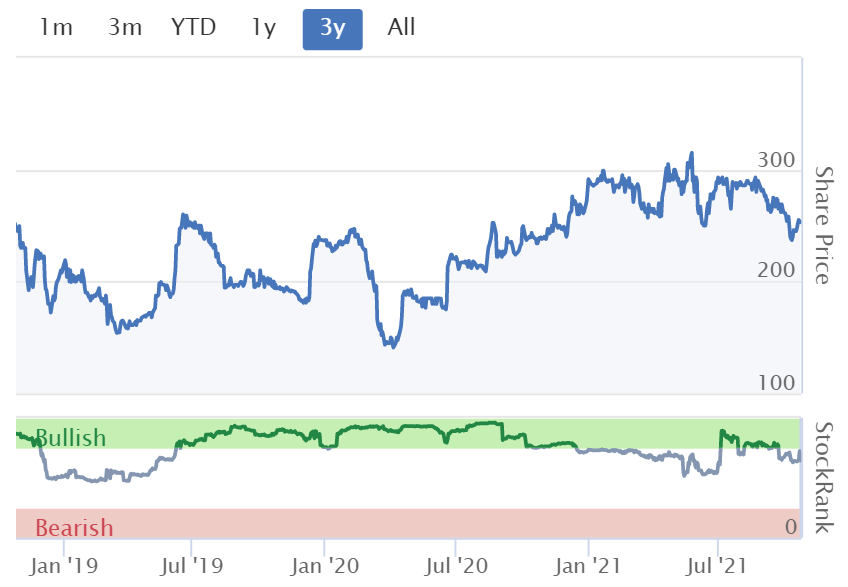
253p (pre market open) - mkt cap £220m
SRG, the digital value retailer, today gives an update on its trading for the first half of the financial year to 24th September 2021(1).
Studio Retail is similar to N Brown (LON:BWNG) in that it sells products online, mainly in order to make profits by charging interest to customers who pay by instalments. In both cases, the numbers are therefore somewhat confusing & difficult to interpret. I abandoned BWNG because of a large and complex legal dispute it has underway, which for me introduces too much uncertainty.
So it’s FY 03/2022, reporting H1 trading figures today.
This shows a similar pattern to other eCommerce companies - very strong growth last year due to the pandemic, and more modest growth this year, as conditions at least partially normalised -
H1 product sales were marginally ahead of the exceptional performance seen in the prior year and up 38% over a 2-year period. Financial services revenue in H1 was 11% ahead of the prior year.
Supply chain - it looks as if STU has managed stock intake well -
As has been well publicised, global shipping container availability and costs have been materially disrupted in recent months. The business took a conscious decision early in the summer to secure its supply chain for the crucial trading period leading up to Christmas, aided by Studio's in-house sourcing office based in Shanghai. This included use of our contracted container shipping plus additional charter ships, which gives more guaranteed stock availability.
This means that overall Studio is in a strong stock position ahead of the peak with inventory levels approximately 10% ahead of last year. However, a small number of ranges have experienced delays which could impact availability late into the peak season.
The point I bolded above about “contracted container shipping” is an important one. It seems that some companies have contracted pricing & availability of shipping, which has turned out to be a master stroke. Whereas other companies have relied on spot rates, thus paying through the nose right now.
So, when companies do Q&A on webinars, these are some good questions to ask;
- Do you have contracted pricing & availability on shipping containers? Or are you having to pay higher spot rates?
- Why didn’t you fix your shipping costs in advance? (if they’re paying spot rates)
- How much are your shipping costs as a percentage of the cost value of the goods in each container, on average? How much has this changed, this year, compared with last year?
- Have you been able to pass on higher costs to customers?
- What proportion of goods come from the Far East?
- Are you going to re-shore production to somewhere nearer, to avoid these problems in future?
I bet some companies will be coy about giving clear answers to some of those questions!
Net debt - what they call “core” net debt doesn’t include the borrowings to fund the huge customer receivables book. So I think calling other debt “core” seems misleading to me. Anyway, it’s down to a low level -
The Group's core net debt ended September at approximately £20.6m (September 2020: £45.2m), with the strong H2 trading from last year and the proceeds from the sale of Education being offset by the growth in receivables and the extra investment in stock.
To reinforce this point, here’s the net debt table from last year’s FY 03/2021 results. As you can see, “core” net debt is a small proportion of total net debt, which really makes a mockery of the description used. They should think up a new way of describing this, in my view -

.
Outlook - we’re coming into its peak trading period, and management don’t sound particularly optimistic -
Studio typically delivers around 40% of its full-year product sales during the upcoming Q3 period that includes Black Friday and Christmas. Whilst the business is well positioned with a strong overall stock position, there are continuing headwinds in the wider market that make the outlook more uncertain than usual at this stage of the year.
We will provide a further update with our interims which we currently expect to announce at the end of November.
Retailers are always nervous before Christmas, but Christmas peak trading always happens. The most recent consumer confidence surveys have shown a downturn, with no doubt higher electricity bills, petrol shortages, shortage of HGV drivers, and continuing worries about covid, etc, denting confidence.
That said, there’s also been positive news (a recent FT article, flagged up to me by a friend), that Yodel are saying there’s evidence of consumers buying early, worried about shortages from well-publicised supply chain problems. That sounds logical to me - the UK public are notorious for panic buying at the first sniff of trouble, hence I reckon retailers (physical and online) are likely to be reporting strong trading over the coming weeks. But I could be wrong, that’s only a guess on the balance of probabilities as I see things.
Also remember that households (and many companies) are fully employed, and cashed up, following the massive taxpayer support measures of last year (funded by QE), and that travel has still not returned to normal, meaning plenty of households have the spending capacity to have a good spending splurge over Christmas. We’ll see, at this stage nobody knows how households are going to spend, nor what shortages might develop. Of course in the long run, nobody will care, because these are only temporary issues, and shouldn’t affect the long-term value of companies’ shares.
My opinion - overall I’d say this update seems neutral, to slightly positive. It’s good that STU reassures on supply chain issues being handled well (that’s the big risk at the moment). However, they spoil that by sounding uncertain about the outlook for peak trading. Still, it’s never wise to brag about Christmas trading, until you’ve got the money in the till.
Based on the broker consensus forecasts, STU looks staggeringly cheap - a forward PER of only 5.4. BWNG is very similar, on a forward PER of 5.6, but with all the added complications & potential costs of a nasty legal case. Hence on that simplistic measure, I’d say STU looks better value & less risky.

STU did a roadshow earlier this year, to drum up interest in the company, saying that its medium-term target was to reach £1bn revenues, and 100p EPS (from memory) which if achieved would surely rerate the shares a lot from the current 253p. But so far, any excitement from that roadshow has scrubbed off, in a general de-rating of eCommerce companies this year - including a battering for Boohoo (LON:BOO) (I hold) and Asos (LON:ASC) (I hold).
Today’s pain could be tomorrow’s potential investing profit. That's the problem when shares (in fundamentally sound companies) fall - often we should be buying more, but the emotional response is to become dejected, and sell, often at the low.
There’s not enough information in today’s update to sway me either way. My current position in STU is only small, a starter sized portion, to make me monitor it more closely. I’m reassured by the supply chain being well managed by the sounds of it. Also, I feel consumer spending is likely to be good this Christmas, so on balance I should probably be buying more. There’s only one problem with that - I haven’t got any spare cash, after a dismal portfolio performance in October.
.
.
Ig Design (LON:IGR)
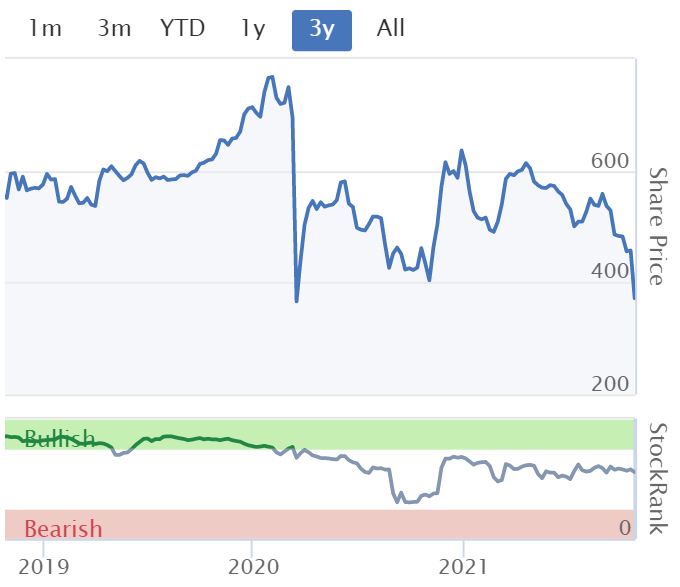
306p (down 31% at 09:52) - mkt cap £295m
Trading Update (profit warning)
My commiserations to shareholders in this purveyor of greetings & celebratory products.
I always thought this was a high quality, well managed company, but it’s clearly time to reassess that, given that the share price has roughly halved this year.
Or could it be a buying opportunity for long-term investors, in an over-reaction to short-term supply problems?
IG Design Group plc, one of the world's leading designers, innovators and manufacturers of celebrations, craft, gifting, stationery and creative play products, today issues a trading update for the six months ended 30 September 2021.
H1 revenue growth (like-for-like) -
- Up 11% vs 2020
- Up 5% vs 2019
That sounds reasonable to me, but it says faster growth was expected but impacted by “supply chain challenges”, which shouldn’t really come as a surprise to anyone I would have thought.
H2 outlook - sounds pretty good -
Pleasingly the Group continues to see good demand in the second half of the financial year and good momentum into FY23 from its customer base...
Cost headwinds - again, why would anyone be surprised by this, given that it’s the main business problem affecting so many companies, around the world? -
In addition to the logistical disruption within the Company's global supply chain, partially related to the impact of Covid-19, the business has experienced worsening cost headwinds during the period, with sea freight costs up significantly across all regions, alongside raw material and labour inflation as well as supply availability issues.
Guidance - this is useful, as we can use this information to work out the financial effect -
However, as a result of the disruption and these cost increases, operating margins in the first half have been negatively impacted and it is expected that the challenges will continue into the second half of the current financial year and also into FY23, although it remains difficult, at this time, to estimate the impact.
As such, the Group now expects FY22 full year operating margins to be 175-225 basis points lower year on year resulting in full year earnings being significantly below current market expectations, with the cost and supply chain headwinds continuing for an as yet unknown period in FY23.
1.75-2.25% off the operating margin doesn’t sound too bad, but given that IGR is a low margin business (very low gross margin of only 17.6% last year), and the adj PBT of $37.0m on revenues of $873m is only 4.2%.
The (unadjusted, I think) operating profit was only $19.9m, or just 2.3% of revenues, before the $22.3m adjustments, which look aggressive to me (including share option costs of $4.2m, and restructuring of $15.4m).
Therefore, today’s guidance means that almost all of last year’s unadjusted operating profit will disappear this year!
We’ve probably become too complacent about operational gearing and the market is now giving us a wake up call, that low margin businesses like IGR don’t have the scope to absorb large increases in costs.
Clearly there’s also been a failure to pass on cost increases to customers, which we need to find out more about. If there’s just a delay in raising selling prices, then the dip in profits could just be temporary. That's not what today's update says though, it's barely mentioned.
Net debt - this level of debt, at the seasonal peak, doesn’t look problematic to me. However, that depends on what the bank covenants are set at. So it might be useful to check the last Annual Report for more info on the bank facilities. Although it’s extremely rare for bank facilities to be removed, as we’ve seen over the last 18 months.
At 30 September 2021 Group net debt was $59 million (30 September 2020: net debt $23 million) reflecting the normal and expected seasonal movement as the Group increases working capital ahead of the Christmas peak season. It also reflects the timing impact of delayed deliveries to customers. Average leverage was zero times in the 12-month period to 30 September 2021 (30 September 2020: 0.2x).
I very much like the disclosure of average net debt, which is far more meaningful than a snapshot on one day. All companies should report average daily net cash/debt over each accounting period.
My opinion - these supply chain problems are so obvious, that it’s not at all surprising to hear of delays and increased costs. However the key point which IGR fails to address in this update, is why it hasn’t been able to pass on the additional costs to customers? That’s the main problem here. This suggests to me a low margin business, with little pricing power. Something that’s obvious now, looking back at previous years’ numbers.
I think we’ve perhaps become complacent, at seeing profits rise each year, with bolt on acquisitions helping to boost things further.
We’re now being reminded by the market that operational gearing also works in reverse, when there’s either a loss of revenues, or unexpected cost increases (or both) - and it’s brutal in the impact on profitability, especially at low margin businesses like IGR. That exposes the weakness in business models.
Over time, no doubt IGR should be able to rebuild margins, but the fact that it’s been caught out by rising costs, and clearly an inability to pass them on quickly enough, undermines my assessment of the business model. For that reason, I’m seeing today’s plunge in share price as being justified, and I don’t see this as a buying opportunity. Particularly as the company has not been able to give guidance on when it will be able to raise selling prices to offset higher costs. That could change though, if the company manages to persuade investors that things are on the mend. So at some stage, there could be a turnaround in share price, I just don't want to gamble on an unknown factor such as that, it's just guesswork.
Based on today’s news, I don’t think this company was a particularly high quality business to start with, so I got that wrong. Its appearance was flattered by a recovery (under new management) from previous trading woes a few years ago, and rising EPS (at least partly driven by acquisitions).
The risk now, having seen the weakness of the business model exposed, is that the market may apply a permanent discount to the future PER, even if earnings do recover in time.
Hence I’m struggling to see much attraction in this share, even though it’s on half price sale.
Note that Directors have banked over £25m in share sales in recent years, at prices now well above today's share price. Sometimes big Director selling can be a warning sign, but not always.
It feels almost like a lottery out there at the moment. Some companies seem to be coping fine with supply chain problems. Others are seeing profits smashed. I can't find any common theme to it, and investing is extremely difficult at the moment.
.
.
Empresaria (LON:EMR) (I hold)
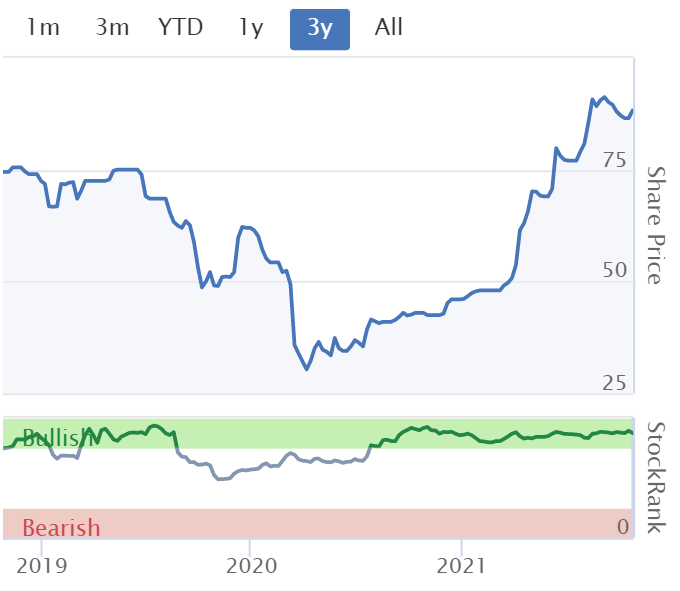
90p (up 4% at 11:33) - mkt cap £45m
Staffing companies have had a great run in recent times, as many sectors quickly recovered from the pandemic. I think some got a bit ahead of themselves in valuation terms, e.g. Gattaca (LON:GATC) but EMR remained cheap as chips, so I picked up a few earlier this year.
It’s a peculiar group of staffing companies in various countries, as far afield as New Zealand, so I can’t see any particular reason to build a group this small, with widespread international operations. Maybe country & sector risk, might help insulate it from problems in any one country?
The other issue with EMR, is I always get myself tied up in knots when I look at its balance sheet. What’s debt, and what isn’t? What metric should we use to value it, and how to compare it with other shares in the sector?
Trading update today -
Empresaria, the global specialist staffing group, provides the market with an update on trading for the current financial year ending 31 December 2021.
Continued growth in profit forecast with Offshore Recruitment Services a key contributor
Following the progress made in the first half of 2021, we have seen increased momentum into the second half of the year...
Guidance - this is crystal clear, why can’t all trading updates give simple profit guidance like this? Top marks to Empresaria & its advisers! -
As a result, it is anticipated that the Group's full year net fee income will be in the range of £57m to £59m and adjusted profit before tax is expected to be in the range of £7.4m to £7.9m (9% to 16% above market consensus).
My immediate thought is that the share price rising only 4% today, when we’ve just been told profits will be 9-16% above expectations, could be a buying opportunity?
The market cap is only £45m, which doesn’t seem much for a company that’s heading for a profit of £7.4-7.9m.
More detail is provided about divisional performance, which generally reads well. There could be further upside when the aviation sector recovers, as EMR has a business in that space.
Valuation - many thanks to Singers for its update note today, available on Research Tree.
Forecast EPS for 2021 is raised from 6.5p to 7.5p, so the PER is 12 - not amazingly cheap, but reasonable value, depending on how you incorporate debt into your valuation calculations.
Note that peak profit was in 2018, and was about 50% higher than 2021 forecast profits. So if staffing conditions remain favourable (realistic, due to widespread skills shortages), then we might be able to expect EPS to rise a similar amount in future, and head over 10p. Possibly. Hence in my view, anything below 100p is probably decent value for this share.
My opinion - Empresaria looks pretty good to me. We’ve mentioned before that some staffing companies seemed to get over-stretched with too much recovery baked into share prices earlier this year (I think that was possibly the case with Gattaca (LON:GATC) ), but EMR shares never really became stretched. Hence it’s proven more resilient than most small caps in the sell-off we’ve seen seemingly indiscriminately recently.
I’m happy to continue holding a small amount, but don’t feel particularly motivated to rush out and buy more, as the % upside doesn’t particularly excite me.
Note that the latest broker forecast hasn't flowed through to the StockReport yet, which is using lower historic profits
.
.
Jack's section
Kin And Carta (LON:KCT)
Share price: 281.8p (+2.47%)
Shares in issue: 172,455,084
Market cap: £486m
Kin + Carta (KCT) is a global digital transformation consultancy serving the healthcare, financial services, B2B, consumer, agriculture, and transportation sectors.
It has three distinct ‘schools of specialist talent’:
- Kin + Carta Advise - management consultancy that helps the C-Suite better understand the shifts in their market and how their products and services need to evolve.
- Kin + Carta Create - cloud, data and software engineering studio. 800+ data scientists, software engineers and designers work to create new products and platforms for clients.
- Kin + Carta Connect - data-driven marketing technology agency.
Trading momentum has been improving here, which is reflected in the share price performance.

The group has made a series of operating losses over the years, but the free cash flow figures have been more encouraging. So although the Quality metrics don’t look too healthy, this is a cash generative enterprise at least.


Excluding acquisitions, the ambition is to double net revenue from FY21 over the next four years. When coupled with carefully targeted M&A, we expect to achieve meaningful scale with double digit growth, improving operational efficiencies and margins with improved cash generation.
Highlights:
- Adjusted net revenue from continuing operations +12.5% to £141.4m (+11.3% like-for-like, excluding Cascade Data Labs),
- Americas net revenue +23% to £85m, with H2 revenue 55% higher than H1,
- Europe net revenue +1% to £44m, with H2 revenue 28% higher than H1,
- Record year-ending backlog of £71m (+50%),
- Adjusted profit before tax of £13m (up from £8.1m), with H2 bringing in £10m ‘on business recovery and surging return to growth’,
- Statutory loss before tax reduced from £36.3m to £4.3m, driven by pension and acquisition charges,
- Net debt reduced from £31.6m to £19.2m, net debt to adjusted EBITDA of 1.0x.
Kin reports ‘significant client wins’ including the UK Government Home Office, Santander, The Economist, US Foods, Hewlett-Packard, and Blue Cross Blue Shield. The volume and scale of client engagements with more than £1m of annual net revenue increased to 30 clients in FY21, up from 19 in the prior year.
It’s been a busy year as the company continues its transformation into a more scalable digital transformation company, so the fact that net revenue growth is accelerating despite all the change is encouraging.
Divestments: Pragma in August 2020 and Hive in December 2020 for £12.6m. Incite was divested in September 2021 for £18m before adjustments for debt and working capital. Two remaining Ventures businesses are in advanced stages of divestment process.
These divestments in total have generated proceeds of £27.2m net of costs and adjustments for debt and working capital.
Acquisitions and product launches: Cascade Data Labs in December 2020. Launched five global service lines to serve the key needs of DX 2.0: Cloud + Platforms, Data + AI, Products + Services, Strategy + Innovation, and Managed Services.
Cascade Data Labs brings relationships with a blue-chip client base, including Adidas, Hewlett-Packard and Starbucks, and has helped in the launch of Kin + Carta Data Labs in the Americas and Europe. More acquisitions like this are expected.
Further territorial expansion is planned for FY22, with target areas being the southern part of the US, Canada, and Latin America.
Financial health, cash flows, and Pension
Operating cash flow before working capital was £13.8m, compared to the prior year of £11.7m.
Net debt fell from £31.6m to £19.2m, primarily due to operating cash flow generation as well as the proceeds of the Hive disposal and partially offset by the acquisition of Cascade Data Labs. The sale of Incite on 28 September 2021 means net debt is now much closer to zero.
On an IAS 19 basis, the surplus on the pension scheme at 31 July 2021 was £19.3m (2020: surplus of £1.1m) before any deferred tax impact.
Plan liabilities increased to £400.5m (2020: £395.5m) although the level of technical funding in the year has improved. The level of risk to the group of the scheme reduced in the year and the strength of covenant has improved. The FY21 charge was £2.9m (2020: £1.8m).
Current trading and outlook
The momentum reported in H2 has continued into the current financial year. The September backlog (signed and committed contracts not yet delivered) value was £78m, up 31% compared to the prior year, and the September pipeline (qualified and targeted sales funnel) value was £135m, a record high, up 43% compared to the prior year.
The company gives good detail with its guidance.
Organic net revenue growth guidance has been increased from c. 20% to c. 30% for the current year ‘with constraints moving from demand for business to supply of talent’. Operating margin guidance reduces from 12-13% to 10-11% following disposals and internal investment.
So taking the lower of those two ranges implies FY22 revenue of £169.7m and operating profit of £17m.
Medium term guidance is unchanged: organic net revenue growth of 15%+ CAGR is expected to drive incremental operating margin improvement each year to mid-teens and a goal of doubling net revenue organically over next four years.
Extrapolating that over three years (after accounting for a 20% increase in revenue in the next year, followed by two years of +15%) would be FY24 revenue of £224.4m and, at an operating margin of say 15%, an operating profit of £33.7m. So plenty of potential growth if the group can execute.
J Schwan, CEO, said:
2021 was a transformational year for Kin + Carta, with growth accelerating as we emerged as a pure-play digital transformation business with a growing US focus, the largest digital transformation market in the world. With the disposal of our non-core ventures nearing completion, we have de-geared our balance sheet, creating significant headroom for our acquisition plans.
Conclusion
A lot of whether Kin is a good investment going forward comes down to its ‘transformation into a scaling, pure-play DX business’. There’s enough in the accelerating momentum to suggest it is worth investigating. And the events of the past year may well help the company (although the company’s transformation strategy pre-dates Covid):
This year has highlighted the gap between businesses with the technical agility to pivot at the pace of evolving consumer demand and those who failed to modernise ahead of the COVID-induced volatility. As a result, there is now accelerated investment in digital transformation (DX) services and a market that was growing at 18% per annum is now projected to grow at a CAGR of more than 20% over the next five years. The World Economic Forum predicts cloud-based digital transformation to be a US$100 trillion business in the next ten years.
Further M&A is expected, there are organic growth opportunities to pursue, and net debt is currently close to zero. There is still the pension scheme situation (currently in surplus and with a shift to less risky assets), but the company is perhaps worth a fresh look for those that considered it a few years ago.
There’s a lot more detail in this update but for now I’ll draw a line under it. There’s also a degree of jargon and an awful lot of adjustments, which makes me pause.
This might be one of those situations where you have to move beyond the historical performance and spend some time envisaging what the future state of the company might look like. For now I’m neutral, but more interested than I was - although there is a time cost to sifting through all the adjustments, acquisitions, disposals, pension schemes, etc.
The share price has also rerated aggressively, from 80p in late 2020 to around 275p today. So you would need to really buy into the group’s vision.
Smartspace Software (LON:SMRT)
Share price: 78.2p (-2.25%)
Shares in issue: 28,941,234
Market cap: £22.6m
Smartspace currently reflects some of the dangers of investing in small software companies. It works in what sounds like an attractive niche - the management of flexible working offices - and touts a big market opportunity. It has recurring revenue SaaS characteristics that bode well for the future.
The story over lockdown led to an influx of investors and pushed the share price to all-time highs a couple of months ago, to what looked like an extremely high valuation. And such valuations can be deserved if the business is very small today and could be much larger in future. Perhaps that is still the case for Smartspace but the perception for now has changed dramatically.
There have been delays in take up of a new product and some moderation in tone, leading to a collapse in the share price from elevated levels.

It’s not necessarily all over for the company. This could prove to be a temporary setback on the road to long term growth. And if that is the case, then Smartspace is now available to investors at a much more attractive price. It is a risky situation though, with a lack of real share price liquidity, which is a dangerous combination.
Highlights:
- Total revenue +8.8% to £2.52m,
- Annual recurring revenue +53% to £1.59m,
- Gross margin up from 51% to 71% ‘reflecting an increased mix of higher margin SaaS revenues’,
- Adjusted LBITDA of £1.29m (a deterioration from £0.87m),
- Loss per share of 5.49p compared to previous loss per share of 3.47p,
- Net cash up from £1.14m to £2.97m.
SwipedOn - ARR increased by 43% year-on-year to £3.21m, with this growth continuing during August and September to £3.47m at 30 September. Monthly average revenue per user (ARPU) increased by 32% year on year to £56 and has advanced further to £61 at 30 September.
SwipedOn locations increased to 7,003 at 31 July (FY 21: 6,741) with customer numbers at 4,747 (FY21: 4,735) with a focus on higher value, multi-location customers. Customer churn is lower than expected and focussed on single site customers. Customer churn in the six-month period averaged 14% whilst revenue churn was 9%.
A 14% customer churn seems on the high side for a six month period.
Space Connect - ARR up 157% to £0.41m in the six-month period and has progressed further to £0.49m at 30 September. At 31 July, Space Connect had 41 customers (an increase of 28 new customers) and this has since increased by a further 18 customers to 59 in total at 30 September. 43 reseller agreements now in place with 14 partners delivering revenue to date.
Sales of Evoko Naso are below expectation, impacted by Covid-19 as offices in Evoko's key markets not yet fully back to normal working capacity leading to delayed investment decision making
Anders & Kern (A+K) - revenue down 27% to £0.96m (H1 FY21 £1.32m) mainly due to the impact of the UK lockdown ‘resulting in a hesitation in returning to the office’.
Commenting on outlook, Frank Beechinor, CEO of SmartSpace, said:
As indicated in our recent Trading Update, our primary objective is to build a high growth SaaS business with strong recurring revenues. The results outlined above for SwipedOn and Space Connect illustrate that these key objectives are being achieved. While Evoko Naso sales continue to be slower than anticipated, we share Evoko's confidence in the medium and long-term potential of Naso. Our business operations continue to focus on a highly attractive sector, evidenced by a number of major competitors consolidating at high ARR multiples. Our priorities remain focused in continuing to deliver strong growth in ARR and to maximise value for shareholders over the coming years.
There’s a presentation today at 12pm on investormeetcompany, here.
Conclusion
There’s not really anything new in today’s update from what I can see.
The slow return to the office is delaying investment decisions with regards to hardware installations. This means the Evoko partnership is taking more time to ramp up. A+K also looks to be underperforming due to the same dynamic. I do note the strong ARR performance from SwipedOn, but also wonder about the churn rate.
These delays to recurring revenue come at a time when the company is loss-making, which raises the prospect of shareholder dilution at potentially low levels. This is an unfortunately common situation that can really hurt the total returns of earlier investors. If Smartspace can reach cash flow breakeven soon, then it can avert this scenario. But this is now a markedly different narrative to the one being put forward a couple of months ago.
The risks have increased here. Yes, the valuation has also become more attractive, but the current share price momentum is poor and, given the small market cap and lack of liquidity in the stock, it’s entirely possible that there are more sellers hoping to offload shares. That doesn’t make the immediate prospects too appealing. You might argue that the shares are oversold at this point, but the direction of travel depends on whether sellers remain.

SwipedOn still seems to be performing well, so there could still be something here, but I can’t see why today’s update would be the one to convince people to make a speculative recovery investment. I’m wary of timing the bottom in these kinds of situations and prefer to wait for more concrete signs of improvement, even if that does miss out on a part of the share price recovery.
Disclaimer
This is not financial advice. Our content is intended to be used and must be used for information and education purposes only. Please read our disclaimer and terms and conditions to understand our obligations.

46 comments
Studio Retail (LON:STU)
Interesting one, it's cheap. Deep value perhaps?
Odd they play on reducing 'core' debt. Looking at their last annual report their funding facility with HSBC has drawn 225m on net receivables of 278.7m (81% leverage) so assuming the funding line is cheaper, why not clear the bank debt in full? If they have headroom that is.
Otherwise, clearly in the sub-prime space. Average interest rate is stated at 3.5% per month thus 42% a year. Add in the thing with integrated retail/finance companies where the retail margin is higher than market (I checked a couple of products on-line and noted higher listed prices for electrics than the Apple store for an iPad and Currys for a TV).
Cash flow statement not for the faint-hearted with huge swings within on the detail.
Looks like the sort of lender which can be very profitable, when you look at ROE. Stocko reports 2021 as 41%. Such high numbers make reinvesting retained earnings into growing the book a good shareholder proposition. So the real question is can they grow? That comes down to the skill of the mgt team, of which I don't have a view. Any views here?
Re EMR - Might be a good trade - it certainly isn't a good business. It's a hodge-podge of price-taking subsidiaries assembled from the fringes of the global HR sector with no strategic coherence other than their uniform cheapness. Good luck to owners.
Empresaria (LON:EMR) ( I hold) is making plenty of profit, ahead of expectations.
So as far as I'm concerned, that does make it a good business, at a cheap valuation. It's not glamorous, and it's a bit odd, but it makes money!
Recruiters are doing well at the moment, I don't hold Empresaria (LON:EMR) but I do hold Sthree (LON:STEM) and £RWA. I will have another look at Empresaria (LON:EMR), I did hold some years ago, from memory they are a small company but have offices in many different countries.
I feel like I've touched a nerve, Paul and that wasn't my intention. A poor company can be a good share and I hope that works out for you . However Empresaria (LON:EMR) has a very poor reputation within the sector and you can see this reflected in the numbers where its returns on capital and margins are roughly half those of the best two UK-listed recruitment firms, Sthree (LON:STEM) and £RWA. And while the latter tend to grow revenues and profits year by year (pandemic aside), EMR runs to stand still with weak profits.
Perhaps that makes it a special situation with more potential upside for the valuation and that could appeal to a seasoned value investor like you, but I wouldn't count on the business having the quality to deliver in the long run, even if they might throw in a good year from time to time when the winds are exceptionally favourable - as they might be in 21/22, so good luck with the investment. Long term investors should be wary.
Electra Private Equity (LON:ELTA) share price fall is continuing. Now at 550p down 20% from 670p June peak and down 10% since the start of this month.
Wondering why?
Could it be disappointment that it’s a demerger in the 4th quarter instead of an IPO in the third as originally announced?
Or now much lower expectations for TGI than Paul calculated?
Or negative reaction to the name changes and move to AIM?
Or something worse?
If none of those then why the now relentless falls just ahead of the demerger? It seems a bit odd.
I can’t decide whether this is a top up opportunity with share price now a bargain or whether the market knows something I don’t!
I would say it is a general malaise towards both the recent trading update and the fear of covid cases rising and causing disruption coupled with the increases in minimum wage and labour shortages in the sector. All of that is probably causing investors to be fearful of the price Hostmore will trade at post merger given that price discovery remains an unknown right now.
Yes recent trading update was a little lacklustre in my opinion, and now you have them problem of getting hold of hospitality staff.
I think it's a mistake to read too much into market price movements, especially in times of volatility, and with fairly illiquid small caps. Share prices are just the current balance of buyers & sellers, who are motivated by any number of factors. Quite often share prices are totally out of kilter with fundamentals. So it's pointless trying to ascribe reasons for share price movements, it's just current market sentiment, sometimes right, sometimes wrong.
The valuation method I've used for ELTA is very robust, and confirmed by the notes from Edison, so no change to my view.
P.
Thanks Paul. Also the sector (e.g Revolution Bars (LON:RBG)) is dull at present.
Smartspace Software (LON:SMRT)
I don't know this biz well and somewhat put off by the retail enthusiasm and ramping around it so haven't spent time on it. Listening to their presentation now and got a couple of points that I find unpalatable:
1) CEO talks a lot about the share price. I don't like CEOs that do this
2) He states that they are targeting £5 per share and at that price they are cheap given their underlying businesses. Their market cap today is £23.5m and sales £5m. So £5ps is nearly £150m market cap. They may get their but it seems hubristic to talk about both getting their and being cheap at that price.
Additionally, CEO mentions that they face competition from bigger and better funded competitors but they will 'out innovate them' to take market share etc. This may be true and is what good little disruptive growth companies do...but from a sceptical perspective that looks like a tough market to keep a foothold in.
My final dissonant flag was that CEO mentioned that they had problems with transitioning their software/product development team to NZ and the lost some local (UK?) located people due to the disruption. This hints at bad management and/or culture in the business.
The product they are selling has obvious appeal and potential. But Smartspace looks at least somewhat overvalued and perhaps very with profits not imminent. Focusing so much on the share price (particularly when talking to 'impressionable' retail!) makes me think mgt objective is to grow through acquisition and/or further significant capital raises from shareholders. This is not bad in itself (AIM was created to fund this sort of biz)...nevertheless I'm uncomfortable with what I see as mgt share price ramping (which will be aided by market ramper sorts no doubt).
I like some things about the biz beyond sp price issues and value....please someone tell me why I'm being too negative
Your mojo
Hi Mojo,
I watched their (Smartspace Software (LON:SMRT)) presentation at Mello Hammersmith a couple of years ago and came away underwhelmed . Having spent several years working in this market (room and building control/management systems, hardware and software) I know there are many competitors, some very large US firms, who sell through country distributors who then sell to a highly fragmented, large number of installer/resellers.
The CEO seemed oblivious to the need to sell through this well established distribution system and insisted he could do it direct. I disagreed and walked away thinking they were uninvestable.
I haven't revisited their go-to-market strategy since so this point might not be valid anymore but I do agree with your other points.
Cheers
Francis
It certainly seems they need to achieve a lot to standstill...lots of scope for downside surprise on any slips. High margin software/saas clearly attractive businesses...but still got to be able to make/grow your market and not enough to have saas-wizz-spin. Given likely capital requirements for growth a continued slip on stated growth aims brings a vicious negative feedback loop for a stock like this....
I will look on with interest as any further slips could bring buying opportunity but, partly baring in mind your point re unwillingness/inability to sell through established channels, it seems that the negative reinforcement cycle for this stock could make it a death-spiral.
Two other smaller negatives:
1) With such a high powered saas-y growth model why do they retain a physical retailer in A+K? Maybe simply that it contributes meaningfully to revenue (c.50% last fy) and makes a profit in normal non covid year -> so its got smoke and mirror value
2) I felt the CEO was on top of the CFO during presentation (physically as much as mentally). CFO seems quite immature/lowly qualified and might struggle to stand up to v dominant CEO. Not saying anything individually wrong with CFO and may be stretching my inshite a bit too far with this point
I did quite a lot of research into their (Smartspace Software (LON:SMRT)) product at the time and it certainly seemed impressive, in particular the UBM case-study. But there are many, many building/room control systems out there which do similar things.
A+K are client facing but there are many similar types of client facing reseller businesses out there who do exactly the same thing as them. And by owning A+K they are effectively stifling wider distribution in my opinion.
Cheers
Francis
Just want to say I really like the current format of these SCVRs, with the brief early morning summaries and the detailed analyses coming later. Thanks chaps.
Gostevie
Hi Gostevie,
Sorry to contradict you, but we publish the summaries at the same time as the main sections go up! (that's when I remember)
Although, I've personally found the summaries are a really useful way to quickly recap on a company when reviewing old articles. So we'll keep doing them! It's also quite a useful way to collect our thoughts when we're writing the articles, having to come up with a short summary that pulls everything together.
Regards, Paul.
A little off topic but curious whether Darktrace (LON:DARK) will be the only FTSE100 unprofitable component?
Hi prem14
Good point about Darktrace (LON:DARK) (I hold).
I sense it is following the US innovation company playbook.
That is to say, quite a few years as a private building up its tech, platform, while acquiring seriously large investors along this process. At a critical mass of investment, product readiness, customer base and market awareness, then an IPO (or DPO as in the case of $PLTR).
So many US tech/innovation companies do it this way and list for several years without making profits. They are pure growth plays.
Darktrace (LON:DARK) s senior team are schooled in US business practices being a cohort from HP, as well as UK innovation people (e.g. Mike Lynch to list but one).
I find with these types of companies it pays to dig quite deeply into who the players are and what their backgrounds and networks are. Overlaps are very prominent.
Regards
Howard
Does anyone have an idea (if you’ll excuse the pun) why the share price of Ideagen (LON:IDEA) has fallen so much recently? (Disclosure: I hold).
I think it's just drift along with the rest of the market - there's been no material news. Shares look cheap relative to peers. I'd be topping up around here if I didn't already hold a decent stake.
Thanks for your reply BnB. In a similar vein, is it market drift that has caused the share price of Team17 (LON:TM17) to have retreated so far? (Disclosure: I do not hold). Team17 (LON:TM17) seems to me like good value at the present price.
I own Team17 (LON:TM17) and the drop feels like the indiscriminate sell-off that's affecting many small caps recently. Moves of this scale are not unusual for high multiple small caps. Shares look attractive long term anywhere near 700p - I bought at 680p - as we are near 12 month lows.
What is going on with Thg (LON:THG) today? Somewhat confused by the market reaction to what I thought was a positive trading update.
I think I saw some numbers isolated for the Ingenuity platform on which a lot of the bull case is based and these were not material relative to the size of the group nor growing at the bulls' expected rate. Nutrition (protein shakes) revenue growth is falling below the required run rate. Also the board are presenting to analysts as I write this and that rarely goes well at the moment!
I'm surprised there's only 1% declarable short on Thg (LON:THG) would have thought there would be more given the downward momentum and negative media sentiment.
Problem here is that a cash-burning company like THG needs to raise more money at some point. Great if there's upward momentum in the share price, and a positive media environment, and squeaky clean corporate governance.
But all three are now shot, so you have to wonder, if they need to raise more cash at some point... what's the discount? Which institution is going to stump up? What punitive terms do they need to offer (eg warrants)?
A fairly balanced but positive 'in line' update from Franchise Brands (LON:FRAN) today (I hold). Strong growth in Metro Rod offset by slower recovery in Willow Pumps. However. I am far more interested in the 2-3 year ambition. It appears that Stephen Hemsley, who has a lot of skin in the game and knows how to execute the franchise model, is building a scalable growth platform - underpinned by digital, which will drive efficiency and cost leadership. There is some risk here, as the growth ambition is in the share price and it does require organic growth to be supplemented with M&A - which is proving difficult to find. I am hopeful that the disciplined M&A approach pays off, and becomes the catalyst, but time will tell.
Franchise Brands (LON; FRAN)
I thought the Q3 update was ok. I am pleased that Stephen is waiting to find the right acquisition rather than rushing into the wrong one or one he is not sure about. There is also strong organic growth at MetroRod and returning to the rest of the business. FRAN are good at acquisitions and Stephen Helmsley had great success at Dominos.
It is not only Helmsley who has a large number of shares but there is an array of directors with large shareholdings so they are aligned with shareholders. I think this is supportive of the share price. The largest shareholder is Nigel Wray who was an Dominos with Helmsley. Helmsley and Wray have had great success in the past which gives confidence in their aspiration for revs of £100m and adjusted EDITDA of £15m for 2023.
I hold
There seems to be plenty of activity going on at Eenergy (LON:EAAS) in terms of holdings, investment and appointments.
If every ecommerce website is now offering credit/installment solutions, via the likes of Clearpay, After pay, Klarna, PayPal Credit, etc etc...
Isn't that a bit of an existential threat to Studio Retail (LON:STU) business model?
Especially as all those credit companies are able to burn investor cash, take losses, and therefore offer sweet credit deals to consumers that Studio Retail probably can't match.
probably not, because the demographic for Klarna, PayPal etc are interest free rates based on higher credit quality (at least on a risk matrix perspective) and in just 3 equal instalments.
Both Studio Retail (LON:STU) (no position) and N Brown (LON:BWNG) (I hold) offer lower quality credit customers much longer to pay off.
Sylvania Platinum (LON:SLP) reporting quarterly results. Very simple effect of chip shortage, low new car production, immediate effect on basket price of their products. Add some production issues and the SP tumbles. However, it has already recovered somewhat which probably reflects the positive note on production solution and also the mass of cash available for funding production improvements from internal sources. When the chip situation and new car production volumes improve, so will the SP. A quality small company in the sector.
Well outside small cap, but the woes at Ig Design (LON:IGR) are interesting not only in the depth of the issues, but the management's views on how long their issues are going to continue. There is a lot of talk about, but when you see it in stark black and white in a company's figures, it is most striking. SP down over a quarter this morning, and showing no signs of recovery from early position this morning.
Ig Design (LON:IGR) is a small cap.
Look on the bright side, at least the Ig Design (LON:IGR) share price is now well below the 450p strike price on the egregious management LTIP that was put in place at the start of the year. Pyrrhic victory for unfortunate shareholders though. (Not one of them).
Gus.
Look on the bright side, at least the Ig Design (LON:IGR) share price is now well below the 450p strike price on the egregious management LTIP that was put in place at the start of the year. Pyrrhic victory for unfortunate shareholders though. (Not one of them).
But you know what will happen... their mates on the remuneration committee will simply cancel the LTIP and set up a new one with double the number of shares at the lower price! Don't call me cynical, it's not without precedent.
All the best, Si
Hi simoan.
I was going to add that very same thought to my original post but didn’t want to rub any more salt into Ig Design (LON:IGR) holders’ wounds.
Gus.
I'm looking at Ig Design (LON:IGR) next!
Shares are 31% down this morning, so clearly a profit warning. We try to focus on beats & misses as a priority here, as they're the most interesting situations, and where out commentary adds value (hopefully) by helping unpick the details & spot potential opportunities from time to time.
P.
Currently just about squeaking in to the upper market cap range for the SCVR report, Petrofac (LON:PFC) announced a major refinancing this morning. This includes a complete refinancing and extension of their debt facilities as well as an underwritten equity placement via a discounted placing and open offer which includes significant participation by current management and principal shareholders (including US$38m from one of the NEDs with an existing 19% holding).
https://www.investegate.co.uk/...
https://www.investegate.co.uk/...
A fair chunk of the new funding is being used to settle the recent fraud case brought by the SFO into former Petrofac (LON:PFC) management that skittled the value of what used to be quite a sizeable mid cap as well as putting the general financial position on a much more stable platform - not dissimilar in many respects to the Gulf Marine Services (LON:GMS) situation that was recently discussed here. Historically the company had a very strong franchise in its O&G servicing speciality field and is now expanding rapidly into the renewables sector. From a sounder financial base this could be a decent recovery turnaround play. I hold.
Gus.
Paul - thanks for your analysis on Studio Retail (LON:STU) and the point about contracted shipping container costs which, being a novice, I overlooked in their update.
One thing to add: on the revenue growth I am not clear if in those figures they mean product sales are marginally ahead of the figure last year including or excluding the education revenue (the education division was then sold). Either way that's a solid performance given last year was seen as a one-off benefit of COVID so this bodes well for growth in future years.
I think Studio Retail (LON:STU) looks like good value - wonder if it might be an opportunity for PIWorld to talk to them?!
(I hold)
If one is a fan of boardroom fireworks, the Science (LON:SAG) / Tp (LON:TPG) RNS today is an amusing read
Indeed - the Science (LON:SAG) RNS makes entertaining reading. They’ve moved on from tanks on the lawn and are now pressing a big shiny red Nuke button.
https://www.investegate.co.uk/....
Only shame is the time, effort and (shareholder) money being wasted when there’s a raft of problems at Tp (LON:TPG) that need sorting out.
Gus.
I think it's all worth the candle though. I suspect there's plenty of potential in the engineering division of Tp (LON:TPG) (the original business - never managed for profit), and Science (LON:SAG) know more about consulting than £TP ever did.
re Tp (LON:TPG), my reading is that the dispute is between those shareholders with Tp (LON:TPG) stock only who object to Science (LON:SAG) acquiring the Tp (LON:TPG) assets on the cheap, and those with stakes in both companies who are happy to see Science (LON:SAG) take over on the cheap, because they hope to see their money back through their Science (LON:SAG) holding. Looks to me like Science (LON:SAG) will win. I hold £TPG.
I suspect it’s possibly as much about the personalities involved as the economic merits of the arguments in the ongoing Science (LON:SAG) / Tp (LON:TPG) spat. Two alpha males in the rutting season clashing antlers. Science (LON:SAG) made an approach with a view to making a bid based on having access to due diligence and we’re given the proverbial finger by the incumbent Chairman. Science (LON:SAG) probably made a lower offer than might have been the case if they’d had access to the books as there are inevitable unknowns that they prudently marked down in their valuation. Science (LON:SAG) called an EGM where their representatives were voted on/a couple of the Chairman’s EDs were voted off the board. As is often the case several of the institutional investors will have backed the Chairman as a matter of policy, presumably on the grounds that they put him there in the first place. Sounds as though the Chairman has since been dragging his heels trying to disenfranchise the Science (LON:SAG) appointees. Science (LON:SAG) have now decided the Chairman has to go - hence today’s meeting requisition - and presumably are doing so confident they have enough support to have their way. The Chairman will eventually be shown the door and although he won’t be thanked he will probably get a healthy pay off. Common enough play book stuff.
Gus.
Announced today that the Tp (LON:TPG) Chairman, Philip Holland, has resigned and Science (LON:SAG) have accordingly pulled the request for an EGM to vote him off the board. He is thanked (for previous service or for stepping down to clear the decks?).
https://www.investegate.co.uk/....
No replacement yet designated, presumably Science (LON:SAG) will have a meaningful say in this.
Gus.