Small Cap Value Report (Tue 3 Oct 2023) - GRG, PDG, MSI, CARD, GHH, BOO, SUS, PCIP

Good morning from Paul & Graham!
Today's report is now finished.
Explanatory notes -
A quick reminder that we don’t recommend any stocks. We aim to review trading updates & results of the day and offer our opinions on them as possible candidates for further research if they interest you. Our opinions will sometimes turn out to be right, and sometimes wrong, because it's anybody's guess what direction market sentiment will take & nobody can predict the future with certainty. We are analysing the company fundamentals, not trying to predict market sentiment.
We stick to companies that have issued news on the day, with market caps (usually) between £10m and £1bn. We usually avoid the smallest, and most speculative companies, and also avoid a few specialist sectors (e.g. natural resources, pharma/biotech).
A key assumption is that readers DYOR (do your own research), and make your own investment decisions. Reader comments are welcomed - please be civil, rational, and include the company name/ticker, otherwise people won't necessarily know what company you are referring to.
What does our colour-coding mean? Will it guarantee instant, easy riches? Sadly not! Share prices move up or down for many reasons, and can often detach from the company fundamentals. So we're not making any predictions about what share prices will do.
Green (thumbs up) - means in our opinion, a company is well-financed (so low risk of dilution/insolvency), is trading well, and has a reasonably good outlook, with the shares reasonably priced.
Amber - means we don't have a strong view either way, and can see some positives, and some negatives. Often companies like this are good, but expensive.
Red (thumbs down) - means we see significant, or serious problems, so anyone looking at the share needs to be aware of the high risk. Sometimes risky shares can produce high returns, if they survive/recover. So again, we're not saying the share price will necessarily under-perform, we're just flagging the high risk.
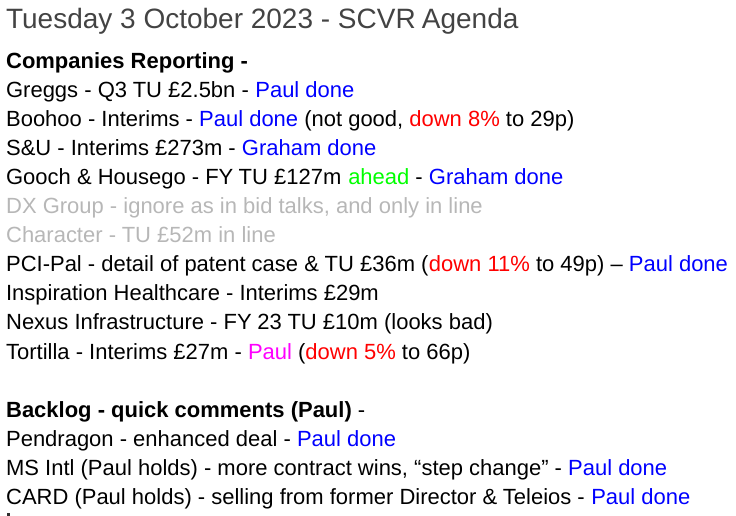
A nice comfortable workload today, we should be able to cover most/all of these. Note we're tending to grey out "in line" statements, as there's nothing much of interest in those -
Summaries
Not a small cap but ...
Greggs (LON:GRG) - 2478p (pre-market) £2.5bn - Q3 Trading Update - Paul - AMBER
As always very impressive, and with interesting sector read-across. "Strong trading continues" in Q3, and "Inflation beginning to ease", as it annualises the large % food/drink cost increases in 2022. Superb LFL revenue performance in Q3 of +14.2% - wow! Store opening programme continues wiith c.140 net new stores this year. Only in line with full year expectations, but it says this is because the Q4 2022 comps are very strong. Paul's opinion - a fabulous business, doing well when almost everything else is struggling. Their secret sauce? I'd say - low prices, ramming through high volumes, decent enough quality, not much direct competition, and constant innovation. Are the shares attractive? Not really no, as it's already priced in: PER 20.9x, 2.4% yield - would you want to chase it any higher? Only if you think it can smash forecasts. For me then, I admire the business very much, but shares are fully priced. [no section below].
Pendragon (LON:PDG) - up 5% y’day to 35p (£490m) - Improved Lithia deal - Paul
A big increase in the terms of the deal with Lithia, to sell the core car dealership business. Lithia has upped the price by 42% to £397m, which confirms out earlier thinking that the original deal undervalued the core business (calling into question management competence). The proposed 16p dividend is upped to 24.5p. The implied total value is 35.4p, but that’s using an arbitrary valuation of the Pinewood Tech software business. I still think shareholders might prefer a clean cash takeover for the whole thing, but we’ll soon find out from the shareholder vote. Exciting times for PDG shareholders - well done! I’m pleased to say we flagged it here as an interesting trade at c.16p, when Odey's forced selling caused a spike down in price. [no section below]
MS International (LON:MSI) (Paul holds) - 780p (£127m) - Contract wins - Paul - GREEN
Just in case you missed it, the military contract wins are coming thick and fast, mainly from the US armed forces. A $15.8m contract with the US navy was announced yesterday. On 29 Sept, this announcement was a $23.5m contract also with the US navy. Here on 1 Sept saw a maintenance contract, also with the US navy.
Note the company’s comments (it’s not given to hyperbole, so I’m taking this seriously) -
“We perceive that we are achieving a significant upward step change in the further development of the Company that will again bring additional rewards and success for the business".
This contract is further confirmation of that upward step change.”
Paul’s opinion - so far, so good. This share is rather under the radar, because there aren’t any broker forecasts, so it doesn’t come up on many value or growth screens. But big (good) things seem to be happening, especially at its military division. It depends what the profit margin is on these contracts, which I don’t know. Combine that with upbeat Directorspeak, and the signs are looking good, so I’m holding very tight onto my own personal MSI shareholdings, and will run it, and see what happens over the next year or two. Shares are illiquid, and can be volatile. [no section below]
Card Factory (LON:CARD) (Paul holds) - 102p (£348m) - Major shareholders selling - Paul - GREEN
A much-discussed value retailer of greetings cards & gifts, which seems to be trading very well, and shares attractively priced. However, there’s little doubt that the major shareholder Teleios dumping shares clumsily in the market seems to be preventing the share price from breaking upwards from 100p. Also, I think maybe some short term traders bailed out on results day recently, when it dropped 10% for no fundamental reason that I could see. The latest update said Teleios still has 40.1m shares, 11.7% of the company. If that is all going to be dribbled out into the market, then there seems only a slim chance of the share price going anywhere for now, which of course doesn’t matter to medium-long term investors, but it’s still annoying. Yesterday, I spotted that Stuart Middleton had reduced from 3.8% to 2.6%. Googling him, he’s the former Creative Director of CARD. Distinctly unhelpful, and it does raise the worry as to whether these bigger shareholders know something we don’t? Some good readers comments here in the last week, thank you for your interesting & varied views. We don’t want to slip into group-think, so appreciate a variety of opinions. [no section below]
Gooch & Housego (LON:GHH) - up 5% at 523p (£135m) - Full Year Trading Update (ahead) - Graham - GREEN
I’m tentatively giving this one the thumbs up on the back of a positive trading update. Revenues are ahead of expectations and the profit forecast gets a slight boost. Acquisitions are bedding in. I’d really like to see an operating margin of 10%+ here in the next few years.
Boohoo (LON:BOO) - down 10% to 28.4p (£360m) - Interim Results - Paul - AMBER
Lacklustre H1 results, positive EBITDA, but here in the real world, the important numbers are a loss before tax, and negative cashflow. Balance sheet & liquidity look fine, providing the RCF remains in place. I discuss the pros and cons in more detail below.
S&U (LON:SUS) - up 1% at £22.74 (£276m) - Interim Results - Graham - GREEN
The key numbers here were already flagged by the H1 update. Profits are up despite a large increase in the interest bill and softness in collections at the motor finance division. Property bridging continues to grow well. At an 8x multiple I continue to view this as attractive.
PCI- PAL (LON:PCIP) - down 13% to 48p (£31m) - Patent detail & trading update - Paul - GREEN
What a pity that PCIP slips out a forecast downgrade without mentioning it at all in the positive sounding RNS! Seems deceptive to me. Despite this, I think the positives outweigh the negatives, and with breakeven approaching this year FY 6/2024, and the patent case hopefully now behind it, then risk:reward looks better than ever before in my opinion.
Paul’s Section:
Boohoo (LON:BOO)
Down 10% to 28.4p (£360m) - Interim Results - Paul - AMBER
My love affair with this fast fashion eCommerce business ended a long time ago, and looking back to previous reports this year, we’ve been either AMBER or RED on Boohoo.
With hindsight, the main problem facing fast fashion businesses is that Chinese (unfair) competitor Shein is under-cutting them on price, by using cheap labour, and then exploiting the small packets exemption from import duty, selling individual parcels direct to consumers. Hardly any investors spotted this threat to Boohoo, instead obsessing over completely irrelevant factors such as ESG, which had little to no bearing on performance. Meanwhile Shein was quietly eating Boohoo’s lunch, something which I only spotted too late.
Although Boohoo does have one key advantage over Shein - namely speed of delivery, next day, whereas ordering from Shein typically involves 1-2 week wait - not much use if you’re impulse shopping for an outfit to wear out the next evening.
Shein seems determined to wipe out the competition, hence why I’ve completely give up on this fast fashion, cheap end of the sector, which doesn’t really interest me at all any more.
Sosandar (LON:SOS) (I hold) is a different matter altogether, with a more affluent customer who I doubt would order anything cheap direct from China, but even then, we can’t be sure that will always remain the case.
H1 figures today from BOO are for 6m to 31 Aug 2023. I’m not going to spend much time on it, as the figures have not impressed.
Revenue down 17% to £729m
Gross margin slightly up to 53.4% (H1 LY: 52.5%)
Adj EBITDA doesn’t interest me, as it’s not a real profit figure, but it’s £31.3m (down 12%)
Adj PBT is more relevant, and this is poor, at a £(9.1)m loss (down from £6.2m profit H1 LY)
Statutory loss before tax is £(26.4)m.
All of that is pretty poor I’d say.
Share based payments of £11.2m stands out as inappropriate, given the shareholder value destruction in recent years.
Exceptional costs, adjusted out, of £10.2m look dubious to me, being warehouse & IT costs.
Cashflow - not good, with a net cash outflow of £(40.9)m. Note quite heavy capex of £36.3m in H1, which is greater than operating cashflow of £21.8m.
Outlook - expecting revenues for FY 2/2024 to be down by 12-17%. I wouldn’t obsess too much on revenues, as eCommerce fashion companies should be focusing on profitable customers, and letting go of customers who are eg. serial returners of product. So I can tolerate reduced revenues, if it helps profitability, and is being done deliberately, which is difficult for outsiders to determine.
Adj EBITDA guidance is £58-70m for the year, but this omits lots of costs, so doesn’t mean a thing.
There’s an aspiration to get EBITDA back up to 6-8% (it used to be 10%), which is just that - an aspiration.
Balance sheet - inventories are much lower than a year ago, but similar to 6 months ago. It’s good to see BOO focusing more on the test & repeat model, which served it well originally.
The huge cash pile of £290m is down by £41m in the last 6 months. This has all been borrowed though, with interest-bearing borrowings static at £325m. Note 14 says this is an RCF, which has (unspecified) covenants related to interest cover, and adj leverage. I don’t think we ever got to the bottom of who is providing this facility? People assumed it was HSBC, but I’ve never seen any proof of that, so post a comment if you have got any information on this.
Overall, if I eliminate intangible assets and the usually related deferred tax, then NTAV is £273m, which is pretty good, and much better than ASOS (LON:ASC) or THG (LON:THG) for example.
The big question is what the terms of the RCF are, because if that £325m RCF was pulled by the lender, then BOO could be in trouble. If the RCF is secure, even at a reduced amount, then BOO should be fine for liquidity and solvency.
Paul’s opinion - ignore me obviously, as I’ve been horribly wrong about Boohoo’s prospects in the past. Although also horribly right, when it originally 15-bagged, and was one of the biggest ever winners we had here. Just shows doesn’t it, business models change so fast now, that the disrupters soon become the disrupted.
I’ve come to the conclusion that my experience in the clothing retailing sector is now too outdated (from the 1990s), to be relevant to the modern world, so I no longer consider myself an expert in this sector, hence am mostly focusing on other sectors where there’s greater visibility of the future.
For what it’s worth though, I think these H1 numbers from BOO are disappointing, it’s basically now operating at a moderate loss. Providing the RCF remains in place, then liquidity is ample, so no solvency issues I can see (unless the RCF was pulled).
How can it fight back against Shein? With great difficulty I imagine. So the days of fat margins look long gone, especially if as some are expecting, it tightens its grip on the UK fast fashion space, eg partnering with Frasers (LON:FRAS) . FRAS has shareholdings in both Asos and Boohoo.
Maybe we should see Asos and Boohoo as special situations, “in play” as Shein and Frasers seemingly try to dominate and carve up UK eCommerce fashion? I can’t imagine the Kamani family being pushed around by any outside shareholders! Will they take it private? I wouldn’t be surprised at all by that, but doubt the price would be generous, given that they’re astute, hard-nosed rag traders.
Zeus has updated its numbers for FY 2/2024, with much lower revenues, but only slightly lower LBT of £(21.5)m, versus its previous £(13.4)m forecast LBT.
Overall, it’s difficult to see why we’d want to invest in a cut-throat sector, where even the shrewdest player (BOO) can’t make any PBT any more, and is forecast for continued losses in FY 2/2025 too. What’s going to change, to get back to decent profitability? I can’t see anything big on the horizon, so it seems more a case of BOO fighting a rearguard action to stay in the game, rather than dominating and making big profits any more.
The value in BOO shares is probably now more strategic, over what happens to what is a sizeable business, generating £1.5bn revenues pa, a bit like Asos nearer £4bn, but neither is making any money. Are they now trophy assets rather than having any intrinsic value?
The shares could go either way, I don’t know what’s likely to happen, so I’ll just declare myself AMBER on BOO.
PCI- PAL (LON:PCIP)
Down 13% to 48p (£31m) - Patent detail & trading update - Paul - GREEN
What a pity, the euphoria on winning its patent case against Sycurio has been very short-lived, as you can see -

PCI-PAL PLC (AIM: PCIP), the global cloud provider of secure payment solutions for business communications, is pleased to provide an update following the successful defence in the UK High Court of the unfounded patent claims being made against it.
Here’s the full Court ruling, if you’re interested in reading it.
PCIP is seeking full costs, which should be determined by the Court in Dec 2023.
The other side might launch an appeal, which PCIP says is commonplace.
Trading update - this sounds positive to me, so I’m unsure why the share price has fallen sharply today -
In FY23 we achieved revenue growth of 25%. Based on the trading year to date we now expect to see revenue growth in FY24 of between 28-30%. This is expected to allow the business to report the Company's first full year of adjusted pre-tax profit.
The year ends are June. Breaking into (adjusted) profit in FY 6/2024 strikes me as impressive.
Broker update - ah I think I’ve discovered why the share price has fallen today! PCIP’s trading update strikes a universally positive tone. However Cavendish says that customers have “slightly delayed decision-making”, resulting in it reducing forecast revenue growth from +34%, down to +28-30%. Not a huge difference, true, but it really grates on me that the company’s RNS reads like a PR release, but the bad news (of slightly lowered expectations) is slipped out via the house broker. I’ve read the RNS twice, and I cannot see any reference to the growth rate slowing. This feels deceptive, which really undermines my trust in management.
Cavendish lowers FY 6/2024 revenue forecast from £20.0m to £19.1m. This results in adj PBT of just £0.1m, so breakeven really.
Forecast net cash looks tight, forecast at only £0.3m by 6/2024 (previous forecast £1.5m). Three’s possible upside from any costs recovery from Sycurio though. Also a £3m RCF is available.
Paul’s opinion - what a pity this has been so badly handled, with I think PCIP being very badly advised, putting out an upbeat trading update, which is actually a downgrade to forecasts, sneaked out via Cavendish. Shareholders need to read the riot act to management, explaining why this is so badly perceived by investors, and undermines trust in them. Why do this, when it only fools people for at best, one day? But it leaves behind a nasty taste, and a feeling that management can’t be trusted, and everything they say in future needs to be taken with a pinch of salt.
So very badly handled today. However, with the patent case now looking resolved (hopefully), and still-good growth in the pipeline, with breakeven now approaching in 12-months, combined with a market cap of only £31m, I’m leaning positively towards this share now. We had to be AMBER whilst the patent case was up in the air, but I moved to AMBER/GREEN on 26 Sept when it announced “total victory”! Despite today’s deceptive handling of the slower growth, the positives outweigh the negatives for me, so I’m happy to see this with a GREEN view now. Risk:reward seems better now than it was earlier this year, and the price has barely changed.
Graham’s Section:
Gooch & Housego (LON:GHH)
Share price: 523p (+5%)
Market cap: £135m
This leads with a positive headline:
"Trading ahead of expectations. Integration of the two recent acquisitions progressing well"
Gooch & Housego is “the specialist manufacturer of photonic components and systems”. I’ve commented previously on the company’s turnaround attempts: in the post-Covid period it built up large order book arrears and suffered a delay before it could pass on cost inflation to its customers, hurting its profitability.
After a few tough years, I’m wondering if it might be in value territory at this point:

As demonstrated again by today’s positive trading update, it has had some time to adjust to changes in costs and pricing, and appears to be doing well in the new environment.
Today we learn:
Industrial markets: destocking in the industrial laser market, but higher sales volumes of acousto-optics and fibre optics.
Aerospace and defence: also sounds positive, especially that there is “good progress on design and development activities for a number of customers for our embedded imaging periscope systems which has the potential to unlock significant orders based upon forecast vehicle build rates”.
Medical diagnostics: revenues are up and the engineering team in Ashford are “fully utilised”.
Estimates: full-year adjusted PBT (for FY September 2023) should be above market expectations.
Order book is stable at around £125m, down slightly on a like-for-like basis, but further confirming that the business has stabilised, and “provides a good underpin for trading in the new financial year”.
Broker note: the latest note from Cavendish (i.e. finnCap/Cenkos) raises the 2023 revenue forecast by 5.8% to £147.9m, and marginally increases the adj. PBT estimate to £9.6m.
Estimates for subsequent years, including the current year (FY September 2024) are unchanged, except for a reduced net debt forecast.
Net debt is currently estimated to be c. £23m.
Acquisitions are “proceeding to plan”.
Graham’s view
I’m leaning towards taking a positive view on this one, as the serious challenges it faced appear to be in the rear-view mirror.
Looking ahead, it should again earn a reasonable operating margin: it used to consistently earn more than 10%, so I’m wondering if it can do that again?
It passes a nice stock screen, highlighting the high-tech nature of the business: the R&D Breakthrough Screen, which is a Quality Investing Screen.

It trades at a moderate P/E rating:

I think I’ll tentatively give this one the thumbs up, switching from a neutral view previously. For me, it has done enough at this stage to deserve that. I don’t often use “price targets” but perhaps I would switch back to neutral around 800-900p.
S&U (LON:SUS)
Share price: £22.74 (+1%)
Market cap: £276m
S&U, the specialist motor and property financier, today announces its results for the six months ending 31 July 2023. S&U continues to trade well and, despite current economic, tax and regulatory burdens weighing on business generally, views the future with confidence.
I covered S&U’s H1 update here, and today we have the results in full.
S&U’s group results:
Revenue £55.3m (H1 last year: £49.4m)
PBT £21.4m (H1 last year: £20.9m)
Gearing is 80% (H1 last year: 73%)
Earnings per share are 133.2p (H1 last year: 140.7p), reflecting higher corporation tax.
The Chairman’s statement is always worth a read.
He notes that the company paid an extra £4.2m in interest during the period, thanks to rate increases.
We had already been told in the H1 update that the net interest margin - the difference between the rate of interest charged to S&U’s customers, and the rate of interest paid to S&U’s lenders - had reduced, as a result of Bank of England rate rises.
So the modest growth in PBT looks much better, once you take this into account.
Let’s look at the two divisions (motor finance and property bridging) separately::
Advantage Finance
PBT almost unchanged at £19.1m
Collection rate 91.1% of due (H1 last year: 94.3%)
S&U has been taking a somewhat cautious approach here, and net new advances of £81m are 11% lower than in H1 last year. But that does still allow for significant growth and the lending book has hit a record high of over £300m. A new CEO will join this division at the start of the new financial year
Aspen Bridging
PBT £2.4m (H1 last year: £2m)
Net receivables £104m (H1 last year: £90m)
Given the property market struggles, average gross LTV from Aspen is now only 65%, down from 72% a year ago.
Out of 130 loans made by Aspen, 15 are “beyond term and in technical default, all of which we anticipate will be profitably recovered”.
Net debt: S&U’s net borrowings finished the first half of the year at £184m, as previously disclosed.
Outlook: cards are kept close to their chest. “Cautious optimism”.
Graham’s view
I don’t see any reason to change my view on this one. The valuation hasn’t increased since the last time I looked at it, and I thought it was attractively priced then:

When it comes to financial stocks, I’m far more interested in the small and simple businesses such as this one, rather than the high street behemoths.
Although, if you’re interested, Barclays (LON:BARC) is thought to be trading on a PER of less than 5x, and Lloyds Banking (LON:LLOY) is at less than 6x. These numbers reflect investor attitudes to UK stocks and the UK economy right now, and they trickle down to S&U, whose 8x P/E multiple seems rich in comparison!
However, in isolation, I do think that 8x is cheap for a business that has historically been as well-run as this one (and long may it continue). It is trading at a premium to net asset value, but I do think it deserves that.
Barring economic armageddon, this looks set up to do very well for shareholders, in my view.
The share price hasn’t progressed in five years, but the company has. The yield of 6% looks sustainable, and is a significant part of the total return here.

Disclaimer
This is not financial advice. Our content is intended to be used and must be used for information and education purposes only. Please read our disclaimer and terms and conditions to understand our obligations.

70 comments
Re Boohoo (LON:BOO) I was reading in Phil Oakley's book about the capex ratio (= capex/operating cash flow). He looks for a capex lower than 30%. There's perhaps a weakness in that approach because it doesn't distinguish between maintenance capex and growth capex. BOO's capex ratio has been high, routinely significantly greater than 30% (above 67% is not atypical).
Arguably BOO needed the capex to expand the business. But it is perhaps a warning that the company was expanding too rapidly. Perhaps it would be better if investors sought companies that were perhaps less aggressive in their expansion, although they will of course miss out on some rocketing growers.
PCI- PAL (LON:PCIP) I absolutely agree with Paul's take of what drove the price down. I should think the board will have learned a good but painful lesson on seeing the reaction to the RNS. The AIM all share index dropped 2% today - there is no doubt the market is still in a bear phase and extremely nervous of small cap stocks and any sign of hyperbole will be punished.
The statement that Sycurio are expected to appeal will also have dampened expectations. If they do it will continue to take up management resource for many more months. Personally I expect to continue holding because I now think they will eventually win and have a clear run at the market together with a sort of capital infusion from costs recovery but that may not be until well into 2024.
Having said that, Sycurio showed a breakeven P&L in 2022 vs £3.1M in 2021. Also no Directors remuneration was paid (£301K in 2021). Net assets are £2.4M of which £3.9 are intangibles. They declared exceptional costs in respect of IP as 2022 £1.29M and 2021 £461K in two separate cases note 10 to the 2022 accounts. I think the first was settled, presumably to Sycurio's advantage. One would expect they would need to be extremely confident to keep the current effort up for long, particularly as the judgement (I've not read it in detail) appears to be very clear at this stage. They might offer to back off for some compromise on costs, once established.
Yep, grim all round. Portfolio of 27, all small caps, excepting ITV (LON:ITV) and Howden Joinery (LON:HWDN) . Most have net cash, those that don't have manageable debt. The downward spiral will end at some point, as to when I have no idea.
Sold Forterra (LON:FORT) today at a 30% loss. Good company but challenging headwinds at present, should have exited earlier. Reinvested most of the proceeds in Porvair (LON:PRV) a quality company trading well at a discount to historic metrics. Also top sliced Ten Entertainment (LON:TEG) that sits at the top of its trading range to re-open a position in SDI (LON:SDI) which is trading at close to a 3 year low and according the recent AGM statement is in-line with current expectations.
Largest position Volex (LON:VLX) at around 12% smallest SDI (LON:SDI) at around 1.5%. My top 6 holdings Volex (LON:VLX) Avingtrans (LON:AVG) Galliford Try Holdings (LON:GFRD) IG group (LON:IGG) Jet2 (LON:JET2) and Bloomsbury Publishing (LON:BMY) account for about 40% of the portfolio.
Regarding Volex (LON:VLX) the move away from the internal combustion engine towards 'electrification' is inexorable, although there is likely to be the occasional bump in the road, along the way. The company is a significant provider of the necessary 'picks and shovels' in this transition.
It is also far from a one trick pony with growth in data centres and medical diagnostics. The recent acquisition of Murat Ticaret adds significantly to its growth potential in my view. It trades at around 12 times earnings, falling to 10.5 or thereabouts next year.
It is reassuring that Nat Rothchild who holds over 25% of the company has never sold a share. That in a nutshell is my reasoning for the oversized holding. Fingers crossed that it is not flawed and I have read the runes correctly. Time will tell.
Best wishes to all
MS International (LON:MSI)
Interesting news article on BBC saying that ammunition stores are relatively low and need to be restocked because of supply tp and use by Ukraine . I’d say that adds positively to future demand for MS International (LON:MSI) defence business and other suppliers
Yet another dire 250 day then when oh when will this end, there seems no significant reason given our mkts are supposedly cheap already, every low beating the previous
Latest sell-off seems to be all driven by the continued rise in US bond yields, which effectively sets the price for everything else. Interestingly, it seems inflation is no longer the issue, but rather concerns over the sheer scale of Treasury issuance that will be needed to fund the US deficit, coupled with a lack of buyers now the Fed is no longer doing QE. History has always shown that something eventually breaks when yields rise this far (whether a big recession or a financial institution going under), so that will be adding to the jitters.
I agree nothing to do with inflation , but only the 32 Trillion debt that will continue to rise with no immediate solution ; there is one , rather painful , but not in the interest of the government as elections are only a year away now.
Comparing that with the US GDP then we are close to the number where the five Eurozone countries collapsed.
Rick Santelli was implying today that the 10 year can climb to 13%! ( I am not saying that ).
Of course the 7-8 Trillion parked in money markets the last 9 months, will be eagerly awaiting for a collapse of the share prices.
In addition and bizarrely its also because the US economy is still strong and therefore the US markets are now finally taking note of what the FED said all along that interest rates will remain higher for longer with 1 more rate increase. Unfortunately when the US markets go down so does the UK. Ho hum.
It's just pure fear out there. I'm seeing lots of capitulation into cash savings accounts and it's looking very (long term) bullish now.
If rates have truly peaked and inflation is getting under control, then we are likely experiencing the final leg down and entering the capitulation stage of the bear market. Historically speaking, the capitulation stage is usually the most brutal part of the bear market.
Best case scenario, we flush in October and rally into the new year
Just to throw my pennyworth in on Boohoo (LON:BOO) as I have held in the passed and commented here often.
Boohoo (LON:BOO) was my third biggest winner with a gain equivalent to 13.3% of my current portfolio (god did I think I was a genius) and largest loser with a loss equivalent to 23% of my current portfolio (f… did that hurt, I finally bit the bullet at 38p).
What have I learnt from the debacle. From Boohoo and others that my big bets never seem to come off and I therefore am much more rigorious in controlling position size and top slicing as things work out.
Smaller position sizes in general and not worrying that if a 1% position 10 bags (I wish) beating myself up wishing the position had been 5% or 10%. Maybe I will get my Geico moment (Graham in the end piled 50% + of his partnership into Geico having spent a lifetime preaching caution) but I would be surprised.
Moving towards 50% or even 70% or 80% of the portfolio in Berkshire Hathaway (NYQ:BRK.B) and and S&P ETF. Though I am taking my time as several of my holdings are in a huge loss situation, which at the moment I think is temporary (though I thought that about Boohoo as well!).
Finally, I understand there 47,000 quoted companies available to invest in and I really do not have to fanny around in the 707 AIM members. I think that this market is and will throw up many bargains further up the quality scale.
I misread Boohoo (LON:BOO) completely. I can think of nothing worse than wondering round a soulless shopping centre shopping for clothes when I can order online and send it back and I try if there is a reasonable alternative not to buy Chinese so I have an iPhone but would never buy a Chinese car or Hoover but obviously most people don’t think that way (and I certainly am not prepared to wait many days/weeks for delivery of a product). Letting your own biases get in the way of stock analysis can be dangerous. That said I didn’t respond to my positive bias to Amazon.com (NSQ:AMZN) Apple (NSQ:AAPL) and Alphabet (NSQ:GOOGL) 10 years ago when my use of these three companies products meant that the investment case should have been staring me in the face.
If you have reached this far, thank you.
Regards
Michael.
Hi Michael
I did reach that far!
Perhaps the most important lesson learnt from my experience is that you should never have more than 5%-7% in your portfolio in one single investment.
It would be interesting to run a survey of readers on position sizing, both maximum and minimum. My minimum is 0.4% which I suspect is too low and maximum is 7.2%.
Min 2.3% max 6.3% - 21 holdings
Min 2.3%, Max 8% - 22 holdings
I should have added that I have 42 holdings
After many years of trial and error I've found that 30 (roughly equally weighted) positions works well for me. It gives very good diversification, with a big sell-off in a single position not being too painful, but at the same time the positions are big enough that you do still notice the rallies. I also find 30 is the maximum number I can stay on top of!
This approach also instils some discipline in position sizing - if something gets to say 5%, I'll usually trim it back to 3% and top up something that's been a bit weak (providing there are no issues with the company of course - would never just blindly top up!)
Obviously a lot depends on the size of one's portfolio - 5k is probably the minimum I'd want to hold in a share, so certainly wouldn't suggest holding 30 positions in a portfolio worth less than 150k
Thanks for this Bouden54. I suspect your are at the sweet spot in terms of number of holdings and concentration. I was holding 32 but allowed myself to be tempted by too many opportunities over the last 2 years many of which are under water.
46 holdings including some tracker ETFs. Largest position 6.8%
Larger position sizes are mainly FTSE250 and trackers. Stable but reflect the lacklustre UK markets over the last few decades.
Small cap positions typically 0.5%- 1.5%. Possibly too small, and result in just tracking the index.
Max 2.28% (I normally cap at 2% but weak sterling has skewed things recently).
Min 0.2% (exluding odds & sods that aren't worth dealing in).
I run my equities more like a corporate bond portfolio - very high diversification. I will probably underperform in a bull market, and that is just fine. The world is unpredictable, I don't know what I don't know, and I will be the victim of multiple frauds.
I go from 2% to 10% (initial position, I think 1% to 15% would be where I take action to slice).
Yes I think you are right though I make an exception for Berkshire Hathaway (NYQ:BRK.B) and my limit is 10%. I currently have 9% inGames Workshop (LON:GAW) Bioventix (LON:BVXP) Volex (LON:VLX) and Sylvania Platinum (LON:SLP
I am still clinging on to BOO albeit with a much reduced position. I am however now ,for the first time in 5 years , more in cash than equities. Cannot see any possibility of upside in most European equity especially UK so have placed significant sums on 1 year deposit at 6.10% . My portfolio now consists mainly of shares such as BAE systems , Rolls Royce and Unilever .
Good luck everyone. I will still subscribe to Stocko but will not be taking much notice of stock tips for the foreseeable future .
It's interesting that ASOS (LON:ASC) is more shorted than Boohoo (LON:BOO) , given that it is more likely to survive the onslaught of Shein and Temu.
Boohoo was always about cheap, no-brand, latest fashions. Which Shein and Temu are doing even cheaper.
Whereas ASOS has somewhat of a moat now, having gone more into branded clothing. And those brands that sell on ASOS, are unlikely to want to sell on Shein and Temu (too cheap / low end. Plus there's blatant copying of designs from the brands).
There's probably room for one dominant, on-shore shipping player. And my money is on ASOS to fulfil that role. Provided that they can get back to profitability, clear their problem stock issue, and also be on a firmer balance sheet. Could be that they will succumb to a huge equity placing, or need to be rescued by Frasers and rehabilitated privately.
Regarding Boohoo (LON:BOO), I asked my daughters why they no longer seem to buy from them. A few years ago, we had a Boohoo/Pretty Little Thing package turn up virtually every week.
The older one (22) says she now prefers Zara, as the quality is so much better.
The younger one (17) usually uses Shein, as their quality is no worse than Boohoo but a lot cheaper.
Thank you to all for the comments and the thumbs up.
I will add that I have 17 positions and that will probably grow to 20/25 but that 65% is in 9 holdings and I’m happy if a holding hits 10% because of price appreciation but that is now my limit and where I would start top slicing.
Regards
Michael
Re S&U (LON:SUS)
Collections not deteriorated and stand at 94.1% v 94.3% versus prior period. Arguably an actual improvement of payments as deliberately shift in customer acquisition focus -> they have moved down the credit quality scale (and so moved up their interest income as these customers pay more interest) -> net net that means that payments improved
I'm happier they move down credit quality scale generally as I believe this is where good non prime lenders differentiate themselves...finding good risks that are not thought to be so good based on (poor) classic credit scoring perspectives
Oxford Metrics (LON:OMG)
My thoughts from a few months ago:
https://www.stockopedia.com/co...
Oxford Metrics (LON:OMG) down to 85p. They have almost 50p cash? Forecasts for next year around 4.3-4.5p EPS
Either forecasts are well off or the seller is handing everyone a great price. Even interest from the cashpile should bring in 1-2million, Anyone have any views?
I'm topping up
Perhaps the writers/actors strike has caused a shortfall in orders for Oxford Metrics (LON:OMG) . Irrelevant for the long term really, but don't think AIM market has the stomach to look through a profit warning right now.
Perhaps the writers/actors strike has caused a shortfall in orders for Oxford Metrics (LON:OMG) . Irrelevant for the long term really, but don't think AIM market has the stomach to look through a profit warning right now.
This seems to me to be a very like source of share price suppression. At least here is one company that isn’t going to exceed its debt covenants and should bounce when the overhang dissolves, making for a relaxing ownership experience. I don’t however find it as cheap as some consider. 10x EV/EBIT, thereby accounting for the cash pile, is not outstanding value for a business whose revenues and eps have gone absolutely nowhere in the last 10 years!
I also have real concerns about the technological moat, if indeed there is one at all. Developments progress so fast in tech nowadays that it’s easy to imagine there are compelling alternatives. On the other hand, if the tech is good, looks a clear target for taking out.
Management are not top drawer either. They deserve some credit for offloading Yotta but experience tells me more of the credit is due to the hired corporate finance advisors who connected buyer and seller and saw the deal through.
Small Caps are getting hammered and another dismal day again today with most in the red, its continual daily now with a steady drip down, and OMG is no exception, back to share price lows before asset disposal of £60 million, beggars belief really and one wonders why Directors have been selling shares when business on the face of it looks undervalued.
Hmmn, big director sales this year Oxford Metrics (LON:OMG).
https://www.londonstockexchang...
The CFO Phillip Vincent has bought some as well 18774 .
Redde Northgate (LON:REDD)
https://www.londonstockexchang...
Redde Northgate (LON:REDD) a reassuring 'buy' from CEO Martin Ward after their positive AGM trading update.
Boohoo (LON:BOO)
There must now be a chance the Kamani family will take-private and delist Boohoo. No doubt at a price, more to their advantage than existing. Just speculatiing, I know, but can't help but wonder.
Incidentally, on Stocko it would be good to have data showing the shareholdings of company directors. There's a tab under "accounts" for director dealings, but I can't find anywhere showing the actual holdings.
Mark L, if directors have a notifiable holding then they appear under Major Shareholders, tab below Directors dealings.
True, and it is a useful page of information, but doesn't give the % of shares held by directors unless they all have notifiable interests.
My source which may be out of date, gives Mahmud Kamani owning investments of £62m, Carol Kane £6.3m, Ian McDonald £237.5k, John Lyttle £59.4k, Shaun McCabe £34.9K, Timothy Morris £14.6k, and Kirsten Michele St Britz £9.7k. Two other Board Members who have recently been engaged hold no shares in BOO. Cannot give numbers of shares, only have percentages of market cap besides this info.
Just look at the last annual financial report of Boohoo (LON:BOO) . Pdf on their investor section of website. Director shareholdings (and any options vested and unvested) should be there.
Avation (LON:AVAP)
Interesting - now we know that Rangley Capital - a U.S. LLP has bought the 19% stake.
Overhang cleared and a fresh and presumably bullish investor - stock now at least moving in right direction with overhang gone.
At NAV of 270p and a historic price for lessors of 1.1* I’d expect 200-220p is a fairer price. Whether we ever get there in this horrid market that is lingering longer than the smell of a decaying rat who knows……..
If it's got to 6% then there's very little further damage to be done - sounds like the only way is up from here.
Did you see the FT on the weekend. Government have twigged that they need to get the stock market going (in terms of upward price movement) - tinkering with listing rules will only get you so far. If you were considering a float - where would you list? In the US where prices double every few years or the UK where the FTSE is static for 23 years?
When you consider the people who are floating have a huge self interest in seeing upward momentum in the share price (because they hold loads of shares and incentivised by options) it becomes a total no-brainer. We need to get prices moving - and fast! Govt ideas so far (apparently) are to change the ISA/SIPP rules so that less can be invested outside the UK. Sounds like a very small but entirely sensible move to me. Getting people back interested in stocks and shares has to be done. It's critical in ensuring that we keep the last decent sector of our economy.
Rant over.
The woes of this country are many but setting up a weak form of currency control will probably not improve things.
Pressure Technologies (LON:PRES) trading update/unaudited results not great but equally not desperate. The investment metrics are moving in the right direction, albeit not as quickly as previously indicated. I think that the dire share price doesn't reflect the improved operational performance or potential.
The reference to raising additional finance perhaps suggest an equity issue, which will no doubt spook the market.. I would expect Harwood with a significant stake via Richard Staveley's Rockwood Strategic (LON:RKW) to be very supportive whatever the outcome. Also Peter Gyllenhammer, a very canny small cap investor has a sizeable holding. I hold but in a much more modest size.
FY23 Post-Close Results
The Group's unaudited results1 for FY23 are expected as follows:
£'million FY23 FY22
The Group has continued to explore options for raising additional finance to provide increased working capital headroom and to fund the transition of CSC into the hydrogen energy market. The Board is in constructive discussions to raise new finance and will update further in due course.
More good news on inflation as UK food prices actually fell MOM in September. Every warning indicator is flashing that a recession has already started and the next BOE move is going to be cutting rates not raising them again
Gooch & Housego (LON:GHH) trading update looks pretty good. Broker ups revenue/eps slightly for this year. EPS forecast to grow at around 27% next 2 years, valued at 13x forecasts. Debt/EBITDA 1.1x
My morning smallcap tweet: Raiding the financial fridge
Boohoo (LON:BOO) Safestyle UK (LON:SFE) Renalytix (LON:RENX) PCI- PAL (LON:PCIP) Nexus Infrastructure (LON:NEXS) Pressure Technologies (LON:PRES) Gooch & Housego (LON:GHH) Oxford Biodynamics (LON:OBD) Inspiration Healthcare (LON:IHC), Character (LON:CCT)
◄boohoo (BOO)► H1-Aug rev down 17%. Core brands down 10%, consistent with guidance of 10-15% for group rev.* "More significant declines in our labels following the successful decision taken to target more profitable sales, which contributed to improved Group profitability." Stock down £94m. Identified over £125m PA cost savings to be delivered across FY24 & FY25. Guides FY rev down 12% to 17%. Blames slower volume recovery than expected.
[edit] but later says "rev in core brands declined 10%, consistent with prior guidance of -10% to -15%" The outlook in the finals said "In the first half, revenues are expected to decline by 10% to 15%...In the second half of the year, the Group expects to return to revenue growth." So a massive miss and misleading spin. [SP=31.58 Cap=401m]
◄Safestyle (SFE)► not seeking a placing but has talks on an alternative financing structure. Likely to breach covenants in revolving credit facility in Nov. [SP=4.5 Cap=6m]
◄Renalytix (RENX)► US Medicare & Medicaid price for kidneyintelX.dkd test set at $950. [SP=60.13 Cap=70m]
◄PCI-PAL (PCIP)► will be a hearing on Sycurio case in Dec where a number of administrative and outstanding matters will be resolved by the Judge. Guides FY24 rev up 28-30% and an adj pretax profit. In line? [SP=54.3 Cap=36m]. I hold.
◄Nexus (NEXS)► warns FY-Sep rev c.£85m and op loss £6-7m, missing mgmt exp. Blames "lack of new order activity due to difficult market-wide conditions, up-front costs in relation to rightsizing the Group's resources and a prudent approach on aged customer debt where a significant portion has been written off". Cost cuts. [SP=112.08 Cap=10m]
◄Pressure Technologies (PRES)► guides FY-Sep rev up c.28% and adj EBITDA £2m (-£0.9m). In line? Expects FY24 rev and profitability to increase slightly. [SP=30.5 Cap=12m]
◄Gooch & Housego (GHH)► guides FY23 rev marginally above and adj pretax above market expectations. [SP=500 Cap=129m]
◄Oxford BioDynamics (OBD)► gets Medicare, Medicaid and private health reimbursement code for EpiSwitch Prostate Screening [SP=33.4 Cap=68m]
◄Inspiration Healthcare (IHC)► H1-July in line. "The headwinds seen in H1 are dissipating and with a strong pipeline of opportunities we are confident of returning to growth in the second half." [SP=42.84 Cap=29m]
In line: CCT
If you want to know why some of us are struggling to generate meaningful returns from the UK stockmarket, this is pretty sobering:
UK pension funds reduced their allocation to stocks from about 73% in 1997 to 27% in 2021, cutting exposure to British equities from 53% to just 6% over the same time period, think tank New Financial said in a report prepared for the Capital Markets Industry Taskforce
This has resulted in ever lower levels of liquidity. But it also means that many small caps in the UK are trading at pretty low valuations.
Despite the above, I remain fully invested in equities. I'm 69 years old but I still consider that equities represent the best asset class for me. I'm up on 2020 valuations, but down on 2021 and 2022. It's a good job that I'm used to pain.
Yes, GreyInvestor its been a one way flow. Being slightly more optimistic the MSCI World Index is now country weighted in August as so: United States 69.91% Japan 6.13% United Kingdom 3.94% France 3.31% Canada 3.14% Other 13.56%.
You can see where the money has gone - into US stocks. c70% of the world, but their share of world GDP is c25% versus c2.3% for the UK. The US looks like Japan in the late 1980s: way overvalued despite having some great tech stocks.
I personally think that fund manager reallocation from the UK to global is entering its final phase. Most investment managers have already re-weighted their portfolios: if they haven't already done so they would have been fired! If the US enters a bear market I get the feeling that we may get an end to this process and even a slight reversal. One would hope that the UK out-performs the US in the final phase of a global bear market (given today's start point). Anyway, I'm heavily weighted to the UK (as probably most of us are) and probably a tad biased!
Another point of note. Has anyone noticed that the yield curve inversion is starting to reduce both in the US and UK? This is not due to lower short-term rates, but due to a massive hike at the long-term end. US 10-yr is now an eye watering 4.7% (heading over 5% I think) and UK not quite as bad at 4.55%. This bodes very badly for the US market and is due to too much debt issuance and not enough buyers (i.e. the main buyer used to be the Fed) with China, Russia and Saudi Arabia no longer interested in US debt. We could be in for a very volatile 6-12 months.
Yes but the long term curve is almost always wrong.
Not so long ago it was pricing 1-2% rates out to 30 years which was always clearly bonkers. Now it’s pricing rates at a more historic norm. That will also prove wrong but is probably closer to accurate than the 1% lark which was never going to persist into perpetuity
It’s more of a concern about fiscal policies , excessive debt and uncertainty that they count these rates and these are the reasons they hit the 5.5%-6% soon and probably 7% after the US general elections.
Long term rates are affected by demographics. Over the last 30 years the baby boomer generation were saving , this supply of money pushed down returns. They are now retired and spending these savings which is increasing rates. It would not surprise me that we are now in for 30 years of above average interest rates.
In addition China is a nation of savers. Over the last 30 years China opened up to the world and a lot of this money was invested globally. They now seem to be closing to the world, this money will be taken out of the global system and just be invested domestically.
Hi Topvest, as you have mentioned US investments you may be interested in the recorded webinar by fund manager Richard de Lisle on the de Lisle Partners web site (Content Library Section), in case you have not yet seen it. I think it is important to compare like with like ie. US smallcaps with UK smallcaps and this fund manager (of over 30 years experience) certainly believes that US smallcaps will continue to outperform other asset classes and his performance record provides some validation for his views. The webinar goes on for over an hour and is a bit slow-paced, but I found it worth listening to.
Grey Investor,
The money must have been invested somehow else, probably in land and why not in Government Bonds? If so, the Chancellor can only be kicking the can further down the road. It annoys me that I am making capital losses when balancing my portfolio and paying tax on my dividends. At 79 at least I don’t have the problem facing those 20 or more years younger who are facing extensions to the state retirement age, bearing in mind that this is being recommended by people well past retirement age but remaining employed in non-jobs.
Silver
Hi Silver
As a youngster, definitely not hip in anyway...
I am very grateful for the opportunities that this country has given me, and that includes how the tax system works for the several years where I took the opportunity to work expatriate when younger. I am also so grateful for my folks, sign up to a pension and pay into it, pay your mortgage off early if you have spare money, don't have a credit card (ok I do but pay in full each month and get the points).
I have benefited from things like ISA as well as Pension, whilst I have not been able to take full advantage, and have made lots of mistakes overall I am still ahead and probably am in a minority where life will be ok hopefully no matter what future regulation changes are in terms of tweaks of the State Pension age (always assumed I would pay into it and not get it as it would go to means tested before I go there). It is crazy to think back the state pension worked on the basis of something like 30% never were able to claim it, and low single digit average claim, and it was left alone for 100 years to 98% claim it and 20+ years average claim. Did someone say Mr Ponzi?
For me I have personally chosen to move a long way down the career ladder, and halved the take home, but then I now work half the hours I typically did, only work 4 days with typically 2 days in the office as much about interaction with other folks and the craic, and now I am very fortunate that I get to do a lot of other things with my family and personal focused. The big change is I am not looking at a stop work at 50 or 55, and life on the golf course, I work because I want to, do something local that I enjoy, if I stop enjoying it I will do something else, and the pay is about the enjoyment factors, help my family, charities, the local school, small luxuries and only touching the "nest egg" for bigger things, and actually most months I am still paying into it with pension contributions and month end sweep up. The charities and kids stuff goes out on the 1st Direct Debit.
I also know that is me, I am a majority of one, and that is not society as a whole. Try to remember no matter how challenging or bad the day feels my glass is actually overflowing, thankfully on the kitchen floor not living room carpet :)
UK versus US versus Global, I have bits everywhere. My strategy is not the best but I am doing ok and trying to learn more every day. It hurt selling stuff yesterday, as Grey talks about on a capital loss for the year, but cut your losses! Your rules are not the best, but then they are not the worst. Then when I look at Mum's (ISA) 6 months into the year and updated the spreadsheet for September, it has given 50% top up to her state pension, which has mostly gone to the grandkids and on a nice holiday so yes capital down, but for someone who is 81 it is about life now really.
Waffle over, I have work call.
Tommy
Good morning Tommy, I must agree with your last sentence and I am slowly getting rid of my non-dividend paying shares. Other than this it is enviable to have enjoyable employment without physical stress. I worked at the coalface in a tyre factory for 40 years, saw fellow workers die well before retirement age and I myself retired early at 60 otherwise I should probably not be here today.
Hi Silver Moon
My dad was the first owner farmer from his family, previously (and some cousins still are) they were upland tenant farmers. My grandfather did not live to claim his pension, my dad thankfully (as I left farming) was made an offer to sell up from the neighbors at 58 it broke his heart at the time, granddad had past several years earlier. But looking back this like yourself saved the last 7 years of work when the body is least able to cope and meant he had a good retirement, rather than being in a box before he got there and me following a well trodden path on the same journey.
Good luck on the journey that I have made with mum, she is now solely dividends, before Covid there was growth in her portfolio but now it is just income and if there is growth (typically PE value or multiple of the dividend, or % dividend drops below my target) or a takeover bid, take the capital gain and move on, as this last couple of years it is just an offset from the overall downward trend.
Tommy
Thanks for this, the numbers are shocking. An explanation for why the UK market has been so poor over the last 20 years. However i view this as good news going forward. Prices are low which means that the risk of a major fall is small and the chance of a substantial rise is high. Pension funds cant sell much more, they must be near the bottom and will perhaps increase buying over the next decade.
Dear GI
This is a fairly stark statistic and also one that politicians of whatever hue should stop and take notice of. It does however force me to ask where have they transferred their allegiance to. Be interested to find the answer to that
Looks like it's going to be boohoo for Boohoo (LON:BOO) .
Lots of encouraging words until you get to the figures, and with guidance for the year of between minus 12 and 17% I suspect the share is going to get hammered, has Ashley got it all wrong with his investment?
Yes, the Boohoo (LON:BOO) figures look rather poor to me, but it has tons of liquidity, which buys time to improve things. Look how price competitive it is - with all the supply chain improvements sucked into lowering prices, not something they're doing out of generosity, it's because of intense competition from eg Shein - that's the fundamental reason fast fashion has been under so much pressure. All the talk about ESG and slave labour, etc, was completely background noise, and had no impact whatsoever on trading. Profits have disappeared due to the intense (and unfair) competition from Shein. I didn't spot that until it was too late unfortunately. Hardly any bears spotted it either. So they were right, but by accident!
Had the honour to meet many years ago one of these lucky bears. One of the best in the business-he made money on Boohoo not by accident , not by luck but by analysing in depth their financial accounts.
You may well be right and well done him. But survivor bias and "conscious rock" effects are real.
I saw the shorting dossier on Boohoo, it was complete rubbish, all of it.
Bears made money shorting BOO because Shein was eating its lunch. I didn't hear a single bear mention that, or even aware of it. So they made money through dumb luck, not through accurate analysis.
Not because Boohoo never actually made money?
Anyway as I understand you are suggesting that bears were lucky and at the same time all the bad luck was on you.
That’s another way of looking at the choice of our investments when they don’t work out- we were unlucky!
Obviously when they go up and we make money , luck had nothing to do with it-we just boast pretending to be Warren Buffett.
Why not? I liked that.
Its about time the papers and BBC put the boot into Shein big time as they they did with Boohoo by comparison probably a bunch of saints. China is a massive and growing threat to all our standards of living. Next target European car manufacturing.
I take a different view and see this as a bottoming out and a bounce point. Several factors whacked this company (and ASOS, others) at the same time. Covid is the obvious one, game them an absolute headache, orders through the roof but a nightmare to source stock and ship it, sent costs all over the place, wrecked customer expectations and when it all eased off they had to reset their business. The press and “serious commentators” were saying “the world will never be the same again” so companies like this got suckered into decisions that were sub optimal in hindsight and have left them with a legacy of cost (mostly people) they don’t need at this stage of their growth.
Next they bought a whole load of collapsed brands at the same time as trying to sort out the Covid management headache. Multitasking is impossible, if you’re multitasking you’re just doing more than one job badly, management must’ve been all over the place trying to sort covid and then tried to ingest numerous brands at the same time.
Next we’ve got the US warehouse, not only did they have covid and its aftermath, then the brands, they then took on a massive project to build a new logistics infrastructure.
Personally I see most of that pain starting to unwind and management can start getting back to a stable footing with time and no emergencies to start making good, long term, sound decisions.
I agree with Paul, politicians need to do something about Chinese companies, nothing that a few tariffs wouldn’t sort with a bit of political will.
Uk has a customs threshold of (from memory) about £120, I think I read US is $800. No wonder home produced stuff is being slaughtered with buying direct duty free is so easy.