Small Cap Value Report (Tue 7 Feb 2023) - NUM, MTW, EBQ

Good morning from Paul & Graham.
Explanatory notes -
A quick reminder that we don’t recommend any stocks. We aim to review trading updates & results of the day and offer our opinions on them as possible candidates for further research if they interest you. Our opinions will sometimes turn out to be right, and sometimes wrong, because it's anybody's guess what direction market sentiment will take & nobody can predict the future with certainty. We are analysing the company fundamentals, not trying to predict market sentiment.
We stick to companies that have issued news on the day, with market caps up to about £700m. We avoid the smallest, and most speculative companies, and also avoid a few specialist sectors (e.g. natural resources, pharma/biotech).
A key assumption is that readers DYOR (do your own research), and make your own investment decisions. Reader comments are welcomed - please be civil, rational, and include the company name/ticker, otherwise people won't necessarily know what company you are referring to.
Agenda/Summaries
Graham’s Section:
Numis (LON:NUM)
Share price: 219p (pre-market)
Market cap: £241m
This investment bank was another member of my top ten list for 2023, so let’s check out its AGM statement!
The statement covers the first four months of its financial year, i.e. from October to January inclusive:
The first four months of our financial year have seen a continuation of the difficult market conditions experienced throughout FY22, with very subdued levels of equity issuance and corporate activity. Our revenues for the period were consequently similar to the second half run-rate of FY22.
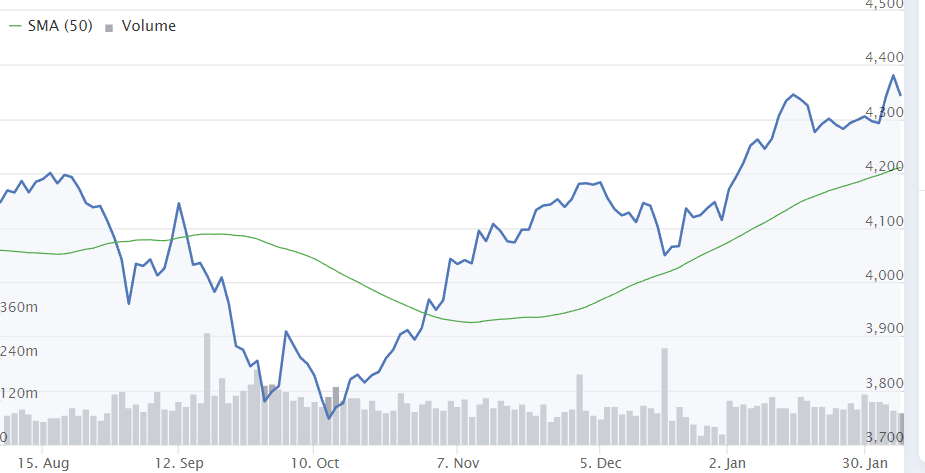
It’s interesting that markets have recovered noticeably from their lows, but this has not yet translated into the sort of dealmaking which the smaller investment banks rely on.
For example, here’s the FTSE-350 over the past six months:
And the AIM Index over six months:
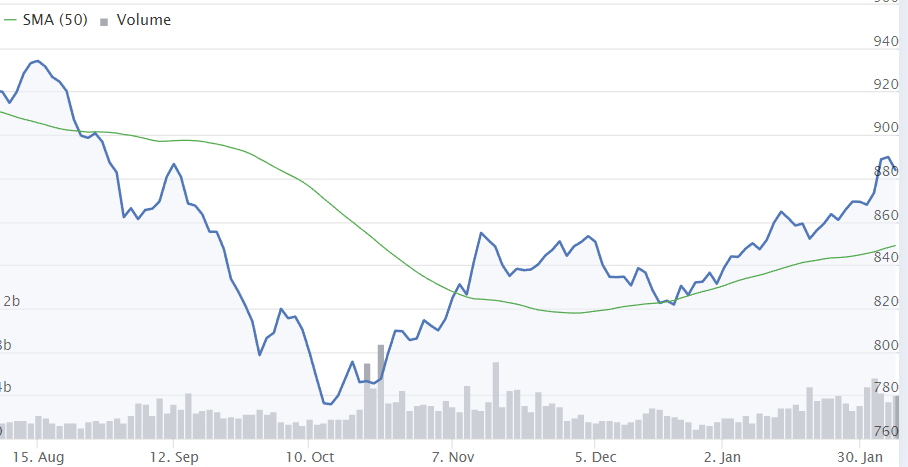
Things are even better in big-cap land. The FTSE-100 made a fresh all-time high a few days ago.
But despite the improved sentiment, we are not yet in an environment where companies wish to IPO en masse. A nice sign that valuations are still very much at the cheap end of the spectrum!
Let’s get back to the specific performance of Numis.
The market recovery did lead to a slight improvement in revenue, as commissions must have improved slightly:
Our equities business has delivered revenue slightly ahead of the second half run-rate of FY22, helped by the significant rally in UK small and mid-cap indices during the period and a general improvement in investor sentiment.
And strategically they are active on a number of fronts:
Focused on M&A transactions in their advisory business with a “strong” near-term pipeline.
Opened a Dublin office for EU transactions and selling to Europe.
Selectively hiring and open to “opportunities which may emerge across the industry during this period of uncertainty” (i.e. possible takeover deals?)
My view
I have little reason to change my tune on this one. I again refer to its net assets of £185m (September 2022 balance sheet) with good liquidity, including cash of £106m.
The share price has risen by 20% since I originally noted its cheapness, and it no longer passes the Ben Graham value screens. However I still see scope for further upside as earnings are currently in a trough.
Mattioli Woods (LON:MTW)
Share price: 622p (-4%)
Market cap: £318m
I restarted our coverage of this stock last month. It provides a very wide range of financial services, and describes itself as “a leading provider of wealth management and employee benefits”.
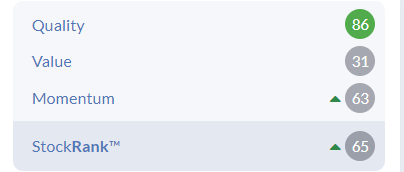
The QualityRank is still very high, at 86 (this is what originally piqued my curiosity).
Let’s see how the company has fared in the six months to November 2022. Here are the interim results highlights:
Revenues +10% to £54.9m.
Modest organic revenue growth of 2.2%.
Small decline (2%) in client assets. This includes the assets at Amati Global Investors (MTW owns 49% of Amati).
Adjusted PBT £13.5m, reported PBT £4.8m.
The impact of gloomy market conditions is further highlighted by a 4% decline in what the company calls its “discretionary” assets under management, despite enjoying small net inflows.
Outlook - in line with expectations.
CEO comment by Ian Mattioloi - describes H1 as a “resilient trading performance”.
Acquisitions - the company has made a remarkable eight acquisitions since 2021, and they seem to be performing as hoped. This has come at the cost of a greatly increased share count.
Balance sheet - £38m of cash, and no financial debt. The interim dividend increases to 8.8p per share.
My view
There are a lot of moving parts involved with this one, but I think investors can continue to take comfort, as I noted last time, from the involvement of co-founder and significant shareholder Ian Mattioli. Trusting the motives and the ability of management is a great start, when you’re trying to form a view on a complicated company!
As for the numbers, today’s adjusted PBT figure of £13.5m can be defended if you’re willing to add back the usual “exceptional” items - amortisation of intangibles, acquisition related costs, etc.
Singers have left their earnings forecasts unchanged this morning, although they do note that meeting their forecasts will require an uplift in profitability from MTW in H2. So today’s results do, in my opinion, lay the foundation for a possible miss when it comes to full-year expectations.
These expectations are for adjusted PBT of £30.8m, and then rising to £33.3m in FY 2024.
I’m going to take a neutral stance on this one. Some positive points:
Strong balance sheet.
Founder-led.
M&A strategy is working for now.
Plenty of demand for its services, regardless of the bear market.
Adjusted profit margins are good.
I can’t take an outright positive stance because very heavy M&A activity always makes me nervous: it makes a business more difficult to understand, it increases business risks, and it makes the financial statements resemble even more the subjective opinion of the company and its accountants, rather than objective facts.
I also think this company is vulnerable to profit warning later this year. And the £300m+ market cap is going to require much higher profit numbers, sooner or later.
Ebiquity (LON:EBQ)
Share price: 58p (+8%)
Market cap: £67m
This calls itself “a world leader in media investment analysis”. On their website, they say:
We harness the power of data to provide independent, fact-based advice, enabling brand owners to perfect media investment decisions and improve business outcomes.
Here’s the financial track record - not too inspiring so far:

Today’s trading update for the full-year 2022 is in line with expectations.
Revenue growth was 20% (total) and 9% (organic). It sounds like the company has made real progress:
Profitability has improved significantly from the prior year with the underlying operating margin expected to be 12%, four percentage points higher than in 2021. This reflects the contribution of recent acquisitions and improved operating efficiencies, as well as the continuing strong growth of our higher margin digital media solutions business.
One of its recent acquisitions has performed better than expected, and this is likely to result in a higher earn-out payment (no bad thing).
Net debt improves to £8.9m. It was £12.9m the last time I checked.
The CEO comment is positive, referring to momentum and progress against their strategic plan.
My view
This stock wouldn’t suit my investment style (I think it’s a consultancy business, at the end of the day), but I won’t take a bearish stance on it because it does appear to be building up a head of steam.
Analysts at Edison are looking for the company to generate an adjusted PBT of £11.5m in FY December 2023. The adjustments will be significant but the cash flow flowing from that performance could be decent, reducing the debt load.
Disclaimer
This is not financial advice. Our content is intended to be used and must be used for information and education purposes only. Please read our disclaimer and terms and conditions to understand our obligations.

44 comments
Paul, You wrote about your portfolio last week sometime. I now cannot find it. Can you send me the date please
It was last Fridays report.
Does anyone know if the stockopedia team are onto fixing the News viewing page. It's virtually unusable, I have to go out of the stocko ecosphere to read them properly.
Raleigh you beat me to it!
Last week, Eagle Eye Solutions (LON:EYE) held an investor event for analysts, to explain the Untied Nots November acquisition, and introduce the management. (It was the reason for the £7m placing). It is worth watching for EYE followers/holders.
I thought Untied Nots sounds impressive, they have grown from nothing in 2016 (and through Covid) and are now supplying all the major French supermarkets, where they gained traction very quickly. They gamify coupons/incentives. Although they didn't give an example of how this works in practice. I think, they take your average spend on a brand (from your data) and try to get you to spend a little bit more for the return of a cash saving.
ShoreCap have a January 2023 note covering Untied Nots (on Research Tree), with updated forecasts, which is comprehensive. At a revenue level, the acquisition has increased EYE full-year revenue estimates by £2.3m, £5.8m and £7.7m in FY23F, FY24F and FY25F respectively.
Here's the video and podcast.
Thanks Tasmin. I love PI World. Really fab. I was on the Untie Nots website earlier. It’s impressive stuff and the two CEO’s look the biz.
Tamzin. I once misspelled typo. Tpyo.
At the weekend i was just looking at Paul & Grahams green thumbs up spreadsheet. As of the weekend there were 77 companies given the thumbs up, there may be a couple of companies duplicated were there has been more than one bit of news released. Of the 77, 48 have increased, 2 there has been no change and 27 have decreased.
I have included the below which lists the top 5 increases and 5 decreases.
Just thought I would post in case it's of interest to anyone.
If only I could get £167.68 for my W7L holding!!! 1/100
Oooppsss! Thanks GTrader. Hope this one is ok now!
Listening to the PI World podcast for Eagle Eye Solutions (LON:EYE) . It’s very interesting. Is the share fully priced for now though?
If there is time, is it worth a look at Alumasc? In 2021 there was an interesting article by Roland on it. He partly liked it, but a bit dubious about its Pension Deficit.
Alumasc has a stonking dividend, which they have slightly increased. But perhaps one should not be seduced!
I am probably being dim, but I find it hard to work out for myself (from the stocko pages) whether a company's pension deficit is a real danger that should strongly be taken into account. I fear that too often I ignore this important metric.
hi nettle
The important figure is not the balance sheet figure for pension deficit/surplus as this is just the annual accounting figure. You should look at the latest tri-annual actuarial review in the Annual Report.
Not only does this provide the actuarial deficit/surplus but you will also find the agreed annual contribution the company is commited to in order to fund any deficit. The annual contribution is an actual cash sum which bypasses the P&L account (it shows in the pension fund breakdown and cash flow). This sum effectively reduces the company's ability to fund dividends and buy backs from cash flow so is a key number.
Depending on the relative size of this annual payment it will usually depress the company's PE rating (ie the rating will be low for a reason and not because it is cheap).
Snazzy
actually both are important figures. The triennial is obviously only done every 3 years and things have changed a lot in the current period for interest rates for example. What may have been a deficit at the last actuarial report may now be a surplus. The balance sheet figure will give you a decent idea of how the pension is performing now as it is marked to market and that performance will feed into the next triennial.
So by looking at both and also considering where the company is in the 3 year cycle you can see how much FCF is absorbed now and when that might need to change. Then looking at the combination of the two will give you a gauge of whether that number is likely to go up or down for the next cycle.
You also want to consider the amount of hedging that goes on. I see too many investors look blindly at the size of a pension fund and panic about it, when actually things like inflation and interest rate risk are hedged and assets are time weighted / matched against future liabilities (ie pension scheme payouts).
In theory if a scheme is in surplus and fully hedged then the company is not on the hook for any future deficit payments as it doesn't matter what happens in the market the scheme will remain balanced and thus the size of the scheme is irrelevant. Of course it rarely happens quite that simply but you get the gist. It is one of the reasons companies can divest schemes once they reach surplus.
so basically you need to put the jigsaw together if you want to consider whether a company has a problem pension that should be discounted in the valuation or whether it really doesn't.
Thank you davidjhill, your post just satisfied my daily need to learn something new. Also can i complement you on explaining it in a way that I could understand.
hi Davidjhill
Agree with all you say.
However, I was trying to keep it as simple as possible.
The only figure that affects company cash flow in the short term is any deficit funding agreed at the triennial review. Once that is agreed the company are commited to pay the contributions no matter what happens to the accountancy valuation of the fund in between triennial valuations.
You can only find this figure by reading the detailed pension section of the Annual Report.
Snazzy
"The only figure that affects company cash flow in the short term is any deficit funding agreed at the triennial review"
IMHO if its an elephant in the room one would be stupid to pay little attention to where all the figures are trending and simply concentate on current obligations/cashflow- i would be certain the "clever money" is looking at the next revaluation and factoring that in (whether payments are likely to go up or down medium term),The fact a company has decent cashflow for the next couple of years )ie low repayments needed)( would mean didly squat to me if those payments could double or treble in a heartbeat and the clues that will happen are present!
In some respects sensible thing is to stay away from "large obligation" companies unless you are happy with the risk. I have large (for me) holding in Norcors which has large scheme and is therefore risky - i am happy with risks but i am aware things still could deteriorate badlly quickly. Just look at the comments by the ex pm (short served joke of a pm) who was blaming everyone else for not knowing that liquidity could be an issue in pension funds investments - Norcros might be adversely affected in this regard and if they have been i certainly didnt see that coming. (note they did in a recent update advise things were "ok" at the time in in that regard)
If you have any doubts simply red flag it all - plenty of companies dont have that hassle.
Pensions
David - hear your comments about the various hedges pensions funds can take out to try to match liabilities & assets. But aren't some of these akin to the LDI strategy that was in the news a bit recently?
Presumably, affordable hedges protect the fund up to a deviation of x% from the mean? So, if we get another Truss tantrum, the risk is that the fund blows through the hedge? From my past in a different financial field (reinsurance), I'd guess that buying unlimited cover would be one, or more, of : unavailable / unaffordable / uncollectable
The LDI crisis was one of liquidity not an issue with the hedge itself nor an issue of leverage. In effect the Gilts market stopped working and those wild swings created large collateral changes. The BoE stepped in to protect the market and effectively provided that liquidity backstop, which is one of the things a central bank should do when the market fails due to an extreme event.
But matching can be done in various forms. At the most simple level if I am due to retire in 10 years time and the pension scheme is due to pay me a single one off payment then it can buy a Gilt that also matures in 10 years that matches that liability. Result - zero pension deficit. Doesn't matter what happens to interest rates or inflation or Gilts during those 10 years - I hold to maturity and settle my liability. My only risk is that the UK Govt defaults and if I really want to I can buy a credit default swap very cheaply to hedge against that unlikely risk.
We've just seen one of the worst types of liquidity crisis in bonds and the markets survived and so did the pension funds because there are mechanisms in place to deal with it, even if they do create headlines!
The point being that if you want to consider whether a pension scheme represents a real risk to a company you need to look at several factors that might include actuarial deficit, current mark to market and hedging strategy and combine that with current funding requirements agreed with trustees and whether those are likely to change, and if so, when.
Anecdotally, despite having been through a financial crisis, plague, war, inflation, liquidity crisis, recession and political turmoil in the last 15 years how many companies have actually been brought down by their pension scheme? very very few and that's because they are largely well run and don't create massive cash drains. Most instances of pension scheme failures (Arcadia for example) are bad failing businesses that go bust on their own rather than due to the pension scheme demands.
"Anecdotally, despite having been through a financial crisis, plague, war, inflation, liquidity crisis, recession and political turmoil in the last 15 years how many companies have actually been brought down by their pension scheme? very very few and that's because they are largely well run and don't create massive cash drains."
A pension company doesnt need to bring down a company to destroy shareholder value - simply look at reach and de la rue for examples of where shareprice has gone nowhere and the realities is the pension issues are beinga very active drag on those companies - slightest bit of bad news and effectively the "pension creditor" effectively can control what hte company does. As ever the lack of any issues does also not mean that there wont be soemthig that goes wrong unexepectedly in the future too.
Hi rmillaree,
I couldn’t agree with you more on this one.
I can name at least another 20 companies that they are just trading in order to service these outrageous old defined pension schemes.
I think a careful study of the defined pension schemes will help people understand what exactly happened with the LDI crisis and the reasons these schemes had to hedge and leverage ( due to the low return of gilts and bonds in general ).
Thanks
Did I read that correctly?
The LDI crisis was not an issue with the hedge itself nor an issue of leverage?
I will appreciate if Paul or Graham can explain what happened with the LDI crisis and the reasons why many of the pension schemes have to be hedged and leveraged in order to be able to pay the pensioners what they are supposed to pay them.
I think a closer review will show it was an issue with leverage. Otherwise there would have been no margin calls, and no problems.
haha - you're kidding right? You understand how hedges work in the financial markets?
Hi galois
I will try to explain this as simple as possible as it was down to over leverage.
The regulator makes it compulsory for the pension funds to invest in gilts. But for so many years the return was minimal and they had to use swaps in order to get a floating rate against the fixed coupon. In many instances they did actually repo out the gilts as well in order to buy shares that paid a decent dividend. And the mess became bigger and bigger as the rates were rising and margin calls started to emerge and the only liquid asset they could easily sell was , of course , equities.
Thanks
A great many thanks to you, and to the others, who have taken such trouble. It has been very educative for me. And this is an example of why the Small Caps report is so useful, and even enjoyable.
I just wonder if any of you think that Stocko could produce somewhere one simple metric showing the size of the Pension Fund Deficit. I have learnt from you all that, to judge the serious aspects, there are many important issues of the deficit that need looking into. That the ramifications aren't simple: it is no good just looking at size.
But perhaps it would just be a useful Heads Up to be alerted in some way if there is a big deficit. After all many companies don't have one. And if one could easily see there was a bit deficit, then this is a useful warning to do the further research that you describe. But one wouldn't have to unnecessarily burrow into company accounts.
Very pleased that my head has not yet been bitten off. But I may take valium just in case.
Alumasc (LON:ALU) I hold - re the pension deficit, the paragraph below is from the FY 22 results published 6/9/22, showing both the amount of deficit and company contributions reducing by roughly half
Pension scheme
The defined benefit pension scheme deficit has further reduced in the year from GBP4.6 million to GBP2.1 million. I would like to thank both our Management Team and the Pension Scheme Trustees for the collaborative approach they have adopted to make further inroads to the deficit for the benefit of Scheme Members, through a combination of Company pension contributions, sensible asset investment decisions and the impact of gilt yields on liability calculations. Agreement has also been reached with the Trustees to reduce the Company's pension contributions to GBP1.2 million pa (previously GBP2.3 million) until the next triennial valuation in 2025, in recognition of the reduced scheme deficit.
Alliance family buys another 1 million shares in £BWNG. If they were to take it private then they'd have to offer minimum 41.75p now I think.
Ashley has spoilt the prospect of a low ball offer imo.
Smartspace Software (LON:SMRT)
Well I hadn't thought I'd be saying this but I think these guys are now starting to look quite cheap at £14m market cap.
SwipedOn will hit full year profitability and group as a whole has just gone cashflow positive. SwipedOn growth of 29% for ARR of £5m with group ARR at £5.8m (SpaceConnect looks like it is also now starting to move ahead again and A+K growing revenues)
Net Cash of £1.6m
Sum of parts they could probably sell SwipedOn at £25m+ (5* ARR - market was more like 10* twelve months ago) so group is maybe worth £30m+ at the moment or twice the current market cap.
hmmmm
Liberum view on UK housebuilders:
https://www.sharecast.com/amp/...
"It also continues to favour Gleeson as its Home business will soon grow much more quickly than peers, given the underserved market in which it operates, and as its growth is much less capital-absorptive than peers."
MJ GLEESON (LON:GLE) very close to 200d SMA
A quick thought/question on Numis (LON:NUM) . I believe that certain regulated financial services firms are required to maintain minimum levels of capital. (That definitely applies e.g. to insurers). Does it apply to Numis?
If so though it is worth checking how much above regulatory minimum the company holds, since any falling to that level would trigger an urgent capital raise.
I have held onto an investment in Numis (LON:NUM) for years, its Momentum has always promised but never delivered. Growth is out of the question. Fine for PI's bottom-fishing though as it will always be there.
I am of the view that the UK IPO market has been seriously damaged by some of the disastrous, opportunistic launches post pandemic - add to that all the economic/political uncertainty post Brexit and can't see any recovery anytime soon so am staying clear of the investment banks for now.
I don't think that's the case Bouden - at least over the medium term. The IPO market builds and crashes over time - it's cyclical really. Having now crashed the next IPOs will be better quality and much cheaper as they will need to be to encourage investors to part with cash. That will lead to some restoration of confidence and then it will build in layers again until greed gets the better of everyone and investors overpay for low quality.
Over the last 25 years we saw the same wave crescendo in the Dot com era around 2000, then in 2008 from commodity stocks and tech/online in 2022. Cycle from what I can see going back is roughly 10 years from trough to peak.
But I'd agree we are at the low-end now so no real incentive to buy those exposed to IPOs yet. Things will be lean for a while on generating fees from that.
Investors however, might want to pay more attention to any new IPOs as I suspect they will now be much more favourably priced. The trick of course is to participate when the cycle is at the lows and leave it well alone as it nudges ever higher.
Realise they are just above small cap territory, but worth thinking if there is read across of impact of cyber attacks to others. First Morgan Advanced Materials (LON:MGAM) (although I remember thinking the market seemed a bit sleepy when the cyber attack was first announced in January), then Vesuvius (LON:VSVS) yesterday (market bit more responsive). Could be coincidence but seems to be an attack on the technical material sector for some reason (maybe someone is looking for the IP on the cheap, or maybe just be disruptive). I guess it can happen to anyone, but it does also suggest these big old industrials may not have been investing enough in their IT. Can only lead to higher opex costs, higher capex to put up better defences I think.
Expect 'stealthy' balloon materials to be on the target list.
Arix Bioscience (LON:ARIX) Reported late yesterday that the chairman had spend £200k+ on share purchases.
Given the pervading economic gloom the trading update from Sanderson Design (LON:SDG) is in my view pleasing. The company's inherent value is in its irreplaceable archive, mainly Arthur Sanderson and Morris and Co.
Lisa Montagu and her team have done an excellent job in reinvigorating the company's brands. Also there is much to like in Sanderson Design (LON:SDG) vertical integration, negating dependence on third parties.
Regarding plantx comment, Yes, no would necessarily want to operate a wallpaper manufacturer in isolation, but as part of an integrated operation, that I would suggest is a different matter.
Interesting to see that Baron Michael Anthony Ashcroft has declared a stake of over 7% in Brave Bison (LON:BBSN) this morning.
My morning smallcap tweet: Easy jogs or hard slogs
Water Intelligence (LON:WATR) Smartspace Software (LON:SMRT) Live (LON:LVCG) E-Therapeutics (LON:ETX) Numis (LON:NUM) Zinc Media (LON:ZIN) Sanderson Design (LON:SDG) IXICO (LON:IXI) Tanfield (LON:TAN) Northcoders (LON:CODE) React (LON:REAT), Frenkel Topping (LON:FEN), East Imperial (LON:EISB), Ebiquity (LON:EBQ), Anexo (LON:ANX), Alumasc (LON:ALU)
◄Water Intelligence (WATR)► guides FY-Dec rev up 31%, adj pretax up 12%. In line? Buys out Nashville franchise. [SP=580 Cap=114m]
◄SmartSpace Software (SMRT)► guides FY-Jan rev up 36% in line. LBITDA better than market expectations. "We have had more churn than we would have liked from our Space Connect base. As the Covid-related regulatory pressure eased last year, these churns came up at annual renewal. However, more positively, new customers are purchasing our solutions to implement their space optimisation policies." [SP=42 Cap=12m]
◄Live Company (LVCG)► 50/50 JV in Japan. [SP=1.9 Cap=5m]
◄e-therapeutics (ETX)► four new patent applications on novel target innovation and new short interfering RNA chemistries. [SP=17.2 Cap=100m]
◄Numis (NUM)► AGM stmt: last 4 months rev flat as difficult market conditions persist. [SP=220.16 Cap=242m]
◄Zinc Media (ZIN)► guides FY22 rev and adj EBITDA ahead of market expectations. FY23 bookings £15m (£9m). [SP=82.25 Cap=18m]
◄Sanderson Design (SDG)► guides FY-Jan rev flat. Underlying profit in line with mgmt exp. [SP=130 Cap=93m]
◄IXICO (IXI)► guides FY-Sept 23 rev in line. Now expects to achieve double digit rev growth in FY24. [SP=25 Cap=12m]
◄Tanfield (TAN)► timetable for the US Proceedings in Snorkel dispute delayed to early 2024. [SP=2.56 Cap=4m]
◄Northcoders (CODE)► to buy Tech Returners, a leading UK technology re-training business, for £1.576m in cash and shares. [SP=300.2 Cap=23m]
◄REACT (REAT)► FY-Sept. Positive outlook. [SP=1.19 Cap=13m]
In line: FEN, EISB, EBQ, ANX, ALU
SDG
6.4 million license royalty for Morris co is very significant .
Any company making clean profit out of licensing deals is in a good position, this L will lift overall group margin .
I think Lisa Montague has this one figured out, the manufacturing operation should tick along but grow the licensing royalty is the key here .
Do that by keep plugging away at Morris co history and heritage .
Once that licensing revenue hits 10 million plus I think SDG will get bought (probably by a gulf state backed fund).
No really wants to own and run a manufacturing plant that makes wallpaper, but a brand capable of generating 10 million a year in royalty income for a historic brand is a prized asset.
Sanderson Design (LON:SDG)
Licence income needs to be sustainable and can be inherently lumpy , so it’s very much a double edged sword unless the company reassures us that future license income will be robust and sustainable. Today they have said didly squat about the new years expectations which is a shame.
overall figure are solid though bearing in mind they were up against tough comparatives and issues with inflation etc.
That’s why a few years of upward trend license royalty is key, remember a good license agreement will have minimums and time scales .
A licensor will not want a 1 year contract .
I know a company that ended up with global license deals all on long contracts with minimum royalty payments , at this stage it becomes a simple multiple of earnings calculation .
So heading in the right direction for me and I think the 10 million is a tipping point number
Agree, and as yet there’s no indication IMO that licensing revenue growth is sustainable. It grew 40% last FY but has reduced to +23%. Also it was £6.5m in 2019 and forecast to be £6.4m for last FY. So clearly can be very lumpy (H&M agreement for one) and they provide zero indication of their potential income from the likes of Ruggable and Disney (whose income won’t even be included in the current FY).
A relatively neutral trading update from Sanderson Design (LON:SDG) - strong growth from Morris and Co and in North America offset by withdrawal from Russia.