Small Cap Value Report (Tue 8 Dec 2020) - REDD, JOUL, BEG, GMR, ZYT, PRV, IDEA

Good morning, it's Paul here with the SCVR for Tuesday. Many thanks to Jack for covering yesterday.
Timing - I should have the whole day free to concentrate on this. Update at 12:31 - I've spent most of the morning on Redde (I hold) because I think it looks excellent on a risk:reward basis. So that's the best use of my time. This afternoon I'll be focused on shorter sections for lots more companies. Likely finish time is about 6pm. Update at 20:06 - I'm still plugging away, should be done when it's done. Update at 21:57 - I got there in the end! Today's report is now finished.
.
Agenda
Redde Northgate (LON:REDD) (I hold) - Interim results & my notes from the analyst call (done)
Joules (LON:JOUL) - Trading update (done)
Begbies Traynor (LON:BEG) - Half year results (done)
Gaming Realms (LON:GMR) - Trading update (done)
Zytronic (LON:ZYT) - Final results (done)
Porvair (LON:PRV) - Trading update (done)
Ideagen (LON:IDEA) - placing at 215p (done)
Anything else that there’s time for, and looks interesting.
.
Redde Northgate (LON:REDD)
Share price: 252p (up 2% today, at 08:17)
No. shares: 246.1m
Market cap: £620.2m
(I hold)
Redde's market cap is now above my usual upper limit of c.£400m, but I like the share (and hold personally), so I would be analysing the figures anyway for myself. So might as well share my work here too. Also an arbitrary upper limit on market caps is crazy really - because it means that we stop covering the winners, and carry on reporting on the also-rans!
Several readers nagged me to look at this group - a combination (all-share merger Feb 2020) of accident management (courtesy cars, etc) group Redde, and Northgate - a white van hire company. Here are my notes from 29 Oct 2020, which are worth re-reading, to set the scene. I felt the share represented an excellent investment proposition at 178p per share (on a PER of only 6.5!), and added some to my own portfolio afterwards, when funds permitted (I tend to be fully invested most of the time). The share price is up nearly 40% since then, although so have lots of other cyclical companies, triggered by the positive news on covid vaccines, so we mustn't run away with the idea that we're genius stock-pickers, when we could have picked anything cyclical and seen a similar rise in the same timeframe.
Today’s interim figures are for the 6 months ended 31 Oct 2020 - the first thing to note is that prior year comparatives are not comparable, as they pre-date the merger in Feb 2020. Also of course this is a period heavily affected by covid.
“Encouraging momentum” - Northgate performed ahead of expectations, recovering to slightly above pre-covid levels. Strong residual values & disposal profits
Redde seeing a slower recovery - impacted by lockdowns - as previously advised, so no surprise here
Cost savings from merger achieved of £15.9m p.a. - ahead of plan
Outlook - remains confident in meeting market expectations for FY 04/2021 - excellent, that’s the main thing I want to know when any company reports on trading, despite possible disruption from further lockdowns
Interim dividend declared of 3.4p. Stockopedia shows full year divis forecast at 13.9p, a yield of a very healthy 5.6% - in a low interest rates environment, that makes this share very attractive I think, and could drive continued share price increases perhaps?
Underlying EPS of 13.4p (down 24.1%) looks in line with full year broker consensus of 27.3p
Note that FY 04/2021 is a heavily disrupted year, so we should realistically expect increased earnings next year. Broker consensus is 36.1p for next year, which would drop the PER to only 6.8 - which looks far too cheap, to me. That's the type of rating I'd expect to see in a structurally declining business, which is not the case here. So it's the wrong rating in my view - irrationally low.
Borrowing facilities - plenty of headroom, and look how cheap these borrowings are!

.
Balance Sheet - looks fine to me. NAV: £882.1m, less intangibles of £296.2m = NTAV £585.9m - a similar figure to the mkt cap of £608m. There's a lot of debt, but the value of the vehicle fleet is very much larger than the debt, so not a problem. That's evidenced by how cheap the borrowings are - i.e. lenders don't see this as risky lending, hence it's cheap.
My opinion - I haven’t read through all the detailed commentary yet, but have the key facts & figures I need - i.e. in line with FY 04/2021 expectations, which means the PER is only about 9 - why so low, that doesn’t make sense to me.
This share seems fundamentally under-priced, especially versus next year’s forecasts, which the market will soon be focusing on for valuation purposes. I really cannot see any valid reason why this share is below 400-500p per share, which seems a reasonable (not even expensive) valuation range of about 11-14 times next years earnings. That seems a sensible price target to me.
Therefore, at the current price of about 245p, this share just looks the wrong price to me. It looks a bargain, despite the recent c.40% share price rise. Plus we’re paid generous divis whilst we wait for it to continue re-rating.
This share looks one of the best value shares I’ve seen in a while. Thanks again to readers who persuaded me to look into it. The white van hire business should continue doing well, because so much retail is now moving online, requiring an army of vans & drivers to deliver everything. The accident management business should recover next year once covid lockdowns are finished. Therefore common sense tells me that it's realistic to expect earnings to recover next year.
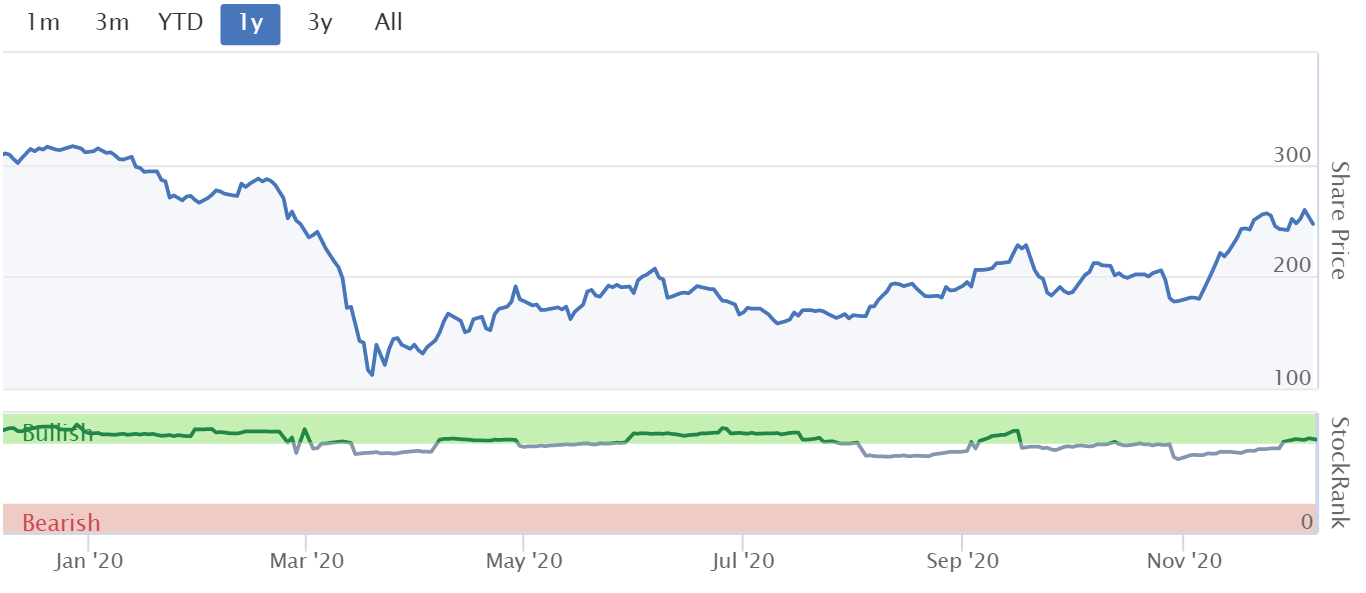
Note the consistently high StockRank too, which reassures me.
.
.
EDIT: Analysts call - I’ve been listening in to this. It mostly reiterates what’s in the results statement. Here are my notes of key points from the call;
- Residual values of vehicles - sold excess stock of vehicles into rising demand/prices. Under-supply supporting residual values. Reckoned to be 20% under-supply of new vehicles this year, and forecast 8% next year (not sure if this is cars or vans, or both?). Remember that right-hand drive vehicles for the UK are bespoke production for European manufacturers.
- Good recovery potential from Nationwide Accident Repair, recent acquisition
- Cost synergies excellent at £19.2m from merger
- Early take-up is good from offering Redde services to Northgate customers
- Better margins, due to cost cuts
- Example of cost control - all done digitally now, everything over £1k (apart from usual consumables) is subject to Board approval. Fantastic way to avoid over-spend
- Lockdowns impact - significant potential once things return to near-normal
- Net Promoter Scores routinely over 70. Good TrustPilot scores. Happy staff & customers creates a good business
- Large new orders being tendered for, sound optimistic about these
- Structural & permanent favourable changes in van market - many fleets that historically bought vehicles, are now switching to leasing
- New lending lines for leasing vehicles, at comparable cost to buying. Coy about size, just said “tens of millions”
- Market expectations - as in RNS, confident of meeting them. That’s based on current run rate. So could be upside, if lockdown restrictions eased this FY. So it sounds to me like likely to meet or beat FY 04/2021 forecasts, rather than just meet
- Vans - now offering a package of services, not just rental of the van itself. Proving popular, strong demand, not seeing margin pressure from competitors
Presentation slides from today's analyst call are available here on Redde's website, worth a look for a nice clear explanation of the main points.
Overall, I think the tone of the call was positive, and management sound down-to-earth, hands-on managers, which is what I like.
I asked the PR company to consider doing a webinar for everyone on future results days, not just for analysts. They said they’ll consider that next time, so let’s hope they go ahead, as there are a lot of private investors interested in this company, so it would be a positive step for the company to engage more with its small army of PIs!
End of edit.
.
Joules (LON:JOUL)
Share price: 162p (down 3%, at 10:23)
No. shares: 108.4m
Market cap: £175.6m
Joules, the premium British lifestyle brand, is pleased to provide a Pre-Close Trading Update in respect of the 26-week period ended 29 November 2020 (the first half of the Group's financial year ending 31 May 2021 or the "Period").
Continued strong e-commerce growth reflecting the strength of the Joules brand and its growing customer base
As I’ve mentioned here many times before, the attraction of Joules over other retailers are twofold;
- Very distinctive brand, customer loyalty, with differentiated (hence high margin) products, and
- High level of internet sales, at c.50% of total retail sales before covid, and even higher now
It’s very clear now, that the brands which are failing, are nearly always the ones that were too slow to embrace eCommerce, and/or failed to crack digital marketing. Probably the only exception I can think of is Primark, which doesn’t sell online, but still attracts large footfall into town centres. Other shops should probably pay Primark a fee, as a thank you for attracting so much footfall into their areas!
Brands that are prospering, or at least not under any threat of insolvency seem to be ones which have a high proportion of internet sales. Next (LON:NXT) springs to mind there. Even stodgy old Marks And Spencer (LON:MKS) (I hold) is making strenuous efforts to increase its online offering, aiming for c.40% in a couple of years’ time.
Back to Joules, and today’s update looks good -
The positive trading trends reported in the Group's update on 5 November 2020 have persisted through the important Black Friday trading period and into the Christmas trading period so far, with sales for the Period remaining ahead of the Board's initial expectations.
E-commerce sales are very good, although bear in mind the period in question would have caught lockdown in November, and lower footfall at other times prior to that. Therefore eCommerce sales would naturally rise as a % of the total from these factors.
- H1 revenues down 15.3% Y-on-Y, is really good in the circumstances, I think.
- Total store trading hours (a useful stat) down 40% of typical trading time
- Like-for-like stores sales down 17% on LY, again very good I think, and ahead of expectations
- Retail gross margin down 300bps in H1 - that’s fine, because retailers must have had nightmares managing intake & inventories, so more discounting is bound to happen. Dropping just 300bps again is impressive in the circumstances I feel
- Wholesale revenue down 44% - I think this reinforces how well Joules has done with its own store sales (and online), very much better than wholesale customers have done. I worry about the bad debt risk from wholesales, it would be good to know what credit control procedures Joules adopts (e.g. insuring its receivables book?). If any of you speak to management, that is a good question to ask for any business doing fashion wholesale.
Liquidity - ample -
The Group's balance sheet remains strong with net cash of £15.6 million and liquidity headroom of £64 million.
Guidance - very impressive that the company has remained profitable, albeit with temporary relief from business rates, and possibly some benefit from furlough. I feel the company should have disclosed the extent of these benefits, to give us the full picture -
As a result of the Group's encouraging trading, the Board anticipates reporting PBT (IFRS16 basis, pre-exceptional items) for the Period of between £3.5 million to £4.0 million. Notwithstanding the significant uncertainties that are anticipated to persist over the remainder of the peak trading period and into the next calendar year, the Board remains confident that the Group will achieve its Full Year expectations.
Outlook sounds confident -
Nick Jones, CEO of Joules, commented:
"The strength of our digital proposition, the increased number of Joules customers and the growing appeal of the brand has meant that Joules has continued to trade well during the Period, despite the impact of enforced store closures.
"We delivered a good Black Friday trading period through our online channel and our Friends of Joules digital marketplace continues to perform ahead of our expectations. We have strong momentum - particularly through our online channel - and a good stock position that underpins our confidence for the peak Christmas trading period. We have been pleased with the performance of our stores in England for the first few days since their re-opening in early December.
"As anticipated, our wholesale sales have been subdued in the first half, however an improved performance over recent weeks and the positive response to our spring/summer 21 ranges, that were sold-in via our digital B2B sales platform, gives us confidence for the recovery of the wholesale channel over the coming seasons.
"The retail sector continues to face a number of near and medium-term challenges, including the ongoing impact of Covid-19 on our communities and economy as well as Brexit-related uncertainties. I have no doubt that Joules, underpinned by the strength of our brand and our flexible and scalable platform that now includes our Friends of Joules digital marketplace, is well positioned to be one of the long-term winners against this challenging backdrop.
My opinion - I’ve been really impressed with how Joules has coped with this chaotic covid/lockdown year. This has been reflected in a very strong share price recovery.
How to value it, that’s the really difficult question? Here are 3 options, take your pick!
- Value JOUL on a multiple of (greatly reduced, and probably too pessimistic) earnings forecasts. So 162p share price, divided by 3.6p FY 05/2021, and 6.7p FY 05/2022 forecasts (I’m using the latest forecasts from Liberum, in its update note today, rather than consensus numbers). That gives a valuation of a PER of 45, and 24.2 - expensive, but I would expect the PER to be high, when based on abnormally bad years.
- Assume a full recovery back to pre-covid actual/forecast earnings, which suggests EPS of maybe 20p is achievable, giving a PER of just 8.1 - attractive value.
- The most bullish scenario - treat Joules as a growing online business, with a few shops (called “showrooming”, I am told!), although with its own lifestyle portal called Friends of Joules, with exponential growth potential, therefore value the shares at a multiple of future sales (i.e. ignore earnings).
Personally, I can’t make up my mind. The recent surge in share price looks justified, but someone else has benefitted from that, and I can’t bring myself to pay top whack for it so soon after this surge - illogical maybe, but there we go -
.

.
As Liberum points out, the share price is now still well below its former highs, despite the business having made great strides in developing its eCommerce side of the business.
I think this share is a good one to consider buying on any market panic which might occur if no-deal Brexit spooks people, if it happens, who knows?
.
Begbies Traynor (LON:BEG)
Share price: 89p (down 3% at 14:35)
No. shares: 127.9m
Market cap: £113.8m
Begbies Traynor Group plc (the 'company' or the 'group'), the business recovery, financial advisory and property services consultancy, today announces its half year results for the six months ended 31 October 2020.
The share price hasn’t moved much today, which suggests there’s probably little changed since Begbies issued a recent H1 trading update, which I covered here on 18 Nov 2020.
H1 revenue up nearly 11% to £37.5m
- Adj PBT up 25% (as guided previously) to £5.0m
- Adj EPS up 19% to 3.1p
- Interim divi of 1.0p (up 11%)
- Net cash £0.7m (as guided previously)
Adjustments relate to acquisitions, £1.5m amortisation of goodwill, which is fine to ignore. Although the £3.1m of transaction costs for acquisitions also adjusted out, seems rather a lot.
Current trading & outlook - this looks very similar to the last trading update, so no surprises -
· Business recovery and financial advisory strongly positioned:
o increased order book of committed future insolvency revenue
o increase in market insolvency levels expected once short-term support measures for the economy are removed
· Property advisory and transactional services continue to recover:
o anticipate will maintain current levels of performance in spite of the challenging environment
· Results for the full year expected to be at least in line with current market consensus*, which would represent a further year of growth
· A Q3 trading update will be issued in March 2021
* Market consensus for adjusted PBT of £9.8m (as compiled by the group)
Balance sheet - is unusual because of the nature of this sector - running up a lot of costs, which are eventually paid longer term when an insolvency case is closed. Although stage payments are often negotiated along the way. BEG seems to be effectively balancing up receivables and payables, such that overall the balance sheet seems reasonable.
NAV: £62.0m, less intangibles of £58.3m, leaves NTAV of only £3.7m. Although of late, I’m deducing deferred taxation creditor too, because this usually seems to relate to intangible assets. That improves the NTAV to £9.4m - adequate, but that is very little asset backing for a £114m mkt cap company - so you’re buying earnings here, not assets.
See note 8, taxes & social security creditor has gone up from £2.6m a year ago, to £6.0m this time, implying creditor stretch - using time to pay schemes from HMRC I imagine. That means cash is likely to be temporarily flattered. Something to bear in mind, but not a major problem given that BEG has plenty of headroom on its bank facilities.
I’d like more clarity on the “Deemed remuneration” receivables, which I think might be connected with partner incomes, or acquisitions? Or both. I’m not saying there’s anything wrong, just that I’d like to understand it better.
Valuation - I can’t find any broker notes unfortunately. The broker consensus figures we have on Stockopedia show net profit (after tax) of £7.84m for FY 04/2021. That looks consistent with the company saying profit before tax of £9.8m, i.e. a tax rate of 20% - near enough to the actual rate. So that means we should be able to rely on the 5.95 EPS forecast shown on Stocopedia (it’s always good to sense check figures for small caps, because just one old forecast could skew the consensus badly).
At 89p per share, divided by 5.95p forecast, then we have a PER of 15.0 times, dropping to 11.3 times if BEG meets FY 04/2022 forecasts.
My opinion - the valuation looks about right to me. Interim results are in line with guidance, and the outlook comments seem positive.
As mentioned before here, I think this share is a nice hedge, if you think the UK economy is going to tank next year. Even if you’re wrong, the downside looks quite limited. It pays divis along the way, whilst you wait.
Quite good overall then, in my opinion.
.
Gaming Realms (LON:GMR)
Share price: 19.65p (down c.5% today, at market close)
No. shares: 286.0m
Market cap: £56.2m
Gaming Realms plc, the technology led developer and licensor of mobile focused gaming content, today issues a trading statement ahead of its 31 December 2020 year end ("the Period").
Today it says -
Since updating the market on 8 September 2020 when publishing its interim results [Paul: see my notes here], the Company is pleased to report that business performance and sales momentum has continued the trend demonstrated throughout the first 8 months of this year.
Revenues for the Period are expected to be £10.7m, 55% ahead of 2019. As a result of this increase in revenue, the Company expects adjusted EBITDA of not less than £2.75m for the year ended 31 December 2020.
Stockopedia is showing broker consensus of £10.8m revenues for FY 12/2020, so that looks almost in line.
Adj EBITDA of £2.75m compares with £1.24m in H1, so that implies an increase to c.£1.51m in H2 - good, but not stellar.
Capitalised development spending was £1.1m in H1, double for the full year to £2.2m, and that’s using up most of the £2.75m adj EBITDA. So in the real world, this business is only just above cashflow breakeven.
Therefore a £56m market cap is factoring in a lot of further growth.
On the upside, it does have some big name clients, and is expanding nicely in the USA. The market cap largely rests on this upside potential, as it wouldn’t be worth anywhere near £56m based on the numbers published today.
This strong performance is due to the expansion of our partners internationally, the release of new "Slingo" games, and improvements to the Group's technology. In the second half of the Period, we have gone live with 5 new partners, including PaddyPower Betfair in Europe, and launched 4 new "Slingo" games including Slingo Fluffy Favourites.
The Company has applied for licenses in Pennsylvania and Michigan in the US and hopes to launch in these states during the first half of 2021.
The Company is confident of achieving further progress during 2021 and will provide further updates on its progress in due course.
My opinion - I’m intrigued by this company. There does seem to be something interesting here, in terms of products, contract wins, international expansion, big end markets, etc. Therefore, I think it could be worth readers investigating it in more detail, perhaps?
A key question to find out about, is how recurring or repeatable are the revenues? It mostly comes from licensing - are those one-offs, or SaaS type recurring revenues? The word recurring doesn’t appear in today’s update, so my hunch is that revenues might be one-off licence wins, because if they were recurring, the company probably would have emphasised that in this update.
Overall, I would need more precise details about the business model to get me interested further. At the moment it looks too expensive for me.
Also as mentioned in my last quick review of the company, its balance sheet looks stretched, and it needs to raise some fresh equity in my view.
A wild card is that it might become a takeover target, for one of its USA customers, possibly?
.
Zytronic (LON:ZYT)
Share price: 135p (down c.7% today, at market close)
No. shares: 16.0m
Market cap: £21.6m
I see from today’s reader comments (always a joy), that I practically had a mutiny on my hands earlier, because I gave priority to more important, more liquid stocks. So just to keep everyone happy, here’s a comment on nanocap bespoke touch screen manufacturer, Zytronic.
Zytronic plc, a leading specialist manufacturer of touch sensors, announces its audited full year results for the period ended 30 September 2020.
Zytronic gave us flash numbers for FY 09/2020 in a trading update, which I reported on here on 21 Oct 2020.
Revenue of £12.7m is as guided (down 37% on LY)
Gross margin also well down, at 20.1% (LY: 33.7%)
Despite this, it only generated a modest loss of £0.4m (LY: £3.1m) - clearly a poor result, but a modest loss in a one-off (hopefully) disrupted year, isn’t the end of the world. Note that a furlough claim helped boost profits by £0.5m (see note 5 - exceptional items)
No divi - strange given the balance sheet is groaning with cash
Net cash of £14.0m, or 65% of the market cap - so you’re really buying a pile of cash, with a business thrown in for half as much as the cash pile - which has to raise questions about what needs to be done. It sounds as if institutions might have been putting pressure on the company behind the scenes, as this is a shift in attitude (I've been telling them this for literally years) -
The Board considers that a large proportion of these cash balances are surplus to current requirements, and it may be appropriate to distribute this surplus cash by a share buy back, and will seek shareholder approval for the requisite authorities at the next general meeting.
It sounds like they've decided on that course of action, if shareholder approval is being sought.
Current trading - not bad, considering that the business is valued at not much above its cash pile -
Sales are still running at similar levels to the last quarter of last year, but even at these low levels, the actions we took to reduce staff levels have enabled us to improve gross margins to close to historic levels, and with reduced overheads produce a positive EBITDA.
On the order front we have experienced some increase in enquiries and activity levels which is encouraging, although we would not expect any material change until the pandemic is under control.
Outlook - I’m not sure about this. It seems to be putting more emphasis on covid than other companies. Which makes me wonder if there might be a deeper problem with demand, beyond covid? I don’t know, only company insiders really know that level of detail.
Whilst we are only two months into the financial year, we have adjusted our operations to the lower levels of demand as it is likely to take several months for the Coronavirus vaccines to allow a return to more normal living and then further time for our customers to operate fully and sales to return.
My main concern with Zytronic, is that it has previously said that some big projects were end of life. Therefore, reliable repeat orders which proved lucrative in the past, could be gone for good maybe?
Balance sheet - the current ratio is almost off the scale good, at 11.6 - bear in mind that I normally see anything over 1.5 as strong!
I’d say there is at least £10m in surplus cash on the balance sheet, which could safely be distributed to shareholders in one form or another. Although bear in mind that as (hopefully) revenues rise again, then that sucks in working capital. So Zytronic will need to keep back some of the cash pile to fund future working capital growth.
My opinion - if it was down to me, I’d say to institutions that are stranded by lack of liquidity, that if they want to sell up, then the company would buy them out at a 20% discount. What other options have they got?
The only problem with a share buyback to get rid of the surplus cash, is that we’re then left with an even smaller, nano market cap company, with no reason to be listed on the stock market at all. Therefore, I’m flagging de-listing risk.
If the market cap drops to say £10m, after distributing the cash via a buyback, then the upside is more nicely leveraged for people who hold on, if (and only if) the company manages to improve future trading.
Either way, I think this share looks quite a nice each way bet - underpinned by the cash pile, and something might happen in future, if trading improves.
I’ve been in contact with Zytronic management several times, over quite a few years, and always found them completely straightforward, and trustworthy. That comes across in the RNSs too - telling it how it is. Hence I have a high level of comfort that they'll do what's best for everyone involved. If you look at Director remuneration, the CEO and CFO are paid appropriately in my view. Whereas so many small companies grotesquely overpay executives. Although £81k for the Non-Exec Chairman seems steep.
For me personally, I don’t want to get involved in yet another tiny, illiquid share, unless I see it as a potential multibagger. Based on current information, it’s difficult to see ZYT multi-bagging. That said, it must be one of the safest nano caps out there, being backed two thirds by net cash, and being close to breakeven despite having just had a horrible year.
.
Porvair (LON:PRV)
Share price: 518p (down 4% today, at market close)
No. shares: 46.1m
Market cap: £238.8m
Porvair plc ("Porvair", "the Group" or "the Company"), the specialist filtration, laboratory and environmental technologies group, announces the following trading update ahead of its close period for the year ended 30 November 2020.
Let me turn the first paragraph of the RNS into bullet points, it’s just easier to read like this -
- Revenues for the year ended 30 November 2020 are expected to be 7% lower than 2019.
- Net cash at 30 November 2020 was £4.9 million (2019: £4.0 million) after capital investment of approximately £5.0 million and dividends of £2.3 million in the year.
- Adjusted operating profits are in line with management's expectations.
Generally, I’m not keen on operating profit these days, as it can be skewed by IFRS 16 effects.
Current trading - this all looks self-explanatory, if almost completely lacking in specific detail! -
As previously announced the Group's aerospace, molten metal and most industrial order books had reduced sharply through the middle of the year. Costs were adjusted and the Group will charge exceptional restructuring costs of around £2.0 million in the second half.
Since July order books have been building steadily from a lower base. The Group was consistently profitable and cash generative in the second half, and showed sequential growth between the third and fourth quarters. The economic outlook for aerospace and some industrial segments remains uncertain but orders for the first quarter of 2021 in the Laboratory division are strong. Investment in productivity, skills and new products have continued at pre-Covid levels throughout 2020.
My opinion - this share has looked over-priced to me for years. The bull case is that it makes niche products with high margins, and being consumables, revenues repeat. Aerospace looks a really grotty sector to be operating in, but maybe things might look better there post-covid?
Why would I want to pay 23.5 times forward earnings for PRV, when I can buy Redde Northgate (LON:REDD) (I hold) which has a similar 10% profit margin, at about 7 times next year’s forecast earnings? Both have earnings recovery potential. Or a 1% dividend yield from PRV, compared with a 5-7% yield from REDD?
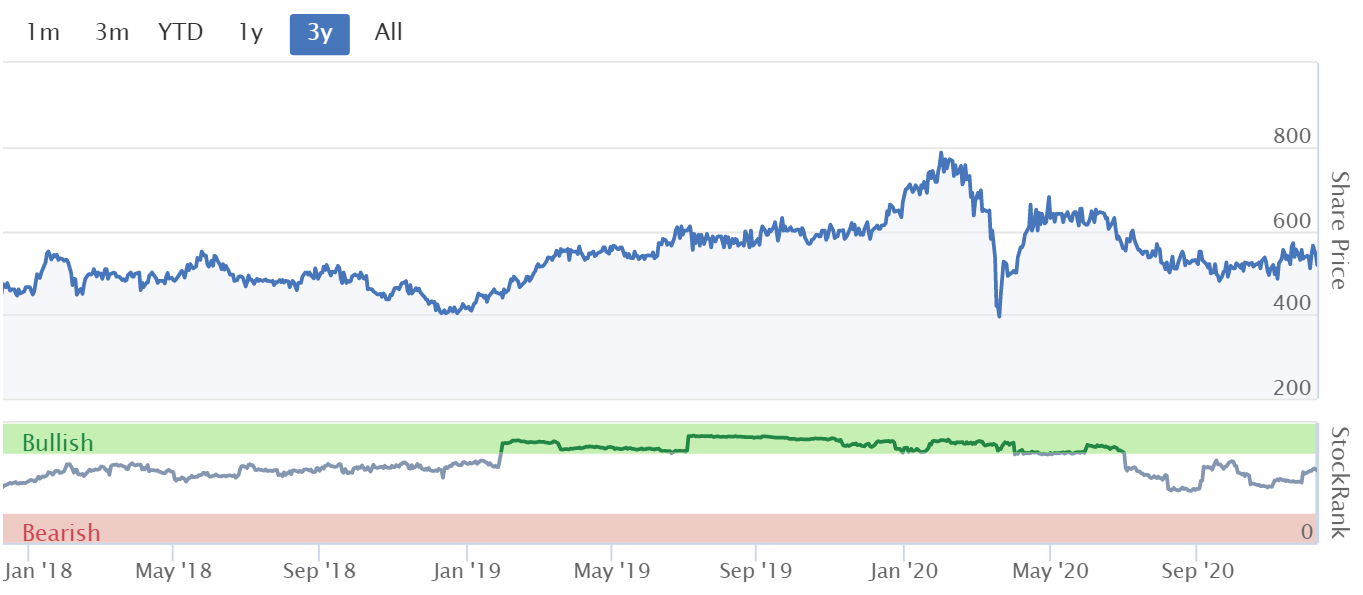
Sideways 3-year chart - sometimes this can cause a revolving door shareholder register, with stale bulls keen to exit as fast as new people come in. I think it might need some fresh news to revitalise things. We didn't get that today.
.
.
Ideagen (LON:IDEA)
Share price: 233p
No, shares: 229.5m
Market cap: 534.7m
I'm pleased to see Ideagen is raising some fresh equity - quite a lot, £48.7m in total, at 215p per share. A nice fee for Finncap too, which recently reported good results.
It says this is possibly for acquisitions, or if none complete then to reduce debt. Either way, this is clearly a good move - companies should take advantage of a buoyant share price to strengthen a weak balance sheet, with relatively modest dilution, as in this case.
Current trading - sounds reassuring -
Current trading and prospects
The Board provided an update on the Company's trading for the six months to 31 October 2020 on 12 November 2020. The Group's trading has continued to be pleasing and there has been no material change in the Company's financial performance, position or outlook since that date.
My opinion - bulls like the recurring & sticky revenues. It's good to see the balance sheet repaired with nice expensive equity, hence little dilution - ideal, and well played!
.
That's it from me today. See you in the morning.
Best wishes, Paul.
Disclaimer
This is not financial advice. Our content is intended to be used and must be used for information and education purposes only. Please read our disclaimer and terms and conditions to understand our obligations.

105 comments
"Update at 20:06 - I'm still plugging away, should be done when it's done"
8148 Reads.
Paul, you're a legend.
Steve Moore over on shareprophets has done a good write up on Zytronic if you need help
I was also waiting for a comment on Zytronic - the only one I was interested in. For what it's worth, the results were reasonable given the disruption caused by C-19. Balance sheet is very strong and the SP supported largely by the cash balance. I've been to two AGMs in the past and had factory tours. So I am biased in favour.
Why do you list shares on which you do not comment - in this case, Zytronic, but it happens usually with shares that I hold!
Because it takes ages to do the work. Sometimes I don't get to finish everything, but usually try to catch up afterwards. I've just got in at 18:00 after taking some exercise. Do you think I'm more, or less motivated now to spend my evening finishing off today's report, after reading your comment? Maybe have a think about that.
Chin up Paul the vast majority on here hugely value and respect you - and of course Paddy too!
I thought you were going to say Jack, but yes, Paddy too - go Paddy!
what a muppet you are Kendal. He’s not a slave. Paul is providing incredible value on here and fits in what he can during the day.
Why do people have to post such stupid and thoughtless comments!
Thanks Ben!
I've cracked open a fresh bottle of Johnnie Walker Blue Label, so the updates are flowing thick & fast now! Not sure it's worth the premium price really, but it's a Xmas treat.
Best wishes, Paul.
Ben, You are the muppet for criticising Kendal for making a reasonable point. We all appreciate Paul's sterling efforts. But why list shares that you may not comment on? Better to under-promise and over-deliver. Anyway, I am missing updates on Boohoo which I reprimanded Paul for covering in too much detail and I regard as "uninvestible". But each to his own. I am a Vianet man myself which Paul dislikes. In the spirit of consolidation, Paul has a standing invitation to lunch here in Edinburgh with me and my mate KingMcKong (who some may remember from Motley Fool days). Kuronagi
Jesus wept. The agenda is to set out what I'm going to try to cover each day. That way people don't drive me mad with requests, as they can see what I intend covering. I may or may not get through the list, because I'll focus my time on things that look most interesting, as in we can make money from (e.g. Redde today).
It'll save me time not to bother putting up an agenda. After wading through all this crap, I won't bother reading the comments for a few days either.
Just leave me alone to write the damn reports, and stop bothering me with these type of crappy comments. By all means comment on the companies.
Paul, we see occasionally that some new folks here don't understand some of the unwritten 'rules' that this blog tends to utilise - a few times there have been comments about having a template leader that explains the process, particularly for new joiners and so on, but I've not really see anything stick.
In this case, the join date isn't so recent so I'm surprised that nearly 7 years of reading this blog hasn't helped to tune into the general process, (assuming the comment hasn't been edited) perhaps there may have been some attempted humor here that didn't land so well. The internet is rife with comments that seemed funny to the author at the time but aren't appreciated in the spirit they were meant - I've been on the losing side of that a few times (generally later at night after a few whiskys).
In any case, would it be possible to have a permanent static header/template/link to a closed blog or whatever to help clear up any misunderstandings around how to interact with each other, set expectations for timings, what will be covered, what won't, what sort of constructive comments offering opinions and analysis/summary might tempt you to add to the list etc? I hope that this might help alleviate some of the unpleasant comments noise for you and the other authors, so help keep the positive mood and vibe that I've found on here over the last couple of years.
Unjustified criticism, Paul. As a comparatively new subscriber, I think you do a fantastic job.
In any case, would it be possible to have a permanent static header/template/link to a closed blog or whatever to help clear up any misunderstandings around how to interact with each other, set expectations for timings, what will be covered, what won't, what sort of constructive comments offering opinions and analysis/summary might tempt you to add to the list etc?
Nice idea, but the people who post sh*tty comments here probably wouldn't read or take notice of it anyway. I just have to accept that sometimes people have had bad days, and want to lash out at someone, take it out on me, or are just complete a$$holes, so they post rubbish here.
I'm trying to ignore it, and just concentrating on writing the reports.
Best wishes, Paul.
Yep - what Paul said!
Can you explain why Boohoo (LON:BOO) is “uninvestable” for you? Like Paul it is my largest holding at 12.5% of PF and for the five years I owned the stock to March 2020 it returned a CAGR of 44%. (I sold in March but that is another story!)
Is the “uninvestable” thing from a ESG perspective?
Thanks.
Regards
Michael.
Can you explain why Boohoo (LON:BOO) is “uninvestable” for you?
Anyone who thinks BOO is uninvestable, is handing a bargain on a plate, to the rest of us. Don't complain, just rejoice!
P.
Not complaining but I always like to hear a bear case on my investments.
I think it helps strengthen my investment thesis.
Regards
Michael
Joules (LON:JOUL) (no position)
I personally remain unimpressed with this company.
E-COMMERCE
E-commerce is now up +35% vs last year (@£55m in H1), but this growth seems quite pedestrian vs many online retailer's performances this year.
Also note that at the height of lockdown (in H2 FY20) - when online should really have been taking off - YOY growth was a measly +0.5%.
RAPID MARKETPLACE GROWTH, BUT FROM A LOW BASE
I also note that the "Friends of Joules" marketplace, whilst in itself is a good idea, comes from a low base and contributes almost nothing to the business - note the £2m of "Other" revenue in H1...and this includes royalties too.
VALUATION
I personally value this sort of business primarily on its online performance, on the assumption that the rest will whittle down to zero in the medium term.
Before buying I would therefore hope for:
a) fast growth, and
b) that the company starts splitting e-commerce out in their reports (at the moment it is simply lumped in with Stores revenue - most unhelpful) in order to see how profitable it really is. The only detail I can see from the annual report is that e-commerce margins are lower than those of items sold through the stores.
Thought as always appreciated.
A
An interesting snippet from the Begbies Traynor figures is that insolvencies are down 30% in 2020. Implication is that these are businesses that would've failed anyway in normal times but have been kept alive because of government support, so potentially there will be a surge caused by these when that support is removed, never mind any actual impact from the Coronavirus and the lockdowns.
Thanks for mentioning that stat, missed that in the results.
Interesting, so while overall insolvencies down 30%, they've managed to grow revenue by more than 10%. Their narrative is that they are also winning bigger jobs.
Look to me Begbies Traynor (LON:BEG) have a strong positioning in the market, taking more market share and also going more upmarket, where margins are higher too.
Hi JCPr,
Re insolvencies, you say;
...so potentially there will be a surge caused by these when that support is removed
I question that narrative, because all the evidence I can see is that the Govt seems averse to withdrawing support, and keeps extending support schemes. E.g. furlough was meant to stop at end Oct 2020, but now seems to have been extended to 31 March 2021, with the sliding scale of reduced support largely reversed.
Time to pay looked likely to cause a cliff edge of overdue VAT payments in March 2021, but one company I covered recently said ( Staffline (LON:STAF) I think) said that had also been extended, to March 2022, with instalments allowed, interest free.
I can see why BEG would get more work from CVAs in the retailing & hospitality sectors, but outright insolvencies seem quite rare. How many notable companies have gone under during this crisis? Very few. With interest rates at zero, it makes more sense for banks to continue supporting many businesses, if they can at least operate at or around cashflow breakeven, then force them into fundraisings once the economy has got back to normal, maybe in mid to late 2021?
How can there possibly be a recession in 2021, when the UK Govt is currently running a deficit of about 20% of GDP, costing it nothing, because interest rates are zero (negative in real terms), and the Bank of England is literally buying ALL new Gilts issued this year (check the BoE website)?! The reality is that cash is piling up in household & company balance sheets, which is likely to be spent in a deluge of pent-up demand, once restrictions are released next year when enough people have been vaccinated.
The data suggests to me that a "roaring twenties" post crisis boom is more likely than a recession, as at least some of this surplus cash is released, but time will tell!
As modern monetary theory points out, the Govt's deficit, is someone else's surplus cashflow.
Regards, Paul.
I had two MK1 Granada's as a young man. Great cars. Amazing look for its time. The Ghia was very plush with its wooden dash and chrome nose grill. The 3.0 Litre 3 speed was good for 21MPG. Long gone.
Before everyone gets carries away on a wave of nostalgia for 1970s British cars, I lived in Oxford during the glory days of the Austin Allegro and Morris Marina. There was a large field full of unpainted cars which no one wanted to buy outside the factory. When the time came to paint them, acid was used to strip off the grease which had been used to protect the bodywork from the rain. It was not unknown for the person who stood on the roof to fit the windscreen to fall through it.
Before I retired I worked in an office on Oxford Business Park North that was rumoured to be built on top of thousands of buried Allegros.
It was such a pity that those 1970/80s BL cars were so badly made, and lacked basic rustproofing, etc. Some of the designs were really good, if they had been made better. OK the Marina/Ital was just a shed. A Moris Minor underneath, terrible.
The Austin/Morris 1100/1300 were good cars, the hydrolastic suspension gave a superb ride, and they were spacious inside. But dogged by stupid reliability problems, constantly breaking down. Sadly the Allegro was probably a backwards step on the 1100/1300 model.
We had a Princess 2.2HLS made in 1981, and it was a magnificent car to drive - I loved it, and used to thrash the hell out of it, when my father was stupid enough to lend it to me! Turbine smooth straight six engine, only 110 bhp, stifled by a 3-speed under-geared auto box, but it was almost silent & smoother than a Rolls Royce. HUGE inside too. What a waste. That could have been a world beater, if they had made it better.
What about SDi Rovers? When they came out, 1974/5, it looked like a space ship! A Brilliant design, with that punchy aluminimum V8 designed by Buick originally. I bought a 1981 Vanden Plas V8 in 1990, with only 50k miles on the clock, and absolutely adored it. That V8 burble was priceless!
I could go on! Shares and cars - my favourite topics!
Best wishes, Paul.
I agree the Mark 1 Granada was a beautiful car. The essex 3.0 V6 engine also a jewel, although personally I love the turbine smoothness of straight sixes more.
The mark 2 Granada looked just like a large mk 4/5 Cortina, but the alloy wheels on the Ghia were so stylish, and who could forget the 160bhp fuel injected version, with the Cologne 2.8 engine (higher tuned) did look magnificent. Remember Cowley from the Profressionals, roaring up to a crime scene in one of those marvellous Granada Mk II? Just superb!
I'm never going to retire, but when I do, I'd want to be sitting in a pub, talking about shares, and cars from the 1970s/80s. My first car was a 1.9GL Vauxhall Cavalier Mk 1, automatic. It was a good thing I enjoyed taking it to bits, because it kept developing catastrophic mechanical problems!
Best wishes, Paul.
Hi Paul Any views on Coral Products (LON:CRU) , which has released both Final year and half year results today!
Hi Paul, it currently looks like the Brexit trade deal could go either way. If it was a no deal Brexit how do you think the market will react?
I think everyone made some good gains in November, my portfolio did well from holdings like Saga (LON:SAGA) Purplebricks (LON:PURP) Headlam (LON:HEAD) Redde Northgate (LON:REDD) Revolution Bars (LON:RBG) Finsbury Food (LON:FIF) Volex (LON:VLX) etc and I am considering reducing my positions to lock in some profits.
I was previously very upbeat about the end of this year/heading into next year. I think when the oxford vaccine gets approved the market will have a further positive reaction and all being well with the vaccine I believe the economy will make a strong recovery next year. However I also thought that the flow of good, positive news would continue and we would sign a trade deal with the EU, with that now not looking as certain doubts are creeping in about the possible impact this could have.
Any opinions welcome.
Thanks
Tom
In my humble opinion, a (bad) Deal would likely see a market bounce as at last, 4.5 years later, business will at least have clarity on what the future holds. Business loves certainty, even certainty of problems, as it allows any well-run business to enter 'adapt and overcome' mode.
No Deal, will likely see a market fall, as everyone knows that No Deal is not a permanent state, and in fact we will be negotiating Deal in 2,3,6 months time. Only No Deal at this point brings chaos: Will road hauliers bother crossing channel? Will 35% tariffs actually apply to UK agriculture? Will, and I can't believe I'm actually writing this 4.5 years later, but will planes be able to transit between UK and EU?
If No Deal, there will probably be acute chaos as everyone scrambles to enact legislation, hire personnel, consult lawyers to cope with the meteorite of red tape that is about to hit, and then chronic uncertainty until the trade deal is done. Business hates uncertainty. Why would anybody make capex investments to cope with a No Deal situation that we all know will eventually be resolved?
It seems to me however, that in the long-term, No Deal will become Deal, and the outlook for equities will be driven more by COVID recovery and asset inflation. No Deal might push that back 9-12 months, but ultimately, it'll be Deal.
I suspect that most of the straining and grunting occurring right now is political theatre, to allow Boris to go right to the wire and then leave with whatever the EU tells him he can have, but allows him to save face with the Tory party.
In summary, patience and waiting.
NB: Yes, yes, yes, I used the word 'will', treat all above as opinion not fact, which should really go without saying.
The UK & EU have done side deals already on loads of stuff - e.g. both sides have confirmed long ago that they will prioritise flow of traffic above paperwork being 100% correct. Similarly on aviation - a deal was done ages ago. I think covid has shown that businesses are amazingly capable at adapting rapidly to changed circumstances. Covid has also shown that we have a highly interventionist Govt, that is perfectly happy to spend at unprecedented levels, funded by QE. Therefore if Brexit does bring chaos, I imagine Rishi would intervene again with a support scheme of some kind. We've seen already this year, how quickly the stock market regains its poise.
I don't see how a deal that the EU wants is possible, because we would then remain subject to their rules, which isn't Brexit!
The only significant tariffs under WHO rules are cars (10%) and food (30-40%). Everything else is little to nothing. So what's the problem? After a period of whinging about the paperwork, businesses are likely to adapt. Plus we can buy stuff from the RoW, if it becomes too problematic to buy from the EU, so permanently lost business for the EU - not wise when the UK is a large net importer.
Personally I don't believe the consensus that free trade is a wonderful thing. All it has actually done, is allow German industry to destroy British industry, because they're better & more efficient than we are at making things. Just before the UK joined the EEC, over 90% of cars sold in the UK were made in the UK. Now that figure is very much lower. We buy German cars instead. How has that benefited the UK - answer it hasn't. A modest level of tariffs is a good thing, in my view, as it protects jobs here in the UK, and gives UK producers a chance to survive against cheaper imports.
Going through my own portfolio, there's hardly anything in it which should be impacted by possible hold-ups at the ports. Bear in mind that ports are apparently struggling already - because companies are building up inventories to tide them over any Brexit disruption. Logically then, trade volumes could drop in Q1 of calendar 2021, as companies run down those excess inventories?
I don't know, we're all guessing, hence why could or might are always better than will! ;-)
Regards, Paul.
All it has actually done, is allow German industry to destroy British industry, because they're better & more efficient than we are at making things. Just before the UK joined the EEC, over 90% of cars sold in the UK were made in the UK. Now that figure is very much lower. We buy German cars instead. How has that benefited the UK - answer it hasn't.
Well, if we're talking comparative advantage as in Ricardo it would make a lot of sense if the Germans do what they're good at and we do what we're good at. And frankly, as someone who remembers what British made cars were like in the 1970s we really, really weren't very good at it. Whereas we're very good at financial services, for instance.
But other than noting that no-deal will probably knock sterling back even more it's hard to say what difference no-deal will make.
timarr
I believe my Ford Granada in the early 1970's was produced in Dagenham before production was transferred to Germany. That first Granada was easily the most luxurious of several models I had. Sure there are a lot of people in financial services but manufacturing is very important to a country. Jobs in manufacturing tended to be better paid than those in the many service industries that have taken there place.
Really well put Paul.
I don't see how a deal that the EU wants is possible, because we would then remain subject to their rules, which isn't Brexit!
I think that we'll find that's exactly what Brexit is.
See for a hint the Northern Ireland Protocol we have just acquiesced to, which effectively leaves N. Ireland within the single market. I don't think that a country that 'holds all the cards' would agree to a customs border that cleaved one part of it's territory from another.
Spot on, can't disagree with a word.
Personally think if business can navigate Covid then they should adjust to WTO trading terms with EU no problem.
Sure there’ll be some holdups at ports short term and 2 or 3% tariff/paperwork, but businesses adapt and make it work. Just look at the remarkable way many have got through the last 9 months.
I agree with Paul. I was speaking to someone this morning who imports materials from outside the EU and then largely exports outside the EU. They said that the paperwork was no issue at all and, in fact, the shipping company deal with most of it. On that basis even with a no deal the extra paperwork with the EU should not create any long term issue. As regards duties hasn't Boris said that 80% of imports will not face any duties.
I learnt at university that free trade was a benefit to all. If German cars are better than UK equivalent, then if free trade British consumer gets a better quality car for the same money. Or the same quality car cheaper. Or taxpayer gets to stop subsidizing worse British industry to make them competitive. The point is that trade benefits both sides - the seller and the buyer. There is painful dislocation then with companies going out of business or people having to find new jobs etc. but the reality is that everyone ends up better off in the end.
It's important to note that I don't think that a deal with europe is the best way to achieve this. That isn't free trade, it is locking up the UK to trade with a group of likewise expensive inefficient trading partners at the expense of access to the rest of the world. The worst possible outcome to this situation would be a deal that locks the UK into europe with their standards (this could be written as non-tariff barriers) paying for that access while not able to negotiate the standards or trade externally.
P.S. think you meant WTO, not WHO above - at least I hope you did lol
I thought the UK car production stats were reasonably acceptable on the basis that recent car production stats in this country were reasonably close to or at highs compared to the last 30 years or so - ok going back past that may paint a different picture but i think its unfair to say we are naff at producing cars if we make over 50% of of cars put on the road each year - probably a better stat than exists than most of the goods we use or consume? to be fair to germany they do somewhat specialise in car engineering and general engineering and the like so having the critical mass of associated skill sets available must help them keep ahead somewhat in that regard?
Ref the balance of trade problem i drink (or should i say used to?) with my mates who started out working in the yards and similar heavy industry and since i started drinking with them in the late 80's they have always insisted that unless we manufacture stuff in this country then its only a matter of time till our country ends up going bankrupt or down the swanny - well that hasn't happended in the last 30 odd years - so i kinda suspect i was right in that one that we have the ability to do just fine while importing way more than we export - but i have to admit i don't have the foggiest what the experts (economists?) would have said 30 years ago - they would possibly say well we didn't expect the service sector to pick up the slack - or would they have agreed with me all along - who knows.
Does anyone actually think a trade deficit in the country is an issue long term?
Upto a couple years ago I worked in a garage assisting with MOTs. We were finding the most reliable cars were Honda closely followed by Toyota and Suzuki, then Hyundai. Ten year old VW Golfs were more reliable than the latest Golfs and Citroen/Peugeot were the worst. Twenty year old Fiats keep going strong while newer ones aren't quite so good and 20 year old Ford Focus is better than new ones. Granted that was just one garage out of many but other local garages were saying similar.
No RM, a trade deficit in itself doesn’t make any difference. The type of trade is much more important. To take our car example, Germany may have a massive trade imbalance with Indonesia because that’s where they get the rubber from that goes into their cars. But that’s basically commodity level - low value add. The Germans take that rubber, process it, slap a BMW badge on it and shift it on. They can run a huge deficit with Indonesia and it doesn’t represent a transfer of wealth from Germany to Indonesia because they can take those raw materials and add substantially more value to them.
For the modern economy like the UK, car production and assembly jobs are high value. Losing those jobs hurts especially if the workers end up long term unemployed and cost the state rather than producing. But if Germany does it better, the UK economy as a whole is better to import those cars. And a tariff on them isn’t leveling the playing field - it is a tax on both the UK consumer and German manufacturer which will almost certainly fall heavier on the consumer than the manufacturer.
Likewise the city of London gives Europe access to cheaper capital costs than anywhere else in Europe. They are hoping that they can recreate this somewhere in Europe - there are three or four cities vying to do so. It remains to be seen - on the negative side, the tighter regulation means it may not be as attractive plus the infrastructure and sheer size of the London market is a major selling point, on the positive IT advances and the pandemic increasing mean having a central hub seems less important. My guess is that they fail and either that business remains in London or migrates to other worldwide financial hubs.
I’m digressing -the point I’m making is that an economy is the sum of what it produces and the value it adds. Individual total deficits or surpluses don’t matter as much as the type of deficit it is - high value goods (computers, cars) and services (marketing expertise, access to financial capital) hurt, low value goods (rubber) and services (cleaners) are better exported because you save money and hopefully free up your workforce to do more constructive things.
I thought I would google what the trade deficit was between the UK and Europe and it came up with " The UK had an overall trade deficit of -£79 billion with the EU in 2019. A surplus of £18 billion on trade in services was outweighed by a deficit of -£97 billion on trade in goods. ..." trade is two way and I can never understand why commentators always comment on the effect on UK trade when it would appear (based on the above figures )that the EU have more to lose . Recent days have seen the footsie go up ( more international and reflective of a fall in stirling ) but the 250 index has gone down because there is a view that mid tier companies will be more effected by tariffs . There could however be a benefit because of import substitution particularly with automotives - putting a 10% tariff on Mercedes built in Germany must surely benefit Jaguars built in Coventry
We shall see - the current EU position reminds me of the expression " cutting off the nose to spite the face "
So, the answer is that we apply WTO tariffs to imports from the EU and then use that money to reimburse exporters who have had WTO tariffs imposed on their sales to the EU.
That softens the blow to our producers exporting to the EU and means they can keep their products competitively priced.
Our imports end up costing a bit more but I think we all knew that was likely to happen and many felt it a price worth paying.
Wouldn't take long before our importers found alternative, cheaper sources of many goods.
Yes, yes, I know. Very simplistic.
I can never understand why commentators always comment on the effect on UK trade when it would appear (based on the above figures )that the EU have more to lose
Consider two trading partners Alice and Bob. Alice earns £100 a year of which £20 comes from selling stuff to Bob. Bob earns £500 a year of which £40 comes from Alice. Therefore Bob has a trade deficit with Alice of £20 a year.
If Alice and Bob fall out and stop trading with each other Alice now has earnings of £80 a year while Bob has earnings of £460 a year. Alice has lost 20% of her income and Bob has lost 8% of his. Both lose but Alice loses more, proportionately.
In fact, the most important market for the EU27 countries, by far, is ... the EU27. Maintaining internal cohesion of their internal market is much more important to them than a trade deal with the UK.
None of that means that a deal isn't important to both sides, otherwise they wouldn't still be talking. But it would hurt the UK more in the short term. In the longer term that'll depend on competitiveness and trade deals with other trading blocks.
timarr
Alice now has more time to sell her wares to Dave and Rachel who realise that Alice is actually quite rich and now Bob has stopped coercively controlling her, they can work together to simplify how they do business.
Bob already sells Dave and Rachel as much as they can take and Bob, being the control freak doesn’t really want Dave and Rachel hanging around talking to his family.
You are absolutely right fred9566 concerning reciprocal trade with the EU. My wife is from Belgium - well Flemish actually and speaks their funny language which I have never in 20 years struggled to learn. We only get the UK situation from our myopic media but she reads me the Belgium press coverage and the job losses anticipated across the channel and particularly in Flanders with a no deal are massive. Not only will they lose a huge market but be paying a significant unemployment bill for many years to come. They had enough of that with the loss of the steel industry in the Walloons which they still apparently resent!
We shall see - the current EU position reminds me of the expression " cutting off the nose to spite the face "
But that's only a small part of the story. For the EU the integrity of the single market, and the level playing field is key, and seen as being essential to their economic success over the past, and future, decades. A hit on exports to the UK, might hurt, but not enough to challenge that. And of course the potentially lost exports are spread across an economy 8 times as large, so the impact is far less than on the UK.
What you are proposing is known as "autarky". It has been rejected by economists since Adam Smith. The only people I have ever seen proposing that it has economic benefits are you and Donald Trump!
There is no economic benefit to be gained from protecting UK jobs in inefficient industries. There may be a social benefit, but how much should we pay? What would the UK look like now if we had been paying since the 1980s to protect jobs in coal mining, ship building etc? Why protect car manufacturing and not everything else? We now have a strong car industry in the UK but it needs to face the competition and keep evolving. As it does, the number of jobs lost to robotics and automation will continue to increase.
As for brexit, we seem to have forgotten that what we now have is a choice between a hard brexit and the hardest of all brexits. Neither offers anything to the services industry which is where we have a trade surplus with the EU. The extent of the damage to services is still unclear because there are many decisions still to be made. The worse our relationship with the EU, the more likely those decisions will be unfavourable to us. Many UK owned companies can avoid a lot of the damage by moving jobs to the EU (which has been happening since 2016) but some significant domestic impacts seem highly likely.
I don't see how a deal that the EU wants is possible, because we would then remain subject to their rules, which isn't Brexit!
Any FTA requires give and take on both sides. Sovereignty is not an indivisible attribute. We were sovereign in the EU, but we chose to work with others on shared rules because of the advantages of doing so. If we want an FTA with the US we'll have to agree on things that we might not accept otherwise. The EU situation is only different in scale, not principle. And it's pretty inevitable given how closely intertwined both economies are, how geographically close, and how large a part of trade of each is with the other (which is why the deal Canada got, after 7 years of talks, is not on offer here.) The reality is that trade negotiations follow playground rules to a large extent - big boy's rules, or gang's rules tend to be matter . And Britain has chosen to put itself outside the gang, and is now a small (or possibly mid sized) boy in the negotiations. It was always clear that would be the case. We either accept compromise to minimise damage to the economy, security etc or or we go for maximum "sovereignty" and maximum economic harm.
Hi Tom
My tuppence worth is that if you hold stocks that you have conviction in and believe they are worth more than the Mr Market is currently willing to pay, stick with them. Of the shares you mention I hold Volex (LON:VLX), Redde Northgate (LON:REDD) and £HEAD. The likes of Revolution Bars (LON:RBG) and Purplebricks (LON:PURP) are not for me but each to their own.
Timing the market is for clairvoyants and I have yet to meet one. After all who saw the arrival of the Pfizer vaccine. Other than the individuals involved no one I would venture, hence the mayhem in the markets following the announcement.
Good luck in whatever you decide.
'After all who saw the arrival of the Pfizer vaccine' actually I believe many did.
It was common knowledge there were many groups working simultaneously on a vaccine and the fact humanity's focus was on developing one and accelerating the approval process meant it was going to be here sooner rather than later.
Dear All, The InvestEGate daily RSS feed I used to get RNS information is still broken, however as a workaround I've refreshed News for 'interesting' instruments individually (as the individual instrument feeds are working fine, it's just 'todays' that aren't). As a result the news / reporting information on the heatmaps is incomplete. Hopefully normal service will be resumed soon!
Here are my heat maps for today (prices as at ~10:45am).
Overall state of the market by ICB Industry classification:
Key to the Industry heat map contents:
SVCR world filtered to 'interesting' instruments ('interesting' means: reporting soon or recently; trending; breaking out; increased volatility - volume / ATR up; moving more than a 20d EMA of the ATR):
Small Caps reporting today (probably incomplete):
Small Caps with RNS news today (probably incomplete):
Big movers today in the SCVR world (moving more than 20d ATR EMA against either yesterdays close, or today's open):
Small Caps breaking out today:
And finally the key to the heat map contents:
The heatmaps are ordered by Stock Rank™, and are limited to the top 75 instruments.
The heatmaps are images and will be resized by your browser to fit your screen. If the heatmaps images are too small to read on your screen, right-click on the image and select 'Open image in new tab'. This will open the heatmap in a new tab in your browser where they can be zoomed as necessary.
I use heatmaps a lot and generate many (from my own application and database) to help focus my research. I use them to help me quickly find instruments which pass my basic 'tradeable' criteria (a 'T' in the top-right of the heatmap, meaning: profitable; low-debt; reasonable liquidity), have a high Stock Rank™ and Quality Rank, and are trending (Tr+ or Tr++) or breaking out (Br+ or Br++) ideally on increased volume (V+). I then research the identified instruments in more depth using the Stockopedia StockReports.
How (or indeed if) you use these heatmaps is up to you, I contribute these SCVR related ones here in the hope that others may also find them interesting or useful. I aim to post sometime in the morning when I can, but sometimes work / family and other priorities get in the way.
greensiax
Hi Greensiax,
Thanks for your informative post.
How do you get all this heatmap ? is it from www.investegate.co.uk ? because I could't mange to get those on their website? I couldnt find "interesting instument" filter on website. How do you get ICB industry classification (frist screenshot you uploaded). Or is it from different website?
Many Thanks
AFAIK Greenslax has his/her on secret sauce to produce the heatmaps blending data from different sources.
However if you want to access source data for ICB industry London Stock Exchange publish it HERE.
Two really important tables for anyone wanting to build their own data resource :
List of "Issuers" and List of "Instruments".
Issues being the companies and instruments being the individual "tradeable instruments" issued by the issuers.
Thankfully most companies only have one instrument, but the differences can take a while to unravel and constantly confound many,
Hi raismalik,
As Gromley has so kindly pointed out for me (Thank You Gromley!), I produce these heatmaps using my own code (my 'secret sauce' as Gromley so eloquently puts it) and my own database. Which is indeed compiled from data from many sources. InvestEGate being one of them - though not my favorite at the moment ;-)
Cheers
greensiax
thx greenslax and as an aside (as private messaging is not a thing for users of the new site) I've been auto-analysing info from Investegate for quite a while - I've not used the RSS feed. So if there is anything useful I can contribute to help you along the way, do feel free to PM me via twitter @gromley20 .
(I suspect it might be case of teaching granny to suck eggs however!)
Thank you, Greensiax.
Thank you Gromley, LSE link was very useful. Thanks again.
Paul,
Further to the comments by illiswilgig (Mark) below, you last commented on Vianet (LON:VNET) on August 26.
Its results today seem to me to contain nothing materially different from the previous update, so I'm wondering whether the 10% fall today is overdone. If you get time to look, I'd appreciate your views.
Interim results for Vianet (LON:VNET) this morning. (I hold)
The company makes, installs and maintains vending and vending monitoring and payment systems. Historically beer monitoring for pubs and bars but now increasingly vending machines, coffee vending machines in particular. Has been moving to a Software as a Service (SaaS) model as it connects all its sites and machines to the internet - providing telemetry, data analytics and cashless and contactless payment systems.
With such a close historical link to the hospitality industry - no great surprise that H1 to end September is badly affected.
Revenue reduced by over 50% to £4m and a loss of £1.4m
Set against this - it is probably to the companies credit that both divisions, pubs/bars and vending, managed a small (adjusted) operating profit. Nimble foot work there? Keeping pubcos on board by offering attractive low rates (30% of normal) whilst closed and 70% once reopened - seems to have gone down well. Furloughing staff and then bringing them back as sites reopen - and offering Covid-19 sanitisation of the machines service.
An interesting silver lining is that the telemetry and data analytics from the sites as they reopen has been well received by the industry helping to adjust rapidly to the changing circumstances and demand and perhaps building in the new SaaS, data management and contactless payment for the future? Evidenced perhaps by renewal of contracts with some pubco's during the period?
The vending machine division performed more strongly - despite offices being closed or much reduced in demand - primarily due to the demand for unattended and contactless payment in key worker sites, hospitals, stations, public services etc. During the period they still managed to sell 50%, or 3200 new device connections most of which were contactless payment.
With the recent lockdown and the current tiered system in H2 there is no reason to see the FY21 results as being miraculously better?
Overall the company has emerged from H1 with its operations still generating cash and marginally profitable, and seemingly demonstrating increased value to its customer base. Cashflow is slightly negative(edit) and both net debt and NAV are stable which is quite an achievement under the circumstances.
Looking to FY22. It looks as if the pub/bars monitoring will return to pre-pandemic levels and with sales connecting vending devices continuing during lockdown the vending business should return to growth - possibly more growth as the industry speeds up the installation of unattended vending and contactless payments?
FY20 delivered 8.5p in eps. FY22 should match or improve upon this? The shares are fairly valued at 80p if you don't see this as a growth market, a bit on the cheap side below 80p. They look very cheap if you see this as a cash generating well funded business transitioning into a software technology niche with good growth prospects - but that growth prospect has proven elusive for some years now. Will they finally crack it?
That's clearly a glass half full view! It all depends upon whether you see this market as a growth market in future?
cheers
Mark
Ooops - £VNET - cashflow was slightly negative - not positive as I wrote. Good in the circumstances but negative until flattered by receivables. Overall cashflow was slightly negative once the £3.5m CBIL loan is taken into account. My apologies - now edited the comment to say cashflow slightly negative.
Vianet (LON:VNET)
Its a company I've glanced at in the past but never spent time looking. Today I looked a bit more as its got high recurring revenues, there's a chance of a delayed covid bounce back and it could have both value/recovery and compound growth potential.
My conclusion is to be a bit concerned for it. I feel it may be a company with a good business concept but poor execution and capability. Also, the cash position is weaker than they present and deteriorated much more markedly as a result of covid than their 'resilience' claim.
Some points to back the above:
Overall, I think there's a chance that prior profits may be somewhat overstated due to a significant investment program being capitalised plus the write back of deferred consideration on Vendeman. Reading between the lines I think the aggressive investment program in recent years is more catch-up than breakout/growth investment. I'm outsider so v hard to know but that's my vibe.
The company could grow its way out of this situation. Anyone got a view on that? They have been losing customers on the pub side for years given closure trend. I note that a company strategy presentation during the summer said that new area growth was likely to be more through M&A rather than organic in areas such as (environment, industrial assets, energy)....they really don't have the balance sheet for that so expect them to ask Mr Market for the money...
...and related to that I find it curious why Vianet persisted with a dividend payout of approx £1.5m pa given all the above plus a plan to 'acquire growth'. I think this is likely a result of habit and 'face' plus the chairman liking a payout on his 20% holding. It would be sensible not to restart dividend payments after the covid hiatus.
My guess is that Vianet will come to market with 'transformative' fund raising to acquire a new 'vertical' for their 'proprietary tech'. Maybe they make a great acquisition but their track record is not great and this does seem a little desperate too. Do they pay down the £3.5m CBIILs too through that raise? I think they have to if they are going to be 'going concern'.
I think this raise occurs before the full year as the figures are likely to be messy and cash position less good. Can they sustain a working capital positive impact or such aggressively reduced spend on PPE? (probably not). They could save full year cash a bit by cutting R&D and so capitalisation...but where does that take them?
There's £18m goodwill on balance sheet too. This is probably vulnerable to write down if the current aggressive investment program is not as productive as desired (there have been modest write downs to date)
Contrary view welcome as I'd like to know what I'm missing and if I'm wrong Vianet could be good.
mojo
(This was longer than expected and I'm going to post it as stock post separately so as I can retrieve in future...plus tidy up some of the stuff above)
Thanks for your post on Vianet (LON:VNET). Brilliant and most insightful analysis.
No worries...it was note for me...believe it or not I feel there might be something in Vianet (LON:VNET) but the stuff I point out gets in the way. Absent a transformative number or type of client win it seems probable to me that H2 2021 is going to be rough...add in longstanding CEO off and a desire to acquire new growth verticals and my spidey sense says they will be coming to market with a plan to raise led by biggest shareholder the Chairman. All guess work by me and I don't know Vianet well...so first decent look today and trying to read tealeaves
In my Vianet post (copy and paste of this) superrupededupe makes a good counter. See here:
https://www.stockopedia.com/co...
I don't have time to think respond to them right now and will do later.
Mojo - Vianet (LON:VNET) - thats helpful thank you.
Actually I don't disagree with your numbers. Though I'd say it's a glass half empty approach, which is probably deserved, rather than the glass half full version I posted this morning.
Growth? Hmm. Not sure. I think that they have demonstrated (pre covid) growth in the vending market. The switch to software as a service has probably masked the effect of the growth on the bottom line from shifting telemetry and payment boxes? But whether that leads to the big breaktrhough in growth that always seems around the next corner is hard to tell.
You may be a bit harsh on the deferred acquisition payment. In essence they bought a customer allowing them to move up the value chain from electronic box service provider? I' ve not checked but I seem to think that they paid some of the deferred payments but not all - that would be a standard conversation in the negotiations 'Well, if you think it's worth that much we'll pay you if it makes the figures'. Basically pays the vendor on any outsized upside achieved. You could equally say that they avoided overpaying?
Your comment over fund raising concerned me. Until I realised what I think it means. I read it as:
Growth in the market areas already addressed (ie pubs/bars and vending) is organically funded. Entering new market segments, such as environmental etc, would probably need to be by acquisition - I don't see it as likely that they could successfully launch into new market segments without the customer relationships, they have done this with Vendman. Implicit in this is that they can't acquire in new market segments until they deliver growth in their currnet market segments
I don't see it as a coded message for a fund raising, can't see the chairman going for that? And he's bought more shares recently?
But I just can't shake the worry that this is a 'growth trap' where the growth is never quite enough to escape the finances? Carclo (LON:CAR) anyone?
I see it as a modestly profitable business which is plodding along and valued about right on a historical basis. Downside is limited, but most likely so is the upside - except that there is a 10-20% chance of a significant upside through the data analytics, device management and payment software taking off. A takeover might be a possible outcome? Agreed its unlikely unless the chairman goes for it.
I've been happy to wait whilst the 5% dividend consoled me - without it I will be looking harder to sense the likelihood of significant growth - the opportunity cost is starting to hurt.......
sorry this is light on numbers,
cheers
Mark
Hi, see comment above and check out this counter argument to me https://www.stockopedia.com/co...
Yes re what you say on reason for fundraise...partly....many companies will seek to disguise a rescue raise as a growth raise. Nothing sinister in this just trying to survive etc. To me this would be a negative....however, a raise and performing well and proving their investments have worked in existing areas would be positive.
My hunch is that they are in rescue disguised as growth raise situation and that second half of the year could be really tricky on cashflows for them for reasons i give above.
I'm a bit interested in Vianet. I realise I might be getting it wrong. I often start out negative....and can turn. I do think this company would really benefit from some more communication (it might be out there and I haven't found) particularly around the large internal investments they are making (I want to hear why they are about the future and not tidying up old tech).
I can see this could be a great little franchise if the product is good and they can find some growth.
In case you missed it, Paul also covered on 26 August
https://www.stockopedia.com/co...
Re Vianet (LON:VNET) - Thank you Mojo. Yes, read the reply you point to - and I think superruped puts it well. I need to find some time to do some more detail and less waffle - be back soon!
cheers
Mark
Good Morning ,
Can you give us a quick analysis on Loop up.I know its not included in your list.Much appreciated.
The agenda here is driven by the day's trading updates & results statements. LOOP has not issued any such announcement today. See my report here from 27 Nov, when it last issued a trading update.
Pls look at Futura Medical (FUM)...we see US and EU approval process going OK for MED3000 erectile dysfunction gel. [SP=14.18 Cap=35m]
FUM, lol. The very definition of sucker stock.
Begbies Traynor (LON:BEG) is in an interesting position at the moment. Clearly has a bit of momentum, going to outperform market consensus for FY, with Brexit and Covid tailwinds to help it over next 12 months too.
Don't like how they've adjusted amortisation out of profits - surely that's suspect? Also acquisition costs too, its not direct acquisition costs but earnouts I believe? Which really should be considered a cost.
Nevertheless, looking like at least £8-10m free cash flow this FY, net cash position, increasing dividend. And historically always traded at at least 20x historic PE, while current year PE is only mid teens (if you expect broker upgrade to 6.5p EPS).
Recent new holder of LON:BEG. You're not the only one who has questions about their numbers. I had a look at the RNS this a.m. and was confused. I am looking forward to Paul's update as he manages to cut through the fog to the facts. I am with you in that this business has to have a lot of upside and little downside - but it requires a safe pair of hands - I do hope that's what we've got in this case.
Redde Northgate (LON:REDD)
Just to briefly flag up that Redde is one of the few (i think??) companies that have a specific area within their investor relations section of the website that provides details of brokers estimates for the current year - the important "date this section was last updated" info is included too. I have only just noticed this section so not sure how often they update but its always preferable getting figures direct from the horses mouth where possible. So plus marks to Redd for this act of transparency.
Good morning Paul, thanks for your update on Redde Northgate (LON:REDD) ( i also hold) i agree with your thoughts and am quite bullish on this one, ( what do i know!) but just a query about the div, I can only see the 3.4p interim. Where does the rest come from ? Or is that just a forecast for the final.
Thank you.
Morning Dicktrade,
Yes, I think the full year divis for Redde Northgate (LON:REDD) must include a forecast for the final divis.
The "Dividend Summary" page on Stockopedia (under the "ACCOUNTS" menu on every StockReport page) is useful for seeing the pattern of divis. Redde seems to pay out a larger final divi, which was halved this year. The interim divi is also reduced. But these should rise back up again next year. The company has previously been a generous divi payer, pre-merger, as it generates plenty of cash.
Buying/holding now, we could be locking in larger divis in future, hence the implied future divi yield I think looks excellent. Could be yielding maybe 7-10% at today's share price, in a year or two time? If things go well.
.
Regards, Paul.
P.S. I've suggested to the company's advisers this morning, that they do investor webinars in future, so that all investors can follow the company's progress & hear direct from management, which they said they will consider.
OK, thats what i thought.
Thank you
Studio Retail (LON:STU) does look interesting..got to confess to not having heard of it before. Very shameful. Excellent figures plus a move to maybe sell the company seems to be a winning combination. Worthy of further investigation I would have thought.
"got to confess to not having heard of it before" ( Studio Retail (LON:STU) )
That's because we knew it for years as Findel before it changed its name last year.
Ha..many thanks. Certainly have heard of Findel! Seems like Frasers and Schroders will be Kingmakers here. I bought some to see how it pans out. Even if no offer is deemed acceptable it looks well supported on fundamentals.
I have held shares in Amino Technologies (LON:AMO) for a few years now and have believed strongly that their position in the global TV market would eventually come through and this mornings Trading Update may finally endorse that belief . "As a cursory read of the trade press will testify, the global TV industry continues to experience seismic change " ( quote from Progressive Equity who have published some interesting research this morning )All the metrics are going in a positive direction even in a covid dominated year mainly because the global TV industry continues to experience an ongoing shift away from traditional linear delivery to a hybrid Pay TV/OTT model. The company has always been cash generative and they have also announced a new dividend policy and the recommencement of dividends next year which can't be bad either . Any chance of taking a look at it
Good trading update from Amino Technologies (LON:AMO) with net cash up, dividend to be reinstated and "improved quality of earnings with higher margin software revenue of approximately $20 million, representing a c.50% increase on FY19".
This company seems to fly under the radar with a low forward p/e for its sector. Hence finnCap today reiterates its TP of 215p and Progressive has issued a comprehensive note putting the case in the context of the TV market -
"Amino, in our view, sits at the sweet spot of TV industry turbulence. Its End-to-End (“E2E”) multi-screen TV and video solutions allow both PayTVand OTT operators to improve their competitive positioning".
(I hold)
Morning Paul. Would you be able to take a look at final results from RNWH (this is definitely a small cap at around 400M!). Results appear positive, government is committed to infrastructure spending especially in non discretionary areas and the valuation does not seem excessive, but the shares have been marked down. Many thanks.
Morning all. Record results from RNWH:
Final Results
Record results, well placed to benefit from increasing investment in UK infrastructure
Renew (AIM: RNWH), the leading Engineering Services Group supporting UK infrastructure, announces a set of record results for the year ended 30 September 2020, reflecting the core strengths and resilience of Renew's business model.
Bohenie
Morning Paul - Cracking results this morning from £NUM. Gives a good insight into what has been going on in the City. Intriguingly their client base has reduced in number but gained in size - and profit has trebled.
Small Cap Uls Technology (LON:ULS), half year report looks rather below expectations. The market will let us know shortly.
My morning smallcap tweet: [edit to correct Porvair ticker]
Joules (LON:JOUL) Futura Medical (LON:FUM) Toople (LON:TOOP) IXICO (LON:IXI) Cloudcoco (LON:CLCO) Porvair (LON:PRV) Northbridge Industrial Services (LON:NBI), Mears (LON:MER)
Joules (JOUL) positive trading trends have continued accounting for lockdwns. Guides H1(Nov) rev down 15.3%. Retail rev down 6%. Store sales (when open) ahead of the Board's expectations, down 17%. Down 46% overall. Guides pre-exceptional pretax £3.5-4m. Guides FY in line. [SP=170 Cap=184m]
Futura Medical (FUM) US and EU approval process going OK for MED3000 erectile dysfunction gel. [SP=14.18 Cap=35m]
Toople (TOOP) two new contract wins and a major extension to an existing contract. No £££. [SP=0.11 Cap=5m]
IXICO (IXI) wins contract for neuroimaging solutions with a new, large global pharmaceutical company. Included in management FY expectations. [SP=107.5 Cap=51m]
Cloudcoco (CLCO) guides FY(Sep) rev up. H2 trading EBITDA (yet another flavour of BS profits) £68k (FY19 -£235k). In line? Didn't the board think the co's name is too close to Cloudcookoo Land? [SP=1.01 Cap=5m]
Porvair (PRV) guides FY(Nov) rev down 7% and adj op profit in line with mgmt expectations. "Since July order books have been building steadily from a lower base. The Group was consistently profitable and cash generative in the second half, and showed sequential growth between the third and fourth quarters." [SP=4.4 Cap=30m]
Northbridge Industrial Services (NBI) guides FY profit before exceptionals. In line? "For the third year in a row we expect to start 2021 with a record new-year order book for the sale of loadbanks and a backlog of enquiries for rental projects." [SP=82 Cap=23m]
In line: Mears (LON:MER)
[Edit] Also
Also Kromek (LON:KMK) Studio Retail (LON:STU) Gaming Realms (LON:GMR) ADES International Holding (LON:ADES) Amino Technologies (LON:AMO)
Kromek (KMK) wins two contract extensions to provide network solutions of its D3S-related technologies to counter nuclear terrorism. Worth total £460k and will be delivered this FY. [SP=12.05 Cap=42m]
Studio Retail (STU) strategic review including a sale of the Group. Also rev up 17%, Q3 up 32% so far. [SP=263 Cap=227m]
Gaming Realms (GMR) business performance and sales momentum has continued the trend. Guides FY(Dec) rev up 55% and adjusted EBITDA at least £2.75m. In line? [SP=21 Cap=60m]
ADES (ADES) guides FY(ADES) rev flat despite covid. [SP=9.5 Cap=382m]
Amino Technologies (AMO) guides FY(Nov) rev up 8%, adj profit slightly up. Will restart divs and pay between 33%-50% of adjusted EPS. [SP=114 Cap=87m]
Cloud Cuckoo Land - very funny :)
As expected Studio Retail Studio Retail (LON:STU) has posted some fantastic numbers in H1. But the growth momentum has continued into Q3 with sales in October and November up 32% with gross margins up 450bps.
According to Similarweb, traffic to the Studio website was just under 20m visits in November and the brand is now the 2nd most popular UK website in the "Ecommerce & Shopping" category after Boots. In the world rankings for the same category, it jumped 51 places to 37th.
No wonder Frasers wrote to the board and said the brand in undervalued and misunderstood by the market. Management have agreed to a strategic review and we enter an "offer period" for the business.
I hope it's not sold. Studio has the potential to be a real category killer.
Zytronic (LON:ZYT) results to September - badly hit by the virus, but getting by. Bullet proof balance sheet with net current assets nearly equating to the market cap and now talking of a share buyback once the virus is tamed.
Morning Paul, I'd appreciate you running the rule over Redde Northgate (LON:REDD) and the interim results. Revenue, EBIT, and profit are all up, but earnings per share is down 46% on same period 2020. According to Stocko, the share volume is unchanged, but does that take into account the merger? Great to have your thoughts as I can't explain the per share declines across the board.
I shall look at Redde Northgate (LON:REDD) first (I hold). I was recently thinking about banking some profits on my holding in this one, but came away thinking it still looks cheap (so continue to hold). So I'll check out the interim numbers as my first job of the day.
Paul - thank you for this excellent piece on £REDD. Like you I was 40% up on REDD and sold out this morning because I didn't like the fact that EPS was in decline.
But as you say, looking at it in the round, the company is well on track with the merger and I've actually bought back in again.
As you say, it's moved out of your usual bracket of £400m mc but I would also add that, it will probably soon move into the 250 (with a 5% sp increase), which will get funds buying and thus increasing demand for the share further. (IMO)
New management seem to be doing a good job at executing change.
Redde Northgate (LON:REDD)
but earnings per share is down 46% on same period 2020. According to Stocko, the share volume is unchanged, but does that take into account the merger? Great to have your thoughts as I can't explain the per share declines across the board.
I don't know the full chapter and verse details but it seems obvious the EPS reduction is directly related to the merger as there was no merged company last year and the share count has gone from 133 mill to 246 mill. Note this was nearly a 50/50 (54/46?) merger by the looks of things so the fact that Redde has brought significanly less profit to the table than Northgate in these results will obviously lead to weak EPS comparitives compared to a 6 month period last year when there was no Redde figures included in the eps calculations.
I have picked up shares recently here (thanks for flagging up whoever) in this company and other than Redde side of things being crapola everything seems tickety boo. Cashflow seems decent which is the main thing for company like this - you want a stable company throwing off cash rather than an entity that is struggling to fund its assets. Having said that with debt they have it does need to genearte decent cashflow.
Morning Paul. Any view on the interims from Solid State (LON:SOLI)
Unless there's something particularly good or bad in the numbers, then I wasn't planning on looking at Solid State (LON:SOLI) today.
Morning Paul
Please could you glance at Ashtead results this morning- would be great to hear what you think
Thank you in advance
We occasionally go above our £400m maximum market cap cut-off, but Ashtead's mkt cap of £14.5bn is pushing it a bit! It is meant to be a small cap report, after all!
Ooops
But bear in mind although Ashtead is North American dominated and very large, its UK rental business is of a broadly similar size to its UK dominated small cap competitors: VP Group, Hss Hire (LON:HSS) and Speedy Hire (LON:SDY) - and unlisted Nationwide Platforms (part of Loxam, now).
I owned Ashtead (LON:AHT) at 8p and sold at 40p, nice profit, as my daughter insisted we move house.
Not a week goes by without me reminding her, every 1K I cashed in would now be worth over 400K - ouch.