Small Cap Value Report (Wed 10 Mar 2021) - KCT, FOXT, SOM, BKS

Good morning, it's Paul & Jack here with the SCVR for Wednesday.
Timing - I'm working at a glacial pace today sadly. Sometimes it flows, other days it has to be forcibly extracted! Still, there's nothing else to do, and it's tipping down with rain, so I'll keep writing until about 4:30pm. Today's report is now finished. I'll start off tomorrow's report with the 2 backlog items left over from today.
We're hoping to look at the following results/trading updates today:
Paul:
Foxtons (LON:FOXT) (I hold) - done
Somero Enterprises Inc (LON:SOM) - done
Beeks Financial Cloud (LON:BKS) (from yesterday) - done
Photo-me International (LON:PHTM) - see tomorrow's report
Restaurant (LON:RTN) - placing - see tomorrow's report
Jack:
Kin And Carta (LON:KCT) - done
Fingers crossed we can get through that lot, we've started work on it now!
.
Paul's Section
My thoughts on re-opening & inflation
I tend to be too optimistic, but am still firmly in the roaring twenties camp, where I think enough people could be eager to get out and spend, to boost the economy nicely as this year sees re-opening of the locked down parts of the economy.
However, I’ve also been listening to opposing views, and wonder if I’m possibly too optimistic, based on my personal circumstances (my portfolio has done very well, so I’ve got plenty of money, unlike maybe some other people in more regular jobs).
Listening to the utterly brilliant Grant Williams podcasts (thank you to several readers here who recommended them, they’re terrific. I’ve even paid a subscription to listen to them, something I’ve never done before), last night I listened to one about inflation. Why hasn’t the huge amount of money-printing triggered inflation? One economist that Grant interviewed, called David Rosenberg, was saying that stimulus money funded by QE has generally been used to pay off debt, and saved. He’s referring to USA here, but it’s probably similar here. Meanwhile, he’s sceptical about the re-opening trade because consumers have just shifted spending from holidays, eating out, etc, to buying exercise equipment, revamping their homes, and online shopping. So when re-opening happens, consumers could just shift their spending back again in the other direction - netting off. That’s an interesting idea. It’s not a given that overall consumer spending will increase, but could just shift from one area to another.
Rosenberg’s other idea is that most people had very little in savings before covid, but it has shocked people into realising that they need to save for a rainy day, because we don’t know what’s around the corner. This all means that, despite vast QE (money printing), there’s still little to nothing in inflationary pressure in the US economy anyway, at the moment. He mentioned the old monetarism formula which I remembered from my University days:
Monetarist theory is governed by a simple formula, MV = PQ, where M is the money supply, V is the velocity (number of times per year the average dollar is spent), P is the price of goods and services and Q is the quantity of goods and services. [source: Google]
Rosenberg’s idea is that QE has hugely increased M, but because people are being cautious about spending, and instead paying down credit cards, and hoarding cash, then V has reduced by a corresponding amount, and he provided some data to back this up. Meanwhile Q remains largely unchanged, therefore the end result is that P, prices, stay the same, despite massive money printing.
I thought that was such an interesting idea, that it was worth putting it in this report.
Inflation - The hot topic of the day seems to be whether inflation is now likely to hot up? As always, the only opinion I can give, is that I have no idea! I can only go on what companies say in their trading updates. Several companies we cover here have mentioned inflationary pressures of late, with raw materials costing more, or there being shortages (e.g. steel, semiconductors), and of course extra costs associated with soaring container shipping costs (a big, but hopefully temporary problem mentioned recently by Shoe Zone (LON:SHOE) (I hold)). So a rise in inflation does seem a potential risk, which could be negative for shares on high ratings particularly, since discount rates would rise, used in valuation, making it harder to justify racy PERs.
Also if we look back at the 1970s, when inflation was high, share valuation multiples were low, so the empirical evidence seems to suggest that higher inflation & higher interest rates should in theory be bad for share prices, or at least cause PERs to reduce somewhat perhaps, from current very elevated levels.
More recent evidence has been very clear from the Fed's limited attempts to normalise interest rates in recent years - every time it tried to ease in higher interest rates, it crashed the stock market and they had to reverse course. The argument therefore seems to be that the Fed cannot, or won't raise interest rates, even if inflation does rise. That underpins equity prices, and seems a widespread belief, that the Fed has got investors' backs.
I think the best way to avoid this inflation risk is just not to buy or hold anything on an overly toppy rating!
Are readers worried about inflation and higher interest rates? Or is this something we shouldn't waste time pondering, as we don't know what the future holds?!
.
Foxtons (LON:FOXT)
(I hold)
59p (pre market open) - mkt cap £193m
The share price here has been volatile of late. It’s participated in the general rally since vaccines started in November, but the market doesn’t seem to be able to make up its mind, as you can see from the chart below (note the high StockRank). I’ve zoomed out to 2 years, because we’re starting to annualise the covid crash as I’m calling it, in Feb-Mar 2020.

.
Foxtons is an estate agents, focused mainly on London. Hence the huge drop in share price when covid started a year ago, as people were apparently leaving London to live and work from home in the countryside.
Newspapers have been saying more recently that, after a year, many people are getting fed up with working from home, and want to at least spend some time back in the office. With shops, then restaurants and bars re-opening in April/May, it will be fascinating to see how this all pans out. It’s a very different ball game once adults have been vaccinated, because I think some people will then be prepared to take the risk of returning to a more normal way of life, but at this stage we don’t know exactly how it all pans out. That could result in a pickup in activity for Foxtons maybe, as London comes alive again?
Foxtons Group plc, London's leading estate agent, today announces its results for the year ended 31 December 2020.
I’m hampered by a lack of available broker notes.
Jack reported here on 11 Dec 2020, when the company said its performance was improving, and guided to £1-1.5m adj operating profit for FY 12/2020.
Today it reports £1.9m adj operating profit, so that’s a modest beat against expectations.
I don’t use operating profit any more, because it’s been distorted by IFRS 16. Hence I’ll measure performance on a statutory profit before tax basis, was a loss of £(1.36)m
Net cash is a healthy £37.0m
Taxpayer support included £2.5m in business rates relief, and £4.4m in furlough funding for staff. Without that support, the company would have been loss-making and probably been forced into making staff redundant.
Stamp Duty holiday has undoubtedly helped bring forward transactions, but logjams in the legals
Outlook - I’d describe this as encouraging -
Following the recovery of profitability in the second half of 2020, Foxtons' financial performance has continued to improve into 2021. Group revenue for the first two months of 2021 is well ahead of 2020 (and 2019) and continued tight cost control has resulted in significant growth in Group operating profit over that period.
The sales commission pipeline started 2021 more than 30% higher than prior year and has led to much improved revenue growth in the first two months of the year. Despite the significant increase in units sold to date, the value of the pipeline has remained stable over this period at levels last seen in early 2017.
Stock levels in lettings are also well ahead of 2020 and, although a relative excess supply of rental properties in London has driven down average rents by 12% versus prior year, we have so far been able to fully mitigate the impact on average commissions through greater volumes as tenants look to take advantage of more attractive prices. Mortgage broking has also started the year well with higher new purchase activity, driven by the stronger sales market.
Acquisitions - Foxtons has been using surplus cash to buy other estate agents, and lettings books, no new information is given on that today.
Balance sheet - dominated by intangibles, but still looks OK even once these are written off. Note that lease liabilities are quite hefty, as you would expect from a company with a network of London offices. Overall it’s healthy, with decent net cash, so I’d say insolvency risk looks negligible.
My opinion - this all looks quite encouraging. How to value the shares? That’s the tricky bit, as Foxtons is only trading around breakeven, with Govt support, but showing an improving trend, and decent current trading/outlook. With no broker forecasts available, and Stockopedia showing broker consensus of around breakeven again for 2021, there’s really nothing to go on.
When the Stamp Duty holiday ends, that could slow down sales activity again.
In the boom years in 2014 & 2015 it made about £35m p.a. profits. But it was then loss-making in 2017 and 2018. So this is a tricky one to forecast.
Overall, I’m flummoxed by this, and don’t really know how to value the shares. All we can do is guess that trading will probably improve from 2020, so Foxtons should return to profits, but we really don’t know at what level.
I think I’ll sit tight on my shares here, because I reckon London should start coming alive again in the next few months, hence sentiment alone could take Foxtons shares higher. Cities do come alive again after disasters. I remember visiting New York just after 9/11, and it was eerily quiet. A year later, it was back to normal. Could covid be the same? Probably, in my view. People have quite short memories.
.
Somero Enterprises Inc (LON:SOM)
350p (down 1.4% at 11:44) - mkt cap £196m
Click here for details of the results webinar at 1pm on 15 March.
I covered the FY 12/2020 year end trading update here on 21 Jan 2021 - reading my notes back, this was an excellent update, guiding to $26.0m adj EBITDA, up 24% on previous guidance. Net cash was also ahead of target at $35.0m. Very impressive.
The outlook comments were more hesitant, pointing to a planned “meaningful” increase in sales & support staff. Share price come down from 380p to 350p in the intervening time. I concluded in January that Somero shares looked good value at 30p more than the current price.
Moving on to today, we have -
Somero Enterprises, Inc. reports its annual results for the twelve months ended 31 December 2020.
The figures are in line (a whisker ahead actually) of previous guidance, so that’s all fine.
A few key numbers (these are in US dollars remember, which has weakened a fair bit against sterling lately, which is a drag on the sterling denominated share price) -
Revenue $88.6m (down 1% on 2019) - impressive considering 2020 was so badly disrupted by covid lockdowns
Profit before tax $24.6m (down 9%)
Diluted adj EPS 0.33 cents (£1 = $1.387) or 23.8p = PER of 14.7 - good value
Dividends converted into sterling are 12.1p ordinary, plus 13.0p supplemental - check with your broker about US taxation, as this can require a form to be filled in, to get paid the full divis without a US tax deduction. Taking both divis together, that's 25.1p, a yield of 7.2% although that might not be necessarily maintained next year in full.
Outlook comments -
The Board is confident in the outlook for 2021 supported by solid momentum in the US carrying forward from the strong finish to 2020 and reinforced by customers reporting project backlogs that span well into 2021....
Solid opportunities for growth in international markets
Confirms increased costs in 2021, above the usual +$2m increase (rather vague, how much above?) - to benefit future years growth
Specific guidance - 2021 revenues to grow in “mid-single digit percentage”. EBITDA “growing modestly” in 2021, due to cost of extra sales & support staff.
Balance sheet - is never a problem with this company, it’s very strong indeed, and stuffed with cash. Note that receivables are extremely low, as indicated in the commentary, the company benefited from a one-off boost to cash by customers paying early by the looks of it. That could reverse in 2021, but it’s not a concern.
Cashflow statement - this also shows how a $5.5m fall in receivables boosted cashflow somewhat, which is likely to reverse next year. Capex is quite modest at $3.7m. Dividends paid is the biggest outflow, at $13.9m. Despite those outflows, cash still rose from $23.8m to $35.4m, demonstrating what a prolific cash generator this business is. It’s really a very good business. If it could turbocharge growth outside of the USA, then the shares could re-rate, but that has been elusive over the years.
My opinion - we’ve always liked Somero here at the SCVR, and so do the Stockopedia computers -
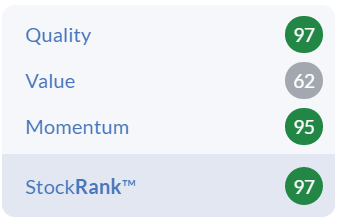
That said, the graphs below show that profit growth has stalled in the last few years, so that’s probably why the market ascribes quite a modest PER to this share. You can see from graph 4 below how modest the PER tends to be for this share. Does that mean it’s dead money? No, because there’s a lovely flow of divis, including supplementary ones.
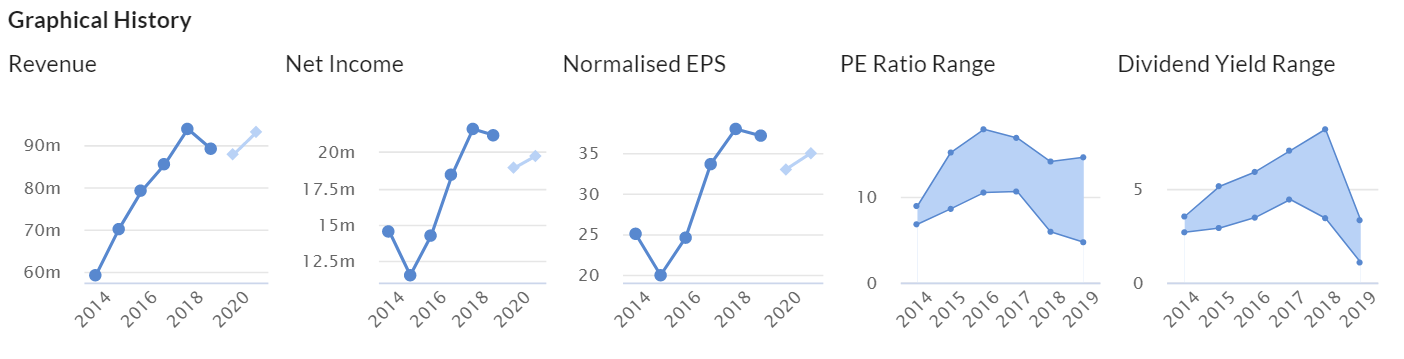
I think shareholders here might need to be patient, and wait until 2022 and beyond for growth to pick up, with new products & the time lag from additional sales staff being recruited in 2021 to delivering results.
That said, SOM often surprises on the upside.
It’s a cyclical business, but with major stimulus & infrastructure spending likely in the its main market, the USA, then I would have thought the outlook seems favourable.
Overall, this looks a decent value share, suitable for patient investors, especially income seekers. I continue to like it, but am not expecting any explosive upside on the share price, unless someone bids for it.
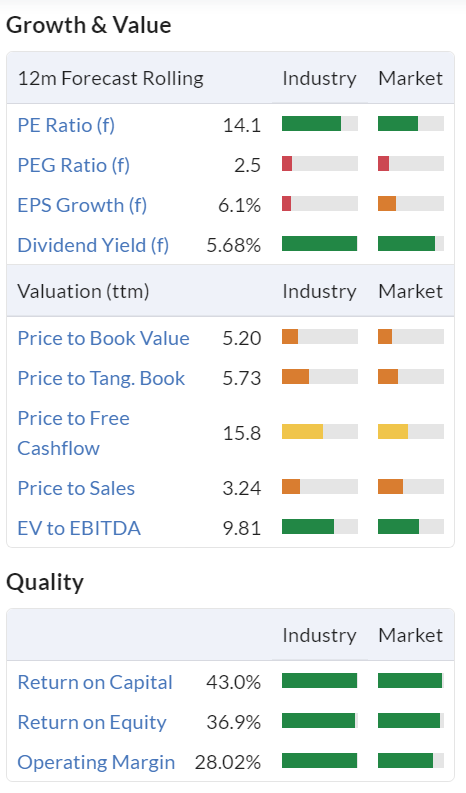
As you can see below, this share stands out for both high quality metrics, and high value scores too, quite an unusual combination. Stockopedia rates it s "Super Stock".
.
Beeks Financial Cloud (LON:BKS)
109p - mkt cap £57m
Here is my review of the FY 06/2020 results, which is a useful refresher of the main points. I like this company, but concluded at 92.5p on 15 Sept 2020 that it looked priced about right - not cheap, but it’s an interesting little growth company, so deserves a punchy rating. Since last autumn practically everything in the small caps space seems to have shot up 50-100%, so the fact that BKS is now only up 18%, means it’s a relative laggard over the last 6 months.
The graphical history below is interesting & tells the story very well. Strong (mainly organic I think) revenue growth, but profitability & EPS have been somewhat disappointing, because costs are rising all the time.

As we’ve been discussing recently in the comments here, UK investors seem to prioritise profits & divis, which forces UK small caps to grow more slowly once they list, and get left behind potentially by better funded competitors, which might be able to run at a loss, with financial backers looking to the longer term, bigger picture.
Personally I’d rather see companies like Beeks prioritise growth, and maybe run at breakeven. That makes it hard to value the shares though, because PER becomes useless.
Maybe companies like this could publish a range of forecast figures, with the various options of slow, medium & fast growth, and how that would pan out over a (say) 5 year period, to show investors what they are aiming for, and why.
Investor Presentation - 2:00pm 11 March, on InvestorMeetCompany - signup link here. Management always present very well I think.
Expansion of Tier 1 customer deployments - a separate announcement 2 days ago.
Including a global private cloud contract expansion to over $2m in annualised revenue… 8 March 2021 - Beeks Financial Cloud, a leader in cloud computing, connectivity and analytics for financial services, is pleased to announce continued strong progress against its land and expand strategy, as also described in the Company's interim results released today.
That’s impressive, and material to the overall revenues.
Further details are given of these 2 large customer contract extensions. This should underpin future growth. Client concentration might become a greater risk though.
8 March 2021 - Beeks Financial Cloud Group plc (AIM: BKS), a cloud computing and connectivity provider for financial markets, is pleased to announce its unaudited results for the six months ended 31 December 2020.
Key points -
- Good revenue growth +24% to £5.29m
- Recurring revenues are 91% of total - very good, I like shares in companies which are building a sticky recurring revenue stream
- Annualised run rate for revenues is £12.0m, giving good visibility of further growth (increased further to £12.8m pa by end Feb 2021)
- Gross margin is only 49% - not great for a cloud software business, but it depends what costs are being absorbed into that figure
- Underlying profit before tax is only £0.55m in H1, down 8% on LY H1 - so the revenue growth is being used to fund extra overheads - your attitude to that is key to whether you like the investment case or not.
- Underlying basic EPS is down 7% at 0.94p in H1. Full year would be double that, so about 2p, hence a PER of c.55 - but PER isn’t necessarily the right way to value a small growth company.
Valuation - rather than using PER, maybe it’s better to try to forecast where the business is going longer term, and what your investing time horizon is? Then decide if the current price offers an attractive price or not.
A recent note from Progressive Equity Research forecasts 2.7p adj EPS this year (FY 06/2021), rising to 3.9p next year. That brings the PER down to a more palatable 40.4 and 28.0 times respectively. Still high, but that can be justified for the growth, if it is achieved, and doesn't get swallowed up in extra overheads again.
Net debt is £2.05m, worsened from a net cash position of £0.7m a year earlier. Given the recurring revenues, I don’t see this as a problem.
Balance sheet - a little weak, I’d prefer to see a bigger cash pile, and no debt. But given the nature of its recurring revenues, the risk isn’t great. A small top up placing could be done any time, one of the big advantages of being a listed company.
Outlook - sounds reassuring -
Solid sales pipeline, including further Tier 1 opportunities
· Continuing to see an increase in the number of financial services organisations take advantage of the benefits of cloud infrastructure
· Increase in new business sales in recent months, trading for the current financial year is positive and remains in line with the range of market expectations
· Revenue and margins expected to benefit in H2 FY2021 and beyond from growth in both existing and new customers
Cashflow - note that development costs of £868k were capitalised in H1, over 4 times the size of H1 LY. Contingent consideration of £1.0m was paid out. Plus physical capex (for computers, I expect) was £1.18m in H1, so it’s not a particularly capital light business model.
My opinion - I do like this market niche, and management. However, given that the company is so small, and not yet really profitable or cash generative, it’s a long-term investment proposition. If you’re prepared to buy the shares, and wait say 5 years, then I reckon this could be a considerably larger business, and generating decent profits. It seems to operate in a good growth niche, and have sticky customers generating recurring revenues - lots to like there.
At this stage, I really can’t work out how to value the shares. It certainly doesn’t look cheap, but in 5 years’ time we could be kicking ourselves, saying why didn’t we pay up for it when it was small? Tricky one. On balance, I’d say I’m leaning towards being moderately bullish with a long-term view.
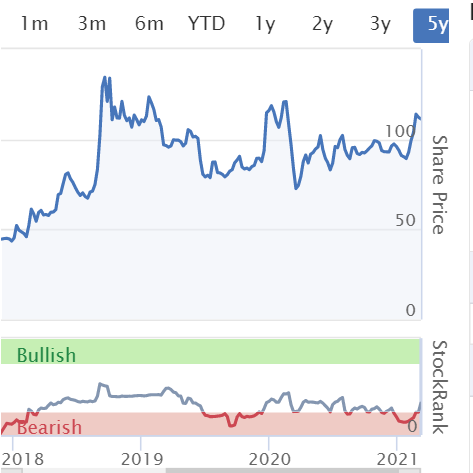
After a burst of excitement in 2018, the share price has since drifted down/sideways. Note also the Stockopedia algorithms aren't impressed at this stage, with a lowish StockRank.
.
Jack's section
Kin and Carta (LON:KCT)
Share price: 155p (+4.73%)
Shares in issue: 168,845,628
Market cap: £261.7m
Kin And Carta (LON:KCT) is ‘digital transformation’ company that drives value for customers across four key digital elements: data, technology, experience, and organisational change. The group is headquartered in London and Chicago and its platform is made up of three distinct areas:
- Kin + Carta Advise - sector-focused management consultants to the C-Suite,
- Kin + Carta Create - 800+ data scientists, software engineers and designers ‘utilise emerging technologies to create new products and platforms’ for CIO clients, and
- Kin + Carta Connect - MarTech experts help CMO clients implement and optimise modern marketing technology and data platforms.
Glancing down the StockReport, we run into a couple of warning signs. KCT is classified as a Momentum Trap, with low Quality and Value Ranks. Meanwhile the strong Momentum Rank suggests shares have already rerated.
And a look at the Financial Summary shows that four of the past six years have resulted in net losses. Today’s results, for all the optimistic narrative and adjusted figures, clock up another net loss (in fairness to the group, its cash generation has been more robust).
But then we get to financial health: the poor F and Z Scores, a net debt position, a pension fund (in surplus), declining book value per share and increasing shares in issue. None of these signs bode well for shareholders.

But the brokers rate this group a strong buy and profitability is forecast to improve by 54% in FY21 and another 40% in FY22. This manifests in the low forecast rolling PEG of 0.6x.
So perhaps the group is reaching an inflection point.
Kin talks of growing momentum and sequential operational improvement. The 90-day net revenue backlog is 77% larger than the start of the fiscal year and 27% larger than February 2020, pre-pandemic.
In terms of half year highlights, we have:
- Revenue from continuing operations down 10% to £64.1m but with improving momentum and sequential growth.
- Adjusted profit before tax from continuing operations of £2.9m, but statutory total loss before tax from continuing operations of £6.4m.
- Net debt reduced from £31.6m to £22.5m.
- Divestment of Ventures businesses Hive and Pragma for £14m (before adjustments for cash, debt and working capital) and acquisition of Cascade Data Labs, a Portland, Oregon-based data transformation consultancy for an initial consideration of USD $6.9m (£5m).
- Digging through the notes we see that the total consideration payable, including contingent consideration payable which is deemed as remuneration, could be as high as £22.3m.
The difference between adjusted and statutory profitability arise primarily from £2.2m of pension scheme costs, £4.9m in amortisation of acquired intangibles, and £1.7m of contingent consideration to be treated as remuneration.
One concern I have is whether or not management is allocating capital prudently and effectively with its acquisitions, especially when a good chunk of the cost is later expensed as remuneration in the income statement.
M&A is a famously value-destructive way of spending money. A few do tremendously well with such strategies but many more ultimately hurt shareholder wealth. For brokers, of course, empire building management teams are a dream due to the fees they generate.
Conclusion
For all Kin’s talk of sequential improvement I wonder why, as a self-declared digital transformation specialist, customers have not been knocking the door down over the past year. Surely it’s the perfect time for a bit of digital transformation? Or perhaps Kin’s services are non-essential.
The direction of travel may be more positive than it was, but the share price has also rerated aggressively and is trading at a significant premium to pre-Covid levels.

We’re seeing this with a lot of companies, where in my view investors’ optimistic sentiment has overrun and has consequently reduced a good chunk of potential upside. Meanwhile, the outlook for Kin is hardly risk free.
Brokers are forecasting net profits for FY21 - but based on these results, things need to improve far and fast in H2, unless we are to continue relying on the group’s heavily adjusted results.
The bottom line is Kin has a history of trading losses and its balance sheet is weak. Interestingly, management says its ‘balance sheet remains strong’ but frankly I dispute that given the net debt and the fact that it is stacked with intangible assets and goodwill.
This gap between management’s narrative and my own perception of financial health along with persistently large differences between adjusted and statutory results makes me question the shorter term risk:reward ratio here.
Disclaimer
This is not financial advice. Our content is intended to be used and must be used for information and education purposes only. Please read our disclaimer and terms and conditions to understand our obligations.

94 comments
Paul, probably off topic this but your note had me thinking M&A small UK stocks what’s the thoughts on specific stocks or sectors that may achieve a quick multiple due to possible take over targets? Pci-Pal had me thinking that could be a takeover target given its scalability and larger players in the financial transaction business maybe wanting to grow into this part of the market to increase margins. Presumably the travel sector another area where consolidation is very likely?
Kin And Carta (LON:KCT) - is ‘digital transformation’ company that drives value for customers across four key digital elements: data, technology, experience, and organisational change. The group is headquartered in London and Chicago and its platform is made up of three distinct areas:
Apologies to SR readers for repeating a 'nothing going on here'. Time is money.
Anyone on here own Eqtec (LON:EQT) ? I watched an interesting article by the guy that runs the Amati fund a while back and they bought a load. I then watched the price soar from 0.5p to 3.5p so I left it alone but picked up some finally today at 1.5p. This is a super interesting space and where a number have promised much and failed on the tech it appears Eqtec (LON:EQT) may be the real deal. Seems like plenty of execution risk here still : £8m to find for the property within 12 months, a deal to be confirmed with a European owner/operator subject to credit review but assuming those not insignificant hurdles are overcome then brokers forecasting some very big revenue and profit jumps : 2021 €48m revenue and PBT of €7.4m and in 2022 €16m of profit.
I've seen enough of these ventures going wrong to take it all with a pinch of salt so I'm interested if others have better insight than me on this.
How can the Cap be >100 times Turnover? Are they about to do a reverse takeover of a larger company?
Eqtec (LON:EQT) specialise is biofuels which is a nonsense concept that releases more carbon into the atmosphere than burning coal, but apparently thats okay because trees are renewable.
Biofuel will have to be abandoned at some time and has a limited future.
Please give an opinion on the proposed takeover of Scapa group
Hi
Does anyone have any idea when the brokers might update the forecasts for Wynnstay (LON:WYN)?
We had the announced acquisitions on 04 March 2021, but with no numbers or dates, and I am just wondering whether this is been an amazing purchase, as it seems on steroids right now but the acquisitions might return this to a more sensible P/E, or whether I should be thinking to step off the dance floor for some fresh air and a drink whilst it all cools down?
Tommy
ps. I hold
pps. Thank you Jack for your report way back when, which gave me the idea to look into!
ppps. In the spirit of FOMO and honesty this was an initial stake (2% of portfolio) and obviously I thought about increasing to 5% on more than one occasion but worried about valuation, and didn't... or do I need to be more Coffee Can?
Thanks for the Foxtons (LON:FOXT) update Paul. Wonder what you and others think about the share buy back programme? Personally I always think if a company has spare cash why don't they pay it to us as dividends?
I should have added, "and thanks for bringing this to our attention in October, Paul". Have just sold the shares I bought after reading the Oct update for 96% profit!
Ekf Diagnostics Holdings (LON:EKF) rather cheeky hand out to the exec directors announced today: https://www.investegate.co.uk/...
I entirely agree with you about EKF Diagnostics Holdings (LON:EKF). It's no different from the directors putting their hand in the till...or MPs voting themselves a pay rise. I hope the larger shareholders express their disapproval.
Just a thought on Somero. Over the last two years, after listening to two video presentations and hearing several managers speak of their responsibilities, management of this firm is quite impressive. The balance sheet, as you observe, is iron-clad and flush. The international potential must be considered terrific, given the on-going success in the U.S. market. The American economy is sure to take off in the coming months, once the pandemic has been mastered. And the firm's products are surrounded by patented moats which give,them a fantastic competitive advantage as can be seen in the profitability figures (just look at return on capital!). And more innovative machines are to come. So, from an investor's point of view, this is almost a no-brainer. Surely a company on the radar of a big international equipment manufacturer, and while waiting for the generous buy-out proposal, a great dividend. As for the coming added costs due to an expansion of their marketing and production facilities, what better way to enhance an already brilliant future?
A small word of apology. Transparency requires that I mention I have invested a moderately significant portion of my portfolio in this name. So anything I say requires DIY analysis.
Paul
You write re Somero, a US company: "to get paid the full divis without a US tax deduction."
My experience is that if one completes a W-8 BEN there is a 15% US Tax charge which can be used as a credit against one's UK tax . The US 15% tax charge is a reduction from the usual 30% US tax charge if no W08 BEN form is completed.
You imply that one can fill in a form and have a zero US tax charge and not as I thought, a 15% reduced tax charge.
If so please can you let me (and other readers) know what that form is ?
Thanks and also thanks for your excellent and sagacious and cogent comments.
Somero Enterprises Inc (LON:SOM)
You imply that one can fill in a form and have a zero US tax charge and not as I thought, a 15% reduced tax charge. If so please can you let me (and other readers) know what that form is ?
Hello Star8 - i can confirm that for sipp accounts this is indeed correct that you CAN have the holy grail of no tax deducted (same does not apply for ISA'S) - there should be no need to complete anything above and beyond the Mr Benn form (W-8 BEN) however i think that you may need to double check that your sipp provider will go this extra mile for you - i am not 100% convinced that all sipp providers will automatically cancel out all the tax charge - hopefully your does. Not sure why it would be the case with some sipp providers may do it and some may not - i may have a foggy memory ref this bit though so it may be now that there is no issues with any sipp providers i just would not preume that to be the case without specifically checking.
I have read recently that some Sipp providers don't reclaim the 15% tax.
So yes you need to check.
Thanks.
A reminder that for beneficial tax reasons you are best investing Somero Enterprises Inc (LON:SOM) within a SIPP.
If I recall correctly, if you fill in a W8-BEN form through your broker you should only pay 15% withholding tax whereas if you hold in a SIPP then you pay nothing.
I have an IKBR account for dealing US shares in dollar once converted and IG for UK in sterling. Would not use a UK account for dealing US shares - did that and got£35 hit per transaction = nil profit for anytime soon.
Anyone recall the not so distant Mervyn King era when he was Governor of the Bank of England?
The BOE's principle target latterly was inflation but never did much to raise interest rates even when inflation was above their target rate. This lead to the Bo'E having to issue a letter on a regular basis saying they had missed their target. (Oil prices were high during that time if I recall correctly, and may have been a factor in the basket of inflation costs?)
I can't recall the reasons at the time for holding back rates, but generally think it was due to the perceived weakness of the economy. Of course in due course the big financial crash occurred and then QE was introduced specifically to reduce interest rates to avoid monetary shock of reduced monetary liquidity (due to tightened credit terms following big losses).
History tends to inform that both the Bo'E and the Govt will not want to encourage interest rates, however, very difficult to control currency flows, and thereby input prices of goods/services sourced from abroad. However, in recent times a low priced UK pound has never really caused a Policy crisis, and QE itself has really only encouraged 'inflation' in asset prices.
Hard to see quite what will be the tipping point for any change in the short term? Even Oil prices increasing may have less effect than they formerly did.
for those who don't read Blain's morning porridge a less serious narrative today on socks
https://morningporridge.com/bl...
Jack's report on Kin and Carta (LON:KCT) is interesting. Having read his comment "For all Kin’s talk of sequential improvement I wonder why, as a self-declared digital transformation specialist, customers have not been knocking the door down over the past year".
I haven't looked at this one before but seeing that it provides "Advise" "Create" and "Connect" reminded me of similar things at a company I once foolishly held called Communisis. Its offering was divided into "Produce", "Deploy" and "Design"but then after much thought and reorganisation became "Customer Experience" and "Brand Deployment".As if all this thinking of words wasn't enough it produced STRATEGIC PRIORITIES of DIGITAL FIRST, GLOBAL REACH and EMPOWERED ORGANISATION.I imagined the sales force spending most of their time explaining the company's language to its potential customers rather than gathering orders. (Is this the answer to Jack's wondering why?).
The profits and share price never took off but mercifully a bid came along allowing me to exit with a positive result. Since then I have been wary of companies using fancy in-house language!
And here's another example:
The name Kin + Carta embodies what the Group stands for. Kin, as in family, represents the Connective's emphases on connection and collaboration. Carta, meaning map, underscores the Connective's mission to help our clients navigate the new digital world, while plotting a clear path to growth for our people and our shareholders.
Communisis, whatever they claimed to be, finished up a very successful holding. I followed Richard Griffiths in when he took a very large position. He has now taken a substantial holding in Esken (Stobart) so lets hope it also gets some funny terminology and gets taken over! I have actually been quite impressed reading the narrative in the annual reports of Kin and Carta. It is, of course, the old St. Ives but has changed its business completely to a sort of tech company doing business on a global basis rather than mundane printing in the UK. At least the share price has done quite well subsequently. Up from I think around 50p when new people went in.
doublelutz - 'a very successful holding' - well not if you bought CMS in Spring 2014 but if you bought with Richard Griffiths, who is certainly one to watch, yes. He declared 5.8% in Jan 16, got to 20% in Jan. 17 and 25% in Sept. 17 see:
sharw, I remember Communisis which was bought out by Bidco leaving me with a small gain, however, next to it in my spreadsheet of failed investments is Conviviality which was a personal disaster, also Carrillion. What is it about these companies beginning with a C ?
UK inflation is very difficult to predict and beyond the scope of the Treasury of BoE to control. Most consumer goods are imported so prices of these depend on exchange rates, commodity prices, productive capacity and wages elsewhere (especially China) and global demand. Many low skilled services have seen deflationary pressure in recent years from EU migration. Even property and private school fees are influenced by international demand. Post Brexit trading and immigration arrangements are bound to have an impact too.
"Newspapers have been saying more recently that, after a year, many people are getting fed up with working from home, and want to at least spend some time back in the office."
But I know people who have a different view, they never want to go back to commuting and working in London, one has said if she has to go back then she will retire.
Some companies have closed down some of their offices, so the return won't be happening for some workers as companies have found working from home works and the costs are much reduced, Aviva (LON:AV.) has close 2 offices "Aviva to close two large office sites in Norwich". From the workers point of view they have reduced costs, ie no travel which can be expensive and more time as no time wasted in travelling. But I understand the negatives as well.
Closed offices will have a knock on effect, no maintenance so may effect companies such as Mitie (LON:MTO) and also council revenues unless these can be relet or turned into some other use such as Hotels.
In Suffolk, there have been a surge in property sales in my area, some are selling even before there have been advertised, many buyers seem to be from London area.
almost everybody I speak to in the city is keen to return to the office. Only one person I spoke to would be happy not to have to go back in. C-Suites are similarly minded that they want people back in. Where the key change comes about for me is that everyone is equally keen on flexibility to work from home a day or two a week and C-Suites are generally keen on allowing it. That has some impact on large firms reducing some office space but as I understand it there is more than enough demand to pick up that space. Main impact is probably therefore on new office builds.
From what I can make out a large %age of those who don't want to go back in are affluent and middle aged / not far off retirement. They tend to have deeper pockets, bigger houses and local social groups (ie older kids where they've met people) so it's comfortable for them. Most others complain about the lack of work/life delineation. The "finish work at 5/6/7pm" just doesn't happen - computers are still on and people seem to think it's fine to message late and get answers.
For what its worth my take is that this is all noise and once the pandemic is properly over the social interaction that working in busy places brings will bring about a return. It's already interesting to see that when a team is in the office and someone is on a zoom call the latter feels slightly out of the loop, somehow not part of the team. That will also bring about social pressure to return.
For what its worth my take is that this is all noise and once the pandemic is properly over the social interaction that working in busy places brings will bring about a return.
Out of my clients and contacts precisely none are planning a full return to the office. It won't even be possible - at least two of the major banks are reducing their office space by 40%. Whether people want to or not they won't be able to go back to the old ways.
What most seem to be doing is creating a mixed environment where meetings can be held in a central (or sometimes regional) hub and actual work is done at home.
timarrAnyone who is an unofficial part time share trader - the numbers of which I suspect have increased significantly in the past year - will definitely not want to return to the office. Its hard to read the small cap report with the boss looking over your shoulder!
I work for a large IT outsourcer and can echo this comment.
My employer has let over 50% of the office space go in bristol (where I live).
We have moved to hotdesks (yuk).
In London my colleagues used to pay > £500 per month to commute in daily from n. essex and now spend £0.
I am sure they will not be taking a 5-15% pay cut later this year...
The mixed environment was pretty much in place in central london ~2-3 years ago.
WTW has a v.v. plush office in the city. It is mostly meeting rooms and kitchens from what I could see - I am sure the other consultancies do the same.
As such for people who have 'knowledge based jobs', I see a central office with lots of nice meeting rooms that we visit once a month and then work at client site / home otherwise.
I have a 'knowledge based job' and recognise that it is v. easy to assume everyone else is in the same position, but, do know that a lot of other jobs that were 100-200 people in a big office on the floor above (different business unit) have been successfully WFH since last march and have no plans to return.
This is a 'good' thing for someone like me - with a room that is an office and who knows everyone I need to contact.
For any fresh graduate joining the business I despair - how does such a person grow into this type of business?
"For any fresh graduate joining the business I despair - how does such a person grow into this type of business?"
Exactly.
I think about my first job and there is no way I would have been able to do it if everyone was at home 3 days a week.
I recall frequently walking around the office asking around for the 1 person who might have the information that I needed. It was also a nice way to get to know people around the office. Doing that remotely, whilst possible, sounds like a nightmare for a first job where you don't know how things work or who does what.
A
I think about my first job and there is no way I would have been able to do it if everyone was at home 3 days a week.
One of my customers has onboarded 250 new staff in the last six months while everyone is working remotely. Broadly that's worked out very well - some people have whole teams working for them that they've never met.
In future there'll be mentoring and training programs. Staff will meet centrally when needed but there won't be enough office space for everyone to work onsite. In fact, when people have to work they've found it's more productive for them to do it from home (this is a progressive employer that judges employees on output not presenteeism).
In fact the hardest issue they've found with new, young staff is that their homes aren't suitable for home working. Two people in a one bedroom flat is a tough working environment, for instance. What they're already seeing is people moving out of central city locations to find bigger properties.
Not everything will change for everyone, but many changes have already occurred. Offices and high streets will look very different when we finally get to return to them.
timarrYes there are opportunities presented to individuals who no longer need to live near work.
I moved out of London over 20 years ago, but only after I had got approval to be "full time" homeworker. As we were somewhat ahead of the curve, the downside was that if I wanted to change company I would have needed to accept the long commute - so it is not without risks until it becomes clear how many companies continue to embrace homeworking.
It has some very strong pros and cons (I could probably write a book on the subject)!
As far as the issue of people whose homes are unsuitable for working from home this could perhaps present opportunities for companies such as IWG (LON:IWG) (Regus) although it will be interesting to see who fund their services.
We I first home-worked, I got a capital sum to kit out my office a paltry allowance towards utilities and got paid expenses whenever I went into the office, but that wouldn't come close to funding a serviced office space.
Getting back to investment matters, I do think it is true that there will be reduced demand for permanent office properties and therefore reduced demand for city centre sandwich shops etc.
But I do feel brave enough to take a stab at this stage as to how significant that will be.
Frankly I would be more comfortable forecasting next years inflation number to two decimal places!
almost everybody I speak to in the city is keen to return to the office. Only one person I spoke to would be happy not to have to go back in.
I am a city worker. Myself and all my friends who work city jobs are all in 100 percent agreement we never want to return or see an office again.
Nice thought, but what happens when the bosses say they want you in :-)
Thats the problem really. The desire to go back seems to be from the top of the food chain so my view is a return to how it was is more likely
Here are my SCVR heat maps for today (prices as at ~10:30am).
Small / Micro Caps reporting today:
Big movers today in the SCVR world (moving more than a 20d EMA of the ATR against either yesterdays close, or today's open):
Warm regards, stay safe, and best of luck!
greensiax
PS: See my main heat map thread for more (non-SCVR specific) heat maps, and keys to the heat maps contents.
Hi Paul
Worrying too much about inflation when there are few to no signs of any real change feels somewhat futile to me. Economic model forecasts are generally wrong and often by a wide margin - as we all know predictions of future effects are phenomenally difficult to get accurate and made worse over time by the global nature of demand and supply.
That doesn't mean one shouldn't consider the macro and potential effects or hypothesise the "what ifs". From my perspective doing this at least allows you to formulate a loose plan around what to do should inflation start to rise and interest rates likewise.
I know a lot of good economists who back in the aftermath of 2008/9 predicted large scale inflation that just didn't happen. Clinging on to a belief when the market and stats tell you something different generally isn't conducive to good returns. Better, I think, to be constantly on watch for a changing narrative.......but that's just me.
best
David
Inflationary pressures include the big gains in commodity prices and also recently the oil price, along with higher costs for some Companies still trying to trade in Europe, and higher shipping costs. Add to that clear evidence of pent up demand for all sorts of things including travel. When demand exceeds supply there’s inflationary pressure as it’s easier than it has been for years to increase prices.
We enquired about a new conservatory with a local Company we’ve used for years. They said they had never ever been so busy. They have had to turn away anyone not local and even for locals the waiting time is over 3 months. It’s the same with sheds. While in the queue to be seen at a shed supplier someone commented that they had saved soooooooo much during lockdown and are keen to spend some of it.
Add to this the uncertain inflationary effects of QE/stimulus packages on a scale never seen before and rising inflation very soon seems inevitable. Question is whether and how it can be prevented from getting out of control. Even a small rise in interest rates would mean much higher mortgage payments for any not with fixed rate mortgages. Inflation and interest rates have been so low for so long that the under 40s have no experience of it and think the current low inflation is the norm. Is there a chance of a return to the 1970s wage/price spiral? Inflation then peaked around 25% and in 1974 the stick market at the time of soaring oil prices crashed 70%..... before doubling in a few days in early 1975!
Sectors to be in with higher inflation? Mining sector seems an obvious beneficiary but shares have already soared. Commercial Property perhaps? Some Commercial Property Investment Trusts are still on very big discounts. What else and what definitely to avoid?
Apologies.Somehow posted this twice.
Inflationary pressures include the big gains in commodity prices and also recently the oil price, along with higher costs for some Companies still trying to trade in Europe, and higher shipping costs. Add to that clear evidence of pent up demand for all sorts of things including travel. When demand exceeds supply there’s inflationary pressure as it’s easier than it has been for years to increase prices.
We enquired about a new conservatory with a local Company we’ve used for years. They said they had never ever been so busy. They have had to turn away anyone not local and even for locals the waiting time is over 3 months. It’s the same with sheds. While in the queue to be seen at a shed supplier tpsomeone commented that they had saved soo much during lockdown and are keen to spend some of it.
Add to this the uncertain inflationary effects of QE/stimulus packages on a scale never seen before and rising inflation very soon seems inevitable. Question is whether and how it can be prevented from getting out of control. Even a small rise in interest rates would mean much higher mortgage payments for any not with fixed rate mortgages. Inflation and interest rates have been so low for so long that the under 40s have no experience of it and think the current low inflation is the norm. Is there a chance of a return to the 1970s wage/price spiral?
Sectors to be in with higher inflation? Mining sector seems an obvious beneficiary but shares have already soared. Commercial Property perhaps? Some Commercial Property Investment Trusts are still on very big discounts. What else and what definitely to avoid?
With more money in the system, some sort of inflation is inevitable.
The powers that be moved the goalposts when they changed the definition of inflation from:
an increase in the quantity of money, that is not offset by a corresponding increase in the need for money, so that a fall in the objective exchange-value of money must occur.
To:
a persistent, substantial rise in the general level of prices related to an increase in the volume of money and resulting in the loss of value of currency.
The obsession with prices is a trick, as it completely misses other dislocations that result from the increase in the supply of money. Where do you think people will put their savings if they want to save for a rainy day? In their current accounts making 0%? Or what about assets - property, gold, shares, crypto?
Where are the stimulus checks going to go - into checking accounts, more spending, gold, where... ?
That money has to pop out somewhere, even if it remains in bank accounts, it can be lent out by the bank to those who do want to spend/invest. Savings are good - shame we're not encouraged to so so with reasonable interest rates. Which is why with ZIRP and continuous money printing/QE we will end up with asset price inflation instead.
Cryptos have had a good run, property is already expensive - but I think the trade to be in at the moment is probably in the precious metals., it is not a crowded trade and that's where I'm currently looking for value (gold and silver miners/producers, oil/energy too.)
I note with interest that coinciding with a well structured presentation to the 'Mello 500' on Monday by the Duke Royalty (LON:DUKE) management, the largest shareholder Cannacord Genuity has reduced its shareholding from nearly 13% to under 11%. To improve liquidity in anticipation of extra demand from private investors?
"To improve liquidity in anticipation of extra demand from private investors?"
I wasn't sure whether this was said tongue in cheek - or do you really believe that CG instigate their trades for the benefit of the hoi polloi?
Sorry Laughton, re Duke Royalty (LON:DUKE) we don't have a sign here for tongue in cheek. Indeed it was.
Yes I'm concerned about inflation, inflation will reduce the value of your money, it will hit people on fixed incomes, on investments you need to take inflation off your gains to get the real gains, it will also cause interest rates to rise which may suit savers but will hit people with mortgagees. I remember the 70s and 80s all too well. I experienced 15% mortgage rates, it was a very difficult time for me. We could see negative equity again. As I have said before when I had a mortgage in the 80/90s most of my repayments were paying the interest not the capital.
As Paul has said shares prices did not perform so well, is that because people now have more disposable income now?
Only benefit I can see from high inflation is reducing our debts in real terms.
Only benefit I can see from high inflation is reducing our debts in real terms.
That is a major benefit in terms of social mobility. You need some inflation with consequent debt forgiveness to let people climb the ladder and reduce inequality. That's why the BoE isn't targetted at 0% inflation.
Of course getting the Goldilocks amount of inflation isn't simple. But I seem to remember that in my first ever post here I argued that the times we lived through in the 70's and 80's were the aberration from the very long term trends and fearing a reversion to those levels is largely a result of the scars we bear from that time.
As long as the idea that governments can create as much money as they like without consequences doesn't take hold.
Paul: "This all means that, despite vast QE (money printing), there’s still little to nothing in inflationary pressure"
QE itself was never going to create much inflationary pressure. Those that hadn't learnt that lesson from Japan learned it in the west in 2008. In the old days they used to think that "V" (in MV = PQ) was relatively stable, so increasing M must drive up nominal GDP. The last financial crisis proved that's wrong.
There is too much focus on QE and monetary analysis. Inflation doesn't care! What matters much more is the fiscal situation, mainly the deficit. Whether the deficit is "funded" by investors buying the debt or, alternatively, by the BOE buying the debt (QE) matters little. It would only matter if neither investors nor the BOE wanted to buy the debt and so yields took off. But that is not where we are, or likely will be for the foreseeable future
The fiscal deficit is the thing that makes the difference because, unlike QE, it puts money in the hands of the people. After the last financial crisis, deficits were big, but never big enough to create much inflationary pressure. So interest rates never escaped the near zero bound. This time is a bit different, particularly in the US with the $1.9 trillion stimulus bill, which might be a bit over the top. That's less true here with Rishi "prudence" Sunak, but what happens in the US will inevitably impact us here anyway.
Overall though, what I expect is just a bit of a return to normal. Yes there will be a return of some inflation (and a few blips up in the headline rate). Yes gilt yields will rise from extraordinariy low and unjustifiable levels. Yes this will mean that growth stocks will need to be discounted at a higher interest rate than practically nothing. But all of this is actually good news for the long term and should be welcomed, even if there is some pain in the adjustment.
The MV = PQ framework is a handy and simple way to look at these post crisis recoveries. What we need to do is to increase "MV". That will happen if deficit spending puts the "M" in the hands of the general population instead of bank reserves and investment portfolios, which is what QE does. In an economy operating below capacity, that will drive up "Q" more than "P" and that will be good, but we shouldn't be surprised to see some increase in "P" too. In an economy operating at full capacity, if we ever get there, increases in "MV" can only drive up "P" because "Q" is maxed out, but that's not where we are now.
Hi Paul, just on the inflation question, I don't know whether we will return to a more inflationary world in the medium term, or whether after a short spike we will revert to the lower for longer environment. However, I can't agree that there is no sign of inflationary pressure yet. Just read the latest PMIs from the US, UK and Eurozone. All of them show input prices rising at an historically high rate.
Education needed. Can any shed light on a share price is determined -is it an algorithm within SETS purely based on supply/demand (ie buyers/sellers) or is there an input from market makers (euphemism for manipulators). Thanks Folks
market makers manipulate to favour their business. buy wholesale, sell retail.
low on merchandise? bring the price down (engender emotion) and buy as low as possible. IMHO if there is no change in a company that you have bought, why sell? Fear, of course.
Buy at the bottom of a downturn, not when it's gone up.
MM's now have full stock of merchandise, so they want the price to go up again. That is when they sell into the market. Drip, drip. The rise rises as their stock level falls. People see the price rising and as often as not, buy in at the top of the rise. (FOMO) - And that is when the MM's start selling again. The cycle repeats.
I have simplified matters but the basic buy/sell demand is the crux of the matter.
Anna Coullings 2013 book on Volume and Price Analysis opened my eyes. Do you look at the volume?
That really isn't how it works. I have been a market maker. "Low on merchandise", the price goes up, I need to make it more attractive to sellers to give me stock, not the other way round.
Good Morning ,
Thank you for your analysis on inflation.The reason why you cannot see inflation because we are still in lock down.We have more deflation than inflation at the moment.USA is a different market, its bigger and the pressure was on currency devaluing because of quantitative easing.However oil price is also pegged to dollar and when this improves dollar also improves.People will need dollar to pay for crude. Therefore fed do not need to raise interest rate or buy more bonds to reduce the cost of borrowing.When you see dollar going up that means there is a demand for it.Everything is linked interest rate, quantitative easing, oil prices, health of the nation, budget(raising taxes and corporation tax) will have an impact on businesses and intern on equity.
The key is when to sell the share if we can master that then we are all winners.
On inflation, yes I am concerned. I’m of the view that there’s no such thing as a free lunch and so there must be some negative consequence of QE. So, where will inflation show up. I think that’s anyone’s guess but depreciation of sterling may be a factor even if it hasn’t occurred yet. However, three additional factors come into play I think.
Climate change. The switch to more expensive green energy may cause inflation (cheaper running costs of EVs are an exception I think). The governments may also have to bring in additional environmental taxes. E.g. on the carbon footprint of goods and services such as aviation and cruises. All difficult to implement but how will we reach the climate and pollution objectives otherwise?
The dash for growth. The productive capacity of the economy can only have been damaged in general by Covid but the governments are angling for fast growth to grow away our debts. Sounds inflationary to me.
Governments will also welcome some inflation to inflate away the size of the debt, so will be happy to tolerate higher inflation for a while.
I thought green energy will be cheaper as once you have set it up, solar and wind are free? In the US they are talking about very low electric prices, which may be a reason to switch to EVs from fossil fuels.
I think food prices will rise, I'm seeing this already in the shops, not sure if Brexit will cause prices to rise or not. I think we should be producing more food ourselves rather than importing a lot of it.
I thought green energy will be cheaper as once you have set it up, solar and wind are free? In the US they are talking about very low electric prices, which may be a reason to switch to EVs from fossil fuels.
I think that is likely true, though there are significant costs in connectiing everything up, long term repair maintenance and provision of charging points.
However, the reason running costs of EVs are currently cheaper than ICE power in the UK is nothing to do with that. It's a simple reflection of fuel duty. And that is a significant source of govt revenue that will have to be replaced somehow as EV use takes off.
Yes I have been wondering how the Govt. will get duty on EVs.
I can't hardly see how we can produce more food ourselves, herbie, when thousands of hectares of good productive land are being used or reserved for housings estates, many farms have been bought up by those with obscene amounts of cash/income for use as personal recreational areas and others are being re-wilded.or covered in solar panels. You know things have got out of hand when foxes are safer than women after dark in urban areas and I apologise for straying off topic but hey, this is the New Millennium.
Tremor International (LON:TRMR) very strong results today. H2 results were EBITDA of $58m and it seems trading in current quarter means confident of growth this year. There is a H2 skew for Christmas window though I'm not entirely sure how large this will be but feels as though $100m+ ebitda is on the cards for the full year. Has $100m in net cash now too despite share buybacks and considers a dual US listing.
now a £780m market cap. Intangibles and thus depreciation are weighty so one needs to be careful of EPS numbers as they mask what's really going on here.
EV/EBITDA probably a better measure in my view and that's around 10* now for current year so doesn't feel particularly stretched given growth outlook.
Of course we still have the recent purchase of one of their competitors at the equiv of around 1000p to also put into context here.
Tremor International (LON:TRMR)
Lot to like here at the moment. Heavy hints at dual UK/US listing (appointment of Stifel, change to US GAAP , accounts produced early ........) which may give further impetus.
Detailed FinnCap note on Researchtree - TP raised to 1000p - now there's a coincidence.
Phil
(I hold)
Tremor International (LON:TRMR) Out of curiousity....what do you guys (David, Edward) particularly like about the results. Where do you think they are surprising and will continue to (?) on operational grounds? The comparative valuation case is clear (in relative sense....tho absolutes can matter).
Unfortunately don't have access to Stifel - anyone do and know how to? I note the also do Bidstack (LON:BIDS)
Hi - I don't think they are surprising. More or less what I expected at an absolute level. The strength for me was in the continuation of the trend despite this being the weaker part of the year. The valuation comparative I hadn't done previously (and probably should) was on the intangibles and depreciation. This has an effect of keeping EPS low whilst growth is occurring and conversely masking slow downs in growth later in the cycle. Strikes me we are in the growth phase so I look at FCF and then EV to EBITDA to get a sense of how well it's actually performing.
My concern on the comparative valuation case was indeed what you suggest - that absolutes matter and to that end I was trying to work out whether the peer group were just way over valued. However, using EV/EBITDA suggests a like for like would put Tremor International (LON:TRMR) at 18* so that gives me some useful comparators.
Thus current trading / net cash / peer comparison / FCF / EV/EBITDA and forward outlook appear ok to me so won't be reducing positions any time soon unless any of those change.
Bidstack (LON:BIDS) drives me crazy. I want to believe the story - it's a theme I think has real legs - I just don't know if Bidstack (LON:BIDS) can be that cutting edge leader that commercialises it or whether they will fail and others will steal in and take the spoils. I do own some but nothing material....... be interested to hear thoughts.
Re Tremor International (LON:TRMR) and surprise all I meant is that the staircase up requires continued achievement or 'surprise'. IMO expectations for fy21 are really quite undercooked. I think upgrade being held back. Managed newsflow. I was curious whether you had angles on what that upside/surprise might be. I see fy21 EV/EBITDA perhaps as low as 7x (inc net cash)...and very very likely under 9.5x. I think that means sp double....obvs ARK and Nasdaq woes could derail things (ARK big in Tradedesk I think).
On Bidstack (LON:BIDS) I hated it....but I now love it and bought some after recent falls. Sadly I'm >10% down on that now (depending what its doing today). I'd own quite a bit more if I knew what was going to happen re financing. They look like they need cash c.3-6 mths time max...unless there's quite a commercial lift off. Even then they need to be at at least £30m revenue to avoid needing cash, and probably a good bit higher. If i could see through this I would own a full position but as i can't I'm much less as they may do another dilutive raise.
I was going to write the stock up but too lazy so far! IMO they know where their financing is coming from. They have been hiring senior commercial talent at pace and recency that means there isn't a doubt on money. I've taken a position ahead of resolution as I think it may come from partnering or something commercial (perhaps Dentsu who have been long time partner).
IMO they are way ahead of Anzu and Adverty the only real competition I think (maybe I'm missing someone). Anzu looks like a catch up reaction from WPP, Sony and some others to BIDS (backed by other players) whereas Adverty is an independent but struck commercialisation and development woes.
Whereas, I think that the most significant thing re BIDS is not their revenue but the work they have done to commercialise and sanitise (safety, revenue recognition, etc) for users of their service. And this is where the hiring in 2020 and early 2021 has been really focused including sales and relationship people rather than the tech....as the tech is not the gamechanger. IMO that's what James Draper et al realised late 2019, early 2020 with profit warning....and rather than sink they seem as if they may have risen to the challenge and reorientated themselves.
There should be news in next 6ish weeks I guess that will give more clarity...tick tock...as money is a significant short term issue
Super speculative stock. Does not look good on visible fundamentals and if I'm wrong its a potential washout.
on Tremor International (LON:TRMR) The broker note today alluded to the fact they've left 2021 forecasts alone basically all covid related but recognise that if Tremor International (LON:TRMR) is performing at the same growth rates as peers then there is a big EBITDA jump coming. I hesitate to say it but I can see 2021 EBITDA coming in at close to $120m and net cash at $140-150m+. As you point out that's an EV/EBITDA of 7.75 and at current market prices a takeover appears to be 18-20* so 1000p could prove very conservative. I love the model they've put together and I try not to get too excited. It would only take the NASDAQ to really tank or another unexpected smack to the economy to hurt the price. My takeaway is that compared to its peers it's a pretty deep value play so has a decent amount of margin for error built in to the share price already and on 8-10* EV/EBITDA should recover if there is a nasty economic hit.
I'm delighted to find another sensible investor who considers Bidstack (LON:BIDS) as a potential star in the making. Everything you say is pretty much spot on and mirrors my own thinking. I want to own more - I did sell some at 20p+ ages ago to be fair when they were very frothy and even more speculative (from a 6p purchase price) so my holding is currently free though still relatively small for me. But I can't quite get past my own fear of a dilutive raise either. As you say has the potential to be a complete washout with other lesser visionaries picking over the carcass but frankly if they get it half right could also be 10 or 20 times the price in my view. It's an uncomfortable feeling of fear and greed at the same time :)
Anyway I may see if I can pick up a few more below 6p and then wait for signals that the model is working before adding more. Any write ups you can be bothered to do I will be a keen reader.
Are readers worried about inflation and higher interest rates? Or is this something we shouldn't waste time pondering, as we don't know what the future holds?
Not exactly worried, but I am out of everything with a p/e that looks toppy and heavy into gold miners.
Speaking of the Grant Williams podcast (also subscriber), the most recent with Russell Clark was a fascinating argument about how food price not oil is the driver of inflation. Briefly, we have had food price deflation since the 1970s due to the reorganisation of the massive land area that functioned under collective farming in both USSR and surprisingly India + the green revolution in Asia. Now that deflation is beginning to slow down.
On a short-term basis, COVID has disrupted supply lines and resulted in a lot of dumping, driving down prices of meat in particular (no restaurants), but now the ticker is moving in the other direction.
I was compelled enough to do some digging in Ros Agro, the 3rd largest agricultural company in Russia, themselves the world's largest wheat exporter. It turns out that the Russian government imposed an export tax about a month ago on wheat and other cereals that is designed to slow export and drive down the rising food inflation in Russia. Ros Agro's stated response is to pivot it's land bank from cereals for the next growing season, driving down wheat supply further. Who knows what this means for the West (it is certainly v.bad for Turkey and Egypt*), but it certainly shows that food inflation is real and beginning, and according to Clark; food price and wages walk hand in hand, regardless of whether there is an obvious mechanism for wage growth like Unions.
If bread triples, will unions seem quite so quaint?
*Why Centamin is uninvestable in my opinion. Food up in Egypt, gold seized in Egypt.
For what it is worth P/E on it's own can be a poor measure of value btw. What one might determine a top PE may not be - watch for tangibles vs intangible investment as it skews the numbers dramatically.
FCF at least is an absolute so I try and look at this before determining whether a PE is a good/bad measure of a stocks value.
Me too. Someone much cleverer than me once said "Earnings are a matter of opinion, cash is a matter of fact". Obviously, the latter assumes you're not looking at the numbers for the next Patisserie Valerie where the cash doesn't exist at all!
All the best, Si
I find there are a number of key measures that I look at when considering any stock. StockoP makes it very simple to do this and normally within 2-mins you can get a feel for if the stock is of interest. I appreciate there is a lot more analysis needed to really get to grips with a company, but a few key measures normally sorts the wheat from the chaff to start with.
I agree with Si & David regards PE and in my PF I have some very high PE stocks and some very low - all of them have other factors I consider to be more important eg. Boohoo (LON:BOO) vs Sylvania Platinum (LON:SLP) both of which I am delighted to own.
Somero Enterprises Inc (LON:SOM)
Numbers as previously flagged are very solid , so its all about the outlook which is as follows.
With this comprehensive view, the Board expects 2021 will be a profitable year with healthy cash generation, with revenues growing in the mid-single digit percentage range and with EBITDA growing modestly compared to 2020 due to the decision to invest to add sales and support staff to benefit future growth.
As the numbers were so barnstorming in H2 - $53 mill out of years total 88.6 mill - its possibly a slight retreat from the H2 numbers what they are expecting for 2021 (where's abtan with his fantastic 6 monthly tables when you need him) - however i suspect no one really expected the H2 2020 surge to last. I am happy with their current modest goals for 2021.
I got lucky here picking up shares at the lowpoint and even scoring for the delayed divi - so in no time the return has been closer to 100% than 50%. I would say the value has somewhat outed itself here with the increase in shareprice as the glass is probably 75% full now compared to 30% full when they went through the temporary week spot. With the quirky overseas listing - possibility of recession at some stage on the horizon i doubt we should expect much a premium from here unless they deliver sustained growth in earnings. Normally if i get super quick return on a share and think the value has outed quickly i get tempted to sell up and move on but for now the solid balance sheet , decent dividend and reasonable pe are making me inclined not to do anything while their outlook is sound - so for now i will continue to hold.
Somero Enterprises Inc (LON:SOM) (I hold)
Ha!
Thank for thinking of me. I actually updated my Somero tables this morning, but schools are still closed where I am so I'm on babysitting duty. I will post later when I'm not making daisy chains.
Overal I was impressed with the results and will continue to hold. I did however notice 4 negatives (that I didn't immediately have time to look into in detail):
Somero Enterprises Inc (LON:SOM) (i hold)
I too get tempted to sell up and move on if I make a quick return but in today's case I have averaged up and bought some more Somero Enterprises Inc (LON:SOM) shares at £3.61. To have the year that they have had with all of the obstacles in their way is very impressive.
Management always come across very well in their presentations and seem to be consistently modest in their outlooks, hence further upgrades are possibly on the way. I feel that there are real growth opportunities here in their overseas markets which all declined due to COVID during the 2020 year. New products are already contributing meaningfully to revenue and they are investing further in sales and support staff in the US and abroad which i see as a positive.
Jack Conney CEO said:
'I believe Somero is emerging as a stronger company having made lasting improvements in the efficiency and effectiveness of our operations and communications during this time. With all the unexpected changes and challenges'
The CEO of Headlam (LON:HEAD) (I hold) said something similar yesterday. I believe that the pandemic has allowed companies to make changes and efficiencies far quicker than what would normally have happened. In time this will allow them to be better companies than they were pre-pandemic.
Somero Enterprises Inc (LON:SOM) still looks great value at todays prices coupled with a very healthy dividend pay out at a time when parts of the market are looking 'frothy'. There is the additional bonus in my mind that with so many takeovers taking place in the UK at present that Somero could be a potential target at a bargain price!
Somero Enterprises Inc (LON:SOM) (I hold)
To add to my comments earlier.
REVENUES BY PRODUCT
REVENUE RECEIVED/PRODUCT
GROSS MARGINS
Cheers
A
Are readers worried about inflation and higher interest rates? Or is this something we shouldn't waste time pondering, as we don't know what the future holds?!
Hi Paul, you've referred to '100 Baggers' by Christopher Mayer a few times recently. He's really clear on macro distractions - spend more time focusing on companies and less on central banks, Governments and economic trends.
Of course that's easier said than done, we nearly all like to study our crystal ball and doing so colours our outlook, level of confidence, and therefore the decisions we make.
Talking of Multi-baggers there is an excellent study of over 100 US and UK companies published here... It covers the 5 years to the summer of 2020.
https://static1.squarespace.com/static/5aaacb57506fbe4636414126/t/5f85c428b4bac16b20450df0/1602602051503/Conclusion+Deck-+Makings+of+a+MultiBagger+-+FINAL-compressed.pdf
Marco doesn't figure, but strong barriers to entry do.
Here is today's screenshot of the UK Multibagger content, for an equally weighted dummy portfolio I set up back in Oct 20:
David Rosenberg gets rolled out every downturn. He is one of those perma-bears who gets to say “I told you so” once every 7 or 8 years and then is entirely wrong for the rest of the time. Like Albert Edwards at SocGen. They make money for themselves by being bearish commentators, not by being right. I wouldn’t pay too much attention to them, the truth usually lies somewhere in the middle rather than at the extremes.
Agreed! As the old saying goes. The best time to invest was fifty years ago. The second best time is today. If you've got time on your side then jump in. Excellent investment opportunities come along once every 10-15 years. Imagine being able to buy brilliant companies with strong balance sheets at rock bottom prices!
I do not have time so thats why I am currently living under a bridge ;-)
There is a great saying by Peter Lynch which goes something like “If you spend 13 minutes thinking about macroeconomics then you have wasted 10 minutes of your life!”
There is a great saying by Peter Lynch which goes something like “If you spend 13 minutes thinking about macroeconomics then you have wasted 10 minutes of your life!”
Spot on. No one can predict the macroeconomic future with any certainty - macroeconomists don't ever get it right so why anyone thinks a bunch of random talking heads who know a bit about shares can do any better is beyond me.
But in a world where every person with a podium and a megaphone is predicting something one of them will probably be right at random. At which point they'll be lauded as a far-sighted genius. At least until the next time.
What's worse is that we don't even remember that we got the future wrong when the future arrives. Hindsight bias is a wonderful thing.
timarr
Hi Paul, thank you for your very interesting macro inflation musings.
I’ve been taken by Russel Napier’s thesis about inflation to be fueled Bounce Back Loans and the like in which governments are side-stepping central banks and printing money by proxy.
I recall a reader here and you making subscribers aware of Napier. Can’t find the link to the podcast now. There is a short interview with him from a few weeks ago which notes how the ECB have commented on this issue too.
Russell Napier stuff generally great IMO (I recommend his book Anatomy of Bear Markets too). I think he's a little too caught up in the idea of financial repression with a view to post WW2 approach (particularly France its '30 golden years' c.1948-78) when central bank very actively controlled credit. Note even in UK we did as prior to the (1974?) consumer credit act provision and access to credit was effectively regulated by govt. So I don't think we can go back to the same repression (which would also entail strict capital controls). Long discussion and don't have time right now...
I agree that inflation is coming and here to stay. However, I feel very cautious of how market participants are straight lining that up at the moment and its global impact...I also look at the global dislocation and rapid long term debts and deficits around the world. How that impacts say SA or Brazil is very different from UK or US....or how Europe chooses to deal with that and use the flexibility that the world would willing bestow on EU wide monetary AND fiscal policy (IF they could do the latter half properly). This looks to me like quite severe countervailing macro deflationary forces kicking around (alongside the tech driven ones we all know)....
So maybe we get an EM crisis later this year that triggers strong USD and capital flows to america despite its flagrant approach and internal inflation pressures. Maybe we get goldilocks in the US again just at higher level of inflation and negative real rates (as its higher yield is bid by outsiders)
I don't know...I'm just cautious the game is obvious from here...like the market and so many commentators are saying
PS here's a fuller Napier interview not behind paywall
https://moneyweek.com/investme...
PS here's a fuller Napier interview not behind paywall
https://moneyweek.com/investme...
just to add to Paul's note on Grant William's, and then comment on Russell Napier above, there is a great podcast where Grant interviews Russell on the Things that make you go Hmmm series. You can access this one without subscription on his website as it's been up there for a while.
Both commentators are very interesting to listen to and Grant has loads of interesting guests. I haven't subscribed yet as I'm working through the back catalogue but like Paul I'm thinking of making it my first paid podcast subscription.
Good morning. I would be interested in your thoughts on the results for Ip (LON:IPO) this morning. I think they looked positive but my experience with this type of company is limited. I think they were covered at a Mello event quite recently which inspired my interest. I am a holder.
Anyone looking at Concurrent Technologies (LON:CNC) or Breedon (LON:BREE), both announcing divi's and the later a trading update
For Concurrent Technologies (LON:CNC) this was already telegraphed in the previous announcements ("The Company also expects to continue the practice of paying a further interim dividend to shareholders and to pay this on or before 6th April 2021"), although it's nice to have it confirmed that dividends have been raised this year even in a year of COVID challenges. I see this one as a great opportunity - the trading update back in December confirmed above market expectations results and quickly sent the price up to 113p, it's since fallen right back down to low 90's on zero news (small uptick this week but still in the 90's) - results will be out soon which should bring attention back onto this share and encourage another rise. The spread is a little wider than I ideally like but a good one for holding for the medium to longer term. Also a Lord Lee favourite for those that see any value or comfort in that.
Good read on inflation, Paul - I enjoy your macro musings. If you look at things like asset prices we've already had massive inflation, its just that it was never measured.
If you believe in inflation and are fearful that a lot of it may be coming, would it be better to invest in things that can better pass their rise onto customers? Something that does have pricing power, and is growing will most likely still be on a high multiple.
For things like eating out, you may have a shift to eating at home. Scandinavia in general sees really high alcohol prices so there is a greater degree of home sales.
I recently had my broadband bill put up by over any of the inflation rates. But even if it went up by 10% a year (and everyone else followed suit) I am quite unlikely to ditch it and simply use the tethering on my phone, even though that would provide and alternative.
It's interesting to look at prices and ask yourself at point do people start to seek alternatives? Arguably for houses that point is already there. Prices in many places in London topped out a few years ago and have been falling gently since, the main driver being IMO that they were at prices that people could not get the finance at.
Good point. Its been mentioned a few times that in the US a lot of the $1,400 cheques have ended up in Robin Hood accounts, geared up and invested in the markets, so maybe the inflation is in asset prices.
Somero Enterprises Inc (LON:SOM) results look pretty good to me. I’m particularly pleased to see that the revenue from new products is now significant. I hold and expect to continue to do so for a significant time. While construction is cyclical, I don’t see any signs of a reduction in the need for warehouses for e-commerce, which requires high racking, which requires flat floors. In the high rise market, while construction may slow, as it is a new market for them there’s a big opportunity even if that market slows.
Spot on Graham I think they are a really solid company with a great board, they make the right choices, I bought back in April so obviously uber cheap along with SAA at the time although the latter had something to prove.
My morning smallcap tweet: Investors' pockets picked clean in Restaurant
Arix Bioscience (LON:ARIX) Restaurant (LON:RTN) Nuformix (LON:NFX) Intelligent Ultrasound (LON:IUG) TT electronics (LON:TTG)
Arix Bioscience (ARIX) public bust up with activist fund, as Acacia Research issues open letter. The 19% shareholder wants the Exec Chmn sacked and claims co is indifferent in shareholder views "in all aspects". https://www.investegate.co.uk/article.aspx?id=202103091743367082R [SP=192.5 Cap=261m]
Restaurant Group (RTN) finals comes with a side of placing: a hefty £175m at 100p, an 11% discount. [SP=110.3 Cap=651m]
Nuformix (NFX) £1.565m placing at 2p, a 17% discount, for drug development and working cap. [SP=2.33 Cap=12m]
Intelligent Ultrasound (IUG) UK launch of the ScanNav Anatomy: Peripheral Nerve Block Trainer. "The system is the first product in the Group's simulation range to benefit from our clinical AI research and development programme." [SP=14.2 Cap=38m]
TT Electronics (TTG) finals. And and what of the miracle 20 second covid testing machine, Virolens? "Evaluation trials of the product are continuing, and iAbra is making good progress with the regulatory approvals process...a wide range of potential commercial outcomes." [SP=215 Cap=375m]
As usual compulsive reading early in the morning, thank you, especially since you have ramped up your ironic comment frequency. I wondered why you had left out the final results for Ip (LON:IPO) and whether you now have anything to say - hopefully positive, and amusing of course if you can!
Ip (LON:IPO) is a listed VC/PE vehicle rather than a trading company and not a small cap as it's in the 250. Also the investee companies are generally still private so do not release revenue & profits. I thought the RNS today was in line with expectations, I thought management needed to grovel a bit more for exiting AVACTA and CERES too early and leaving £millions on the table. However they hinted at a NANOPORE float which got my attention, I'm hoping they go for a NASDAQ listing in 2021. Maiden divi announcement was also nice, and a scrip option to boot.
The placing from Restaurant (LON:RTN) is interesting.
It's smart, I think, because they're addressing the inevitable uncertainty ahead of another potential wave of capital raising. Their potential worst case scenario covers:
In determining the potential impact resulting from Covid-19, TRG has assumed:
the extension of business support initiatives in line with prior government policy, principally through: the extension of VAT reduction to 5% and business rates relief until 17 May 2021 (i.e. during the period of national lockdown restrictions); and the extension of the Coronavirus Job Retention Scheme until the end of December 2021 (i.e. during the period of social restrictions).
The only caveat I'd add to that is that if you have restrictions until the end of December then you'll probably have them to spring 2022. Respiratory diseases don't just self-resolve at Christmas.
Anyway, they're setting themselves up to survive which is an unambiguously good thing. I'm not sure all other businesses are being quite so prudent.
timarr
Yes and Restaurant (LON:RTN) have done a lot of re-structuring of their business getting rid of out-of-date concepts and re-negotiating leases. I can add that as a regular visitor to their pub restaurants they are well located in affluent areas, very busy and provide good food. The previous downside was the huge Frankie and Benny's chain but with a lot of that gone and concentration on the pubs and Wagamana then I can see progress in the future.