Small Cap Value Report (Wed 22 June 2022) - VTU, CHH, SYS1, UPGS, IQE, MCRO

Good morning! It's Paul & Graham again today - the new normal, now Jack has moved on to a job in the city. Hopefully he'll let us know how he's getting on!
Grim market conditions continue for now, but we're finding bargains almost on a daily basis, for your watch lists, or brave purchases that could be the multi-baggers of the future. It's the work done now, which I think will lay the foundations for the next period of out-performance. The only thing we don't know, is the timing.
Mello show tomorrow - this one's free, and the content looks interesting, from 12:30. I tend to put on my bluetooth headphones, and then wander around doing other things whilst listening to webinars, which is a good use of time.
Agenda -
Paul's Section:
Vertu Motors (LON:VTU) (£189m) (I hold) - strong trading continues, although the company is coy about raising guidance again, due to consumer uncertainty. It says supply of new cars is expected to gradually improve in the coming months. Exceptionally cheap value share, strongly asset backed too. CEO previously said sector consolidation is inevitable, so prospect of a takeover bid looks high.
Micro Focus International (LON:MCRO) - amongst the top fallers today, it's rapidly approaching small cap territory from the wrong direction. The ultra-low PER indicates that something is badly wrong, which it is - a $3.65bn debt mountain. This looks precarious, as a result. The business itself looks decent, but equity seems at risk of being engulfed by the higher-ranking debt holders. A special situation, only for experts who know what they're doing, I would say.
Graham's Section:
Churchill China (LON:CHH) (£154m) - This year’s AGM statement guides for year-on-year improvement in 2022, with the company experiencing record demand. The trends in hospitality remain positive and this bodes well for Churchill. Against that, I have some concerns that inflation may affect the company’s margins and profitability in the medium-term. Real profitability may not reach pre-pandemic levels until this situation has normalised.
System1 (LON:SYS1) (£36m) - this advertising consultancy announces that future distributions will be made in the form of share buybacks or tender offers. While this won’t be to everybody’s taste, I think that it signals intelligent leadership. When combined with the announcement of a one-off tender offer, I think this company is showing excellent shareholder orientation. If it can continue to raise the quality of its earnings - which is uncertain - then shareholders should do very well with this one.
UP Global Sourcing Holdings (LON:UPGS) (£98m) [No section below] - This company owns some consumer brands including Beldray, Dreamtime and Salter. Today’s minor announcement lets us know that the company has bought the Salter.com domain, and will be giving beldray.com an overhaul. UPGS has traditionally been a supplier to the retail sector, but has aspirations to build a strong direct-to-consumer business, including sales on Amazon and eBay. The questionable pricing power of the company’s brands is potentially priced in at this market cap.
Iqe (LON:IQE) (£283m) [No section below] - this company loves to make announcements via RNS. Last week, it entered the news feed with the declaration that it was committed to “Net Zero” and carbon neutrality. This week, it lets us know that it has signed a multi-year agreement with a customer to provide its semiconductor wafers for a variety of applications.
This is not a new customer for IQE, and there is no indication as to the impact that the deal will have on IQE’s revenues or profits. One thing I am certain about: if somebody drops a hat at IQE headquarters next week, we are likely to hear about it via RNS.
Explanatory notes -
A quick reminder that we don’t recommend any stocks. We aim to review trading updates & results of the day and offer our opinions on them as possible candidates for further research if they interest you. Our opinions will sometimes turn out to be right, and sometimes wrong, because it's anybody's guess what direction market sentiment will take & nobody can predict the future with certainty. We are analysing the company fundamentals, not trying to predict market sentiment.
We stick to companies that have issued news on the day, with market caps up to about £700m. We avoid the smallest, and most speculative companies, and also avoid a few specialist sectors (e.g. natural resources, pharma/biotech).
A key assumption is that readers DYOR (do your own research), and make your own investment decisions. Reader comments are welcomed - please be civil, rational, and include the company name/ticker, otherwise people won't necessarily know what company you are referring to.
Paul’s Section:
Vertu Motors (LON:VTU) (I hold)
53p (yesterday’s closing price)
Market cap £187m
I reported quite thoroughly on the FY 2/2022 results & last trading update here on 11 May 2022, for background. This showed that bonanza profitability from last year had continued in March & April 2022 (due to a shortage of new cars, causing sale of used cars to be highly profitable).
On to today’s news.
Continuing constrained supply of new vehicles (this is good news for car dealers, as it keeps prices & margins high!)
Margins have remained strong as a result (for new vehicles)
Used cars also supply constrained.
Decline in used car volumes sold, as expected, due to strong comparative (pent-up demand in 2021 when lockdown ended).
Gross margin is strong on used cars, higher per unit profit than prior year May comparative.
Used car prices have stabilised (after a large increase last year).
Aftersales (e.g. servicing, warranty work) - doing well (high margins).
Parts & accident repair departments - the group “continues to make progress”.
Outlook - unclear. New car supply expected to “improve gradually in the months ahead”
Profit guidance - “strong start” to FY 2/2023, but “premature” to change full year expectations.
Strategy -
Management remains focused on the delivery of operational excellence around cost, conversion and customer experience. In addition, the Group continues to evaluate and execute acquisition opportunities as it seeks to deliver its core strategic objective of growth.
My opinion - the context here is that pre-pandemic, Vertu achieved c.5p adj EPS. In the first pandemic year, FY 2/2021, EPS rose slightly to 5.27p, thanks to Govt support measures, but hindered by lockdowns. Then in FY 2/2022 it had an absolute bonanza, as used car prices shot up, achieving a one-off 17.92p EPS.
Therefore, we all know profits will come back down again, and that’s allowed for in the share price of only 53p (historic PER of 3!)
Consensus forecasts are for EPS to more than halve from last year’s peak, to c.7.5p this year, and slightly less next year.
Reading between the lines today, it seems that the current year is probably tracking ahead of that, but they’re holding back on raising forecasts due to uncertainty, that’s how I read it anyway, Hence risk, as they say, to current guidance looks to be on the upside, which is very pleasing - I’d say the opposite is true for so many current forecasts. That should make it safer to buy & hold Vertu shares, since we probably won’t see a profit warning, given that there looks to already be some slack in the forecasts.
(EDIT: Liberum has just updated, saying its forecast of 7.6p for FY 2/2023 is "cautiously set", which I find reassuring. End of edit).
That means we have a PER of only 7.1, at 53p per share, if we assume 7.5p EPS is probably fairly safe for this year & next year.
Asset backing is another key attraction of VTU shares - last time I calculated NTAV as about 63p (the company works it out differently, and said NTAV was 67p), so the current share price of 53p applies an unjustified discount to the assets, which are generating good profits, so why would they be discounted? It doesn't make sense to me.
NTAV will have gone up further too, since Mar & Apr 2022 generated £19.1m profit (as reported on 11 May 2022), take off say 25% tax, and that’s earnings of c.£14m, which would boost NTAV further by about another 4p per share. So I reckon NTAV is now more like 67-71p. Remember that’s mainly freehold property, which is probably worth at least book value, maybe more?
Note that VTU is reducing the share count on a daily basis, with buybacks, which will enhance EPS and NTAV per share further.
Overall then, we’ve got -
- a still highly profitable business,
- NTAV now about 30% higher than the share price,
- reasonably priced, even allowing for profits more than halving, and
- a takeover bid could come any time as the sector is ripe for consolidation.
That’s a fantastic set of factors, and makes this a highly attractive value share, in my view, even allowing for a consumer slowdown.
Note the StockRank looks jammed on maximum too (below the share price chart here, for anyone not aware) -
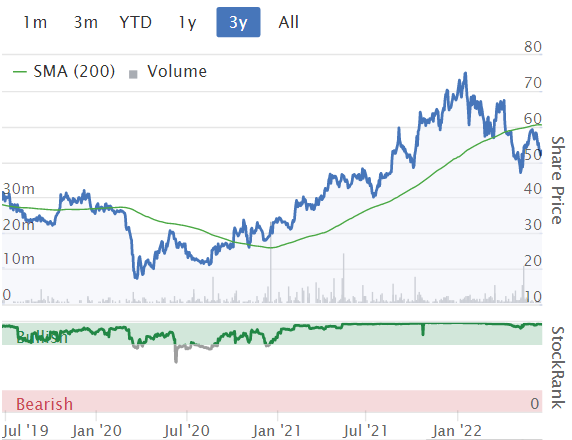
.
Micro Focus International (LON:MCRO)
290p (down 19% at 10:01)
Market cap £964m
This is a large software group, which I spotted on the top fallers list today, down 19%, and looking like it’s going to be knocking on the door of the SCVR for inclusion, if the share price drops much further.
I recalled that MCRO had a weak balance sheet, so wanted to check that, in case it does start to attract interest around here.
Interim results are out today, for the 6 months to 30 April 2022.
H1 revenue is down 6.8% on a like-for-like basis, to $1.3bn
Adj EBITDA is down 12% to $449m
Operating profit was only £35m, the main reason for this being so far below EBITDA is due to the $413m amortisation charge of intangibles (non-cash), and the huge $129m interest charge for just 6 months - so clearly debt is the big issue.
H1 adj EPS is 57p, with consensus FY 10/2022 forecast at 120p - the company says FY expectations are unchanged.
PER - at 290p per share, with c.120p EPS for this year expected, the PER is just 2.4 - a big warning sign, that there’s something badly wrong with either/both future earnings, and balance sheet weakness.
Exceptional items - are positive this time, at $42m, due to a profit on disposal, whereas H1 LY saw exceptional costs of $143m.
Free cashflow looks good in H1 at $190m.
Net debt - the big issue here. It’s gigantic, at $3.65bn. This has come down from $4.2bn a year earlier, but most of the reduction seems to have come from a $364m disposal. This is nearly all interest-bearing borrowings, with only a small amount being lease liabilities. The ratio is high, at 3.7x adj EBITDA.
Balance sheet - is dominated by $3.63bn goodwill, and $3.89m other intangible assets.
NAV is $2.65bn. Writing off the intangible assets, takes NTAV to a staggering negative $(4.87)bn! Now we could be charitable, and also write off the $522m deferred tax liabilities, which are often related to intangible assets, which takes NTAV to negative $(4.35)bn.
Another argument is that intangible assets at software companies could have some real world value.
However you look at it though, MCRO has a massive net debt pile of $3.65bn, which would take many years to repay from cashflows.
My opinion - going into an economic slowdown, and with interest rates rising, MCRO looks to be in a potentially precarious position, due to its wildly excessive debt pile, and one of the worst balance sheets I’ve ever seen. This is precisely the type of situation we need to be steering clear of, at the current stage of the economic cycle.
A key research issue would be to look in detail at the terms of the debt, in particular when it falls due for repayment, and the covenants which could trigger immediate repayment if breached. Also the interest rate is important - fixed or floating?
I’m worried that readers might look at the PER of 2.4, think it’s a bargain, and buy a share that is very high risk, due to its excessive borrowings, and extremely weak balance sheet.
What many relatively new investors don’t understand is that debt can easily become toxic in a downturn. Lenders can force companies to raise fresh equity, causing (sometimes heavy) dilution. If existing shareholders don’t want to stand their corner in an equity fundraise, then any fundraising (if one happens at all) can be at a huge discount, thus diluting existing shareholders to almost nothing sometimes. You’re then forced to either accept you’ve lost your money, or go back into the market to buy loads more shares in a company that’s already been a disaster - a horrible choice.
If things get even worse than this, then insolvency looms. As we saw with McColls recently, once equity is worth very little, then it’s the debt holders who call the shots. That’s because shares rank behind debt in company law. Therefore, in such situations, equity is often wiped out, along with unsecured creditors too usually (the trade creditors), leaving the remaining assets to be sold (often the business as a going concern, without the debt), with the spoils being taken first by the administrators & preferential creditors, then the bank getting what’s left. In insolvencies, there’s rarely anything for unsecured creditors, although MCLS was unusual in that they did get a partial payment I believe. There’s hardly ever anything remaining for shareholders, who are last in the queue.
Could MCRO end up in that situation? I don’t know, but the huge debt position means that investors need to be really careful before committing funds here. This is really a special situation now, where debt reduction is the no.1 priority. That could involve selling off the best parts of the business.
Thinking about a bullish case, for balance. Software companies can have considerable hidden value to an acquirer, since customers are often very long-term, and captive, since the software is often business-critical. Therefore the software company gets a reliable, recurring, and high margin stream of maintenance & support revenues. Plus there are cross-selling opportunities often perceived by companies which launch takeover bids at apparently very high prices - e.g. the recent bid for EMIS (LON:EMIS) looked a full price. Other apparent basket case software companies have attracted bids recently - e.g. Proactis (PHD), and Tungsten (TUNG) - both serial disappointers, which looked doomed to eventual failure. Yet they were sold in takeovers.
MCRO is now c.£1bn equity, and c.$3.65bn debt. So if the situation improves, and debt reduces, then the benefit could flow through to equity, giving a geared favourable outcome for shareholders. Equally, if the situation deteriorates, then equity could be reduced, or even wiped out. Hence a volatile share price looks set to continue.
Overall then, MCRO looks too high risk for me. In a deteriorating economy, it could attract the attention of short sellers too. It’s very high risk, and suitable only for experienced special situations investors, in my view.
Forget the high dividend yield, as divis are clearly not sustainable.
Indeed this is a situation where the apparently great value scores are rendered null & void by the debt mountain -
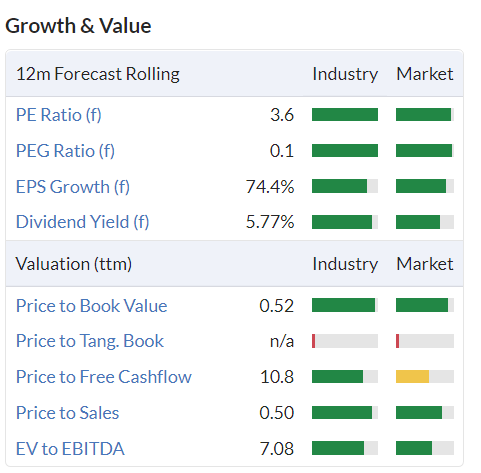
.
At times like this, checking the Z-Score (statistically proven measure of bankruptcy risk) is absolutely vital. Although my manual assessment of the balance sheet suggests a far worse position of financial distress than the Z-score indicates -
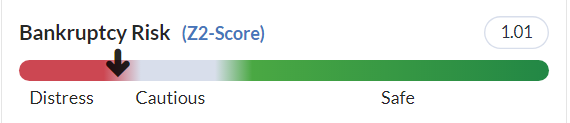
.
Clearly big problems emerged, well before the pandemic -
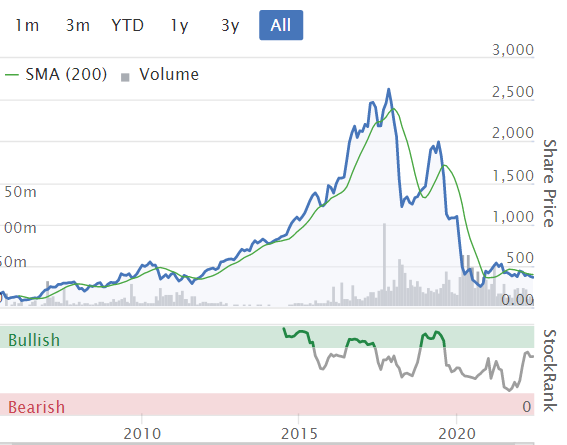
.
Therefore, as you might have guessed, it's a thumbs down from me for MCRO.
Graham’s Section:
Churchill China (LON:CHH)
Market cap: £154 million
I’ve always liked writing about this ceramics company: it’s a family business with an impressive history stretching back a few decades. It hasn’t made a loss since the last millennium, has barely issued any stock in all that time, and normally grinds out an acceptable return on capital for shareholders.
As previously reported in the SCVR, Churchill has already reported that trading has returned to pre-pandemic levels. The hospitality industry is Churchill’s end-market, and so the level of demand is always going to be a little unpredictable.
Fortunately, sales in the most recent H2 period were ahead of the comparable period in 2019 – before adjusting for inflation. If you adjust for inflation then it becomes debatable! But the point is that trading has mostly, if not fully, recovered. This is reflected in the share price performance:
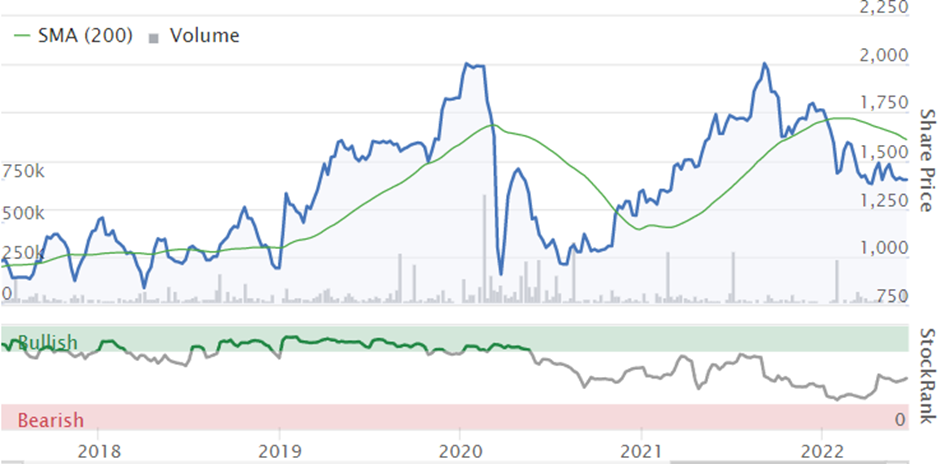
The AGM statement today is the first update since April. The Chairman says:
"In our Preliminary Results, announced on 21 April 2022, we advised that we were experiencing record demand across our geographic markets. I am pleased to report that this demand has continued and our order book remains healthy. We remain confident in our ability to deliver an improved year on year performance in 2022.
My view
It’s all systems go at Churchill, and hopefully the trends in hospitality will remain positive, giving the company a sustained tailwind.
However, like many companies, this one won’t be immune to the effects of inflation. As a manufacturer we can expect some margin pressures and some volatility in results. The most recent results statement noted the following (I have added the bold):
The sharp increase in production output required to satisfy demand, together with elevated levels of input price inflation, have in the short term constrained the improvement in overall business performance…
the inflationary pressures more generally evident within the global economy have […] impacted both our material and energy costs. While we have ultimately raised our prices to reflect these rises we have absorbed some of the increases in the short term.
As I’m very worried about inflation in the medium-term, I would have concerns that the real profitability at Churchill might lag the results of 2019 for some time, even if nominal sales have improved and even exceeded those levels.
City forecasts share this caution, at least for this year and next:

This company is rarely “on sale”, and building a stake in it has nearly always involved paying high multiples. That remains the case today.
System1 (LON:SYS1)
Market cap: £36m (+4%)
I loved this advertising consultancy when it was known as “Brainjuicer”. It had a quirky website that was more like watching a cartoon than visiting the homepage of a listed company!
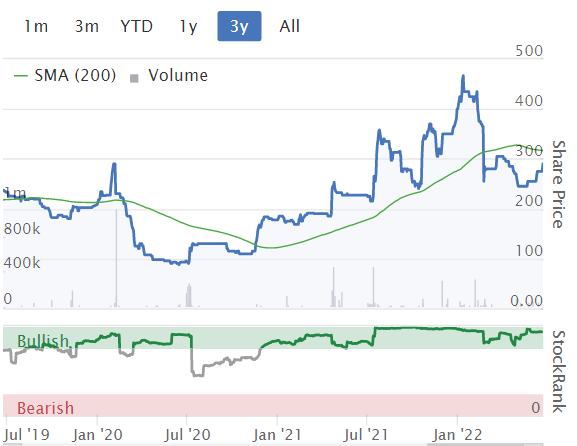
Unfortunately, the share price overheated, when a temporary rush of sales and profits in 2017 was wrongly interpreted by the market. The shares are still down over 70% from the high that was achieved back then.
More recently, it has changed tack and focused on more automated marketing solutions, with less focus on the lumpy, unpredictable, labour-intensive revenues that have traditionally made up the bulk of its revenues.
It also made it onto Ed’s 2022 New Year NAPS. The StockRank is terrific:

Today we get an update on the company’s distribution policy:
…the Board has decided to pay annual distributions to shareholders by way of on market share buyback or tender offer, rather than by way of a dividend. The Board has concluded that the distribution policy will be progressive, taking into account underlying business performance. It is expected that the absolute level of distribution for the year end 31 March 2023 will be between 30 - 40% of through-the-cycle profit after tax.
This is music to my ears – I love buybacks! For all of the following reasons:
- There’s no tax liability for me, if I hold on to all of my shares while one of my companies carries out a buyback (of course for shares in an ISA or other tax-free wrapper, then dividends generally don’t have a tax liability, either).
- I get a bigger percentage ownership of my companies, without needing to put any more money in! This is preferable to dividends since my primary goal is to build my portfolio, not live off my dividend yield. Of course other people will have different preferences!
- The overall value of the company’s equity increases, so long as the shares have been bought back below fair value and without creating a risk of financial distress.
The last bit is what trips up many investors, and many companies. On the one hand, many companies do carry out buybacks when their shares are overpriced, and this destroys value for the remaining shareholders while also increasing the company’s financial risk.
On the other hand, the fact that many buybacks are overpriced leads many investors to be suspicious of them – perhaps overly suspicious.
I’ve just double-checked my personal portfolio. Out of the nine companies I own shares in, seven of them are engaged in buying back their own shares. I don’t believe that they are recklessly endangering shareholder interests – quite the opposite. I think they are well-managed and responsibly run companies, arguably to the point of being boring! And I’m delighted that my long-term percentage ownership in these companies is increasing while I sit back and do nothing except continue to hold my existing shares.
Let’s get back to System1. The only criticism I have of the policy just announced is that it doesn’t allow for any discretion, based on the company’s share price. Most good management teams have some idea about whether or not their company is overvalued (better than we do, at least) – and when they think their company is overvalued, it would be better if they didn’t carry out buybacks at that time. So I would prefer to see a condition that buybacks will be subject to market conditions.
Anyway, there is yet more pleasant news to be found in today’s announcement: the Board at System1 believe that “the Company has cash at levels above its through-the-cycle and near-term requirements and will therefore seek to return up to £1.5m of excess cash by way of a tender offer”.
My view – I like the strategic direction at System1, and today’s announcement gives me additional confidence in the company’s shareholder orientation. Whether or not it will achieve the quality of earnings that it seeks is uncertain, but it still has some very attractive features for potential shareholders.
Disclaimer
This is not financial advice. Our content is intended to be used and must be used for information and education purposes only. Please read our disclaimer and terms and conditions to understand our obligations.

45 comments
Paul, buybacks are fine as long the bought shares are canceled. Putting the in the treasury to reward to Board, later on, serves no benefit to the ord shareholders!
Hi Bagash, I think that the context is critical.
If the shares are simply bought and given to management then I agree wholeheartedly with your comment.
If there is a well thought through equity element to senior management remuneration which both helps to retain key executives and aligns their interests with other shareholders then I think that the holding of shares in treasury is useful. Doing this can prevent shareholder dilution (cash is paid out effectively rather than shares) and can be used to support the share price during periods of weakness/undervaluation.
I put Record (LON:REC) share purchases in the later category.
If anyone is interested in Record who announced good results yesterday but missed the Company meeting today II thought I would just pass on a few notes. The meeting was attended by Leslie Hill CEO and Steve Cullen FD. I really like Leslie in particular she is transparent, keep things simple and clear which is a big tick for me. There was a bit of talking over one another which I hope isn't a sign of competition or bad will. It looks to me like it is a good management team. Brief remnder
AUMe +4%, Revenue +38%, Op Margin +7% (31% - big one for me!), Basic EPS +64% at 4.52p putting them on PE of 16 times. Final div 1.8p +57%, Special Div 0.92p +104%. The Board like to deliver a dividend of 70 to 90% of earnings. The investment summary is this is a growing business as they diversify from Foreign Exchange hedging to other asset classes with a growing dividend. Whilst they never say never they do have enough cash and cashflow to deliver their plans as they exist at the moment.
They have three main development pillars. 1) Modernise. A lot of their software and tech had fallen behind and they have spent much time catching up. They believe they have made good ground with introducing the cloud, better tech and new software. Software is getting cheaper. They have a budget for constant development. 2)Diversification. As were, was a currency niche. Hard to make progress of any form in this niche given commoditisation. Whereas used to sit down as a sales team discuss potential attractive ops, they now allow the customers to lead their product ops. Diversifying out across asset class, geography and staff. Pillar 3) Continue to work on succession plan. Leslie believes she has the right people in the right roles now and has to ensure they keep them.
That lead to a question as to whether the company is prepared to allow the savings scheme for staff to dilute the share holding. Steve answered they had always bought through the market and didn't have any plans to change this. Although they do have the freedom through their articles to issue up to 5% if needed.
Leslie explained her targets through to end 2025. She said these are based on real opportunities and not just numbers picked at leisure. She expects revenue around £60m (currently around £25m) and Op Margin 40%. So that would bring in profits of £24m (my estimate) with no impact on share numbers as enough cash. Currently in the £7 to £8m range. So this is a significant growth story if you believe the management.
A question was raised about the current rocky situation and how it might affect the company? Leslies response was diversification is being planned for that purpose. They also use hedging to reduce issue. Steve added that the underlying client portfolios are well diversified in 2020 when markets fell 20 to 25% their portfolios fell around 7%.
They talked about current clients in relation to how they work with them. But clear they have good long term relationships. 42% of the clients of the clients have been with them longer than 10 years. A further 18% have been with them more than 6 years. Their top ten clients represent about 73% of management fees covering 4 different product categories. So I would say still work to be done here.
Their Passive hedging product represents 35% now of management fees. In 2020 that was over 50%. At the same time dynamic hedging has grown from 17 to 29%. Currencies for return from 9 to 16% and multi product has fallen from 22% to 20%. Clearly progress is being made to higher margin products.
So how is inflation going to affect them. As a business their main cost is salaries and to keep staff they will have to keep up with inflation was my read so that 40% margin may be a bit hopefull!! Very hard to pass that on. That said they are growing the business, they don't have legacy issues other fund managers may have. They have now launched the German Municipal Fund and whilst it has taken time they believe it will grow quite fast. They are looking at a Sharia type investment with a client which is interesting.
My view for what it is worth. I have decent holding and won't be selling. Hope someone gets something out of this.
hi Camtab
Record (LON:REC)
Thanks for your very useful summary.
I also watched the presentation and agree that there was much talking over each other. Additionally the sound quality was poor with an off putting room echo and much banging of coffee cups on the table (too close to the mics) so it was hard to pick up what they were saying at times.
For some reason Leslie was determined to answer questions as the presentation continued with the result that it became a hotchpotch of a presentation (skipping and missing many slides) interspersed with answering questions in rather random fashion. All very ad lib and most unsatisfactory.
They need to sort this out and revert to the standard pre-prepared company presentation style of CEO opening remarks / CFO financial review / CEO Strategy / Q&A's.
Despite all this I am positive about the company's prospects in pivoting to higher margin asset management products. Their prospects look encouraging, much in line with Graham's comments on here yesterday (I hold).
I too listened to the IMC presentation given by Record (LON:REC) which I hold.
I thought that Leslie's confidence had grown since previous presentations and while acknowledging that they skipped around a bit, they seemed keen to answer all the questions in a very open manner which should be applauded. I think that the dynamic with Steve works well and they work well together as a team. I did not pick up any contradictions, just an appetite to explain.
The stating of their targets for FY25 gives a useful underpin to the detail on how the strategy has changed since Leslie took over,
RE: Vertu Motors (LON:VTU)
Maybe it’s just me, but when I read trading updates I’m always looking for the dog that’s not barking. We all know pretty much where interest rates are heading to combat inflation and that the splurge of spending on cars in the past few years has been fuelled by ultra cheap contract finance.
Surely much higher car finance costs driven by higher interest rates, at a time when consumers food and energy bills are increasing must greatly affect car sales, regardless of availability? For me, availability as mentioned by Vertu Motors (LON:VTU) is now largely irrelevant. Affordability is everything and cars will become much less affordable going forwards.
All the best, Si
Just have in mind that the Chrysler group was one of the best performing stocks during the last inflationary cycle.
Vertu is a growing company with serious people that manage it and deliver returns for its shareholders.
Looking (deeply) at the balance sheet , the company will use another £35m for the next three years for buybacks and thus cancellation of its shares.
Adding to that the dividend will grow to at least 2p per share, making the total returns to its shareholders ( plus buybacks )of around £60m for the next 3 years.
This is an amazingly cheap share and I will continue buying.
This is an amazingly cheap share and I will continue buying.
Actually, it was amazingly cheap when I bought at 22p and it wasn’t discussed on this blog. I get the discount to NAV but that didn’t stop it tanking last time.
Sorry but I don’t understand how the rest of your reply relates to the point I was making about affordability and the loss of cheap finance. I know people who don’t have two halfpennies to rub together driving round in new cars. Something has not felt right about this for ages and some kind of car finance mis-selling scandal down the line would not surprise me at all.
Appreciate this is a macro comment and not small cap specific but an announcement from one of my European holdings £UMI illustrates the problems facing companies and the shift to a 'greener' economy. Also politicians are encouraging business investment but where is the incentive for companies when short termism in the financial markets hammers the companies share price:
LONDON, June 22 (Reuters Breakingviews) - Investors in Belgian’s Umicore UMI.BR have sent a worrying message to heavy corporate spenders. The 8 billion euro chemicals and battery-materials supplier on Wednesday lost more than a tenthof its market value after pledging 5 billion euros https://capitalmarketsday.umic... outlays over the next five years. The capital expenditures, roughly double what analysts expected according to Refinitiv data, are supposed to help the group meet rising demand for electric-vehicle batteries and their component materials. Chief Financial Officer Filip Platteeuw said at an investor event that Umicore could potentially raise equity to pay for the investments.
It’s a cautionary tale for carmakers, renewable-energy companies and other industrial groups that are also on the verge of an investment splurge to fund the move away from fossil fuels. Umicore reckons the new capex will help it to more than double revenue by 2030. But investors seem to be ignoring those long-term benefits and focusing on the near-term pain. Umicore’s shares are down 30% in a year. Its enterprise value is less than 8 times 2021 EBITDA. The lesson is that ramping up spending in a bear market can be costly. (By Liam Proud)
There may be a read across for large oil & gas players as well as the miners who are aiming to ramp up investment in renewables. Their prices are down significantly today too though it is difficult to disentangle the causes. Take your pick form short termism, inflation, falling oil price, looming UK recession, war in Ukraine, slowdown in China - perfect storm anyone but there must be buying opportunities somewhere!
Hi Graham,
As you say System1 (LON:SYS1) was a NAPs pick at the start of 2022 and has an excellent Stock Rank. Unfortunately even after a small bounce today it is down nearly 30% YTD. In the current market even strong results seem to have little positive impact on small cap shares and the downward trend continues. There seem to be real fears of a prolonged recession in the UK.
Interesting/depressing market dynamics at the moment. In my portfolio K3 Capital (LON:K3C) and Photo-Me International (LON:PHTM) issued excellent trading updates (ahead of consensus) and gave upbeat outlook for coming year and yet (after a modest initial gain) the share price is back under pressure.
Both of the above companies (and most of my portfolio) are offering a good dividend so its not a hardship holding them (or adding more) but you cant help wondering if they'll be cheaper tomorrow!
It appears to me that sellers aren't selling based on fundamentals. So what stage in the bear market are we? I can't see this situation changing until inflation turns or investors realise how quickly cash is devaluing.
Doesn't the yield depend on when you bought though? E.g. you bought when the yield was 3% but the share has tanked so the yield is now 7%. You are still "only" getting 3%!
True but I bought the 2 mentioned above at less than their current price.
Doesn't the yield depend on when you bought though? E.g. you bought when the yield was 3% but the share has tanked so the yield is now 7%. You are still "only" getting 3%!
Yes, and no! You're only getting 3% on what you paid, but you are getting 7% on what you could raise by selling. It's the latter I'd be more likely to take into account in deciding should I stay or should I go. That's what you need to compare with alternative homes for the, reduced, cash now
I guess it also depends if you DRIP.
Your reinvestments would yield 7%.
Nanotrader. This argument gets aired regularly. Historic yield is almost irrelevant - it's boasting points down the pub. If the SP has dropped, all things being equal, then ergo - you must have an increase in yield. Now you reassess the share, could I get a better return elsewhere. Your choice, stay or go. The reverse applies - the SP rises and the yield drops, and now you have a capital profit. You reassess the share, could I get a better return elsewhere. Again, your choice. Take the capital profit and look for a better home for the money or stay.
Of course, it's not quite that simple in real life. Emotion (kill that!) comes into play plus your view of the future of the share. Happy investing!!
K3 Capital (LON:K3C)
Apologies bit of a rambling post this one - hey ho i aint done much rambling recently
I think the thing is with part people businesses should one expecting to pay any more than 10 * earnings ever?? . Even though they say they are more than a people business facts are i suspect the peeps that know the business inside out could easily depart and set up in direct competition and make good inroads into the "profitable stuff" that this company does. It doesnt even have to be someone internal - another company happy to be slightly cheaper than K3. I have so often seen these business types go off the rails quick when it all goes wrong - presumably the egoes at the top as soon as things are tough they may be looking to find something less tough - presumably if they dont get chomping payrises they may be tempted top lok at waht can be had elsewhere.
I am probably being over cautious but as soon as i hear the term "exeptional" used with regard to current trading - as K3 have done. I immediately take them at face value and presume we should not be expecting the current exceptionality. Ok the outlook is fairly positive at present but if they didnt see rersults as being "exceptional" as per the dictionary definition why use that word? . Personally i think this word is perhaps used too often in updates - but when it is no sour grapes later on if results arent repeated you were warned !
It appears to me that sellers aren't selling based on fundamentals
With current market cap 172 mill and expected net profit ye 31/5/2023 of 16.5 mill It seems a nice hold IF you are comfortable with the people element and possible "peak earnings now" risks. The company does not strike me as being obviously undervalued though so its no surpise to me that peeps may sell despite the fundamnetals being what they are - decent chance to "revalue" when/if they continue in upward trend ref results but at present there is enough question marks to make me not presume a return to highs should be expected until they deliver higher profits and no bad news. I think its reasonably obvious we should not be expecting "market froth" that has existed previously to return anytime soon.
Ref worry about shares being cheaper tomorrow i dont think anyone knows - i would say i had not noticed till today that dividend yield is now 6.6% - i suspect until they have some bad news i would be surprised to see this one go below 200p and would guess that 6.6% yield may be enough bribery to limit chances of further declines from where we are now until peeps worry about the next update. Must admit if i did hold this share i would be watching like a hawk and quick to ditch if the newsflow turns for the worse.
I don’t disagree but what more can companies do to reassure investors? They report past figures that are above expectations and tell us that forecasts profits look good.
There appear to be many companies who are not yet seeing the downturn that investors are pricing in and maybe won’t?
In the case of K3 Capital (LON:K3C) they might actually see more business in a downturn. Photo-Me International (LON:PHTM) are growing their launderette business rapidly. Not a discretionary spend.
At some point I hope the better companies will start to differentiate from ones who should have gone long ago.
You can't say Photo-Me International (LON:PHTM) has been disappointing after the TU and expectation upgrade. It went from 70p before to now 77p. Granted, it overshot to 84p but you have to ignore that, unless you were actively trying to sell right after the results. Market volatility will be a fact in these crazy markets, both up and down.
I'd argue that PHTM is still too reliant on photobooths for profit. I know Paul mentioned like c30% EBITDA from laundry operations that is fast growing. However, that 30% number I believe is from last FY (until Oct21).... when photobooths did almost zero revenues. I'd argue that the HY22 results, with the photobooths revenues surging, will probably see laundry at c.15-20% of total EBITDA.
If you are on Linklin there is a good 25 min podcast on Photo Me 'The Private Investor' with Mark Atkinson.I am a holder as the CEO has put millions into the business recently and although 79 yrs old his CV is worth respecting
re Berkeley group (LON:BKG)
I gave Berkeley group (LON:BKG) the man from mars treatment this morning, a quick glance at headline numbers and thought they read ok... be interesting to see the share price reaction. Clearly sentiment is poor .... they have been underperforming for over a year now. This is a tell .... the equity market has voted on prospects for UK housing. Todays reaction says the mkt just aint interested and they are likely to make further lows. Stanley Druckenmiller has built a successful career making economic forecasts based on equity relative strength... this is a strong recession indicator.
Berkeley group (LON:BKG)
The market is meant to be a discounting mechanism. The share prices of many shares have been hit hard in "anticipation " of a recession. What is a recession? That itself can mean many things.
Am I being paid or incentivised to own a share because its long term prospects are sufficiently strong?
I've traded Housebuilders since 1990 when I was a marketmaker. At sub market NAVs , you have been handsomely rewarded over the years.
It doesn't mean they are "definitely " a buy now but you are being paid well in income to consider a stock that is long of land in an inflationary environment.
I don't disagree .... I wasn't suggesting they are bad investments, just that their relative performance and todays reaction is a fairly negative indicator for the UK economy.
Hi RDHowarth,
I don't know much about Berkeley group (LON:BKG) but had a quick look at its accounts this morning. Outlook said something like, nowithstanding all the macro uncertainties, we're in a great position. Very strong balance sheet. Explicit about future shareholder returns. One number jumped out at me, about (sorry this is from memory) £8bn in build-out gross profit. I've not seen housebuilders disclose that figure before.
Historically, periods of higher inflation saw nominal house prices go through the roof. This time, house prices are starting out at a historically high price to average income level. So that might drop, offsetting the nominal rise in average incomes (remember incomes are rising about 7% nominally p.a. right now).
In the last 2 recessions, housebuilders almost went bust, as they had to write down land values, and had problem levels of debt. That's not the case now, some are even holding net cash, or very little debt.
Overall then, I struggle to see house prices dropping much, if at all. There's such a shortage of decent housing. Also, personally I don't believe bank base rates are likely to get anywhere near the inflation rate, so depressed housebuilders shares could turn out to be decent investments from here, if my theory is correct!
Regards, Paul.
Vertu Motors (LON:VTU) and other car dealers alike, does any member here have any expertise/ insight on whether the reinvention of cars changes the commercial value in after sales, service and repair? (I hold)
I thought they gave a free read of one article....Summary of article - there's going to be another leg down in markets, probably.....It compares stock returns to bond yields and concludes that share prices have fallen, but the equity risk premium (return over bonds) has been broadly constant with the last 20 years
I find that most commentators/economists just take whatever the current trend is, and assume it will continue.
My old economics teacher would say "boys, if you want some easy money, go to the racecourse and sell tips on the favourite"
interesting article from The Economist on whether stockmarket is overvalued https://www.economist.com/fina...
Hello Colin. Only interesting if one can access it - which I cant because I don't have a subscription with them! Can you be more explicit?
Little tip to access paywalled content where services expose the full page to Google's web-crawler:
This works for The Economist, the FT and a few other publications.
Direct link: https://webcache.googleusercon...
Brilliant. I have often wished to do this.
ridavies: I was able to register for a free account but just giving my email and a new password ...
... but I didn't find the article said anything new. It gives a graph of the US equity risk premium relative to US Treasury bonds over the past decades and shows that it is currently at its historic average. There's a warning about trying to time the market.
Hi FREng, if the premium was less than historic average it would imply that investors have become risk averse and that the market is at a low - therefore the market could only go up in future. Because it is at historic average it implies that it could fall to the low before moving up. Hence why I interpreted it as a negative sign
Thumbs up! I call it 'par' and view the dotted line on the Bollinger Band.
Liontrust Asset Management (LON:LIO) results out. Increase in dividends and AUM. One of the 2022 NAPS selections
Liontrust Asset Management (LON:LIO) results out. Increase in dividends and AUM. One of the 2022 NAPS selections
Since year end AUM has dropped from £38.7 billion to £34.2 billion. Which isn't much of a surprise in the current market.
timarr
I did a buy order on LIO before the open and it opened and closed for me with a loss? It has to be a good buy now with such good results. The world has gone mad.
Liontrust Asset Management (LON:LIO) results look very good although obviously could face headwinds in near term from further market falls and outflows. Longer term I think these will be fine - they have some excellent fund managers who have delivered consistently strong performance (and a sensible approach, not just chasing the latest trend). They are also leaders in sustainable investing, which is obviously the big thing now. SP has fallen very sharply and looks excellent value now in my view. They also have a lot of cash on the balance sheet, so plenty of firepower for further acquisitions.
As a holder of Liontrust Asset Management (LON:LIO) I fear we may have to wait a very long time for any improvement. Even with reasonable results this is another example of a small company share that is only heading in one direction, Liontrust Asset Management (LON:LIO) is down 57% YTD. So many shares are so far down that the best policy is to put them in a 'trash can' rather than a 'coffee can' and forgot about the for 10 years if you can afford it. That way there may be a pleasant surprise - we may have got back to cost! Very pessimistic this morning but not selling as many shares just too far underwater.
Liontrust Asset Management (LON:LIO) As a fund manager, share price performance heavily correlated to equity markets - so will recover when markets recover. No idea when that will be, but doesnt necessarily mean we have to wait a long time - sentiment can change pretty quickly. If markets get a sense that US inflation is heading back down then we could see a big rally IMO
Morning ! Well I'm still buying, for better or for worse...very recently I have bought (more of !) Portmeirion (LON:PMP), Robert Walters (LON:RWA), Coral Products (LON:CRU), STV (LON:STVG) and in my shopping basket is (more of !) Brickability (LON:BRCK) & Photo-Me International (LON:PHTM) ...lots of low p/e stocks right now having net cash and high div yields...
I am with you truegent, but my portfolio is within an ISA so it is a little more difficult as I have to sell to buy, being more or less fully invested. Still I will reinvest the dividends.
jonno, couldn't you put a few bob into a trading account now, buy what you fancy and bed and Isa your buys in ten months time?