Small Cap Value Report (Wed 24 Aug 2022) - ALM, LOOK, TMO

Good morning , Graham and Megan here this morning as Paul is off.
Summaries
Allied Minds (LON:ALM) (£26m) (-42%) [no section below] - let’s put a full stop on the story of Allied Minds. This was a Woodford-backed venture which at one point in 2015 had a market cap of over £1.5 billion. It’s a collection of blue-sky technology investments, as the underlying companies have typically been in the research phase, i.e. quite a long way from generating any revenues. The thesis was that at least some of these investments would succeed, and that a patient, long-term ALM shareholder would do well. Unfortunately, we have now arrived at the long-run destination and it’s a possible delisting: “the costs of maintaining a premium listing on the Official List and the Main Market of the London Stock Exchange are now prohibitively high”. Cash has dwindled to $9.7m (December 2021 balance sheet) plus a few million dollars from a disposal. ALM’s portfolio now has just five companies and it is surely a matter of time before ALM winds itself up - whether or not it keeps its LSE listing.
Sopheon (LON:SPE) (£68m) ($80m) (-1%) [no section below] - This enterprise software group shows an H1 operating loss, albeit a small loss ($0.8m) in the context of the company’s overall size. I find it frustrating that the company refuses to acknowledge the loss in its headlines, only mentioning that adjusted EBITDA was $2.9m (last year: $2.8m). Management appear overly keen to portray Sopheon in a positive light, despite reported revenues falling (to $15.7m). The type of contract signed with customers has changed, and the company says this is to blame for the lower amount of revenue recognised. Many other factors combine to bring about these poor results: unfavourable currency fluctuations, salary inflation, a small impairment provision against development costs, and large share-based payments ($3.7m, which are excluded from adjusted EBITDA).
Sopheon does have a large net cash position ($23.5m), which is just as well since it has capitalised $3m of development costs in this six-month period, i.e. these are costs that are not included in the latest operating loss. I still suspect Sopheon has a decent underlying business, but it is requiring enormous patience. Annualised recurring revenue has reached $21.9m, so the market cap (ex-cash) works out at around 2.5x recurring revenues. At least this valuation isn’t too frothy; this could make a nice recovery if the company can get back in the black.
Lookers (LON:LOOK) (£306m) (+4%) - Excellent results from this group of car dealerships. Trading so far in H2 has continued in line with expectations and with margins remaining at their unusually high levels. These shares are cheap compared to current profitability and so the big question is how long the stressed car market conditions can continue. I’m struggling to find reasons not to like the shares at this level, on the basis that constrained supply, inflation and high margins could prevail for another couple of years. When a stock is trading at 6x earnings, it doesn’t need many years of continued success in order to justify its market cap!
Time Out (LON:TMO) (£138m) (-5%) - Short term funding secured to bridge the gap before the lenders call in the big loan in November this year. It’s not looking good for Time Out which is now having to lean on its largest shareholder to cough up the capital at a hefty interest rate. More detail below.
Main Sections
Lookers (LON:LOOK)
Share price: 78.13p (+4%)
Market cap: £306m
This collection of 143 car dealerships, representing 31 manufacturers, has produced its interim results. Here are the headlines:
- H1 revenue +3.6% to £2,230m (strength from used vehicles and aftersales, not new cars)
- H1 PBT minus 1% to £49.9m
- H1 underlying PBT minus 5.6% to £47.2m
The company excuses the fall in underlying PBT on an “exceptionally strong comparative”, as £12.7m of government supports was received in H1 of last year. It makes me wonder why these supports weren’t excluded from underlying PBT last year!
More positively, the underlying PBT result is better than the £45m guidance the company provided at the trading update in June.
Balance sheet
The company announces net funds of £78.5m, and cash and property of 95p per share. The excellent balance sheet strength and net asset values at these dealerships are well-known: again, see Paul’s coverage of the trading update in June.
Lookers today reports net assets of £410m, or £224m excluding intangibles. That’s about 57p per share. I haven’t made any adjustments to these figures for the value of leases; if you check footnote 1 today, you will find a long list of errors made to the company’s previous calculations of its lease liabilities and right-of-use assets.
Short note on IFRS 16
While I remain broadly positive on the adoption of IFRS 16, which brought leases onto the balance sheet instead of leaving them off-balance sheet, I must admit that the complexity involved is staggering. Since their introduction in 2019, the new rules have bewildered even some large-ish companies, such as Lookers.
Maybe we just needed a better system of disclosures? Perhaps IFRS 16 could have been voluntary, or could be made voluntary, with companies having the choice to instead provide a detailed schedule of that future lease payments they’ve agreed to?
I do think that the previous system left something to be desired, as huge liabilities were left off-balance sheet and there was little granularity in the disclosures.
Leases were a form of hidden leverage that often led to companies running into financial difficulties or even going bust, despite their balance sheets looking healthy - that was far from ideal, in my view!
But the current system might not be sustainable, as I reckon that few investors or business managers understand IFRS 16, and that most of them would prefer everyday language. If only 1% of users understand and get value from an accounting standard, is there any point to it? There are no easy solutions, I’m afraid.
Lookers’ performance
I’ve mentioned previously how impressed I’ve been by the car dealerships. Their supply of new vehicles has been disrupted, but they’ve managed to raise prices of both new and used vehicles to such an extent that their profitability has been protected. In some cases, their profitability has soared!
If you take into account the loss of government supports in H1 2022, then the “real” underlying performance by Looker is a terrific improvement on last year:
- H1 2022 underlying PBT: £47m
- H1 2021 underlying PBT minus government supports: £37.3m
As the company points out, it has done this despite the inflationary environment which has pushed up its own costs. But the price of vehicles and service has risen even faster!
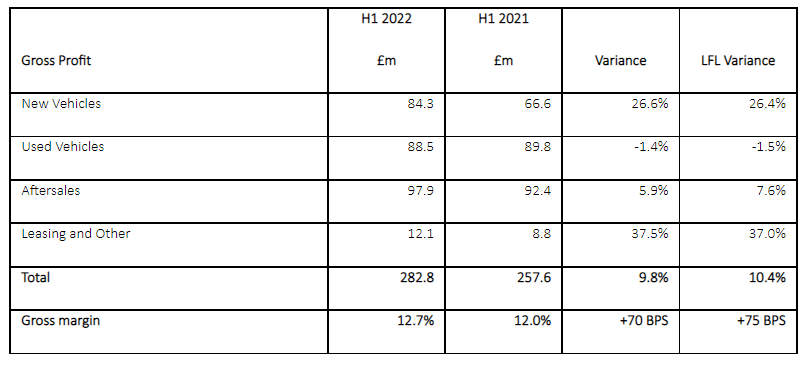
This table illustrates the strong growth in gross profit on new vehicles. When you read this, bear in mind that total unit sales from new vehicles are down by 19%. Unit sales down, but total gross profits up - extraordinary!
Some other interesting aspects of the performance:
- 16,000 warranties on used cars were sold, versus just 5,000 in last year. I wonder what’s driving this - if consumer budgets are stressed, does it increase the demand for this type of insurance?
- “Significant increase in used finance penetration to 48%” - again, this looks like a sign of stressed budgets.
- Enormous cash flow benefits from working capital management. The company generated £80m in net cash flow from operating activities, after stretching out its payables by over £50m. Some of this will unwind in H2.
- Many initiatives are underway including a new centralised procurement team, a new dealer management system, developing relationships with new brands and EV-only manufacturers, “click and collect” locations for used vehicles, and cosmetic repairs.
My view
It can be hard to distinguish between car dealership groups. Where Lookers stands out is perhaps its size - it’s bigger than most of the others we cover in this report. However, it doesn’t match the likes of Inchcape (LON:INCH) (which I would recommend looking at as an alternative).
Indeed, using Stocko’s comparison tool, I’m intrigued to see that Lookers is cheaper than Inchcape on every metric:

Despite its apparent cheapness, Lookers says that it has outperformed the UK new car market by 1.7%, and it’s hard to find much wrong with today’s results.
Outlook - trading so far in H2 (July and August) has been in line with expectations and margins are said to remain at the levels of H1.
So what’s not to like? I suppose that if you take a cautious view on the sector, you would have to suppose that margins will revert back to “normal” at some point.
When that happens, if you view car dealerships as companies lacking in competitive advantages, then you might not want to pay more than net asset value for them. And again, if you are deeply sceptical, then you might not want to pay more than net tangible asset value for them (which I calculated today for Lookers as 56p per share).
But on the other hand, if things don’t return to normal soon, then Lookers is going to earn these extraordinary profits for some time - and it wouldn’t take long for the company to prove that it’s undervalued, given where the PE Ratio is:

It’s possible that I’ve missed something, but I’m scratching my head to understand why this isn’t rated a little higher. Are investors really so sure that the conditions in the car market are about to normalise?
Time Out (LON:TMO)
Share Price: 39p
Market Cap: £138m
Media group Time Out has agreed an unsecured loan facility with Oakley Capital, here are the headlines:
- Time Out can borrow up to £8m at an interest rate of 10%
- The money will be used to help complete the development of the Time Out Market in Porto before long term financing arrangements can be agreed
- Company cash balances are currently at £4.8m, but these are partly ring-fenced by existing financial agreements
- Oakley Capital Investments - the provider of the loan - is the largest investor in the company, with a stake of about 20%
There was a time when Time Out looked like it was on its way to becoming a great company again. The magazine business had moved online and management had realised that the advertising revenue of old would eventually dry up. The business turned to marketplaces - large open-air food halls for restaurants, pop-ups and stalls. “The best of the city all under one roof”, according to a review by the Time Out magazine (perhaps not the most reliable of sources).
Time Out Lisbon opened to much acclaim in 2014 and the company set out an ambitious roadmap for further food halls around the world. In 2019, five more sites were opened in North America and the company reported a 58% jump in revenue that year. The share price peaked in January 2020 at 121p.
First hint of financing worries
But the ambitious expansion project had come at a severe cost to the balance sheet. In December 2019 the company was sitting on £44m of net debt, including £5m due to be repaid within one year and £38m due to be repaid within two.
With countries going into lockdown just a few months after the end of the 2019 financial year, Time Out was forced straight to its loan providers for an immediate boost. The company’s share price crashed with the market in March 2020 and has not yet recovered.
Balance sheet woes continue
In March 2022, the company reported £34.6m of net debt including £22.7m in lease liabilities, reported under IFRS 16 accounting rules. Of the £20m in bank borrowings, £19.2m was owed to Incus Capital Finance and due for repayment in November this year - there have been no covenants on that loan since September 2021. At the time, the company said it was confident it could renegotiate in plenty of time before the loan was due to be settled.
Perhaps this was another moment of overconfidence. Time Out has now had to lean on its largest shareholder for a short term loan to bridge the gap while the Incus loan is being renegotiated. The short term borrowing from Oakley comes with a 10% interest rate - hardly helpful as the company struggles to get back to profitability.
Income statement
Revenue bounced back in the first half of the 2022 financial year (comprising the six months to December 2021) and are likely to continue to do so as the company’s marketplaces shake off the burdens of low global travel. Losses are also narrowing at the operating level, but the company spent £2.5m in finance costs in the first half, which looks likely to spike in the second half now that the company is paying 10% interest on a loan.
My view
There is a lot to like about Time Out’s strategy and ambition in steering away from traditional media. Its expertise and contacts in cities where tourist footfall is high suggests that it is well placed to set up thriving markets.
But the financial discipline needed to set up a thriving business which relies so heavily on expensive property is very different from that needed to run a media company. Setting up five markets in one year was a mistake and Time Out and its investors are still paying the price.
Disclaimer
This is not financial advice. Our content is intended to be used and must be used for information and education purposes only. Please read our disclaimer and terms and conditions to understand our obligations.

37 comments
Graham
TMO seems to be struggling to refinance the Incus Loan of £20m due in November. This is disturbing. The Directors had flagged the refinacing in their comments regarding operating as a Going Concern.
On your comment below, note that the company is paying Euribor plus 11% on the existing Incus facility, more than what it will pay on the £8m borrowing from Oakley.
Losses are also narrowing at the operating level, but the company spent
£2.5m in finance costs in the first half, which looks likely to spike in
the second half now that the company is paying 10% inter
Thanks for the comment Yusuf, for your info it was Megan who covered TMO in this report. Best, Graham.
Graham's comments about the property values underpinning Lookers (LON:LOOK) made me think again about my lunch yesterday in a J D Wetherspoon (LON:JDW) pub when I sat looking at the share chart, wondering if the bottom was in (spoiler: it wasn't). As we all know 'Spoons owns the freehold of a lot of its sites, and I think this is a good thing. But I found myself asking, if they couldn't make this particular site pay, who would want it? I don't mean that this particular site is loss-making - of course I don't know one way or the other - but it's a large historic building with some quirks and I wondered who would take it if they had to offload it. So long as they are there it has value, but if they vacate it who would actually want it as a property investment? Somebody would, but what would it actually be worth if J D Wetherspoon (LON:JDW) didn't want to own it or lease it? And today I find myself asking the same question about the car showrooms etc. on the balance sheet of Lookers (LON:LOOK)
Michael C,
The value surely comes through their alternative use as brown field development sites. There are very few car showrooms of architectural merit, so that is rarely a barrier to redevelopment.
I agree, but what is their value as brownfield sites? Is it the same value as shown in the accounts? We just don't know.
Michael C - I know people in the commercial property game, and without trying to sound like a condescending tw@t (I will probably fail), this isn't something you need to worry about, on a general scale at least.
Except when harsh credit conditions abound, there's a healthy commercial property market out there, with its own rules/ for valuing properties, depending on location, comparative sales, usage, availability and cost of debt, etc. etc. etc..
The only time you should worry is about specific sites, e.g. if Wetherspoons has (say) a listed building, so you can't knock it down and start again, in a run down location with crappy transport links, where you can't readily convert it to other uses.
There's a multitude of reasons that people/organisations want to own, rent, or develop a building, and not all of them are money laundering ;) and a lot of those reasons won't be obvious to the likes of you and me.
I hope this helps.
Chris
"Except when harsh credit conditions abound..." but that's really my point. The values given to freehold properties in most company accounts are those which applied in recent times. What happens if there is another credit crunch?
My starting point for all this is the Bank of England's statement in February that they have cut the magic money tree off at the roots. No more money printed out of thin air. And by the way would the government start repaying its debts please?
Lookers (LON:LOOK) Anecdotes from investors about single instances are sometimes of dubious value, but I will post this, not about Lookers specifically but about the car trade. For 3 months we have been looking for a modest SUV, something below the £40k road tax threshold. We had time to shop around so we had test drives in several cars. The "boom" atmosphere in all the different dealerships raised the hairs on my neck. So we hung on. Last week a Toyota dealer came back to us and offered us a discount on a new car, and when I haggled he increased it. Quite a chunky discount actually, about 7% all-in. We haven't got a firm delivery date, the estimate of January is tentative, but that's normal. The point is I definitely got the feeling this salesman really wanted the sale.
Something else I picked up - we are really unusual because we are cash buyers. When I queried this, in 2 separate dealerships, I was told that absolutely nobody under the age of 40 wants to know the price of a car. They only want to know how much the monthly payment is. Nobody under 40 has any actual money. It's only older people like us that pay cash.
I'm posting separately about something else concerning Lookers (LON:LOOK)
Michael,
After years of buying new or nearly new cars for cash and keeping them 7 or 8 years a friend persuaded me to try leasing, I am on my second lease now and I dont think i would go back , you dont pay any road tax, servicing intervals are usually 20,000 miles, so costs are minimal, you do choose a mileage allowance but the penalties for exceeding are not huge. I think the future of car ownership will be some type of lease/shared ownership, especially with EVs. whether this will include Car dealers or not i'm not convinced, maybe all manufactures, stronger ones more than likely, will go direct to consumer .
As for your comment re Weatherspoons freeholds, surely the same goes for most retail space and with WFH a lot of office space, I would think a lot of Spoons freeholds are prime for residential redevelopment.
Richard
"I would think a lot of Spoons freeholds are prime for residential redevelopment." Yes, but does that give them the same value as the balance sheet? We don't know.
Same here Richard,
After struggling to sell a car a few years back I saw the market had moved to largely a 'trade' market. I looked into leasing as an alternative and worked out that it is far cheaper if i) you want to buy a new car, ii) you are not clocking many miles in a year, iii) don't care about being the 'owner' (sounds strange but a lot of people want to feel they 'own' something)
My first lease (six years ago) was a Ford Fiesta ST which cost £125 per month (+ 9 months upfront). Nippy little car for little over the cost of some mobile phone contracts.
What the average punter doesn't realise is that the lease company may order say 100 cars off the manufacturer at a time and will negotiate a far better discount than you can buying 1 off your local dealership (maybe 20-25%). They also order and fill production slots in the manufacturers schedule which are not used (yes, car factories don't switch themselves on and off depending on demand!) so can negotiate very good deals.
They then 'pre-sell' those 100 cars to say British Car Auctions in 2/3 years time for a higher 'trade' rate than you can sell your car privately. Second hand cars with not many miles make good secondary sales.
Therefore, they lock in the depreciation cost at a far far better rate than an individual buyer / seller is able to achieve. & can pass on some of the savings to you!
This is why if you are buying a new car with the intention to only own it for ~3 years (highest part of the depreciation curve), it probably makes financial sense to lease.
I need to go to work so no time to illustrate the maths but hopefully you get the point !
Paul, Lookers (LON:LOOK) I first bought in 2016 and it's no surprise to me that you ponder over it. Your assessment could well prompt me to double-down but the average price I paid was 111 pence a share, a note I left myself was to sell at 130 pence. This day may come to fruition but it has been a bumpy ride and may well continue to be so I will remain a cautious holder.
Great analysis as usual this morning. Couple of small typos in Time Out (LON:TMO) - you mean m not bn
But the ambitious expansion project had come at a severe cost to the balance sheet. In December 2019 the company was sitting on £44m of net debt, including £5bn due to be repaid within one year and £38bn due to be repaid within two.
Thanks Martin - good spot, will change that now
Seems the board of Allied Minds have a lot to answer for over the years for the destruction in shareholder value. The board seem to have done very nicely with the remuneration packages. Even Allied Minds failed to effect meaningful change. So much waste of shareholder funds, for example, millions were being paid for a leasehold property which was probably not needed.
An old article but shows the kind of issues going on at the company.
I held previously but sold for a profit so a lucky escape
https://www.lightreading.com/p...
Anyone following Paul on Twitter will know why he is "off sick" this morning...! Bless, we've all been there!
What is his latest name? @paulypilot shows Account suspended
Scotty @sco15375772
This is embarrassing ; the least.
What is embarrassing Yiannos?
"what is embarrassing ..."?
His po-faced response to levity is.
I notice that the bid price for RPS (LON:RPS) has crept up to 208p, a fraction over the 206p accepted all cash recent takeover offer from Canadian giant $WSP.
Could this signify a rival bidder lurking or might there just be some arcane technical reason? Interesting if it’s the former.
Going ex a 4.5p div on 15/09?
woops a 0.45p div - so clearly not that
Tracsis (LON:TRCS) Group revenue is expected to have increased to c.GBP69.0m (2021: GBP50.2m), reflecting strong organic and acquisitive growth. Both divisions have delivered high levels of revenue growth, which includes a strong post-Covid lockdown recovery of activities in the Events and Traffic Data business units, the contribution from the RailComm and Icon GEO businesses that were acquired in the year, and the initial benefit from the previously announced multi-year Rail Technology software contracts that were won during the year. The Group expects adjusted EBITDA to be ahead of market expectations.
Haydale Graphene (HAYD) placing at 2p, a 20% discount, and 30% to Mon's close even though it come with 1:2 warrants at 2p strike. Floated at 210p.
Good morning Paul & Graham! A request please for a review of Lookers (LOOK) trading update please...I see their cash and property valuation has increased to the equivalent of 95p per share. About a 24% increase on last year. Good working capital too and strong results compared to 2021 comparatives they say, with an 'in line' pbt of £49.9 million. Hopefully this reads very well for Vertu (VTU), whom I hold...
Many thanks DH2......
Dieselhead, the review of LOOK will be published shortly... stay tuned. G
Much appreciated Graham, thankyou very much.
DH2
lol!
?
Maybe he's just read Paul's twitter feed from last night...
Someone hacked into the SCVR, but normal service has been resumed, I blame Kermit.
you had to. be up early!
My first instinct was to search for the ticker HIYA. Sometimes you can be up too early...
And sometimes you can be up too late!