Small Cap Value Report (Wed 5 Oct 2022) - Macro, VTU, PCF, KETL, TPT

Good morning from Paul & Graham. Today's report is now finished.
Agenda -
Paul's Section:
Starts (below) with some macro/markets general commentary. I should emphasise that these are all ideas that I pick up on my travels, from a wide network of experts. So I'm not trying to set myself up as a guru, but instead am really just regurgitating & summarising all the various good ideas & views that I think are the most interesting, and credible, that I've picked up from the best sources in my network.
Vertu Motors (LON:VTU) - I've completely re-written this section, after originally dropping a clanger by reviewing an old trading update by accident, doh! Interim results look good, and it now expected to beat (very modest) full year expectations, due to good trading in Sept, and the benefit of recent Govt help on energy bills, and lower NICs. Balance sheet is superb. Even taking into account the known bear points, this share still looks remarkably cheap to me.
Topps Tiles (LON:TPT) - Q4 and FY 9/2022 trading update. Profitability is expected to be at the top end of market expectations, so about £15m. That's not bad, given the tightening macro picture, and low consumer confidence. Balance sheet looks fine, with net cash. Great divi yield too. Providing consumers hold up reasonably well, then this looks a good, cheap entry point. If you're expecting armageddon, then obviously you won't be interested at almost any price. Thumbs up from me - it looks a solid business, well-managed I think, and shares look cheap.
Graham's Section:
PCF (LON:PCF) (£7.5m) - this stricken challenger bank announces that it continues to explore options to raise “growth capital”. If it doesn’t get it, it might engage in various disposals or “other options” to deliver value and certainty to shareholders. It’s scary language as management continue urgently looking for external help. They also announce today that PCF will cease any new lending activities, and will also look to cut their corporate overhead costs. In the main section, I review some of the warning signs (there weren’t many) that the wheels were about to fall off this company, and conclude that the existing equity should be assumed worthless. Balance sheet equity was £41m in March, giving hope of a recovery, but ongoing losses have spooked the new management team and it’s impossible to predict the dilutive terms of any future fundraising deals.
Strix (LON:KETL) (£255m) - a £38m acquisition is announced by Strix, with the help of a £10m equity placing and a debt refinancing. I’m starting to wonder if the market might be overly pessimistic about this one. When I covered it in July, I thought that it was fairly valued at a PE of 12x, given its short track record when it came to acquisitions (and also its financial risk). But the PE is now in the single digits, the dividend yield looks attractive, and today’s acquisition appears to make lots of strategic sense. Could the risks be fully priced in?
Explanatory notes -
A quick reminder that we don’t recommend any stocks. We aim to review trading updates & results of the day and offer our opinions on them as possible candidates for further research if they interest you. Our opinions will sometimes turn out to be right, and sometimes wrong, because it's anybody's guess what direction market sentiment will take & nobody can predict the future with certainty. We are analysing the company fundamentals, not trying to predict market sentiment.
We stick to companies that have issued news on the day, with market caps up to about £700m. We avoid the smallest, and most speculative companies, and also avoid a few specialist sectors (e.g. natural resources, pharma/biotech).
A key assumption is that readers DYOR (do your own research), and make your own investment decisions. Reader comments are welcomed - please be civil, rational, and include the company name/ticker, otherwise people won't necessarily know what company you are referring to.
Paul’s Section:
Macro/Market Comments
There seem to be a few glimmers of light at the moment -
US markets (which drive the direction of ours) have staged another rally - but is it another bear market rally, or a turning point? No idea! Although commentators in the US are pointing out that inflation seems to be peaking, which could then take the pressure off the Fed raising rates much further, which in turn should be good for equities. So there does seem to be some logic in stock markets looking forward to finding a floor, perhaps?
Set against that is apparently a now falling property market in the US, much higher mortgage rates, and the likelihood of company earnings coming under pressure.
Higher interest rates usually mean lower PERs for equities, and for the first time in many years, some bonds are actually looking quite reasonable alternatives to equities, especially if you think (as I do) that interest rates might only be spiking up, and could come down again next year if inflation subsides (as forecasters seem to think it will, but they’re usually wrong).
Over here in the UK, we’ve seen an impressive rebound in sterling, from a low of about $1.04, to about $1.14 in a short space of time. A reminder that the vast majority of huge trading in forex markets, is speculative. Sometimes markets smell blood, for whatever reason, and trigger a spike down, as has happened recently with sterling. The rebound this week takes off a fair bit of strain, and is good for inflation (see last week’s review here of the outlook from £NEXT - which emphasised that the strong dollar is inflationary for 2023).
Lastly, the wobble in the Gilts market, caused by derivatives used by pension schemes (who would have thought that posed a threat to financial stability?) was quickly snuffed out by the Bank of England, which only used a small fraction of its reported £100bn (not £65bn) maximum firepower. Gilt yields in the UK are now very similar to those in the US, so this looks to have been another storm in a teacup. Sorry to disappoint those who like to constantly talk the UK down! (and isn't it nice to see them with egg on their faces, as their predictions of doom fizzle out!)
Put that lot together, and things seem considerably more settled than they were a week or two ago. Although to me, things at the moment do have a whiff of 2007-8 about it - when a housing market crash in the US triggered the Great Financial Crisis, when enormous derivatives trades went badly wrong (caused by unforeseen risk from asset prices suddenly falling). Sound familiar? Recently we’ve had multiple asset classes crash (shares, bonds, property, crypto). There are bound to be casualties from that in the financial system, where gearing and derivatives multiply the losses. So I’m actually quite worried about the macro picture now.
I don’t know where the next crisis is going to come from, but it does feel as if we could be entering a problematic phase. Back in 2007-8, it was the sudden failure of big players in financial markets (Bear Sterns, AIG, then Lehman, and others) which caused a domino effect, where counter-party risk in the financial system caused everyone to retrench. Before that, other financial crises have also happened when a major player suddenly collapsed. People are talking about Credit Suisse looking wobbly right now.
On the upside, everyone knows what to do this time, after the experience gained in 2008. Governments & regulators have to move fast, and contain any problems with key institutions - forcing them to merge or refinance, giving guarantees, etc. The reason 2008 got so bad, was because they were so slow to act, to shore up the system.
Maybe if we get into another financial crisis again, we can be reassured that the people in charge know what to do this time to nip problems in the bud?
Financial crises usually start with something completely unforeseen. Although I think the stability of the Eurozone (with funding Italian deficits in particular looking a weak point) could be the next target of speculators.
I reckon it may not be long before we’re back at zero interest rates, and deficits funded by QE again, once inflation has moderated as supply chains ease. If that turns out to be right, then there are numerous equities today that could do seriously well in future, and be valued much more highly if interest rates do return to zero.
Personally, I don't think QE is likely to ever be seriously unwound. Look what happens every time they try! (they quickly have to abandon it).
If you think the opposite, that higher interest rates are here to stay, and could go higher, then equities could have further to fall. It will certainly be interesting to see how things pan out. Fascinating, albeit painful times. No matter how confident the delivery of their comments, forecasters/economists are only guessing. They don't have any better idea than you or I, as to what will happen in future. Actually, some of them might even be worse at forecasting than us, because they're locked into some dogma or other.
Mortgages
Friends & family tend to ask me for a second opinion when arranging mortgages etc (the fools!). Obviously I can't, and don't want to give advice. It's more about talking people through the options, then armed with the facts, they can decide. It’s very tricky at the moment. A close friend is looking at remortgaging from a 2-year fix that’s coming to an end in about 6 months. The old rate was crazily low, not much about 1%. The new rate quoted by a broker/adviser who has screened the market, for both 2 and 5 year fixes, is about 5.0-5.5%, on a fairly low loan to equity mortgage (about 40%). We discussed the options, and my feeling was that it seemed unwise to fix into a rate so much higher than before, when mortgage markets are currently a bit haywire. I looked into discounted rates, which were much more competitive, but with that option we run the risk of not having protection if interest rates really rocket.
Everyone’s situation is different of course, and the ability to meet higher payments (if rates do soar) is important. We could cope with a short term spike in interest rates, so we’ve decided to probably go for discounted, rather than fixed rate. But that might not suit other people. For the moment though, we’re not doing anything. We can wait until next summer when the current rate ends, when I suspect/hope better deals might be available, because inflation is forecast to have fallen significantly by then.
I can see why journalists & people on Twitter were joking that the main topic of dinner party conversations in polite society has now become when does your fixed rate mortgage expire?! So people are dividing into the smug, and the panicking.
Vertu Motors (LON:VTU)
46.5p (up 7% at 08:28)
Market cap £160m
Right, let’s try this again, reviewing the correct announcement this time!
Vertu Motors plc, the automotive retailer with a network of 160 sales and aftersales outlets across the UK and a sector leading online presence, announces its interim results for the six months ended 31 August 2022 ("the Period").
"Full year profits anticipated to be ahead of market expectations"
Here are my notes from reviewing the interim results (not comprehensive, just what struck me as most important) -
H1 revenue £2.0bn, most of which is pass-through value of the cars.
Gross margin of £223.7m (I tend to see this as being more like revenue) - almost identical to H1 LY.
Costs rose substantially (mainly salaries), so adj PBT fell from £51.8m H1 LY, to £28.2m H1 TY (this year), but this is not a surprise, it’s as planned due to LY numbers being a one-off due to pandemic effects. Adjustments are small, and mostly share options costs.
Basic adj EPS 6.5p in H, so nearly all of the 7.5p full year forecast has already been made.
Net tangible asset value per share is strikingly high, way above the share price, at 71.2p (working shown in the notes) - this is very unusual, and marks out VTU as the sector bargain for asset-backing.
Share buybacks - Vertu has bought back 2.9% of all its shares in the last 6 months - impressive.
Divis - interim of 0.7p. Finals tend to be bigger. Forward yield is about 4%, covered multiple times.
Outlook - moved from “in line” last time VTU reported, now to "ahead of market expectations". Driven by good trading in September, plus H2 benefit from Govt support for energy costs, and reduction in NICs.
Strong acquisition pipeline.
Costs are a key focus, especially energy. Installing solar power, capital cost, but good payback c.4.5 years. This is very interesting, and we’re seeing other companies report the same thing as a self-help measure, and good for the overall energy crisis, if companies produce more of their own energy on-site.
Vehicle shortages expected to continue “well into next financial year”.
Agency model - this is a key concern about the dealership model, as it might damage their future profits. VTU says Mercedes is the first one moving to agency model (no haggling on price, manufacturer owns the stock) from Jan 2023 and VTU expects no change in profitability. Although doing a bit of googling, other manufacturers have said the move to an agency model is being done to strip out distribution costs - which does suggest that dealership profits could be harmed by the move (but not all manufacturers are changing to this new model).
Balance sheet - very strong. NAV £340.0m, less intangible assets of £107.5m, gives NTAV of £232.5m. The market cap is only £160m, so really you’re getting part of the business for free, if you buy at the current share price. Although with commercial property prices now falling, maybe the freeholds might be worth less now?
Cash is £85.9m, and note interest receivable is now coming back. That’s mostly offset by interest-bearing debt of £68.1m.
The commentary mentions the possibility of taking out mortgages on its freeholds to raise cash for acquisitions. Pity they didn’t do that when mortgages were cheap. Maybe not such a good idea now?
Pension scheme - this is interesting. The scheme benefitted by £8.2m from a reduction in measurement of liabilities (due to rising bond yields). However, its assets fell by more, £12.2m. Therefore we need to be careful in assuming that pension deficits at other companies must be falling due to higher bond yields. We need to watch this area closely, and I’m not comfortable investing in companies with big pension schemes, due to the uncertainty in this area.
Cashflow statement - very straightforward. The operating cashflow generation has been spent on acquisitions, capex, divis and share buybacks, leaving cash little changed. That’s fine.
My opinion - that all sounds fine to me. To summarise -
Bull points:
- Trading well, now above expectations.
- Revised (up) broker forecast still looks low.
- Very low valuation - forward PER of only 5.5 (on modest forecasts)
- Decent divis of 4.4%, and 4-times covered by earnings.
- Share count falling, due to buybacks.
- Balance sheet very strong, including many freeholds, and shares trade at discount to NTAV.
- Sector consolidation likely - takeover bid?
Bear points:
- Reduced profits inevitable, when vehicle supply returns to normal (but that's already in the forecasts).
- Electric Vehicles - less servicing, and customers might buy direct from manufacturers in future?
- Agency model could be a potential threat to profits?
- Property assets might have fallen in value recently, due to higher interest rates.
- Impact on earnings from higher costs, esp salaries & utilities.
- Wafer thin profit margins, although note that the biggest contributor to gross profit is high margin aftersales (e.g. servicing, repairs)
Overall, I continue to see VTU shares as a particularly good value share. Strongly asset backed, with a low PER and decent divis on top. So this is attractive to value investors.
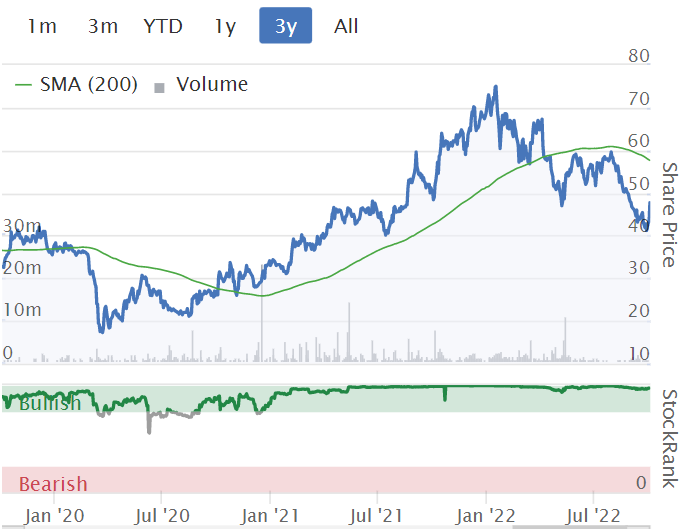
Stockopedia also likes it - look how high the StockRank is (below - chart below the share price chart) -
.
Topps Tiles (LON:TPT)
42.3p (up 3% at 12:48)
Market cap £86m
Topps Tiles Plc (or the "Group"), the UK's leading tile specialist, announces a trading update for the 52-week period ended 1 October 2022.
A second record year for sales; full year profits towards upper end of market expectations
7 Market expectations for adjusted profit before tax for the 52 week period ended 1 October 2022 are in the range £13.8 million to £15.4 million, with a consensus of £14.6 million.
Revenue for FY 9/2022 is £247.3m
Adj PBT looks to be about £15m, a 6.1% margin, which isn’t bad for a retailer, valued at only £86m market cap.
TPT made £7.0m adj PBT in H1, so H2 looks like an increase, at about £8m aPBT.
There’s a lot more divisional detail in the update today, but it only gives % figures, not actuals, which isn’t terribly helpful. The core brand seems to constitute the bulk of the business. Its sales are up 25% compared with pre-pandemic, which is very impressive. Companies need a decent uplift against pre-pandemic, to soak up all the extra cost inflation of the last 3 years, especially wages & utilities. Half of this sales uplift has come from rationalising the store estate, and the sales from closed stores moving to other stores, a good thing, which suggests to me that existing customers seek out a Topps Tile site, if an existing one closes.
59% of sales are now trade sales - good, because it’s repeat business, and has a much higher lifetime value than mainly one-off retail sales.
Nothing is said about utilities costs, which would have been useful.
Balance sheet - I’ve reviewed the last one, back in March 2022, and it’s fine, with net cash, no concerns there.
Today we’re told cash is currently £15.9m, with no interest bearing debt. I always strip out intangible assets and lease entries, and TPT’s balance sheet is also fine once that’s done.
Bank facility - in final stages of negotiation. To reduce from £39m to £30m, and extended to autumn 2025. “Slightly favourable margin structure” I assume meant to say slightly more favourable?
We might ask why it needs a bank facility, if it has £15.9m net cash? It doesn’t say, but I think the reason is to probably allow for intra-month swings in the cash position. Remember a balance sheet is only a snapshot on that day. Whereas on quarterly rent & VAT payments days, plus monthly payroll day, there can often be large outflows which cause a spike down in cash, and might need a temporary dip into an overdraft. So it makes sense to have some bank facilities, to allow for that. The liquidity position here looks ample, so no concerns.
Bank facilities also provide scope for some more acquisitions. There might be opportunities to pick up some distressed competitors or assets, and market share in a downturn maybe?
Outlook - today’s commentary generally sounds pretty upbeat, but there’s caution re consumer behaviour, as I would expect from everyone at the moment -
"The Group has worked hard to achieve a strong balance sheet with positive net cash and this will serve us well as we move into a period of macroeconomic volatility, leading to a more uncertain environment for consumers. In this context, our 20% market share goal of '1 in 5 by 2025' and our growth strategy to deliver this will remain our primary focus, and we are confident that we will deliver against them both."
My opinion - this looks good actually, I’m impressed.
The PER and divi yield are similar, both at around 7. So if this current level of trading can be maintained in future, then this would be a good entry point I think. There’s obviously a question mark over the future, which is why the shares are cheap. It’s been resilient so far, so I reckon the stock market might be unduly pessimistic, but time will tell on that.
Overall - thumbs up from me. This looks good value, and is financially strong enough to get through a downturn without problems, I reckon. In fact, decent, well-funded companies usually emerge from recessions in much better shape, and with less competition.
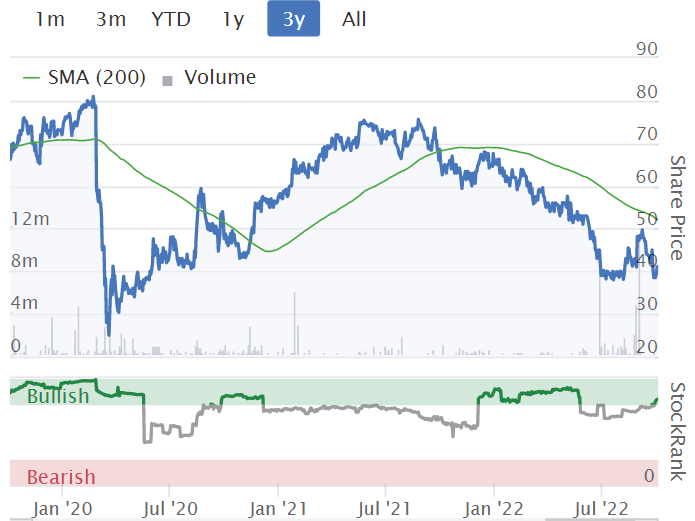
Thumbs up from me. We have the further reassurance of a high StockRank.
.
Graham’s Section:
PCF (LON:PCF)
Share price: 2.25p (pre-market)
Market cap: £7.5m
This is below our normal £10m cut-off, but I think it deserves an update as this is one that I previously covered in some detail. It’s also a stock that I previously owned.
You can read my final SCVR report on it here (from April 2020). I also wrote a detailed overview on my own website here (November 2021).
In summary, this looked like a fast-growing, high-performing challenger bank with a lot of potential. But over the last few years it has suffered a vast array of problems, many of which were self-inflicted (although the impact of Covid hardly helped them).
Most shockingly, the problems included “members of the finance team, under instruction, manually adjusting certain accounting entries for both financial and regulatory reporting purposes”. In other words, we may have been analysing falsified numbers from this company.
Some of the recent events here are:
- May 2022: early-stage takeover discussions with Castle Trust Capital Plc. “Under the terms of the possible offer, PCF shareholders would have a small minority position” in the combined group.”
- June 2022: interim results to March 2022 show a pre-tax loss of £7.5m as the company’s expenses increase and its lending book reduces. Balance sheet equity falls from £49m to £41m.
- July 2022: the major shareholder injects £1.5m at the low, low price of just 5p per share (9% dilution).
- August 2022: PCF starts selling defaulted receivables to a specialist.
- September 2022: Castle Trust Capital says it does not intend to make an offer for PCF.
This brings us to today. With the Castle deal no longer on the cards, PCF wants to let shareholders know what it is planning to do:
The Company continues to be engaged in its objectives of seeking to raise further growth capital despite the difficult market backdrop whilst separately continuing to explore other transactional options, be that by way of business, operational or asset sales or other options to give greater certainty to, and maximise value for, shareholders.
In my view, this is the sort of language that tends to precede a fire sale, or worse. The problems at PCF must run very deep. Even with £41m of balance sheet equity (as of March), it feels unable to continue without external help.
Indeed, current management have decided they need to slim down and stop lending:
…the Board of PCF has taken the decision, with effect from today, that it would be prudent for PCF Bank to suspend any new lending activities until further notice. The business will also accelerate a review process of its operational structure with the intention of further reducing its cost base.
My view
From my perspective, there were only a few, mild warning signs that all was not well at PCF.
- In the good times, PCF had raised equity at a substantial discount to its prevailing share price. They seemed unnecessarily eager to raise funds.
- The acquisition of a company providing asset finance to the media industry looked like a distraction and a high-risk investment.
- There were some signs of deterioration in the lending portfolio in December 2019.
The wheels subsequently fell off - to the great harm of many private investors.
Still, at least former CEO Scott Maybury is doing well. On his LinkedIn, he describes his current occupation as “retired”.

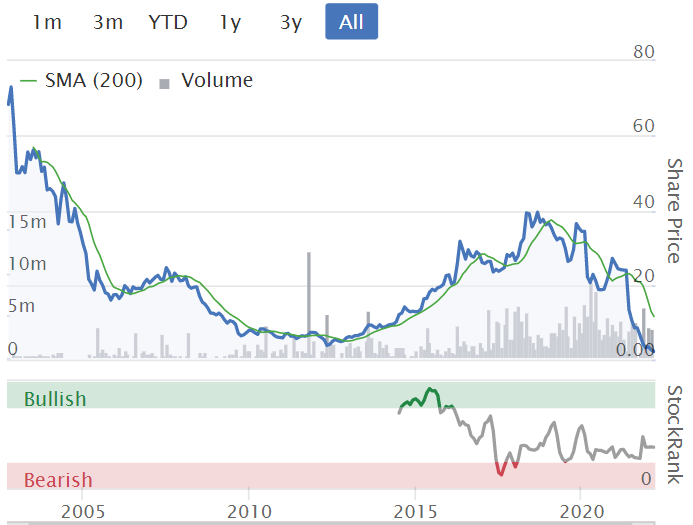
Where do PCF shares go from here? Unfortunately, for anybody still holding them, I think we have to presume that their value is zero. They might not be worthless, but the positioning of management clearly indicates that additional capital is needed (and is not yet forthcoming).
And in the meanwhile, the company is suffering from much higher expenses and a much smaller lending portfolio than it originally planned for.
Castle Trust Capital looked like a suitable buyer, and it had a long time to review the opportunity. In the end, they walked away. I wonder what they saw that put them off?
Additionally, the decision to cease lending will send a signal to customers that the bank is not in great shape. This could have longer-term reputational implications.
I’m very curious to see the final outcome. Maybe there is still hope, if the company can raise enough funds to cover its higher expenses for the next year or two, while it sorts out its problems? But hope is a dangerous thing.
.
Strix (LON:KETL)
Share price: 123p (-4%)
Market cap: £255m
This company reported its interims in September, showing a £4m reduction in H1 revenues (to £50.7m) and an increase in net debt to £61.3m.
The last time I covered this (July 2022) I said that it would definitely be worth keeping an eye on its balance sheet, as debt was growing to fund a highly ambitious growth strategy. The company has been seeking to double revenues by 2025, and is pulling out all the stops to do this.
As a reminder: Strix provides kettle safety controls to a huge proportion of the global population (it claims to have 56% value share of the global kettle controls market). But in order to turbocharge its growth prospects, it has been branching out to water filtration, water purification, and various appliances.
Today, it announces a £10m placing, at 115p:
- 10% discount to the prevailing share price.
- 4% dilution for existing shareholders.
Dilution at this scale doesn’t tend to arouse much anger among shareholders, especially if it’s for a good cause.
The purpose of the placing is to help Strix buy a company called Billi: see its Australian and UK websites.
The acquisition will cost £38m, and so the placing only helps to part-fund it. The rest of the funds will be borrowed through a new term loan.
Debt refinancing
Strix’s current £80m RCF (revolving credit facility) has been given a new tenor of 3 years, plus two 1 year extension options, i.e. the banks are potentially happy to keep this facility open for up to another five years.
In addition, Strix is taking out a new £49m term loan with a tenor of three years. Unlike the RCF, this one needs to be paid down gradually over time.
It feels like a lot of debt to take on. But for context, Strix’s H1 2022 operating profit was £12.9m. Full-year operating profit in 2020 was £33.7m. Its cash generation has, I think, usually been quite good. The banks will have run the numbers, of course, and must believe that a £130m debt load is manageable.
Strix says that net debt to adjusted EBITDA will peak at 1.9x this year and reduce to 1.4x by the end of next year. By the standards of some other companies, that debt multiple could be considered modest.
Strategic Rationale
The acquisition “changes the earnings profile of the Group, accelerating growth plans for the Water & Appliance categories”. Medium term targets - presumably including the revenue target - are now expected to be reached in advance of the 2025 timeframe.
Billi’s products include a range of water systems, high-tech taps and accessories. Like me, perhaps you’ve noticed that high-tech taps are all the rage now!
Here’s some of the explanation from Strix around why it’s making this acquisition:
Billi is benefitting from structural market and ESG tailwinds including increasing focus on water filtration, a reduction in single use plastics and a focus on energy consumption from heating water which is aligned with Strix's sustainability goals
Opportunity for further organic growth driven by increased residential sales, new product development particularly in sparkling, internationalising Billi's revenue stream through Strix's global footprint, cross selling Strix products into commercial applications and growing aftermarket sales
Identified efficiencies across Billi's product lifecycle through utilising Strix's Chinese operation to improve procurement, using Strix filters in Billi products, consolidating the marketing group and rationalising the store estate
My view
This acquisition gets the thumbs up from me. I say this nervously, as I’m aware of the pitfalls that come with M&A. But the strategic rationale makes a lot of sense to me, and I would view this as a highly complementary acquisition that fits in well with what Strix has been trying to achieve in water filtration and appliances.
As for the financial aspects of the deal, you could of course argue that the risk profile has increased and that the shares need to be priced lower, to reflect this financial risk.
However, I don’t think we should be too surprised at today’s news. Strix has been clear about its growth ambitions and has not been shy to use debt to achieve them. If anything, I think we should be relieved that they decided to at least use some additional equity to help pay for the deal.
They are paying around 4x Billi’s expected EBITDA this year, which sounds reasonable (it depends on how much EBITDA converts into net income, but a 4x EBITDA multiple can hardly be considered extortionate).
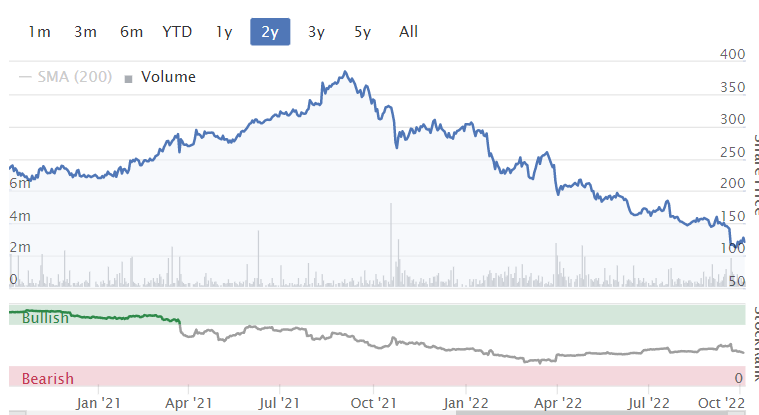
Finally, I think it makes sense that the Strix share price is lower today, to reflect the issuance of new shares at 115p. The company’s recent lack of growth is a concern, and I must acknowledge that its falling share price indicates that investors are worried. The stock is down by almost 70% from its peak in September last year:
But I’m intrigued as to whether the market is overly concerned about the situation here, and might have served us up a value opportunity? The Stockopedia Value Rank is 89, and the dividend yield has become rather fat:
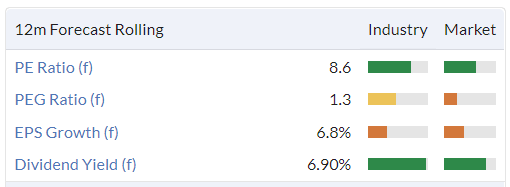
Certainly there are risks, and I wouldn’t bet my retirement on this stock. But has it possibly got too cheap at this level?
Disclaimer
This is not financial advice. Our content is intended to be used and must be used for information and education purposes only. Please read our disclaimer and terms and conditions to understand our obligations.

80 comments
The Tern (LON:TERN) accelerated book build this evening (£1.3m at 7.5p - 14% discount) has been supported rather weakly by the directors. I hold but won't be trying to avoid dilution.
pushing my luck, you wrote a couple of weeks ago about your’ increasing belief that Small Caps were not appropriate for long term holds.have you written up your thoughts on.this or otherwise could you elaborate,please.
Dear Paul,
Please excuse my ignorance but you keep using ‘amp’ and I cannot work out what it stands for! Please illuminate.
I don't keep seeing "amp" in Paul's report. Maybe because I am reading it on my Windows 11 laptop. Maybe you are on your mobile? Anyway "amp" is probably short for ampersand. Ampersand is the name of the symbol "&". It means "and".
Regarding the US property market, a commentator I've been following for some time likes this for an indicator:
CME Metro Area Housing Index Futures
This would suggest a bottom in early 2024...
Eurocell (LON:ECEL) - Somehow EQMC quietly bought nearly 13% of the company as the price kept dropping.... Strange but good, they seem to know what they are doing:
"EQMC is the leading, award-winning active investor in the European, listed small and mid-cap space, one of the best performing funds of its kind. It has an active ownership strategy which has achieved 15% net annualized returns since its inception in January 2010. The fund has outperformed indexes by 170% to 220%+ as well as most hedge funds, with controlled risks while typically holding a small net cash position with no leverage.
The fund’s portfolio of 12 to 15 companies is managed by an investment team which is disciplined, thorough and held to strict value metrics for the investments it makes. EQMC has around €1.3bn AuM under the strategy. Our 12-person portfolio management team is supplemented by a group of advisors with executive level experience and connections to boards across Europe."
Double news from Integrated Diagnostics Holdings (LON:IDHC) (I hold) - its radiology venture, Al-Borg Scan, has obtained ACR accreditation "widely considered one of the most prestigious certifications for radiology service providers in the world", and they also announce the launch of Al-Borg Scan's sixth branch.
Regarding Corp tax being kept at 19% & not going to25% will make a big difference to UK companies. That is a 6% saving instead of a 6% extra cost.
I can remember in the US about 10+ years ago when different states had cheaper Corp tax than others, which caused companies to move to the cheaper areas to save paying higher rates.
Another example is my Hyundai which I bought new just over 10 years ago which was supposed to be made in Korea & it was actually made in India because it was cheaper to make them there. I think it was mainly due to cheaper labour costs. There was a boatload of about 3000 cars on it, so I had to wait for more than 3 mths or so for delivery.
The point I am making is that companies will move to a different location if it is worth it.
The biggest problem looming now are that mortgage payments about to double, & the UK debt is going up.
I used to do loads of mortgages & re- mortgages years ago as a Financial advisor for 14 years, but now retired. Not sure if there are any discounted deals out there now just as it is needed most. At least you can now get 4% interest for cash.
Discounted deals available 2 year @ 2.34% variable rate.
Good stuff, lightningtiger - but I’m not sure it was my post you meant to reply to!
Placement raises £13m. Much as usual they have ignored the private investors who can't buy any shares at 115p, unless of course the price falls further . . .
Strix (LON:KETL) To me, the declining share price chart and the declining EPS forecasts chart on the Stockreport are both saying the same thing. What they say is "Don't buy until the share price has stopped falling".
Re PCF (LON:PCF) ...I think that what happens here is pretty obvious and has been for years. As I wrote at end of my incredulous note on results reported in early throes of covid:
"IMO they don't care. Their 70% shareholders wants them to grow as fast as possible using capital from public market. If the lending goes wrong they'll step in provide capital and take control of the whole thing at bargain price....but have a much bigger banking franchise that others have paid for."
https://www.stockopedia.com/co...
The offshore family foundation that owns most of the stock has just got to play it cool, let the pain run, current mgt scratch around for funds that are not going to be forthcoming and then step in with a de-list or if generous a minimal bid. Note, if you search around the Castle Trust current and past executives you can find ties into the offshore family trust...spooky...
Strix (LON:KETL) one thing I've never understood about this company is how it can have a very high ROCE (above 50% according to Stockopedia) but EPS basically flat for several years - not even sure how that is possible?
Strix (LON:KETL) one thing I've never understood about this company is how it can have a very high ROCE (above 50% according to Stockopedia) but EPS basically flat for several years - not even sure how that is possible?
I’m not very good with the maths on these things but the company has very high gearing, which always dramatically boosts ROCE.
Bear in mind that Strix is another PE float. As background Montagu (private equity) acquired the business in 2000. It then sold the business in May 2005 to another private equity firm, a subsidiary of ABN Amro (later rebranded AAC) for a rumoured £300m. In 2014 (after a very unusually long holding period for a PE firm) it was reported that AAC had hired Lazard to explore a trade sale of the business. This clearly led nowhere because in 2017 AAC finally exited by way of an IPO of the business. For PE's the latter route is always less favoured as its more time consuming, costly and usually involves a discount rather than a premium valuation. I'm not an accountant but it looks like AAC did some 'balance sheet optimisation' during its holding period to minimise the asset side of the balance sheet, presumably aggressive capital distributions, minimising capex, etc. This gives an artificially flattering picture of ROCE. Post float and as Strix has embarked on its acquisition spree the Asset picture has begun to normalise with ROCE rapidly declining year by year
Sorry to sound negative on this one. I never go short so please believe that I have no incentive to be negative. I just think that private shareholders have been sold a bit of a pup on this one. You have a niche, largely ex-growth kettles control business. The sort of business that PE likes to lever up and cream the dividends. Just look at the historic top line of the business to see how pedestrian growth has been. In 2017 the business having failed to find a trade buyer or another PE buyer has been floated. Perhaps drawn by the impressive ROCE (that's certainly what triggered my initial screen) and rising dividends created a bit of small investor fan club. Hence the ballon in the share price. In the interim management have been desperately trying to turn a tortoise into a growth story to justify the multiple. More recently Mr market has begun to take a more sceptical view. And now here we are. Where it goes is anyones guess. I have no reason to believe that management are dishonest or don't believe in their strategy. But the execution risk is clearly huge. And with so many great value shares right now why park your capital in this one...
I know this is a small-cap focused report (and a very good job it does of it too) but I would also love to get some feedback on quality larger caps via the expertise on this board. We are told to buy quality stocks at low prices. It would be nice to have two or three stocks in my portfolio, which don’t go up and down quite so much…
Judges Scientific (LON:JDG) is a quality stock but the time to have bought was March 2020, as it was for most stocks. AstraZeneca (LON:AZN) is a quality stock but the time to have bought that was also in March 2020 or when its reputation was being sullied by the eminent virologist M. Macron. Is Next (LON:NXT) a quality stock? Probably. After reading this board many times a day for the last 18 months, I now know quite a lot about quite a lot of stocks but they are all small ones.
It has been shown before that whereas a portfolio of high stock-ranked stocks will perform well, one can’t rely on the stock rank for individual stocks. In football parlance, I am happy with my attack options but the defense needs shoring up. Any recommendations welcomed.
Strix moved to a capital light model 15/16ish, so capital is now stock, cash etc. Production is entirely outsourced. So quite difficult to compare to other manufactures who own the fixed capital and would have lower ROCE. Good if your can control capital and IP.
Paul enjoyed your macro insights. A request any chance you could look at Concurrent Technologies. Had interims out today. Reduced profit, dividend suspended, so major price fall? No up 7%!!! As Manuel would have said "Que"?
Concurrent Technologies (LON:CNC) am pretty bullish about this companies prospects and the new ex QQ. management structure, coupled with the roll out of new products, but with restricted supply of semiconductors they cannot get the orders out.
So IMO its a matter of when they start to deliver good results rather than if.....the problem is when....and do you believe the management who are saying supply chains are to improve as of now. The market didn't think so (nor did I) so there was a decent sell off following the recent trading update.
I have been reading that folks are not buying laptops etc etc because of tighten money so chips are becoming more available, are they the right chips? I have no idea, but took a punt this morning, at 75p, and to be honest I would not pay anymore than that at the moment because of this potential shortage, and the risk of another sell off.
I do think the price will come back down towards 75p and will try and build a position from there, but am not sure a 9 percent increase on one product launch RNS is justified.
One final point is the CEO has said he would sooner not give dividends in favour of product development, so not a great surprise he suspended the dividend.
They don't have any better idea than you or I, as to what will happen in future. Actually, some of them might even be worse at forecasting than us, because they're locked into some dogma or other.
I've long stopped listening to economists. Their only real purpose, if they could be said to have any at all, is as a contrarian indicator. They keep getting it wrong, time after time, and yet they still keep making pronouncements, and people still keep listening.
I agree with your statement "locked into some dogma." Economists make assumptions, then do a whole of number-crunching based on those assumptions. It all sounds very scientific, but it relies on those assumptions being right. We have no real reason to suppose that they can see the future better than you, me, or astrologists.
As an example, economists predicted disaster as a result of Brexit. One of their assumptions was that the price of drugs would rise to be the same as in the US. As soon as I heard that I realised that they had no real idea what they were talking about. If you're in a pessimistic mood, then you make pessimistic assumptions, and , surprise surprise, the results look bad.
So despite the veneer of objectivity, it all just boils down to how you feel about something.
Economists completely failed to anticipate the banking crisis of 2008, COVID, and the Ukrainian conflict. These were huge events that affected economies enormously.
Hi Mark,
On top of economists there are then also newspaper journalists (plus TV and all of the others). Their sole job is to sell stories. If all they could come up with was simple, middle of the road stories they'd get put out of business by the sensationalist journos whose stories grab peoples attention and sell media space.
When you put the doom and gloom from economists together with the sensationalist journalists is it little wonder we have nothing but gutter press, news & TV. I rarely last more than 5-minutes into any news programme before I get frustrated and turn it off. If it's about a topic I am knowledgeable on I find my blood-pressure boiling....... better not to watch.
For those who hold Time Finance (LON:TIME) there might be some read-across from PCF (LON:PCF)
Their latest statement say "current challenging and volatile macro-economic conditions" for their small business lending. PCF seem to do similar types of SME lending that Time does? But equally, the statement is vague and that seems like a default throwaway line every company is using right now to excuse poor trading, whether it is genuinely macro driven or not.
The other interesting outcome is whether PCF withdrawing from the market now, means less competition for Time?
Also a potential outcome could be Time picking up parts of PCF's operations or loan book, on the cheap.
(I hold Time in the Boon Fund)
I think there will be zero read across for Time Finance (LON:TIME) from PCF (LON:PCF) - it’s possible they pick up a bit more business flow as pcf backs away from new customers. Time’s balance sheet capacity is good and they have managed their risk thro long covid period really well. As is always the case when times get tougher they will be finding more requests for their service. To date they’ve shown their underwriting of risk to be good .
True, Time Finance (LON:TIME) bad debt metrics are pretty good so far, and they have reported up until Aug22 so the data is fresh.
Great macro commentary Paul - thanks. Ruffer are always worth reading I find. Today's summary....
https://www.rns-pdf.londonstoc...
"Summary
1 The long term – an era of inflation volatility
2 The short term – the impossible tightrope walk
3 The bear is mid-grizzle
4 Hard hats on"
Thanks for the macro overview Paul. Enjoying the weekly podcasts.
Thank you for your Vertu comments Paul, I'm looking forward to their webinar at 2.15. We hold.
£VTU I thought the webinar very reassuring. Both CEO and FD appear to know the business inside out and come across as realistic and forward thinking. I shall continue to hold.
Interesting acquisition for Strix (LON:KETL) as they expand into the discretionary purchase domestic appliance market. This one is at the high end, and the growth in the last couple of years for the acquisition is good. Will it continue? Arguably, those who invest in instant hot water heaters will still be able to afford them even in high inflationary periods, and console themselves that they are acting sustainably! Market not impressed, though the share benefited form the mad rush upwards in values yesterday after the US data was announced.
Yesterday's SP rise mainly wiped out by today's announcement, or just coming back down to earth? The 10% discounted placing price wont have helped either.
It’s encouraging to see the directors buying quite heavily into the placing.
I don't have a dog in this fight as not a holder but have looked at Strix in the past and would just ask one question to holders. If the target is really such a great business how come Strix are able to buy it at only 4x EBITDA. That's including the implied control / synergy premium. Graham rightly says that that "can hardly be considered extortionate". I would turn that on its head and say that it looks suspiciously cheap. Ask yourselves just why are the current owners ready and willing to exit at this valuation. Is it because they fear the recession? Is the business hard to scale further without significant investment? Bear in mind that Strix itself trades on a one year forward valuation of 8x EBITDA (that's using the Equity Development Research note forecasts) and that's after the huge derating in its share price. To put it another way is 4x the normal valuation of the sectors Strix is expanding into. In which case will its own blended multiple have to fall as kettle controls becomes an ever diminishing part of the business?
There are things to like about Strix, not least about the one factor that seems to get least attention, namely that as an Isle of Man incorporated business it pays very little tax. On the other hand I think the jury is very much still out on management's buy and build strategy, which presumably has been embarked on to mask the fact that its core kettles business is essentially ex-growth. The result has been a pivot into what are a bit of a hodgepodge of new businesses, accompanied by rising leverage. That chunky dividend yield is not exactly well covered either. No wonder the share price has come under such pressure. And with all due respect I believe it will stay that way until management can demonstrate some meaningful growth in the top line, successful integration of new acquisitions, etc, etc. Will be an interesting one to watch from the side lines. Best of luck to holders!
Some very good points Phil.
It is one share I've kept an eye on Strix (LON:KETL) and it does have some attractions - some great quality metrics and a good story/target for longer-term growth ambitions.
Bust as you say, whilst the Divi is very generous at these prices, it won't take much of a drop in margins/revenue to end up with that being cut. It's covered 1.2 times last year & TTM. I'd like to see a brokers note to understand better its forecasts - I can't really tell with all of the buying of companies if its downgraded its "base" numbers or if its still assuming LFL numbers in its old stable of products and small growth from its acquisitions.
I am sure it will be extremely tempting for people at this price, but I have to keep reminding myself that should the well publicised recession hit us then Strix (LON:KETL) could easily be hit - some of its essentials (kettles) may continue, but more luxury items around the kitchen/house and flashy boiling taps may not be on peoples "must-buy" list.
Because of this uncertainty I will keep my powder dry for the moment and avoid. I appreciate I am likely to miss any jump-up should things not get worse, but capital preservation has become quite important - just wish I'd preserved more over the last 12mths........... As many great market gurus keep saying you don't need to be in a stock when it first turns - await the upturn and get in after you have evidence of a recovery.
Concise and informative summary. Other factors I include in my thoughts about the UK are disposable incomes (inc. bank of mum and dad), demographics, pension savings and withdraws, and the extent of consumers and businesses confidence about their futures.
Mortgages
Probably in a minority on this but I hope rates stay up at a reasonable level and this deflates the property market, and encourages saving.
Having so much of the economy dependant on ever increasing house prices is creating massive problems with wealth distribution and the ability for people to build wealth, if you are young or missed the bus there is no way to get on.
High house prices also cause high rents which, is also pushing inflation up, which takes a huge amount of income out of the system that people could be spending.
A more sensible property market would I think be massively beneficial for the economy.
Hi Random13,
Good points, well made. Although remember that higher interest rates causing house prices to potentially fall, doesn't mean they are more affordable at all. That's because monthly mortgage costs have gone through the roof recently, for new mortgages. That makes property even less affordable for younger people.
But I agree it is a structural problem in the UK, and makes life very tricky for younger people who can't fall back on the bank of Mum & Dad to help them with a substantial deposit.
Or they could all move to the Midlands or the North, and buy a MJ GLEESON (LON:GLE) new build house for £127k. That's a much more viable option now many people can work from home.
Regards, Paul.
Hi Paul
Having come from a high interest rate country it was actually much easier for me to purchase my first property as the deposit cost was not onerous, and of course the insanity of stamp duty being paid upfront rather than on sale didn't exist, so swapping rent for owning was easy.
While I agree the mortgage costs are now high that is a direct correlation with the underlying cost of the property, if the cost falls the mortgage costs falls and less deposit is required.
Low capital costs of property mean it is much easier to jump in. The affordability should be measured as a comparison to the total cost of getting a property and not just the repayments.
What will be interesting is the work from home impact, I know my organisation is pushing for a return to office and am sure many others are as well.
Getting a mortgage on fixed or variable rate is always going to be a gamble (except when rates are at rock bottom). The important question for a borrower though is "Can you afford to gamble? Will you be able to afford the property if rates rise?"
Pleased I no longer have to ask that question for a living.
Hello Pau Scottl. Re actions to get on the housing ladder, hear hear. Support the MJ GLEESON (LON:GLE) charity fund!! Bought into the shares and the story around 9 months ago.
Paul, have you looked at the £127k houses. Space as tight as a duck's a£%$. in areas which are challenging , to say the least. Plus not a good build if you look closely. Tomorrows slums I think.
Trustpilot says the same
Hi Robert,
I didn't say Gleeson's houses are any good! ;-) I've looked at the floorplans on their website, and yes the designs are clever, but very cramped for more than say 2 people to live in one of their tiny houses. Still, it's better than living in the spare bedroom of Mum & Dad's house, or a winnebago, or a converted shipping container!
Anyone who's looked at Trustpilot can see that Gleeson's certainly don't delight many of their customers!
But they're cheap as chips, and even a couple on minimum wage can afford to buy one.
The website says that many are sold to key workers, so if it was a rough neighbourhood, at least you'd probably have off duty emergency workers on hand nearby.
Regards, Paul.
Afraid this is very true - at current rates borrowing capacity has fallen from 250k to 100k - this will kill the housing market. In theory it should half. Highly unlikely current rates are still relevant in such an environment. Paul’s right rates have gone too far for now esp if UK housing affordability is your barometer.
It caught my eye this morning that Zeus upgraded EPS expectations for Vertu Motors (LON:VTU) in part due to the Government's cancelled corporation tax rise. This has fed through to EPS expectations for subsequent years too. I'd kind of forgotten that might be baked into EPS estimates so perhaps we might see some broker estimates rising for companies over next couple of months providing the trading of the company in question isn't falling off a cliff?
Hi Patrick,
Very well spotted! Yes, the cancellation of the rise in Corp Tax from 19% to 25%, is a big boost to earnings for most companies. Interesting that you've spotted it coming through in broker forecast. Thanks for flagging, we should see the same thing happen for other companies - could be a good way of burying mild profit warnings!
Regards, Paul.
£SAGA
Director share purchase: Sir Peter Bazalgette purchases 212,249 ordinary shares at £0.9423
And another non exec bought 24,500 @.8194
Vertu results available on their website, we hold, I'm no longer in the brace position. I hope Paul or Graham cover them today.
Topps Tiles (LON:TPT)
Morning Paul and Graham,
I read the Q4 RNS detailing record sales and was impressed that a retailer/wholesaler was doing well in the current environment.
Stockopedia says PE 8 and Dividend 7% are at similar levels.
RNS also says: "The Group has a positive net cash balance of approximately £15.9 million at year end, with no borrowings."
This doesn't correlate with Stocko net debt of £92m or Enterprise value £175m when the MCap is £80m.
This is confusing. I suppose 'net cash with no borrowings' and 'net debt' are not the same measurements.
No position.
Investegate |Topps Tiles Announcements | Topps Tiles: Q4 Trading Update
The problem is that Stocko includes the lease liabilities in the net debt figure without taking into account the right-of-use-assets. They shouldn't. I have contacted Stocko about this but got nowhere so I just ignore it now. Shame since we pay for all this, the numbers should be right.
But lease liabilities must be included in the debt figure according to the accounting standards (although I do not agree as well). They just follow the official guidelines.
yes but as i say you must then also include right-of-use-assets...
Hi yiannos1,
Yes you're right. The accounting standards now require that net debt is reported including lease liabilities. This is madness of course, but the data has to be compliant with accounting standards.
It's such a distorting factor for companies with multiple sites, that I would prefer if both figures were disclosed - EV with and without lease debt.
Hence unfortunately, we just have to remember that EV will be inflated by leasehold liabilities at any company which operates from many rented sites (retail, hospitality, car dealers, etc).
There is a quick way to check. If you look at the "Net Debt" line on the StockReport, and you see a sudden, massive jump in net debt about 2 years ago, then that's probably due to the implementation of IFRS 16, requiring leases to be shown as debt.
Here's an example from Vertu Motors (LON:VTU) -
There could be other factors though, e.g. a large acquisition, so I wouldn't rely on this as being necessarily entirely due to IFRS 16, but it's a good indicator that it probably is.
Regards, Paul.
Thanks Paul. That's helpful.
Good result today in Q4 TU for £TOPPS predicting Fins really.
Rob Parker, CEO, said: "We are delighted to have delivered a second successive year of record sales for the Group, with profits expected to be towards the upper end of market expectations. All parts of the Group contributed to this performance and are making good strategic progress as we develop and diversify the business
I am also minded that there were major changes in shareholding positions in the recent past. This could still be a takeover situation. Top 3 holders 54%, top holder at the limit before offer.
Vertu
Head scratching company valuation with more good results today wonder if the share price will turn.
I keep buying
It keeps dropping .
Bullet proof asset backing, cash in the bank, and keeps rattling out the profits basically a good well run business.
6 months to august 31
PBT 28 million
Free cash flow 23 million
Cash 17 million
NAV. 71p. Per share , 243 million
If a bloke walked in the pub and a bloke offered me all the above for 150 million I would not take him serious .
Just seems a monstrous Benjamin Graham gift being offered by a manic Mr Market but I was saying that a few weeks ago as it breached the 50p barrier and headed to the low 40s.
Consumer cyclical. People don't buy cars when their mortgage jumps or they think they will lose their job. PER of 5.5 is not super low these days. Below 5, i am interested.
PER 5.5
Is that right ? How are you working that. ?
You're right 5 I PER not exceptional in current market, but it is the combination of low PE and huge discount to tangible net assets that makes this look very interesting
Hi Epitychia,
I take your point that in a downturn, people tend to refrain from buying new cars. However, the market has changed a lot, and most people now take personal leases, which are much more affordable. For example I've got an Audi A4 on order, on a lease which will only be £267 per month. Is that a big ticket item? No, not really. It's going to be less than my electric bill! So I can always sit in the car to keep warm!!
Although the danger to the car dealers is that people just use them for test drives, then shop for the best lease deal on the internet.
Regards, Paul.
Although the danger to the car dealers is that people just use them for test drives, then shop for the best lease deal on the internet.
A good observation. And one which points towards a multi-channel future for car purchases that might disintermediate the main dealers’ traditional hold on new car sales. Tesla sells direct to the public, as does highly regarded new gun Polestar, and more and more manufacturers are upping their game in this respect. Of course servicing will still be the preserve of the dealer but electric vehicles have lower servicing requirements reducing the lifetime value of the after sales. Only in the purchase and sale of second hand vehicles do I see a more resilient moat for dealers but even that is constantly under pressure from new offerings like WBAC.
In answer to those who cannot make sense of the valuation afforded to Vertu Motors (LON:VTU), I would point to the eps line in the accounts which is basically in a narrow channel for a decade, barring an extraordinary performance in ‘21 which is in full reversal, and which might sink to its lower boundary when supply chain issues are finally resolved and demand evaporates simultaneously - as seems likely in the near future. I simply don’t agree that, as you suggest, the likely drop in demand is in the forecasts. Margins are also at risk “Cost pressures evident, particularly energy costs”. Dividend growth is satisfactory but it’s no high yielder and the SP is bang on its average for the last 15 years.
The balance sheet and NAV give great comfort but is it a business I want to own at a time of disruption, both to the sector and on a macro level? There’s a profitable trade for those who buy at the right level and wait for a recovery in cyclicals, but that’s not my MO.
Volume of units sold from today's figures:
Margins seem to be holding up fine,
I always go back to a first principles when really looking at a business .
If I had 150 million quid in my bank and Robert Forrester walked up to me and said. “Hey Dave just write the cheque out and you can buy vertu motors right now for 150 million “. Would I do it ?
I could. buy (albeit maybe cyclical business) that still makes money with cash in the bank with 243 million of real estate .
Have to say on my first principles “would I buy it if “ then that’s a yes for sure , and I can’t think of many others that wouldn’t .
Why is there no portfolio news today, no RNS's coming though on email either. Has Russia dropped the bomb or something?
Take all the points re RNS. I always use LSE RNS because I get the whole picture on the first screen. If you use Stocko RNS, then to get a readable picture, you have to copy the link at the top of the RNS to give you the true readable picture and plug that in. You takes your pick.
Must be a slow news day. Thought Vertu Motors (LON:VTU) had an update today?
Have it through Hargreaves Lansdown - full year is anticipated to exceed market expectations. Not too much detail above basic comparisons etc
Hi The Jayman,
Previous message deleted.
Just realised I've dropped a massive clanger!
The wrong news item came up and I reviewed an old trading update from September, thinking it was new today, arrgghh!!
So I'll have to delete & completely re-write the VTU section.
Apologies!
Regards, Paul.
Paul, I think you were reading the 6th Sept pre close update for £VTU. Today's interims say
Unaudited interim results for the six months ended 31 August 2022
" Full year profits anticipated to be ahead of market expectations"
Yes that's right, sorry peterg. I'm just re-writing the Vertu Motors (LON:VTU) section now.
Good, that's fixed, with the new section on VTU now up. I need a lie down, in a cool, dark room! ;-)
Anyone else getting no news feeds this morning?
Not just news feed.
Pricing for shares listed on Aquis, like Chapel Down (OFEX:CDGP) isn't appearing at all.
Stockranks for everything else might be wonky too, as if a bunch of shares aren't getting pricing feed and aren't getting SR-calculated, then the SR of all the other shares will be off (since it is a relative measure compared to the universe of shares, instead of an absolute measure).
Also portfolio values are not accurate for anyone with shares that are not getting pricing.
Yes thats true, I had Daniel Thwaites (OFEX:THW) (Daniel Thwaites) is in several of my folios, that has completely gone off the system, not just the share but Stockreport as well.
Update: the Stockreport is now back but the prices and a lot of the information is missing.
Can't even rely on Stockopedia these days. Cough cough.
The news feed does not appear to be working today
Mine hasn't been since yesterday afternoon
Seems to be affecting AJBell too.
#BMS - Anyone have any thoughts how the EU's/G7's plan to cap the prices of Russian oil will impact the likes of #braemar #shipping and associated freight rates?
"From 5th Dec, EU firms will be banned from insuring Russian sea-borne oil".
https://www.wsj.com/articles/eu-likely-to-approve-g-7-cap-on-russian-oil-price-in-two-steps-11664906852?mod=itp_wsj&mod=djemITP_h
Anything could happen to change this between now and December 5th.
Morning Paul Martin Hill ,
Other things being equal (Russia trying to sell more oil to Asia) , this should create a shortage in the oil tanker market , and , therefore , shipping rates should rise.
Yiannos