Small Cap Value Report (Weds 11 Nov 2020) - ZOO, MKS, WATR, RCDO, RNO, MCS

Good evening/morning, it's Paul & Jack here with the SCVR for Wednesday.
I'm starting this report early, on Tuesday evening, with some catch up sections from my backlog.
Agenda -
Zoo Digital (LON:ZOO) - Interim results from yesterday (Paul, done)
Marks And Spencer (LON:MKS) - interesting interim results webinar (Paul holds a long position) - (Paul, done)
Water Intelligence (LON:WATR) - interesting news on a new product (Paul, done)
Ricardo (LON:RCDO) - trading update and share placing (Jack, done)
Renold (LON:RNO) - Half year results (Paul holds a long position) - (Paul, done)
Mccarthy & Stone (LON:MCS) - Trading update (Paul, done)
.
Timing - today's report is now finished.
.
Zoo Digital (LON:ZOO)
Share price: 53.5p (down 3.6%, at market close)
No. shares: 74.6m
Market cap: £39.9m
ZOO Digital Group plc (LON: ZOO), a world-leading provider of cloud-based localisation and digital media services to the global entertainment industry, today announces its unaudited financial results for the six months ended 30 September 2020 ("H1 FY21").
I’ve been following this company for several years now, and it never seems to manage to live up to the expectations created. As you can see from the graphs below, at times it’s been valued at a high PER, despite lumpy and overall rather unimpressive profits, and it doesn't pay any divis;
.

.
I covered the trading update from ZOO here on 23 Sept 2020 where it indicated H1 (to 30 Sept 2020) should deliver double digit revenue growth. Nothing was said about profitability.
Interim results today;
- H1 revenue growth of 15%, to $16.4m, consistent with the last trading update
- Lower gross profit though, due to increased costs
- Loss before tax of $(710)k vs. $374k profit in H1 LY - not very impressive
- Balance sheet - quite weak, with NTAV negative, at $(2.0)m. Receivables look rather high at $9.2m
Outlook comments seem quite positive, especially the bits I’ve applied the wonky highlighter to below;

.
My opinion - I‘ve not seen anything in these interim results to make me want to buy this share.
To be fair to ZOO, the TV/film sector has been struggling this year, due to social distancing, which has led to a marked slowdown in production of new programmes. Therefore the figures for H1 from ZOO are not representative of what it might be able to achieve in future.
I’ll keep an open mind about the future, but there’s not enough in this announcement to get me interested at the moment.
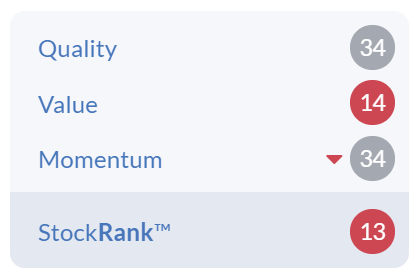
The StockRank algorithms don't rate it either;
.
.
Marks And Spencer (LON:MKS)
Share price: 120p
No. shares: 1,953.4m
Market cap: £2,344m
(I hold)
Just a quick mention, but I've just enjoyed watching a very interesting interim results webinar here. Highly recommended, it's really thorough.
MKS has been trying to turn itself around for a long time, with repeated restructuring programmes. It feels to me, as if this time it could be the real deal - Chairman Archie Norman is well respected, and a few things jump out at me from this webinar, so here are the key points from my notes;
- High performing food business, with LFL sales up 6.6% in H1, once things likes cafes are stripped out (as they were forced to close)
- Full M&S food range now available on Ocado, doing well apparently, profitable
- Plenty of liquidity: £1.4bn cash & undrawn facilities - "far better" than anticipated
- Costs cut & layers of management removed
- Supply chain being "radically reshaped" & costs removed
- M&S is now the UK's #2 clothing retailer online - surprising
- Relaunch of Sparks loyalty scheme, with 1.5m app downloads
- Targeting >40% of total sales online, within 3 years
- Digital transformation, lots of credible stuff to back this up
My opinion - I think M&S could be beginning a genuine resurgence. As mentioned last week, I've dipped my toe in with a starter size position at something like 96p. Lucky timing, because then the positive Pfizer covid news came out. So it's important not to delude oneself that lucky timing was anything more than just luck. It's now about 118p, due to that indiscriminate vaccine bounce.
The mkt cap of MKS is about £2.3bn now, yet I reckon it's by far the best brand on the High Street. How many other food retailers make you feel special, and warm/fuzzy, even privileged, as you walk in? Maybe just Waitrose, but none of the others do. I think the MKS brand is incredibly valuable, potentially multiples of the £2.3bn market cap.
Debt is fine, at £1.4bn (excluding leases), with loads of headroom.
The challenge is obviously how they turn around the clothing/home part of the business, which lost its way many years ago, and has never really recovered?
I'll keep monitoring MKS, and for the time being am only dipping my toe in the water, with a small position (about 1% of my portfolio). I really do think it could be a recovery story, not a terminal decline story. Time will tell!
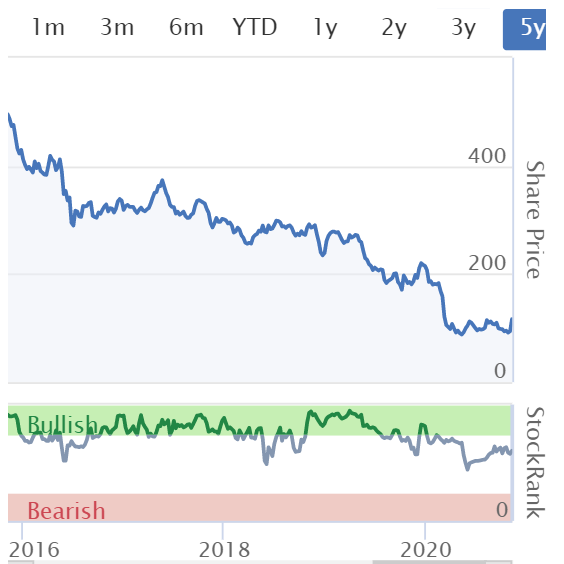
Pretty awful chart, so there's a lot to do.
.
.
Water Intelligence (LON:WATR)
Share price: 490p (up 2% yesterday)
No. shares: 17.6m
Market cap: £86.2m
Initiation of Sales of Sewer Diagnostic Product
Water Intelligence plc (AIM: WATR.L) ("Water Intelligence" or "Group"), a leading multinational provider of precision, minimally-invasive leak detection and remediation solutions for both potable and non-potable water is pleased to announce the initiation of sales from OrcaTM, its proprietary sewer diagnostic product. Such initiation of sales has been delivered on schedule, as guided by the 3Q Trading Update previously released...
This sounds rather interesting -
Orca has been in development at the Group's UK-based, Water Intelligence International subsidiary (WII). The proprietary product uses acoustic technology to identify sewer blockages in municipal pipes more effectively than any competitive solution.
WII has paid engagements starting with 4 large municipal customers in the UK. The Group expects that such engagements will lead to a broader rollout in 2021 in the United States, Canada and Australia within a subset of the Group's 140+ locations.
It would be good to get some third party confirmation of what this product is like, and what potential it might have. No financial details are provided today.
Directorspeak -
Commenting on the Group's performance, Executive Chairman, Dr. Patrick DeSouza remarked: "We are pleased with the initiation of commercial sales of Orca. The product is timely and will add to the growth of our Water Intelligence International subsidiary. Such sales, combined with our recent insurance customer wins, will reinforce our growth trajectory for the remainder of 2020 and 2021.
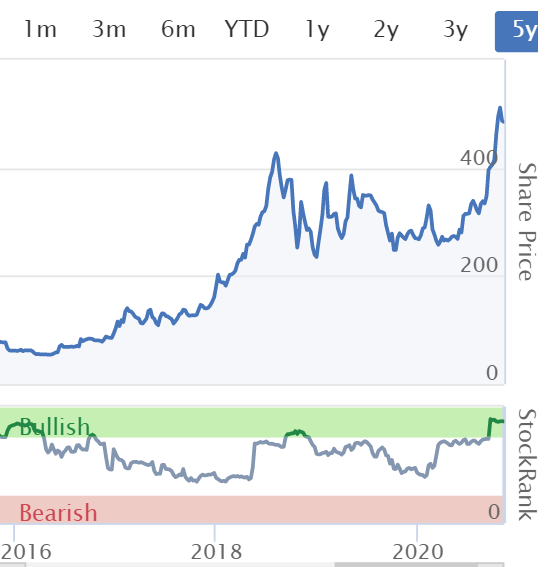
My opinion - every time I report on this company, I moan about the high valuation. However, the company keeps throwing more red meat to shareholders, with a succession of positive-sounding announcements.
It's looking quite interesting. If this Orca product takes off, then the addressable market must be very large, globally. What other competitive products are there, I wonder? If WATR has something genuinely ground-breaking, then things could be good. Its not for me to say, I'm just flagging up the share as something that readers might want to look into in more detail.
.
.
** This section written by Jack **
Ricardo (LON:RCDO)
Share price: 340p (-7.4%)
Shares in issue: 53,406,250
Market cap: £181.6m
(Jack writing)
A hat-trick of RNS statements from Ricardo (LON:RCDO) this morning: a trading update, a proposed share placing, and a linked PrimaryBid offer.
This environmental and engineering consultancy specialises in the transport, energy and scarce resources sectors. While those areas are hopefully poised to recover in the months and years ahead, 2020 has been a hard year so far. The same can be said for Ricardo’s share price.

Mind you, this has been another defining week and market sentiment has totally flipped - for now, at least - on the back of Pfizer’s vaccine announcement. So perhaps this type of beaten up share will be viewed more favourably by the market in the weeks ahead.
This is for the first quarter's trading to 30 September 2020. Half year results are expected in February 2021.
In the quarter to 30 September 2020, overall order intake was strong at £105.2m, up 19% year-on-year (note that comparable was before COVID disruption) and an improvement on the £70m of orders received in the quarter ended 30 June 2020.
All segments delivered an increase in order intake except for Performance Products. Running through those business units in a little more detail, we have:
- Energy & Environment orders up 29% to £11.7m.
- Rail orders up 40% at £26.9m.
- Defense orders up 141% to £14.2m.
- Performance Products down 42% with received orders of £13.2m.
- A&I up 27% with an order intake to £39.2m.
The group continues to experience challenging conditions in Automotive & Industrial (A&I) EMEA and expects the order intake to remain at a low level over the next few months.
Consequently it’s guiding towards more of an H2 weighting in full-year results - this can be (but isn’t always) an early warning sign. Per the group:
Historically operating profit phasing has typically been 40% H1 and 60% H2 and in FY21, as we emerge from the impact of COVID 19, we expect this to be approximately 25% H1 and 75% H2.
So at least the company is sticking its neck out and giving some guidance, rather than pinning hopes on poorly-defined H2 recovery.
Dave Shemmans, Chief Executive Officer, commented:
The economic outlook continues to be uncertain and we approach the year ahead with a degree of caution, with our non-Automotive businesses providing some resilience against continuing challenges in the Automotive segment. Nevertheless, we have established a firm and diversified platform for our business and looking forward I remain confident of the prospects for the Group.
Mixed orders aside, Ricardo anticipates a small net cash outflow in addition to the payment of £5.2m of earnout costs in relation to previous acquisitions and approximately £3m of redundancy costs. It’s burning cash and net debt has increased. That’s why it is placing shares.
Up to 7,981,809 new ordinary shares at a price of 333p, with directors subscribing to 29,128 (c£97,000). There’s an additional offer of up to 801,093 shares to retail investors on Primary Bid. So gross proceeds of around £29m representing 16.5% of existing share capital.
This is driven by the Automotive EMEA business, which continues to receive a lower than required level of workable orders.
Per the group:
The Fundraise is intended to reset the capital structure of the Group, reducing leverage to achieve an appropriate level of balance sheet efficiency and resilience. The net proceeds will be used to pay down drawn debt facilities, resulting in increased headroom, lower net debt and lower adjusted leverage, and providing greater flexibility to invest in growth projects and meet working capital requirements.
Conclusion
This looks like an interesting company but I’m not tempted.
There’s a slight mismatch between the tone of the trading update, which sounds reasonably resilient, and the placing, which, reading between the lines, sounds much more distressed.
Given that, perhaps I am more sceptical about the H2 weighting. Obviously I hope the company prospers but I don’t see why I need to risk my capital to make that happen. You can see the net debt spiking up this past year.

Directors are participating but have been heavy sellers in the past. I’m quite happy to leave this one for now and potentially revisit once we are well and truly past this COVID disruption. The outlook for its problem division, Automotive and Performance Products, continues to look uncertain.
In fairness its other divisions appear to be performing strongly and there could be longer term potential here if trading recovers - but right now seems a particularly intriguing time elsewhere in the market.
Is there a changing of the guard taking place, with a rotation from lockdown beneficiaries to beaten down recovery stocks? Or have the past few days been a false dawn? There might be more immediate reratings out there.
.
Renold (LON:RNO)
Share price: 12.2p (up 12%, at 12:22)
No. shares: 225.4m
Market cap: £27.5m
(Paul holds a long position)
I bought a small opening size position in this one back in June 2020, as it looked an interesting potential turnaround, and management were indicating that a dilutive fundraising could be avoided. The thorn in the side is a humongous pension scheme, in deficit, draining cash out of the company, a long-term problem, particularly in times of ultra low interest rates.
I often like to make a small initial investment into something, then monitor it closely, and either gradually increase, or cull the position over time, as my knowledge of the company increases, and news comes out to either weaken or strengthen my conviction about the company.
Renold, a leading international supplier of industrial chains and related power transmission products, today announces its unaudited interim results for the half year ended 30 September 2020 (the 'period').
Resilient performance…strong cash generation…significant net debt reduction
The summary points above are accurate, so I’ve included them.
Clearly this has been a period (April-Sept 2020) when covid/lockdown has had a major impact on many/most companies. So I’m not expecting great numbers. These do however indeed look resilient;
.

.
Revenues are down about 16%, which I would normally expect to have a much larger, operationally geared impact on profits. However, in this case you can see that profitability has been fairly resilient (down 25%). This is due to restructuring & cost-cutting done before covid, fortuitously. See also how H.O. costs are down about 10%.
These figures are only for 6 months remember, so if we look at adj EPS of 1.1p for H1, and double it to approximate to a full year (ignoring seasonality), and 2.2p, with a share price of only 12.2p that’s a PER of just 5.5 - quick ring the broker & get a buy order in! Not so fast, because of course there’s a catch - a huge pension deficit.
The Group has a number of defined benefit pension schemes (accounted for in accordance with IAS 19R 'Employee benefits'). During the period agreement was reached with the UK pension trustee to defer contributions (£2.8m) to the UK pension scheme. This delays agreed contributions, now payable between April 2022 and April 2027, but maintains the consistent cash requirements of the Group's schemes.
Cash pension costs are sustainable, having remained consistent at approximately £5m for several years, and are expected to remain broadly stable over the longer term.
The Group's retirement benefit obligations increased from £97.6m (£80.2m net of deferred tax) at 31 March 2020 to £115.6m (£94.7m net of deferred tax) at 30 September 2020.
Continuing declines in corporate bond yields, which determine discount rates, have increased the deficits in the key UK and German schemes. In the UK, discount rates falling to 1.55% (31 March 2020: 2.4%) and the CPI inflation assumption increasing to 2.2% (31 March 2020: 2.0%) has the effect of increasing the present value of future liabilities by £29.2m.
Strong asset returns helped to mitigate the impact of change in the financial assumptions, with the net UK deficit increasing by £16.0m to £84.0m.
These are massive numbers for a company with a market cap of only £27.5m.
We’ve discussed pension deficits here quite a lot recently, and it cropped up in discussions of Reach (LON:RCH) . My worry is that, as in this case, good investment returns are not enough to offset the problem of low bond yields inflating the liabilities. An interesting angle on this, is if policymakers could be persuaded to allow pension schemes to reduce their liabilities by coming up with an alternative way of discounting them?
The nightmare scenario would be if investment returns crash the assets values, e.g. another collapse like we saw in March, without a rebound. Where pension schemes are a material factor, it really is vital to understand the situation properly, by reading all the disclosures at the back of annual reports, e.g. to see what the pension scheme assets are invested in, and how risky those investments might be. Sometimes risk has been mitigated by the trustees, by taking out insurance policies, or other hedging.
How to adjust the valuation? Personally I’m mostly concerned about the cash outflows. We’re told that these are c.£5m p.a., and likely to continue at that level. Hence I would adjust earnings down by that amount, then put the shares on a more normal PER. Or work out a reduced PER, on the basis of how much is being absorbed by the pension scheme?
Or, you could look at free cashflow, and adjust that for the pension cash payments maybe, then put the shares on a multiple of cashflows?
Net debt & cashflow - there’s an impressive reduction in net debt;
Strong cash generation resulting in a £10.2m reduction in net debt to £26.4m (31 March 2020: £36.6m); with net debt to adjusted EBITDA ratio of 1.2x (31 March 2020: 1.5x)
That’s a huge reduction in net debt, over just 6 months. Looking through the numbers, the main factors for this are: very strong EBITDA (bear in mind there is a large depreciation charge), low capex (restructuring done last year), favourable working capital movements from decline in business (inventories & receivables down), deferral of pension payment, and a tax rebate.
I think this big debt reduction, and cash generating ability (even in a downturn) augurs well for the future, in that the company probably won’t need a fresh equity raise, when it can demonstrate the ability to pay down debt fairly quickly without it.
However, there is a warning in the going concern note, that a downside scenario could trigger a covenant breach (and hence maybe an equity raise);
However, the most severe downside case indicates the potential for a covenant breach during the test period, indicating a material uncertainty related to events or conditions which may cast significant doubt over the Group's ability to continue as a going concern in the event that, following a covenant breach, lenders elected to trigger a repayment of outstanding debt….
Balance sheet - is dominated by the huge pension deficit of £115.6m. However, if we park that to one side as being a manageable long-term creditor, costing £5m p.a. to service, then things start to look more manageable.
The working capital position looks fine, with a big surplus of current assets over current liabilities, but a fair bit of long-term debt.
Overall, I’d like to see net debt come down some more, to make me fully comfortable with the balance sheet.
Dividends - none for the moment, but will be kept under review. As a small shareholder, I don’t want divis, I’d much rather see the company retain cash, and reduce its debt, and thereby reduce my investment risk. Divis can come at a later date, once the balance sheet is more robust.
Outlook - not madly exciting, recovery sounds slow;
The trends exiting the period suggest that order intake should continue to improve slowly, albeit this is likely to be at levels below the prior year in the near term. The immediate outlook varies by both geography and sector, and is difficult to forecast, however, Renold benefits from its geographic, customer and sector diversity. The tight focus on cost and cash management in the first half has created a strong platform from which the Group can manage through short-term disruption, whilst retaining the ability to invest in support of our strategy as markets recover.
My opinion - I’m happy to continue holding, and might top up my existing position. This share can be very illiquid. I remember when I needed to sell some when a margin call hit me, my broker could only shift 5,000 shares, for about £500! And that pushed the price down, which made my margin call bigger! For that reason, I probably shouldn’t be using margin for something this small & illiquid, hence why I’m reluctant to increase my position size. As mentioned earlier this week, it’s vital to be able to exit from positions where you’re using margin. Most readers are probably more sensible, and wouldn’t use margin on this type of thing, or at all.
Taking everything into account (including the pension deficit), I reckon this share looks cheap. It’s whether you can live with the pension problems or not, that is the deciding factor.
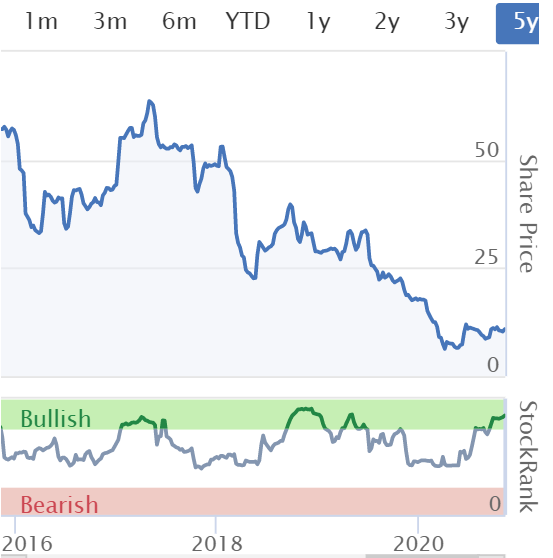
The 5-year chart below shows that Mr Market hasn't given the company much credit for its turaround restructurin last year, which could be an opportunity maybe?
.
.
Mccarthy & Stone (LON:MCS)
Share price: 116.7p (up 0.5%, at 15:14)
No. shares: 537.8m
Market cap: £627.6m
I mentioned this retirement housing developer yesterday, casting doubt on whether the 115p cash takeover offer from Lone Star Real Estate would gain enough shareholder support to proceed, or whether a higher-priced offer might crop up, or the offer lapse.
Today we have a trading update.
McCarthy & Stone, (the 'Group') the UK's leading developer and manager of retirement communities, is today issuing a trading update for the financial year ended 31 October 2020 ('2020'). All comparatives are for the 14 months financial year ended 31 October 2019 ('2019') unless otherwise stated.
To summarise the main points;
Completions are well down on last year:
Total completions of 832 units (2019: 2,402) … and generated full year revenue of c.£197m (2019: £725m).
Operating loss in line with the Board’s expectations, but we’re not given any figures on profitability
Modest net debt, it’s a low geared balance sheet. That might have attracted the bidder, who could be planning to fund the bid partially by loading it up with cheap debt maybe?
Net debt of c.£63m (2019: net cash £25m) with a continuing focus on cautious cash flow and investment management … which provides £137m headroom versus bank facilities in place of £200m
Current trading -
Current trading increasingly affected by rising COVID-19 infection rates and Government lockdown measures
"However, with national COVID-19 infection rates rising and lockdown measures in place, the retirement housing market is expected to remain difficult. As a result, the Group will continue to cautiously and actively manage cash flow balancing investment in land and development to support future sales with the need to preserve headroom in order to enable the Group to navigate the short-term risks. It is against this backdrop that the Board believes the 115p cash offer from Lone Star Real Estate Fund represents fair value reflecting both the future opportunities and risks facing the business."
My opinion - personally I was happy to grab the profit, and sell out at c.115p when the bid was announced. A friend emailed me to point out that the offer price is below NAV. Working out the figures, last reported NAV was £695.1m at the recent interims. Deduct £4.3m intangibles, gives NTAV of £690.8m. Divide that by 537.8m shares in issue, and that gives NTAV (sometimes called P/TBV) of 128.4p per share.
I wonder if major shareholders might be angling for a premium to NTAV? Maybe the bidder might need to raise the price to say 130p+ to get more support from institutions? So far only one, holding c.17%, has publicly given an irrevocable undertaking to support the 115p takeover bid.
.
All done for today! See you tomorrow.
Best wishes, Paul.
Disclaimer
This is not financial advice. Our content is intended to be used and must be used for information and education purposes only. Please read our disclaimer and terms and conditions to understand our obligations.

96 comments
Paul any thoughts on Yu (LON:YU.) 100p made a small acquisition yesterday, mc 15million massive 100m revenue rather to small market cap maybe turning itself around the strongest of the bunch nice staff long term incentive plan up to 625p ceo owns 50%
Re Renold (LON:RNO) and other companies with material DB pension liabilities, people really should at least skim read the Pensions Regulator's latest consultation document summary https://www.thepensionsregulat...
In particular, p. 11 suggests trustees aim for a target 'Long-term Objective' for technical provisions (ie the present value of future liabilities) once a scheme is 'significantly mature') based on a discount rate of no more than Gilts +0.5% pa. Also note ''We are consulting on the principle that a scheme’s investment strategy and asset allocation
over time should be broadly aligned with the funding strategy, including consideration of
the TPs and journey plan. At the point of significant maturity, the asset allocation should
have a high resilience to risk along with sufficient liquidity and a high average credit quality.'' So, as time goes on, there won't be a great deal of scope for assumed equity out-performance and this is likely to become reflected in schemes' actual investment strategies.
Remember that 'employer covenant' is long been a key metric in tPR's thinking. In particular, a financial weak employer should take less risk and repair deficits faster than a stronger employer might be allowed.
It's all an evolving, joined-up approach to ensuring that pension promises are ultimately met. Some might argue the pendulum has swung too far towards member protection at all costs......
I was a pension scheme trustee for 25 years. The whole thing is a dog's breakfast. We see what is happening to some plc's but many private companies are under pressure as a result also. Indeed there have been many insolvencies caused by pension scheme deficits. More insidiously, funds that would otherwise be used in developing the business such as keeping up to date with technology or paying competitive wages are being poured into the pension scheme black hole. Over time, firms with pension scheme deficits get overtaken by companies that never had one in the first place. An example would be traditional retailers with old style pension schemes trying to cope with new online rivals.
I could go on. My personal view that investing in companies carrying a pension scheme deficit is not worth the risk Just my opinion.
That’s an interesting insight and (pension deficit shoring up old, legacy tech firms trying to update/compete (read Digital Transformation). I keep a watchful eye on the solid Q and V fundamentals, but even they are easy prey to a management pressure point of “lets shore up the pension black hole”.
Good insight and noteworthy
Excellent insight, whatmore1951,
I am invested in a few companies with pension deficits and my rationale is essentially that they have more than enough cashflow to satisfy the top-up payments and that the share-price is overly suppressed by pension concerns.
Given that their business plans don't appear to be cash constrained, it never occurred to me to ask what they would spend the cash on if they didn't have to top up the pension.
The cynical answer might be that they would spaff the money up the wall on corporate vanity - but I have to have more faith in the management teams I am invested in.
I might try this question on a few CFOs and see what answers I get.
Paul your Nov 5th article was favourable re N Brown open offer at57p what say you now as the shares are trading now at 51p
Hi E1Sutton,
I've just re-read my notes on N Brown (LON:BWNG) again, here on 5 Nov, and wouldn't describe them as a positive or negative, it's quite nuanced.
If the open market price is 51p, and the open offer is 57p, then clearly it would make sense to buy in the open market, rather than taking up open offer entitlements for existing small shareholders.
I don't really have a strong view either way on BWNG. What's your opinion?
Regards, Paul.
Premier Foods (LON:PFD), (I hold) Hi Jack, any thoughts on PFD results from yesterday? They looked ok on the face of it to me, I realise the stock got knocked down on the commentary linking duration of lockdown to further gains. I also liked the comments re: TV advertising as a potential read across to Itv (LON:ITV) ( I hold) .
Thanks Alb
Here are my heat maps for today (prices as at 2:30pm).
SVCR filtered to 'interesting' instruments (reporting soon or recently, trending, breaking out, or moving more than the 20d EMA of ATR):
Big movers today (moving more than 20d ATR EMA against either yesterdays close, or today's open - not limited to small caps):
And finally the key to the heat map contents:
The heatmaps are ordered by Stock Rank™, and are limited to the top 80 instruments.
The heatmaps are images and will be resized by your browser to fit your screen. If the heatmap images are too small to read on your screen, right-click on the image and select 'Open image in new tab'. This will open the heatmap in a new tab in your browser where they can be zoomed as necessary.
I use heatmaps a lot and generate many as part of my research. I use them to help find instruments with a high Stock Rank™ and Quality Rank which are trending (Tr+ or Tr++) or breaking out (Br+ or Br++), ideally on increased volume (V+). I then research them further using the Stockopedia Stock Report.
How (or indeed if) you use the heatmaps is up to you, I contribute them here in the hope that others may also find them interesting or useful.
Banks are sexy
Chriskay's determination to leave AJBell reminds me that was July 18 when the FCA proposed to ban exit fees. The consultation has dragged on ad nauseam as detailed here:
https://www.ftadviser.com/regu...
ii was the first mover and banned its exit fees late in 2018 using that as a plus point in its "Why move to us?".
Looking around at a couple of other popular sites iWeb and parent Halifax no longer charge exit fees but at x-o it is £15 plus VAT per holding. AJBell Youinvest? £25 per holding.
My only advice to Chriskay is to move to someone that will not charge you to leave if you don't like them.
Thanks sharw. I thought my ears were burning over dinner. In fairness exit fees are only part of a platform cost package and one usually finds if they don't charge for one thing then they make it up by charging for something else, so the bottom line comes out at around the same figure across the board. My trades per month are reasonably high so that brings the cost per trade down too. Having been in IT for most of my life and also managed a lot of web design projects, I am acutely aware of sites which flow and ones which are just plain hard work. AJB must have designed theirs over a pint on a beer mat whereas IG's which I understand is a new one, is a dream - one click searches, intuitive, live SPs included and the ability to design your own workspace. Also end user evidence suggests that AJB clearly have creaking IT which I simply do not want to trade on or trust with my cash.
The covid stocks took a caning on Monday. What has changed? A lot. The announced vaccine does not affect the need for testing or masks at the moment but the market always looks forward of course. Novacyt Sa (LON:NCYT) fell nearly £6 per share on Monday to just £5.50p at one stage. The spread companies advise that 88% are long of this stock and the heavy fall hit a lot of accounts very hard. Some huge losses. Just about every share account with a "stop loss" got closed out of their holding. A rally today on a director buy has seen the price rally back above £8.00.
Remote Monitored Systems (LON:RMS) has recovered over 100% on news that its facemasks will be available soon. However, Monday was evidence that stocks go down as well as up. The Dow is racing up just as the Nasdaq has been racing down. I read that Zoom, the star of lockdown lost 28 billion dollars on Monday from its market cap. I cannot even imagine the margin calls that went out.
There are over 40 different Covid vaccines being tested out of the 200 plus being developed. What will happen when the next vaccine roll out is announced? Many of the big losers this year are suddenly racing away. Where next after a huge 8 day 15% rally on the Ftse? No idea!
I think the directors of £RCDO are some smart guys, they knew when to buy and when to sell. Thanks for pointing this out Paul. Their participation in the fund raising is also interesting.
I can't understand the markets reaction to the vaccine news. It has hit online shares (like Boohoo etc). The high street was dying long before the virus and the virus has accelerated its decline. I would rather buy Boohoo at 265p than Easyjet at 730p by a long way. The economy was in poor shape before the virus and it is now in complete dire straits. Businesses with a lot of debt will do well to survive certainly without going back to shareholders for more cash. I personally wouldn't touch the 'recovery' shares with a bargepole and was quite happy that my virus and recession proof (hopefully) portfolio barely moved on Monday.
You may well be right but I wouldn't say Boohoo shares have been hit by the vaccine news. They have hardly moved. As far as Easyjet is concerned if we get a vaccine they won't have a spare seat next year and will be able to up prices. Everyone I know is absolutely frustrated that they have not been able to get away on holiday and that will be the first thing they will do when they are able.
Boohoo were 295p before the news and are now 265p so they are down over 10%. I agree EJ will be busy but I am not sure investors understand the debt mountain and battle they face.
I imagine Boohoo didnt move because a vaccine means conventional retailers can remain open. Boohoo doubled earlier from Jul to Sept, based on the pandemic lasting and online retailers being able to take advantage, so no surprise it hasnt moved this week..
Yes I think the same consideration applies to the cruise lines. They will all be a long time paying back their debt.
My preferred bet on air travel is the aircraft leasing companies. I started buying back in to Avation (LON:AVAP) yesterday.
Agreed John, Avation (LON:AVAP) is at a large discount to net assets which looks unjustified in the current environment. I also hold (and added yesterday). One of the things that has impressed me is their ability to repossess leased aircraft from failed carriers and redeploy them elsewhere. This means that shareholders are insulated from the single-company risk which you would face if investing in an individual airline. Plus the low interest rate environment must help them. It's a well-run business.
And, re Easyjet (LON:EZJ), it is noticeable that, on their current restricted flight schedule, ticket prices have risen markedly. RPK, a key metric for the sector, will rise quite a bit next year. Although, having been trying to remain solvent, they have been increasing their operating cost base by selling aircraft to lessors.
I agree the price reaction to the virus news on Boohoo (LON:BOO) was ridiculous, and makes no sense whatsoever. The fact is that BOO traded very strongly in Q2 (June, July, August), which was the period when High Street competitors were re-opening. A resumption of activity by competitors therefore did not hurt BOO, it produced superb growth, and guided profits up again.
What I think we saw on Monday morning was a kneejerk reaction - i.e. anything covid testing related (e.g. SNG, NCYT, AVCT) dropped by about a third. Anything retailing/hospitality/travel/leisure went up indiscriminately (e.g. CINE shot up, despite being effectively insolvent on a balance sheet basis). And anything work from home, or internet selling (e.g. LOOP, G4M, BOO, ASC), went down.
I think, over time, these are likely to fan out into the actual winners & losers, rather than what traders bet on short term either way.
To me it's yet another buying opp in BOO. We should get the next trading update in early Dec, which could once again produce a vertical move upwards, as trading results are more important than anything else. Remember that the next trading update will include the key Black Friday trading period 27 Nov 2020, which falls within the current English lockdown period - i.e. BOO won't face much competition from physical retailers. So it should be able to go bananas with its online marketing, to scoop in all those sales.
The other thing to consider with the vaccine, is that once it & testing have kicked in, and lockdowns become a thing of the past, then demand for clothing overall is likely to go up. Special occasions & parties, and nights out, are all likely to resume. There will be a backlog & pent up demand for these things plus weddings, so I see 2021 likely being a bumper year for clothing retailers, which should benefit everyone, including BOO, Asos, and of course QUIZ which used to focus on special occasionwear.
Disclosure: I hold BOO and QUIZ.
Regards, Paul.
P.S. I wonder how many more new brands that BOO will be able to pick up in the future? They're likely to be spoiled for choice as more well-known brands collapse due to losses from their physical stores. Who knows, my FCCN shares might one day end up within BOO?! Each time they bolt on a new brand, it comes with existing online sales & customer database, which BOO then drastically increase using their expertise across multiple areas, but keeping the existing team of designers & buyers from each brand, to keep the existing brand signature on its products, but with a hugely increased range, and better marketing. It generates superb results & limitless future growth.
Re Boohoo (LON:BOO) building a platform on to which they are adding other collapsed brands, this is a strategy followed by Frasers (fka Sports Direct) with mixed success. However, the other obvious candidate for this approach is £Next who (Lipsey apart) have chosen to co-operate rather than than buy extra brands to operate on their NEXT platform. Historically, Next was focused on its own brand but I think this is less true now it realises the potential for its total system and has proven able to operate Lipsey at arms length.
I have often though French Connection (LON:FCCN) as a particularly good fit with them, as an older age premium brand target to complement Lipsey especially their core range of women's dresses (although there are others brands like Karen Millen they could have/will be able to have),. Next could also help out French Connection (LON:FCCN) by at least reducing losses in retail stores quickly by taking over & rebranding them and trading the site for cash until disposal of lease. Will be increasing amounts of fittings lying about! Certainly, I think French Connection concessions would do well in Next stores and online. The FCCN product has generally been OK (IMHO) - it is the Marketing muscle, website and logistics that doom it.
Perhaps a sale to a proper retailer like Next would (finally) be an appealing retirement option to Marks who must be kicking himself for failing to sell French Connection (LON:FCCN) to PE last year. All speculation but here's hoping as I still own some FCCN for my sins.
Anyone would think you were a shopkeeper Paul, I'm completely with your Boohoo (LON:BOO) assessment from a trading perspective. This is an online Christmas like never before and I expect Boohoo to take full advantage. By the time bricks and mortar stores re-open the on-line trade will be passing peak. The only cautions are that the party dress season will probably weigh down growth a little, and consumer confidence may detract from the size of non food retail this Christmas, meaning buying could be late. I'd be interested to know also if the lockdown benefit of lower customer returns in Lockdown 1.0 is holding up, Lockdown 2.0 not being as restrictive.
It is a sign of the times that Marks and Spencer is now considered to be a mid cap company. One of their performance targets must be a return to the FTSE 100.
I recollect a visit to the menswear department of Marks and Spencer's about two years ago. I noticed that some clothing stock had fallen on the floor but was disappointed to see several sales assistants walk straight past as if it was nothing to do with them. Shortly afterwards I noticed an opened can of Red Bull standing amidst the formal shirts and then noticed a woman in a supervisors uniform walking straight past and being no where near as concerned as I was.
I am a long term customer of Marks and Spencer and was certainly heartened by Paul's report. In addition to the improvements Paul mentioned I think certain fundamentals need to be addressed including pride in performance and developing the concept of salesmanship amongst the staff.
Once upon a time (you will like this Gromley) our new Works Manager called his Supervisors together and told them they were stepping over elephants every day. Next thing, the Business Consultants came in. There was a bloodbath. There are two morals to this story, one is avoid consultants at all costs and the other is why should shareholders care.
I tend to think shareholders should care about the overuse of consultants. Not only can they be very expensive, I suspect that in many cases (as your posts suggests may be the case) what they propose can lead to lower rather than higher performance than listening properly to those involved.
I wouldn't argue that consultants have no role or should never be used, but I think there is a very worrying pattern for many to employ consultants simply to save making decisions themselves and taking responsibility for them. That's very poor management, and unlikely to be of benefit to shareholders.
Did I ever give the impression I had some grievance with elephants?
re £MKS. Whenever I go there - admittedly more to use the loo (its an age thing) - I am reminded of former stalwarts of the High Street like Dunn and Co - the home of the suede fronted cardigan and the flat cap - and C&A (Coats and Ats). Younger readers should consult their grandparents. I can't see much future for it.
Minds and Machines Minds Machines (LON:MMX) up over 30% today. Financial doubts cleared, new management and share buy back. Seems to be on track to get up to 6p and beyond.
Minds Machines (LON:MMX) (held last week, but sold out)
Hi Greenhat2
Just to mention that I personally still have financial doubts, despite today's update.
The re-published figures didn't make complete sense and as much as I would like to buy back, I will only do so when complete financials are available.
Cheers
A
This looks seriously good news for Cenkos today, who are acting as sole bookrunner and financial adviser:-
https://www.investegate.co.uk/round-hill-music/rns/results-of-ipo/202011110800049032E/
Cenkos have not issued a separate RNS, but that’s standard for news like this.
Bearing in mind that cash accounts for a big chunk of the Cenkos hare price, along with price to book value a bit over 1 compared with double that in the past, this looks a significant booster for Cenkos. Share price response so far is muted. I hold.
Hi Ken
Do you know what sort of commission Cenkos will get from this IPO.
I’m fairly new to this game and not sure if brokers get a bigger fee for IPOs than share placings?
I hold.
thanks
Sovereign Individuals and maxistaxis.
I don’t know how much Cenkos gets from this IPO nor whether there is a bigger fee for IPOs than share Placings. If anyone reading this does know please post. Obviously the bigger the Placing or IPO the bigger the fees. And further Placings are likely from this IPO today.
As for whether the news was already priced in; the muted share price reaction suggests it was. But it was far from certain in this market that they would be able to get it away, so isn’t it a feather in Cenkos’s cap that they have? They can refer to this big success when going for others.
Also, regardless of whether it was largely priced in, Cenkos is on a much lower rating than others in the sector like Numis. So there is imo potential for considerable share price upside. I forgot to check whether this is still the case before posting this, but Cenkos Director pay was modest, but they have (or did have) large shareholdings.. Cenkos paid out the bulk of their profits in dividends and they supplemented their income that way.
So assuming a good increase in profits ahead, dividend yield ahead could again be substantial. They’ve paid some very big dividends in the past.
There’s some very good comment on Cenkos here both grim Paul and also Graham Neary. I think Cenkos is one of so many bargain shares around now. Certainly worth checking out imo.
If I am not mistake Cenkos Securities (LON:CNKS) SP already reacted earlier in the month to this news - so if you see the SP chart - around 4th Nov. A few stockopedia viewers mentioned it, from my memory. To confirm, you may want to go back to 4/11/20 stockopedia comments section and review.
I'm an optimist like you Paul & see great potential for a real turnaround at Marks And Spencer (LON:MKS) - I am currently watching the webinar and think that if they can't do it with this current management team - they never will!! I have recently been into one of their stores and was impressed with the range of mens clothing - not something I have ever thought before. The potential with the Ocado deal is large and I'm positive about the future. (I bought some shares in the March meltdown)
If you look at the Marks And Spencer (LON:MKS) half year operating profit for Ocado and the food business, once clothing and home gets back to some sort of normality (even if long-term trend in that business remains negative) you can see a decent re-rating of this share happening.
Also some of its most up-to-date food stores (e.g. Clapham Junction) are incredibly well designed and great places to shop. I think they need to improve the store experience for clothing and home though as I agree with kgb1953 that those stores feel a bit drab.
A J Bell - The broker from hell!
9.38am and the value of my portfolio with A J Bell looks remarkably similar to what it was last night. In fact it is identical to what it was last night! They are unable to update them this morning due to 'technical problems'. Going to dig into my pocket and bear the cost of transferring everything out today assuming they are still in business!
I am a very happy customer of Degiro although I realise they cannot handle ISA and SIPP. Only problem I have found is a delay in responding to customer queries,but otherwise they are exceptional in what really matters .
I've had a DeGiro account for a couple of years and it's been a positive experience. Not the most user friendly platform but I've never found it down or unable to transact. you need o take an online test before being able to trade some ETFs, ITs, bonds and other 'complex' instruments.
My account is denominated in GBP but is used mainly for US holdings. GBP/USD conversion always appears to be at within 0.1%-0.2% of the prevailing FX rate with no added commission. Somewhere I read their price quotes perhaps aren't the keenest but I haven't seen any real analysis.
Only 'funny' was this summer when they decided to refund most of my cash holding as they'd underwritten the possibility of the underlying money market fund going to negative interest rates. I believe they're due to transition cash holdings to an EU-regulated deposit account soon, which should resolve that problem.
btw, for anyone trying to transition holdings in specie from one (UK) broker to another, my experience a couple of years ago was that it was a painfully slow process and proceeded at the pace of the slowest of the several custodians involved, ie a couple of months where one couldn't deal online (though perhaps I could have by phone?). Need to balance this hassle against just selling for cash and crystallising the dealing spread and CGT gain/loss. Cash transfers 'should' happen much faster. Will shortly be facing this hurdle when at last I move from Barclays.
Wilbraham
I moved from Barclays about 2 years ago and it took so many months that they gave me some financial compensation. I'll never use them again.
Hi Chriskay
I am with IG Index and I am more than pleased with their service. I would highly recommend them, For your info, I have no connection with them.
I would also highly recommend Interactive Investor (ii) - they have a great platform at a reasonable price plus, they have stood up to the stresses and strains of this weeks market volatility. I have no connection to ii, either - DYOR. Cheers
I recently moved from Interactive Investor to IG as they offer direct market access and seemed to have cheaper trade prices. I have started to regret it as so far, and I have quite a small portfolio, I’ve not been able to buy and sell four times so far ( in 1 month) and its cost me several hundred pounds. Also their spreads are always wider than ii . ii is always exactly the same as the spread as level 2 and I was always able trade at any time and also they have a great app.
The saving on the trade prices with IG are easily eaten up with the wider spreads.
it took 7 weeks to transfer with just 1 holding , and was free. I’d highly recommend ii fir their really fast and helpful customer service by phone and their efficient trading platform.
I recently moved from Interactive Investor to IG as they offer direct market access and seemed to have cheaper trade prices. I have started to regret it as so far
The larger platforms can have their problems as we've seen , but if hoards of investors move to the smaller brokers then they'll take the issues with them - the problem is one of scale, and the likes of HL, ii and AJ Bell are bigger than everyone else so get hit with higher volumes. If there's a wholesale move to smaller platforms there's no guarantee they'll hold up either in a volatile market.
I actually moved away from smaller providers to ii and AJ Bell even while recognising there might be issues under these circumstances. If you're holding funds via nominee accounts you really, really want to be with the biggest providers. Back in 2008 and 2009 a lot of us were wondering if our monies were safe and even with ringfencing it seems that's not always the case as the Beaufort Securities fiasco showed:
https://www.thisismoney.co.uk/...
I've had problems with access with both ii and AJ Bell in the past but I'd rather accept that and moan at them than risk my funds in a smaller provider. That said the biggest platforms really ought to be able to handle this kind of surge volume, there's no real excuse for the kind of outages seen this week.
timarr
IG is 6 times bigger than AJB and their site stayed up whilst HL is bigger than them all put together and they went down timarr. In my opinion it is a matter of whether these companies are sufficiently customer focused to invest in excess system capacity in preparedness for such eventualities or if they calculate that the inevitable customer loss incurred by distancing the customers from their investments is financially bearable. Also in the case of AJB their system was already creaking well before this, having been down a number of times in the last few weeks and having problems paying over cash. They claimed in the Times this week that the recent outages were 'unprecedented' when they certainly were not. The inability to update portfolios today which still persists, is a new issue and one wonders what will be next. I am going to try the tricky manoeuvre of selling all holdings at AJB and selectively rebuying on the IG platform rather than paying £25 per holding and waiting ages for a transfer. At least it will keep me occupied during the lockdown.
Hi Chriskay
Fair enough but just remember that IG are not really a stockbroker, they're primarily a spreadbetting platform. In fact some IG clients had account access issues earlier this week. I'd also note the issues raised by Stuart Stone below.
To put this in context IG had access issues last year and earlier this year and most of the major US platforms crashed during the crisis in March. It's not really good enough, it's not like this doesn't happen with depressing regularity.
That said I hold a lot of both Aj Bell (LON:AJB) and Ig Group (LON:IGG) so personally I'm neutral :-)
timarr
Thanks Terry. I have recently opened an account with IG and it is a super site at an excellent cost per trade. They stayed up earlier this week too. AJB which is still not showing my portfolio prices is frankly not fit for purpose.
Hi Chriskay - noted problems with ajbell this week also.
Without the fine detail is/was the cost to move platforms significant ? It used to be that platforms paid for you to cross over, but suspect that's no longer the case ? Does shifting mean lost trading days ?
I already have ii account, which like IG performed well (for me) this week & would be shifting to that - it looks like they can handle all the various etfs, funds etc alongside side the shares and Trusts.
Thanks
Its £25 per holding with AJB Nigem but according to another post on here today, transferring a portfolio can be complicated and take time so maybe best to sell holdings and buy again on new platform, although there could be a valuation impact with this approach.
thanks : )
thanks : )
I don't blame you - the only way these businesses will learn is if clients vote with their feet
I accept that AJ Bell are having a few problems this week but then so did a number of other market leading platforms on Monday (HL & Fidelity in particularly). As a counter to the negatives comments on Stockopedia today I currently have 6 regular monthly investments which all executed on Tuesday no problem. I addition I contacted their telephone dealing service yesterday regarding a share I was interested in which had multiple listing status on Canadian, US and more recently UK exchanges. The phone was answered promptly and the AJ Bell dealer provided excellent information on where the the bid offer spread was the tightest (i.e the best liquidity) and the relevant SEDOL codes to purchase online. Consequently I was able to buy online 7.5% more shares for the same amount of money that It would have cost had I bought the UK listed stock. This more than offsets the FX charge of 1% for foreign dealing in this instance. As a long term investor with occasional forays into more speculative share dealing I find AJ Bell manages my ISA and SIPP investments very effectively. I suspect in times of extreme market volatility (and Monday was certainly that!) a dedicated trading platform might be a safer and more reliable option.
Regarding AJBell and my experience. I went through the pain of transferring to them from HL late last year to save money on fees, it was a very long and frustrating business with me not being able to buy and sell for a considerable time and with me having to play go between to keep the transfer moving. Unfortunately things didn't start well with AJBell when they failed to act on my instructions to withdraw funds from my SIPP before the year end to take advantage of the tax allowance despite me sending 2 secure messages and making several phone calls. I raised a formal complaint and asked for compensation for the tax I would have to pay (only a few hundred pounds) and after 4 weeks and several letters from them they rejected my complaint and told me to contact HMRC for a refund, which I did but HMRC said they would only deal with AJBell but AJBell refused to contact them on my behalf. I was in the process of writing to the ombudsman and transferring again when I contacted their back office staff for some information and when I explained why I need it they said they could contact HMRC to reclaim the tax and I wouldn't need to do anything!! I have decided (for now) to stay with them after all as I can't face the pain of another transfer.
Chriskay - you have caused a good discussion on this today but here is something that could help from one of the suggested alternatives:
https://www.ii.co.uk/special-offers
Nice thought sharw but this is about service not price, and being able to consistently transact, get your cash out and view your up to date portfolio - pretty basic stuff!
A J Bell - The broker from hell!
9.38am and the value of my portfolio with A J Bell looks remarkably similar to what it was last night. In fact it is identical to what it was last night! They are unable to update them this morning due to 'technical problems'. Going to dig into my pocket and bear the cost of transferring everything out today assuming they are still in business!
Actually, you should be able to transfer stocks from AJ Bell at no cost since I won a FOS complaint against them a couple of years ago. The FCA stepped in to stop them charging exit fees for transfers to another broker. Of course, Andy Bell wrote some gushing promotional letter after the event making out it was a jolly good thing they were doing for their customers. You could hear his teeth grinding... the very essence of being disingenuous!
Anyway, I agree they are useless but still use them to hold my more long term SIPP holdings - there's no way I'd want to trade regularly using them in ordinary conditions, let alone on trading days like we have seen this week.
All the best, Si
Actually, you should be able to transfer stocks from AJ Bell at no cost since I won a FOS complaint against them a couple of years ago. The FCA stepped in to stop them charging exit fees for transfers to another broker.
Sorry for replying to my own post but I see that the FCA never banned or capped exits fees. How utterly toothless they are. I left this story once I had won my case against AJ Bell at the end of 2018 and accepted the compensation they offered. They also offered me a free transfer in specie from my SIPP to another provider, which I declined at the time, as that was not the point of my complaint.
However, it turns out the FCA never enacted a full ban or a cap on exit fees as they had proposed as part of their investigation. This means AJ Bell still charge £25 per stock for transfer out to another provider from ISA, SIPP or Dealing accounts. Just for a laugh, this is the announcement AJ Bell made at the time of the FCA findings in March 2019:
The FCA has today published the final report from its Investment Platforms Market Study. As one of the UK's largest investment platforms, AJ Bell welcomes the FCA's findings which it believes will help improve competition in the market and deliver improved customer outcomes.
Andy Bell, chief executive at investment platform AJ Bell, comments:
"Investment platforms play a vital function in helping people manage their long term savings and the regulator is absolutely right to question whether consumers are receiving the best possible service and value for money. Identifying areas where customer outcomes can be improved is vital for the development and growth of an increasingly important market and today's report is a significant step in the right direction.
"The FCA has confirmed that measures to improve transferability of assets between platforms will be extended to comparable services which is a positive development, particularly in relation to exit fees. A restriction in platform exit fees would not have a material impact on our business and as a net receiver of assets, we would expect to benefit from greater transferability of assets in the market.
“Enabling easier transfers of assets between platforms and other competing products will ensure customers are able to move more easily to better value services and will ensure healthy competition in the sector. We look forward to engaging with the FCA during the consultation phase.”
Andy Bell is wasted running a financial services company - he should be doing stand up.
All the best, Si
That would be nice, but I feel that a call for 'no exit fees' is whistling in the wind. As I understand things, there's often significant manual involvement in stock transfers between nominee accounts due to the complexity of different custodians etc. It's not a common activity so there's probably no great incentive to build a streamlined process. Perhaps ShareSoc is working behind the scenes to improve matters? For most investors, it won't be simply UK equities, but investment funds, overseas holdings etc which I suspect can be more complex. I suspect things could get quite sticky with a small stand-alone broker is there were a mass client exodus and they drowned in admin.
As things stand, £15-25 per line of stock doesn't sound unreasonable. My last transfer was at nil cost because the broker (ODL/FXCM) had decided to ditch its UK clients. Even that took a while and there were complications, eg with nil-value shares that had become delisted where I still had to sign undertakings that I was happy for them not to be transferred (as the receiving broker couldn't accept them).
There's a basic description of the transfer process here https://www.willisowen.co.uk/h...
The more I reflect, the more I feel it's often best just to bite the bullet and liquidate everything before initiating a transfer. And maintain at least two broker accounts to accommodate occasional 'issues' with one.
Would be interesting to hear from anyone who's experienced a smooth transfer process!
That would be nice, but I feel that a call for 'no exit fees' is whistling in the wind. As I understand things, there's often significant manual involvement in stock transfers between nominee accounts due to the complexity of different custodians etc. It's not a common activity so there's probably no great incentive to build a streamlined process.
Well, seeing as I took AJ Bell to the Ombudsman about their exit fees and they found in my favour and I received compensation for my exit fees from AJ Bell, I'd hardly call that "whistling in the wind". What's more, a few months afterwards in March 2019 the FCA published their final Investment Platforms Market Study report: https://www.fca.org.uk/publica...
Which contains the following:
Exit fees: discussion on the scope of potential remedies
1.10 In the IPMS Final Report, we state our view that a ban on platform exit fees is likely to be appropriate as a measure to reduce consumer harm. The report notes that to achieve
our aim, we need to consider the scope of any such remedy, given that platforms
compete in a wider retail distribution market. In Chapter 4 of this paper, we are
seeking further views on the potential nature and scope of this remedy. This includes
the extent to which any intervention should be extended to other types of firm that
compete with platforms in the retail distribution market. We are particularly keen to
hear from firms that are active in the distribution of retail investment products, but
which were outside the initial scope of the Market Study
Outcome we are seeking
1.11 Our proposals seek to improve consumers’ ability to switch between platforms
and enable them to benefit from lower costs and/or better functionality that suits
their needs. In turn, we expect this (along with the other remedies set out in the
Final Report) to improve competition in the sector, including lower prices, increased
efficiency and an improvement in the consumer experience. We consider that overall
this will help us to deliver public value through a better functioning retail distribution
sector.
My own assertion to the FOS was that it may all be very well imposing exit fees but £25 per stock is ludicrous. Does transferring 10 stocks really cost 10x more than transferring a single stock? If it does, why? High exit fees have only one use, as a disincentive for consumers to move provider if they are unhappy with the service they receive.
If other companies allow in-specie transfer out for free, why does AJ Bell still charge £25 per stock?? It's because they are egregious money grabbers who want to lock you in to their platform. I know that Hargreaves Lansdown and other brokers dropped exit fees following the FCA report but didn't realise that AJ Bell had clung onto them for dear life.
All the best, Si
same with halifax prices were last night close
The new 5 year deal with Woolworths could be a very important deal for Eagle Eye Solutions (LON:EYE) (I hold). Wikipedia says Woolworths has an annual revenue of AUD60 billion. - and while this is can only be a rough proxy (no doubt distortions like petrol sales) for the potential value of the contract - this would make it, by my research, the largest client EYE has signed to date for the AIR platform.
Mr C is correct in his summary that the RNS gives no monetary value to the contract - but none of Eagle Eye's historic contract announcements have ever given a monetary estimate - and as much of the later year revenues will come from transaction fees (rather than software licences or onboarding fees), it would be difficult to estimate a value. Historically, Eagle Eye has shown that its revenues have tended to rise each year with its existing clients.
Going through historic RNSs, these are the new "full-service" AIR clients, that Eagle Eye has signed since its signed its historic deal with Loblaw in 2017:
All the deals are 5 year deals, apart from the Warehouse Group (3 years) and Loblaw (which was described as "multi-year").
With EYE now moving into (hopefully) a positive cash flow situation - I think this is an interesting company, particularly if it can show it can win contracts elsewhere in Asia - or if it can follow up on its win last year with Southeastern Grocers and win more US contracts.
Braemar Shipping Services (LON:BMS) Braemer had interesting results today. I'm sure not everyone's interest (cyclical industry, high intangibles on B/S, might appear exposed to global downturn) but with a glass half full there is an alternative narrative (prev mgt team gone after a acquisition spree, new mgt team clearing up the mess, global brand in a consolidating sector, and most importantly good CASH flow)
the results (after adj) are similar to last year but even in the main ship-broking division is full of pluses and minuses. overall i think this can be seen as strength of diversification. similarly in their finance division - i.e. they benefit from the pandemic as lots of ship owners need to refinance etc... and their logistics business will benefit from Brexit impacts albeit has been impacted by lower port volumes during the lockdowns.
there are lots of adjs which relate to the historical businesses so one prob needs to read and analyse the results to get your own opinion .
but for me, they will have CASH profits of 13-14m, debt of 20m, defd payments of up to 10m and a stake in listed PLC worth 12-14m. for a MV of 43m.
i've met the mgt and am invested due to the attractions of the CASH flow and the chart recovery. the internal new CEO starts on 1 Jan 2021 - so me thinks he might have held back some good news and profits until his first results next April.
Seem to remember this is (was?) a John Lee holding.
RE: Braemar Shipping Services (LON:BMS)
Seem to remember this is (was?) a John Lee holding.
Not any more according to his House of Lords register of interests:
https://members.parliament.uk/...
timarr
Thanks
thanks timarr that’s very useful, otherwise have to wait for his quarterly FT updates!!
Thanks 352 - got my attention. I'm a half full person so maybe it was easy, but I agree there is lots to like. I would be interested in your views, if you have any, of how it compares to Clarkson LON:CKN which I believe plays in the same space. On one hand LON:BMS looks much better value but on the other Stocko gives it an ugly Z Score. But then BMS has an excellent value score which confuses me somewhat. I’ve held CKN for a long time and for me it’s a keeper. Looks an excellent entry point for BMS.
Paul would appreciate your wise words on the results if you have time.
Monday vaccine euphoria, and market mania pouring monies onto shares of insolvent companies and now news coming out:
Pfizer CEO and vice president cooked the world and their company's share price with their over optimistic wordings about a vaccine's interim results and then sold over $6 million stocks of PFizer themselves on the same day...great isn't it?!
Interesting to note that one credible commentator spoke that releasing interim results was almost unprecedented because it had the capacity to influence the trial. So maybe less euphoria should be attributed to PFizer’s announcement than perhaps the media has done, given other financial motives. I wonder if the Govt has got rather too excited about it at this stage. But they seem to like deflating their own PR balloon!
I met an investor once who said what I try and remember is that it's bullsh1t on the way up and bullsh1t on the way down.
Trident
Interesting to note that one credible commentator spoke that releasing interim results was almost unprecedented because it had the capacity to influence the trial.
I read that too and on the face of it straying away from the norms is far from ideal as behaviour could be affected if people believe they are immune, on the flip side if they are getting pressure from the powers that be (MR T or even internally) , and people are also dying daily so it does sort of make sense once the numbers are statistically proved beyond any doubt there is the argument that not waiting the 1-4 weeks extra before getting the ball rolling will no doubt save lives. If we say the relevant expected success rate needed was approx 50% - and they are hitting 90% - it seems about right that the maths would be settled now after 90 odd positives rather than after the 160 expected positives that would perhaps have been needed if the % sucess rate was closer to 50% - In summary i am guesing at 90 odd they have proven sucess based on the original expected sample size now anyway - so job done and the fact the numbers are so good all the better. Based on 45k live sample size i would at present be expecting 20 bods or so to be testing positive each day - or lets say 11 if vaccince is doing its job and preventing 9 cases - so they probably arent far away from already having the required 164 needed if you factor in the delay in positives being flagged up by the system after the volunteer is infected. Then again perhaps they want the spin of being first out with the news and the Pfizer top bod wanted his shares cash out in time for XMas - deffo job done in that regard.
My morning smallcap tweet:
Minds Machines (LON:MMX) Mereo BioPharma (LON:MPH) Tiziana Life Sciences (LON:TILS) Thinksmart (LON:TSL) Octagonal (LON:OCT) Gulf Marine Services (LON:GMS) Eagle Eye Solutions (LON:EYE) Ilika (LON:IKA) Ricardo (LON:RCDO)
Minds + Machines (MMX) guides FY op C/F over $4m. Sacking of directors reduces dilutes share cap by 4.7% as options forfeited. I hope those incentives didn't incentivise the accounting shenanigans. £2.3m max share buyback. [SP=3.8 Cap=34m]
Mereo BioPharma (MPH) proposes to delist from AIM, leaving only NASDAQ listing. Blames low volume and costs. [SP=34.5 Cap=117m]
Tiziana Life Sciences (TILS) collaboration with Parexel Biotech to conduct phase 1b/2 clinical trial in Crohn's Disease. Will be the with take-home capsules of Foralumab, a Fully Human Anti-CD3 Monoclonal Antibody. ""Previously, we reported that oral administration of Foralumab was well-tolerated and that the treatment did not result in severe toxicities that are so commonly observed with intravenous (TILS) administration of anti-CD3 mAbs." [SP=95 Cap=185m]
ThinkSmart (TSL) AGM stmt. Points to 53% inc in SP of its CLearpay holding from last valuation of £53.7m. Net cash A$18m. Expects cash to continue to build over the next few years, adj for capital return and dividend payments. [SP=58.7 Cap=63m]. I hold.
Octagonal (OCT) H1 trading: GIS subsidiary rev up 43%, profit up 42%. "GIS faces an incredibly broad range of outcomes tied to the coronavirus pandemic and there remain many challenges with no assurances of sustaining these levels of revenue." [SP=1.5 Cap=9m]
Gulf Marine Services (GMS) now that the CEO has been kicked off the board (but remans CEO for handover) the new board will talk to banks to reach a workable way forward. [SP=5.6 Cap=20m]
Eagle Eye Solutions (EYE) wins 5 year contract with Woolworths in Australia & NZ which has over 3000 stores. No £££. [SP=346 Cap=89m]
Ilika (IKA) the serial disappointer guides H1(Oct) broadly in-line with mgmt exp. Rev 'recognition' (is that the same as rev?) down c.13%. Plans to ramp Goliath battery pre-pilot line (1 kWh/week) to 10 kWh/week by 2022 with grant funding. [SP=94.45 Cap=131m]
Ricardo (RCDO) £29.3m max placing and PrimaryBid offer at 333p, a 9% discount, to cut debt. Q1 trading: orders up 19% but includes automotive order intake over £20m for two large multi-year programmes workable over a longer period. Co continues to experience challenging conditions in Automotive & Industrial. EMEA and expects the order intake that is workable in the short term to remain at a low level in the remaining months of H1 [SP=369 Cap=197m]
Interesting piece on M&S by Paul. My feedback would be that buying clothes online with M&S is a weird and massively inefficient process for the consumer, and therefore likely to be costly for M&S.
We had delivery of items (about 8 in all, nothing large) split across 5 packages and 3 deliveries on 3 separate days. This mirrored a similar annoying experience that we had in June. Until M&S mirror the majority of efficient and easy online experiences, I fear clothing will continue to be their Achilles heel. With their success with Ocado perhaps there will be renewed calls to split the business?
// Q3 2020 Trading Update
// Group ex-US 2020 EBITDA expected to be £1,275-1,350m driven by higher customer volumes across all divisions (previous guidance: £1,175-1,325m)
// STRONGLY IMPROVED TRADING IN Q3
// The improvement in performance in the third quarter has been most notable in the out-of-home channel, which typically accounts for slightly over 40% of our revenues.
// Half-year Report
// The Company generated a total return of 3.8% on opening NAV for the first half of the year.
// Great Portland Estates Half Year Results 2020
// Portfolio valuation of £2.5 billion, down 6.6>#sup###2 (-2.4% offices and -18.0% retail)
// Trading Update
// For the 15 weeks to 8 November 2020, like-for-like sales decreased by 27.6%.
// Interim Dividend and Enhanced Scrip Alternative
// The Company is obliged to distribute 90% of its tax-exempt income to Shareholders in the form of a PID each year.
// Trading Statement
// Although the Group saw some benefit from improved liquidity in the secondary housing market during late summer and early autumn driven by pent-up demand and Stamp Duty holiday, our markets remain affected by COVID-19. New sales leads and net reservation rates improved gradually as the Group emerged in June from the first COVID-19 lockdown.
// Trading Update
// In the quarter to 30 September 2020, overall order intake was strong at £105.2m, up 19% on the pre-COVID quarter to 30 September 2019
// Trading Update & Notice of Results
// Trading in the first half of the year has been broadly in-line with our expectations
// Interim Results
// Revenue for the period decreased by 2% to £56.3 million (2019: £57.6 million)
// Interim Results
// Whilst the performance of the Company has continued to exceed many benchmarks and indices, it was disappointing to see the discount to NAV widen to 18% as at 2 October 2020 but pleasing since to see this narrow again to 8.35% (as at 6 November 2020).
// Half-year Report
// The effect of the pandemic has been more acute in order intake, which declined by 21% to £76m (2019: £96m).
// Half Year Results
// Upcoming "Jagdishpur - Haldia & Bokaro - Dhamra pipeline" is expected to be operational by February 2021.
// Trading Update and Timing Update for Accounts
// Revenues of GBP 4.794m and profits of GBP 2.082m for the 6 months to 30 September 2020. This was an increase of 42.7% in revenue and 41.2% in profit compared with the corresponding period last year
// Trading Statement
// We see a stable outlook for our UK operations, with defence revenues centred around long-term, contracted and critical defence programmes in the Air and Maritime domains.
Straying slightly from pure smallcap talk into a bigger picture view (though one very relevant to all stocks - including smallcaps) I thought this little snippet from John Authors' Bloomberg column yesterday (which was excellent, as usual) was particularly interesting in relation to the vaccine-fuelled market movements this week:
"In technical terms, the clearest expression of the violence of the turnaround comes from tracking the performance of stocks that have had the greatest positive momentum, relative to the market. Bloomberg’s measure of the pure momentum factor in the U.S. stock market (the FTW function on the terminal), shows that momentum dropped 4% Monday. Since Bloomberg started tracking daily moves in 2008, it had never before fallen as much as 2%."
It's almost easy to miss that huge down line on the right as it looks so far out of place!
I'd be very interested to know what sort of an impact this might be expected to have on the 'Momentum' element of the Stockranks (assuming the trend doesn't immediately reverse). I appreciate the Momentum ranks here will not be based on the same factors as the FTW function for Bloomberg, but I do not know how they differ. One for the Stocko Ed or technical team? Any input would be appreciated... this may be very relevant for the Stocko systems and portfolios with an M factor.
Will be fascinating to see if this market rotation is a blip or a new trend... value is perhaps overdue a mini renaissance.
Another thing that struck me as being of interest is that whilst the beneficiary stocks of COVID and the WFH revolution have dropped this week - the drop hasn't been anything like the rise for the beaten down, cyclical and value stocks that have absolutely flown. So we have an asymmetrical situation of some things rising monumentally, and others falling a little. I have not dug into the numbers and volumes to see if price changes correlate to volume and money flows - but it looks as though there may be new funds entering the market from outside of equities, rather than just a rotation within equities occurring here (which would make sense if the market thinks we are 'risk on' again with a leap forward in the COVID battle). All we need now is a Brexit deal announcement (however rubbish... a bad deal is still a deal and gives more certainty which the market loves) which seems fairly likely to occur, and we're all set for a big Santa Rally this year? Unless Trump clings on with his fingernails refusing to concede and barricades the White House doors and we have a constitutional crisis in the US of course... ah, 2020, how you tease us ...
BIACS
Another thing that struck me as being of interest is that whilst the beneficiary stocks of COVID and the WFH revolution have dropped this week - the drop hasn't been anything like the rise for the beaten down, cyclical and value stocks that have absolutely flown.
Well, it's not a see-saw :-)
Most of the Covid-safe stocks have risen this year on actual news and earnings upgrades. True, the last month has seen a frenzy of speculation and the froth has now been wiped off - which essentially means (as usual) that late stage speculators have lost money - but underlying that a lot of the investment cases still hold.
Where the stocks were driven by CV-19 itself - so stuff like Novacyt Sa (LON:NCYT) or Ekf Diagnostics Holdings (LON:EKF) - the management clearly understand they're receiving a windfall, the future there depends on how well they spend it. Things that benefited from the changes driven by CV-19 restrictions like Loopup (LON:LOOP) or Ocado (LON:OCDO) will probably continue to benefit longer term - but right now the market is struggling to price them efficiently. But none of these will retrace to March prices, ever.
On the other side some of this is simply a relief rally - the two largest risers yesterday were Cineworld (LON:CINE) and Capita (LON:CPI) which are terrible companies. We've seen their pricing move from "guaranteed to go bust" to "probably go bust". OK for speculators, absolute anathema for anyone investing on anything other than sentiment.
But beyond this the UK markets have simply been beaten up and beaten down far more than those elsewhere. Partly that's to do with sterling - which itself is to do with Brexit, or at least Brexit uncertainty - and partly to do with a preponderance of "old economy" stocks which no one is very keen on.
However, everything has its price. Even away from the riskier leisure and travel sectors stuff like life insurers, asset management companies and housebuilders were simply languishing at stupid prices. It's no surprise we're starting to see M&A in those areas. Beyond that there are some gems sitting around waiting to be stolen, I suspect we're in for a very interesting few months.
Anyway, as the jargon goes - markets are repricing risk. It's always an entertaining watch but sometimes a less enjoyable ride.
timarr
Hello timarr, nice piece of writing. At the end you have said 'that there are some little gems sitting round waiting to be stolen', in your opinion who are the little gems waiting to be stolen ?
Hi apjacko
I started a thread here, but at the moment I'm talking to myself :-)
https://www.stockopedia.com/co...
I'm talking my own book there, but even after the rally a lot of UK stocks are looking cheap.
You'd think that someone would be running the rule over the Central London property REITs as well. Possibly Sage (LON:SGE) too? And Burberry (LON:BRBY) is far from out of reach in the high fashion stakes - LMVH have just bid $16 billion for Tiffany.
I should note that have a lousy record of predicting M&A. I can unfailingly pick the one company that doesn't get taken over in a sector rife with consolidation ...
timarr
I nearly missed that comment until someone flagged timarr's response to it.
I think it comes down to perspective - as I noted in an article shortly to be published at cube, by close Tuesday (I haven't updated for Wednesday yet) UK pubcos had soared by 30% on the back of the vaccine announcement. - That seems insane to me, given that for their purposes Christmas remains cancelled.
Taken in a wider timeframe though - Restaurants and Pubcos are still down c. 40% (average) on pre-pandemic levels.
So perhaps - they have seen an insane rise this week, but are still insanely cheap?
(Other interpretations of course, as ever, are available).
One interesting point to consider about Marks And Spencer (LON:MKS) is the location of their stores and what this means for the increasingly popular - and profitable for the supermarket - click and collect. Tesco and now Sainsbury, Asda and Waitrose are able to offer this as they are larger and have car parks adjacent to the store. House deliveries are notoriously unprofitable - so much so that US supermarkets are embracing click and collect as their main delivery channel for on line. M&S may be selling more via Ocado but will this be profitable?
Strange to think of M&S as a mid cap, FTSE 250 when most of my life it was the absolute king of the High Street. I dont even but my underwear there any more! (TK Maxx though I doubt if you are interested).
I think that is a bit presumptuous.
What colour do you wear?
lol
What colour do you like?
Today I read the following on CityAM https://www.cityam.com/schrode...
Schroders is set to raise £250m for a new investment trust preparing to float in London that will plug cash into companies that have prospered during the pandemic.
Schroders British Opportunities Trust has earmarked 22 listed and private companies for fresh equity, including technology and healthcare firms that have fared well throughout the coronavirus crisis. In a statement, the firm said the pandemic presented a “once in a generation opportunity” to invest in “high quality, high growth UK companies”.
I am eager to know what listed companies they are referring to: will they need to disclose them in the flotation prospectus?
My take was that the demand is coming from the companies that are looking to raise funds rather than from investors keen to invest in the sector. They face the same issue as the two recent failed launches that they need to convince us to buy in at par when we can buy an established fund like Standard Life Uk Smaller Companies Trust (LON:SLS) at a 6% discount.
I’m not sure that assembling a bunch of companies that all need to raise money makes for a better portfolio. But to be fair Schroder’s are putting their own money in as a cornerstone investment so best of luck to them.
Dear RG they dont normally disclose companies in the prospectus. They raise money first and it can take a while before they fully invest. It sounds like thats all you want to know rather than investing. If you go to the AIC web site you will find more info on ITs including the Top 10 for each IT. There are a number of very good ITs already out there available at a discount - Artemis Alpha Trust (LON:ATS) and Herald Investment Trust (LON:HRI), for example.
Thanks for your input JohnEustace and kgb1953. Yes correct, all i want to know really is what companies (listed) they have in mind and then research if they are worth investing. thanks
Gosh you are unstoppable Paul! and always one step ahead :-) really appreciate your efforts.
Zoo Digital (LON:ZOO) Thanks for your thoughts Paul. I added mine earlier (Tuesday) which seemed to be similar to yours (although yours were a lot better obviously). I then bailed out at a small loss.
What surprises me though is the slight mismatch in their thinking......on one hand the film and TV industry is struggling this year, but on the other hand I've definitely seen it commented on that £ZOO should be benefitting from a lot of TV companies wanting to regurgitate old programmes/films due to not having much new stuff available. I didn't see a lot of upside from this if it was true.
Just having to employ a couple of extra staff to deal with an increase in demand, but as a result making a small loss, surely must indicate slim margins Id've thought.
Good luck to those that remain invested. I shall search for profits elsewhere.
Hi Kevin,
What surprises me though is the slight mismatch in their thinking......on one hand the film and TV industry is struggling this year, but on the other hand I've definitely seen it commented on that Zoo Digital (LON:ZOO) should be benefitting from a lot of TV companies wanting to regurgitate old programmes/films due to not having much new stuff available. I didn't see a lot of upside from this if it was true.
That's right, ZOO said earlier this year that it's replacing lost new business by doing work to regurgitate old content. So there's no mismatch there. But the figures clearly show that the regurgitation work must be lower margin.
I feel that the clock is really ticking for ZOO management. They keep telling us how wonderful their tech platform is, but where are the profits and growth? Maybe they should stop talking about the future upside, and get on with delivering it instead? Their messaging feels rampy to me, and they've been talking up the potential for too long now. Let's see some action! Talk is cheap.
Regards, Paul.
Paul, regarding Zoo Digital (LON:ZOO) (I hold), if looking at the total numbers your conclusion seems inescapable. But I think it is necessary to go one level deeper here. I recommend studying page 19 in the results presentation when interpreting management's comments, as there are important margin differences between the business lines.
I believe that the increased "regurgitation" of existing content is reflected in the "Digital Packaging" business line which increased by 31% at an admirable and roughly unchanged gross profit margin of 65% (manual calculation needed). The margin problem relates solely to "Localisation" where I believe hiring of expensive dubbing producers probably contributed to the poor gross margin (16% vs. 31% previously). Dubbing is a relatively new and unproven business which is reported as part of "Localisation" and which is being invested in (i.e. cross-subsidised by subtitling which is also in Localisation) for the future.
Yes, I share the "jam tomorrow" concern, but this is partially alleviated by (1) today's FD purchase (2) the quite specific outline, on page 25, of how they can grow the business to $100m revenues (3) Progressive's fresh revenue and profit forecast upgrades (4) if you accept "grow revenues first and profits later", then EV/Revenues of 1.7x is quite attractive, given the growth. So, yet again, I have given the (always bullish) management the benefit of the doubt...
evening/morning Paul
I dropped a question this morning on your earlier post but no doubt got lost in the vaccine chatter with the group.
but I was hoping you could glance your eye at £pos. seems to be some potentially game changing news for the gas industry with their new POs-Grip deal agreed with Cameron.
Thanks,
Seb
Hi Sebastian,
My apologies, I did see your question yesterday re £POS , but as usual got overwhelmed with so many other things going on.
I've followed Plexus for a few years, and always thought its tech looked interesting, but sadly the financial results have been poor, so I dropped coverage of it a while back. Also I have near-zero knowledge of the oil sector.
Looking at yesterday's contract announcement, it's very thin on detail, and doesn't give any idea of how material or not the contract might be. Hence there's nothing for me to comment on unfortunately. I need hard numbers to be able to interpret announcements, and to value shares.
There's a brief update note from Cenkos today, available on Research Tree, but it doesn't seem to have any forecasts in it.
So, unfortunately, I can't help you, due to a lack of information.
Sorry about that,
Paul.
Thanks Paul for the response, much appreciated