Small Cap Value Report (Weds 12 Feb 2020) - AA., CNEL, INTU, CTI, TED, SCPA, UCG, DNLM, SOS

Good morning. It’s Paul here, with the SCVR for Weds.
I had to chuckle at one reader's feedback on the small cap value report - "Waaay too much focus on small caps!" :-)
Estimated time of completion: 3:00pm (a bit later than usual, as a placing has just been announced by Sosandar (LON:SOS) so I want to comment on that, in addition to everything else).
EDIT at 13:31 - I'm tired out now, after a mammoth report, so today's report is now finished.
Sorry I didn't get round to looking at PLUS or RWS, but they're quite big, so you can find analysis of them elsewhere easily enough. My focus here is mainly on the smaller, overlooked stocks that have little to no coverage elsewhere.
GDP first quarterly estimate, UK Oct to Dec 2019
I’ve signed up for the Office for National Statistics (ONS) emails of important economic data, so I can comment here direct from the source material, rather than second-hand via newspaper articles.
It’s no great surprise that UK GDP (the main measure of economic performance) was flat in Q4 2019, given all the political uncertainty. The ONS says this is as expected.
The first estimate for the whole of 2019, is that UK GDP grew +1.4% - not too shabby in the circumstances [source: section 3]
Bear in mind that GDP statistics strip out inflation. The most recent inflation figure I have (CPIH) is +1.4% for the 12 months to Dec 2019, coincidentally the same figure as GDP growth. To put that into the same terms that companies report their revenue, we need to add the figures together. Therefore, just to be standing still, a UK business should be reporting organic revenue growth of 2.8% (i.e. GDP growth, plus inflation).
We should also bear in mind that initial estimates of GDP are often revised subsequently, sometimes quite a lot. Do you remember how, when coming out of the financial crisis after 2008, there was prolonged talk of a double-dip, or even triple-dip recession? It turned out that neither actually happened, as the initial GDP estimates were subsequently revised upwards, hence were initially too pessimistic.
Ed Balls and David Cameron both cover this issue in their respective memoirs – both of which are worth a read or a listen. I recently enjoyed both books, in audiobook format, as it’s less strain on the eyes after a day staring at computer screens. Also, with audiobooks you can drift off during the boring bits, and still feel virtuous for having completed the book. As with all political memoirs, both Balls and Cameron put their own spin on things. I found it interesting to compare them, and the sometimes remarkably different interpretations of the same events! Both Cameron & Balls are noteworthy for including important personal matters, often very poignant, in their memoirs.
Gordon Brown’s memoirs were probably the worst I’ve read recently. Edit: mayabe that's unfair? Good in places might be a better description. (end of edit) He completely re-writes (and conveniently omits parts of) economic history whilst he was Chancellor & PM, to suit his own narrative. This reminds me of Churchill's quip that history will be kind to him, because he intends to write it!
Incidentally, Alastair Darling’s account of the GFC in 2008 is a riveting read, highly recommended. It's truly shocking how close the UK banking system came (literally a couple of hours away) to collapse in 2008. On the positive side, at least next time there’s a massive financial crisis, everyone will know what to do – forcibly recapitalise the banks, Govt guarantee for systemically important banks' deposits, and create however much money is needed via QE, to keep the system running.
Moving on to a few stragglers from yesterday’s RNS…
Aa (LON:AA.)
Share price: 46p
No. shares: 616.7m
Market cap: £283.7m
AA plc today publishes its pre-close trading update for the year ended 31 January 2020 (FY20).
It sounds in line;
The Group looks forward to announcing growth in Trading EBITDA and strong free cash flow generation in line with market expectations*. The positive operational momentum in FY20 continues to gather pace and the Group remains on-track with its strategic plan.
(*) Based on latest published estimates from seven analysts.
The footnote falls a bit short of what we need. They should have provided the consensus estimate. Also I’m not keen on companies quoting EBITDA. That is not the same as profit! We really need some standardisation of trading updates. It’s a free-for-all at the moment, with companies cherry-picking whatever metrics they feel like reporting on.
The AA has two divisions, roadside breakdowns, and insurance.
Roadside sounds like it’s stabilised, and insurance is said to be generating “strong rates of growth”.
Balance sheet – this is the elephant in the room. Probably the two worst balance sheets I’ve ever seen, are the AA’s, and Thomas Cook. Both had been wrecked by financial engineers, loading them up with crushing levels of debt.
The AA has £2.7bn of net debt. Yes, you read that right. £2.7 billion. That was as at the last interim accounts at 31 July 2019. This is a net debt: EBITDA level of 7.8x. Normally banks are comfortable to lend up to about 2x, maybe a bit more, so this is off the scale. The AA’s debt is class A and class B2 notes. I see there has been some juggling around with its bonds, which looks complicated & outside my remit here. All I care about is that this company is burdened with debt levels that cannot be repaid. Indeed, I read somewhere that that was in the intention – to have debt which is never repaid, just permanently rolled over. What could possibly go wrong?! How come it’s even legal to structure a balance sheet like this?
At 31 July 2019, the balance sheet showed NAV negative, at -£1,696m. Deduct intangible assets of £1,345m, and NTAV is negative on a scarcely believable scale, at -£3,041m.
Since debt ranks ahead of equity, this situation means that the equity is really almost like an option. Equity could easily get wiped out completely if business turned down, and/or if debt could not be rolled over at low interest rates – potentially debt becoming too expensive to service, and covenants breached.
There was a warning buried in the last interim results;
We are due to refinance £1.5bn of debt by July 2022 of which £200m relates to the refinancing of the Class A3 note in July 2020 and can be fully funded by a committed forward starting senior facility with a maturity date of July 2023. The current bond market suggests that debt would need to be refinanced at a much higher interest rate than the current debt and this is considered an emerging risk. Consistent with our approach to proactive debt management, we continue to regularly assess a range of strategic options and are monitoring market conditions closely.
Modelling indicates that even at higher interest rates, the business remains cash generative and able to meet its financing commitments at the same time as being able to pay down debt.
Debt interest already consumed 65% of operating profit, in the last interim results, and it sounds like that could go higher when bonds are refinanced on expiry.
Is AA equity worth anything? I’m thinking it’s probably only worth a few pence. Since dividends have already been slashed by more than three quarters, and it’s only paying out 2.0p, then you could argue that the only value in the equity is likely to be maybe a couple of years’ more divis, then nothing, possibly. That would value this share at maybe 4-6p. That’s all I would be willing to pay for it.
At some point I think the only solution here would be to persuade debt holders to convert into equity, at least partially. Situations like that usually all but wipe out existing equity holders.
Note that the Altman Z-Score (a proven system of assessing financial risk) is flagging that the AA is financially distressed.
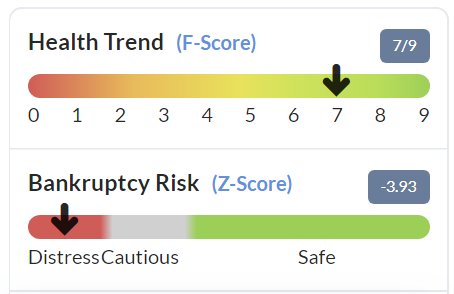
I don’t use the F-Score, but that is showing a surprisingly high reading. Looking at the 9 factors that make up the F-Score, the flaw seems to be that it doesn’t take into account the actual level of debt, which in this case is extraordinarily & very dangerously high. So I wouldn’t rely on the F-Score in this situation. Manual work shows that the good F-Score looks a bit of a red herring in this case. Personally, I place a lot more reliance on the Altman Z-Score, than the F-Score.
Overall, we must be careful not to be tricked by the low PER, and high value scores here. It’s not good value at all, it’s submerged in excessive debt, such that the equity could easily turn out to be worth nothing.
The upside case, is that if debt can be refinanced cheaply, and if the business trades well, then equity could see leveraged upside.
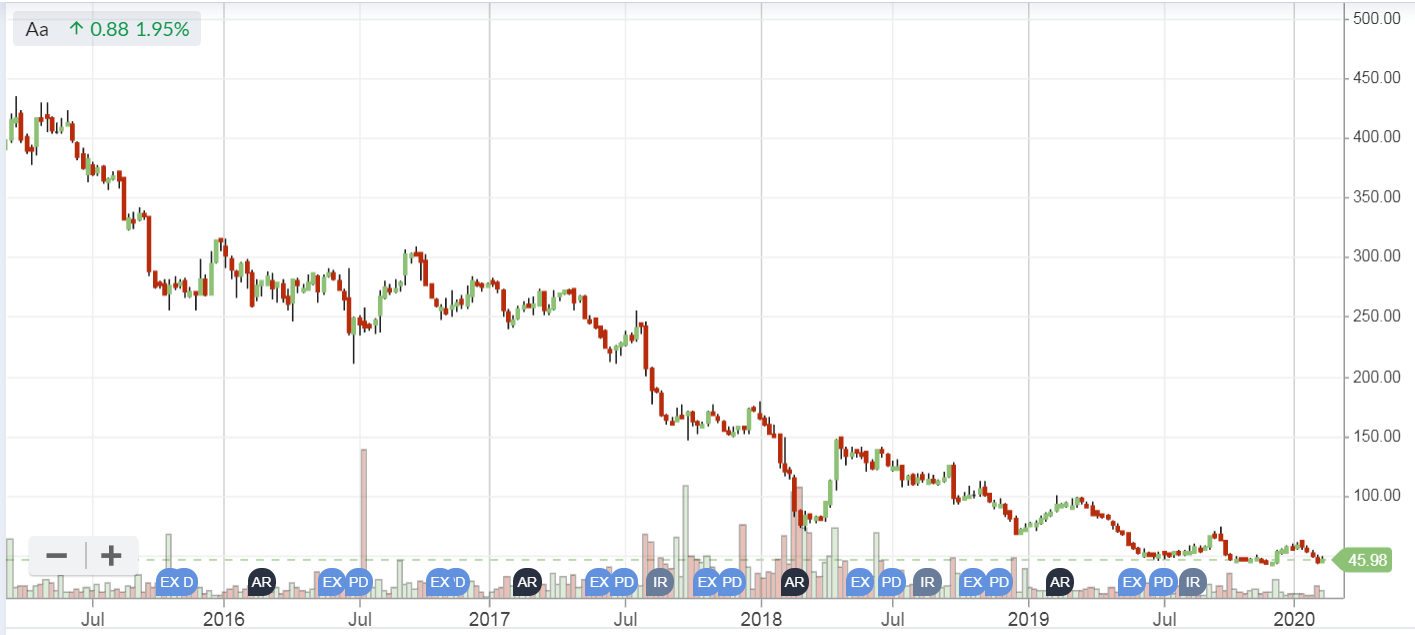
You would really need to be an expert on junk bond financing, to properly assess this situation. I’m just flagging that the equity is very high risk. Just look at the shareholder value destruction here, from an obviously inappropriate financial structure that was deliberately created;
China New Energy (LON:CNEL)
I’m flagging this one purely for its RNS comments yesterday about China/coronavirus.
The Board of CNE (AIM: CNEL), the AIM quoted engineering and technology solutions provider to the bioenergy sector, provides a trading update for the year ended 31 December 2019 and outlines its response to the novel coronavirus (2019-nCoV) ("Coronavirus").
As widely reported in the press, business activities in China are being disrupted by the Coronavirus outbreak and, whilst the Company does not currently believe this will cause a significant financial impact in 2020, the Board of CNE would like to provide shareholders with further information to understand the situation as it relates to CNE.
Firstly, during the Chinese New Year holiday also known as the Spring Festival, the Company usually closes its office and factory for a period of two weeks which this year ran from 23 January 2020 to 6 February 2020. In order to contain the Coronavirus, the authorities have requested that companies in our region should remain closed until 15 February 2020 and the Company will comply with this directive.
During this extended holiday period, the Company's Chinese employees are working from home and the Company expects minimal interruption to its office-related business activities and, specifically, minimal impact to its ongoing audit and resubmission application to the HKEx. The closure of the factory for an additional five working days is expected to cause only minor manufacturing delays which, with overtime, the Company expects to correct quickly during production in Q1 2020….
… The Company will only provide further updates on the Coronavirus outbreak if it is expected to materially affect the performance of its business.
My view – this is the most upbeat assessment I’ve read so far, from any company operating in China.
Intu Properties (LON:INTU)
Plunged another 30% yesterday to 12.18p.
The immediate catalyst for this was the withdrawal of Link Real Estate (a Hong Kong investor) from the refinancing talks.
There’s an interesting article in the FT here.
It looks as if existing equity in INTU could turn out to be worth little to nothing. Hence it’s far too risky to even consider catching this falling knife.
Today's updates;
China/Coronavirus updates
Cathay International Holdings (LON:CTI) - a micro cap listed in the UK, which operates hotels & makes healthcare products in China.
What it says today is interesting;
The majority of the Group's operations are based in China and a number of restrictions have been imposed by provincial and national government to limit travel within China and to extend the Chinese New Year holiday period, in an attempt to control the spread of the novel coronavirus.
At present production at all of our plants is either on hold or preparing to gradually resume production within the next 7-10 days, subject to the further development of the epidemic and government advice or restrictions. Accordingly, there is a risk that these restrictions, if prolonged, may limit production and sales of our products which may have an adverse impact on our results for 2020. At this stage it is too early to gauge whether there will be an impact of any significance on the Group's operations for the year 2020.
Our hotel business in Shenzhen is showing a marked reduction in occupancy and bookings in the short term, as a result of the extended Chinese New Year break and restrictions or travel warning on travel within and to China. In the short term this will have a material impact on the hotel's financial performance, but it is not yet possible to say whether this will translate into a material impact on the results for the Group for 2020 as a whole.
We are monitoring the situation closely and will provide further updates as appropriate.
I read somewhere that hotel occupancy is down to only 25% in China, but that was about a week ago, so I don't know if that has changed or not.
Given the track record of small Chinese companies listing in the UK, then obviously I wouldn't touch this share, or anything like it. But it's still interesting to hear what it says about the situation on the ground in China.
.
Heineken Holding NV - in its 2019 results today, this large cap says;
As a result, HEINEKEN currently expects operating profit (beia) to grow by mid-single digit on an organic basis, barring major negative macro economic or political developments. In particular it is at this stage not possible to assess the extent and duration of the impact of Coronavirus on the economy and on HEINEKEN's business.
No other mention is made of this issue in its results statement.
.
Scapa (LON:SCPA)
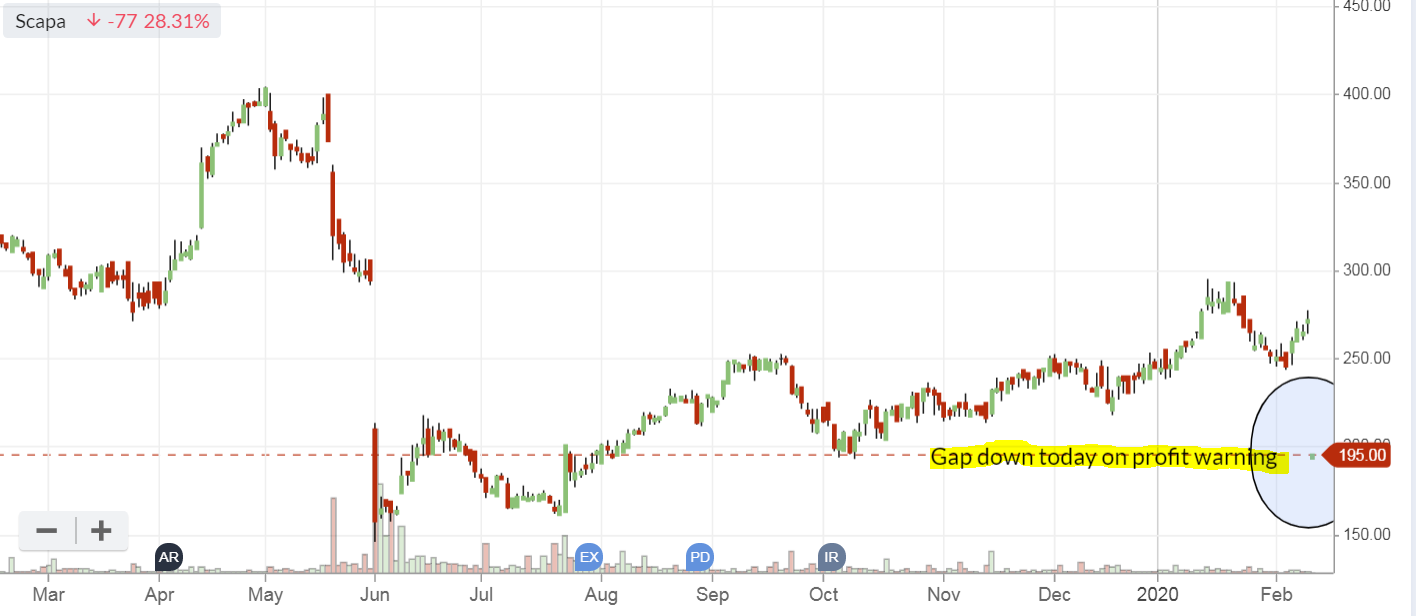
Share price: 175p (down 36%, at 08:26, price volatile)
No. shares: 155.2m
Market cap: £271.6m
Trading update (profit warning)
Scapa makes adhesive-based products, for healthcare & industrial markets.
The share price had been recovering from a previous profit warning, but is back to square one after another one today.
Scapa Group plc (AIM: SCPA) provides an update on current trading ahead of its financial year-end on 31 March 2020.
.
.
Profit warnings are a nuisance, because the share price often moves so quickly, that by the time I've typed the above header, it has to be recalculated because the price has dropped. I started at 190p, and in a few minutes it had dropped further to 175p.
The Group expects FY20 revenue to be approximately £306 million, broadly in line with market expectations. However, trading profit is now expected to be approximately £28 million, significantly below consensus.
Whilst it's good that revised profit guidance is given, unfortunately there is no footnote to explain what consensus expectations are. That wastes time for everyone reading the RNS, as we now have to look it up, and that info may not be available to everyone.
A hat tip to Arden, which has helpfully issued an update note today. This quantifies the revised profit guidance of £28m as being a shortfall of 11% vs previous consensus. You could argue that a 36% negative share price reaction seems a bit harsh, but I suppose to miss the full year forecast by 11% less than 2 months before year end, suggests a sharp recent reduction in trading.
Reasons given for the profit shortfall;
Healthcare trading profit is expected to be lower than consensus, reflecting slower progress in reducing costs than expected at the time of the interim results.
Industrial revenue is expected to be approximately £168 million, which is slightly below market expectations but has a material impact on Group trading profit. This is primarily the result of adverse macroeconomic conditions, particularly in the automotive and specialty products markets.
If industrial revenues is only slightly down, but profit materially down, then to me that suggests it's having to discount prices to achieve sales. What other reason could there be, apart from increased costs?
Outlook - not great;
The Group expects the macro environment to remain challenging in some of the industrial markets in which it operates.... we will focus on cost reductions to drive the margin in Industrial to historical levels.
Automotive is a sector with well-known problems, so that must be tough for Scapa, although I don't know what proportion of sales/profits it represents.
Legal action - Scapa lost a lucrative contract with ConvaTec. Its interim results say that Scapa has filed an $83m+ claim against ConvaTec in Connecticut. Given the materiality of this legal claim, there really should have been an update in today's statement. However, nothing is mentioned. That's a glaring omission.
My opinion - this seems a fundamentally good business, and it remains highly profitable, even after today's update.
I imagine forecasts for FY 03/2021 are likely to be reduced too, but don't yet see any updated numbers.
A lot hinges on how the ConvaTec legal action pans out. Scapa's claim at around £64m, is almost a quarter of its market cap. We need more information about this case, and the likelihood of success or failure. Without that, I'm struggling to form a view on this share, hence have to say I'm neutral.
Ted Baker (LON:TED)
Toscafund - an activist investor, is now up to 15.5%, with continued buying.
As mentioned here previously, Tosca (15.5%) and the founder Ray Kelvin (34.9%) combined, are now in the driving seat, with a controlling 50.4% stake potentially, if they decide to work together. I've not seen any evidence of that yet, and they would have to declare a concert party.
The big risk for outside shareholders is if they decide to launch a low-priced takeover bid.
The other big risk is that the company continues its meltdown, as it has serious problems with excessive inventories, and declining sales/profits, and debt, as previously covered here - where Graham, Ben, and I have written loads of stuff about TED, it's a really interesting situation.
To my mind, it's too risky to either be long, or short, as it could go either way.
United Carpets (LON:UCG)
Too small for a full section, only c.£4m market cap
United Carpets Group plc (AIM: UCG) the third largest chain of specialist retail carpet and floor covering stores in the UK, announces the following trading update for the year ending 31 March 2020.
Profit warning -
- No uplift in trading after Election result in Dec 2019
- Still challenging environment
- LFL sales down -5.7%
- Startup & servicing costs of new instalment scheme higher than expected, won't contribute to profits this year
- "Very competitive" market conditions, including aggressive discounting
Overall - top marks to the company and its advisers (Cantors, and Novella Comms) for the simplicity & clarity of this announcement, when it gives us precisely the information we need, which so many other companies (aided & abetted by their PRs) try to obscure! Trying to pull the wool over our eyes is not helpful, it's actually counter-productive, undermining trust.
The combination of these factors means that the Board now expects profit before tax for the full year to be below current market expectations of £0.5m and in the range of £0.15m to £0.20m (before non-cash costs associated with IFRS16).
The share price is only down 14% today, probably (at least in part) because the company has just told it like it is, and given us the numbers. Everyone can now crunch the numbers, form an accurate view, and move on. This is how all profit warnings should be presented. What a pity that very few are served up in this clear, common sense way.
Outlook - these are fair comments;
Importantly, United Carpets remains a well-positioned business with a strong brand and well established, predominantly franchised, store network. The Company has significant cash balances and virtually no debt, creating a platform that together with its experienced management team means it is well placed to benefit from any upturn in market conditions.
My opinion - It's not a bad little company, just too small to be listed. I don't see how all the costs & hassle of a listing make any sense at this level.
That's the small caps done for today. On to some other interesting announcements.
Dunelm (LON:DNLM)
Share price: 1326p (up 10.3%, at 10:20)
No. shares: 202.2m
Market cap: £2,681.2m
Dunelm Group plc ("Dunelm"), the UK's leading homewares retailer, today announces its interim results for the 26 weeks to 28 December 2019.
I'm not going through all the detail, this is just a quick heads up to flag smashing results. It just goes to show, that not all retailers are struggling, if they provide what people want, at a sensible price.
Stand out points include;
- LFL revenues up +5.6% - that's outstanding, in a market where most retailers complained how tough it was! Also talks about positive footfall, unlike others. Its sites are in retail parks, so must be destination stores
- Gross margin up 120 bips
- Profit before tax in H1 up 21.3% to £83.6m in H1 (which includes Xmas, so is the seasonally more profitable half)
- New digital platform launched - more sales growth?
Outlook & current trading -
The third quarter has started well, with a successful Winter Sale across the total retail system. As a result, we expect full year FY20 profit before tax to be slightly ahead of the top of the latest range of analyst expectations9.
9 Management understand that updated FY20 PBT analyst estimates are in the range of £135.0m to £137.3m (adjusted for IFRS 16 where appropriate)
We are monitoring the Coronavirus outbreak carefully. To date we have not assumed any material disruption to our supply chain or any financial impact in the year.
Fantastic that a footnote was included, to tell us what the analyst forecasts are. Thank you to the company, and its advisers, MHP Comms, who are noteworthy for being investor friendly.
Whether a slight beat justifies a 10% rise in share price today, is a question.
Balance sheet - looks fine to me. Lease liabilities don't matter, because it's so profitable. Also, the rent as a percentage of revenues seems amazingly low. Selling stuff that people want, at good margins, from cheap sheds, is clearly a great business. Not rocket science, retailing, is it really?! Although Dunelm has not had to deal with legacy issues like older retailers.
Valuation - it looks as if EPS might be around 55p this year, rising to maybe 60p+ next year (I've added a bit on to existing forecasts there). So PERs of 24 and 22 times. That's toppy for this sector, even allowing for what a cracking business Dunelm is.
My opinion - I put this in the same category as Greggs (LON:GRG) - lovely business, but shares have gone up too much, and now look over-priced.
I'd buy both on a big pullback though, as they're clear winners in a very difficult sector.
It makes so much more sense to buy the best, and pay up for the privilege, rather than buying cheap retailers in the hope of a turnaround. Even if we overpay, timing a purchase badly, we'll still probably make a decent profit by tucking away shares like this for several years.
Overall then, I love the company (by which I mean its financials, nothing to do with emotions), not too keen on the valuation right now. A lot of its product must come from China, so this share would be very vulnerable to an escalation of coronavirus. Hence I'm inclined to play it safe, and sit on the sidelines for now.
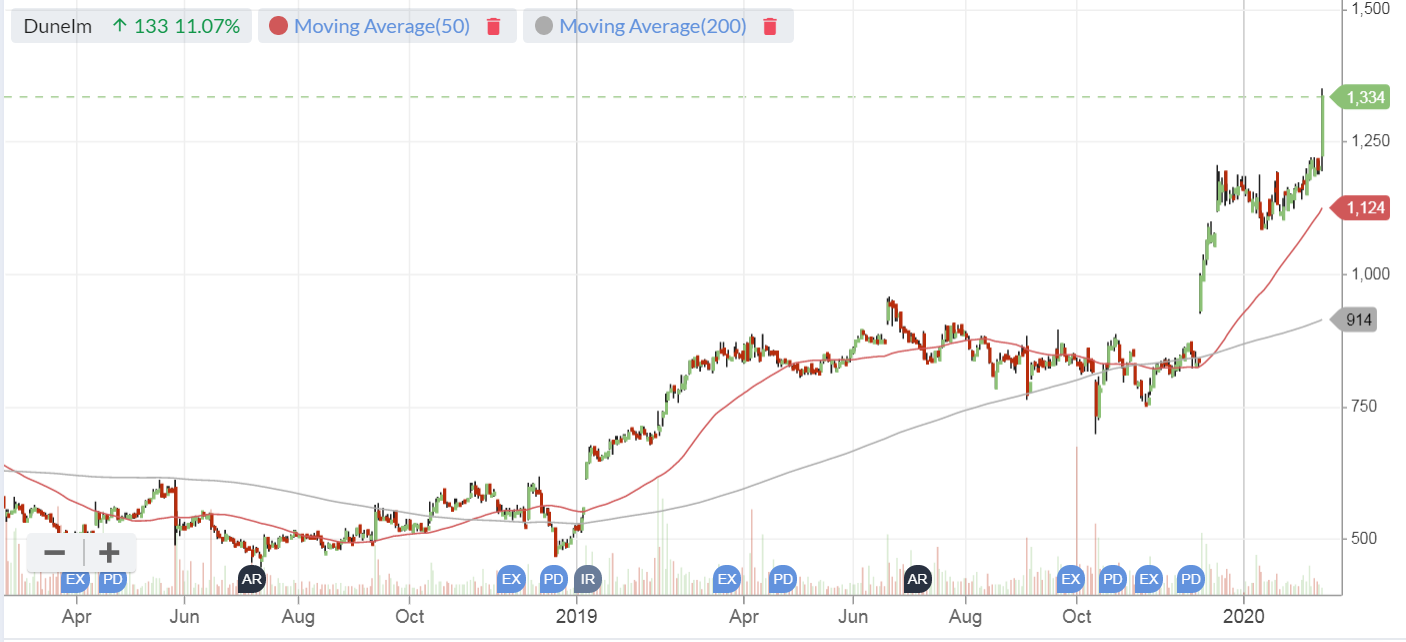
This would have made such a good buy in 2018!
.
Sosandar (LON:SOS)
Share price: 17.5p (down c.3% today, at 12:50)
No. shares: 162.9m existing + at least 29.4m new shares = 192.3m
Market cap: £33.7m after new placing shares issued
£5m institutional placing at 17p
This is an 18% increase in the share count, at a modest 5.6% discount, so I don't see either of these points as being a cause for concern. Institutions are happy to put more money in, to accelerate growth.
In the meantime, I've already spoken to management, and my main question is probably what you're all thinking too - why have they done another placing, so soon after the last one (raising £7m in July 2019)? Three main reasons;
Inventories - the original business plan assumed that factories would, once established, be prepared to supply on credit terms. However, in the last 3-4 years there have been so many bad debts from UK retailers, that suppliers are not prepared to offer credit terms. Therefore Sosandar needs cash up-front to buy inventories.
This is an increasing hit to cashflow, as the business is expanding so fast. New products such as denim are now being bought in much larger quantities, because sales were lost last year from running out too quickly & not being able to re-order fast enough. This was reflected in much higher inventories (at cost) reported recently (£3.5m at 31 Dec 2019) - a lot of that apparently is the spring/summer denim which landed just before Xmas. This needs funding.
Marketing spend - the increased marketing spend which started after the last fundraising, has been highly successful. TV in particular, has been very successful. They want to spend more on all marketing channels, which are delivering strong results. The payback period on marketing spend is 12 months. Therefore the more they do, the heavier the short term losses, but the greater the long-term benefit.
Growing faster - this really puts together the above 2 points. Management want to scale up the business as fast as possible, which because the customer repeat spending is so strong, and getting better as they expand the ranges. Shareholders are supportive of this faster growth strategy, hence the opportunity to raise more money, and get on with it.
The alternative would have been having to cut back on other marketing channels, in order to fund more TV ads, and larger inventories. Management felt that was not in the best long-term interests of the business, so they've swallowed the dilution, and pushed ahead with this latest funding round.
My view - I was a bit surprised that they've decided to raise again, but the reasons make sense. As I've mentioned before, it's taking a lot more money than originally planned, to achieve scale. But the good thing is, they've achieved stunning growth so far (ahead of the original plan), but it's costing more than originally expected.
Sales are being made at high gross margins (50%+), the overheads are largely fixed, so it's now just all about scaling up sales to about double the current level. Then it moves into profit.
I expect there will be some critics of this strategy, but they don't really matter as they're never going to buy any shares in this anyway. The people who matter, are the people who are backing the placing! That 's providing the funds to accelerate growth, and reach breakeven (or close to it) in about a year.
The next couple of trading updates in early April, and early July, should look stunningly good, because the comps are very soft, as the company wasn't spending much on marketing last year. Plus, the next 6 months will benefit from the long tail of new customers recruited last autumn, who are already repeat-ordering strongly apparently.
As I said to SOS management in a recent call, you're going to get some flak for this in the short term, but the early April & July trading updates should silence your critics (as they're up against soft comps where marketing spend was low).
Here's a reminder of the significant escalation in sales growth once TV ads were trialled in Sept, then continued because they were doing so well;
- October revenues up 108%
- November up 138%
- December up 153% year on year. This momentum has continued post-period, with
- January tracking up over 160%, and pleasingly repeat order performance is exceeding that in the highly successful Autumn/Winter period.
To properly understand this share, the key concept to grasp is that marketing spend has a payback period of 12 months, and builds an ever larger group of repeat customers. Established customers (i.e. stripping out new customers from the figures) are ordering 4 times per year. This makes the marketing spending an absolute no-brainer. That comes at an up-front cost, but once acquired, results in long-term profitable customers.
Once scale is reached, then we should be looking at operationally geared profits kicking in from 2021.
Edit: A key question I always now ask management, is what their exposure is to China supply chain. Sosandar has minimal exposure to China, under 5% of supplies, and it can easily switch elsewhere if needed. End of edit.
That's me done for today. Thanks for your comments, and thumbs ups, both are great!
Best wishes, Paul.
Disclaimer
This is not financial advice. Our content is intended to be used and must be used for information and education purposes only. Please read our disclaimer and terms and conditions to understand our obligations.

78 comments
I don't know how DNLM do it, I'm more than curious, they just seem immune to the high street climate, I'm not suggesting there is something funny going on but I'm mystified.
No position.
AA (LON:AA.)
Interesting one. Quick look at H1 results. Holds 2.7B in net debt plus a hefty pension liability. Cash flow, after paying 65m in interest, 8m in dividends, 4m in tax, 37m in capex and some other bits, was left with 16m net increase in cash, from 120m in top-line Operating Profit.
Fun facts, 2.7B divided by 32m (16 * 2) means they will repay their debt in full after 84 years. Appreciate it’s quicker as the interest bill reduces, but still it’s interesting.
I called some friends who use the AA, all positive. Revenues seem stable, on the surface not about to go bust, but obviously on the knife edge. I see the short interest has been increasing recently, currently 8.34%
Question is, what about the Strategic Plan? Watching the CEO results video, seemed fairly understated. Essentially flat membership numbers next year, growth after. Targeting return to EBITDA growth 5% - 8% by 2023. Insurance seemed the bright spot. I was hoping for a narrative on deep cost reductions driving up cash, but instead seemed to be talking about modest investments in roadside.
In terms of a trigger, there’s this:
“We are due to refinance £1.5bn of debt by July 2022 of which £200m relates to the refinancing of the Class A3 note in July 2020 and can be fully funded by a committed forward starting senior facility with a maturity date of July 2023. The current bond market suggests that debt would need to be refinanced at a much higher interest rate than the current debt and this is considered an emerging risk.”
So, the debt bell rings in about two years. They have until then to get in shape.
”On the positive side, at least next time there’s a massive financial crisis, everyone will know what to do – forcibly recapitalise the banks, Govt guarantee for systemically important banks' deposits, and create however much money is needed via QE, to keep the system running”
this made me cringe from Paul. Nonchalant currency debasement and Negative side effects of QE. It’s become normalised. I’m opting out to hard money stores of wealth such as gold and bitcoin.
I'm not advocating any of that policy. I was merely pointing out what, in actual fact, stopped the financial crisis last time. I agree with you completely though, that bizarre & dangerous policies are now normalised. How this all ends, is the big unknown.
A great report yet again Paul. The narrative you provide is very educational as well as entertaining. I really appreciate the mix of small cap analysis together with the macro views. I have a small holding in Sosandar (LON:SOS) and am looking forward to continued coverage (whichever way it goes).
As always Paul, most illuminating and helpful to say nothing of your views on Cameron's Balls
Any chance of a view on Kainos which seems to be racing; could it run out of steam like Accesso?
I've just had a look at the StockReport for Kainos (LON:KNOS) and it looks extremely expensive. When the forward PER is 43.9, it's going to have to smash current forecasts to justify that kind of valuation. People buying it at this level must be convinced it's going to beat forecasts. I don't know the company well enough to give a view on that.
The higher these things go, then risk:reward can start to be unfavourable.
P.
When Scapa (LON:SCPA) originally announced the loss of the Convatec contract, I did a back of fag packet calculation here that the gross profit hit could be c. £10m. Initially brokers reduced their forecasts by much less, but within a couple of months had reduced by the full £10m. This suggests to me, that those revised forecasts did not have anything in for overhead reduction related to the Convatec contract. Either that or they already assumed a deterioration in the rest of the business.
So the miss today is against an already significantly lowered target.
The gross margin weakness in industrials is a significant issue and the fact that they are seeking to cut costs to address it suggests little pricing power.
A 30% fall for an 11% miss might seem an over-reaction, but there was a near 100% rise since the June profits warning, with no particular reason for it in my view. The share price remains c. 20% above level after the previous warning and yet we know the numbers will be worse than thought then and the business metrics are definitely going in the wrong direction.
As noted they say nothing about the Convatec legal case (which if won could bring in something in the region of 40p / share) – that is a possible upside of course.
As I understand it the case is for breach of contract, but Convatec maintain that Scapa breached a non-complete clause in that contract so they were entitled to cancel. I don’t think we have any way to judge that, but the fact that the Scapa CEO resigned on the loss of the contract only to retract his resignation wouldn’t give me much confidence that they have an open & shut case.
Not the time to buy imho.
£AA Market cap £283m, EV £3b. 'nuff said. Massively undercapitalised.
How much of that enterprise value is attributable to equity holders?
Re AA (LON:AA.)
All of it - but that's not really a meaningful number.
The better metric is that shareholders (I am one) are the proud owners of a company whose balance sheet value is... minus £1.7 billion - and that's including intangibles, so NTAV is worse.
As others have said, it's risk and reward. It's more like an option than a share. Owning the AA is like having an annuity (unless you manage it really badly) and by the way, I see a great opportunity in rescuing stranded electric cars in the years ahead. This business has a secure future. However that regular income flow has been mortgaged to the hilt, to a really absurd extent. So at some point you assume that a debt to equity conversion will take place, or you raise more equity and pay some of the bond-holders off, or you keep trading and pay down the debt over several years. It will be fascinating to see which it is. Maybe a combination.
I bought into AA (LON:AA.) last year after hearing a pitch at a StockSlam and doing my research. More recently I was encouraged when Albert Bridge Capital disclosed a 10% stake. Drew Dickson is a shrewd guy I think, worth following on Twitter and writes an interesting blog.
Whitbourne!
I owe you my apologies as I was the guy that pitched at StockSlam...I hope I gave enough cautionary statements! And I definitely did say the debt was mad.
Aside from that I agree with what you say and I too was interested that Drew Dickson bought more who I regard as a good investor
Enterprise value is calculated as the market capitalization plus debt, minority interest and preferred shares, minus total cash and cash equivalents.
So the answer isn't all of it.
Yup Mark, this is clear and is both the threat and opportunity as stated by me and others for AA (LON:AA.) . This is why I used the simplistic thought of £1bn less debt and compared to Diageo (LON:DGE) - if this is done simplistically then it is clear there is some general similarities in a financial performance sense between the two cos and from a judgement perspective it is possible to view them as 'high quality' enterprises...obvs ignoring capital structure factors. So...
1) Is The AA core roadside business losing relevance and deteriorating rapidly soon? Obvs we cannot know and an argument can be made to the negative side. IMO I think they are likely to dominate full service roadside more over time and particularly for premium marques and in partnership with car brands or others (like the Uber agreement announced last year - not that its super significant just indicative that The AA is the only viable partnership option)
2) Do the debt holders gain from a capital crisis at AA? Definitely not as the value of the business is all in the intangible of brand and service. Any form of distressed and administrative proceedings will harm debt investors potentially hugely. They need it to be an ongoing operation. If it comes to equity v debt showdown the equity holds a surprisingly good hand and some concessions from debt possible/likely.
3) Its unlikely to be a candidate for take private as that will need significant equity not debt injected and so is unlikely to attract a financial orientated private buyer. An operating business of some sort is the more likely candidate and that is possible but improbable given lack of scale closely related acquirer. An OEM would not do it as they would dislodge other OEM customers (they would not want to share the valuable underlying data that AA gathers)
4) We are left with either a public equity raise or a very gradual debt pay down which is dependent on strategic plan generating some annual growth in coming years and current high investment costs reducing a bit. A sustained rise in general corporate debt yields would force AA into equity raise.
The super return scenario (10-20x over c. 7 years) is slow debt pay down - will feel messy and painful for several years until light appears at end of tunnel. The lower but still very high return scenario is an equity raise. Where this takes place is unknown and obvs the higher it is the better for current shareholders. I point you to the institutional investor base for AA as very interesting (aside from that dog Woodford). They all tend to be longer term with a little bit of Buffet sorts in the mix. On the short side more than half of the interest is from guys that are short term on short side and driven by sentiment and momentum factors....I know them all a little and believe that their commitment to AA short is quite fleeting and they wont fight the tape. Ennismore the clear exception and they provide a not of caution.
AA is super messy and always super risky as steady states are hard to perceive with such a ridiculous debt burden
"Way too much focus on small caps"!!!! Love it! You have to wonder sometimes don't you? Great report Paul, excellent detail and analysis as ever!
I agree with Paul's comments on AA. It's been a bargepole job for several years, probably since flotation. Such high levels of debt make it a a gamble. Incidentally, how on earth are private equity firms socially useful in any way where their role is stuffing companies with so much debt that they're likely to fail.
It seems weird to me that the Stockpedia Quality rank doesn't plummet for any company with large debt as a % of equity, or low interest cover. It's like flying in a plane where the wings haven't been designed for turbulence. Even if "quality" in the first class cabin is great, sooner or later you'll hit bad weather and come to a sticky end.
Some business models naturally run on high liability levels (mainly debt or other liabilities) like banks. It's not true to say any company with high debt/liabilities is bad.
Good piece on Sosandar (LON:SOS) Paul, I have been put off by the raising I must say, but you make a good case.
My overriding question is how much impact not having credit terms will have l to capital deployment, margins and liquidity?
Credit terms are free capital, did Sosandar management negotiate better margin terms in exchange for no credit terms?
It can have a significant impact on return on capital. I seem to remember the now ex-CEO of Sainsbury's making comments during the failed merger with Asda about how they are not powerful because they only have 3% margins, where-as Unilever (supplier) has 16%, however, he omitted the fact that they have suppliers on 90-120 day credit terms for goods they sell the next days. Effectively getting free capital which they are able to deploy.
the next day* jeez phone auto-correct is annoying.
PS AA (LON:AA.) is super risky...anything one can see a 20 bag in is. There is a chance of zero with that silly debt burden. Play accordingly. I do not recommend it for most
Hi Paul,
Given your interest in macro I would recommend Shaun Richards daily blog: https://notayesmanseconomics.wordpress.com/
I picked it up when Phil Oakley recommended him on twitter, he provides some interesting and independent daily commentary on UK and international economics data. He also does a weekly podcast on a Friday up to 10 mins long and will field questions leading up to it on twitter.
On AA (LON:AA.) ->
Slice a bit of debt off it (call it round £1bn for simplicity of optics), assume that its got low growth potential with high margins and whiz bang you've got Diageo (LON:DGE) ....
Now have a look at what that does to metrics in terms of valuation and price
For sure, TheAA is a bit of a frog...and a risky frog at that....on interest payments in H1 2020 they paid £65m from £164 of post tax op cash flow. That 164 does have higher short term expenses travelling thro due to current quite heavy 'reshaping' commitments. Overall, the current CEO has moved to presenting cleaner accounts than the old private equity jiggery pockery ones (why it scored badly on earnings quality for most of the shorts in it that run short through quant screen of earnings q, momentum and debt) and that partially impacts the presentation of some current debt ratios compared to old ones without actually shifting the actual real position. But free cash is down from a much more ambitious investment in both protection of current business and brand and future growth....risky...but right thing to do.
But what's safer and got more probable upside plus let's say more adaptable within its capital structure - AA or Sosandar (LON:SOS) ?
Looking forward to answers
I don't recommend AA to anyone....its by far my riskiest position given combo of position size (full) and financial risks
I like your analysis but where is the billion to pay off the debt going to come from? its not like diverting all the div to pay debt is going to make much difference, so that means a rights issue or debt for equity. both ways current shareholders get smashed.
Ive always felt theres a good company hidden beneath the debt, but its hidden by a giant portion of debt
(I must confess I do have a small position)
Well ambrosia, the £1bn was to be simple and very round and make an instantaneous comparable with Diageo (LON:DGE) (by the way its quite possible that AA (LON:AA.) would be on higher growth trajectory so that multiple stretches more)...
But for the sake of realism the long hard but most profitable road is clearly incremental but exponentially faster debt repayment which in x years would reach an inflexion point. As a belief thing inflexion say 2-3 years if current CEO and strategy proves out and financially maybe about 5+ years. The journey as a share price would go something like
Stage 1: Oh its not going bust tomorrow...re-rate to higher single digit valuation. No real belief in this other than the end horizon isn't immediately in sight
Stage 2: Strategic turnaround has value and produces improved operational results and robustness...push towards the boundaries of single digit valuation. Probably quite a volatile staging post this as the inflexion from rubbish to maybe good will be viscous on minor news flow
Stage 3: There's underling revenue growth compounding a few years and feeding increased EBITDA growth through op leverage and we can see the debt is stupid but manageable... It goes low teen (and as there has been some earnings growth we're at the 5ish plus bags stage)
Stage 4: Debt is getting incrementally but meaningfully paid down (there could have been a raise too from stage 2 thro to 4 at some point). The stock's got life and its semi quality growth...its hitting around mid teen valuations on good news flow
Stage 5: There's £1bn less debt and its a better quality growth company than Diageo :)...well into the 20s
Through the above process the AA is increasingly seen as a tech and data company.
The above is the road to 20 bags....or they go for the dilution...
Lets says they hit up institutional investors on an accelerated book build at 40p. A sort of 2 new for 1 old crudely. I think institutions will snap your hand off and the stock would pretty quickly treble in price and the cost of new debt go down all else be equal....but current shareholders don't want that as they see some of the above and have resisted any suggestion of that sort of equity injection at the moment.
The above is only an imagining.
"But what's safer and got more probable upside plus let's say more adaptable within its capital structure - AA or Sosandar (LON:SOS) ?"
Well, if for the sake of argument you're intending to inject £1bn of cash into each, the answer has to be Sosandar (LON:SOS) - after all, Sosandar (LON:SOS) would then be a high growth retailer with £1bn of cash to fuel it's growth - whereas AA (LON:AA.) would still be ex-growth service business laden with £1.7bn of debt (previously £2.7bn before your cash injection).
Have I misunderstood your question?!
Mr Marx! We talked before about your fragile grasp of capitalism.
Inject £1bn today into Sosandar (LON:SOS) as a raise and its clear the price would absolutely tank. What price is the raise taking place? 1p?
What magic-damage could Sosandar do with £1bn....they'd have to pay all 25-50 females to wear their stuff. Perhaps they'd make their market by offering brand marketing space on their kit? Is that what you envisage.
I'm looking forward to the logic in your reply....
I couldn't help but notice you can apply that exact same logic to £AA whose directors have clearly taken optimal capital structure theory to the limits to work-out some return to shareholders because they lacked confidence in growth.
You make an interesting contrast to Diageo but I can't help but feel they have actually achieved a more optimal capital structure and have far superior returns on assets.
Particularly consider the ease for them to access new markets and deploy capital compared to a car breakdown and insurance business. Most of the world drinks alcohol and it only requires a good marketing scheme and solid backing to break into a new market (sure it is harder than I am making it sound but comparatively the point stands).
That was supposed to say erk-out* some return. Silly auto-correct.
Thornabian
Diageo (LON:DGE) organic growth is low. True they can deploy their excess margin in to other markets but they do that from already huge scale and share in a market where desirable brands already cost a lot.
How the capital structure of AA (LON:AA.) and Diageo compare is highly reflexive...if the outlook for AA improves the equity part goes up a lot. Put the current equity bit on a 22x multiple and it looks much better (although still substandard...hence the need to swap out debt)
The future is not the past and the market doesn't stand still
Loving the red thumbs...sincere thank you to all of you.
I assume you aren't all on here for a little cuddle or ego salve and I haven't hurt your feelings....right? And you are objective and in no way emotional about your holdings in something like, say, Sosandar (LON:SOS) ...?
So I'd love someone to explain why £1bn into Sosandar will create more upside and value that can
be quantified now than into AA (LON:AA.) ...fire away...
Otherwise, please provide me pleasure by red thumbing this comment as much as possible
One observation about the two recent Sosandar (LON:SOS) placements is that they seem uncannily poor with their timing. In July the placing was done at 15p and this one is going at 17p. In both cases the share price was significantly higher in the two to three week timeframe immediately before the placings were made. Presumably the company knew there was a likely need for more funding over a period of time so why wait for the bottom of the market? Fine for the new money coming in but arguably much more dilutive to existing PI holders who don’t participate in the placings than strictly necessary with a bit more forethought on the part of their advisers.
Gus.
I'm sure Sosandar (LON:SOS) would have preferred to get a raise away at a higher price, as would existing non-participating shareholders due to the dilution. However, might it not be the case that the price fall(s), is as a result of the (ahem, unknown) fund raise, not the way you describe it?
Low liquidity small caps aren't shall we say completely protected from "efficient" markets.
Even were one to subscribe to the view that insiders exist, and prices can be influenced, it would be difficult to deny that low liquidity stocks are priced day-to-day on a few marginal buyers and sellers, yet ultimately are valued by, amongst others, institutions whose size of holding means they don't participate in the day-to-day market. Who is to say which price provides the truer valuation?
I'm sick to death of witnessing - and being a victim of - what is so clearly insider trading at companies like £SOS. The SP had reached 27p just a month ago, and there was no publicly available information to explain why it had dropped by a third to just above the 17p placing price in such a short time. It's also noticeable that the SP didn't drop below the placing price.
The only reasonable explanation is that news of the placing had leaked out, and that short sellers took advantage of it.
With such a small company it must be fairly easy to identify the short sellers, and it would probably be fairly easy to identify the source of the leaks. It would only take one or two well-publicised prosecutions for insider trading to discourage others, but it's obviously a very long way down the list of priorities for the regulatory authorities.
£sos
For anyone investing in the sector, I suppose the next step is to check if other fashion retailers need more working capital if they are also finding it more difficult to get trade credit ?
I’ve been in other retailers with £25m+ EBITDA, multi year increases in sales and profit and seen credit insurance costs significantly increased or removed simply because there have been other failures in the market.
Thanks Paul for yet another excellent report. Alcohol-free Paul is very good for us PI's judging by the depth and quality of your output and its punctuality.
My question about Sosandar (LON:SOS) is this: why can't they get credit insurance as it seems a shame to tie up so much capital in inventory? Or are they too young still? But given where they are having to pay in advance, I think they should be reporting the time between supplier payment and customer sale as a key KPI.
I managed to top up today (I was offered at 17p online at one point but my aged mother rang and so had to make do with 17.19p). Looking forward to their end of year statement in the next month or so.
cheers
Francis
Thanks again for another great report Paul.
As a long time holder of Scapa (LON:SCPA) it is good to read commentary on it. I bought in many years ago averaging under a £/share and have made multiple sales so that I got more than my original capital value back and what is left is "on the house". I have been monitoring their progress since the Convatec dispute blew up and even last week looking at the share price performance over recent months was thinking whether to assess to put more money in. Now I need to reassess whether I take all my profit and go elsewhere.
Also many thanks for the reading list suggestions. In recent weeks my Amazon kindle books wish list has grown substantially from just investment books to a load of biographies. Just need time to read them all now. (A good distraction to not look at the market all the time :-) )
Re Sosandar (LON:SOS) the need for capital to fund stock makes sense as suppliers are much less flexible than they used to be. But not getting that in the business plan was a bit unfortunate as those challenges have been around for a few years now.
Fundamentally they are providing product to an underserved market - and seem to be good at hitting styles and trends. As Dunelm show, along with a few others, if you know your market and customer and execute well there is still good money to be made in retail. Hopefully the trading updates in Spring and Summer will reflect that.
did you take part in the placing paul?
I would have liked to didn;t get the chance
No, I didn't buy any more shares in the placing, because I already have enough, and can buy in the open market if I want more. Also, available funds are thin on the ground at the moment, after stepping on a few landmines recently!
Did you get offered the chance to take part. As I was wondering how do private Investors get an opportunity to take part is it our brokers that get in contact with us and offer the opportunity
why does aa have a stock rank above 80 when it has a net debt problem
Paul, your insights on the Sosandar (LON:SOS) raise are much appreciated. You know much more about this business than I do, but I thought the raise was inevitable and thought that might prove a good entry point. It probably is a good entry point, so I've bought a tiny amount.
However, I'm cautious of this because I can't see £5m as being enough, given where they are now and the scale of ambition. It's not that cheap to build a brand and fund a growing business. Even when it starts to make a profit, it will still need more cash than it is generating. Isn't a further (bigger?) raise highly likely another year down the road? Maybe it starts to fund from debt? You haven't commented on that yet and I'd be interested in your thoughts. Would be very happy to be told I'm wrong.
I don't know whether Sosandar will need another raise or not. On looking at the more recent Shore capital note (before today's raise), I was concerned that cash looked a bit tight by Mar 2020, which would then perhaps leave them struggling to buy in the large inventories for peak trading in the autumn.
Having to fund the inventories from cash, rather than on supplier credit, is a very big change to the business model, which was forced on them through circumstances. Also, they're buying in a lot more depth now - I'm told that some key ranges sell well all year round, so they don't want to keep running out, as has happened in the past. Hence much larger orders are going in for known winners. That needs cash to fund it, but delivers much stronger sales (e.g. +160% in January 2020).
I know people don't like repeat fundraisings in the public markets, but Sosandar is getting great results at the top line from its marketing push. So it would be crazy not to keep pushing.
A friend just rang me to chat about Sosandar, he's at a PE/VC conference, where many small cos & startups are pitching for investment. He said the difference in tone & valuation, compared with the UK listed small caps space is like chalk & cheese. There's a vast amount of speculative money sloshing around, prepared to pay huge valuations for growth companies. Unfortunately, not much of that seems to be coming into public markets, where people agonise over small fundraises like this.
Thinking it through, I reckon that Sosandar could need another top-up fundraise in 2021, to fund higher inventories mainly. It should be near breakeven by then, but as you suggest, rapid sales growth has to be funded with much higher inventories, which needs cash.
That would not necessarily be a problem though. If the company is near breakeven, and sales growing at say 100%+ per annum as they are now, then the market cap would be a lot higher, and hence say another £10m fundraise might only need 10-15% dilution by that point.
Cheers, Paul.
I think your point about valuations for start-ups is well made.
I am an angel investor and recently was approached by a med-tech firm which had no product, no customers and one member of staff. They successfully did their first raise at £5m (which I did not take part in). I am a long-term holder in another tech start-up which has turnover three times Sosandar (LON:SOS) 2020 forecast and is currently valued around £200m.
As someone else pointed out here last week, the UK is very different to the US when it comes to valuations . We seem to be too conservative compared to US investors in start-ups, who would probably value SOS at least 5 times sales at this point in its growth. So long as the business model works and growth doesn't stall....
cheers
Francis
Francis I hope you are right about Sosandar (LON:SOS) in its particular case but I am not sure that the UK markets systematically underprice start-ups.
Woodford had the same general thesis for UK biotech etc startups and the medium-term judgement must be that he overpaid for his selection of start-ups in Schroder Uk Public Private Trust (LON:SUPP) and in his open-ended funds. Similarly looking at the long-term performance of AIM (admittedly not all start-ups) would also not support these shares have been systematically undervalued in the UK, historically.
Obviously we can only make firm judgements about historical valuations. Maybe now Schroder Uk Public Private Trust (LON:SUPP) and other shares are too cheap.
I would agree with you that private market valuations (EIS etc) are higher than public market valuations. But maybe the quality of companies and their management in the private world is higher. Given the fact that private valuations are so high, if a company is in a lucky enough position (because it is a high quality company) to choose - surely it would stay unlisted. Companies that can't convince venture/ seed capital to invest need to look at the public market option. Indeed, this seems to support one of Paul's frequent grumbles about advisers too frequently bringing rubbish companies in IPO. Maybe it is not just the advisers' fault - but they are facing an uphill battle given the valuation gap between the private/ public markets.
I was previous shareholder in Sosandar (LON:SOS) but have a continuing interest in following its progress.
I guess its no great surprise to see a further cash call, as this is a cash hungry business. To some extent as Paul signals suppliers are getting wary of overextending credit, but also this company is also searching for its tipping point, and is learning as it goes along some of the true cost metrics of online versus bricks and mortar, while it does so.
For me this is too unnerving, and I don't see much advantage at being an early shareholder. Repeated raises will have to be followed by material growth to ultimately justify the dilution. The naivety of the management in the online space has perhaps lead to slightly enthusiastic estimate of its cash/profit generation capabilities in its early development.
That said they do say feed the thriving child, so hopefully future sales/margins will more than justify its strategy.
I think they could perhaps do with someone on the board with actual online retail experience in the rag trade, perhaps rather than some of the current non-execs?
SOS management are not naive at all. If you talk to them, they're on top of everything, and the whole business is very data driven.
I take your point about the potential disadvantages of being an early shareholder, when repeat fundraises are needed. It's often better to let other people fund the growth, then buy in later at a low valuation, and with better risk:reward.
Paul,
Did management mention anything about supply issues due to Coronavirus situation ?
Hi James,
Re: Sosandar (LON:SOS)
I posted about this last week after contacting their PR agency. They have less than 5% supply from China, all knitwear, which is not required until later in the year. So no worries on that front.
cheers
Francis
Hi Francis,
I didn't see your post last week,
many thanks for the response.
James
I became moderately interested in Sosandar (LON:SOS) few months back, not anymore. Don't see it lasting many years and can see it eroding a lot of value in the process. My personal opinion.
Sosandar (LON:SOS) placing just announced to raise £5m
i am a new subscriber. On the comments on AA group having such a high rank does not stack up with the facts and could lead to a poor decision.
Very much enjoying the preamble around the markets and the virus situation. When I look back at Gordon Brown he was someone driven by ambition but totally unsuited to the role he sought and eventually won. Clearly intelligent but capable of making some awful howlers perhaps the most notable being the decision to sell down the UK gold reserves at near an all time low gold price and I believe announcing the fact so that the savvy speculators could position to profit from those huge sales. What a plonker. Another totally unsuited to the role was Theresa May despite having some decent personal qualities. All IMO.
Paul: "at least next time there’s a massive financial crisis, everyone will know what to do – forcibly recapitalise the banks"
You would think so wouldn't you, but unfortunately that wasn't the lesson learned in America. As you rightly observe of our politicians, everyone draws the lessons that they want to. If America was ever going to learn this lesson, they would have learned it from the Great Depression. Any objective analysis says that Treasury Secretary Andrew Mellon's decision to let the banking system go to the wall in the early 1930s was the primary reason that the Great Depression wasn't just a simple recession. But that didn't stop the US govt from refusing to recapitalise the banks in 2008.
The financial backers of the Republicans, and hence the Republicans themselves, are strongly anti govt intervention. It's an ideology that "Trumps" the lessons of history. The lessons of the Great Depression were incorporated in the The Glass-Steagall Act, but this was largely repealed in 1999 and that paved the way for the 2008 financial crisis. Some lessons of the financial crisis were incorporated in the Dodd-Frank act but Trump has started repealing that too. Some lessons of history will need to be repeated.
Whatever lessons of history we think we've leaned, it's still a big problem if the Americans are playing a different tune. We can't escape the impact of an international banking crisis and America is no better prepared for the next one than it was for the last.
My calculations on Scapa (LON:SCPA) show a 2020 adjusted EPS of around 12p (including £2m of irrecoverable overseas tax). I don't think that an historic p/e of around 15 at current levels represents particularly good value given the high debt level and the failure to execute their cost-reduction plan in Industrial. Berenberg retain their 'Buy' rating this am but with a TP cut from 300 to 250. I think there must also be a hefty cut to 2021 forecasts as they seem to be pinning their hopes on cutting costs rather than any meaningful growth in the top-line.
Long time holder of Scapa (LON:SCPA) but exited this morning. Too accident-prone recently, debt looking too high, pension fund liability, HSE investigation into workplace death and dispute with Convatec. I am not convinced that the management always seek to provide clarity in their communications and am unsurprised that obscuring the scale of the warning against consensus forecasts has led to an out-size sell-off. Like you, I am not encouraged by a failure to update on the single most important and material issue - the pending legal case with Convatec.
,
Agreed. You might also want to check out the Glassdoor employee reviews on £SCPA. I read an article this week which leveraged these ratings to select companies with good/poor corporate culture and Scapa (LON:SCPA) came out badly. This might explain the sequence of 'accidents'?
Thank you Paul - interesting commentary on the actual riskiness of AA (LON:AA.), as against the StockRank measures. As ever, the SR measures need digging into for a more realistic assessment I get the impression the StockRanks work less well on outliers like AA (LON:AA.) than on more typical companies where the balance sheet has not been pillaged.
Nice work Paul, really enjoy you mixing it up with the cogs that drive the markets, cutting out the noise & going direct..Love your independent thinking & going the extra mile. O ne of my investment rules is never buy a stock that has come to market via private" equity,ie AA",more times than not they de list ,cut costs ,sell of the best parts, "make a fortune", leverage up & re float.. sorry for comment 11 of 11, words got muddled up while correcting errors, can someone tell me how to delete.,
on Heineken you might expect them to take some market share from Corona
Is there time for a quick look at Plus500 (LON:PLUS) ? Not many companies can claim to payout their entire profit as dividends (OK, this includes share buy-back too)?
Jim
Solid margins allow them to, even with the drop in revenue and profits, due to the amount built up over the years. They also need little extra to expand capex which is a good sign. A luxury only really enjoyed by big investments banks and payment companies atm (that I can think of).
Nice work Paul, personally. One of my investment rules is never really enjoy you mixing it up with the cogs that drive markets,cutting out the noise & going direct.Love your independent thinking & going the extra mile.One of my rules on investment is never buy a stock that has come to market via private equity" ie AA", more times than not they de list, cut out costs ,sell of the best parts ",make a fortune",leverage up & re float..
Oliver's comments are the same as mine but he beat me to it.
By the same token, I note that £sos has a terrible stock rank of 14 - makes me wonder why Paul thinks it is such a winner!
Should be Sosandar - doesn’t seem to be workin.
Keywords Studios (LON:KWS) Capital Markets Day last week.
A detailed overview of all services lines. The MDs of the recent acquisitions are particularly impressive c. 2hrs in. Must watch for any holders, or those investors interested in the video games market.
https://www.piworld.co.uk/2020/02/07/kws-cmd-presentation-london-february-2020/
The Aa (LON:AA.) has been loaded up with debt by a series of private equity owners, who could gear up the predicable, dependable cash flows and strip out a higher dividend.
They were able to do this as throughout, the business generates a short £1bln in sales from a loyal and longstanding customer base. Its more like a utility than a travel company?
The gearing is too high for the public market but there is no refinancing now due until 2022. If, as early indications suggest, the current management team can return the company to growth, bring down costs and even maintain the dividend, suddenly the equity looks pretty cheap. Bonkers cheap even!?
The range of target prices seems to go from bears at 60p to bulls at 200p and there is c.8.5% in short positions - if the FY statement on 31/3 can build on yesterdays outlook then these will quickly unwind and with a positive outlook statement suddenly the AA looks like a company on a very low FCF yield.
Thats what i though until I read SCVR above! - now I'm not so sure but still think the risk/reward here favours the long side of the trade?
Aa (LON:AA.) If all the debt were converted to equity, with no discount and no broker fees, ie an optimistic scenario, I estimate a PE of about 16. This does not look like a bargain.
I am a new subscriber and slowly finding my way around. Please excuse me being nieve, but if AA having such bad debt and a bad investment, then how come it scores so well on the Quality Value and Stock rankings. Just seems a bit confusing.
On companies cherry picking metrics eg EBITDA - agree.
But maybe you can also apply this as heuristic to help with investing?
I want to do some work comparing companies that voluntarily reporting RoCE (surprisingly few, most of the time you have to work it out yourself). I'd then do a five year comparison against a random basket of companies that highlight EBITDA as the metric to focus on.
My hunch is that the voluntary RoCE reporting companies would significantly outperformer the EBITDA reporting companies.
If anyone knows of someone who has done this already, please let me know!
Re INTU I think this shows that we have yet to reach the bottom in retail blood bath as I expect to see more downward pressure on rents ( and hence capital values) from those still trading well. Too late to short this? It is grim out there in retail and where is the catalyst for recovery?
AA a Woodford stock and disaster zone unless you happened to be be the buy out firn who ripped out its heart, No justification for any dividend given borrowings. The cows do come home on these situations, just waiting for someone or something to make that a reality
"Too late to short this?"
The best time to kick a man is when he is down. I'm short from much higher, but I increased my short yesterday. The end game here is either a massive debt for equity, which will all but wipe out existing shareholders or Peel Group picking off the bits it wants (Trafford Centre, for example) and let the rest collapse under the weight of the remaining debt.
I can't see a good outcome for Intu Properties (LON:INTU) shareholders from here.
My morning smallcap tweet:
United Carpets (LON:UCG) Scapa (LON:SCPA) Arbuthnot Banking (LON:ARBB) EPE Special Opportunities (LON:ESO) Craven House Capital (LON:CRV)
United Carpets Group (UCG) guides FY pretax £0.15-0.3m cf F/C £0.5m. Iy seems that the election hasn't driven people to the carpet shops. Also new instalment payment channel had higher start-up and servicing costs than expected.
Scapa Group (SCPA) guides FY rev broadly in line but trading profit only ~£28m, significantly below consensus. Blames slower progress in reducing costs at Healthcare and weak Industrial revenue.
Arbuthnot Banking (ARBB) guides FY pretax towards the upper end of the range of market expectations.
EPE Special Opportunities (ESO) YE NAV 317.18p/sh, up 55%. Cites growth in value of two largest assets, Luceco and Whittard of Chelsea
Craven House Capital (CRV) $1.9m placing at £10 a 237% premium. What? It's a 1% premium to NAV at 31 May 2019.
Paul Happily voted up at 7:10 am - a good days read from you already, many thanks for the continued quality out put
Thanks ezlifeme! :-)
I was bored last night, so decided to write up some stuff in Word, to publish first thing this morning. It takes the pressure off me in the morning, and gives subscribers something to get stuck into first thing. Although obviously I can't do that every night/day.
I'm really in the zone this year so far (aided by Dry January & February!), and am enjoying writing these articles, and all the interaction with subscribers too. Positive feedback certainly helps motivate me to go the extra mile! It's great when people appreciate our work.
Hopefully readers will reward me via my favourite charity (ZANE) when I launch my charity appeal for ZANE shortly. I've put it on hold just while coronavirus is rumbling away.
Best wishes, Paul.