Small Cap Value Report (Weds 2 Nov 2022) - NXT, CER, FOXT, AML, MGNS, MTRO

Good morning! It's Paul & Graham here as usual.
Small caps discussion - Paul Hill of Vox Markets ( a highly accomplished investor, and small caps specialist/analyst) likes to touch base with me every few months, and we had a really interesting discussion yesterday on video, covering lots of topics & small cap shares. It's also available on podcast format. Paul & I get on very well, so it's a nice relaxed conversation, which I hope you find interesting.
Agenda
Paul’s Section:
Next (LON:NXT) - I quickly review the main points from a reassuring Q3 update today. As usual, the sector leader seems to be performing fine, despite all the macro headwinds. Remarkable stuff, and on a PER of only 9.0, this does look an attractive share. I always try to report on NXT, as a benchmark for how a well-run retailer is performing. Now wait for all the excuses from competitors to explain why they're under-performing!
Cerillion (LON:CER) [no section below] - I'm interviewing the CEO/Founder, Louis Hall today at 13:00, the audio should go up around 14:00, I'll put a link in here when it's ready. EDIT - my audio interview is here (and on podcast). The main thrust of my interview will really just be one key question, namely - "Why is the business performing so well, and is that likely to continue?". There's a superb results webinar here from ShareSoc, so I won't be replicating this content. Hence I recommend anyone interested in CER to watch that presentation first, for background. This is such an impressive company, but the share price reflects that, with a hefty valuation. [no section below]
Morgan Sindall (LON:MGNS) - my first look at this sprawling construction/infrastructure group. It's not really my cup of tea, doing low margin, major projects. However, the performance and outlook seem resilient (in line with exps for FY 12/2022), and a huge order book. Also I really like that it reports average daily cash, thus demonstrating clearly that its cash pile is not window-dressed for the balance sheet date, but a true reflection of reality throughout the year. Worth considering, with a PER = divi yield, at around 6.8.
Graham's Section:
Foxtons (LON:FOXT) (£93m) (pre-market) [no section below] - I noticed some brilliant comments in recent days on the merits of buybacks versus other uses of cash. Without wanting to go over old ground, it caught my eye this morning that London-focused estate agent Foxtons has launched a new £3m share buyback programme, which is the second such buyback it has announced in 2022. This follows a positive Q3 update last week (covered by Paul). With trading ahead of expectations, the sales pipeline up 15% year-on-year, £6m in total buybacks this year, and a PE ratio of only around 11x, it would be easy to get carried away with bullishness here. However, I do think it’s worth noting that the new CEO’s bonus plan, announced in September, included a £2.5m LTIP arrangement. This award only pays out if the Foxtons share price rises above 70p, but if it did pay out, it would effectively nullify a big chunk of this year’s buybacks. Sometimes, even with large buybacks, you find that a company’s share count is not reducing all that much! [no section below]
Aston Martin Lagonda Global Holdings (LON:AML) (£654m) - another profit warning in a very long stream of bad financial news from this luxury car brand. It says it all that it now falls within our small-cap market cap remit. Covid was certainly unhelpful but Aston Martin’s shareholders had already suffered a huge fall in value prior to that event. Looking forward, the company’s recent large equity raise of £650m has enabled it to buy back some debt, but it still has a large chunk of secured, USD-denominated loan notes coming due in 2025. Who knows where interest rates will be then, and what the terms of any refinancing might be. I would continue to vigorously avoid these shares.
Metro Bank (LON:MTRO) (£141m) - the original challenger bank (that is twelve years old now!) reports that it had a profitable month in September. That might not sound terribly impressive, but it’s big news for a company that has had red ink spilled all over its recent financial statements. Rising interest rates at a macro level and tighter cost discipline at a micro level have combined to bring about this happy result. It may need rates to keep rising in order to build on this momentum. If that happens, I think shareholders with the courage to remain invested could do very well here.
Explanatory notes -
A quick reminder that we don’t recommend any stocks. We aim to review trading updates & results of the day and offer our opinions on them as possible candidates for further research if they interest you. Our opinions will sometimes turn out to be right, and sometimes wrong, because it's anybody's guess what direction market sentiment will take & nobody can predict the future with certainty. We are analysing the company fundamentals, not trying to predict market sentiment.
We stick to companies that have issued news on the day, with market caps up to about £700m. We avoid the smallest, and most speculative companies, and also avoid a few specialist sectors (e.g. natural resources, pharma/biotech).
A key assumption is that readers DYOR (do your own research), and make your own investment decisions. Reader comments are welcomed - please be civil, rational, and include the company name/ticker, otherwise people won't necessarily know what company you are referring to.
Paul's Section:
Next (LON:NXT)
Q3 to 29 October 2022 - full price sales “slightly ahead of our expectations” at +0.4% vs LY.
Maintaining full year profit guidance (FY 1/2023) at £840m (up 2.1% vs LY)
EPS guidance: 554.5p (up 4.5% vs LY) - PER of 9.0 at 4963p/share.
Russia/Ukraine took 1.1% off sales.
Sales within Q3 - Aug soft (very hot), Sept v good, Oct slightly soft (my interpretation of a weekly sales chart)
My opinion - how do they do it?! Next seems to sail through economic difficulties with aplomb. It does make me ask, why buy small caps, when you can buy the sector leader on a PER of 9? OK, there’s limited upside as giants like this cannot gallop, but it just seems bulletproof in terms of performance.
Note that guidance for next year is being steadily reduced (very sensible in the circumstances), which quietly avoids having to issue a profit warning in future - I wish all companies would do this, it's a sign of strong management who are in control, I think -
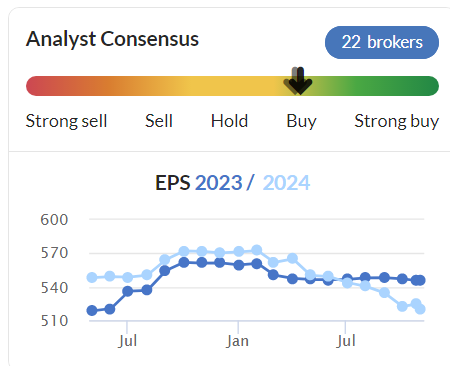
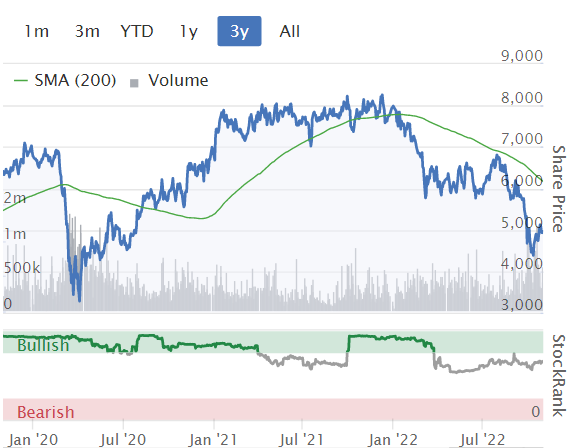
The stock market seems to have priced-in a downturn that, so far anyway, has not happened.
.
Morgan Sindall (LON:MGNS)
1556p (down 1.4% at 08:34)
Market cap £735m
Morgan Sindall Group plc is a leading UK Construction & Regeneration group with annual revenue of £3.2bn, employing around 7,200 employees and operating in the public, regulated and private sectors. It reports through five divisions of Construction & Infrastructure, Fit Out, Property Services, Partnership Housing and Urban Regeneration.
I’ve not looked at this share before, because it’s been too big, and in a sector that is low margin, and prone to failures. A lot of previous mid-caps are starting to appear on my small cap radar at the moment, so there could be some opportunities maybe? Especially in property-related companies, many of which have sold off so much, that they could be interesting.
Morgan Sindall is a sprawling construction, infrastructure, and other property services group, its group website is here. I quickly realised that it’s too big & complex for me to get into the detail here, but I do want to mention a couple of interesting points which arose from my quick review of today's trading update.
Macro uncertainty & inflation have created a “more challenging economic backdrop” - no surprise there.
Despite this, trading is “robust”, and on track to deliver FY 12/2022 in line with (company) expectations (so we have to assume also in line with broker forecasts).
It provides a brief comment on each of the 5 divisions.
Order book - impressive, at £8.8bn, up slightly. That seems to give decent visibility.
Balance sheet we’re told is strong. I’ve checked, and it’s OK, I wouldn’t say particularly strong given the size of the group. NTAV is £266m. However, the working capital cycle looks favourable, with net cash of £274m at 6/2022. There’s a fantastic additional disclosure here - average daily net cash - I would like this to become adopted by all companies as the gold standard of reporting. After all, period end snapshots of cash can be so easily manipulated, something I’ve mentioned in these reports so many times.
This is what MGNS says today about cash & liquidity, which is superb disclosure, and gives great confidence to me in the financial strength of the group (and hence lowers risk for investors, compared with competitors which might be jammed up at their overdraft limit!) -
The Group's balance sheet remains strong and in an uncertain trading environment, the holding of a significant cash balance is more of a competitive advantage than ever.
The average daily net cash for the period from 1 January to 28 October was £260m (of which £62m was held in jointly controlled operations or held for future payment to designated suppliers).
As previously guided at the time of the half year results, the average daily net cash for the full year is expected to be around £250m.
In addition, the Group has significant undrawn bank facilities available to it. These total £180m, of which £165m mature in 2025 and £15m in 2024.
Outlook - sounds solid -
"In recent months, increased general market uncertainty together with continued inflationary headwinds have provided for a more challenging economic backdrop.
Despite this, trading across the Group has been robust and with our high-quality secured workload giving good forward visibility, we're on track to deliver a full year performance in line with our expectations."
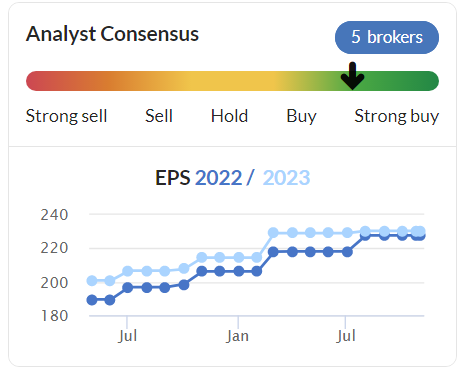
Broker forecasts - what is particularly noteworthy from a quick review of the StockReport, is that estimates have been rising this year - very unusual in a worsening economy, which suggests to me that MGNS has considerable resilience, at least so far, and well-structured contracts (e.g. they don’t seem to be suffering from increased costs, so must have factored in cost increases into their contracts - this sector is really all about how good management are at selecting viable projects, and drawing up watertight contracts, plus of course then executing well. But just one badly worded contract, with unforeseen consequences, can torpedo companies in this sector, which is why I normally avoid it altogether) -
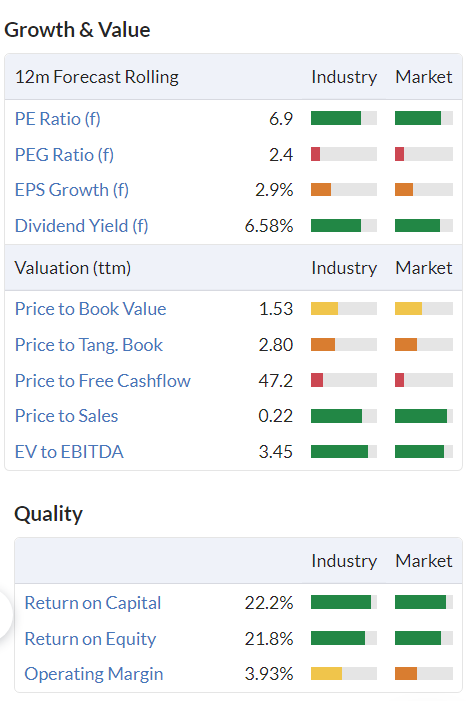
Valuation - is looking attractive, with the forward PER (confirmed today with an in line update) being the same as the dividend yield. There’s a good track record paying divis too.
Some attractive metrics here -
.
My opinion - neutral, as I don’t invest in this low margin, complicated sector. However, I can see plenty of positives for this share.
I see the MGNS has been careful about share issuance, showing the benefit of a decent cash position - it got through covid without having to do an equity raise. The share count is currently 47m, which has not changed since 2017.
If you do invest in this sector, the MGNS looks a sensible choice to me, whilst obviously taking into account that there might be headwinds from possibly project cancellations, and other economic headwinds?
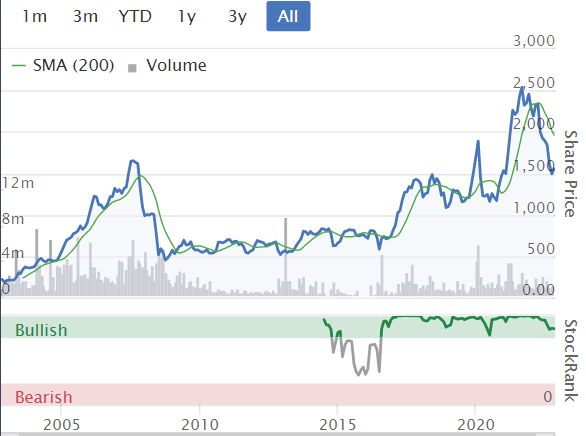
As you can see from the long-term chart below, the share price crashed in the 2008 economic meltdown, and then took 10 years to recover. Although it was paying divis all the way through that period, so it looks as if the company is seasoned at surviving and coping OK with recessions. So it’s an income share really, and looks quite interesting to me.
Good StockRank too, as you can see below.
On balance, I think it’s something I’ll keep on my watch list, and consider buying if there was a share price meltdown on a profit warning, or a big general market sell-off -
.
Graham’s Section:
Aston Martin Lagonda Global Holdings (LON:AML)
Share price: 93.6p (-11%)
Market cap: £654m
This was one of the most disastrous IPOs of the pre-Covid bull market, at least as far as the LSE is concerned. Today brings a fresh profit warning.
It hit the market in late 2018 at £19 per share, and now trades at only around £1.
And by the way, that’s after a 20:1 share consolidation: twenty old shares (originally priced at £19 each) were converted for one of the new shares (now trading at less than £1 each)!
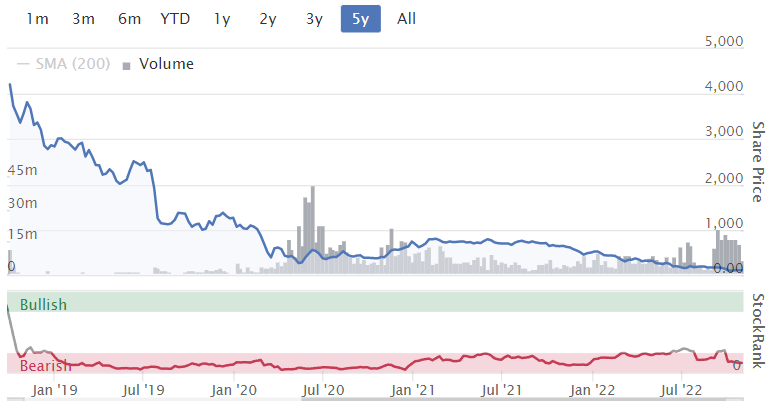
After numerous fundraisings and changes in management, hopefully it is a different proposition to what it was at IPO.
Let’s get up to speed with the latest news from today’s Q3 update: results for the nine months to 30 September 2022:
- Revenue +16% to £857m
- Adjusted operating loss £128m (last year: loss £65m)
- Pre-tax loss £511m (last year: loss £189m)
- Net debt £833m
Ok, these numbers are worse than I expected! It appears that even after five years of terrible financial results, the company is no better than it was before.
The company points to adjusted EBITDA up 10% year-on-year, but this is a nonsense number for a business with large and very real depreciation and amortisation costs.
Here are the explanations for the really bad numbers:
Operating loss of £148m included a £71m year-on-year increase in depreciation and amortisation, driven by accelerated amortisation of capitalised development costs ahead of next generation GT/sports vehicles starting in 2023
Loss before tax of £511m was materially impacted by a £245m negative non-cash FX revaluation of US dollar-denominated debt as the GBP significantly weakened against the US dollar during the period
The depreciation of equipment and the amortisation of development spending are absolutely real costs: while accountants might argue over the exact pace at which they should be recognised, there is no doubt in my mind that the operating loss is a far more realistic reflection of what is happening here than EBITDA.
The £245m FX hit mentioned above, arising from currency movements, is of course beyond AML’s direct control. But the company did choose to borrow in US dollars and its lenders will eventually want to be repaid in the same US dollars, which have now risen in value.
Executive Chairman comment:
"On one hand, we have continued to see very impressive demand across our product range and the underlying fundamentals of Aston Martin are very strong…
"On the other hand, and in the context of supply chain and logistics disruption as well as inflationary pressures impacting the broader automotive industry, over the last two quarters we have encountered specific supply chain challenges that have delayed our ability to meet customer demand… Although these headwinds, which are already improving in Q4, have disrupted our near-term financial performance and modestly impacted our full year guidance, the medium and long-term outlook is robust.
Outlook: the outlook statement explains the company's goals for vehicle sales, revenues and adjusted EBITDA, to be achieved by 2025. Unfortunately, there is no mention of positive operating profit.
Near-term, the supply chain problems will cost about £20m to resolve, and the working capital situation is going to take a few months longer to normalise (meaning that cash will remain tied up).
Net debt looked like this at the end of Q3: £1.6 billion of gross debt, including lease liabilities of £100m, offset by cash of £772m.
In recent weeks, the company has used some of its cash balance to buy back some of its debt:
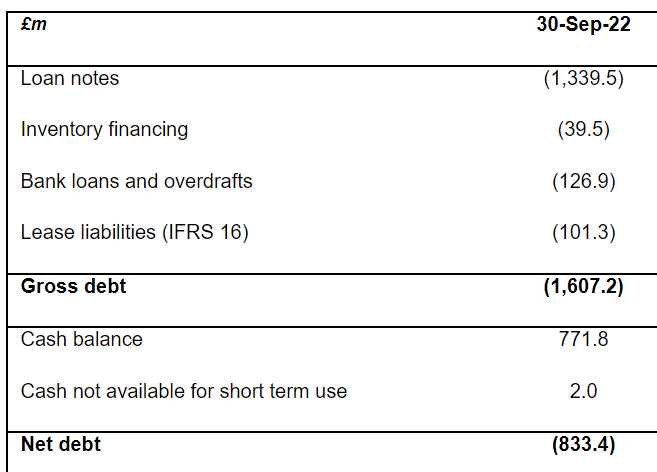
The cash interest cost this year is about £130m.
My view
I’m dismayed to see so little progress here, since the last time I looked at it.
It remains hugely unprofitable - by a wide margin - and consensus earnings forecasts suggest that breakeven won’t be reached until 2024 (and I would suggest that this is an optimistic scenario).
The level of gearing remains a huge concern, despite the company raising £650m in fresh equity during Q3. Chairman Lawrence Stroll says that this equity raise is “the last foundation we need to realise our vision and start to unlock long-term shareholder value creation”.
He might be right. But think of the economic risks involved here: the company’s results have been rocked by FX and supply chain issues, and it is now going to have to face a much higher interest rate environment and perhaps a serious international recession. Its loan notes are due in 2025. Why will things get any easier? And how will the company survive, if the situation gets much worse?
Metro Bank (LON:MTRO)
Share price: 81.7p (+12%)
Market cap: £141m
Here’s a good news story: Metro’s performance in September is ahead of previous guidance.
Rising interest rates are, overall, supposed to be good news for banks - as they improve the spread between a bank’s borrowing and lending rates.
That is the case here, as Metro’s net interest margin (NIM) has been boosted:
Active balance sheet management and prevailing interest rates supported exit NIM of 2.04%
Expect NIM to improve through 2023 given evolving balance sheet composition, base rate increases and deposit pricing discipline
NIM was 1.56% at the end of 2021, and then 1.73% at the end of H1 2022. So we have another nice increase just three months later, to 2.04%.
This “NIM expansion”, along with cost discipline, are cited as the reasons for Metro recording a profit in the month of September. Metro has been posting consistent losses in recent years, so this is significant news.
There’s not much change in deposits or loans: deposits are flat with the company focused on selling the cheapest, instant access accounts.
Loans are up 4% with an emphasis on residential mortgages and consumer unsecured lending. Importantly and perhaps this will come as a surprise, “there has been no deterioration in early warning indicators and no signs of stress or increased delinquency across the customer base”.
My view
I haven’t studied Metro’s interim results in detail but a superficial review shows tangible balance sheet equity of £742m, many multiples of the current market capitalisation.
While every company lives or dies according to its profitability, I think that Metro bank would experience a particularly impressive valuation uplift if its profitability improved, as investors started to look more positively on its enormous balance sheet.
There is no denying that it is highly leveraged and has struggled to generate cash. Fitch recognises this with a below-investment grade credit rating of only B.
However, as a risky play on rising interest rates and continued NIM expansion, these shares could have some merit.
Disclaimer
This is not financial advice. Our content is intended to be used and must be used for information and education purposes only. Please read our disclaimer and terms and conditions to understand our obligations.

29 comments
Metro Bank (LON:MTRO) could be a serious multibagger in the next few months IMO.
- reaching profitability early. In Sep, vs Q1 2023 as last guided
- Net Interest Margin still some way to grow. More than half of lending will see interest rate reset over the next two years.
- moving from loss making to profitable is always one of the key share price re-rating plays
- huge gearing. Costs are fixed mostly. Any increase in NIM goes straight to bottom line.
- various PE firms had been circling in the past. Arguably, Metro in better shape now.
- PB, PS valuations very low vs banking peers in the UK. I think PB is like 0.2x compared to 0.5x and above for peers (albeit larger, proven profitability peers).
(I hold in the Boon fund)
Why is it that Ferrari (RACE) seems to be able to be continuely profitable; €901m on revenue of €4,911m (these for a car company are phenominal, of course some may argue it is not sustainable) and command a premium rating of, according to Stocko, 44.1 (that does seem absurd?) and enjoys a mkt cap of €42.15 BILLION!
Whereas Aston Martin Lagonda Global Holdings (LON:AML) cannot manage a profit and has a mkt cap of £739m. Even though in my subjective opinion they produce beautiful motor cars (I have never owned or driven one), are now in F1 and have had the tail wind of the James Bond franchise for 63 years (Goldfinger published 1959 and the film released in 1965). I can only assume awful management at Aston Martin and brilliant management at Ferrari is the main reason, as the ingredients for Aston Martin Lagonda Global Holdings (LON:AML) to be a successful company are there.
I do not hold either.
Regards
Michael.
There are sure to be multiple reasons but engineering excellence, for which Ferrari is renowned but where AML has a so-so reputation, is a good starting point. But the building of the brand is at least as important. Ferrari and Porsche know how to capture the imagination of the young enthusiast and will happily let youngsters clutter up their showrooms. AML barely let the (then) 35-year old jeans-clad me through the showroom doors.
Agree about Aston Martin Lagonda Global Holdings (LON:AML) and engineering excellence. I remember being told more years ago than I care to remember that an Aston Martin spent more time in the garage on the road (hopefully that is not true now) but I still feel that is the fault of management.
Regards
Michael.
Good product doesn't always mean profits?
We've seen it so often in the markets. Amateur investors getting carried away by having a good customer experience of the product; yes, that is maybe the hygiene factor for a company to be successful. But not the only factor.
I think you probably have it right, that it is better management and operations at Ferrari that has made it financially healthier than Aston Martin...
I know we don’t do energy stocks here but posting mainly for others who may have missed the RNS. Takeover bid to be knocked back at Hurricane Energy (LON:HUR) (I hold). Bid of 7.7p considered to undervalue the company. Major shareholder wants out, formal sale process initiated to look for fairly priced bid. Capital return to shareholders (up to 3.1p per share) to be initiated if sale process unsuccessful. Current sp ~8p , up from 6.8p yesterday.
As an aside, this is now my third holding this year to be approached / taken over. Contour Global (energy), Shanta Gold , and now Hurricane. This suggests to me that the U.K. resource sector is being targeted by foreign investors just now!
Thanks for taking an look at Morgan Sindall (LON:MGNS) which I've always been a fan of, but tends to get overlooked. They have a very prudent approach, and I like the fact they are well diversified across different sectors. Also worth noting that founder John Morgan is a significant shareholder which is always a big plus for me.
Morning Paul,
I am a fan of Paul Hill and usually watch his interviews, however the one you link came up yesterday but i didn't watch because i thought it was an old one . It seems to be dated 1-22-22 which i assumed he was using the American date form .
Just about to sit down with a tea and watch now, thanks.
R
Thanks, I've emailed Paul Hill to flag that the date is wrong! Glad it's not just me who gets dates wrong all the time LOL!
Hi Paul, I am a big fan of Paul Hill so this is very welcome - disclosure I subscribed to his precision guided investments service about 10 years ago that contained several multi-baggers. BTW I am also a big fan of another Paul but I will keep his surname secret as it might make someone blush!
Hi Paul
Thanks for the link to your/Paul Hill interview. A nice friendly format with some interesting reflections. In particular the thoughts on the house building sector resonated with me. Cheers.
Mark
Re Grahams comments on Foxtons (LON:FOXT) : does 69p look like a good sell target ? Two can play at that game :o)
hi Paul
Thanks for your 'hat tip' in yesterday's commentary.
Just a small correction in that the ticker symbol you quoted - £OIS - was incorrect. It should have been Osirium Technologies (LON:OSI)
Snazzy
Ah yes, sorry I corrected that in the tag, but must have forgotten in the other bit. I'll fix that now, thanks for flagging! OK that's sorted now, and I added my own comment on OSI, as curiosity got the better of me after hours! Could be an interesting little speculation, but only after the next fundraise has been done. It's got convertible loans too, so the terms of those need to be scrutinised. As you say, just for gamblers at this stage, I agree. Thanks again for your input!
The £2.7m 7.5% convertibles for Osirium Technologies (LON:OSI) are repayable 28 October 2024 do seem quite dilutive. In theory the conversion price is 40p - but this is rachetable downwards in quite a complicated manner (details on p66 of the annual report) to a 25% discount to the 90 day average share price or the most recent placing price.
Good spot Wimbledonsprinter.
Latest share placing was at 6p. A 25% discount would reduce the option price to 4.5p which is similar to the current share price. However, there will be another fund raise soon so another placing would more than likely reduce this option price further.
Assuming a 100% conversion was taken up at an option price of 4.5p this would result in another 60m shares being issued. Current shares in issue total 46m. This would result in a further 57% dilution for existing shareholders.
Is there any way to establish whether management hold any of the convertibles? I can't see any information as to who the holders are in the Annual Report but assumed if management held any then this might be disclosable. Does anyone know the rules?
Remains one for gamblers only.
Noticed a decent move up last couple of days £TEG. Either a positive trading update imminent or something else brewing?!
Hi JohnDoe2378, just a tip on getting the £TICKER to work - you put a full stop immediately after it, which stops it working.
I find that sometimes the £TICKER doesn't work, even if correctly formatted. Dunno why, it's just temperamental! This is the workaround which always works - put in £TICKER as usual, then immediately after it (no spaces) do carriage return. It always works, if you do this.
Then just go back in using EDIT symbol, and remove the carriage return.
Bit of a faff, but it works every time doing that, I find.
I know its not quite in our ambit, but why would anyone have ever bought Aston Martin Lagonda Global Holdings (LON:AML) when you look at the charts. More than 80% down this year, heaven knows what % down versus the launch price in 2019, and another 11% down so far today. It beggars belief. I have done some silly things in my time, but I remember thinking at the time that this is dream investing, but the dreams have turned very quickly to nightmares on a grand scale for any poor - much poorer - holders.
I guess one persons water is another's champagne. Agree with you entirely though I wouldn't have put a dollar into this and not sure what the bulls would say positively about why they would buy into it
Hi ridavies. I suspect that they bought the shares because they got all enthusiastic about the cars and the brand. But they failed to conduct a proper analysis of the company and the risk / reward profile of the shares. Also the shares may well have been over-priced & over-hyped at launch.
I suspect that they bought the shares because they got all enthusiastic about the cars and the brand
And the extremely high valuation that Ferrari commands - with, in Ferrari’s case, much greater justification.
To be fair to Aston Martin Lagonda Global Holdings (LON:AML) they unveiled the DBX, widely reviewed as the best vehicle in its class, in November 2019 and launched it in July 2020. I am not suggesting that if Covid had not happened the company would have been profitable, but their sales were undoubtedly hit by the pandemic.
Been wondering what Aston Martin Lagonda Global Holdings (LON:AML) intangible assets are - clearly a brand, racing technical expertise and innovation, designers, but can't see what unusual and undervalued.
They could introduce a cheaper family friendly hybrid similar to the Focus but think Ford already nicked their grill design lol. And it didn't work for MG (so sad).
Replying to Ridavies re £AML historically the marque has been a strong money loser for everyone from Ford to David Brown Engineering via Victor Gauntlet and probably even the original Mr Martin. Sadly this isn't unusual at this rarified level of car building, the list of evocative names that have struggled is too long to repeat here. A luxury car factory looks to be a charismatic way of making a small fortune: out of the large fortune that you started with, or worse. The Pesenti family watched the fortune they had sunk into Lancia turn into a £20m* loss in a decade, followed by a sale to Fiat for a token value.
I wonder if holding a few shares in Aston acts as a proxy for owning one of their cars, for some enthusiasts? Personal I'd rather just have an AML branded golf umbrella and invest the rest of my money elsewhere. Seen as you can now buy a used DB7 for Ford Focus money, a careful invester enthusiast could probably build up a nest egg via sensible shares and a fair wind, cash in their portfolio in a few years, part ex the family car to make up the balance and voila suddenly they own an Aston (With decent spares backup and alleged good reliability). All done without holding any AML stock!
*At 1969 prices. Gulp!
Morning Paul/Graham,
Out of interest, when is your interview with Cerillion (LON:CER) CEO Louis Hall happening?
Many thanks.
I'll be interviewing Louis Hall today, at 13:00. So the audio should be up by 14:00-ish, and then I'll type up a written summary, in a separate post here, later today (hopefully).
Here's my agenda -
Brilliant, than you