Small Cap Value Report (Weds 29 Sept 2021) - CARD, HEIQ, GOG, ESC, QUIZ, AIR, FUL, COM

Good morning, it's Paul & Jack here, with the SCVR for Wednesday.
Agenda -
Paul's Section:
Card Factory (LON:CARD) - interim results show a small loss, due to lockdown 3. Footfall still well down on pre-pandemic level, but average transaction value is higher. CARD has missed the boat online, with only trivial eCommerce sales, an area now dominated by e.g. Moonpig (LON:MOON) . Bank debt still a problem, and very weak balance sheet, means high risk of dilution. I'm steering clear.
Heiq (LON:HEIQ) - poor interim results, way down on last year's H1. Wobbly-sounding outlook. It's halved in price, but still looks over-valued to me.
Go-ahead (LON:GOG) - lost southeastern rail franchise, due to accounting "errors". CFO resigns & accounts delayed. I'm steering clear.
Escape Hunt (LON:ESC) - improved trading recently, since reopening, but it's not yet clear whether this is a viable business being rolled out, or just a fad.
Quiz (LON:QUIZ) (I hold) - results for FY 03/2021 show a heavy underlying loss, as expected. However the commentary shows encouraging signs of much improved current year trading, improving gross margin, and a positive outlook for FY 03/2022. This is very much a glass half full or half empty share! I see it half full, with recovery underway, but others may disagree.
Jack's section:
Air Partner (LON:AIR) - trading figures are down on exceptional H121 figures but are up on H120, which is a more appropriate comparison. A couple of significant acquisitions have been made over the past couple of years and if the group can generate sustainable growth going forwards, then the share price today does not seem expensive.
Fulham Shore (LON:FUL) and Comptoir (LON:COM) - two listed restaurant companies, both reporting positive trading, but with two very different valuations and track records.
Explanatory notes -
A quick reminder that we don’t recommend any stocks. We aim to cover trading updates & results of the day and offer our opinions on them as possible candidates for further research if they interest you. Our opinions will sometimes turn out to be right, and sometimes wrong, because it's anybody's guess what direction market sentiment will take & nobody can predict the future with certainty.
We stick to companies that have issued news on the day, with market caps up to about £700m. We avoid the smallest, and most speculative companies, and also avoid a few specialist sectors (e.g. natural resources, pharma/biotech).
A key assumption is that readers DYOR (do your own research), and make your own investment decisions. Reader comments are welcomed - please be civil, rational, and include the company name/ticker, otherwise people won't necessarily know what company you are referring to.
Paul’s Section
Card Factory (LON:CARD)
56p (down 6% at 13:44) - mkt cap £193m
Card Factory, the UK's leading specialist retailer of greeting cards and complementary products, announces its interim results for the six months ended 31 July 2021 ('HY22') and an update on its long-term strategy.
Company’s summary -
Results in line with expectations
Business review successfully completed - transformation underway to omni-channel model to deliver sustainable revenue and profit growth.
Target over £600m of sales by FY 2026
H1 was impacted by lockdown 3, with stores closed for 10+ weeks
Footfall down 27% on pre-covid levels, but ATV (average transaction value) up 28% - so customers are shopping less frequently, but buying more on each trip - quite encouraging.
CARD claims to be out-performing High Street averages, but I couldn’t see the source for this.
Net debt has long been a problem, but has reduced somewhat, at £96.5m, down from £107.7m in the 6 month period.
Revenues £116.9m
Loss before tax of £(6.5)m
Targets revised (downwards) - now revenues >£600m by FY 26, and “trending towards” a profit before tax margin of 17% - sounds ambitious, and this is only an aspiration, so I’m not giving it much weight.
Funding options still being evaluated - bank debt remains a problem, and there are financial penalties if it is not reduced. Hence CARD remains under pressure to repair its balance sheet with an equity raise, or more expensive subordinated debt. Hence there remains dilution risk for shareholders - unknown quantity, and unknown price. Why take on that risk?
Poor online sales - only £11.9m in H1, which was down 10% on last year, but up 50% on pre-pandemic. For me, this is the deal-breaker. To be credible, CARD needs to become a substantial online player. Instead it’s let the grass grow under its feet. Moonpig (LON:MOON) for example is valued at £1.2bn, over 6 times what CARD is worth. What a missed opportunity for CARD.
Current trading & outlook - I can’t get excited about this, as like-for-like (“LFL”) sales are down on both last year, and pre-pandemic, which is not good enough -
We are satisfied with trading since the period end, with better-than-expected performance driven by improvements across all areas of the business. Online is trading in-line with our expectations and in store footfall and transaction volumes continue to recover, albeit transaction volumes remain 21.9% below pre-pandemic levels. Average basket value remains higher than pre-pandemic levels, with basket mix reflecting our broader product offering, offsetting lower footfall. LFL trading post period end for the 7 weeks to 19 September is -3.6% and -6.3% versus the equivalent period in FY21 and FY20 respectively.
Notwithstanding short-term uncertainty around the speed of the market recovery the well-publicised disruption that is being seen in the supply chain, shortage of staff heading into Christmas, increasing freight costs, increased energy costs and adverse product mix, we remain cautiously positive about the second half of FY22.
Balance Sheet - still the weak point for CARD. NAV is £202.7m, which includes (worthless) intangible assets of £321.3m that I deduct, to arrive at NTAV negative £(118.6)m. I think the company needs to do an equity raise of £50-100m to repair its balance sheet. If that has to be done from weakness, it could involve a deep discount, and put existing shareholders in that horrible situation where you’re almost forced to buy more shares at a lower price, to average down.
If the share price has a strong run (as it did earlier this year), then dilution becomes less of a problem, but it seems to me that management missed the opportunity to raise equity at a favourable price earlier this year, with an irrational spike in price from Feb-May 2021 having since wilted somewhat.
My opinion -
Loss of business to online rivals such as Moonpig (LON:MOON) - demonstrating how poor CARD’s strategy has been allowing online rivals to emerge & prosper, with its own online offerings being poor, almost insignificant.
Weak balance sheet, saddled with too much debt, still unresolved - dilution likely, at unknown price.
High Streets & shopping centres not fully recovered to pre-covid levels - will they ever?
Large cost pressures coming, from withdrawal of Govt support, especially furlough & business rates relief. Also availability & increased cost of labour (and recent NI rise), and ubiquitous supply chain/delivery issues that are likely to affect everyone this autumn/winter.
I don’t find the strategy particularly compelling, it all sounds quite predictable, and uses the buzzwords like omni-channel.
All in all, there’s nothing here to interest me. I’d look at it more favourably once the balance sheet has been repaired, and fresh equity used to pay off a lot of the bank debt.
.

.
Heiq (LON:HEIQ)
101p (down 24% y’day) - mkt cap £132m
HeiQ Plc (LSE:HEIQ), an established global brand in materials and textile innovation which operates in high-growth markets, is pleased to announce its interim results for six months to 30 June 2021.
I’ve never been able to fathom why people were prepared to pay such a high valuation for this company.
Company summary - sounds like waffle to me -
Positive progress in executing growth strategy through strengthened product portfolio and increased customer base despite significant Covid-19 pandemic related headwinds
H1 revenue of $25.8m, down 14% on H1 LY (which benefited from the pandemic)
Gross margin fell from 57.4% H1 LY, to 50.2% H1 this time, due to cost pressures on inputs and outputs.
Operating costs up 48% to $10.6m
That’s the worst possible combination - lower revenues, lower margins, and higher overheads.
Operating profit has crashed from $10.9m H1 LY, to $3.3m H1 this year (although this is better than just $0.6m in H2 LY)
Three acquisitions in the period, costing $26.7m
New product launches.
Outlook - again rather waffly, but my overall impression is that the outlook seems uncertain, and a bit wobbly. Therefore the 24% drop in share price today is probably justified. Here’s an excerpt -
In concrete terms, we are strategically and financially engaging key customers into our innovation pipeline and at the same time leveraging the customer base and product ranges of our acquisitions to generate additional revenues. In the current market conditions, our ability to supply these newly secured customer programs throughout 2HY 2021 will be essential for our short term success.
We anticipate that the rest of 2021 will continue to be unpredictable with the previously mentioned headwinds, for us, our customers and our competitors worldwide. While we are engaging in a number of significant projects, which would have an impact on the outcome for the full year, with various factors remaining outside of our control, we cannot be certain that all of these projects will materialize in 2HY 2021.
Balance sheet - overall looks OK, although trade receivables and inventories seem high, which can sometimes indicate problems (e.g. slow-selling products, and disputed customer invoices).
Cashflow statement - another area that raises some concerns - despite bumper profits in H1 last year, it didn’t generate much cash for H1 or the full year, instead the profit got sucked into working capital.
Cash generation has improved in H1 this year.
My opinion - based on these numbers, and a wobbly outlook, I wouldn’t pay anywhere near £132m for this company.
So it looks as if the valuation includes a lot of hope for future growth.
I wasn’t impressed at all with an online presentation the company did earlier this year, which was unconvincing.
As you can see from the chart below, most of the hype from earlier this year has dissipated. Looks like Heiq reversed into a cash shell in Dec 2020. That’s a good way of floating a new company, because it means there’s an existing shareholder base, hence improved liquidity compared with a completely new listing.
.

.
Go-ahead (LON:GOG)
780p (down 24% y’day) - mkt cap £337m
Loss of South Eastern rail franchise
This looks a can of worms. The Department of Transport is taking back Go Ahead’s rail franchise for Southeastern. Its other rail business, GTR is not affected.
“Errors” totalling £25m have emerged (i.e. under-payments to the Dept of Transport by Go Ahead), with the CFO resigning immediately.
My opinion - I don’t touch any regulated industries, because there are too many uncertainties, and they often operate on low margins, and are subject to sudden changes being imposed on them, and often carry too much debt, as we see here.
Regulated transport companies are particularly difficult to analyse, reliant on taxpayer subsidies often, with complicated contracts & regulatory issues. I think you need to be a sector specialist to stand any chance of picking the winners in this sector.
Today’s kerfuffle with Go Ahead reinforces my determination to steer well clear of the whole sector.
.
Escape Hunt (LON:ESC)
35.7p (down 5% y’day) - mkt cap £31m
I’ve had a very quick look at the interims announced yesterday, and there’s not a lot to say really, because its sites were closed for much of H1.
It looks as if the annualised run rate of revenues (based on the recent 6 weeks re-opening) is about £10m p.a.
It’s too early to say if the company is profitable, and if this is a viable business model.
The company’s outlook comments raise the question whether it can be profitable once costs have normalised (e.g. business rates being charged again)?
With the need to constantly refresh the fit-outs, so they don’t get stale, then EBITDA seems meaningless. Capex would need to be depreciated quite quickly in my view.
The Group reached a significant milestone, delivering a positive group level EBITDA in both July and August, helped by the 'stay at home' summer in the UK, lower VAT rates and the business rates holiday. The performance has validated our previous assertion that, with its current estate, is the Group could become cash generative given reasonable trading assumptions.
With the foundations laid for a profitable and cash generative business, we look to the future with confidence.
My opinion - you can probably guess what I’m going to say! A market cap of £33m for what is an unproven business model, strikes me as bonkers.
Is it a fad? Possibly, we don’t know. I would only invest if individual sites were throwing off big cashflows, but that does not seem to be the case so far, although covid is bound to be suppressing demand somewhat, after all gathering in a confined space is the business model, precisely the opposite of what some people want to do.
I imagine there are likely to be more placings in future. The business model might work, who knows. But why gamble on that happening, when there isn’t yet much evidence it is likely?
.
Quiz (LON:QUIZ) (I hold)
21p (down c.15% at 09:05) - mkt cap £26m
QUIZ, the omni-channel fashion brand, announces its unaudited results for the year ended 31 March 2021 ("FY 2021").
These accounts are quite late, and only of passing interest because FY 03/2021 was impacted by 3 lockdowns, forcing the intermittent closure of Quiz’s shops. Further disruption occurred from the closure of Debenhams, resulting in most of Quiz’s concessions (shops within a shop) closing. It did a pre-pack administration in June 2020, to ditch the heavy lease liabilities, with new, improved lease terms negotiated on cheaper, more flexible turnover rents - where rent adjusts because it’s a % of monthly revenues from that site, as opposed to a fixed quarterly rent on old style leases. A handful of stores in Spain were also closed.
Therefore it’s been a highly disrupted year, what with all the chaos caused by the pandemic. On top of all that, widespread supply chain issues, and staffing, were additional headwinds.
Put all that together, and it’s remarkable the business has survived, and seems to be recovering well. It’s funny how people have different perceptions. I read this morning’s update with an increasing sense of pleasure, as for me this glass seems half full. So I was amazed that the share price fell sharply in early trading. Also I had a Whatsapp discussion with a friend who took a negative view about the update, so it just shows, different people perceive companies in sometimes very different ways.
Short term share price movements don’t bother me, as I tend to take a medium to long term view of my personal holdings, and I try to ignore the share price in between my buy & sell decisions. Fundamentals are what interest me & drive my buy/sell decisions. Day to day volatility is just background noise.
I’m more interested in current trading & the outlook, but for completeness here are some numbers from the (now largely irrelevant) FY 03/2021 results -
Revenue £39.7m, down 66% on prior year - obviously a dire outcome, mainly due to enforced store closures.
QUIZ not only suffered from lockdowns, but also took a hit with online sales falling sharply to £21.6m (prior year: £37.5m). This was unfortunate, because QUIZ specialises in special occasionwear, which of course was the segment that was hit hardest by the pandemic, with events being cancelled for most of the year. It tried to pivot to casualwear, but that wasn’t enough to recoup sales of its core products largely fizzling out.
Gross margin reduced, due to discounting to clear excess stock, but at 53.4% is still reasonably strong, but well down on 60.3% in the prior year.
The underlying operating loss for FY 03/2021 was £(9.4)m, and that’s after including the benefit from £8.2m in Govt grants. So an awful year, as expected.
Statutory figures are interesting, with a profit of £6.0m being reported. How come? It’s because there was a £15.6m exceptional profit from the restructuring (pre-pack administration in June 2020), as onerous liabilities were ditched, and assets bought back on the cheap, in a controversial process which enables failed businesses to clear the decks and start again, but at a heavy cost to creditors.
Profit after tax feeds through to the balance sheet, so NAV actually rose from £10.1m to £16.6m in FY 03/2021, due to the pre-pack administration.
Here are my notes from reviewing the results statement & narrative -
Recent trading shows store performance is now “approaching pre-pandemic levels” on a like-for-like basis - this is very encouraging in my view, because bear in mind costs (especially rents) have been slashed, so the shops should now be trading profitably.
Sales in the 5 months to Aug 2021 are up 132% on LY to £30.6m. That annualises to about £73m sales, and if we add in something for the Xmas party season, then I reckon we’re looking at a run rate of c.£80m - so a decent sized business, and considerably larger than higher market cap online-only fashion businesses Sosandar (LON:SOS) (I hold) and In Style (LON:ITS) - although they are both growing their top lines strongly, which QUIZ is not. So maybe the price differential is warranted?
Bank facility of £3.5m extended a year, to Sept 2022. It’s not being used anyway, but is a good backup. No covenants on this facility, making it low risk.
Key point - anticipated positive cashflow for FY 03/2022.
Reduced reliance on third parties, with most concessions now closed, and focusing on own-website sales, rather than lower margin third party website sales.
Concessions are mainly in New Look shops, an interesting development that I wasn’t aware of. There are 45 concession sites in total, which are stores within a store, operated & staffed by the host company, with QUIZ just supplying the inventories.
International - surprisingly high, at 19% of revenues. This is the stores in Ireland, plus franchises in 20 countries - interesting, again I wasn’t aware of this. Spain now closed.
Stores - reduced footfall partially offset by increased spend per customer (similar to what CARD said yesterday).
Gross margin since year end has improved by 400bps, so half way back up from 53% to 60%, around 57% - an encouraging sign.
Sold much of the excess inventories since year end. No additional stock provisions required.
Supply chain - QUIZ seems to have fared well here. It mentions cost price inflation, higher shipping costs, and delays, but has been able to minimise disruption, and held excess inventories, so could fill any gaps from existing surplus stock.
Substantial cost savings achieved - e.g. lower rents, reduced HQ staffing, and less marketing spend during lockdowns.
Govt support - critical, and large, at £8.2m cash (mainly furlough), plus business rates suspension.
Online - sharp increase in activity April-August 2021, as special occasions resumed.
Marketing spend now being increased, as activity improves.
Balance sheet - is surprisingly strong, largely thanks to the pre-pack administration done in June 2020. NTAV is £13.2m - a healthy position. So insolvency risk is very low now, which might surprise people who haven’t done their research properly. A widespread perception is that QUIZ is financially distressed, but that is clearly wrong if you look at the balance sheet numbers.
Working capital looks healthy, with current assets of £18.9m, and current liabilities of £12.75m. Note also how the lease liabilities are now very small.
Going concern note is interesting, as it includes a stress test of a downside trading scenario. The company sails through with adequate liquidity even in the downside case.
My opinion - I see this update positively, but that could be because it’s a top 3 position in my personal portfolio, hence the ever-present risk of rose-tinted glasses! I try to be objective always, but unconscious bias may creep in without me realising it.
The share price more than tripled recently, so the market had already priced in a change from basket case at risk of going bust, to a recovery situation with little to no insolvency risk. So maybe it was too much to expect another rise on publication of these results?
That said, a drop from a recent peak of 26p, to around 20p at the time of writing, doesn’t make sense to me, hence why at c.£26m market cap, I see this share as something I’m likely to be buying more of, rather than selling. Anything below 20p seems an attractive buying price in my opinion, with good potential upside if recovery continues.
QUIZ is not a particularly good retailer. They had a series of excellent years before the IPO, but then began deteriorating quite badly. That suggests something went wrong with product, and the competitive position clearly deteriorated.
Having said that, QUIZ has survived the pandemic, unlike many of its supposedly superior rivals (e.g. Debenhams, Arcadia Group, and many other smaller competitors). So it now benefits from less physical stores competition, and much lower rents - arguably the best position it’s ever been in, as regards competitive landscape.
Online, QUIZ seems to regaining its poise, and if they can accelerate growth there, then the upside potential for the shares could be considerable.
I bought my shares at about 8p, which was an absolute steal. I’m happy to sit tight, as the £26m valuation still looks cheap to me, given the recovery potential that appears to be taking hold.
I’m targeting an exit at 40-50p, which looks possible in my opinion.
QUIZ has been a successful, highly profitable business in the past. So with a much reduced cost base now, I don’t see any reason why they couldn’t rebuild profitability. The key focus now is to get the product right. Having survived the pandemic, and with sound finances now, management should be free to focus on getting the product right, rather than fighting for survival.
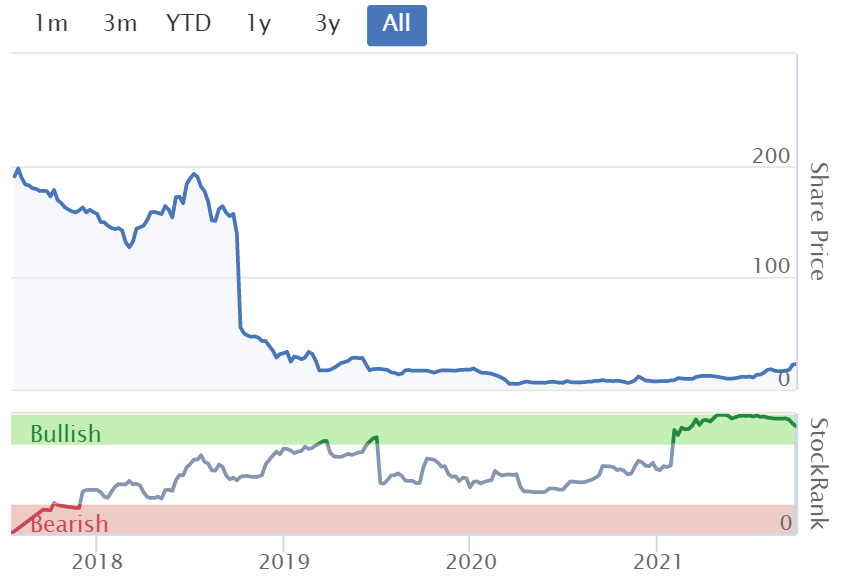
See the terrible performance of this company since it listed. Although interestingly, there has not been any dilution - it still has 124m shares in issue. Therefore, in theory at least, the share price could recover to previous highs, if financial performance recovers. That's probably pie in the sky, as in hindsight the company was polished up for the IPO, and they stuffed a load of fund managers with over-priced shares, after a period of unsustainably good trading.
.
.
Jack’s section
Air Partner (LON:AIR)
Share price: 96p (+2.13%)
Shares in issue: 63,562,601
Market cap: £61m
Founded in 1961, Air Partner was originally a school for military pilots converting to civilian flying. Over the past 60 years it has evolved into a broader global aviation services group, providing aircraft charter and aviation safety & security solutions to a diverse customer base.
The group had a surprisingly strong Covid, characterised by increased demand for its charter services during lockdowns. Since then, the group has made a promising acquisition and released a confident trading update, marking it as a company of interest.
The shares have recovered in recent days but the Value Rank is still an attractive 83 and if the company is building the platform for long term sustainable growth then the share price today is not expensive by any means. Also note the persistently strong StockRank over time.

Strong H1 trading performance… The Company now expects performance for the full year to 31 January 2022 to be materially above market expectations.
Highlights:
- Gross profit down from £27.7m to £18.6m, but still higher than FY19’s £17.2m,
- Underlying profit before tax of £3.8m, down from £10.5m but up 26.7% on the FY19 re-pandemic level of £3m,
- Net cash of £9.8m and liquidity headroom of £24.3m after accounting for £13m undrawn RCF and £1.5m overdraft,
- JetCard cash deposits up 12.5% to £19.8m due to high demand in Private Jets (H1 2020: £17.6m / H1 2019: £18.5m) ,
- Basic EPS of 4.2p; underlying EPS of 4.6p, down 64.1% on the prior year, but up 7.0% on H1 2019 (4.3p),
- Interim dividend up 6.3% to 0.85p.
Overall, 48.2% of gross profit came from outside of the UK, with the US contributing 31.6%.
As mentioned above, 2020 was uncommonly strong for Air Partner due to exceptional Covid-related demand for its charter and freight services, so FY19 figures are a more appropriate comparison.
There’s been the anticipated change in product mix since, with this Covid trade normalising and other previously depressed areas of the company recovering. Management believes current trading patterns are sustainable and all products (Group Charter, Private Jets, Freight and Safety & Security) have contributed at least 20% to gross profit. So there’s a nice balance to the divisions and a sense of diversified operations.
Private jets - gross profit in the US and UK is now at pre-pandemic levels despite travel restrictions in Q1, although activity in Europe is more limited.
JetCard sales have grown, particularly in the US (+229%) ‘as travellers sought a flexible and bespoke solution for flying requirements’.
Charter and Freight demand is down year on year against an exceptional comparable period. Currently charter demand is coming from government, oil & gas, and sport customers.
Safety & Security performing well, having secured business wins across a diverse range of customers.
In August 2021, Air Partner acquired the ‘strategically important’ Kenyon, a leading emergency planning and incident response company. This follows the acquisition of Redline in late 2019. Kenyon is expected to be earnings enhancing in 2022 and should contribute meaningfully to Air Partner's long-term financial performance.
Recent strong cash generation will be used for organic investment and potentially additional acquisitions in line with its strategy to diversify and extend its customer offering.
Outlook:
The Board expects underlying profit before tax in the second half of the year to be strongly ahead of H2 FY21, which will result in performance for the full year being materially above current market expectations.
As the business normalises, the expected underlying PBT for FY22 could be c.66% ahead of FY20 (pre COVID-19)
Looking back at Air Partner’s FY20 annual report, that underlying PBT figure was £4.2m, so the group must be guiding towards a shade under £7m of profit before tax. Given the c£60m market cap, that looks good.
Conclusion
There are a lot of different business activities at Air Partner but the company comes across as well managed and so it could well be that these diversified operations present greater growth opportunities, rather than being too much to handle.
Even taking into account the recent spike in the share price, the shares are not overly expensive, particularly given today’s improved guidance. So there is still time to assess the growth potential of the group’s various divisions.

That could take a little time as there are a lot of different strands here for a c£60m market cap company, particularly after the recent Kenyon acquisition. Overall though I’ve a favourable impression of this share so far and believe further research could be rewarded.
Fulham Shore (LON:FUL)
Share price: 18.74 (+2.71%)
Shares in issue: 630,528,425
Market cap: £118.2m
Two listed restaurant operators reporting today, with markedly different market caps. Fulham Shore has 75 sites and a market cap of more than £115m, so about £1.53m per site. Comptoir has 21 sites and a market cap of £9m, so just £0.43m per site. You might argue that one is overvalued and the other is undervalued but there are a few points to consider.
One, Fulham Shore has very experienced management who know exactly how to roll out a pizzeria chain nationwide. They know where the best sites are and how to outperform the competition, because they used to be that competition. They also know how to negotiate site rents to generate attractive returns on capital - much more difficult before Covid when it was very much landlords calling the shots. A lot of competitors have been stung this way, signing up to expensive units with poor economics that make it difficult to turn a profit no matter how robust the trading.
The other, Comptoir, offers a good product, but also an inherently more expensive one due to the wide menu and ingredients. I’m not sure about the terms they have signed historically for sites. Perhaps they too were able to negotiate good deals.
What’s interesting is that for two companies that listed at similar times, Fulham Shore has been able to expand much more rapidly.
But the important point now is that Comptoir has survived the lockdowns and, as with Fulham Shore, it can now grow into much more favourable market conditions. And there is that wide valuation gap of course, which means both companies are worth looking at for different reasons.
Restrictions on dine in customers were lifted by the UK Government on 19 July 2021 and the company's financial half year to 26 September 2021 ended three days ago. That makes for ten weeks of full trading and 16 weeks of restricted trading. Trading comparatives within this update are the comparable period in 2019.
Total revenues increased to over £39m compared to £36m. This is due to the group opening eight new sites since September 2019, strong trading when restaurants have been open, and a good performance in Franco Manca delivery. Trading in suburban sites has been particularly strong, as flagged before, but city sites are gradually recovering. Both brands (Franco Manca and The Real Greek) are trading well.
The period post lockdown restrictions being lifted, on 19 July 2021, saw a number of the Group's restaurants around the UK breaking trading records on a regular basis. Group revenues for the three full weeks to 26 September 2021 averaged 33% ahead of the same period in 2019, an improvement on the 27% reported in our previous trading statement achieved during the three weeks to 5 September 2021. During this time, cost of sales and labour margins continued to remain stable despite inflationary pressures.
Fulham Shore is trading ahead of management's expectations. This augurs well for the full year performance and UK wide expansion plans, with much more scope for ‘opportunistic property portfolio acquisitions’. The group is now also more actively considering dividend payments.
So far this financial year, the group has opened two Franco Manca and its 20th TRG, taking the estate to 75 units. Work is ongoing on two additional Franco Manca sites, another TRG is in the works, and 16 more potential sites are in solicitors' hands.
Cash - cash generation is strong. Fulham Shore started the year with net debt of £3.6m (excluding lease liabilities) but this has now swung to net cash of £5m after almost £9m in net cash generation over six months, despite opening three new restaurants and building a fourth.
Conclusion
Fulham Shore is a best in class operator, one which now finds itself in unprecedentedly favourable market conditions. Page et al are well placed to build a restaurant business of substantial scale.
The obvious point to consider is valuation. I think given the conditions and the experience of the management team, there is scope for further upside but how much? The group says it has identified more than 150 additional sites and also has international franchising ambitions.
The historic £650k fit out cost has reduced to around c£500k. Those restaurants are then valued by the market at c£1.5m due to their ongoing cash generation characteristics as viable businesses.
It hopes to reach 110 sites by the end of 2025. If sites continue to be valued at £1.5m then that would be a £165m market cap by 2025, or c43% upside. But that’s assuming the market continues to value its sites in the same way. Sentiment can change.
I’m very happy with how the company is doing, but I also wonder if there are potentially bigger rewards out there for investors not already holding the shares. Which takes us onto Comptoir.
Comptoir (LON:COM)
Share price: 7.44p (+1.22%)
Shares in issue: 122,666,667
Market cap: £9.1m
While Comptoir has not been able to expand at the same rate as Fulham Shore, you can argue that the low valuation more than makes up for that. It has 21 restaurants and a further four franchise units. If it were to be revalued on a unit basis to be in line with its competitor, the market cap would be more than £30m.
That’s still a very small listed company, so the risks are high here and you really can’t purchase many shares at all.
Unlike Fulham Shore, Comptoir is not comparing its results to 2019 either. Note that these results are impacted by COVID-19 related closures. In 2020 periods were affected from 19 March onwards. In 2021 the periods affected were between 1 January and 19 July. So it’s still tricky to get a clear picture.
Highlights:
- Revenue down 6.9% to £5.7m,
- Gross profit down 4.8% to £4.3m,
- Loss after tax has reduced from £4.5m to £1.2m,
- Basic loss per share of 0.98p, improved from a loss per share of 4.05p,
- Net cash of £9.2m, up from £7.8m in December 2020.
The group comments:
The sector is still under extreme pressure from well-documented challenges such as the availability of labour as well as the pressure on the supply chain, but we recognise we are fortunate to be in a better position relative to many of our peers… With strong sales since the phased reopening began in April, a relatively strong balance sheet and the potential for new openings, we are optimistic for the future and the long-term prospects for the business looks extremely positive.
Since reopening, the trading performance has been very strong with the group comfortably outperforming forecasts. Since reopening in April, the group has reported positive EBITDA every period ‘at a level ahead of expectations’.
But there are some incoming challenges, namely:
- the end of the Government support such as the furlough scheme, rates holiday, normalisation of VAT
- the availability of labour and the inflationary pressures on the supply chain.
The labour and inflationary pressures will continue through 2021 and into 2022 with the National Living Wage (NLW), as well as the recently announced 1.25% increase in Employers NI (both April 2022).
The group expects to be able to navigate these issues, but there has always been a struggle to generate profits here.
On the other hand, Comptoir is adding to its site pipeline with the reduction in competition for premium sites. It intends to invest in both its Comptoir Libanais and QSR Shawa brands, with the latest Shawa opening in Westfield Shepherds Bush in September.
Outlook and current trading
Trading has continued to improve week to week. As with Fulham Shore, regional sites are outperforming those in central London. Comptoir is seeing record levels of trading in a selection of sites and all of them are making a positive contribution at the profit level.
Cash flow - Some £2.4m of cash generated from operations set against c£164k spent on investing activities and £900k of lease liability payments, but CFO is helped by a large increase in payables and provisions, up from £440k to £1.69m.
Conclusion
The shares do look cheap, particularly when contrasted with its listed peer, and trading is encouraging. Comptoir is to be commended for withstanding the past year and it will be interesting to see further updates from the group.
But it has always struggled to generate good margins and I wonder if that is just because its restaurants are expensive to run. It makes me hesitate.

You could say the same of Fulham Shore, but its margins have been better and the group has opened up a lot more new sites. So if it turned the growth tap off, profitability would increase. Pizza is also fundamentally one of the higher margin cuisines.
There is potential for margins to improve at Comptoir in today’s environment, with more favourable lease terms and less competition. But then there are also inflationary pressures. So my concern is not so much that Comptoir is a going concern, it’s more a question of how profitable that going concern can be.
That said, the market cap is tiny, so if the group can prove itself as a sustainable, profitable, growing business then the shares could multiply quite quickly. It’s very high risk though, and extremely illiquid.
Disclaimer
This is not financial advice. Our content is intended to be used and must be used for information and education purposes only. Please read our disclaimer and terms and conditions to understand our obligations.

63 comments
HEIQ easily my worst recent investment it has halved and was not as small a position as I had thought. To be honest I heard Leon Boros raving about it and was suckered in, thinking the ppe business - especially masks - would stay buoyant whilst other newer businesses were developed, especially additives for paint seemed attractive to me. In the event the mask business has pretty much collapsed in volume and price and there have been problems in the supply chain meaning the company has been unable to meet the terms of some contracts whilst others have suffered from nil pricing flexibility in the face of rising costs. Some of the explanation on the Investormeet video is helpful. To some extent I see this as the canary in the mine for smaller manufacturers relying on cross border suppliers. There is no realistic end in sight to the worsening margins, I do think this will look better in eighteen months but have no idea whether it is worth holding the rump of my position given current very weak trading. On balance probably safer in depreciating cash.
I bailed (for a small loss) on £HIEQ when I started hearing negative sentiment; they had stock tied up in the suez canal block and Leon bailed when he saw there was a high receivable amount on the balance sheet. Interesting to read Paul spotted the same today. Maybe it's a red flag that they are spread over so many markets; graphine has been a notoriously bad investment over the last 10 year's; promises to be world changing, but not much has happened yet. I also got lucky with Novacyt Sa (LON:NCYT), not feeling comfortable with the high price when there were rumours that the NHS wasn't happy with the product (sold for a small gain). Unfortunately, one of my worst so far (-60%) is Best Of The Best (LON:BOTB), that's the one that's got me. I'm hanging on in hope it's been oversold and the dark nights will return the punters. Oh, and Bushveld Minerals (LON:BMN) hasn't faired much better. I've held since 2019 and was hopeful this year would be its turning point, given the keeness in the stocko voting at the start of the year. Unfortunately, this year's gain is faster disappearing and making it hard to be a newish small cap investor. I'm still learning patience :)
Great comparison Fulham shore versus Comptoir thank you real added value
What went wrong at Loopup (LON:LOOP) I’ve paper traded for a long time waiting for the right moment to buy. It never came. They have just announced a placing on Primary Bid at a 31.5% discount to a bombed out share price. They had the tech to clean up through Covid. I feel for anyone invested. Any other views. Recovery stock?
Hi Toad1957,
Loopup (LON:LOOP) has looked promising at times, but execution by management has been awful. They had a big opportunity, but squandered it. Made a terrible, value destroying acquisition, and their software has effectively been made redundant by Zoom & Teams.
I think they're trying to mask the decline of the old business, by pumping up the story for this new venture in cloud telephony. It's a startup, with a legacy business attached, in my view.
Overall, I think mgt seem incompetent, judging from their lousy track record, so I wouldn't go near it again. The deep discount to this latest fundraising, suggests there's little institutional interest in supporting it.
Regards, Paul.
Thanks Paul. I’ll definitely follow your advice on this one. I agree it must be poor management - I had corporate clients swear by Loopup (LON:LOOP) but those same clients are now users of Teams mainly with Zoom second. No way back surely.
The Loopup (LON:LOOP) placing is dressed up with a (small $4.5m) acquisition, but ultimately it looks like a fire sale fundraise with an additional 50%+ being added to the shares in issue off the back of an already depressed share price. If you believe the stock ranks (very high Q and V rankings) it may be a time to buy at a knock down price via the PB offer if you’re feeling brave - not sure I am though.
Completely different topic - Tritax Big Box Reit (LON:BBOX) is also doing a placing of up to £300 million including a PB tranche this evening. Already a holder so looking at this one. With associated debt, looking to add up to £530m to their funding base.
Gus.
The toe that I dipped in the water with my initial Alphawave Ip (LON:AWE) purchase last week got badly scalded today - it's down around 30% after an FT article about the role of related party transactions and past questions for some of those parties around revenue recognition. I expect there will need to be a rebuttal or clarification RNS but for now I've exited the hot water.
Subscription needed https://www.ft.com/content/1a5...
Alphawave Ip (LON:AWE) I was just about to ask what was happening, it was down 46% just now.
yeah - wow! was not expecting this. The article by the way coincides with a short attack!! funny that.....
also looks like £8m worth of stock has traded and collapsed the market cap by over £1bn !!!
Yes, 53% down now. I can't read the FT article but this sounds a bit like Wirecard which the FT also investigated and were correct.
it's about a disclosure they are claiming wasn't made in the IPO document about connected parties to Versilicon.
Doesn't strike me as same as wirecard as this appears to be about an exclusive 3 year reseller agreement the company has with Versilicon who are themselves an entity of around $5bn mkt cap with 1000 employees, so I'm not entirely clear what the accusation is expect that one of the directors brother in-law is also a director of Versilicon and there are questions (refuted by the company) as to whether this should have been disclosed as connected parties.?
Strikes me this may be an opportunistic short attack but irrespective management are going to have to explain things very clearly as it has had a huge impact on the share price.
Alphawave Ip (LON:AWE)
The following is probably worth a read - i am a bit surprised company has not commented today - i am sure they will be on the case in that regard as we speak.
https://californianewstimes.co...
Phenomenal output today guys. Thank you.
Wonder if there are any views on the recent Fulham Shore (LON:FUL) placement by a combination of directors and employees who exercised various share options and sold a fair chunk of these and other holdings (about 3.7% of the issued share capital in total) last Friday (24/9) at 18p. Full details in this RNS which was followed up subsequently with confirmation that the placement was successfully completed.
https://www.investegate.co.uk/...
Seems to be a fairly comprehensive statement by a cross section of the company’s directors/ employees that the shares are fully priced at the moment.
Gus.
Paul,
I said yesterday that I always look for the iOS app when looking at consumer companies, especially fashion. Quiz (LON:QUIZ) seem to have a well rated one, so a tick there. As our phones have become central to the way we run our lives a strong app presence is essential.
Sosandar (LON:SOS) as far as I can see don't have an app at all which is something you might ask management about when next you talk to them. The top hit I get when searching for one is the Next app.
The rankings for downloads of shopping apps for some names discussed here are;
Shein 7
Boohoo 15
Next 40
Quiz 165
Sosandar - no entry
Hi, re Sosandar (LON:SOS) app, so not great for Direct To Consumer; however, this is why listing their product on Next, John Lewis & M&S is more important, as they do have exposure through those apps :)
The importance of the app to brands and platforms is enhanced data collection on customers vs through websites. It also allows push notification marketing.
Except this enhanced data collection is no longer true, at least for iOS customers. You cannot now collect data through app for marketing purposes unless you've explicitly asked customers to opt in - and the opt in rates on average are low.
For Sosandar (LON:SOS) it is so misunderstood that they compete against the likes of boohoo, Shein, Quiz, etc. Their target demographic is older. Who are still more comfortable buying online with a laptop or tablet than using an app on mobile.
Also if you look at their data on recency/frequency of repeat buying, it isn't as high as the fast fashion brands (where its almost like a weekly addiction for some customers). Hence why an app doesn't make sense.
(I hold Sosandar)
Perhaps Sosandar (LON:SOS) have poor repeat sales precisely because they don't have an app?
I've been patronised by a well meaning sales assistant in Next who explained to me very slowly and carefully that the item I wanted wasn't available in store but they might have it on this thing they had called a website if I had an internet connection... I just smiled and thanked him, being grateful that I don't have to spend my days in an out of town retail shed.
In any case I thought Sosandar (LON:SOS) were targeting working age ladies buying office wear - I imagine they have phones.
The whole app vs website thing for D2C businesses is something I had not considered at all! Thanks for flagging it
In my personal experience I find having a load of apps for the various websites I use tedious - and don't find them any more useful than the mobile sites - so I have none. For the one shopping site I always use (Amazon) I spent way too much money and time on their app so I deleted it. The fact that I had to delete it and now spend a lot less money/time on it suggests how effective they are!
Apps used to be a bit of a fad, where every company had to have one and they used to be quite poorly designed, in the meantime mobile responsive sites have improved. I don't really care if I use a mobile responsive site or an app, and if its a product I need to compare with another one carefully I'll use a computer with a screen. Has anyone got any research or articles on this? I'm just looking into it now.
The demographic argument res Sosandar (LON:SOS) makes a lot of sense, and I agree, or at least I did initially. Then I thought about my own online shopping behaviour and the fact that my parents are glued to mobile devices. I wonder if customers frequency of buying would increase with an app? And as unsavoury as it might be (re our screen/shopping addictions), would it induce behaviour change? That said people have browsed catalogues and magazines for a long time, the new thing is the dopamine hit from the variable rewards (sales, new products etc) each time you reload.
The demographic argument res Sosandar (LON:SOS) makes a lot of sense, and I agree, or at least I did initially. Then I thought about my own online shopping behaviour and the fact that my parents are glued to mobile devices. I wonder if customers frequency of buying would increase with an app? And as unsavoury as it might be (re our screen/shopping addictions), would it induce behaviour change?
Broadly, yes. Apps are more effective at driving conversion than websites because they're designed for it. They're also better at capturing user data - which is becoming increasingly more difficult on browsers due to changes in the way cookies can be used.
Younger demographics - 21 to 35 in particular - are more likely to use apps because a) they're more familiar with them, b) their eyesight is better and c) they are incredibly switched on to the savings that apps offer - in well designed apps the loyalty schemes are built in. Changes in the way payments work online are also tending to advantage mobile payment solutions over online ones, although some of that is because merchants are still struggling with the upgrades.
No idea about Sosander. If they're targeting an older demographic then an app would likely be less effective but even so, you'd hope a well designed mobile experience would appeal to users on larger format devices.
timarr
Heiq (LON:HEIQ) - I'm one of the suckers unfortunately.
Has various high performance textiles tech from anti-viral, oil, thermal, protective qualities. Their HeiQ Viroblock was developed during the Ebola crisis. Have even stuck it in wall paints, printing, food, beverage and pharma packaging.
But as you say over-hyped, over-priced and no history of earnings - as can be said of most IPO's.
I need a bigger Coffee Can.
Heiq (LON:HEIQ)
GarryC
But as you say over-hyped, over-priced and no history of earnings - as can be said of most IPO's.
I have had a quick look at 2022 numbers and they were showing as £9 mill net profit expectred for that year (i guess this number may be going down the pan about now?) - so if we say its simply a case of waiting for them to deliver the promised fruits that number would be semi encouraging to me if i held and knew that revenues and prfoit expectations were trending in the correct direction - vague updates don;t really help here. Nothing worse than being the donkey with a permanent carrot on a string 2 foot out of reach in front of your face - that aint gonna sort your dinner - however on the basis it seems like "they had some plan to make some profits " i have added to my watchlist.
The problem is, of course, that the world is structured to focus on spending money on cures to fix problems once they occur, rather than spending money on preventive actions.
This happens across the entire medical sector - the amount of funding that preventive programmes get is miniscule. Also happens across many other areas; think climate change too.
Therefore, while the Heiq (LON:HEIQ) product might be good at anti-viral properties, people are not going to spend more money to have it in paints, fabrics, etc. So it will always end up being a bit of a niche, blue sky company. Promising tech, but no huge commercial scale.
hi Paul
re Quiz (LON:QUIZ) I am, like you, amazed it is trading down 26% this morning. Last years results are irrelevant but the outlook is important and the key takeaways for me are an expected revenue of £70-80m on good gross margins with far less cost in the organisation and positive cashflow. Even the first few months of the year increased cash so the stronger back end should throw off a decent amount. A market cap of £22m seems paltry and I am similar to you in having a 40-60p target.
To be fair 1.6m shares have traded hands this morning so this is only like £340k worth of stock. Appears the liquidity factor is the major driver.
I was slightly behind you and bought around 9.5p but am also likely to increase my position sub 20p.
re: Quiz (LON:QUIZ)
Hi David & Paul,
It does seem possible that revenue for FY22 could be around £80m.
I was a bit disappointed by the gross margins - in the July trading update they stated "The Group is pleased with the gross margins generated in during the Period which compare favourably to those generated in both 2020 and 2019." however todays update indicates gross margin is running around 57.4% which is below the c. 60% gross margin achieved in FY19 & FY20.
Do either of you have a good idea of the cost structure, and where earnings might be at these revenue levels? Although quite a bit of detail on cost savings is given, I don't think it's that straightforward to estimate going forward costs. From their outlook statements, I have the impression perhaps expecting breakeven or small profit to align with the positive cash flow from operations.
Thanks.
costs are quite tricky to pin down given the level of changes that went through the business during the year. However, my back of envelope guesstimate at this stage is...
£80m revenue at 58% gm = £46.4m
less admin costs of £27m (which takes the £30m for this year but reducing 10% further mainly due to the benefit of a full year of the reduced cost base) plus distribution costs £10-12m (25-50% higher than last year). Let's say £40m total,though I'd hope lower.
Leaves £6.4m profit or effectively a 5.5p EPS which should pretty much all convert to cash so perhaps £9-10m net cash position at y/e.
Strip out that cash makes the EV £12m based on current sp or 2* EBIT. If we assume 5 or 6* EBIT is more apt for a retailer then 33p + 10p (cash) = 43p target.
Not foolproof calc by any stretch but that's my read of todays trading announcement and why I think 19p is the wrong price.
EDIT : my rule of thumb for this business is that PBT should be 10-12% of revenue which would make £8-10m and push the target price up but I am taking a more conservative view given the business upheaval coming out at 8%.
Thanks David.
I have actually been thinking costs would rise for FY22, with more trading / stores open / staff required / business rate waivers expire etc. But perhaps I am not properly factoring in how much smaller the business now is.
Appears they achieved c. 8-9% operating margin FY15-18, which is close to your range. Although this was a while ago now, and costs were much higher in FY19 & 20.
Appreciate your perspective on this, what you estimate is where they need to get to, but tricky to figure if likely to be achieved or not.
The problem is that Rent is a big factor in the admin costs and we don't know what that has come down by post the pre-pack administration. Looking at other markers it could be as much as 25-40% but I can't get hold of that info and there doesn't appear to be any broker research available on Research Tree. It is also primarily revenue based but we don't know what the baseline is either. On the plus side the more variable you can make the cost base the more certainty you can achieve a set net margin. I've baselined at 8% which I think should be conservative given (a) this is what they were doing pre pandemic and before the ill-fated 2019 expansion (b) the fact that rent costs are lower (c) other costs have been stripped out (d) there are more online sales and (e) the very low margin concessions business is primarily exited.
If anyone has more accurate numbers I'd love to get hold of them though.
Probably best to check, but I think the rent reductions were meant to halve rent if revenue was the same as FY20. I am also unclear exactly how much rent was though, it seems FY20 total property costs were £13.3m - but a decent chunk of this was presumably business rates which I'd expect won't go down until / if there is a rates review. Of course they have reduced the number of stores as well.
4basebio (LON:4BB) anyone else looking at these guys? I was fortunate enough to pick some up at 170p, but MMs wanted 210p to fill my size and I stupidly declined given the 25% premium to the price at the time, so I ended up with about half what I wanted!!
Yesterday they announced development of their GMP manufacturing facility that will generate DNA to be sold with revenues in excess of £25m p.a and should be operational during H1 2022
Given the IP in this type of DNA manufacture and the benefits of being able to produce in relatively small space (compared to the football pitch size facilities currently needed) and the safety benefits of not needing to remove toxins it feels to me like £90m market cap could be an absolute snip. Industry demand for manufactured DNA is growing rapidly. I intend to hold for the longer term as for me this has the potential to be 10 or 20 times the price but wondered if anyone else was a holder. Very illiquid : 2500 shares has moved the price up 30p and then there's that spread of course!! I am tempted to buy more but conscious it is a stock I can't trade.
Petrotal (LON:PTAL) I know we don't usually talk about resource businesses here but at current oil prices these guys have a free cash flow of circa $200m and a market cap of $237m and are currently bringing further production on stream. Expected to have a EV of $136m by end of 2022. I'm scratching my head - trading on 0.6 * annual free cashflow, surely that's nuts?
Re. Petrotal (LON:PTAL) , I’ve looked at this a couple of times. At face value the financials look very good - although they’ve still got plenty of Capex for future wells in the pipeline (no pun intended) and a fair bit of debt on the balance sheet they’re producing O&G in decent quantities and market conditions are in their favour.
Be aware there are some ongoing disputes with the local population which seem to be more between them and the central government rather than with the company about allocation of the resource benefits but it may cause disruption if not suitably resolved. Ever was it so in the resource sector - I don’t think Peru is unique in this regard. Probably worth digging a bit into these side issues if you are investing.
Gus.
thanks Gus - yeah I am invested and have gone into a lot of the bear case. The company actually has an excellent relationship with the locals but as you say they had protested against the government and caused disruption. That appears settled now as the government have provided what had been agreed. The other element holding it back was the Peru election as the new President had threatened ultra high taxes on mining companies (though wasn't clear this was also for oil). However, he doesn't have the mandate for any of his more extreme policies and it appears the company has a decent relationship with the new govt as well so this threat appears to have receded for the next few years at least. Finally they got into trouble with their hedging when covid struck - they had a weird distribution agreement whereby oil was delivered into the pipeline but not sold for 9 months with any variance being settled on a MtM basis. When oil went negative in Mar 2020 that had a big negative impact, though ironically by the time the oil was actually sold they were owed money!! Anyway, that galvanised them to put a more appropriate payment/hedging structure in place.
So those were all reasons not to invest and which inevitably held the shares back but have all been subsequently solved. Even with the planned Capex you highlight they move into a negative EV in 2023 even at $65 per barrel (and obviously we are way higher atm).
Basically you can buy a $ of cash for less than a $ and have the future oil and assets thrown in for free !! Whilst this is never going to be on 15* earnings it does feel as though it should be on at least 3 or 4* and that would put the share price around 70-80p
Hi David,
I had a look at the latest Petrotal (LON:PTAL) investor presentation and searched for the word "dividend". It only appears once, listed as something they could possibly do in the future, alongside buybacks and M&A. So I'm sceptical as to how much of that cash will flow to investors.
Actually I thought it was quite fulsome praise given to the old FD @ Sanderson Design (LON:SDG)
He started as an interim and then stayed on a bit. That's not unusual (particularly withBrexit and Covid) but then wants to return to the more freewheeling interim role/lifelstyle.
The new FD experience appears very relevant for Sanderson Design (LON:SDG) - no I'm not concerned about his involvement with Paperchase, but his experience of brands such as Dunhill and Belstaff may be valuable.
super, thank you Martin :)
Really pleasing results from Avingtrans (LON:AVG) and as already mentioned Air Partner (LON:AIR), both of which I hold. It is such a pity that Avingtrans (LON:AVG) doesn't take a leaf out of the Air Partner (LON:AIR) book and engage with private investors. They are missing a trick in my view.
I hold AVG as well and have done since they took over Hayward Tyler and since added substantially shareholding to my holding as they have continued to impress me with there mini Melrose strategy. Particularly pleasing was the increase in margins accompanied by the sale of Peter Brotherhood and reinstatement of the dividend. Below is a link to a Voxmarkets webchat with Avingtrans's CEO, Steve McQuillan, and CFO, Stephen King.
www.voxmarkets.co.uk/articles/avingtrans-discusses-their-impressive-results-e0e40a4
For any chartists amongst you AVG appear to be on the verge of an all time breakout, perhaps 3rd time lucky?
Any thoughts on Comptoir (LON:COM) Paul? A restaurant group right in your sweet spot of interest.....
Valued at only circa £9m......1/2 year results out today. Still loss making. Outlook statement does not seem as positive as some. Still planning to let 2 leases go.
I normally don't do restaurant / retail groups BUT I used Comptoir in Terminal 4 for breakfast over a number of years when travelling and was always impressed (T4 outlet has now closed)
Comptoir (LON:COM) - thankyou for your thoughts Jack
Totally agree Paul on Gog,was a shareholder of NEX which have now had two big share dilutions,they consistently rewarded themselves excessive remuneration regardless of profit ,speaking to Bus drivers got the clear impression they were not a nice company to work for so took my loss & moved on.
I am wondering if anyone has thoughts on the Directorate Change RNS from Sanderson Design (LON:SDG) this am.
The current CFO gets a cursory mention, leaving 'on 31 October 2021 to pursue new career opportunities'
The newly appointed CFO, Mike Woodcock, is described as 'an experienced finance director with a track record in brand-based businesses' and 'His breadth of experience of luxury consumer brands will be of great value as we continue to deliver our strategy'
yet the RNS then details four appointments where Mike Woodcock was in post when the companies went into administration!
Paperchase Products Limited, a company of which Mike Woodcock was appointed a director on 2 September 2019, was placed into administration on 28 January 2021, the process of which is ongoing.
Paperchase Canada Retail Ltd, a company of which Mike Woodcock was a director of from 2 September 2019 until 2 September 2021, was placed into bankruptcy on 2 September 2021.
Murtrang Limited, the holding company of Paperchase Products Limited and a company of which Mike Woodcock was appointed a director on 2 September 2019, was placed into voluntary creditors liquidation on 10 June 2021, the process of which is ongoing.
Murtranh Limited, the holding company of Murtrang Limited and a company of which Mike Woodcock was appointed a director on 2 September 2019, was placed into voluntary creditors liquidation on 10 June 2021, the process of which is ongoing.
Any thoughts or views. Does this seem entirely normal?
I mean - they're all the same company right? Just different subsidiaries of the same. So, yeah you can be concerned that companies he was FD of went into administration a year or so after he joined them, but given paperchase went bust only 16 months later and there was, you know Brexit and a pandemic inbetween, you might want to cut him some slack, prima facie it seems the rot was already there before he joined straight into a crisis.
You don't have to cut him slack, but one is inclined to think he was just unlucky, further research needed to get to the truth of it.
thank you. It is not that I am not wanting to Cut Them Slack, just trying to get a few views, just like yours, on the situation.
Looking on Linked In, Mike Woodcock had 13 years at Dunhill, followed by Montblanc and Belstaff before Paperchase. Seems very well suited to me as Sanderson say.
On the principle of “what doesn’t kill you makes you stronger”, I think the new FD at Sanderson Design (LON:SDG) has hopefully learned a few useful lessons while at Paperchase that will make him a safer pair of hands going forward. In my previous life, the “problem” FDs were the ones that thought they could walk on water and tried to make the finance function the value driver of the business rather than keeping an accurate count of the beans and making sure that the operational and marketing side of the business had a stable platform to work from. A bit of previous (provided they haven’t ended up in jail/being struck off for fraud or negligence!) isn’t a show stopper for me.
Gus.
Revolution Bars (LON:RBG) seems to be a bit of movement in the shares yesterday due to a delayed TR1 for Mr M Ward's upped holding from 5% to nearly 10%, slightly off way round to release paperwork this delayed as the purchase seems to have been in June,
I think it was related to the fundraising in June? I could be wrong but that was my initial impression.
Revolution Bars (LON:RBG)
(i hold)
Riverfort Global Opportunities (LON:RGO) interims out this morning are a bit better than I had expected with a good increase in both investment income and NAV. Always difficult to work out what that warrant portfolio is worth though. Pleased to see they still seem to be holding their Jubilee Metals (LON:JLP) warrants. I hold.
Air Partner (LON:AIR) CEO Mark Briffa discusses the interim results and trading update. A very positive period resulting in expectations for the full year materially ahead of expectations. We see how the strategy is coming together, including the recent acquisition of Kenyon. I've never heard Mark so excited. (Although I knew Lord Lee held I didn't realise he was notifiable. He'll be happy this morning.) Video & podcast.
Next (LON:NXT) half year results out this morning. Not a small cap but a gold standard bellwether for U.K. retail so worth the time to read through IMO.
Next half year results here:-
https://www.rns-pdf.londonstoc...
Headline figures:-
“Performance in the Six Months to July 2021
● Brand full price sales1 up +8.8% versus 2019 (and +62% against 2020).
● Profit before tax of £347m, up +5.9% versus 2019.
Sales Performance in the Last Eight Weeks
● Full price sales in the last eight weeks were up +20% versus 2019, materially exceeding our expectations. This compares with our previous guidance for the second half of +6%.
Upgraded Guidance for the Full Year to January 2022
● We are increasing our full price sales guidance for the rest of the year to be up +10% versus 2019.
● Forecast profit before tax (post-IFRS 16) now £800m, up +6.9% versus 2019 and +£36m ahead of our previous guidance of £764m.
● Year end net debt2 forecast at £610m, a reduction of £502m against two years ago.
● Earnings Per Share forecast to be 516.9p, up +9% versus two years ago.”
Seems to be firing on all cylinders. A lot of material to digest!
Gus.
Next (LON:NXT)
Those do look look a stonking set of highlights there - based on pe of 15 or so i would even say the shares don't look expensive particularly. For my sins i thought i got a good price when i offloaded in December 2019 for 7100p . Don't they have put a foot wrong since then.
yet Next (LON:NXT) have a stock rank of 58 ... can anyone explain why to a newbie ?
Next (LON:NXT)
Its probably a mixture of issues that the company are unlucky on - it looks like the downward trend stemmed from post covid times , so a alot of the metrics will have taken temporary kicking (i guess) - i suspect as debt reduces and profits increase the numbers will tick up very nicely back to prior higher levels (permanently 80+ pre covid) . If you look at the various button colours ref growth and value there is distinct lack of many being "green" - so looks like its being punished on a few fronts due to the algo being used.
Note there is material debt here and that should never be taken lightly but i would have zilch concerns perosnally investing in this company from solvency point of view (presuming no major future forced lockdowns)
yes thanks ! interesting as it’s stock rank has fallen whilst it’s share price has continued to rise - it’s had a good time post-Covid unlike many others, i understand that would effect the value rating - I suppose worth looking at historic stock ranks...
Nice set of interims and updated guidance from £AIR.
Good morning Paul, well said re Go-ahead (LON:GOG), I'm in full agreement with you.