Smiths News (NWS): Staying relevant

 Smiths News (LON:NWS) is an interesting company. It's an interesting company primarily for the reason I always come out with - they do something ostensibly very simple. How can simple be interesting? I find simple interesting because companies doing straightforward tasks, by virtue of competition, have to do them well. Bunzl supply products (all sorts) to places and supply vending machines, but they are everywhere. That's a business we can all relate to - hell, if you can drive, it's a service you could set up and start providing yourself. Safestyle manufacture windows, market windows and install windows; clearly, this too is not rocket science. When you strip away a lot of the stuff which puts people off investing - the image of the banks' 200 page annual reports, full of bizarre terminology and impenetrable figures, I think understanding the businesses is the really enjoyable bit.
Smiths News, hinted at in the name, are distributors of newspapers and magazines. They also own Consortium, which anyone who went to school in the last 15 years (maybe more - I can only speak for myself!) might remember from rubbers, rulers and pencils, and Bertrams, a book distributor. Given that both Consortium and Bertrams were fairly recent acquisitions in the history of the group, it doesn't take too much thought to figure out what's going on here - Smiths News are diversifying. Why are they diversifying? It's an age-old story; a decline in their core market, and an attempt to apply expertise and processes from that core market to other sectors.
I'm looking at Smiths News again because their pre-close trading statement saw the group's share price price dip about 20%, and they currently sit a third off their high - for what seems to me to be a fairly innocuous forecast. The group saw performance in line with last year, itself a reasonable performance, though perhaps some of the disappointment comes from the faster-growing segment (Bertrams) performing poorly. I'm not hugely concerned with trying to figure out what the market was thinking or why it reacts in the way it does, but it seems fairly safe to say that growth was expected, and none was delivered.
The sector
Smiths News, really, is a business buffeted by the winds of economic change, but for those running for the hills - who'd want to buy a newspaper distributor? - there are some clear positives. As I said above, doing simple things often requires an edge. In this case, the edge they primarily provide is encouragingly simple - scale. The economics of a distribution business like this - with daily deliveries of newspapers to outlets - create a structure where it's always going to be cheaper and more efficient to have provision concentrated in the hands of one company (a natural monopoly, in economic parlance). If a city has 300 independent outlets and 5 supermarkets, the cheapest way of serving that area certainly seems to be to have one company taking in all the newspapers from an external source, sorting them (this is clearly more efficient than 4 different companies sorting), and then delivering them (you can optimise routes and so on here, too) all by themselves.
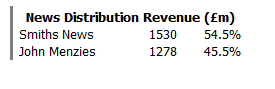 By my reckoning, this is exactly what has happened. Actually, I give myself too much credit with that phrasing - I can see what had happened, and then I fit the story (above) to the facts. I spend too long moaning about data snooping and the problem of people always being retrospectively correct to let myself get away with it! To the right, I've presented the revenue figures for John Menzies and Smiths News, the two biggest news distributors in the UK. To the right of that is the % of the total revenue for both of them - so add up the two figures, and divide by the original figure for each company.
Now, of course, on its own this doesn't tell us anything - so Smiths News has a 55% share of the market if we just look at these two companies. There could be hundreds of other companies out there! Here's the rub - John Menzies say they've got 'c45% of all UK news print daily'. Smiths News say they're the largest newspaper and magazine wholesaler in the UK. Now, I'm always wary when comparing statistics over whether the statistics are truly comparable; but in this case I think the picture being painted is fairly striking. By way of tying it together, we can put in a quick Google and see if we can find more. Sure enough:
The Association of Newspaper and Magazine Wholesalers (ANMW) is a trade association representing over 99% of wholesalers of newspapers and magazines in the United Kingdom.
The membership consists of the two multiple companies - Smiths News and Menzies Distribution, which between them account for 97% and 86% of the magazine & newspaper markets respectively and five Independent News Wholesalers.
Bingo. Smiths News and Menzies basically own the market.
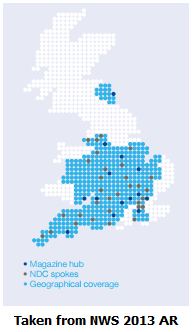
One last note before I wrap up this introductory post - take a quick look at the figure to the right, taken from Smiths News's 2013 Annual Report. It shows their operating set-up, with each of the dark blue dots representing regional 'hubs', the grey dots smaller 'spokes' and the light blue figures their geographic coverage. I've said there are two major national players, but I've also said there are economies of scale in there only being one player in an area. How do I reconcile these facts? My guess is that the two groups divvy up the workload, for the most part. John Menzies is a Scottish business, after all. This isn't to say there isn't no overlap - that would be ludicrous - but given that Smiths News don't even compete in the north of the country (apart from the lump which looks Newcastle-ish?), there must be some segregation going on.
That's why I think Smiths News is worth a look, then; I think these are interesting economics. They're likely to have dominant regional shares, which leaves their customers with little recourse to go elsewhere; and even where John Menzies do compete, oligopolies aren't exactly the most punishing of competitive environments, to put it carefully. Sure, newspapers and magazines circulations are declining, but the competitive structure should provide some insulation to the effects of that.
At the same time, I've talked about the scale economies here. Where are the scale economies if the business is going downhill?
I'll take a look at that - and more of the financials - tomorrow.
Disclaimer
This is not financial advice. Our content is intended to be used and must be used for information and education purposes only. Please read our disclaimer and terms and conditions to understand our obligations.
No comments yet
No one has commented here yet! Why not be the first one?