Somero: Big Income from a Small Cap

In my last article, I developed a Stock Screen to find a wide range of income stocks that could be used to build a diversified income portfolio. Many of the companies from that screen are too large for an individual investor to be able to gain an analytical advantage over the market. Instead, investors in these companies are obtaining a behavioural advantage by thinking longer term than the average market participant. However, smaller companies are often overlooked by the market and allow both a behavioural and an analytical advantage to be gained. This week I take a look at one of the smaller companies from the income screen: Somero Enterprises (LON:SOM)
Somero is a manufacturer of laser concrete screed machines. These are used by concrete contractors to ensure that concrete surfaces, typically flooring spaces, are flat. This is particularly important for warehousing, where the flatness of the floor determines how high racking can be built and, therefore, the storage capacity of the shed.
Although the main selling point of the machines is the flatness tolerance, they also provide labour savings compared to manual concrete screeding with boards. The machine was developed by a concrete contractor, Dave Somero, in the mid-80s, who ended up with a massive amount of rework on a floor that didn’t meet his client’s specifications. He had to manually grind the concrete floor - a laborious and time-consuming job. Vowing never to have to do this again, he invented the laser screed and set up Somero Enterprises with his brother Paul to manufacture and market their idea. In 1987 they were awarded a patent for their invention. It wasn’t all easy in the early days, as Dave described in a 2013 interview:
Coming up with new ideas was easy, getting a patent wasn’t bad. Getting the prototype built and the engineering for the improved telescoping model cost about $500,000. All that was doable. But the one thing I was not prepared for was the marketing.
We had an awful time getting a contractor to buy a machine. We bought a twin-engine plane and offered free rides to New England to watch the screed work. We only had one taker, and I don’t know if he ever did buy one. We tried discounting, but that still didn’t help. Finally, we sold a machine to a contractor in England. Then two went to Canada. Finally, they started to sell in the United States. Then we went into a recession, but we had enough paid-for inventory to carry us through. In the 1990s, it took off.
In 1997, Private Equity fund Summit Partners invested in Somero and brought in a new management team led by the current CEO Jack Cooney. The Dover Corporation then purchased Somero Enterprises in 1999 and owned the business until it was acquired by another Private Equity house, Gores Group, in August 2005. Gores then listed the company on AIM in 2006. Despite being a US headquartered company with US manufacturing, Gores felt that Somero wouldn’t fit well on the NASDAQ due to its size, hence its arrival on the UK AIM.
Today Somero’s Global Headquarters and Training Facility, and the home of the Somero Concrete Institute is located in Fort Myers, Florida, while the Company’s Operations and Support Center is located in Houghton, Michigan. Jack Cooney is now 73, and with former CFO John Yuncza being recently promoted to President of the company, I think it is safe to assume that he is being groomed to take on the CEO role when Mr Cooney decides it is the right time to hand over the reins. Mr Yuncza is 49, so we can expect another period of stable experienced management.
[As an aside, this history helps settle how the Somero name should be pronounced. Dave Somero pronounced his surname som-err-oh, so this is how the company name is pronounced, not sum-air-oh, as some mistakenly do.]
It has not been all plain sailing for Somero. Prior to their listing, their Private Equity owners saddled them with $19m of debt. That sounds relatively modest compared to their current business, but at the time, it was significant. Although they managed to pay the debt down somewhat, when non-residential construction ground to a halt due to the Great Financial Crisis, the company’s profits collapsed and led to them requiring a $5m emergency fundraise in 2009. Interestingly, despite facing weak markets themselves, their US customers were phoning Somero and offering to lend them money to keep them going if needed. The concrete contractors who had adopted Somero’s machines had made so much money from them that they were willing to do everything possible to keep the company afloat. In the end, this customer support was not needed, but the experience of this period means that Somero now always keeps enough cash on hand to ensure they will not be at the mercy of banks or equity markets in the next major downturn.
Growth
Since the wobble in the GFC, Somero has gone from strength to strength, with sales growing from $21m in 2010 to $133m in 2021. Since returning to profitability in 2012, operating profits have grown at an average rate of 47% per annum. Quite some achievement, even if it is set in a period of strong economic growth.
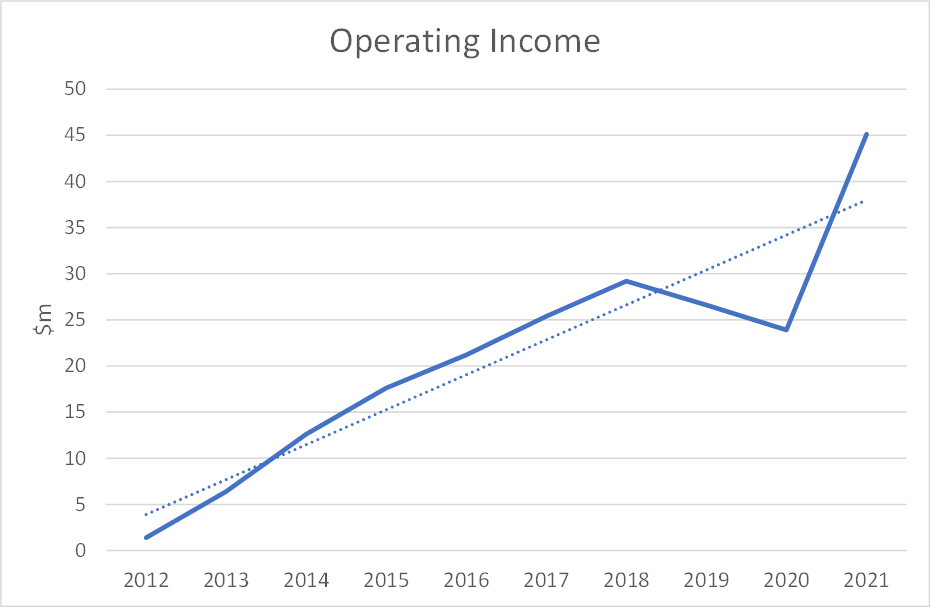
Although, it is worth noting that this growth appears to be more linear than exponential.
Products
Their main products are boomed screeds and ride-on screeds. The boomed screeds allow large areas of concrete to be levelled from a fixed position. Their latest release is the S- PS50 has a 50-foot four-stage boom:

Ride-on screeds enable smaller areas to be levelled where access and manoeuvrability are key considerations:

They also have several smaller hand-operated screeds, and machines that aid materials placement, such as the Broom + Cure machine:

Recently the company has also developed innovative new products for the high-rise market called SkyScreed and SkyStrip.However, these have yet to gain any significant sales traction yet. Indeed, looking at the breakdown of sales by product we see a very strong bias towards Boom Screeds over the last few years:

While it is good to see the company with such a successful product, this does increase the product concentration risk.
Regions
As well as being mainly a boomed screed story, Somero’s sales are still highly focused on the US:

This is for two main reasons. The first is that this is where their strongest customer relations lie, which is understandable given their long history of supporting the US market. I suspect that they have been prioritising US orders at the expense of some delays in Europe. In their H1 results, they said:
The H1 2022 trading result in Europe was impacted by temporary logistics delays that resulted in shipment of certain orders getting pushed to H2 2022. We anticipate improved trading in Europe in H2 2022 as these temporary delays are resolved and with the solid activity and interest levels expected to continue.
The second reason is that there exist some technical and cultural differences between the US and Europe. Earlier this year, I attended the UK Concrete Show and I got to meet Somero’s Innovation VP. He was over in the UK, looking at how their products could be adapted to be more relevant to European markets. Factors such as Laser Screeds fitting on standard European trailer sizes, and therefore not requiring specialist transportation to job sites are particularly important over here. There was also work ongoing to make the promotional materials more suited to a European audience since it was recognised that the American style isn’t always a hit on this side of the Atlantic.
The company did attempt to sell products in China. However, this has largely been unsuccessful. The demand for high-quality flat flooring and labour saving that makes Somero a success elsewhere don’t seem to exist in this market. In the last Interim Results, the company said:
China reported H1 2022 revenues of US$ 0.4m (H1 2021: US$ 1.7m), down from the prior year period as expected due to the previously announced downsizing of our local China team, severe COVID-19 restrictions put in place by the Chinese government that drastically limited activity across broad sections of the country, and to the negative impact of a worsening environment for multi-national firms investing in China-based building projects.
Leaving this market to focus where they are seeing much stronger potential makes sense.
StockRanks
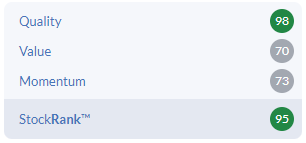
The StockRank for Somero is an impressive 95 with the standout being the Quality Rank of 98:
Quality
Somero has an exceptionally high gross margin for an equipment manufacturer. Even in the dark days of 2009-2011 when sales struggled after the Great Financial Crisis, their Gross Margin didn’t drop below 45%:

This gives them an exceptional Return on Capital Employed. Even with the company holding significant net cash for safety they have a very high Return on Equity. However, there are a couple of quirks to consider with this high return on capital. The first is that a period of high exceptional profits may flatter this figure. In this case, there has been remarkable consistency:

Net fixed assets and working capital have grown with the growth in turnover:


So the current ROCE may be at the upper end of the range, however, their full-cycle average will still be significantly above their cost of capital.
The second quirk to be aware of is that Somero capitalises very little of their innovation and product development spend. Their intangible assets, excluding goodwill, are just $1.3m. This means that their balance sheet doesn’t reflect the real value of all of their product development costs over the years. If a company expensed large amounts of historical development costs to launch new products and then reduced this expenditure, this would flatter near-term profits and return on capital. In Somero’s case, this is unlikely to be an issue. If anything, the rate of their innovation and new product launches has accelerated recently. However, it is something to be aware of if they slow their investment into product development in the future.
A company with such a high consistent return on capital will typically have a strong competitive advantage, also known as a moat. This prevents competitors from simply copying the company’s products and under-cutting them on margins. Although the company owns several patents for its technology, the main patents for Laser Screeds have long expired. Given this situation, Somero regularly gets asked about competition. Here is what Jack Cooney had to say in a 2016 interview with Paul Scott:
We had our first competitor in 1989, he was a Somero customer out of Holland, and basically, anybody can reverse engineer our equipment, any mechanical piece of equipment. And we still have competitors today, and we anticipate that we will always have competitors.
The difference that we have seen is that when a competitor copies a piece of equipment, he thinks of himself as an equipment manufacturer. So he copies a piece of equipment, puts it in his product line, and sends it out in his brochure. For us, we are much more than just an equipment company, because what we do is we provide a piece of equipment to our customer, but we also supply the education, the training, and the ongoing technical support to make his business highly successful. Because our customer only does concrete floors, that is his whole business, and that is our only business. So it is up to us to not only just sell him a piece of equipment, but to make sure he uses it so that he can meet the specifications, the flatness specifications, that building owners want, and to be a highly successful business. And that is what separates us from the other people who are just making machines. What also goes along with the technical support is that since we sell in 95 countries/93 countries around the world, we have 24/7 phone support. And in that period of time, we will guarantee that you will get a certified engineer on the phone in ten minutes, and we have a translation system built into our phone system, so we can talk to people in 65 different languages. That is not something that any of our competitors have.
While Somero may have one of the most extensive training and support programs, I don’t think this is the full story. Their competitors certainly do provide 24-hour support lines and training programs. Where I think Somero’s moat lies is that they are the market leader in an industry where making a mistake is very costly. Their customers will happily pay a premium to know that the job they are contracted to do will be done correctly without issues. It is the concrete industry’s equivalent of “nobody ever got fired for buying from IBM”. With experienced contractors and skilled labour in short supply, the familiarity of operating known machinery can’t be discounted as another reason customers are happy to pay more for the safety of a Somero product.
I saw evidence of this at the UK Concrete Show. The Somero stand wasn’t the flashiest or the most prominent, but while competitors were very active in talking to everyone who passed, it was the Somero team that I saw complete a sale on their stand with minimal effort. In many ways, the product and the strength of the Somero name sell themselves.
Innovation
The other key to maintaining a moat is to drive further innovation in the industry. Having talked to their Innovation VP at length, I was impressed with their approach. All their new products are developed in partnership with key customers or universities so that they get innovative products that either directly meet a customer's need or make big leaps in technology. Each new product has a design lead who sees the project from the idea through to launch. Customers who help develop a new product get a lifetime discount on that product.
The most recent innovations have been in the area of high-rise buildings with SkyScreed, a laser screed for the floors of multi-floor buildings, and SkyStrip which allows the safe removal of plywood boards used in concrete formwork. Much like the original laser screed machines, these have been slow to be adopted by the industry and many demonstrations are required for buyers to get comfortable with the technology. The company has also recently changed its sales strategy. Previously the sales teams sold both the original Laser Screeds and the high-rise products. However, a salesforce with a large commission element is clearly incentivised to spend time selling where they make the sales that require the least amount of effort i.e. to their existing industry contacts. A separate salesforce for SkyScreed and SkyStrip has been established. I don’t see why these products should not be as successful as the original machines, given sufficient time for operators to see the benefits.
Where Somero may be a little behind competitors is in the development of electrically powered ride-on screeds. Others have been first-to-market with these. Somero claims that the demand for these isn't currently high and that they will respond to that demand when it arrives. However, this may be a function of their US focus, a market that may be slower to adopt such technology. The lack of these available for the European market may be a current product gap.
Value
Somero has a value rank of 70. Its high Price to Book Value and higher than the market average Price to Sales means that this doesn’t score more highly:

However, this is a function of the company's high gross margin and high return on capital employed. The Price to Free Cashflow is impressive, as is the dividend yield, which is why the company qualifies for my income screen. Somero has a policy of paying out a growing regular dividend, and then any extra cash above a level that the board has determined provides an adequate level of safety for the business to survive any severe recession, gets returned as an extra final dividend. On some level this is disappointing; with such a high Return on Capital, it would be great if the company could invest incremental capital into similar opportunities and generate even faster growth in earnings. However, with the lack of such opportunities, returning excess capital to shareholders is definitely the next best thing.
I think timing issues and the "extra dividend" may be confusing the Stockopedia algorithms since the TTM dividend payout is actually USD52c not the USD32c that the StockReport has, making this an even better yield than shown. The broker's consensus for FY23 is for a payout of USD49c making an 11% forward yield, although this will depend on future trading performance and the excess capital they have at the time. The company does conduct a share buyback but the intention of this is to offset share dilution from options grants rather than to reduce the share count or return capital this way. Given the low valuation, this is perhaps a little disappointing but the company has said that major shareholders have indicated a strong preference for dividends One quirk of being a US company is that the dividends are subject to US withholding tax. However, those who hold the company in their SIPP and fill in a form with their broker should be able to receive the payout without this tax deducted.
Momentum
With the share price 35% off the 52-week high, the price momentum is not particularly strong:

However, the earnings momentum means that the overall momentum rank is 73. Considering this is a stock that met the criteria for a value and income screen this is surprisingly good.
Outlook
In their last result the company gave the following outlook guidance:
We maintain a positive outlook for the remainder of 2022 and anticipate delivering strong revenues, profits, and cash flows to shareholders for the year. We recognize risks associated with supply chain shortages that could slow our ability to fulfill customer orders and the pace of customers' work on their healthy backlog of projects.
One of the challenges that the construction industry has faced this year is actually getting a supply of concrete to pour. This has led to a slowing pace of work on the backlog of projects in the industry and therefore lower equipment usage. The good news is that the overall level of demand remains the same and simply gets pushed out further. This reduces the peak demand for Somero’s equipment but potentially extends it over a longer time period.
Despite the weak economic outlook in many areas, the labour market remains tight, particularly for skilled construction labour. The ability of Somero machines to allow large labour savings for a concrete contractor and improve safety is a strong selling point in the current market.
Risks
Given that the company’s recent strong performance has largely been driven by demand for Boomed Screeds in the US, any weakness in this market will have a large impact. There is no getting around the fact that construction is a cyclical business and this remains the biggest risk to Somero’s business.
Over recent years, there has been a structural demand for automated warehousing to meet increased e-commerce trends and Somero has benefitted from these. There is a risk that this market is now oversupplied. For example, the market leader, Amazon, fell recently on lowered Q4 market guidance. A cyclical downturn plus secular trends weakening could have a severe impact on Somero’s sales if these occur in tandem. Offsetting these concerns is a general lack of skilled labour to meet demand in the construction industry. This should be a positive for Somero’s equipment which significantly improves both productivity and safety.
Another risk is that the company’s headquarters and training facility is in Fort Myers in Florida, an area which was recently hit by flooding following Hurricane Ian. The company issued an update to confirm that there was no damage to their facility or operations. However, being in a hurricane zone is a future risk.
Conclusion
Somero is undoubtedly a quality company and one that pays a decent income, currently with a forecast yield of 11% for 2023. The exact amount may be subject to some uncertainty because their policy is to pay a regular dividend and then top it up with special dividends when they have excess capital. However, even the regular payout provides a healthy yield.
At some point, there will be a downturn in the construction industry which will negatively impact Somero’s sales. However, the company’s cost base is also very flexible and the impact on profitability can be mitigated. Their current forward Price-Earnings Ratio of just 7.2 reflects the market’s belief that we are at the top of the cycle and Somero’s earnings will fall significantly from here. However, there are reasons to doubt the severity of the falls being anticipated. New innovative products being marketed, the possibility for their non-US business to return to growth, and the demand for extra productivity in the construction industry to offset labour shortages, are just some of the reasons that any downturn may prove more short-lived than the market is currently pricing. In the meantime, investors are getting a healthy income. The presence of a highly variable cost base and a rock-solid balance sheet means that the company should survive even the deepest of construction recessions.
Next week I will introduce a new stock screen, looking for companies that have the potential to generate very high returns for investors.
[Disclosure: Mark owns shares in Somero Enterprises (LON:SOM) ]
Disclaimer
This is not financial advice. Our content is intended to be used and must be used for information and education purposes only. Please read our disclaimer and terms and conditions to understand our obligations.
16 comments
Somero Enterprises (LON:SOM) (no position)
Somero Enterprises (LON:SOM) specifically mentioned in their last call a concern around cement shortages.
Some might be interested in the extract below, specific to the USA, which was published today by Buzzi Unicem, an Italian company, which produces cement, ready-mix concrete, and construction aggregates.
"...our cement sales, after the progress recorded in the first half, marginally contracted during the third quarter, mainly due to some production problems at the Festus (Missouri) plant and, in September, to the logistical problems caused by the low water level of the Mississippi River.
In the first nine months of 2022, therefore, the cement volumes sold recorded a level in line with that of the previous year.
These trends also affected the production of ready-mix concrete, which closed with an unfavorable sign also in the third quarter, still penalized by the shortage of drivers.
In general, difficulties remain with regard to the human resources management, such as high turnover, shortage of staff and wage increases..."
Thank You Mark for a very comprehensive detailed report on Somero, I got out in the Spring but keen to get back in again so monitoring the firm and USA construction sector regularly.
Somero is the best example of why I am an enthusiastic consumer of Stockopedia's wares. Without the analytical tools provided by the site, I never would have discovered this company. Since first investing several years ago, I have progressively increased my holding until Somero has become a major element of my portfolio. Management's outstanding web presentations are my ongoing sources of updates which give credible life to the figures. Now, comes Mark's article, a superb complement to my perception of the company. Many thanks, I will keep it and reread it.
One question for Marc, if he reads this. In addition to all the positive factors which lead me to maintain my commitment to Somero, I am persuaded that there is an unspoken possibilty that the company may one day be the object of a takeover by a big equipment manufacturer seeking to diversify it's offerings. Do you, Mark, have any opinion on this subject?
Hi dmcarver,
I certainly think it is a possibility. That they have been owned by two Private Equity companies and one global equipment manufacturer in the past means that there is clearly something about them that is attractive to these sorts of buyers. Not least because such a buyer could take all the cash out and secure debt against the business, as long as they were willing to support the company in any downturn.
I asked the company if they had a bid defence strategy on the recent PI World results call. Their answer was that they agreed that the valuation is low, but they haven't discussed bid defence as a board and they have not seen any approaches yet.
So, not something that is an immediate concern. And they seem to think a supportive shareholder base is some protection. However, there is no blocking stake, management doesn't hold huge amounts (because none of them are founders despite their long tenure) and I'm not convinced that the institutions wouldn't take a quick 50% premium in the current markets if it was offered.
I suspect any interested parties, if they exist, may be waiting to see if the drop that johnsmith68 expects materialises. Strangely, takeovers don't always arrive when stocks look their cheapest. The same psychological effect where no one wants to look stupid buying before a downturn, even if it is expected and largely in the price, affects corporations as well as individuals. Perhaps even more so for a company where you have to justify your buying decisions to a boss. Whereas individual investors only have to justify it to themselves. In that way, a takeover offer may be more likely after any drop in trading, rather than before, even if any acquirer ends up having to pay more.
I would still like the company to be more active in their bid defence though. A buyback instead of the extra dividend would help take excess stock out of the market and stop small sells on down days having a disproportionate effect on the price.
Mark
Thank you, Mark. Your thoughtful reply exceeded my expectation. Though the stock is going through a rather down period for the moment due to, probably, general market conditions, the cyclical nature of the industry, and, in particular, the exposure to the narrow niche of Internet-serving warehousing, the company's various moats, its more than solid balance sheet, and its dividend policy are elements likely to see it through troubled waters. You point out that the limited trading volume is a confusing feature that might undermine a bid defense (sorry for the American 's'). I'm not sure I see the connection, but that trading volume is definitely a problem for me as it has a significant impact on the spread which makes buying or selling the stock somewhat uncertain. As I hold a fairly large position, I am somewhat of a hostage (though a happy one up until now!). A takeover bid might be an excellent way to capîtalize on one's profits without the penalty of an unfavorable spread. But there's no rush, and let's wait until management's next presentation of results scheduled for this Spring.
Certainly looking forward to your new screen given the quality of your reporting on Somero.
Douglass
A buyback instead of the extra dividend would help take excess stock out of the market and stop small sells on down days having a disproportionate effect on the price.
I’m not sure how this would solve the problem in the medium term though? Buybacks only act to remove shares from the market and make liquidity worse in the medium term. I would hope the management are totally focused on running the business than manipulating the share price. I’ll take a dividend over a buyback every time.
All the best, Si
Thanks Mark for such an insightful article. I've owned Somero Enterprises (LON:SOM) on and off since I started investing seriously around 8 years ago and it's always been a very impressive company but also one that seems prone to a lowly valuation in part due to the cyclical risk, I imagine also due to the market's memory of the GFC impact on Somero and perhaps in some part because of the unusual AIM listing for what is very much a US business.
The lack of an electric ride-on screed also struck me as an unusual blind spot for a company as engaged with the market as Somero and when I listened to a recent management interview, they came across as a little complacent in regard to this but I do accept that they have a far deeper insight into what their end markets are demanding than I do.
FWIW my view is that the latest outlook guidance will be the last really positive one for some time. The continued hiking of interest rates and the European energy crisis will likely have a lagging impact on demand and I won't be surprised to see the share price retracing to the COVID lows of around 200p or less by the middle of next year. In my view that would be the time to back the truck up!
Great article Mark…there’s an awful lot to like about Somero..weather permitting
A fantastic article that for me at least is an exemplar how to perform a comprehensive and relevant analysis. More please.
Fantastic article Mark - I hold and thought I'd done a thorough analysis but your article was great - thanks for sharing.
Me too! I am a long-term holder but you have highlighted things that I had either overlooked or forgotten. Thanks Mark.
This is brilliant. I thought I knew the company quite well but this is fascinating, especially the history of its origin and growth. Thank you!
Great company indeed with dividends, special dividends and share buybacks. Share buybacks could and should have been more though at current price levels.
But the greatest risk is a bad winter (heavy snow) just like 4-5 years ago when the company lost half of its value. Also , the growth in revenues seems limited.
I believe these are the reasons it trades on a such low multiple.
A very interesting article. Thank you.
great work mark i have owned them for a few years and you have told me a few things i did not know so thanks for that. i will be buying some more when the price settles
So when Somero Enterprises (LON:SOM) came out of GFC and was refinanced the installed fleet in the market was quite small. Given the unit growth since 2012 this has very much changed. The rush to build warehouses to satisfy Amazon and co created an extremely tight market. This has shown little sign of slowing so far. I would not underestimate operational gearing and the additional impact larger machines can have. Sales of these fell to zero during GFC. You can drive a pretty big hole in the P&L if this should materialise. The company has grown up and put a defensive balance sheet in place but it won't mean it is immune to the downturn....therefore for me one to look at after the recession, not going into it.