Spring Budget 2024: British ISA provides £5k boost to allowance

This article has been updated to include all the main announcements and analysis following the Chancellor's statement today.
Welcome to our coverage of the Spring Budget.
It’s strange that in a pre-election budget (an election that does not look like it is going to go the way of the incumbent party) the Chancellor does not feel able to be bold.
“Growth” is the tagline of choice for Jeremy Hunt but growth opportunities are thin on the ground in the UK and today’s announcements don’t sound like they are going to do much to stimulate change. Key takeaways for investors are the announcement of a British ISA and a handful of minor tax adjustments which will impact certain sectors. But this was an uninspiring announcement, devoid of any measures that will truly stimulate some much needed excitement in the economy.
Updates from the Office for Budget Responsibility (OBR) have confirmed that inflation has fallen to 4% (from 11% when the Chancellor and Prime Minister took office) and will dip below the target 2% in just a few months time (well ahead of the timeline set out in last year's statement). This should give the markets some hope that interest rate cuts will soon be on the cards, providing some much needed stimulus.
But while Britain’s economy goes through what is described as a very ‘mild’ recession, its economic growth lags behind many of its international peers, as can be seen by the OECD GDP growth chart below. The European Union narrowly avoided entering a recession last quarter (Q4), however, the UK has a lot of work to do if it wishes to catch up to the growth rates seen across the pond.
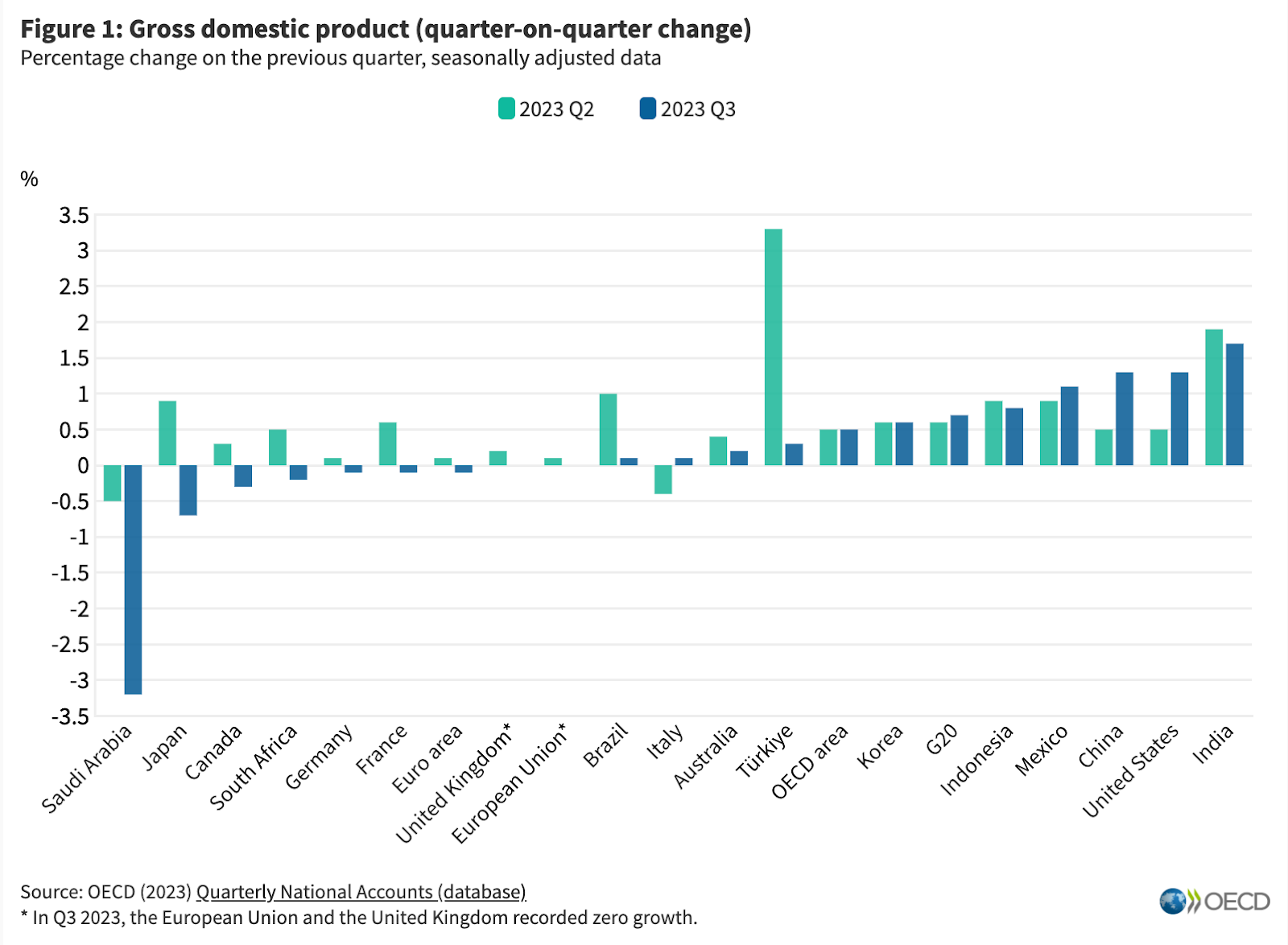
Source: OECD
In this budget, Mr Hunt shied away from any decline in the headline corporate tax rate (a change that many economists suggested could bolster investor sentiment and stimulate investment). Instead, the Chancellor has targeted incentives for investment, including applying full expensing to leased assets - the previous announcement of full expensing has been described (by Mr Hunt) as "the most attractive tax regime in the G7". I am less convinced that it provides more of a growth stimulus than a corporate tax rate cut.
Beyond this minor tweak to expensing and some impressive boasting about the (mainly foreign) companies looking to increase investment in the UK, the budget was largely devoid of any real proposals to stimulate investment. The business recovery loan scheme has a £200m extension to help support SMEs, while he VAT threshold has been increased from £85,000 to £90,000. The latter point probably comes as a bit of a kick in the teeth considering companies like Google are not troubled at all by VAT.
British ISA: Additional allowance for domestic investment
The much anticipated British ISA has now been confirmed, providing private investors with an additional £5k allowance (on top of the annual £20k allowance) for investment exclusively in UK listed stocks.
That sounds a bit more like it. No one wanted a cut to the proportion of the allowance available to invest in international markets at a time when the UK market is in the doldrums.
An additional allowance is sensible. It gives a focus to investors who may have fallen out of love with the domestic market - I for one am already pondering where I could use my additional allowance most effectively.
And it seems I am not the only one. The FTSE 350 has jumped on the announcement from Jeremy Hunt, led by the investment platforms that will be able to facilitate such investment including AJ Bell (LON:AJB) and Hargreaves Lansdown (LON:HL.).
But there is an argument to be made that Mr Hunt should have gone further with his British ISA and rather than simply providing an additional allowance, he should have offered additional tax breaks for investments in domestic shares.
And it’s unlikely that the British ISA will stimulate much more interest in the FTSE or Aim. British investors are uninspired by the domestic markets because of the lack of opportunities available. Providing an additional allowance for investment in these laggards will not fix the problem. Nor will the flotation of additional shares in Natwest (LON:NWG) - an idea first mooted in the Autumn which Mr Hunt confirmed was still on the table.
A bigger stimulus could come from the pensions sector. According to the Chancellor, only 4% of pensions are invested in UK stocks which is very poor, especially compared to other countries. Mr Hunt has now announced that pension funds will be forced to publish details of the geographic breakdown of their investments.
It's unlikely that these measures will do enough to cull the slump in IPO activity in London (which recently reached its lowest point in a decade) and has been underlined by innovative UK-headquartered companies opting to list in the US (Cambridge-based chipmaker, Arm, for example).

Source: S&P Global
No help for housebuilders but reforms for property tax
Recently, The Independent disclosed the government's deliberation on a scheme enabling young individuals to embark on homeownership with a mere 1% deposit. This proposed 99% mortgage initiative surpasses the previous Help to Buy program, which facilitated first-time buyers in acquiring newly built properties with only 5% deposits. This initiative could significantly benefit housebuilders by expanding the pool of potential homebuyers and stimulating demand for new residential developments.
Pressure had also been mounting to reconsider stamp duty policies, especially in England and Northern Ireland, where it applies to properties over £250,000. There are calls to abolish stamp duty for older homeowners downsizing to smaller properties, a move supported by academics from LSE and the University of Sheffield.
But these initiatives failed to materialise. The main property takeaways from the announcement were plans to abolish the ‘multiple dwelling relief’ furnished holiday lettings and a decrease in the higher rate of capital gains tax on the sale of properties from 28% to 24%. The latter point is expected to raise more revenues by increasing the number of transactions.
Tempering expectations: A cautionary approach to tax cuts
The main feature of Mr Hunt’s autumn statement, was a further cut to national insurance, reducing worker contributions from 10% to 8% starting April 6, 2024. According to the latest figures, these cuts have translated to substantial savings, with an average worker on a £35,400 salary saving over £900 annually. And in this statement the NI contribution has been cut again, by another 2% - all part of the Chancellor's plan for lower taxes stimulating higher spending and better growth prospects.
The Office for Budget Responsibility (OBR) forecasts that the national insurance cuts will contribute positively to GDP and GDP per capita, expecting a 0.4% increase in both metrics. Additionally, the personal tax rate is now at its lowest since 1975, positioning the UK lower than all G7 countries in terms of tax burden.
The government's long-term ambition includes ongoing reductions in national insurance contributions, aiming to ensure that work remains financially rewarding and incentivised for individuals across the country.
Additional contributions for the UK creative sector
A range of policy enhancements aim to bolster the UK TV/film industry and cultural sector through strategic financial measures. By doubling studio space, increasing tax credits by 5%, removing the 80% cap on audio/visual effects relief, and introducing new tax credits for independent films, the government seeks to stimulate production and investment.
The additional funding of £26 million for the National Theatre and the permanent 40-45% relief on tourism-related expenses further contribute to sector growth. These initiatives are projected to drive economic expansion, enhance cultural offerings, and solidify the UK's position as a global leader in entertainment and creativity.
A new Vape Levy and Tobacco tax... from October 2026
Mr Hunt has decided to go ahead and make a provision for tax increases on tobacco and vaping products. An excise duty will now be payable on vaping products and one-off increase in tobacco duty will also come into effect, but not until October 2026. This news will have come to the relief of those operating within the sector such as Supreme (LON:SUP), Imperial Brands (LON:IMB) and British American Tobacco (LON:BATS), who may have expected the changes to take place sooner.
Confirmed extension of the EPL Levy until 2029
The windfall tax on the profits of oil and gas companies by Jeremy Hunt will likely continue to affect plenty of companies operating within the North Sea. The proposals will see an extension of the energy profits levy, currently set at 35% and due to expire in March 2028, to March 2029.
This prolonged rate of taxation will amplify the tax burden on North Sea oil and gas producers, already among the highest globally, following the tax hike from 25% to 35% in November 2022. Companies such as Harbour Energy (LON:HBR), Serica Energy (LON:SQZ), Enquest (LON:ENQ), Ithaca Energy (LON:ITH), and Kistos Holdings (LON:KIST) are particularly vulnerable to the extended levy, potentially facing constrained earnings for an additional year for their UK-based assets.
However, the Chancellor did confirm that the EPL levy would indeed be abolished if oil and gas prices ever retreated to more historical norms.
In summary, while the budget statement on March 6th may not have unveiled sweeping tax cuts, Chancellor Hunt's deliberative approach underscores the government's commitment to fiscal prudence and economic stability.
We’ll have to have our fingers crossed for some promising announcements in the future that may provide a much-needed boost to our stock markets. It's been a tough decade for UK markets, as can be seen by the chart below. The upsurge in takeover activity in the country right now further highlights the extent of the undervaluation of UK equities compared to international peers.

Source: MSCI United Kindgom Index Returns (www.msci.com)
Disclaimer
This is not financial advice. Our content is intended to be used and must be used for information and education purposes only. Please read our disclaimer and terms and conditions to understand our obligations.

29 comments
https://assets.publishing.serv... Consultation Document for UK ISA. Confirms that UK ISA in addition to 20k ISA not part of it.
I think VAT threshold was increased from 85k to 90k (not 95k as mentioned in the article)
Hi MetalMaid,
Thanks for pointing this out!
I've now updated this in the article.
Best,
Keelan
Trying not to get political about a political budget..... A budget for growth is a joke and insulting given the harsh treatment of CGT allowances in the recent budgets. What can be more anti growth/ business than Capital Gains Tax. Probably a very clumsy aim at the buy to let brigade (they are probably thinking they should have bought bitcoin the way some of us think we should have bought Nvidia lol).
Had a brief read there is virtually nothing about growth here but given Hunt's record and Truss's calamity this is no surprise.
British Isa, NI cuts. Minor. Still billionaires can squirrel away into pensions courtesy of the previous budget which unless the press remind the voting public of will be conveniently forgotten by most.
Yeah I'm a bit annoyed! Mostly I just sigh and roll my eyes but this time it's different I'm actually annoyed!
Ps. For all that chest beating over Brexit being a good thing masters of our own destiny (decisions now made by geniuses in Westminster) and being 5th largest economy (so they said at the time).... Who would thought the results would have been complications in northern Ireland (ok perhaps that) and something of a boycott (probably not the right word) of uk stock markets by international investors......
And finally if he wants to get more money into the UK markets, 1. Have a word with the FCA and 2. Maybe tell whoever has been selling off the gilts (mid term) - bought in QE days rather than letting them run to expiry.
Spot on the losses taken by the B of E as a result of qt are eye watering but not to worry they are underwritten by the treasury.
The British ISA is not imminent. Responses to this consultation should be sent to HM Treasury by 6th June 2024.
https://assets.publishing.serv...
The British ISA is not imminent. Responses to this consultation should be sent to HM Treasury by 6th June 2024.
- marked for the attention of Rachel Reeves !
British ISA sounds like a half-baked idea which will never be implemented. An extra £5k to the ISA allowance would barely move the dial for UK stocks in my opinion. It is the staggering lack of pension fund investment in UK companies that they ought to address. See below:
Personally not sure if it’s sensible for pension providers to be forced or bribed to hold anything investments wise. Can’t be good for that country if the nations economy tanks and the peeps pensions tank in alignment with everything else as they are all in on domestic companies.
Agree with Rmillaree on this, the mandate of pension funds is to provide returns for fund in order to ensure payments can be made to members in their retirement, not pump liquidity into a moribund domestic stock market.
When the long grass is longer.
Asset managers should benefit from the extra ISA allowance and top of my portfolio risers today are Jupiter Fund Management (LON:JUP) and Liontrust Asset Management (LON:LIO) and Hargreaves Lansdown (LON:HL.) - every little helps! I haven't seen the detail but wonder if it will be a separate wrapper like the Lifetime ISA? (ISA £20k, Lifetime ISA £4k, British ISA £5k?)
I thought that the Lifetime Isa was part of the 20k ISA Allowance?
it does count towards the 20k yearly allowance, yes
This says it all...
Duty on vaping products will not come in until Oct. 26 (following consultation). SP of Supreme (LON:SUP) has sharp rebound.
Hi sharw,
Well noted!
I can see the Supreme (LON:SUP) share price reacting positively to the news. I've made sure to include this in the article now.
Best,
Keelan
British ISA: Additional allowance for domestic investment
strewth wander how much it costs to setup admin and monitor ridiculous ideas like this
Facilities by ADF (LON:ADF) should benefit from the funding for the film industry
Interesting, thank you. It has seen a bit of a jump following the announcement.
Simon French, Chief Economist for Panmure Gordon had some interesting thoughts on Sky News’ If I was Chancellor series (screenshot below). Most interesting to me was the idea of reducing corporation tax to 15%. Discuss…
Hi Simon,
Hope all is well!
This is a really interesting idea. If the UK government wanted to get more serious about restoring our global competitiveness, attracting foreign investment, encouraging domestic innovation, and bolstering our stock markets, reducing corporation taxes to 15% could be among the best routes to get these.
A reduction to 15% would undoubtedly constitute a huge loss of government revenue though. I'm not sure they'd be able to manage this at a time when our debt burden has exceeded 100% of GDP.
Perhaps by adjusting corporation tax to 18%, the government could strike a better balance between stimulating business activity and maintaining a reasonable level of revenue. Additionally, enhancing R&D incentives and offering targeted tax breaks for pivotal growth sectors could help fuel innovation and entrepreneurship, positioning the UK as a dynamic hub for technological advancement (I honestly can't remember the last time we had a big tech IPO).
Moreover, the removal of stamp duty could further facilitate liquidity and investment flow within the economy. I particularly liked Peel Hunt's study in support of this.
Here's to hoping for some promising announcements today.
Best,
Keelan
A reduction to 15% would undoubtedly constitute a huge loss of government revenue though.
I am not 100% convinced that is the case - dont think corp tax is one of the bigger earners and it would help keep multinationals who could be based anywhere here or be located here.
anyway back to 20% would be a start.
At present its a joke that facebook/google/ uber can extract all their earnings overseas paying virtually nothing in coproration tax or vat.
A non vat registered buisness pays uk based company like reach for adverts and 20% vat is paid over. If they pay google or facebook no vat due as they are not deemed to be based in tehn uk ! . crimnal stupidity that they arent levied teh equivalent of 20% vat.
Uber pretended for 7 years they were an overseas app company and not a transport provider (standard rated vat) - they then agreed to register for vat and as soon as they did they are arguing they can use the tour operator scheme and avoid paying vat on most of their income.
Crazy how happy powers that be are for cash to be directly exported overseas with c lose to zero paid to uk coffers. wouldnt surprise me if facebook and google didnt have over 50% of online advertising market nowadays for smaller businesses.
Look at indeed who seem to be clearing up ref job listing and again no uk vat presence
A non vat registered buisness pays uk based company like reach for adverts and 20% vat is paid over. If they pay google or facebook no vat due as they are not deemed to be based in tehn uk ! . crimnal stupidity that they arent levied teh equivalent of 20% vat.
Only true to the extent that such spending doesn't take the UK business over the VAT registration threshold. The vast majority of google/fb ad spend in the UK will be subject to VAT.
Uber pretended for 7 years they were an overseas app company and not a transport provider (standard rated vat) - they then agreed to register for vat and as soon as they did they are arguing they can use the tour operator scheme and avoid paying vat on most of their income.
Not really much different to private hire firms which act as agent for VAT purposes and so don't pay VAT on the fares, only their margin (same as Uber now)
Only true to the extent that such spending doesn't take the UK business over the VAT registration threshold. The vast majority of google/fb ad spend in the UK will be subject to VAT.
there is an awful lot of business peeps not vat registered - factor in exempt companies too - in theory the larger exempt ones should acount for the vat - but onus if on them to have correc t systems in place when often they wont deal in vat otherwise. Facts are though is clealry not a level playing field - should uk based advertising company not expect google facebook to be paying at least the same on all their sales rather than being able to target decent % of self employed uk vat free?
Not really much different to private hire firms which act as agent for VAT purposes and so don't pay VAT on the fares, only their margin (same as Uber now)
the majority of old school taxi firms traditionally paid full vat on their corporate work from my experience - perhaps things have moved on though in that regard. i suspect the subtle difference is whether the services are passed on without material alteration - its not obvious to me whether they would meet the relevant condition or not. The fact they chanced their arm for so long paying no vat when they were clearly a transport provider shows just how aggressive these companies are happy to be - ie they knew they were the wrong side of the line and yet still went ahead on basis that they didnt care. In that regard vat office need to be more proactive IMHO to provide level playing filed and zero oportunity for funds to be extracted to no benefit of the uk economy.
Whatever happens it will be a complete con job.
Reducing ni a bit whilst freezing allowances says all you know about the reality of how these politicians work.
Hey ho there is an election around the corner so chances are that even if they can’t afford to do stuff and shouldn’t do stuff they will do stuff if that is likely to get them votes whatever mr hunt says about fiscal responsibility.
ref corporation tax they have just upped it between 5 and 7.5% from last April - if they are going to reduce corporation tax now why the f are they doing that directly after they have just increased the rate? So even if corp tax comes down it again makes them look like fools for increasing too much less than 12 months ago.
Hi rmillaree,
I would tend to agree with you here. There is always some element of trying to pull the wool over our eyes by shouting about positive contributions in one area, only to silently take away more in another.
Much of the decisions today will likely indeed be short-term focused for political gain. But this can again bring about certain opportunities for those who astutely recognise the nuances and implications hidden within these decisions.
Best,
Keelan
old enough to realise whatever they give they will more than take back on the plus side may be abolish stamp duty on share purchases
Stamp duty on shares is 'a tax on growth', new CPS modelling shows
https://cps.org.uk/media/post/...
My ISA is tax free but I'm taxed almost every time I buy shares!