Stock Brief - Royal Mail (LON:RMG)

As one of the most consistently high-ranked shares on Stockopedia, the Royal Mail turned out to be one of the top performers after the onset of the Covid-19 pandemic. As parcel demand boomed from people stuck at home, so did the company’s share price, which more than quadrupled from the March 2020 lows to the June 2021 highs.
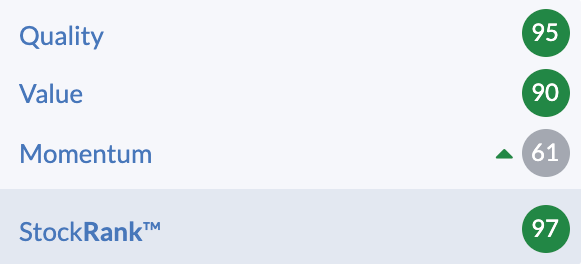
FY2021 was an exceptional year for the company, and generating £620 million in net profits blew away even the company’s own internal expectations. However, the Royal Mail’s share price has taken a breather after the company cited cost pressures in a number of markets. The share price has drifted lower as a result and is currently almost 30% below its 52 week high.
Despite the increase in costs, the company has still guided for a strong H2, with revenue and profit figures expected to be higher than H1 (operating profit estimated at £395 to £400 million in H1).
In an industry facing ever-evolving structural changes, as letter volumes decline and parcel volumes soar, will the Royal Mail continue to deliver?
Profile
What are the company's principal business activities, how does it generate its revenues?
The company’s business activities are split in two: Royal Mail and General Logistics Systems (GLS). Through the Royal Mail, the company collects, sorts and delivers letters and parcels to over 31 million addresses across the UK. It is also the UK’s sole designated Universal Service Provider.
Delivering over 840 million parcels last year, GLS is one of the largest ground-based deferred parcel operators in Europe. Covering over 40 countries, GLS has rapidly expanded its global presence in recent years, particularly in North America.
The Royal Mail accounted for 68% of group revenues last year, with GLS making up the remaining 32%.
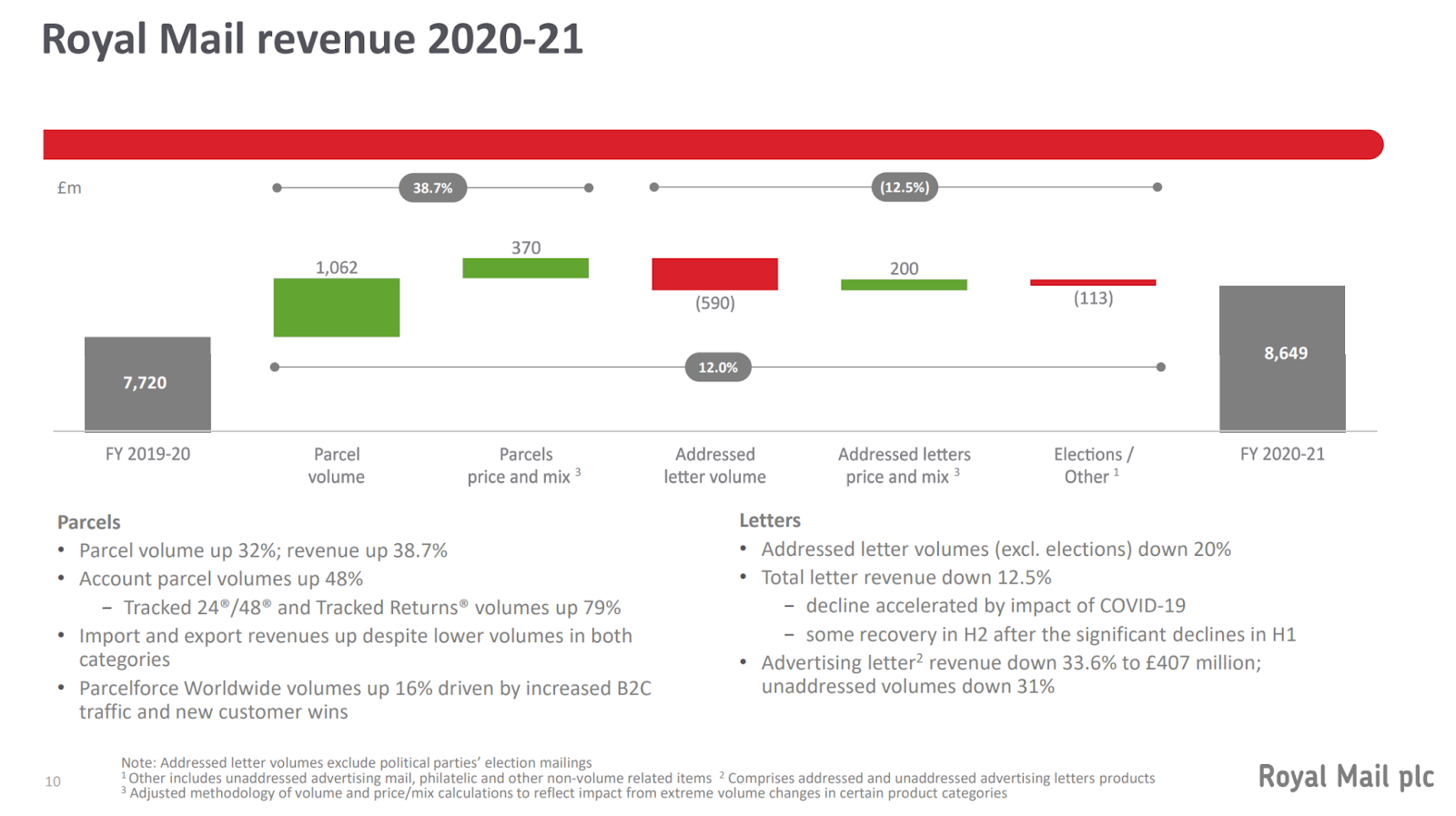
Parcels now represent 72% of group revenue, which was up from 63% in the prior year. This has helped to offset the decline in Royal Mail letter revenues.
Size, Sector & Exchange
At the current share price of 430p, the Royal Mail is worth just over £4.3 billion, giving it large cap status. The company operates in the Industrials sector, as part of the Freight & Logistics Services industry group. The Royal Mail is currently a constituent of the FTSE 100.
Business strategy
Formerly a UK-focused letter business that also delivered parcels, Royal Mail is transforming itself into a parcels-led international business, which still delivers letters in the UK. The company now operates across 41 countries worldwide, and has recently expanded its operations with a major acquisition in Canada.
The company has had to accelerate its strategy in recent years, as the pandemic hastened the speed of growth in parcel volumes. Two new parcel hubs are currently under construction and a fully-automated parcel sorting system will be operational in the Midlands hub in 2023. The Midlands hub will be able to sort over one million parcels a day from this point.
Interestingly, the Royal Mail currently lags behind its industry peers when it comes to the automation of parcels sorting. The company’s percentage of parcels sorted by machine currently stands at 33%, which is notably inferior to the industry benchmark of 90%. Improving automation across the business therefore now forms a key part of the company’s strategy moving forward.
History & Growth
In 2016, the Royal Mail celebrated its 500th birthday. Indeed, the company can trace its origins all the way back to 1516, when Henry VIII established the ‘Master of the Posts’ position. It wasn’t until 1635 that the postage service became available to the public, but it highlights the rich history and importance of the Royal Mail.
Fast forward to 2013 and the Royal Mail was floated on the London Stock Exchange, with the company given a £3.3 billion valuation.
Recent company timeline:

Recent News
GLS Agrees to Acquire Rosenau Transport in Canada - A £210.5 million acquisition carried out by GLS in order to expand its reach in Canada. The acquisition will be funded through existing debt facilities and cash flows, and is expected to be earnings accretive in the current financial year.
Plenty of cost synergies are expected to be realised, and the acquisition will enable GLS to cover the vast majority of the Canadian population, whilst unlocking significant growth opportunities along the US West Coast.
Trading update - Strong revenue growth across the business for the five months to August. Revenues grew 8.2% year on year, and 17.7% compared to the same period in 2019.
Keith Williams, Chair, commented the following: “In Royal Mail, we are increasingly confident that domestic parcels are re-basing at a significantly higher level than pre-COVID and believe we are maintaining our share of the market. Domestic parcel volumes are up around a third compared to pre-COVID. Domestic parcels performance continues to be more robust against ongoing challenges in international. Whilst we continue to expect further normalisation of parcel performance as we unwind from the pandemic and anticipate some upward pressure on costs, both adjusted operating profit and margin are expected to be higher in H2 compared to H1.”
Catalysts
Trends & Events
Royal Mail is undoubtedly one of the biggest beneficiaries of the accelerated transition towards online shopping as a result of the Covid-19 pandemic. Parcel volumes have exploded across the world, and it seems as though this trend is here to stay as more and more people opt for the convenience of home deliveries.
The total value of the courier, express, and parcel market is expected to grow by a staggering USD 141.05 billion from 2021-2025. This is the equivalent to a compound annual growth rate of over 7% during the period. According to research carried out by McKinsey, the parcel market in the U.S. alone is set to double by 2025. Moreover, same-day delivery and instant delivery are expected to account for around one-fifth of the demand.

Source: PR Newswire (Technavio report)
On the 18th November, Royal Mail will report its H1 2021 Interim Results, which could provide a further short-term catalyst for the share price.
Risks
What risks does the business face?
Operational - Efficiency is key to competing in the parcel and letter markets. The Royal Mail’s logistical operations are highly complex, and any inefficiencies or issues can cause huge delays. Not only do these delays prove costly in monetary terms, but can also affect the company’s reputation, which in turn could lead to a loss of customers, market share and revenue.
Macroeconomic/political - As seen with Brexit and the Covid-19 pandemic, external forces can significantly impact upon the running of business operations. In a highly competitive industry, where margins are typically quite low, shocks such as these can quite quickly turn a profitable business into a loss-making one.
Cost pressures - The company has already cited that current labour shortages and inflationary cost pressures are starting to put upwards pressure on costs for the business. Should inflation reach the 5% that has been touted by the Band Of England next year, then profitability could start to be seriously affected.
Summary
Bull points
Dominant player in its market, attractive all round fundamentals, transforming business to boost long-term efficiency, diversifying and expanding into new markets, progressive dividend policy from 21/22
Bear points
At risk from on-going labour shortages and inflationary cost pressures, thin margins based business model, letter volumes continuing to decline, lags behind competitors in terms of automation and innovation
Disclaimer
This is not financial advice. Our content is intended to be used and must be used for information and education purposes only. Please read our disclaimer and terms and conditions to understand our obligations.

14 comments
good writeup and analysis. i bought back in again on the good interims and technicals which show price is sticking above EMA on 8, 21 day time frames
Great results today, I have been a holder of RMG for 3 years. They look like they have been a net winner since pandemic and still look cheap. Div back, strong balance sheet, low debt, growing profit, look to have for now resolved Union disputes and in a growth sector. Main downsides will there be future union disputes (probably) will there be margin pressure as labour costs increase (probably) but still feel there more upside than down, currently.
I love in Sweden abandons have had 2 private parcels sento me in the last year via Royal Mail normal post and none of the, have ever arrived. One made it back to the sender 4 months later. Maybe a brexit problem but not a good green flag for me, though I’m having a punt as a spread bet for the next results.
Royal Mail is worth at least £6bln ent value in this market with the primary tailwind being parcel delivery. A nice 25% gain if you are looking to spread portfolio risk. There are better stocks out there though.
Rm (LON:RM.) looks good value however the competition is increasing and is better. They lost the monopoly with the post office, back in August: https://tamebay.com/2021/08/po...
How will that affect them?
I have parcels delivered by DPD and RM. DPD are a lot more efficient and their tracking system works well, unlike RM's which is useless. DPD has invested a lot in technology.
I had to return an item to Paris because it was faulty, they agreed to pay, I would have sent via DPD but they insisted on RM, cost was £25, DPD was £14. Tracking was completely useless but it did turn after about 1 week.
Major problems in Chelmsford area with deliveries, was on the news the other day, people are not getting post for weeks or just once a week.
Must admit i have had a punt here and it aint going to well as i bought before recent spike down on somewhat dubious broker note (other brokers seem to be much more positive but the market only reacted to the negative note)
When i say punt - i have low conviction that my investemnt here will be a wise one - that probably says everything that needs to be said about my punt type trades - probably best to do the opposite of me :)
"Deferred parcel operator"? English translation please.
Deferred parcels can be put aside to wait for more deferred parcels to arrive until a large delivery vehicle can be filled.
I think Royal Mail (LON:RMG) looks very good value at these levels. GLS by itself probably almost justifies then current market cap, and there has to be a decent likelihood that this will be sold off.
Parcels are clearly a structural growth area, and in the UK they have a strong market position as result of their infrastructure and brand.
The share price has dropped quite a bit recently, mainly due to concerns over rising costs, especially labour. But ultimately I think they should be well placed and able to pass these on through higher parcel prices. If we do see an ongoing shortage of labour, their lower cost peers (Amazon, Hermes, etc) will probably find it more difficult to get hold of staff - the majority of RM staff are on permanent (and fairly generous) contracts, so retention should be better than average.
There is also potentially a lot of low hanging fruit which could lead to quite significant productivity gains - I'm thinking mainly of the moves towards greater automation as the new distribution centres are rolled out.
The decision not to replace the group CEO, when Rico Back left, I think backs up your point that GLS and Royal Mail could well be separated. There is only a Group Chair and a group Finance Director. I think they will probably want to see a year or so of “post-pandemic” trading to just verify that each business can stand alone financially. I see such a potential break-up as the main medium-term catalyst.
possible exit from fste100 in December?!
And your conclusion is..?
I understand there's a countervalent risk case, but how might you express that for example on the basis of 60/40.
Bought in after recent pronounced retrace, and was interested to see JP Morgan very recently set a tp of c. £8 on basis of doubling the PE. Your analysis of the automation issue and outlining of the Canadian expansion story is therefore very helpful in setting out the context.
Look more good than bad to me, particularly if it can make itself to attractive to growth with income seekers.
JP Morgan set a price target of 804p last week. I hold.
This could encourage unwary buyers while institutions off-load. i do hold, and hold, and hope for the best.
Silver