Stock in Focus: Can momentum be maintained at Burford Capital?

Litigation financing specialist Burford Capital has been one of the most successful stock market performers of recent times. The AIM-listed firm’s share price has risen by about 1,200% in just four years. It now commands a market cap that would place it near the top of the FTSE 250.
However, Stockopedia’s algorithms have recently flagged up this stock as a potential Momentum Trap, a losing style that suggests valuation has risen far ahead of fundamentals.
There are no new stocks to add to my SIF fund this week, so instead I’ve decided to take a closer look at Burford Capital’s performance to date. I’ll be asking whether now might be a good time to take profits -- or whether this is actually the kind of stock I should be buying.
Litigation finance is hot
There seems to be no limit to the current market appetite for litigation finance. Investors seem happy to provide increasing amounts of money to firms such as Burford Capital, in the hope that its legal expertise and skilled due diligence will result in a profitable settlement in a few years’ time.
Burford remains the standout success on the UK market, but it’s growth has triggered a string of me-too flotations on AIM over the last year:
Manolete Partners (LON:MANO) - specialises in insolvency cases, which are said to be quicker to resolve than some other types
Rosenblatt (LON:RBGP) - this established law firm plans to use IPO proceeds to seed a new litigation finance division
Litigation Capital Management (LON:LIT) - an Australian firm that listed in December 2018
A fourth firm, Vannin Capital, planned to float in October 2018 but cancelled its IPO due to market volatility
It’s too soon to judge the track records of these recent arrivals. But Burford has been listed since 2009 and now commands a £3.9bn market cap. I think we should be able to learn something interesting from its numbers.
How are profits calculated?
Burford’s annual profits are based largely on estimates of the likely outcome of the legal cases in which it has invested. IFRS accounting rules specify that litigation financiers can book non-cash gains on cases, based on an independent review of the likelihood of success and the potential value of any settlement.
The problem is that these cases often take many years to resolve. So while money floods into firms like Burford, we have little real idea of how consistent and sustainable its track record of wins will be.
The company’s 2017 annual report shows that it still has investments ongoing from 2010, although the average length of a case is said to be about two years. The report also shows that the amount committed to investments each year has risen from $11.5m in 2009 to $697.8m in 2017.
Despite this incredible rate of growth, the supply of potential cases appears to be almost unlimited. The company says that in 2017, its selection process resulted in 59 closed investments from 1,561 initial approaches.
The class of the field?
At the end of 2017, the company said that since 2009, it had delivered a 75% return on invested capital on investments of $442.8m.
It seems fair to assume that the company has some fine legal brains on its team, as well as good accountants. But it’s worth noting that these impressive returns could be adversely affected if the returns from the firm’s ongoing investments -- which totalled $628.8m at the end of 2017 -- don’t match previous results.
It’s also worth remembering that this business is a black box for most investors. Although I think Burford makes a good effort to be as transparent as possible, there is no way for most investors to assess the likely outcome of litigation cases, however much information might be available.
Since its flotation in 2009, Burford has expanded rapidly to take advantage of what appears to be strong demand. This has meant that despite rising cash receipts, new investments made each year have consistently exceeded the return from concluded cases. That’s understandable, but it’s not without risk, in my view.
Cash vs profits
As a fairly conservative investor, I feel that the ultimate measure of success for Burford will be that it returns more cash to investors than it invests each year.
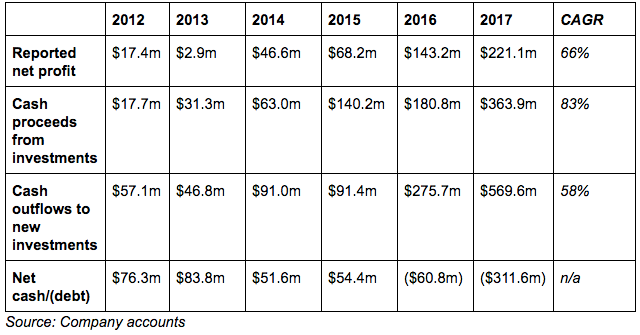
How close is Burford to reaching this point? I’ve taken a look at the firm’s accounts to find out more:
2018: During H1, Burford reported $342.6m of cash proceeds from investments and committed $540.3m of new funding.
In H2, Burford has secured $1.6bn of committed funding, of which it will provide $633m. The company will benefit from what appear to me to be generous management fees and profit share arrangements on the capital provided by external investors.
My view: There are no obvious red flags here. Burford’s cash receipts have grown faster than its reported profits, which suggests the company has made some good investments so far. Debt levels look fine so far. 2017 net debt was less than one year’s cash inflows.
The shift towards external funding means that outside investors will get a growing share of the group’s profits. I’d guess that it may also reduce Burford’s funding obligations and slow the increase in debt. Eventually, perhaps we will see the firm’s accounts start to represent those of a fund manager.
Principal investing: One area that I think is worth watching is the group’s expansion into “principal investing”. This is where Burford takes a position in an asset that will be involved in a litigation claim. In 2017, $500m was raised to pursue this strategy.
An example given by the firm is that it might buy distressed bonds in a corporate fraud case, and then take part in litigation against the perpetrator of the fraud.
Management say that principal investing will allow Burford to “exercise more control over litigation outcomes than we are permitted to exercise as a financier”. With my sceptical hat on, I would suggest that principal investing might also function as a kind of leverage. When successful, it could amplify the returns that might be received from financing. Of course, in unsuccessful cases, the opposite might apply.
Are the StockRanks right?
Stockopedia’s algorithms respect the firm’s consistent strong growth, but Burford scores poorly elsewhere:
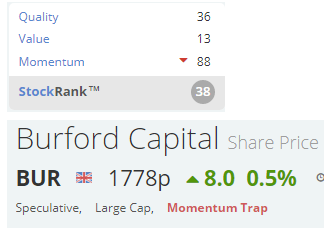
Are the StockRanks right? Looked at in purely financial terms, Burford is a business with fast-rising profits:

Very high profit margins and returns on equity:
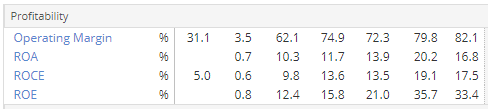
But negative cash flows and rising debt:

Looked at in these terms, the firm sounds pretty dubious! However, I don’t think this is a fair way to characterise this business. Burford does appear to be a significant and successful player in a growing part of the legal sector.
There are two risks that would stop me investing. The first is that the black box nature of the business appears to make it impossible for investors to form an informed judgement. The second is that the group’s aggressive growth poses an additional risk (in my opinion) and prevents it generating any free cash flow.
Overall, I think the StockRanks are giving us a balanced view of the current situation.
Although I would agree that the stock’s rolling forecast P/E of 16 and 0.6% yield actually seems quite reasonable for a growth stock, I think the stock’s valuation might be better measured relative to its balance sheet.
The H1 2018 balance sheet shows investments valued at $1.2bn and a net asset value of nearly $1bn. Burford’s market cap of £3.9bn values the equity at more than five times this book value.
When combined with the shift towards external financing, I think this valuation could come under pressure. The situation is too speculative for me personally.
Disclaimer
This is not financial advice. Our content is intended to be used and must be used for information and education purposes only. Please read our disclaimer and terms and conditions to understand our obligations.

24 comments
With hindsight in August, this has proved to be an excellent, measured and insightful analysis Roland.
Well done.
I think it's about time that Stocko committed to a date for the next major update which may or may not include such a feature.
Burford Capital (LON:BUR) also deserve to be commended for writing annual reports that are both informative and interesting. It isn't easy to understand exactly what they do but I take great comfort from 2 aspects in particular:
1) In the last AR they explicitly refer to Tienver and Petersen, their two biggest cases, and say that it would be a mistake to look at those cases as exceptional, because the entire nature of their business is that there is always the possibility of getting outsize gains;
2) They provide clear information on the time between an investment being made and (on average) a return being received. This is (from memory) around 2 years, and it was around 2.5-3 years ago that there was a significant ramp up in the investments BUR made. That being the case, it is reasonable to expect that the results start showing the effect of that ramp up. So my personal view is that we are in the foothills of a period of exponential growth that could last for several years, and which has also been accelerated by the acquisition of GK, the placing and the involvement of the SW fund.
I think many people who invest in Burford Capital (LON:BUR) do so as a leap of faith. I held off from £1.80 to £7.50 before investing. I hope there will be others who hold off from £18 to £75 before making the leap!
I agree about the quality of the formal reporting from BUR. The annual report is written to be understood by shareholders not financial experts. I have rarely come across such a clear and easily understood explanation of a complex business.
I have held Burford shares for several years and added as I gained more confidence in management and future prospects. It is by now the largest component in my portfolio and keenly watched for clues as to how the vompany is performing. That’s where most people have an issue because no one is able to provide a credible forecast. The nature of the business is such that outcomes remain uncertain until resolved. Even management decline to forecast financial outcomes. Why then invest?
My reason to remain invested is that BUR has a more than decent track record of backing legal disputes that resolve in their favour. They are highly selective, not simply chasing volume at low margin. That remains key despite increasing levels of funding. It is clear that there is a significant and growing unfulfilled demand for additional funding of legal disputes and the attendant consequences, eg asset recovery post case judgement.
As Donald Pond says, there is a time lag between a given investment and its outcome. Ramping up the amount invested can reasonably be expected to produce a ramping up of profits unless BUR lose their ability to put money into winnable propositions. The recent trend away from single case finance reduces the risk of failure but may reduce the profit margin. That seems to me to be worthwhile given the growth in the amount of finance available for investment.
So it all comes down to the question, “ do you trust BUR to invest wisely?” and do you see the recent increase in the availability of additional funds continuing for years to come?
This thread is, in my opinion, a golden example of the strengths of Stockopedia and the community of investors who contribute to it. Thoughtful, insightful and well considered contributions bound into a civilised, polite and friendly discussion. What a delightful demonstration of the potential of social media (if I can label Stockopedia in that fashion) and a sharp contrast with the other sites where "investors" behave like gladiators. Unfortunately for me, most of the stocks I invest in and follow, attract little if any interest here so I am compelled to frequent the ADVFN bear pit. Some ADVFN threads (Hurricane Energy for example) are well populated by decent contributors but are also peppered with cranks and hooligans, whilst others serve as assembly points for the emotionally disturbed.
So thank you to everyone on this and other Stockopedia threads. I look forward to permanent relocation in the fullness of time.
tournesol - I concur entirely.
A light comment about the hooligans, cranks and mentally deranged who populate the ADVFN threads.
I wouldn't say they are totally a waste of space. I often go there to find light entertainment and a laugh or two. Just like a visit to the zoo. Very therapeutic.
Tournesol,
Yes I agree with you comments concerning the combined wisdom of the Stocko community - Long may it last.
I looked back at my Burford Capital (LON:BUR) notes and much to my pleasant surprise my 1st purchase was in October 2015 at 186p. Since then I bought and sold along the way and together with Bioventix they have been my best performing shares. I recall one of the brokers referring to acquisition by Burford Capital (LON:BUR) of Gerchen Keller Capital in late 2016 for $160 million as, "A Gorilla is Born" and so it has turned out to be. Great company not to be underestimated. Ian
Thank you Roland for an interesting article on Burford.
Burford is my largest and most profitable position in 15 years of investing.
I started building my position in Burford in March 2017 at 834p.
Stockopedia gives Burford an Operating Margin of 82%.
In 2017 Burford received 1,561 enquiries but only took on 59 cases.
Make no mistake this is a very professional firm who are No. 1 in their field.
For years Burford have surprised the market and I see this as a long term investment with potential to achieve an SP of £30.
On the few occasions I have contacted the Company I have received a speedy and professional response.
On Price to NAV Hardman & Co project 3.2x by 2020.
"As a fairly conservative investor, I feel that the ultimate measure of success for Burford will be that it returns more cash to investors than it invests each year."
That's why Berkshire Hathaway has always been such a crap investment. I mean, on paper it's made a ridiculous amount of money over the years and generated bucket loads of cash, but when you hold it to the same reporting requirements as Burford, where proceeds from investments and new investments are included in operating cash flow and not separated out into 'cash flows from investing activities', poor old Uncle Warren is caught swimming without his speedos on when the tide goes out. Just like Burford, BRK apparently has an insatiable need for capital, and the naïve suckers who put their dough into the company decades ago have yet to see a single dime in cash from their 'investment'.
Luckily for Warren, Stockopedia's algorithms give Berkshire a free pass on the cash flow calcs, otherwise it too would likely have been classified as a Momentum Trap for most of its existence.
Hi Roland.
You said Burford had "recently" appeared as a momentum trap.
In fact, back at the start of 2017, when the share price was 623p stockopedia ranked it Q54 V16 M99
http://reports.stockopedia.co.uk/64683554/Burford_Capital_LSE_64683554_20170103.pdf
Since then it has almost trebled.
Stockopedia ranks are a great tool. But I think stocko's algo should be used with caution with a stock like Burford Capital (LON:BUR), especially for signalling when to take profits.
Burford Capital (LON:BUR) gets classified as a Momentum trap or a High Flyer depending on which side of 50 Q happens to be at the time; and Q has a habit of moving back and forth across the 50 line:
Hi Nick, how do you get the QVM rank chart over time? Regards, Steve
It's a chart from data I've collected over time. Unfortunately Stocko do not provide the ability to plot metrics over time.
Despite numerous requests from users and vague "we are looking at it" comments from Stocko.
For those interested, there is an earnings call for Burford Capital (LON:BUR) scheduled for Wednesday 13th March at 2.00pm. Details at this link.
https://www.stockopedia.com/share-prices/burford-capital-LON:BUR/news/burford-capital-notice-of-fy18-earnings-call-registration-details-urn:newsml:reuters.com:20190227:nRSa2598Ra/
I’ve listened in to a few of these and they’re pretty good at “opening up the black box” given the confidential nature of litigation finance. I’ve held Burford Capital (LON:BUR) for a few years and have found the level of communication from the company to be good. I’ve also contacted the CFO on a couple of questions in the past and received prompt and considered replies so a tick in the box from me on that point.
Unlike wilkonz in post #1, I was quite happy for the to raise funds when the shares hit £20 even with a placement discount given the high rates of sustainable growth they’ve been able to achieve in recent years. Surely it’s better for existing shareholders for them to raise at the top of the market than when the shares are in a trough?
Gus.
Thank you for very well put together note
Burford Capital (LON:BUR) I'm a holder. Its a hard company to like at a detailed fundamental level and I confess I can understand more and will be doing more work. JohnEustace's comments are good. I'm not going to write much as puffed myself out on another stock recently;) ....but....
The catalyst that got me into this somewhat opaque and unconventional stock is I realised that it is a highly innovative and specialist event driven hedge par excellence. Probably better than anything we've seen in terms of 'edge' maybe except for going back to event driven pioneers who had no real competition (can't date exactly but mid 70s roughly).
Event driven hedge funds combined legal insight with financial analysis. They make returns by having a level of insight above the rest of the market in controversial situations. Its been achieved by buying in legal insight to support financial analysis. Burford have turned that on its head. They start from legal analysis (including strong network factors that others can't replicate) and screening and then overlay a financial analysis. This is so much better as it is the legal analysis that is not commoditised
If you are a 'hedge fund' with an edge that no one can really compete with then more capital is good as long as you do not become to big relative to the market opportunity. IMO more capital to Burford means more future returns (although exact amount and timing unsure)
The company tries to be as transparent as possible and seems conservative to boot in how it accounts but when I say its opaque I mean that its inherently part of the business and opportunity - can't report too openly on most cases, can't forecast wins and win rates, etc. So there's a leap of faith...I make the leap of faith as I believe it has demonstrated 'edge', they are not taking too much market share and they don't have real competition. The newbies are much more at risk from event and capital perspective.
So Burford has growth potential ahead of it and large market to grow into in which they have an ability and innovation edge. I think the company will be much bigger in 5 years time.
I expect the price to be volatile.
Their book value is greater than reported above as the funds need to be included. In many respects the funds are probably earnings enhancing rather diluting due to fee structure (Burford earn ahead of other capital providers so it leverage without risk) and the removal of a large part of capital risk generally.
The later stage cascade from European waterfall could be very impactful.
I have no clue what the results on 13 March will say nor what the price response will be. There's a chance of large movements either way based on short term sentiment factors meeting complex fundamentals.
The risk is around regulatory interference in some way. This could be govt not liking the model or legal pressure groups and industry oversight bodies getting sniffy as their other members can't play the same game
Burford Capital (LON:BUR) does seem to oscillate between High Flyer and Momentum Trap in the Stocko classifications. It was a Momentum Trap in June '17 at 905p until it became a High Flyer in August '17 at 1193p.
It'll be right one day.
Ramridge,
They detail what they do here.
http://www.burfordcapital.com/investors/investor-information/financial-reporting-and-investment-valuation/
John - thanks for the link.
With respect to investments with unrealised gains, the key sentence in this explanation is this.
"Following the close of each financial reporting period, Burford’s board determines the fair values of investments after taking into account the views of management, the operation of the audit process and input from external experts (as it considers appropriate)."
I would submit that this is not an independent valuation of the open investments. It is the Board's valuations.
You are left with a choice of putting your faith in the Board of the company that they are valuing these investments conservatively and fairly.
Ramridge,
That's correct. By way of backup I quote this sentence from Slide 45 of their Capital Markets presentation:
"Only two investments that were written up, amounting to 0.2% of total write-ups by dollar value, have ever turned into a loss"
http://www.burfordcapital.com/wp-content/uploads/2018/11/Burford-Master-Capital-Markets-Slides_FINAL.pdf
Hi Roland - This is a useful summary, thank you.
You say
" IFRS accounting rules specify that litigation financiers can book non-cash gains on cases, based on an independent review of the likelihood of success and the potential value of any settlement."
Do we have visibility of this process and who are the independent valuers?
Without putting pen to paper I am pretty sure that the difference between conservative valuations and ones not so conservative would be fairly significant to the balance sheet and p&l items.
I have no position but have been tempted several times over the past year.
There's an interesting and thorough presentation on Burford at https://moiglobal.com/artem-fokin-201901/.
It was presented at the MOI Global Best Ideas 2019 Conference by Artem Fokin.
One point he raises as a potential price catalyst is that the fund management business that Burford acquired when they bought Girchen Keller is about to start delivering returns.
The funds are structured under the European Waterfall method. This means that Burford get nothing until the outside investors have been paid back their original investment in full, but thereafter Burford get their healthy share of the profits.
I'm a longtime holder.
Thanks for that presentation @JohnEustace
I've "only" read the first 60 slides, but lots of stuff in there I didn't know already!
Thanks Roland.
A useful resume and I agree with your verdict.
(I don't currently hold any shares in Burford Capital (LON:BUR) although I used to be an investor.) My disillusionment with Burford dates back to last autumn when they issued some new shares at £18.50 and knocked 8% off the share price which was around £20 at the time. To be blunt I felt as if I'd been robbed.
In my opinion these shares are highly speculative. The price is volatile. The debt is rising. The business - as you say - is. 'black box'. The management will raise capital in any way it sees fit in order to fund its ambitious plans for expansion, even at the expense of existing shareholders. For those reasons I wouldn't invest in them again even if they produce a good set of figures for FY18 earnings on Wednesday March 13th. The risk reward ratio just isn't good enough, at least for me. The fundamentals are just too flimsy.
.