Stock Pitch - Reach (LON:RCH)

Reach (LON:RCH) is attempting to extricate itself from a structurally challenged Print industry and aims to re-focus on Digital Advertising - a change driven in part by its new Board, which is spearheaded by Jim Mullen.
The company is very cheap at just 4.1x reported FY19 EPS (3.2x normalised FY19 EPS) - but it has remained resiliently cash generative throughout its trials and tribulations. It's not all roses at Reach, but a valuation of just 4.6x TTM free cash flow does suggest a margin of safety.
Among the top four of the UK's digital assets (Google, Facebook, Amazon, and Microsoft), Reach estimates that more than 90% of customers have signed up and provided their data.
In contrast, Reach has gone from just 2% of customers to 8% between FY19 and H1 20. Increased customer engagement will enable Reach to better tailor advertising. Importantly, a lot of the necessary technical resource is already in house. Reach does not anticipate significant capex spend. In fact, it is actively cutting costs in its Print business.
As Mark Twain once wrote of a prematurely published obituary: Reports of my death are greatly exaggerated. The pitch is that there is life after Print, and Reach can successfully monetise its digital content to such an extent that the current valuation makes it cheap.
The share price has moved fast: from initial research for a related article (see here) through to Investment Club buy/sell decision, RCH has appreciated by around 20% (from 104p to 124p). So has the window of opportunity closed, or is there still value on offer?
Profile
Reach, formerly known as Trinity Mirror, is in the Consumer Cyclicals sector and owns and operates a portfolio of Print and Digital newspapers and magazines. It trades on the London Main Market.
What is the opportunity type?
Reach has a strong blend of Ranks.
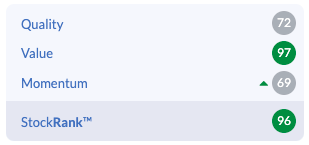
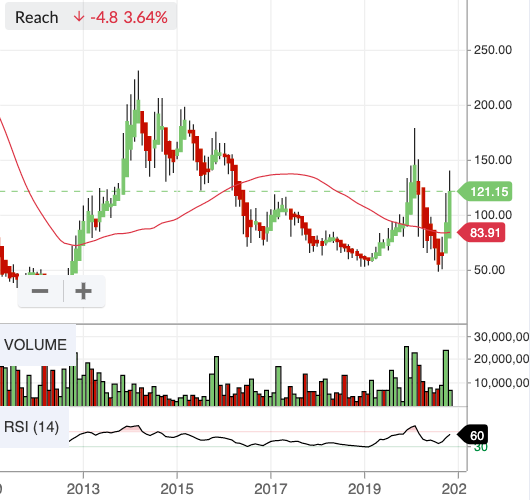
It's classified as a Speculative Mid Cap Super Stock, with a low forecast PE and strong historic cash generation. It is a turnaround situation, as shown in the longer-term share price chart below.
What is the business model?
Reach produces and distributes content through paid-for and free newspapers, magazines, and websites.

Source: company website
Digital (15% of revenue) is a network of over 50 sites providing 24/7 coverage of news, sport, and showbiz stories, with 1.3bn average monthly page views and over 40m UK unique monthly users. It's the fifth-largest online property in the UK. Digital makes money from advertising and partnerships
Print (84% of revenue) is a mix of national and regional paid-for and free publications. Print makes money from paid-for publications (circulation), advertising, contract printing, and events. It has 9 national newspapers, 110+ regional newspapers, and 2 national magazines
You can see all of Reach's brands here.
What is the history?
Reach's properties have been around for decades and there is plenty of history. Here's a condensed timeline.
- 1903 - The Daily Mirror was launched.
- 1953 - The Daily Mirror is listed on the London Stock Exchange.
- 1991 - the company is re-listed as Mirror Group. It begins to acquire smaller, regional papers in the following years.
- 1999 - Mirror Group merges with Trinity International Holdings, which owns the Liverpool Echo. The combined entity is named Trinity Mirror.
- 2010 - Trinity Mirror buys M.E.N. Media and S&B Media from The Guardian, adding 22 local titles including the Manchester Evening News.
- 2015 - Trinity Mirror launches Belfast Live and purchases Local World for £220m, which holds all of DMGT's local newspaper holdings other than Metro.
- 2017 - InYourArea launched: a new online "hyperlocal" news, information, and local community product aggregating in real-time from various public sources, such as new websites and councils.
- 2018 - acquires the UK publishing assets of Northern & Shell, including the Daily Express, Sunday Express, Daily Star, and OK!. Rebrands as Reach.
- 2019 - Jim Mullen joins as CEO. Reach announces a major "Live" sites expansion.
Trends/Market/Competition
Market
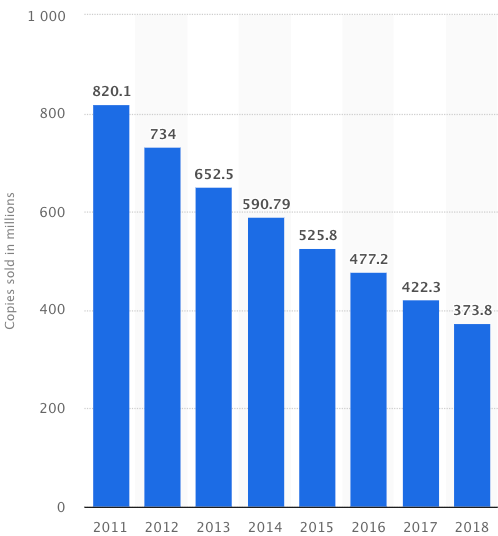
The UK Print market continues to decline at pace, per Statista.
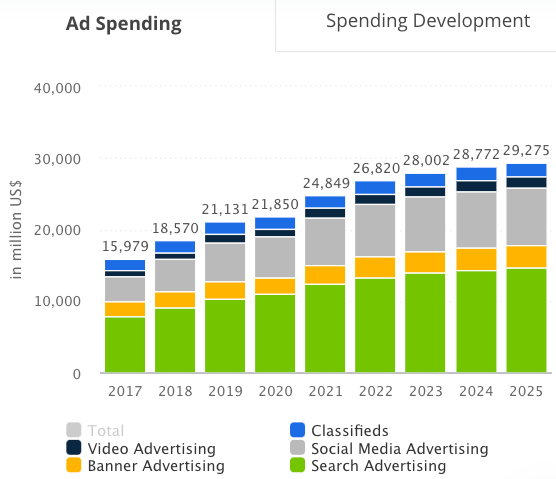
However, the UK Digital Advertising market (also per Statista, measured below in USD) is large and growing. This is where Reach aims to generate more revenue.
Competition
This is an issue for Reach.
On the content side, it faces competition from both national publications and online bloggers. Print revenue continues to decline, although the division is usefully and resiliently cash generative.
On the Digital side, Reach is dwarfed by global giants such as Google and Facebook that are increasingly grabbing and curating content from around the web for customers. This adds a lot of value.
Competitive advantages
Although competition is a concern, Reach does have some useful characteristics it can take advantage of, including:
- Its scale,
- A focus on established local titles, and
- Existing cash flows and infrastructure (low capex needs going forwards) which should fund digital revenue growth initiatives.
Strategy
Reach touches on a couple of strategic initiatives in its Annual Report, including:
- Maximise Print cash flows via editorial initiatives and cost cutting. In 2019 £12m of cost savings (£2m ahead of target) were gained from optimising its printing supply chain and evolving printing processes. The integration of Express & Star delivered annualised savings of £23m. Three titles were also closed in the year.
- Accelerate digital audience revenue. Strong organic growth in FY19 with worldwide monthly pageviews up 25% to 1.3bn (up 34% in H2) and LfL digital revenue +13.2%. MEN became the first-ever regional news site to break 1bn views in a year. Significant expansion of its 'Live' brand and InYourArea. Maureen McDonagh was hired from Facebook in Jan 2020 as Chief Customer Officer responsible for delivering joined-up data and customer strategy.
- M&A opportunities.
Financials & Ownership
What is the company's track record of growth and profitability?
Mixed. Reach is re-focusing away from structurally declining print into a rapidly evolving digital landscape. Revenue performance has been choppy. The group made a loss in 2018 but apart from that has remained profitable
We believe growth from digital and new revenue streams will offset print declines on an aggregate basis, leading to a future stabilisation of revenue
Trade was hit by COVID in H1 2020 as well but was showing signs of recovery in Q3.
If Reach can execute, there are underlying signs of a cash generative company capable of generating double-digit operating margins.
What is the company's financial status and balance sheet strength?
Again, mixed.
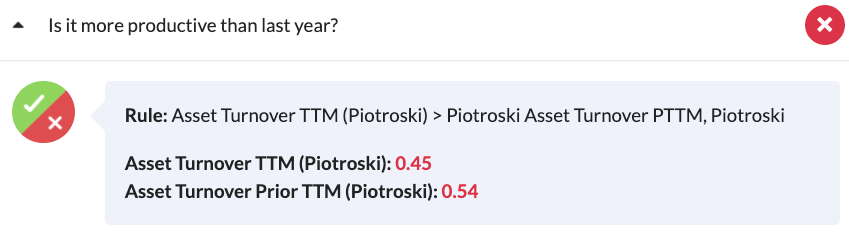
Strong F-Score of 8, failing the asset turnover check. That checks how effectively a company uses its assets to generate revenue.
This reflects not just £259m in net PPE but also a considerable £810m in intangible assets.
Weak Z-Score of 0.97, indicating "a serious risk of financial distress within the next two years". More specifically, it fails:
- Are liquid assets a significant proportion of total assets (working capital / total assets TTM)
- Does firm compare favourably to its liabilities (market value of equity / book value of total liabilities TTM)
- Are the assets relatively productive in terms of sales (Sales / Total Assets TTM)
Again, this checklist identifies the high level of illiquid intangible assets as a concern. The middle check correctly identifies the group's pension deficit as another flag.
Current ratios also leave a little to be desired, with a current ratio of 0.92 and a Quick ratio of 0.89. Compare to DMGT with a current ratio of 1.44 and a quick ratio of 1.41
The group has net debt of £2.9m on a TTM basis but improved net cash of £41.9m reported in its recent half-year update.
It has a substantial pension liability of c£2bn and a c£200m deficit. It pays about £40m annually into this. The deficit has been coming down - from £242.9m at FY19 to £209.9m at half-year 2020 'helped by cash contributions and strong asset returns'.
The triennial review is ongoing so we should have more news here soon.
Reach is reliably and resiliently cash generative, though. It regularly clocks up more than £100m annually in operating cash flow - enough to cover pension commitments and fund growth projects.
Pros:
- Cash generative and improving net cash figure,
- Strong F-Score,
- Declining pension deficit
Cons:
- High level of intangibles,
- Weak Z-Score,
- Large pension liability compared to market equity,
- Weak liquidity ratios
Valuation & Sentiment
How is the company currently valued both absolutely and relative to its sector and the market as a whole?
Reach has a ValueRank of 97/100, meaning it's cheap on historic data. The forecast PE Ratio is just 4x and the price to TTM free cash flow is 4.3x.
This cheap valuation could make up for near term turbulence as it executes its digital advertising strategy and de-emphasises a declining Print operation.
I think the base case is Reach proves itself as a viable company over the next few years. This implies upside as the market is extremely sceptical of Reach's prospects.
TTM revenue is £640m. 1x revenue is a modest rating for a going-concern company with double-digit margins. That implies a share price of (640,000,000 revenue / 312,067,649 shares in issue) £2.05 if it can successfully replace Print revenue with Digital Advertising revenue.
DMGT (Daily Mail) is valued at 25.7x forecast earnings. In reality, it's a different model with a lot more going on - but say Reach has less than half that valuation. 12x forecast earnings implies a share price of (12 * 28.9p) £3.47.
Of course, Reach is cheap for a reason - it could fail to monetise its digital operations or the pension deficit could worsen - but if it can successfully execute on its strategy then there could be material upside.
Potential catalysts include:
- The 'materially ahead' half-year statement,
- The upcoming trading update on 27 November 2020,
- A favourable triennial pension review outcome,
- Revenue growth and margin expansion from Digital.
Possible reasons for selling include:
- Profit takers who have more than doubled since August/September
- Those sceptical about the new business model and Reach's ability to capture value compared to larger aggregators like Facebook and Google
- Balance sheet concerns over pension liability and intangibles
Recent Trading
H1 update, 28 September 2020:
'Performing materially ahead of 2020 market expectations'
- H1 revenue down 6.3% LFL
- Adjusted operating profit of £54.9m
- Accounting pension deficit decreased by £33m to £209.9m
- Cash generated from operations of £47.9m
- Half-year net cash position of £41.9m
- The transformation programme is now materially complete with anticipated annualised savings of at least £35m.
- average monthly loyal users in March to August increasing by 27.2% year on year. This is delivering a related digital revenue acceleration.
Current trading
- For Q3, Group revenue declined by 15.0% year on year, a significant improvement on the 27.5% decline seen in Q2.
- Print declined by 19.9% in Q3, improving on the 29.5% decline in Q2, helped by gradual improvements in circulation revenue.
- The digital business grew 12.9% in Q3, compared with a Q2 decline of 14.8%, benefitting from a strong recovery in digital advertising and increased customer engagement across all channels.
- In Q4 the company will introduce a single Reach customer view to better track the impact of enhanced data on advertising yields.
*In just six months since February, we have increased the percentage of our audience that is registered from around 2% to 8% and maintained our position as the fifth-largest platform in the UK - with only Google, Facebook, Microsoft and Amazon ahead of us.
...Moving forward, the business has a strong foundation from which it can realise its true potential and value. We have established a lower cost base and reorganised the business in a new, agile structure. We continue to deliver a stable market share in print and we are seeing momentum in our customer value strategy. Once fully completed the transformation will improve our adjusted operating margin. We anticipate it will grow further next year, enabling Reach to generate significant levels of cash, enabling us to invest in the customer value strategy, pay down the historic pension deficits, and resume cash dividends at an appropriate time, subject to market conditions.*
Risks
Key risks include:
- Balance sheet risk - high intangibles and a big pension liability,
- Decline of circulation revenues - Print is in structural decline,
- Monetising online - can Reach capture value and effectively monetise its online content? Or will the value flow to larger aggregators like Facebook and Google?
From the 2019 Annual Report:
The growth in the first half was impacted by our digital audience continuing to be negatively impacted by the changes in Facebook and Google algorithms in early 2018, while the second half benefited from our digital initiatives.
Conclusion
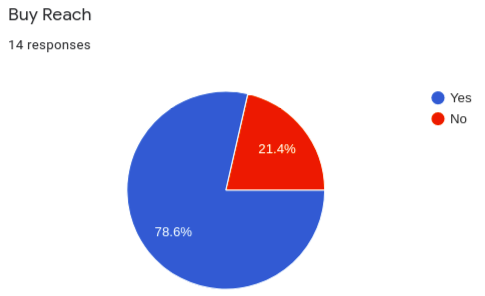
Votes were mixed on this one, but Reach made it through with eleven votes to three and the Club bought at £1.3074 per share.
A slightly controversial pick, and one that has just rerated aggressively (albeit from depressed levels).
Have we bought at the peak, or is there further to run here? Reach has a job on its hands effectively monetising its digital properties, but it has an experienced management team and remains modestly valued in relation to its resilient cash flows.
Disclaimer
This is not financial advice. Our content is intended to be used and must be used for information and education purposes only. Please read our disclaimer and terms and conditions to understand our obligations.

14 comments
Big breakout on Reach (LON:RCH) today - up 8% with an enormous volume spike:
Still a core holding of the investment club and personally now my largest UK position. I do like a volume breakout in a high ranking share on no news - and would consider buying more if it wasn't already overweight.
Another update from Reach (LON:RCH) on its Customer Value Strategy, with shares up 6% to 140p at time of writing.
Highlights include:
5 million is well ahead of target. Weren't they aiming for 8 or 9 million over 2 years?
10m by the end of 2022 was the figure I seem to recall so it does look like they are nicely ahead of target.
I particularly like the 20%+ YoY digital revenue growth. One of my key scepticisms has been whether they can successfully monetise digital, so that looks promising.
Reach (LON:RCH) trading update today - positive language but light on actual trading numbers. The stock opened up c8% but has since fallen to +3.3%.
There was an analyst call with some of the key takeaways being good margin progress, further Print cost cutting in store, and good digital performance.
Paul's covering it later in today's SCVR. There's an N+1 broker note out too (you can find it on Research Tree if you have an account there) with an intrinsic valuation of 310p.
DYOR
@jack Thanks for the article. Any idea what the margin mix is between digital and print?
Chris,
"Newsagents" stay open during the lockdown (most of them are effectively convenience stores these days anyway) and in fact there was an uptick in paper delivery during the first lockdown.
It is true of course that the lockdown is somewhat negative for the physical newspaper business, with lack of commuting especially, but most of that was curtailed already.
Personally I don't think a lot will have changed for the physical paper side of things since they reported being "materially ahead" at the end of September. More recently Daily Mail and General Trust P L C (LON:DMGT) were positive in their statement a couple of weeks ago.
DMGT will give a further update on the 23rd and Reach on the 27th so we will know more in he next few weeks.
Great article Jack. I fully appreciate their targeted migration to digital but in the meantime I am just wondering how they will maintain their print circulation and revenues during another protracted lockdown? In other words how does the printed matter get into the readers hands? Sorry if I am missing something obvious.
"In other words how does the printed matter get into the readers hands?"
Supermarkets, newspaper shops, corner shops - all treated as "essential" and, as last time, will be selling newspapers.
Great article Jack.
I just wonder about the revenue growth potential. I think they have a great product suite of local newspapers and I regularly use the Daily Record, Stoke Sentinel and more. Each time though I feel flooded with adverts which makes me wonder if there is room for more adverts or will they be able to charge more for each advertising slot? Or can they develop more slick and productive advertising methods?
Given they’ve got some way to go before on line revenue is as large as current print revenue I’m struggling to convince myself on this one, though I like the PER, the cash generation and newspaper products they sell.
Just to mention that Reach will feature in our MelloBASH (Buy, avoid, sell or hold) panel session this Monday and will be one of five companies analysed by the panel of fund managers, analysts and well known investors. It is an action packed 3.5 hour evening event and the full details of the programme are here....
https://melloevents.com/upcoming-event/mellomonday-9th-november/
Companies to be covered on Monday include Peloton, Reach, Tremor, Tristel, Versarian
If any of you would like to join the audience and there is participation via a poll at the end of each company review then Stockopedia tickets are half price using this code ....MMStocko21
One useful by-product of the crazy EU cookie law... websites have to ask permission for the storage of their cookies. Reach present their cookie request in a large box titled "REACH". I recently noticed that 9 times out of 10 when searching out info on up and coming football matches the best info was presented by Reach sites. Try it yourself...
Although it may seem irrelevant to non football fans I think it shows that they have a focussed team of motivated reporters putting out content in a timely fashion on websites that are extremely well optimised for search engine positions. I suspect that they rank well on most other local info other than football.
As a result I have started investing in Reach as they're clearly not being associated with the sector that i think will ultimately be their core market. People still view them as a dying print business.
That's a very good summary Jack.
One thing though that you touch on that I think deserves further emphasis is their strong track record in driving out costs in the legacy businesses. As they have acquired businesses over time they have progressively driven out costs to compensate for the declines in the print circulation business.
Like other businesses they have taken advantage of (and I don't mean that in a negative sense) the pandemic to accelerate transformation / cost reduction approaches.
In the HY results announced at the end of September they told us their latest transformational programme
Taken in the context of 2019 Net Profits being £94m (after Opex of around £200m) that is a pretty profound number. I am doubtful that has been fully reflected in the 2021 analysts forecasts which show only a modest improvement in profits.
Thanks Gromley,
Good point on the cost cutting - 'at least £35m' is a pretty impressive achievement in a relatively short span of time. It shows there are a couple of ways Reach (LON:RCH) can drive profitable growth.
Pension deficit reduction is another - it might take a while for the benefits of an improved pension position to be reflected in cash flows but the direction of travel, for now, is positive at least.
And then of course the pivot to Digital Advertising. Still a bit of an unknown quantity to my mind, but if the group can replace Print revenue with Digital, that will be positive for margins.
Next update on 27 Nov, IIRC