Stocks Swimming Naked

2023: an annus horribilis
This year has been pretty brutal for the average UK stockpicker. Apart from a brief period of optimism in January, the FTSE AIM All Share Index has declined almost continuously since then:

The Investment Association shows that, apart from a brief positive month in March, retail fund flows have been consistently out of equity funds for the last year. Most of those flows appear to have gone into fixed-income funds, which are now paying higher interest rates (although still below inflation.)

Focussing on proven factor styles hasn’t helped investors this year, either. Despite an excellent track record over many years, the Value Rank has underperformed the FTSE All Share this year:

As has the Quality Rank:

And the Momentum Rank performed even worse:

It seems any strategy that uses equal weight and hence is biased towards smaller stocks has underperformed.
Stocks swimming naked
While the returns of the AIM index and factor styles have been poor, the performance of some individual stocks has been abysmal. As Warren Buffett famously said:
“Only when the tide goes out do you learn who has been swimming naked.”
The real lessons in investing are learnt during the periods when companies struggle, and the access to easy capital is reduced. In this article, I will look at some of the worst-performing stocks this year and what investors can learn from this underperformance. I will see if investors could have got an inkling that these were swimming naked prior to the receding tide revealing all.
A quick screen reveals that three UK stocks with a market cap currently greater than £10m have lost more than 80% of their value in the last six months:

In addition to these big losers, I will take a look at what might be learnt from three well-known UK companies that have called in the administrators this year: Cineworld, Trackwise Designs, and Ince.
tinyBuild (LON:TBLD)
The tinyBuild share price started the year at over 100p:

However, things quickly started to go wrong in the Pre-Close Trading Statement in January:
Revenue in line with expectations, with adjusted EBITDA broadly in line
“Broadly” is, of course, corporate code for slightly below. Still, this seemed relatively minor. The results themselves, when they arrived at the end of March, didn’t look too bad:
● Revenue grew 21% to $63.3m (2021: $52.2m), reflecting a solid performance in the last part of the year from new titles including Hello Neighbor 2, Tinykin, Asterigos, Spiderheck and back catalogue sales.
● Adj. EBITDA increased to $24.4m (2021: $22.2m) up 10% y-o-y, while margin decreased to 38.5% (2021: 42.6%) primarily due to the consolidation of Versus Evil and Red Cerberus acquired in November 2021
And the outlook was in line with expectations for 2023:
● All considered, the Board remains confident the Company is on track to deliver results at least in line with expectations, plus accretive acquisitions.
However, the share price continued to decline. It was only in the AGM Statement at the end of June that the updated situation was revealed:
● First-half performance below expectations due to lower contribution from platform deals and the underperformance of Red Cerberus and Versus Evil has resulted in a material reduction to FY consensus revenue and a more acute reduction in Adj. EBITDA in 2023 and 2024.
It is only after this update that brokers slashed their forecasts:
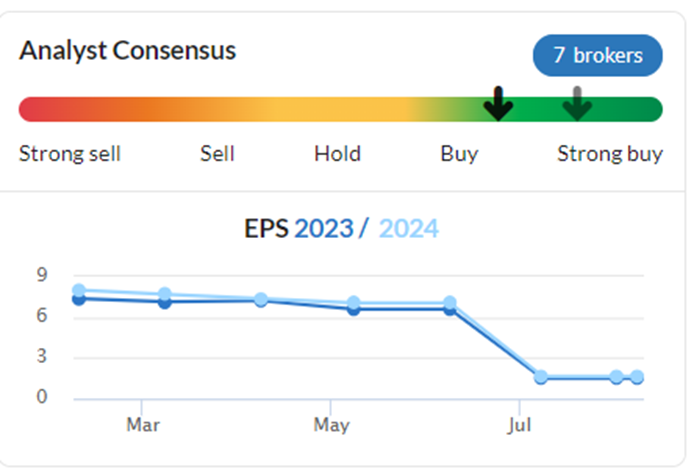
This drop in earnings forecasts has done the damage, with the share price dropping largely in line with the decline in EPS. There has been a slight derating, too, as investors have lost confidence in the company. However, this is minor compared to the effect of the drop in EPS. It is worth noting that this also had a notable impact on the cash balance:
The reduction of adjusted EBITDA in 2023 and 2024 will be more substantial, due to a significant increase in development cost amortisation and a slightly higher percentage of revenues paid out to developers as royalties adding to the flow through from lower platform deals. As a combination of the above, cash at the end of December 2023 is expected to be between $10-20m, below the previous expectations of at least $26.5m.
Which also reduces some of the downside protection.
It would seem to be pretty hard to spot this large drop in earnings prior to it happening and hence learn from this fall. However, it is worth noting that the Momentum Rank was pretty weak at the start of the year, and was declining further:
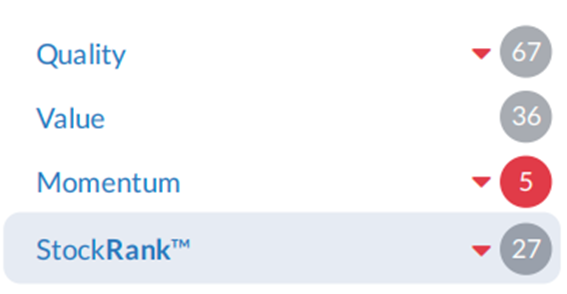
It seems investors should be wary of weak and falling Momentum Ranks, particularly when this is not offset by strong Quality and Value Ranks. Today the picture is quite different despite the momentum rank remaining weak:
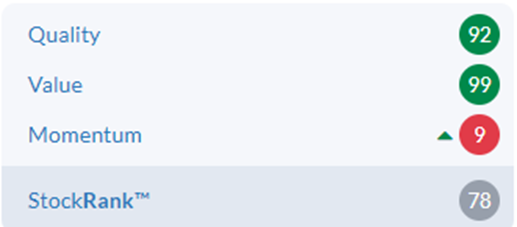
This may now be attractive to contrarian investors. However, this will be of scant consolation to those who bought the shares prior to June this year.
Aferian (LON:AFRN)
Aferian used to be called Amino Technologies and creates hardware and software for on-demand TV. The set-top box market has been in decline recently, and the Company has been attempting to pivot increasingly towards the software side of the business.
Things appeared to be going well for Aferian at the start of the year. With a November 2022 year-end, the Company issued a trading statement in December 2022 saying:
For the year ended 30 November 2022 the Group expects to report adjusted operating profit within the $7.8m-$8.8m guidance range…
Higher margin software and services revenue is expected to be approximately $24m (FY21: $22.4m), an increase of 7%, or 15% on a constant currency basis…
Device revenues in our Amino business (which connects Pay TV to streaming services) are expected to be approximately $67m (FY21: 70.5m), a decrease of 5% year-on year.
However, a trading update in March 2023 revealed that the current year is going much less well:
Whilst it is early in the new financial year, in light of the above performance from the Amino division, the Board now expects Group revenue and adjusted EBITDA for the year ending 30 November 2023 to be substantially below its original expectations.
In addition, the FY22 results were delayed, and the Company said:
The Company is in compliance with its banking covenants and is in discussions with its banks to ensure future covenant compliance. This will delay the announcement of the full year audited results for the year ended 30 November 2022. A further announcement will be made as and when practicable.
This suggests they would breach banking covenants, potentially putting the banks in control of the business. In May, the Company required an expensive shareholder loan of £3.25m to satisfy the banks. The loss in confidence that the Company would survive meant that a share price that started the year at 100p had dropped to just 9p:
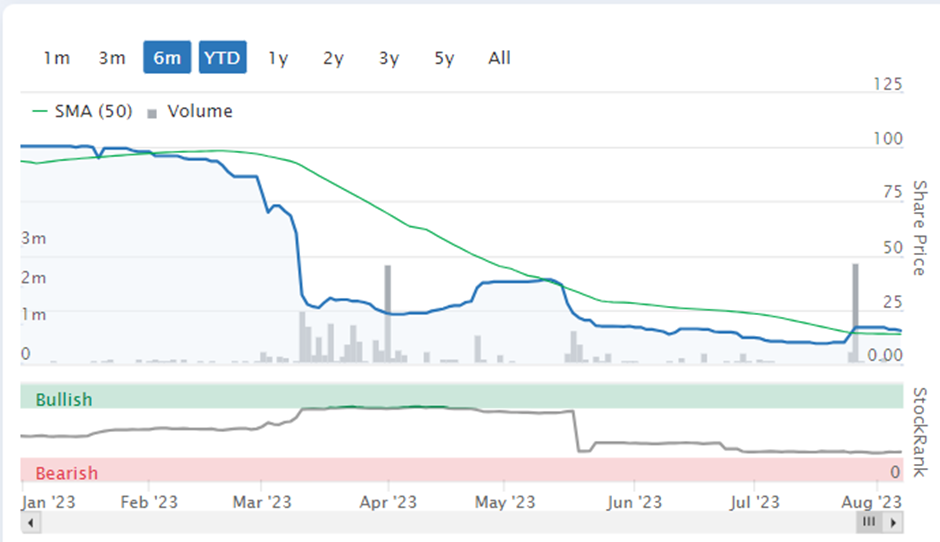
In July, the Company managed to raise $4m in a placing. There was shareholder support for this because the money was raised at 12p, a premium to the then share price. However, this locks in a 30% dilution at a very low share price compared to historical levels.
Looking at the StockReport from early January, only the Momentum Rank was flashing a warning sign:
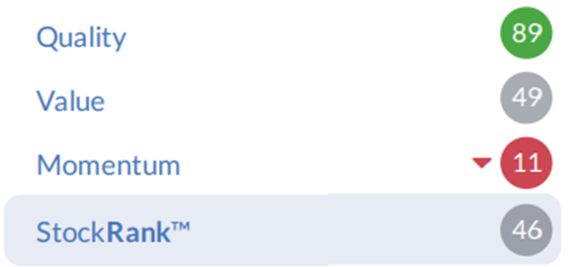
The Company had net cash at the previous Half Year, although the low level of working capital may have caused some pause for thought. The reality is that the scale and the severity of the downturn in demand caused the problem here. They say in their latest trading statement:
Device revenues in the first half are expected to be c.$9.4m, representing a decrease of 71% year-on-year.
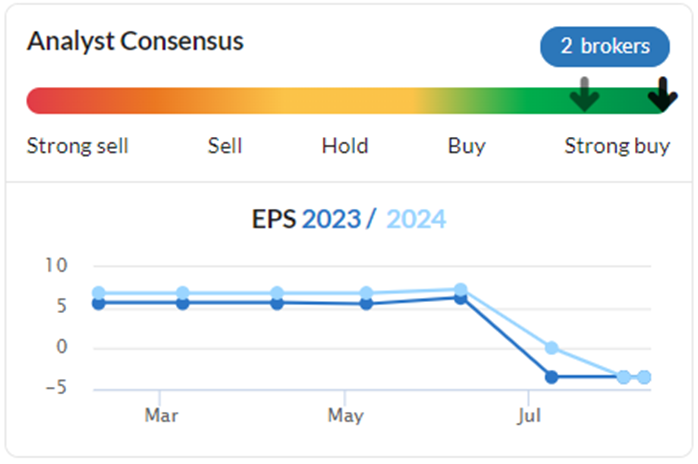
Such a huge drop means that they are forecast to be loss-making for the foreseeable future, despite growing software and services revenue:

WANdisco (LON:WAND)
Unlike TinyBuild and Aferian, the WANdisco share price had been strong prior to its fall from grace:
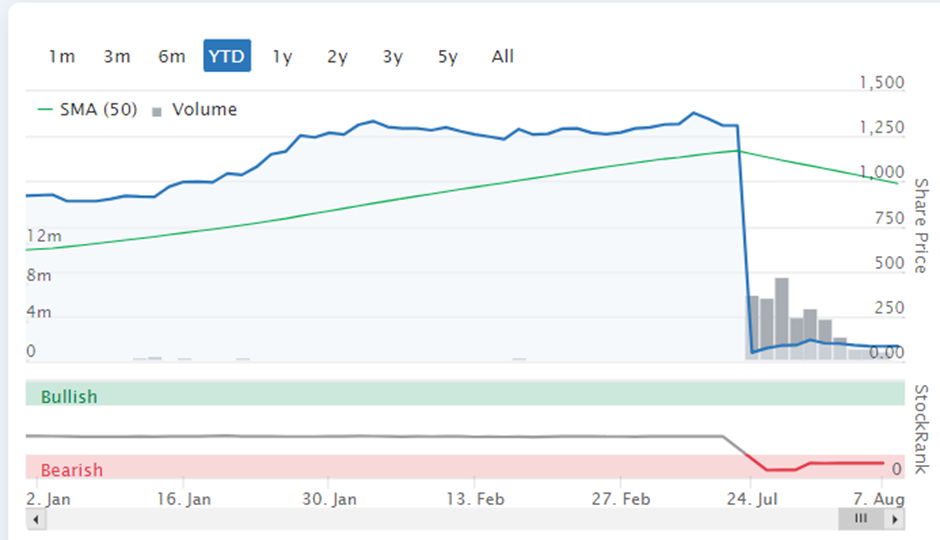
On 11 January, the Company gave a trading update that said:
Trading in Q4 2022 finished strongly following significant contract momentum with both new and existing customers. As a result, the Company’s preliminary unaudited revenues are expected to be no less than $24m, growth of 229% year on year (FY21: $7.3m).
Bookings in FY22 grew 967% to $127m (FY21: $11.9m).
Unfortunately, that proved to be untrue, as the Company found irregularities in sales bookings, and on 9 March announced:
The identification of these irregularities will significantly impact the Company’s cash position and lead to a material uncertainty regarding its overall financial position and significant going concern issues. The Board now expects that anticipated FY22 revenue could be as low as USD 9 million and not USD 24 million as previously reported. In addition, the Company has no confidence in its announced FY22 bookings expectations.
This shocking announcement saw the shares suspended, and they didn’t return until the Company had a rescue placing at just 50p. The new shares represent over 70% of the new share capital, and 50p is a 96% discount to where the shares were trading prior to suspension. Even then, this appears to have been a lucky escape for shareholders, as the Company seemed to be weeks away from running out of cash and becoming a zero for shareholders.
These events may appear to be a “Black Swan” event coming out of the blue. The issue here appears to be revenue recognition, and the Company blames a rogue employee. However, concerns with revenue recognition almost always appear on the balance sheet, usually in moves in trade receivables. These should have given investors pause for thought, even before more recent events. Here is how these looked in the 2022 Half-Year Results:
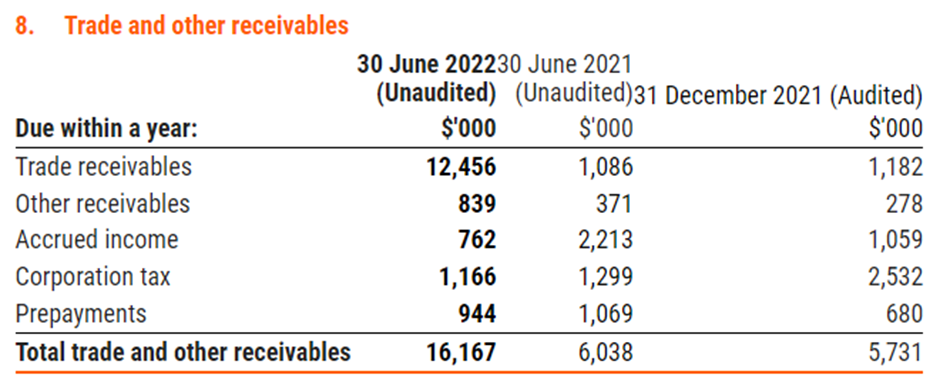
The increase in trade receivables in the six months to 30 June 2022, was far in excess of the revenue booked during this period, which should have raised red flags amongst the former management as well as investors:
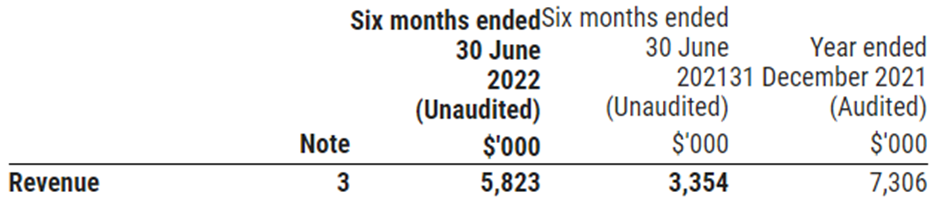
I’d like to say I’d spotted this issue with receivables before the collapse, but that wouldn’t be true. For the reason that I wasn't even looking. With a Value Rank of just 2 and a financial history that looks like this, I already knew the risk-reward didn’t favour investing here:

So, perhaps the real lesson is perhaps to ignore stocks whose figures look like this. Ones that trumpet their growth potential, yet revenue remains below the figures of 5 years ago. There are many ways that academics have tried to systematise the detection of earnings problems. These almost always include rapid historical or forecast growth as a risk factor. It seems that such companies’ management often comes under pressure to show results, one way or another.
These pressures are unlikely to abate here, either. The placing has only bought the Company just over a year to turn things around, even after they have significantly reduced their cost base. Recently announced, and therefore presumably carefully checked, contracts have been underwhelming. For example:
…a new one-year contract valued at $7,680 with FordDirect for WANdisco’s Data Migrator product.
It is clear that this sort of contract won’t make a dent in a $20m+ ongoing cost base.
Cineworld
The story here is a simple one. The Company took on too much debt to buy out a competitor. Net debt was around $5b, while the company posted an operating loss in the last period before the collapse. It is not entirely management’s fault. Historically, cinemas were steady earners and could take on high debt loads. However, COVID hit and wiped out their ability to operate. The lesson is that “Black Swan” events can wipe out even the most stable businesses.
The bonkers part was that the Company’s shares continued to trade above zero despite the Company saying in January:
As previously announced, it is expected that any restructuring or sale transaction agreed with stakeholders will result in a very significant dilution of existing equity interests in Cineworld and there is no guarantee of any recovery for holders of Cineworld’s existing equity interests.
Investors who still held after that statement were perhaps not operating wholly rationally.
Trackwise Designs
Given the difficult markets for raising equity, one would expect that the only reason a company would fail would be the inability to raise funds. However, Trackwise did manage to complete a raise of funds in January this year:
The Company has therefore raised, in aggregate, approximately £4.76 million (before expenses) through the Placing, Subscription and Open Offer.
The Company also received an advanced payment in October 2022 of close to £4m from a customer to support an order of a fixed quantity of flexible printed circuit boards. They were due to be paid the balance of another £4m on delivery of parts between April and July. However, in March, they said:
The Company now expects a delay in the manufacture and deliveries of the Parts to the EV OEM, whilst the EV OEM undertakes a redesign and validation of the Parts to meet their revised design requirements. The Change Control procedure within the contract has been initiated, including the impact upon the Parts price and production completion. At this time the Change is yet to be quantified and agreed but the Company expects this to include an amended payment profile, to offset the delay in cash receipt to the Company as a result of the redesign and validation of the Parts.
However, no payment appears to have been received by the Company. An attempt to sell first a non-core subsidiary, and finally, the whole Company didn’t receive any offers that would complete in time, and on 2 August, they appointed administrators.
The issue appears to be that the Company had taken on debt prior to becoming sustainably cash flow positive:

And the equity raise was not enough to clear this debt and fund ongoing losses:
Net debt at the year-end was £9.34m prior to the receipt of the placing and open offer net proceeds of the recent equity raise which completed in the new financial year of approximately £4.75m (before expenses).
This meant the Company was not in a position to be able to cope with the contract issues they experienced. The lesson is to avoid companies that have not yet reached cash flow-positive trading and have debt. Investors may even want to expand this to avoid companies that don’t have enough money to fund themselves through to cash flow break-even, including severe downside scenarios for short-term trading. The reality is that no company can guarantee to raise fresh equity, no matter how good the story may appear in a bull market.
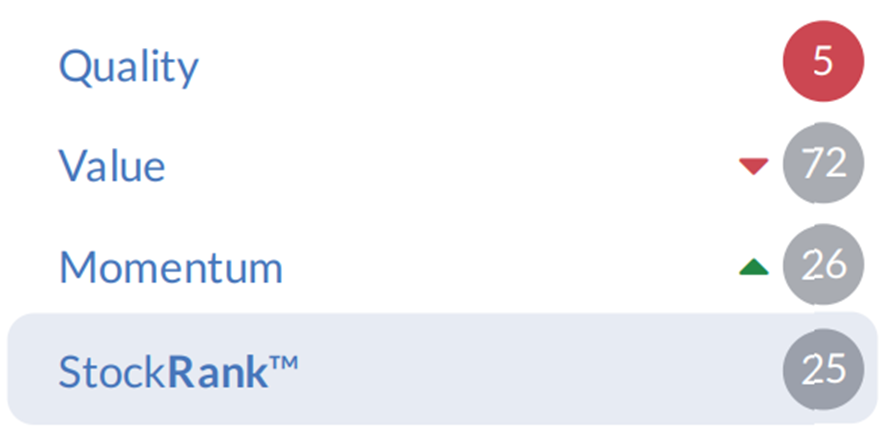
This is another company where the StockRank in January this year should have been a warning sign:
Ince
Ince is another company that didn’t fail due to its inability to raise money from the market. Indeed they conducted two placings in 2022. They raised £9.1m in July and £4.7m in November 2022. However, a failure to produce accounts saw them suspended from December 2022 until administrators were appointed in April this year. In addition, they disposed of non-core assets and acquired Arden Partners for shares, meaning they had access to Arden’s cash reserves.
Given the lack of recent accounts, it is hard to say precisely what has happened, but again, debt appears to have been a significant factor in their demise. At the last known balance sheet date of 30 November 2021, the Company had £15.1m of net debt.
Even excluding the debt, the balance sheet didn’t look strong, with Current Liabilities exceeding Current Assets and almost all Non-Current Assets being intangible:
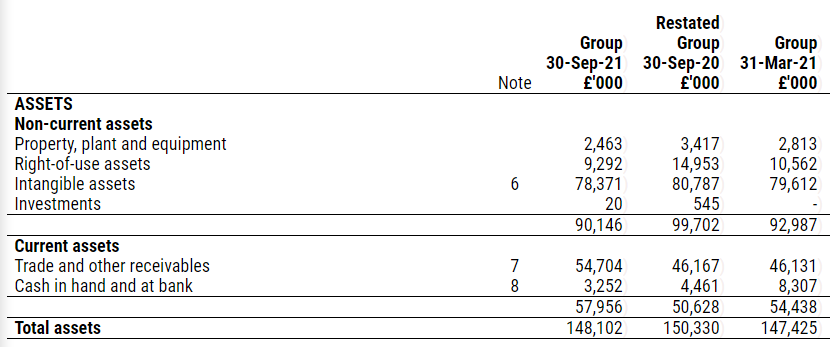
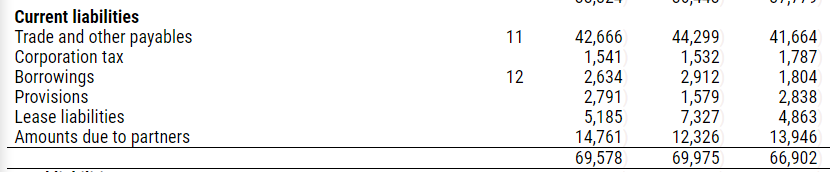
It seems the Company simply over-extended itself, and the lessons to be learnt were written in the balance sheet.
Conclusion
It isn’t possible to spot every Company that is swimming naked. However, many of them have features in common. They usually have large debts or have very high levels of cash burn. This means that they cannot weather even minor short-term issues they face, or they rely on raising future equity to survive, which may not always be possible. Even companies that could raise equity didn’t always survive, or they diluted existing holders significantly. These types of companies are also susceptible to revenue recognition issues, and investors should be extremely vigilant for signs of this.
The Stockopedia StockRanks are also a valuable tool for avoiding companies that are swimming naked. The Value Rank of just 2 for WANdisco (LON:WAND) should have been a warning sign. As should the low Momentum Rank at £TBLD. Particularly when the Value or Quality Ranks were not particularly high to offset this indicator. While investing in high StockRank companies has not prevented losses in 2023, avoiding lowly-ranked companies may have spared investors much worse blushes.
Disclaimer
This is not financial advice. Our content is intended to be used and must be used for information and education purposes only. Please read our disclaimer and terms and conditions to understand our obligations.

15 comments
Regarding Ince you say "Given the lack of recent accounts, it is hard to say precisely what has happened". The administrators' report is filed here. It is 137 pages long but I did find this from a brief look - it would appear that the final twist of the knife was done by HMRC:
Great forensic analysis Mark. I wonder if there were some wiley folk who were short these shares (Cineworld was an obvious short I'd think). Perhaps you have highlighted a good hunting ground for short traders. Many thanks
I don't tend to short. Particularly for situations like Cineworld. Although the destination with situations like this is always to zero, the path is rarely straight down. Others know that professional investors are short and try to orchestrate short squeezes where the price rapidly rises. Even if you avoid these, shorting via spread bet companies can leave you with your money tied up, fully margined, for a long time while administrators/exchanges declare the stock valueless.
Investing is hard enough without adding those factors in too. I prefer an easy life.
I dont know why so many have to overcomplicate it. Just go with the trend.
If you want to gamble against trend you can make some nice quick profits but you've got to be very very careful. I almost always only buy when the price closes above the 10d trend line, and always set a stop loss close by. Fundamentals are great but theyre lagging on the way down. Personally I buy using a combination of fundamentals and charts. I'll sell most of the time just based on the chart.
tinyBuild (LON:TBLD) Price is saying DONT BUY. Possible buying opportunity in May, should have been stopped out for little or no damage tho
Trackwise Designs (LON:TWD) Price is saying DO NOT BUY
Aferian (LON:AFRN) Possible buy in April when price closed above the trend line. Should have been stopped out at break even at the very worst and a reasonable profit at best.
A couple Ive traded recently for a quick profit. SCS (LON:SCS)
Mind Gym (LON:MIND)
PayPoint (LON:PAY)
I agree completely, I also do things just like you. Buy on a mix of technicals and fundamentals and sell (mostly) on technicals.
Unfortunately, I was going with the trend on WANdisco (LON:WAND) which I was in as a pure momentum play, and look what happened. With hindsight I think you need trend but it is a dangerous game to ignore fundamentals as well, which I unfortunately did in this case.
Nowadays I really like the F score to keep me out of trouble. A low F score, and in particular a negative on any of the first 3 questions, and I avoid.
Really helpful post. Many thanks
Hi WOSS,
Hope you don't mind me asking regards your strategy - are you trading in and out a lot? Looks like the 10 DMA seems like a good spot to get in, but do you simply trade in and out with close stops, or are you a long-term buy & hold?
Kevin, I'm not a buy and hold investor. More medium term trader so average hold is maybe a few months, tho the last year it's probably less. With forced sellers and AIM in a downtrend just have to work with the market as it is.
Depends on the company tho. If it's in an uptrend with rising forecast earnings then I'm happy to hold. Shorter term trend reversals as above I'm looking for a 20% pop and I'm out when momentum fades. PayPoint (LON:PAY) being the exception as forecasts were raised and I averaged up on results.
Longer term investors still need a good entry point tho, so patience is needed. Trend line stops you buying falling knives. Whether you then use a stop loss is up to the individual, I'd never be without one and I never average down. Everyone has their own strategy tho so I'm not saying one is right the other wrong.
You can use any period moving average you like but this is what I use. Setting to 'high' helps eliminate many false signals. This works best with those shares which are down day after day frequently because funds are trapped in
Managed to be publicly negative on WANdisco (LON:WAND), tinyBuild (LON:TBLD) & Aferian (LON:AFRN) (when £AMO) .........yay! #TheSignsWereThere
#TheSignsWereThere. Indeed they were. I'd highly recommend a read of the book of the same title by Tim Steer
Thanks for this. It is as useful to know what to avoid as well as what to buy.
Thanks for posting this interesting article. Great to not only have articles pointing out potential opportunities but by including lessons like these, it helps investors like us not to lose money