STV tunes into Scotland

STV Group describes itself as “Scotland’s leading media brand” with 92% of Scots interacting with it every month. The main revenue generator is advertising on Channel 3 in Scotland but the digital business is seeing strong growth. A modest valuation and business momentum suggest that investors should tune in.
On face value the media company STV Group looks attractive with growing profits and a falling net debt position. The company also presents a recovery story with the dividend reintroduced in 2013 after having been cut in 2007.
The business also appears to be underpinned by the renewal of the Channel 3 license in Scotland for 10 years from the start of 2015. This helps lower the cost of debt and allows for an increase in capital spending.
As such the business momentum look set to continue with advertising spending in the UK geared towards the economic recovery. To capitalize on this trend STV has launched city TV stations and is investing in its digital offering.
STV Group’s financial momentum

Source: STV Annual report
Looking at STV Group’s recent headline numbers and revenue rose by 7% in 2014 while earnings per share increased by 13% to 38.7p. Net debt fell 18% to £29.4m and the dividend for 2014 increased to 8p from 2p in 2013.
Set against this the valuation looks modest with the share price of 415p giving an historic P/E ratio for 2014 at 10.7X. The company is also targeting a 10% annual increase in earnings per share from 2014 to 2017.
The forecast valuation is therefore low with a 10.2X P/E for 2015 and then falls to 9.3X in 2016 and 8.5X in 2017. The forecast yield is 2.4% for 2015 and increases to 3.4% by 2017 with the payout more than 3X covered by profits.
Clearly this is a company seeing profits momentum and lowering its risk profile as net debt falls back. At the current stage of the economic cycle this combination is attractive as long as the underlying business is sound.

STV Group profile
In 1995 Independent Television was launched by what is now OFCOM to provide competition to the BBC. In England the licenses are operated by ITV, in Scotland it is run by STV Group and in Northern Ireland they are operated by UTV Media.
Currently ITV commissions and funds the network schedule while STV and UTV pay broadcast fees to run it. STV Group was previously in dispute with ITV but this was resolved in 2011 and STV now pays a flat fee to ITV.
STV Group’s media presence
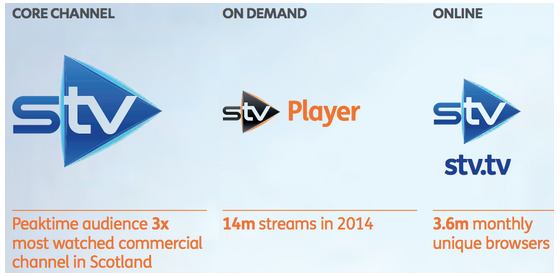
Source: STV Group annual report
The group breaks up its airtime revenue into national (Scotland), regional (sections of Scotland) and city (Glasgow and Edinburgh). The City TV business is relatively new but allows advertisers to tailor their marketing efforts.
TV generates the bulk of STV Group’s revenue but the digital business is the fastest growing with a 23% revenue gain in 2014. All these businesses are lumped together as STV Consumer and generate revenue through advertising.
The production business was 11% of revenue in 2014 with this area creating content for networks. This is a higher risk business but the group has a number of strong programme franchises such as Catchphrase and The Link.
STV Group revenue in 2014
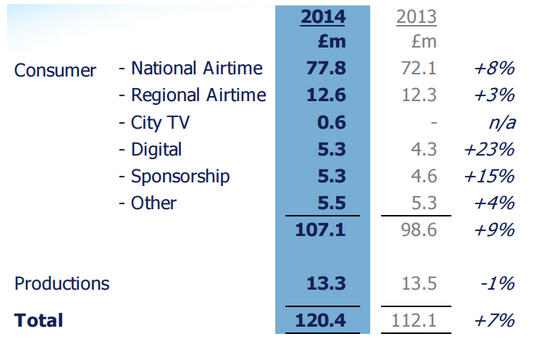
Source: STV Group investor presentation
In terms of the group’s strategy, the aim is to diversify the business away from its reliance on broadcast profits. In 2012 the non-broadcast profit was 11% of the total, in 2014 it came in at 21% and the target for 2015 is 33%.
For the programme business a key target is to deliver a peak time audience in excess of the ITV network. This was achieved for the fifth year in a row in 2014 suggesting that STV Group is able to tailor content to what is popular in Scotland.
Key developments in 2014
STV Group renewed its banking facilities on improved terms in mid-2014 which followed the renewal of its TV license. The stronger terms reflects the normalized balance sheet a robust trading position and the renewal of the TV license.
On the political front the results of the Scottish referendum eliminated the near-term risk of regulatory change. After the referendum the Smith Commission recommended that broadcasting should remain a matter for Westminster.
STV Group also agreed a long-term pension deficit recovery plan in 2014 in which it will pay £7m-£7.75m a year from 2015 to 2025. The actuarial deficit at March 2014 was £85m but has been trending down due to asset value gains.
STV’s Outlook
Last year was a strong one for the business with the FIFA world cup and the independence referendum big draws. Nevertheless the group’s airtime revenues from the start of 2015 to May are expected to be 3% higher than a year ago.
Revenues from the digital business were up by a third in Q1 and are expected to increase by 40% in the year to date. As such the performance is in-line with expectations which puts STV Group on track to meet its growth targets.
STV’s Risk profile
Advertising expenditure is cyclical and helps explain the weak share price performance during the financial crisis. The group also suffered from over expansion and therefore divested non-core businesses in 2007.
The current business structure is more focused and should help the group to be more resilient in the next downturn. STV Group also appears to be getting on top of its pension deficit and has seen its balance sheet strengthen.
Summary and valuation
STV Group offers a way to buy into the recovery in advertising expenditure in the UK as the economy picks up. The group is also seeing strong digital revenue momentum and diversifying away from a reliance on broadcasting profits.
Given the rocky long-term history of STV Group as a listed company it is understandable that investor are wary. The pension deficit remains a risk and Scotland could eventually opt to leave the UK.
However, the fall in net debt, strong profits growth and continued advertising pickup suggest that the medium-term outlook is strong. The valuation is modest, in our view, with a forecast P/E of 10.2X for 2015 falling back to 8.6X by 2017.
This report was produced by Fat Prophets Senior Research Analyst, Andrew Latto.
Disclaimer
This is not financial advice. Our content is intended to be used and must be used for information and education purposes only. Please read our disclaimer and terms and conditions to understand our obligations.
No comments yet
No one has commented here yet! Why not be the first one?