Takeover 2026!

One of the predictions I made recently for 2026 was that I expected the rapid pace of takeovers in the UK market to continue. There is no doubt that takeovers and consolidations have been shrinking the number of UK-listed stocks at quite a pace over the last few years (although delistings also play a part in this):

[Chart: Statista]
Many stocks on the UK market seem cheap at the moment. Almost continuous outflows from UK Equity Funds mean that institutions have been net sellers, whatever they think of the valuation or outlook for their holdings. In these times, even surprise good news gets sold into:

[Chart: Calastone]
It would be naïve to think that these outflows will suddenly reverse because we are into a new year, so identifying catalysts for re-valuation may be one of the keys to strong returns in 2026. Finding the type of companies that may be more likely to receive takeover offers is one way to accelerate price discovery. This is the task that Alex and I have set ourselves.
Obtaining a list of takeover offers over time is actually quite challenging. While the takeover panel publishes a list of current active offers, there is no historical record. Looking through all past announcements for all UK stocks is a task so onerous that even ChatGPT tells me to get lost. However, at Stockopedia, we have a resource others may not have. On the DSMR, we report on the material news for all companies each day, and we flag potential takeovers as PINK. Combining Alex’s analytic skills with some donkey work from me, we have been able to examine what types of companies have received takeover offers in the past. We are not claiming our data is totally exhaustive, but by using the DSMR, we will have captured the majority of the offers that have been announced over the last few years:

The number of offers we found actually dropped slightly in 2025 compared to the boom year of 2024. However, there were around 10% fewer listed companies at the start of 2025, meaning that takeover activity as a proportion of companies has been consistently high.
Over the next few weeks, Alex and I will be looking at what we can learn from this data. There is still a huge amount of randomness involved in which companies receive an offer, and when. However, if we can tip the balance in our favour, this may give an edge.
Takeover Announcements
Shareholders will not always hear about every approach made to the board. Shareholders are likely to only hear about potential offers (and hence be on the DSMR PINK list) for one of the following reasons:
- The offer is credible and is being seriously considered by the board.
- The acquirer makes a statement to the market indicating their intention to make an offer. This is usually because the acquirer feels that their interest is credible, but the board disagrees.
- The possibility of a takeover is leaked to the press or has leaked to the market and caused a significant rise in the share price.
- For companies subject to the Takeover Code, a shareholder purchases shares which take them above the 30% holding level (or increases their holding if they already own more than 30% but less than 50%) and is forced to make a mandatory offer.
This is controversial, and some high-profile investors feel that this information asymmetry disadvantages smaller investors. However, I am more sanguine about this. Reporting every offer, no matter how tenuous, would lead to a lot of noise and distraction for investors. It would also be open to abuse from more promotional management teams. I think the status quo probably strikes the right balance.
UK Takeover Structures
In the UK, there are two types of typical takeover structures:
Offer
- An acquirer gains control at 50% acceptance
- The company can stay listed unless 75% accept (enables delisting)
- At 90% acceptance, the acquirer can force remaining shareholders to sell
- Minority holders may be pressured to exit after delisting (e.g. via rights issues)
- Accepting shareholders cannot trade shares once tendered
- Cash consideration is usually received quickly
- Acquirers often keep offers open to reach full ownership
Scheme of Arrangement
- Typically requires 75% shareholder approval and court sanction
- Results in 100% ownership by the acquirer
- Higher certainty of full control but higher approval threshold
- Shares remain tradable until court approval
- The acquirer may switch to an Offer if Scheme approval looks unlikely
Schemes of Arrangement have become increasingly popular in recent years, as acquirers tend to prefer the certainty that these afford. The vast majority of the takeovers we’ve seen are implemented via Schemes of Arrangement:
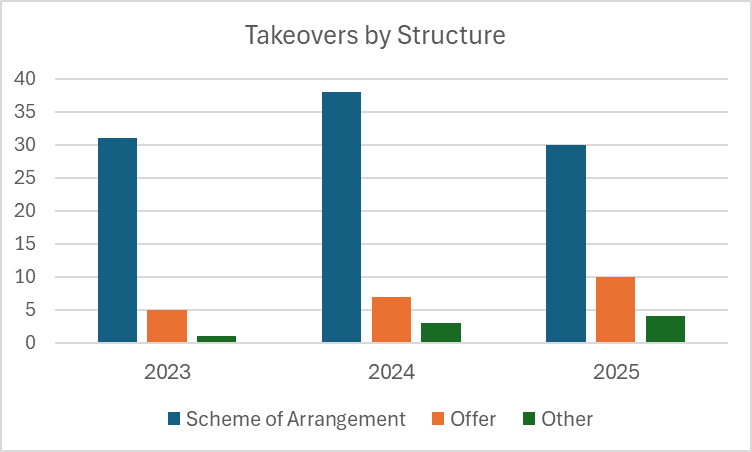
[“Other” includes any more obscure transactions, such as the divestment of most of the trading assets to an acquirer, but not the parent company.]
However, the lower threshold for control is attracting some acquirers back to traditional takeover offers in 2025. Indeed, we have seen some companies switch from a Scheme of Arrangement to an Offer. Idox (LON:IDOX) announced such a change this week. Presumably because the acquirer sees a risk that they won’t get 75% approval for the deal, despite board recommendation.
The vast majority of takeovers that were publicly mooted were successfully completed, meaning that if an offer is made public, it is likely to result in a payout:
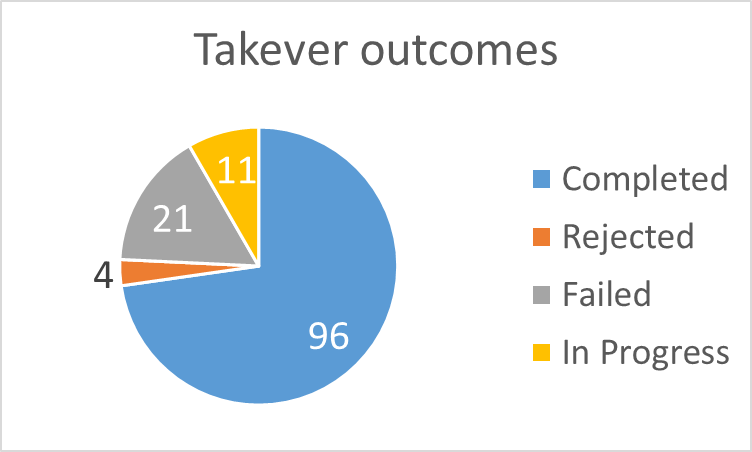
Only a small number were rejected by the board. However, there are still a number of offers where the acquirer pulled out. This is usually because they couldn’t agree on a price to be recommended, or they found something untoward in their due diligence.
Stakebuilding to prevent a takeover
One notable trend that we have seen in recent months is for some funds or trade buyers to block a bid where they feel that they would be better served by the business remaining independent. They do this by building up a stake in the target greater than 25%, which means that a Scheme of Arrangement won’t be able to be implemented. Dohler did this at Treatt (LON:TET). With the bidder, Natara, committing to a final offer at a given level, Dohler’s holding meant that the takeover didn’t go ahead. A similar situation is ongoing at TT electronics (LON:TTG), with DBAY announcing that they didn’t intend to support the 150p cash bid from Swiss-listed Cicor Technologies. However, that example is complicated by DBAY having made their own inferior offer.
Types of acquirer
Typically, there are two types of buyers: companies in the same business and investment funds, including Private Equity. The number of Private Equity bids has declined over the last few years, although this again probably reflects fewer listed companies available to acquire:
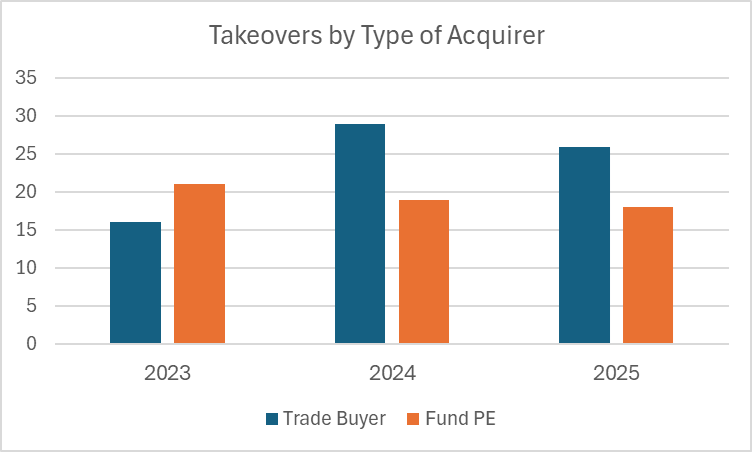
The number of Trade acquisitions in 2025 is down slightly on 2024, but still elevated.
Premiums paid
Calculating a premium can be tricky, as share price responses can be variable given the different stages at which takeovers are announced to the market. To estimate the premium, as well as using the published offer price, I have looked at historical charts to try to identify the “undisturbed price” prior to any offer being made public. Looking at the results, it is obvious why takeovers have the potential to make a difference to short-term shareholder returns. The median premium in our dataset is close to a 50% uplift. On a median view, trade buyers are definitely more generous. However, looking at the mean average, it is the Fund buyers that come out on top. This suggests that Private Equity is more variable in the price they are willing to pay.
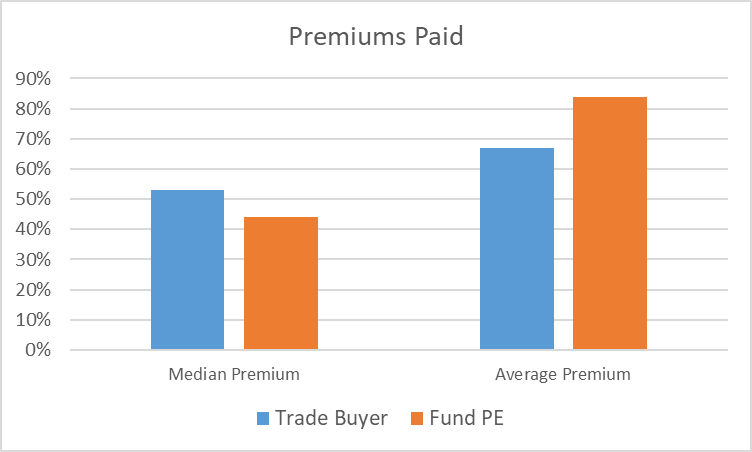
When it comes to premiums over time, the data is a bit noisy:
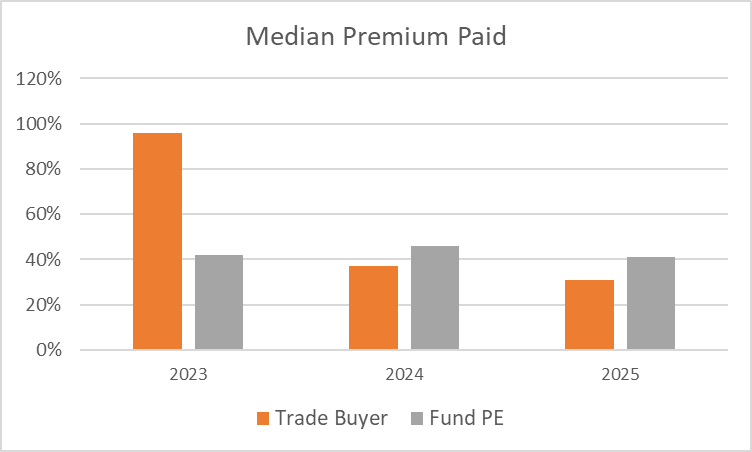
2023 had an unusually large number of Trade Buyer takeovers at high premiums. However, these included companies, such as FireAngel, which found themselves in financial trouble and where the share price had been dropping precipitously, hence a large premium to the undisturbed price was not unusual.
While the median private equity premium looks pretty consistent over time, trade buyers look to have paid a lower premium in 2025. Out of 51 completed trade buyer deals in our data set, 43 were all cash, 5 were a mix of cash and shares, and only 3 were share-based offers. This suggests a reluctance of trade buyers to use their shares to make acquisitions, as they may view these as undervalued in these markets too. Overall, it is not clear whether investors should prefer a trade bidder or a private equity deal.
Size of target companies
The size of the companies bid for varied significantly, from just a few million pounds to Anglo American (LON:AAL) at £29bn. The larger the company, the more likely the offer was to be in shares or a mix of shares and cash. The largest deals often look more like mergers than takeovers. This makes sense as few companies have billions of pounds sitting available for deals.
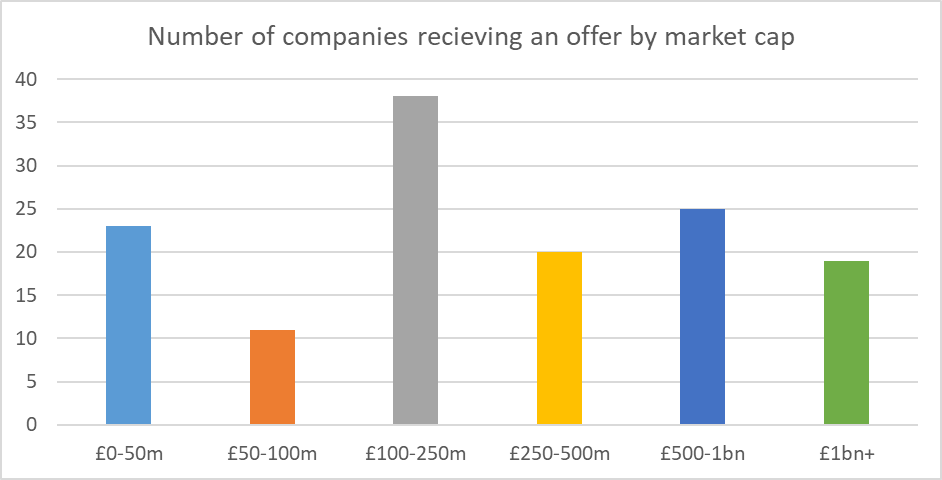
The lower end tended to be dominated by trade buyers, but there were several Private Equity offers below £20m, so I don’t think we can rule out any size of company from receiving takeover interest. The median size of a company receiving an offer in our data set was £243m. There does seem to be a certain sweet spot from £100-£250m market cap:
I have a theory that we are going to see takeovers accelerate in the smaller companies in 2026, as the valuation gap between profitable small and micro caps continues to widen compared to the largest UK-listed companies. Here is how this metric has changed since I started tracking it in the Summer:
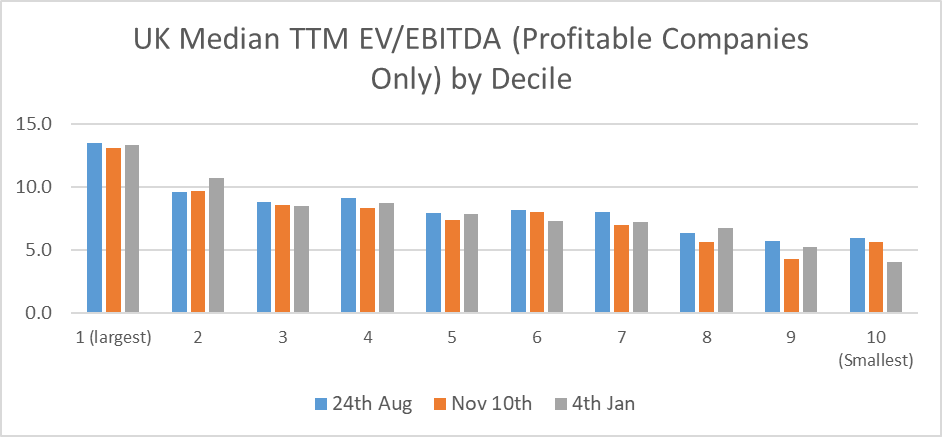
[Each decile here represents around 80 trading companies. So Decile 1 is roughly the FTSE100, 2-4 the FTSE250. The £100m market cap level and below is decile 7-10.]
To be honest, anything out of the top 150 largest trading companies (i.e. less than £1.5bn market cap) looks to be a pretty compelling fishing ground for acquirers on these metrics.
Next week, Alex will take a more detailed look at the characteristics of companies that have been taken over in the last few years.
Disclaimer
This is not financial advice. Our content is intended to be used and must be used for information and education purposes only. Please read our disclaimer and terms and conditions to understand our obligations.

12 comments
The first chart is rather alarming. I do not see a future for the uk market if it keeps along the current trajectory. Thanks for the article, I’m looking forward to reading more.
But Mark has cheekily used a standard ruse in this setting by plotting the y axis starting at 1600 instead of zero. Very naughty.
Regardless, the number of UK listed stocks reducing by over 30% over c. 10 years is rather alarming!
Not my chart so I had no control over this I'm afraid!
Interesting article, would be revealing to see the companies behind the analysis. Maybe the London Stock exchange needs to relocate to New York at this rate of attrition.
The high number of takeovers and tiny number of IPOs in recent years is a very worrying trend that must be broken as soon as possible, if you ask me. The UK market feels far less deep than it did ten years ago. A one-off 30-40% return is no compensation for the loss of quality long-term investment opportunities.
I was actually thinking about compiling a table listing all the good names that have been removed from our investible universe in recent years, compared to the new issues that have come to market. When viewed that way I think it would really highlight how the pool has shrunk.
Why funds keep ignoring the uk market is beyond me.
Interesting post based on a lot of hard work ... thank you.
Thanks for this interesting article. It sounds like it took a fair amount of legwork to pull this together from Stockopedia resources so kudos for that. On the takeover outcomes chart, does the completed section include initial board rejections?
An initial board rejection could still end up in a successful takeover if a) an improved offer is made or b) a hostile takeover is forced through if major shareholders don't share the board's view that the offer should be rejected. I don't suppose it is straightforward to find data on this but would be interesting if it could be found.
Hi Michael_P,
It depends if we hear about it and it is considered serious enough to be rated PINK on the DSMR. I'd imagine we may miss a few where the management said we received an offer and rejected it (say on an investors call rather than in a RNS, for example), and the takeover panel didn't get involved. This is actually very rare. Typically, management just don't tell us if they get a speculative offer that they reject out of hand. But then since nobody knows and it comes to nothing then it doesn't move the price, so it's not worth considereing in our analysis anyway!
HTH,
Mark
Thanks Mark but my point was more about serious offers that might get rejected initially but where the takeover still ultimately goes through. So this would be where the potential buyer's access to funding is not in question, but the disagreement may be mostly about price and possibly also about strategic direction. A slightly different way of framing my question is what percentage of rejections of those type of offers still lead to the takeover going through with that buyer in the end?
Related to that, an initial serious bid can sometimes draw competing bids so even if one potential acquirer is rejected, that still might lead to an increased chance of an acquisition by another party.
interesting look forward to seeing some names