Taking losses or cutting positions; my experience with JohnsInvestmentChronicle

Since launching the JIC Portfolio in January 2012 it is up 114.5% as of Friday 19th June 2015. I have had some losses along the way but in general I have tried to cut losses before they inflict too much damage. The table below shows the nine worst losses in the JIC Portfolio since inception in January 2012. Apart from Gem Diamonds, which I still hold, all the others were sold, or cut, crystallising a loss.

My approach to “cutting” positions
“It’s not a member of the family!”
The biggest obstacle to cutting a position and taking a loss is our own psychological frailties. In general we hate to admit we are wrong and thus find it painful contemplating taking a loss; I find that once I cut a holding from the portfolio, that I have been fretting over for days or weeks, I actually get an enormous sense of relief; I don’t have to stare at it anymore with it taking up a disproportionate amount of my time and sapping my energy. The most important thing to me is the performance of the overall portfolio; that’s all that matters, not what one individual stock does. Don’t get emotionally involved, after all, as one of my old colleagues says “it’s not a member of the family!”
My view, learned through bitter experience, is that you are best cutting losses quickly. Conversely you should let your winners run. As Warren Buffet said “cut out your weeds and water your flowers”! All too often we are tempted to do the opposite. We add to our losers as it reinforces our original decision to buy it: “I was right to buy it at 100p so I must be even more right to buy more at 85p, after all it’s cheaper. Oh, and I will fund my purchase by selling part of my holding in another stock which is doing really well!”
I think it’s best to sell and move on; it saves a lot of emotional heart ache as well as money. The only stocks I really worry about are the stocks that I hold, after all they are the only ones that can damage my wealth should their share prices collapse. Stocks that are going up that I do not hold are purely “opportunities lost”. In other words, if I cut a holding because it looks like it is going to damage the overall portfolio, I do not beat myself up if it bounces afterwards!
When to cut; “When my information changes, I change my mind. What do you do?”
If things change: If you bought a stock because you thought the market was underestimating the potential growth in the business and that earnings would be upgraded and then suddenly it starts to disappoint and earnings start to slip. As the great economist and investor John Maynard Keynes reportedly said after being criticised for changing his view, “When my information changes, I change my mind. What do you do, sir?”
Profit warnings: If I am unfortunate enough to hold a stock that issues a profit warning I tend to get out. Humans are generally optimists and management rarely communicate how bad things really are, either because they cannot see how bad it is or because they have an innate optimism that things will get better, or that they can make them better. Things normally get worse before they get better and as the old saying goes “profit warnings are like buses – they come in threes.”
Change in share price trend: One of the triggers I use is when the trend in the share price clearly looks as though it has changed from moving upwards to downwards. A few years back a City chartist showed me a simple rule which I quite liked; if you put a share price chart up on the wall and step back to the other side of the room, you can get a pretty good idea what the trend in the share price is. If it looks like it has rolled over then that’s time to ask yourself why you are holding this stock.
Gut feel; sometimes it just does not feel right. The worst that can happen is that the stock goes up!
Automatic stop losses
I do not put automatic stop losses on with my online broker; I like to have control of when I sell and in any case I tend to look at the closing price each day. I don’t like being taken out by an intra-day spike down in the share price which proves temporary.
What happened to each of the nine stocks subsequently?
Coms PLC, sold in November last year has fallen another 80%!
Chariot Oil & Gas, sold in December 2012 has fallen a further 64%
Cape PLC, sold in August 2012 has been volatile but is up 36%, (however the JIC Portfolio has pretty much doubled since then).
Polo Resources, sold in December 2013, along with Anglo Pacific and Agriterra is down a further 73%. Anglo Pacific has halved and Agriterra has dropped 64%.
FlowGroup, cut on the 8th May this year is down 46% after last week’s profit warning
International Biotechnology Trust is up a lot but I decided at that time to focus my exposure to biotechnology through the Biotech Growth Trust, which has also performed extremely well.
Run your winners
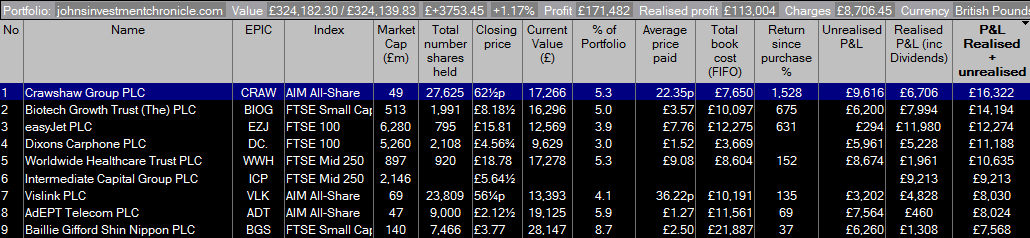
Just for completeness, and because the list of losers makes pretty depressing reading, I have shown below the nine most profitable holdings in the JIC Portfolio since inception; of the nine, eight are still in the Portfolio. “Run your winners!”
Disclaimer
This is not financial advice. Our content is intended to be used and must be used for information and education purposes only. Please read our disclaimer and terms and conditions to understand our obligations.
4 comments
"Every dog has its day"
Fully support John's comments re: cutting losses. One point to bear in mind though is that possibly many investors psychologically find it difficult buying back into a company they have sold and lost money on before, e.g. cutting losses after dropping 20% and then buying back after a further sustained price fall.
Some of my most profitable investments have been so by doing exactly this. Of course, doesn't always work if the fall is due to bad news or a change in direction.
I just remind myself that if a share price drops by 50% then I need it to go up by 100% in order to recover my losses. It focuses your mind pretty sharpish.
Good article John - Thanks for posting. I find selling my poorly performing stocks very difficult mainly in part because the market tends to overreact to profit warnings. When a profit warning comes along the stock price is usually hit badly on the day and then recovers somewhat over the next few weeks. However, I agree that profit warnings are not isolated incidents and Xaar (LON:XAR) is an excellent example of where over a 12-18 month period they issued a number of warnings and the price fell further each time. Incidentally, I bought after the 3rd or 4th warning but was in too early and am now only at break even. I would now sell at the first sign of difficulty (1st warning), because it's highly likely that there will be further and worse profit warnings to come - Tesco springs to mind. I do however look at companies which have under-performed and there are indications that the worst is over - management have addressed the issues head on and looked to diversify away from difficult markets for example. It may also mean that management make a better effort to guide and inform the market conservatively (under promise and over deliver) and this is especially important for businesses that have lumpy earnings - Spaceandpeople (LON:SAL) is a great example of how the management have become much more focused, transparent and better at conservatively guiding the market, so that expectations do not get ahead of the actual business. Such companies and turnaround situations are risky but can be rich pickings for value investors. I think what i'm trying to say is timing is crucial - That is not selling at the bottom when management have finally come to terms with the specific issues and are actively addressing them (after more than one warning) but to sell straight away after the first signs of difficulty - you can always buy back at a later date when the turnaround has started!
As Warren Buffet said “cut out your weeds and water your flowers”!
Peter Lynch I think. In one of his books he proudly recounts how Warren Buffet had telephoned hinm to ask permission to use that quote.