The Jump - what to do when share prices react to Trading Statements

It’s trading statement season. Every January, a flood of company announcements hit the RNS newswire. There are often 25-30 every morning. It feels like a tsunami of information and can be overwhelming to take in. It’s daunting reading every one, and most serious investors barely get through a fraction of them. But what if there was an easy way to identify the ones that matter? Just this week we’ve seen two small cap companies jump 20% or more on a trading statement. What is this signalling to the market? What should you do as a shareholder, or potential shareholder? That’s what we’ll dive into today, and identify some simple rules of thumb that work.
Why UK trading statements are unique
Trading statements are a real cultural artefact of the LSE reporting environment. In the USA, companies report their financials quarterly, rather than every 6 months as in the UK, so the gaps between announcements are much shorter. UK companies routinely fill this gap with “Trading Statements” which give a good read whether the company is “ahead”, “inline” or “below” expectations.
These public trading statements kick off a round of discussions with city brokers and company analysts, leading to earnings forecast upgrades or downgrades. This creates a cycle where analysts revise their expectations, research is disseminated to clients, and buying or selling intent feeds into the market. As a private investor, getting ahead of these cycles is key, which is why trading statements matter.
The impact of trading statements on prices
In my piece before Christmas, “ahead of expectations” I noted how the academic research shows that when there is a surprise on the upside or downside, the share price tends to drift in the same direction in the coming months.
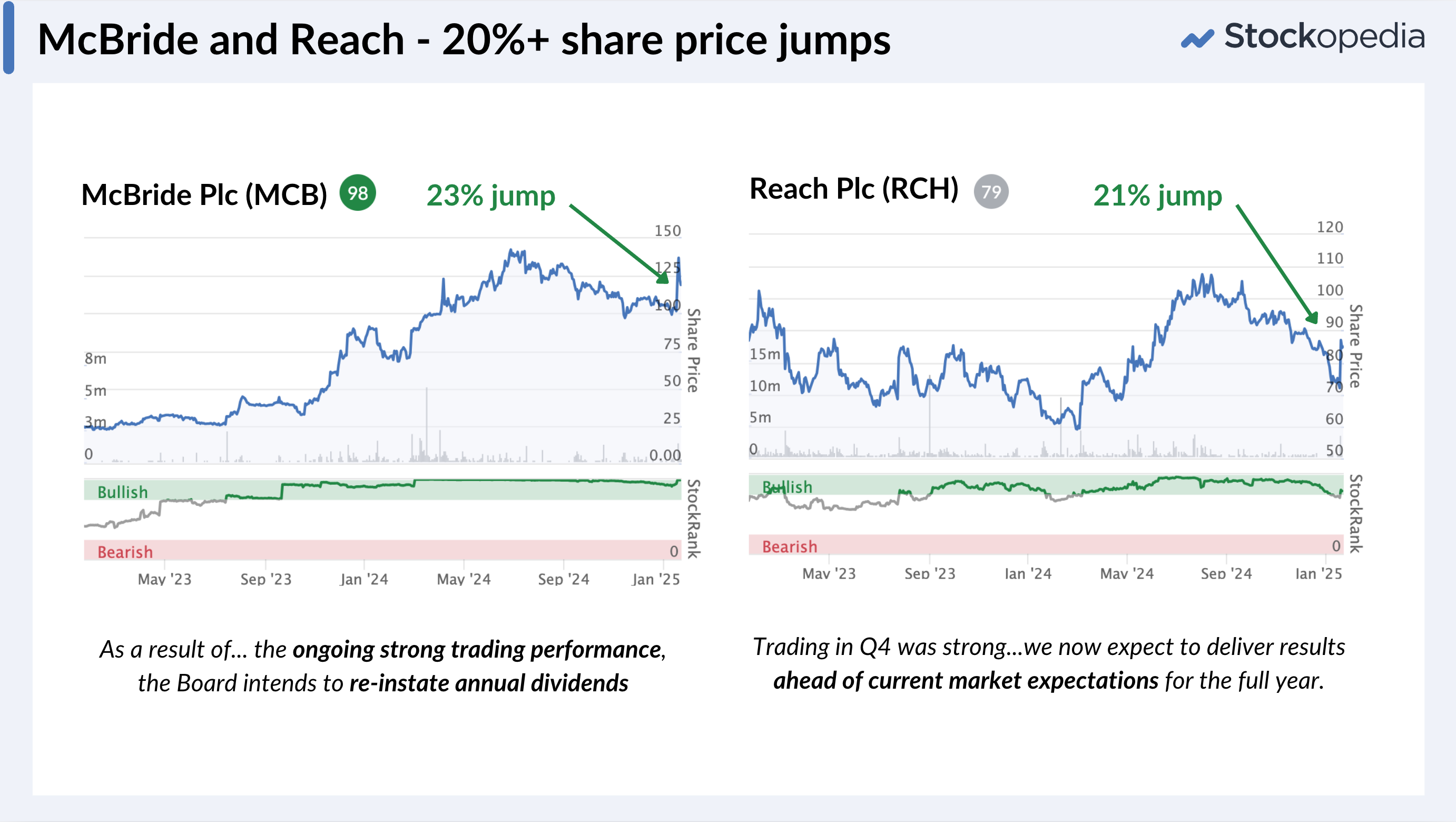
In the last few reporting days, we’ve seen two popular small caps, McBride (LON:MCB) and Reach (LON:RCH), release trading statements that caused their share prices to jump 20% in a single day. As an ex-Reach shareholder, my immediate thought was “I knew that was going to happen” and then went off to research other shares. But in the light of the academic research, this may not be a rational decision.
New insights from our own research
While academic research from the US is valuable, the UK environment is different. So we’ve kicked off a research project into the value of UK trading statements. The goal being to understand how investors should act when companies experience significant single-day price jumps for different announcement types.
As part of this project, we’ve collected and analysed 2,699 trading statements published over the last two years in the official RNS trading statement classification. By identifying exact matches to key phrases like "materially ahead of expectations", "ahead of expectations", and "below expectations", we’ve studied how share prices react on the day of the announcement and in the months that follow.
What the data reveals about price jumps
We’ve only been able to match 55% of trading statements with these exact phrases, but the results are compelling. Here are some key insights:
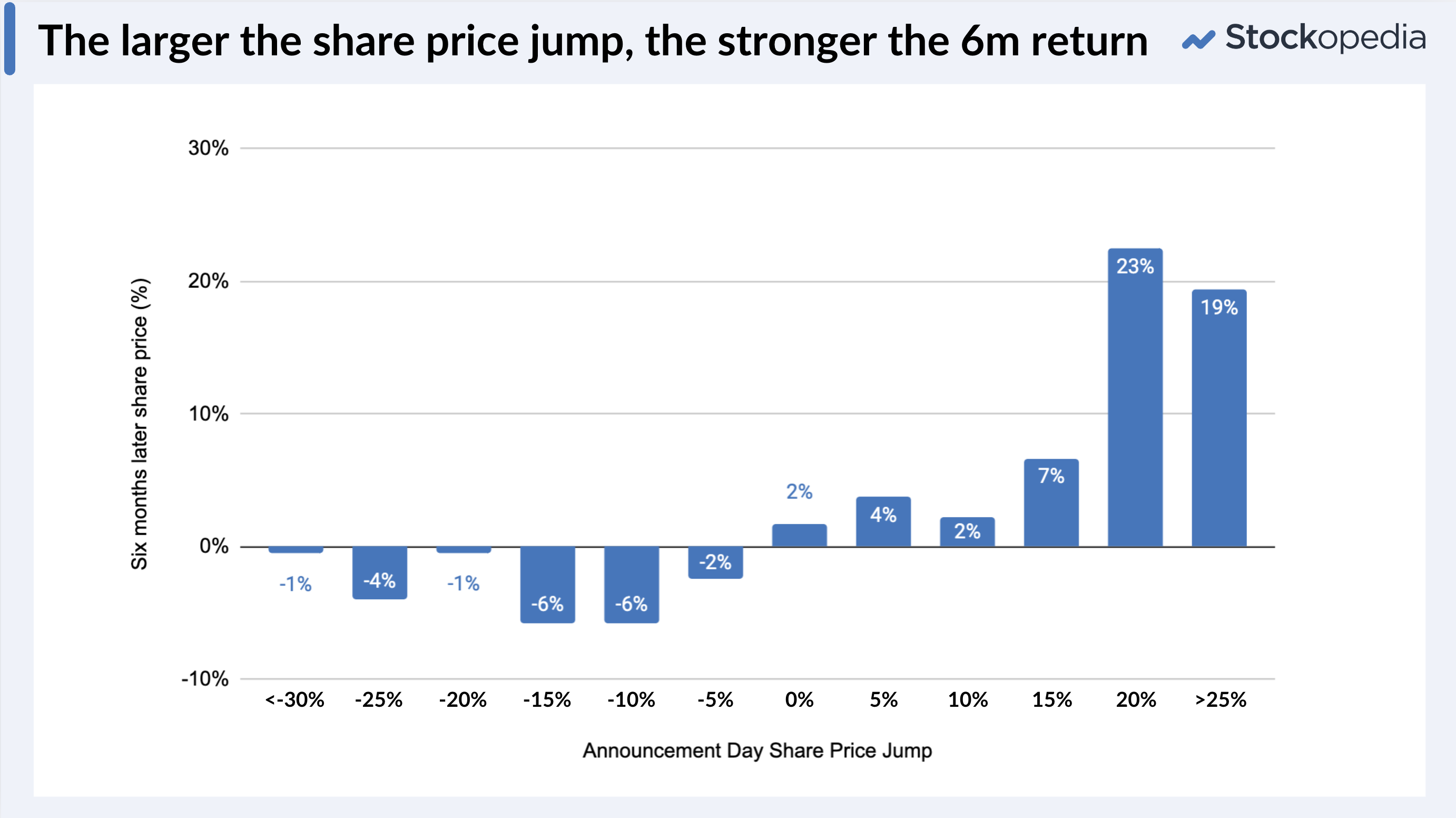
1. Larger First-Day Jumps => Stronger Share Price Returns
- A 5% jump on the day is promising, but a 20%+ jump even more so.
- Large jumps may indicate that current expectations are wrong. This is regardless of whether the actual company announcement is “inline”, “ahead” or “below” official expectations.
2. Post-Announcement Share Price Drift is Real
- For stocks with a 15% or more jump on the day, the average return over the next six months (excluding the first day jump) is an additional 14%. This is what academics call the Post-Earnings Announcement Drift (PEAD).
- We found that companies that reported an announcement in one direction (ahead or below) were significantly likely to report another announcement in the same direction following it.
3. “Significantly Ahead/Below Expectations” Phrases Matter
- Companies reporting “significantly ahead of expectations” on average jump the most on the day, and experience the strongest continued share price drift in the same direction.
- Companies reporting “significantly below expectations” act similarly in the opposite direction.
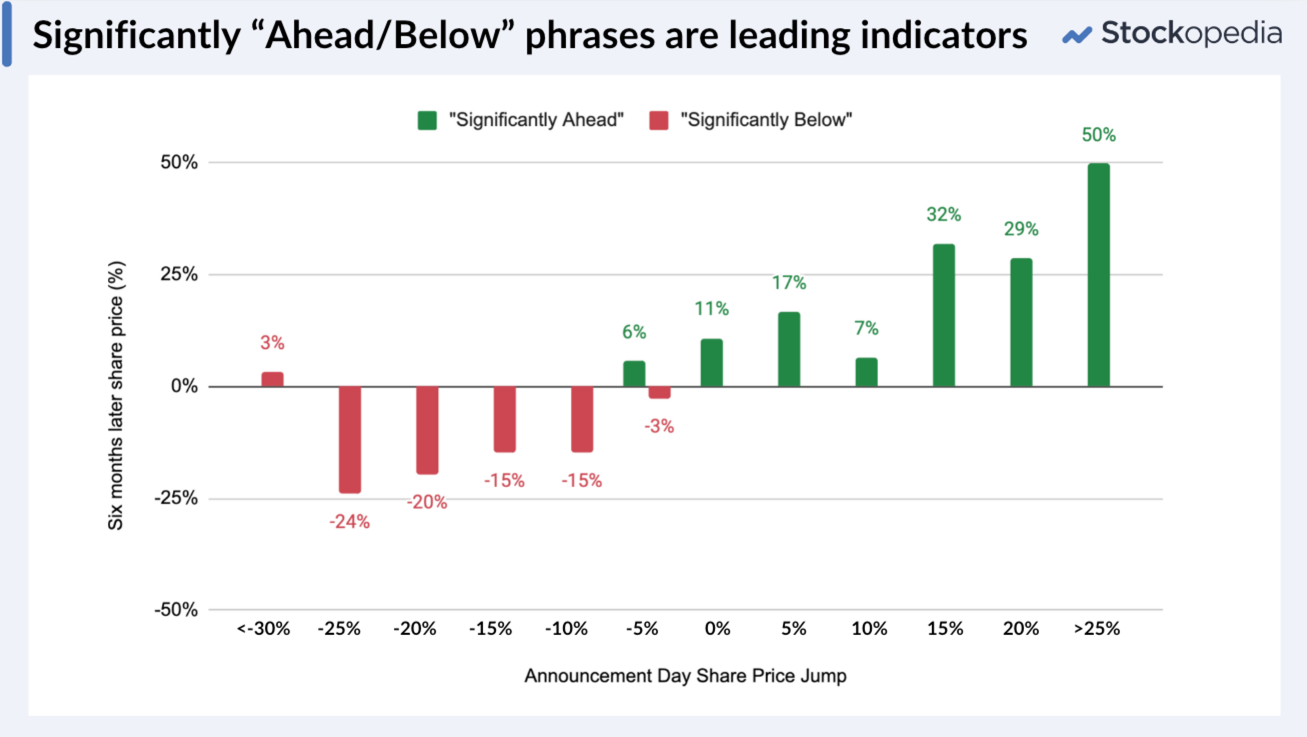
NB - it’s important to state that there are small sample sizes in the above chart. The “significantly ahead > 25% jump” cohort in the chart has only 3 stocks in it. What the community might enjoy is that the stocks in question are Filtronic (LON:FTC) (trading statement → 2024-04-24), Synectics (LON:SNX) (2023-12-11) and Beeks Financial Cloud (LON:BKS) (2024-02-06). Please do discuss!
Using these signals
The real magic of trading statements is in their ability to reveal expectation errors - i.e. shares that are just priced wrong. These share price jumps seem to be the best indicators. While these results are just preliminary and only based on two years of data, they do show that share price jumps may be more than just noise. They are actionable.
Some ways you can incorporate these into your own research and investing process include:
1. Pay attention to share price jumps
- Watch the market for companies that announce trading statements, and dig into the ones that show significant share price reactions, especially with clearly phrased statements like “materially ahead” - it may be a leading indicator.
3. Let the share price drift
- If you own a stock that announces it’s ahead, and whose share price jumps - don’t sell. Stay invested for the next six months at least. When buying on a positive announcement, again, don’t trade short term, let the post-earnings share price drift do its thing.
4. Sell on profit warnings
- I’m sure by now you don’t need me to remind you about this. But these results reinforce our previous research into below expectations announcements. These are profit warnings. “Sell immediately on a profit warning” still stands, unless of course the share price jumps!
Next steps
Going forwards, I’m keen to push this analysis back 10 years, drive the phrase matching percentage up, and also incorporate the StockRanks as an overlay. Several recent research papers suggest that the returns to quality, value and momentum may be driven entirely by expectation errors. If we validate that, then the StockRanks are ultimately good predictors of companies that will beat expectations. But beating expectations is generally only seen in news announcements… so if you want to be first in the queue, reading trading statements matters!
Disclaimer
This is not financial advice. Our content is intended to be used and must be used for information and education purposes only. Please read our disclaimer and terms and conditions to understand our obligations.

71 comments
This morning I came across this report on the Academy- Ahead of Expectations: How trading updates drive share price momentum. Dont know if I missed the report being discussed on here, but I think the results in the two charts which are also displayed in this article, are really interesting. Firstly regardless of whether the share was in line, ahead or below expectations, the exceptional results only came if the share price rose over 15%, especially 20%. Secondly if the company significantly beat expectations the performance was considerably better if the share price rose on the day. The slight laggard for both data sets was 10-15%, yet 10% is the minimum requirement for Ed`s 3 rules (later article) which add stock rank over 75 to the equation, as well as above expectations in the report. This has left me wondering a couple of things. If a share significantly beats expectations, will it outperform on average a share which just beats expectations ie do we have data for shares merely beating expectations and rising on the day. Secondly if the share rises more than 15% in a day is it more likely to outperform, as this data suggests so. This has changed my perspective a little, as I was suffering from recency bias and too much focusing on Ed`s last article on this subject and whether a stock rank was over 75 and whether the share price has risen 10% or not, yet this article suggests to me each factor is important on its own. Perhaps significant beat can be accompanied with a lower daily share price rise, perhaps a share rising 15-20% doesnt need the other two factors.
Would it be possible to see the ‘larger first day jump’ data split between stock rank quintiles on the day of the trading statement?
Would be great to get something added in the 'events' section of charts to show trading updates, here is a mock up of what it could look like.
A basic colour coded system: green = 'ahead', grey = 'in line' etc.
Great idea!
Lovely trend on AT&T (NYQ:T) having pulled back somewhat and recovering into a solid buyable gap today
Possibly an extreme example Aurora Mobile (NAQ:JG) had a buyable gap in November and one today but 200% gain! I'd find it difficult to buy
Ed,
You point out the shortage of UK data measuring the effect a of large >15% Day 1 price jump so your Stocko back test returns and rules of thumb outcomes are particularly interesting.
So I hesitate to add an additional 2023 Chinese stock market analysis which finds that a jump in a stock's price between its closing price on Day 1 and its opening price on Day 2 after an earnings surprise, is a better predictor of subsequent PEAD. (It's not clear to me though whether their opening definition is the price at the opening bell, or sometime later).
The authors report that a positive “Overnight Return Jump (ORJ)” gives the market longer to assimilate positive earnings surprise news and is more predictive in a long only strategy. A >3% (higher is better) Jump at the open of Day 2 is significant in predicting future Chinese PEAD and produces a quarterly excess return of >6%.
The authors point out that China has a large % of retail investors so an Overnight Jump signal leading to PEAD may not apply to the same extent in the UK. But my feeling is that because the PEAD anomaly is pervasive then the UK investor has probably not missed out by not buying on a Day 1 Jump and can profitably wait until the morning of Day 2 to decide whether to buy, or not?
For curiosity I looked back at the next day price of the >25% Surprise Jump PEAD stocks you reviewed namely Filtronic (LON:FTC) Synectics (LON:SNX) and Beeks Financial Cloud (LON:BKS) and 2 of the 3 went up further by the close of the next day. McBride (LON:MCB) was also up by the next day close. Would be interesting to know if and what their % price change was up at the open, but unfortunately I don’t have access to this data?
The China PEAD Download: https://papers.ssrn.com/sol3/papers.cfm?abstract_id=4589824 Post earnings announcement drift: A simple earnings surprise measure, the medium effect of investor attention and investing strategy (2023)
Ian
BKS was gapped up 15.43%, FTC 15.15%, SNX 9.73% and MCB 11.41%
Recent gaps:
Paul,
Yes in the UK Concurrent Technologies (LON:CNC) looks good and passes my Trended Momentum screens.
Interesting - I'll definitely take a look at the Chinese PEAD research ! One to add to my Zotero.
Ed, has your research shown any material evidence of the correlation in wording to to the significance of the move:
eg:
Ahead,
Slightly ahead,
Materially ahead,
Substantially ahead,
Significantly ahead..
Is there some kind of implied effect to the wording/terms used?
I have just attempted a 5 tiered classification that's best summed up as "significantly ahead", "ahead", "inline", "below", "significantly below". There are market abuse rules and regulations (MAR) which provide guidance given to companies and PRs about issuing insider knowledge whenever it is likely to have a market impacting results. Not all companies though give clear market feedback - but essentially "significantly" or "materially" when added to "above/behind" or "below/behind" has a strong impact.
From a methodological PoV Ed, are you looking at sentiment? : many of the initial responses are more about how investors behave rather than how they should act . This can often be that Buffet window of opportunity "impatient vs patient" or Ben Graham's "voting vs weighting": it was as true 100 years ago as now.
Sounds like you are taking a more longitudinal view in measuring the impact: I've found the the real hard bit is often acting in the heat of battle but having the rigour of that research reduces the uncertainty on a probabilistic basis. A lot of the methodological work I have been doing is how to do that better and not lose too many fingers but then I have approached this incrementally by studying price dislocations on a daily basis for years whereas you are coming from a study of the trading statements and then the impact on price retrospectively : they are two sides of the same coin though my data contains more noise (which can be filtered which I do by datamining ) .
Reading your work has sparked some ideas to scrutinise my own though I try to tame the academic in me as it was my original metier and passion (QM and data modelling complex experimental data using Monet Carlo type analyses to find s structure- activity relationships so not that a million miles away )
There's also a sectoral asymmetric response for example. Biotechs have a much higher sensitivity than Utes to the same phrases : Retail tends to misbehave , junior Oilers and Miners can go bananas on drilling/reserve and story stocks " ramp and deramp" with the changing narratives. That is also a function of the majority holders (retail vs instis) and on the mcaps/relative liquidity (galloping elephants) as well as the underlying nature of the business and inherent risks/rewards .
Guessing you are being selective on sectors. In my work I have found the vast majority of price dislocations occur in resource stocks : of the 10% price pops and drops they are even more weighted towards resources - the pie chart below shows the 7261 LSE share price daily movements of >10% in a day over the past 8 years : mainly miners , oilers, pharm and software companies which is unsurprising (these are number of price changes and not unique stocks )
This is from a total universe of 53,994 daily price movements of over 3% since 2018 which skews to Oil and gas, Miners and then Software
.Adds to the complexity.. and I know and sometimes simplifying can be edifying but then the devil can be in detail
I'll follow your work with interest
dscollard - yes, I've only looked at wording in trading statements, and not at the sentiment of the overall news article. I have had openai try and classify, which is still quite promising, but gives varied results.
I've not looked at sectors, but I have now pulled in the first day gap data, which is quite useful. As you say "in the heat of battle" it would be good to be ready to purchase during the first trading day, or before the open, rather than waiting till the end of the day.
My initial stab at this suggests that the end of day move is about 25% higher than the opening gap on average ... so there is correlation, but also a lot of noise!
I've done some research on those stock that have produced buy-able gaps over the last year using the criteria set out by Kacher & Morales (see below). Quality in the form of the F-Score (I've chosen this as havent access to Stocko database) doesnt make much difference to the results. In fact it's probably detrimental to the stocks performance after a gap. So have set F-Score to minimum of zero. Also some F-Scores have improved e.g. Beeks Financial Cloud (LON:BKS) improved from 3 to 7 over the course of the year. Cap loosened to 10m minimum. Adjusted Slope set to minimum of -1, catches stocks going sideways as a minimum. Only included stocks that havent gap filled results in 29 stocks with an average gain of 68% and current gain of 41%. Pretty impressive and worth further research imo. Those in green have gapped up in the last 30 days.The volume rank gives the rank of the weekly volume compared to the last 52 weeks, 1 is best. Just need to delve through the RNS' to see if there's a definite reason for the gap.
Plenty of big risers this week, will be interesting ti see how they fare, over the next 6-12 months. I do hold a few such as Mortgage Advice Bureau (Holdings) (LON:MAB1) and Ashtead Technology Holdings (LON:AT.).
I may start a folio, see that performs.
l wonder if the performance, is due to a few big risers, l know some have doubled last year and the rest cancel each out, more or less.
Excellent article again Ed with plenty of things to think about / opportunities to improve my stock selection.
Thanks Ted - more to come on this. We've just pushed the research back by ten years, and the results vary in magnitude but not in conclusion. I'll likely continue to publish on this for the next 2 weeks. I'm trying to stick to a Wednesday routine for publishing with everything else going on - so next insights should be then.
SRT Marine Systems (LON:SRT) I hold
I posted earlier in response to Ed highlighting a significant SP move and said I would post again after attending the AGM yesterday.
For anyone unfamiliar with what SRT does, in its own words SRT" is an established leader in the rapidly developing global maritime surveillance and navigation safety market which is entering a long term phase of rapid growth. Our technology driven products and systems enable marine stakeholders from nation-states to individual mariners to enhance their marine domain awareness and improve surveillance, intelligence, safety and security at sea, in ports, along waterways and coast lines." SRT designs the high tech devices that send and receive AIS signals universally used by shipping to announce their position, speed and course. These signals can be collected and interpreted by its Maritime Domain Awareness system akin to Air Traffic Control for boats. The GeoVis system is capable of fusing data from multiple sources, including AIS, cameras, radar, radio, satellites and biometrics. From millions of individual inputs, the system seeks those that point to activity that requires human response and alerts system operators so that they can respond. The systems side of the business offers sovereign countries the ability to know what is going on in their waters. This is vital for security, safety, fisheries management, etc to identify illegal, terrorist, smuggling activities as well as observing activity by foreign states with bad intentions. These systems have already been sold to Bahrain, Saudi Arabia, Philippines, Kuwait and a large contract with Indonesia is close to initiation. These are my notes from the AGM:
As ever it was very informative and certainly worth the effort folk made to attend. One person I spoke to said he thought SRT were very unusual in allowing shareholders unfettered access to employees to ask whatever they wished. Answers whilst avoiding sensitive information were genuinely useful in forming a view on how things are going and in the sort of detail that will never be seen in published reports.
I started by trying to find out more about the launch of the X100 (Nexus). Initially it will be an EmTrak product hence X100 not Nexus. In time OEM’s are anticipated to include it in their offering but the strategy is to get a substantial user base who think it is a marvellous product. Marketing is planned via 5000 or so dealers so SRT will ensure they know what the X100 can do and they will have their own customer base into which it will be sold. Sound quality has been a top priority in the development of this product to ensure it performs better than anything else on the market. The actual product is constantly being tested by a small cohort of real boat owners who supply SRT with feedback on a weekly basis which allows for tweeks if there’s anything they would like to see done differently. The X100 has inbuilt MOB (Man Overboard) unlike rival products which tend to be standalone and often not used because it’s too inconvenient. Software updates are simply done by feeding the update to the mobile phone or watch and then to the Transceiver as soon as they connect.
Early feedback is that users love the convenience of the connectivity and the ability to use the radio via their ‘phone or smart watch without any delay. The overwhelming impression I got was that SRT are very pleased with the market response, eg at METS, and the volume of pre-orders exceeding expectations. I was told more than once that there is nothing on the market that can match it. A very limited production run has begun and is expected to ramp up gradually once everyone is confident that the user feedback will be highly positive. They do not want any disappointment hence the controlled, cautious early production.
Kuwait required pretty much immediate mobilisation and staff were called upon to work over the Christmas period to meet customer expectations. Simon Tucker CEO said he met no pushback to this request which demonstrates to me the commitment and unity of staff to the collective goal. The customer was very impressed and this has boosted SRT’s reputation in the region. Some existing structures are having to be used for control centres and towers because they exist not because they are ideal. Building new ones takes time but this approach gets things up and running earlier. They even have a mobile control “room”, a van full of servers that can collect data from remote locations and feed it into the system until more permanent arrangements are put in place. Ocean Infinity will provide underwater and surface level autonomous vessels/drones. With the advent of drones and unmanned aircraft decisons will have to be made about how high surveillance needs to go. Oliver stated that the sea is a very challenging environment for this equipment and the customer needs to understand that things may not work perfectly from day one. Internet provision is less than ideal and there is no broadband as we know it at present. Satellite communication may be needed, eg Starlink. Clearly Kuwait is at the start of a journey which will take years to travel.
I asked about Indonesia and EKEF financing which being a Government agency is incapable of moving at the pace required in the real commercial world. The customer wanted a performance bond the next day, and was persuaded to extend the time limit to 30 days. Even that was too quick for UKEF resulting in SRT seeking new finance from Ocean Infinity. The loan to cover the entire project cost has now been agreed in principle (having taken nearly two years from the initial request), with Banco Santander (in Spain) providing the money. It will be released in stages as SRT raise invoices for each delivery milestone. I got the impression that we are just weeks away from the start of the project but everyone here has learned to wait for the confirmation rather than the expectation. The question of the effect of inflation on the fixed project cost was raised. SRT build in a contingency to costs which mitigates this. It is also the case that much of the Dell servers and desktops were acquired earlier and at lower prices. It was estimated that roughly 40% of the total project cost is shielded in this way and ST thought that the contingency allowance would suffice.
It was said that Indonesia are already talking about what they would want in the future as there is no Fisheries component in the project that has been approved. This underlines how, once a customer buys the system, it is normal for it to expand and evolve over many years.
I raised the question of staffing needs as they have a long list of positions to fill. ST and Neil Penniket agreed that it is difficult to find the right people and have already employed a recruitment specialist with another needed to seek out candidates for the vacancies. Conventional recruitment agencies do not have the same focus. LinkedIn is where they expect to find the people they need.
Countries are beginning to realise that they need what SRT can supply. Bahrain has suffered from depletion of fish stocks and because it has no means of regulating where and what can be fished it has imposed a blanket ban on fishing.
In Saudi they are intent on creating an environment that attracts tourists under Project NEOM on the Red Sea (Dubai on Steroids was quipped). Here security, safety , water quality, fish and reef health are vital and SRT can enable the customer to achieve what they need. Proximity to Yemen, Somalia, Syria and Iraq presents risk that will have to be managed by KSA.
OI were represented by Oliver Plunkett CEO of OI and our newest NED. Some investors enquired about the relationship between the two companies and the answers were reassuring from my point of view. At the most fundamental level OI can supply data that SRT currently doesn’t have but GeoVis can make sense of that data and present it to the customer, something OI cannot do on their own. That looks like a very symbiotic relationship to me where both parties see value added. Both companies have very similar cultures seeking to collaborate to make things happen. Each is pragmatic about how costs and profits should be divided. In the longer term Oliver said OI had not sought to enter into this relationship in order to take over SRT. Nevertheless, he was clear that things can change. ST expressed the hope that SRT would remain an independent company in 20 years time although he wouldn’t be its CEO. I took away the strong impression that there is no tension between these two entities.
In reviewing future project opportunities ST was confident that SRT will be spoilt for choice given the rapidly dawning appreciation that countries need data to be able to manage their MDA. They have already identified nearly £1bn of project opportunities that are realistic and capable of progressing.
Someone asked about Digital Aids to Navigation and ST said that it was part of what SRT offered and would enable autonomous shipping on rivers to know if there was enough room to pass under a bridge or enough depth to avoid grounding. At sea it would warn ships of the state of the tide and currents so course corrections could be taken. Margins on the equipment are very high.
My overall take on prospects for SRT are that the next twelve months should be transformative. For the first time they have multiple projects with truly long term customers, substantial revenues and a rapidly growing awareness around the world that digitising all available data is an imperative. This is a link to a presentation about the capabilities of SRT's MDA system.
https://srt-marine.com/mda-sys...
Thanks for the effort rwh3ue very helpful and comprehensive post
This is a fantastic piece of research, Ed, congratulations. I look forward to its ongoing development!
Yourself and other readers may find of interest the parallels with the work of Chris Kacher and Gil Morales in their (2013) Book "In the Trading Cockpit with the O'Neil Disciples". One of their key set-ups is the "Buyable Gap Up". Attached is a slide of their key rules. Some of their recommendations and qualifiers (volume, trend direction, etc) may be relevant in your own research, and help to tease out why some stocks perform even better than others from the "ahead of expectations" starting point..
There is a 45 minute Youtube video (from which the slide is taken) explaining the approach,, with real life examples, should anyone be interested:
Yes I've read the book - have always followed the O'Neil tribe ! Thanks for reminding me.
I've read the book. Thx for the reminder. I've been doing some work on gaps today so I'll incorporate their findings, see if it applies to the UK market
Saucepan. Thanks for posting this. I agree that this is very closely related to Ed's article above. Would it be fair to say that for most users of this approach, fundamental measures of value would play no part? I am sort of sat on the fence between fundamental analysis and technical analysis! To me it seems sensible to use both. So, for gap ups, I might just use a valuation measure to rule out extremely expensive shares. What do you & everybody else think?
WarrantStar, thanks for your thoughts. Like you, I prefer to have both fundamental and technical ducks in a row. Buyable Gap Ups normally occur frequently enough in the market to be able to have that luxury when making a choice from a number of candidates. I assume Morales and Kacher did enough research to conclude that strong fundamentals (however defined) made a statistical difference to outcomes. I also suspect, however, that the Disciples defined strong fundamentals more in terms of quality (margins, eps growth, etc) than value, and probably would not mind paying up. It is may be no coincidence that "value" is not one of the criteria in William O'Neil's "CAN-SLIM" approach.
Is there a stocko screen for these rules?
Hi Ed. Thanks for the excellent article. It has reminded me to cut losses asap on a bad market reaction. Unfortunately that is happening too often at the moment.
Most salient to me is that it is not the size of the profit warning (or earnings beat) that matters, it is the market reaction. For example CMC Markets (LON:CMCX) today down 20% because of a short RNS confirming previous guidance.
No point whining about Mr Market. He’s in a very twitchy/negative mood.
Very useful research. Can i make a suggestion?
The market does seem particularly 'jumpy' at the moment, probably due to the low UK market valuation. So it is important to look at other years. But this is a massive task.
I suggest that if just one month out of each of the past 10 years is used that would be a valid sample.
P.S. I have a PhD in finance.
@epitychia - I do agree. It's just an initial 2 year sample, as that's when the LSE RNS topic codes started... but we're going to push this back 10 more years as we are pattern matching the RNS headlines. The results will change I am sure.
What is interesting is the general theme is aligned with the PEAD research - so it's good to have some preliminary insights relating to the UK market.
I'm conscious of publishing early insight, when there's more to do and the findings will no doubt change, but the trading statements season ends in about 10 days, so thought it would be topical!
Hi I Ed, I love articles like this because 1) They are based on research 2) They are actionable.
In your prior article of 12/12/2024 on the related subject of "
“Ahead of Expectations” - three of the most powerful words in investing" you said "it’s often inexpensive value stocks like Greencore, rather than premium growth stocks, that respond the best to ahead of expectations announcements." Does the more recent research that you enlighten us with above confirm this valuation effect?
I was looking at Greencore (LON:GNC) yesterday. Last update 3/12/24, was good, shares went about 10% on the day, then fell back around 22% to 170p.
Since there has been a bounce but still well below the peak. Maybe a good buying opportunity?
Rusty, Thanks for your reply. The motivation behind my question to Ed was that I want to keep improving my investment process. I don't know much about Greencore apart from the fact that the rise in share price on the day of the announcement is a good thing. So I would say that Greencore might be worthy of further investigation,. But the original ahead of expectations statement was in October 2023, so I think we have missed the boat on that announcement. I haven't looked at the latest update that you refer to but, if it was ahead of expectations, and caused a decent share price rice on the day, then it would certainly be worth further examination.
Yes l agree we have missed the initial boat but this still applies to subsequent updates. I'm curious to know why the +10%, on the day, have performed worse than the +5% on the day risers. The latest update was at the top end of expectations. Since then the shares have fallen significantly.
Ed,
In your study were the PEAD returns quoted "actual" returns or "abnormal" returns. If "abnormal", how did you estimate normal?
Hi Ed,
It pains me to ask the question (see my comment in todays daily stock report) but what do you make of the 242% (an unbelievable one day jump!) in the 'penny' share price of ENGAGE XR Holdings (LON:EXR. This is not even on the back of a trading update but 'just' the announcement of a new product launch at an upcoming education exhibition. Whoever bought my shares at 0.5p on 6th January will have pretty much five bagged in a little over two weeks. I sold on what was yet another profit warning having held for 4 years - oh for a crystal ball!!
Personally - I avoid any stock below a £10m market cap... or even £20m these days. Liquidity can be just awful (in a bear market you never get out) and they are prone to manipulation.
Never heard of EXR - and I see it's all an AI/Meta/Education announcement. It's a product announcement and for all I know it's game-changing for the business, but it's not one for me.
I always wonder why nano-caps are listed at all.
£30m and a min gap of 2% on the open reduces the typical daily universe of gaps to 50-100 (from total LSE UK of about 1750)
..I set a max spread of 8% to further reduce the universe as low liquidity, spready shares give a lot of false reads ..they are inherently gapoy
Thanks for the great article Ed.
Ed
Been doing this kind of stuff for a few years (since 2018) - I call them Pops and Drops though they do conform to some rules and can be characterised in terms of the type of behaviour (breakaway, runaway, exhaustion etc) this depends on the gap type . I've drafted an ebook though never published it: contains a lot of rules and setups on how to handle these price dislocations and do what I call a Jump on Board (JoB)
Here's grab from today's which links the price movement to the Trading Statements and differentiates the Opening Gap from the overall price pop intraday (and then on subsequent days post gap to highlight the most persistent) : doesn't quite go to the granularity of the wording in the trading statements but does link to them as catalysts
I capture the same for price Drops
I have an archive of these going back to 2018 so about 55000 price dislocations which can be mined: i use simple rules to determine which momentum phase these are in (GoGo, MoMo, SloMo ) as mom post gap can be modelled based on some simple rules that characterize each phase (in decreasing mom)
The data model also differentiates between the opening gap and the increase since the gap : so can screen for all those which increased by a certain amount post gap - ie the more persistent ones
Easy to integrate the stock ranks into the data model and cross correlate
happy to chat if you are interested?
Please consider publishing your e-book! The data you've put together looks great.
Would love to read that if you ever decide the make the research available
Outstanding work, hoping you get your book out there sir
Is there anyway in which you could please make this e-book accessible to us?
I do plan to at some stage , much of the draft is done albeit the primary drivers were to -
So a whole schema which builds frameworks and processes with productised set-ups aligned to the overarching principle and underpinning research
below is one such Set-up process for a JoB as an example . The setup itself has a lot more detail and rules which define the conditions and therefore informs the risk (if/when those conditions ae violated) and help develop a trade narrative to track. While I make money on the outcomes I am becoming a much bigger stickler on process which needs enormous discipline and psychology
I was piqued by Ed's use of the word "Jump" as I use similar though as a verb not a noun but then I am more of a trader these days
Long answer to a short question but it's complicated and time consuming and I am busy doing the doing and executing the setups ... I hope to get time at some stage in Q1/Q2
Thank you for your detailed reply. One thing we have in common is that process development is top priority! I guess what would please a lot of us would be if you were generous enough to publish your trading rules on here for this kind of jump / gap up event. Thanks for considering it.
Very good article, sound advice, thank you
Thanks Ed - but with the MKT as it is - everything is an exception and 'rules' hard to follow. Just look at Beeks Financial Cloud (LON:BKS) - up 10% first thing today, now up just 3% - but yes, lets see where it is in 6 months
Bohenie, To be fair the Beeks Financial Cloud (LON:BKS) rns today was not a trading update it was simply to confirm that the Exchange Cloud contract was indeed for the Nasdaq and it has now gone live.
Stocks can be very volatile when digesting news intraday (e.g. see the profit warnings chart from yesteryear in this thread)... the analysis today is done on the close of the announcement day.
I'm keen to extend the analysis to contract wins, acquisitions and other types of announcements through time - to see if it holds.
Regarding your comment Bohenie, the market seems to have changed over the last month. Several stocks I hold have had TUs. A good TU ( or at least it seemed so to me) triggered a good rise of 5%+ early at 8am. However prices have then fallen gradually over the day eg Card Factory (LON:CARD) , B&M European Value Retail SA (LON:BME) and today J D Wetherspoon (LON:JDW) and I'm sure many others.
I wonder if amongst other factors the underlying reason is the lack of buying volume causing asking prices to slip.
Anyone have any other thought on any of my comments
BTW I have only listed stocks I hold
The early morning prices are set by the market makers, if there is more selling than buying then the price will fall. Good update then the price will be marked up at the opening. Thin market, low volume, even small trades, under £1,000 can move the prices.
Threepeat.
The 3 shares you asked about did not issue “better than expected” trading updates. It’s those “better than expected” and “profits warnings/ below expectations” updates that often see the big share price moves as covered in detail by Ed Croft in his brilliant article today.
I think already up trending stocks are favoured. Ones like McBride (LON:MCB) on a downtrend could easily fall prey to profit taking. Lots of things to consider
Paul, Yes I favour smooth uptrends to, but just occasionally run with early recovery picks if the news and the metrics align.
Interestingly – the very best one day move was in SRT Marine Systems (LON:SRT) right at the bottom. It ended up marking the low, and it wasn't an "ahead" of expectations announcement.
So yes, this announcement price change is a very good recovery indicator too.
SRT Marine Systems (LON:SRT)
I hold and follow closely so I know the company well. The share price jump coincided with a trading update that exceeded expectations. It said "Unaudited group revenues for the first half are expected to be £25.5m, generating a profit before tax of approximately £2.5m."
Recently the prospects for this company have strengthened significantly. They undoubtedly have world beating tech in the field of maritime surveillance but the process of securing contracts has been beset by delays owing to the complexities of dealing with overseas countries. However in a surprisingly rapid turn of events, in October they were awarded a £170m contract by Kuwait which was required to start immediately. The customer required a performance guarantee bond which SRT would find difficult to finance at short notice. The solution came from an injection of capital from Ocean Infinity which received a stake in the company of approximately 24% and a seat on the board.
OI are themselves able to supply high tech monitoring equipment to complement SRT's system software increasing the attraction of the joint offering. Having such a well financed partner has encouraged shareholders to expect further contracts to be initiated, particularly with Indonesia and Kingdom of Saudi Arabia which are already well defined. In addition there is a pipeline of prospects which SRT values at £1.2bn
Ultimately, SRT watchers believe OI will takeover the company in which a large percentage of shares is tightly held by a relatively small number of individuals rather than Institutional investors. The belief is that SRT will be worth considerably more than the current market cap.
It's the AGM tomorrow and I plan to attend. If I learn something useful, I hope to post it.
Fascinating re. SRT Marine Systems (LON:SRT) - thanks for the insights. Just goes to show how much price and volume action around announcements can point the way...
Yes McBride (LON:MCB) is a low margin business with a chequered past. Costs are very likely to increase for various reasons. I don't what proportion of their products are imported but with the £ falling, that could have an impact. Plus we have all the wage rises and NI increases to contend with soon.
Certainly is allot of profit taking going on at the moment. Good updates, shares go up 8% only to close up 1% on the day, seen that quite a few times recently.
McBride (LON:MCB) is an interesting case where the closing price on Friday had jumped +23% to 124p. Early this week the closing price peaked at 137p before settling at 120p by lunchtime today. Having read you piece and looked into McBride (LON:MCB) more closely I have opened a starter position. Am hoping your PEAD of +14% average subsequent 1st day gain apples 6M later, so the SP is 140p. In this case though because the V and Q scores are so high I would’nt be surprised if the price isn’t a lot higher.
It’s rarely too late to jump on board PEAD, but I will review again after their H1 outlook on 25th Feb.
McBride (LON:MCB) the large rise has resulted in profit taking, it has given back over half already. I was considering buying this just before the rise. Reach (LON:RCH) l did hold and have sold.
An 8% share price lift on McBride (LON:MCB) on Thursday so others are buying into their changing fortunes today.
These are a list of phrases ive come across over the years:
I sold Sanderson Design (LON:SDG) immediately on the recent profit warning, only to see it go up over 20%, in the next 2 days. I'm seeing quite a few shares bounce after falls from profit warnings. Vistry (LON:VTY) and IG Design (LON:IGR) are 2 but there have been some others.
Profit warnings do bounce on the day - they bounce the most if they've fallen the most. But they mostly end up as opportunity cost for the next 18 months. See the ebook.
I find these stock market observations by Ed and others most interesting so keep them coming. Reading in the business section today was the
I keep a log of discretionary analysis like this (see below) if it helps. Not completely upto date as only needed when a share comes onto the radar. I own Filtronic (LON:FTC) ,Beeks Financial Cloud (LON:BKS) Supreme (LON:SUP) and On Beach group (LON:OTB) and hoping to hop on Synectics (LON:SNX) and maybe Sage (LON:SGE) at some point. Most are in profit so your analysis has some merit
Yes - and it's fascinating how much companies with momentum continue to announce beats.
e.g. here's Filtronic (LON:FTC) since the first SpaceX announcement. Up 95% since that first "significantly ahead" announcement.
When was the Yu (LON:YU.) significantly ahead because the shares are significantly down.
re. Yu - The last significantly ahead was Jan 23rd 2024 - up 25% since the close that day. But it was up 46% after 6 months. I don't have the last couple of week's announcements in my db... but it's been more inline recently.
Also Yu took off well before my database starts... it was announcing "ahead" from September 2022, and the first "significantly ahead" announcement was I believe this one. in November 2022.
Another really interesting and useful article - these really add value to the Stockopedia subscription so please keep them coming. As it happens I bought 4imprint (LON:FOUR) this morning based on the principles outlined. Very helpful to have some facts and figures to confirm that this was probably a good thing to do. I'm looking forward to further research in this area particularly data based on a greater time period.