The top rated ASX financial stock

Janus Henderson (ASX:JHG) is the highest ranked Australasian stock in the Financial Sector with an overall StockRank of 98. It is also the largest funds management stock on the ASX by market capitalization. Investors in ASX listed fund managers have had a fairly bruising time over the last few years, but it has not all been bad news.
The chart below depicts the performance of the five major fund managers listed on the ASX compared with the S&P/ASX All Ordinaries Index. As can be seen the fund managers have significantly underperformed the index in the last 12 months, however the majority of that underperformance occurred in 2022. Indeed, the fund managers group have outperformed the index since the start of 2023.
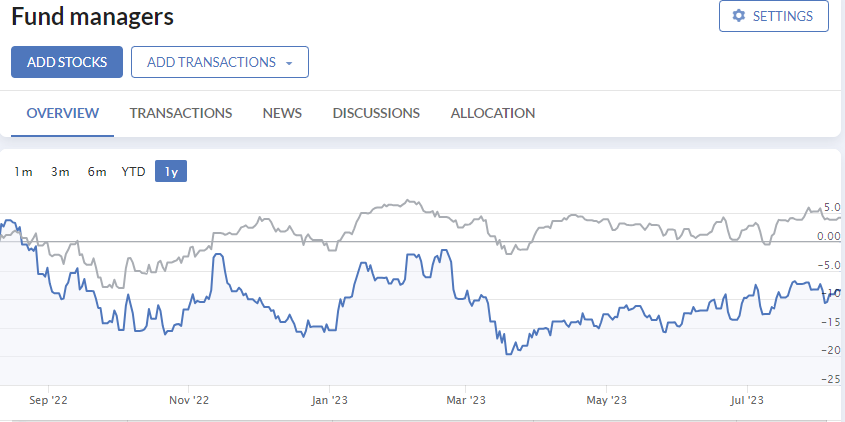
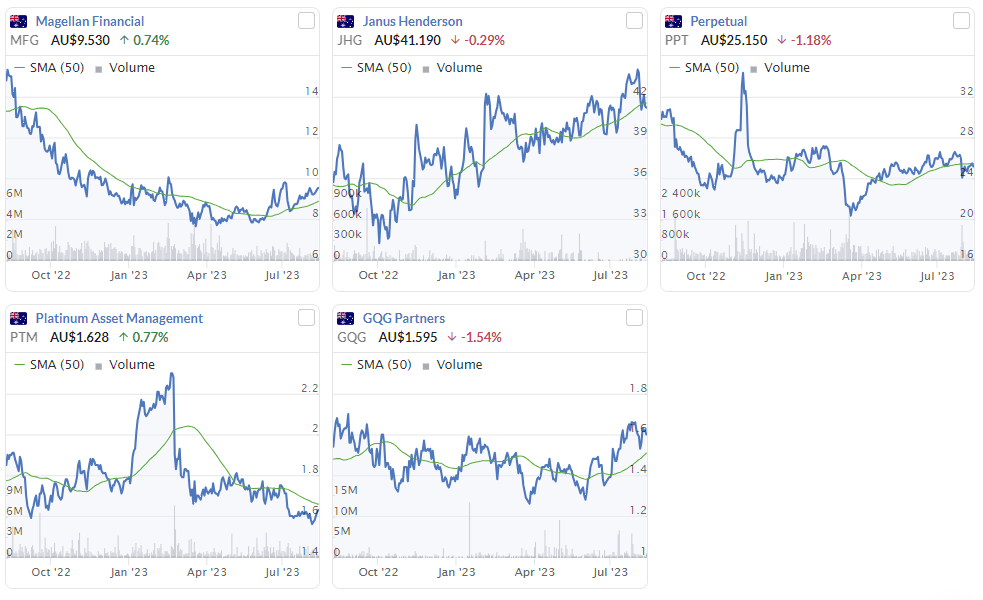
Within those five, Janus Henderson has been the standout performer over the last year.
Janus Henderson has a long history of nearly 90 years and has undergone a lot of corporate shape shifting over that period. Henderson was a UK company and Janus Capital was a US company. The Australian connection occurred in 1998 when AMP acquired Henderson. This marriage only lasted five years and Henderson was demerged from AMP and began trading in its own right on the London and Australian Stock Exchanges in 2003. They made further acquisitions of funds management groups including Australia based Perennial Fixed Interest and Kapstream Capital.
In 2017 the merger between Henderson and Janus took place. The shares are now traded on the ASX as well as the New York Stock Exchange. They are headquartered in London with offices in 24 cities throughout the world, including Sydney, Melbourne and Brisbane.
Today Janus Henderson has about $500 billion AUD in funds under management. They are an active manager employing strategies across multiple asset classes. 62% of the funds are invested in equities strategies, 20% in fixed income and the rest is in multi-asset and alternatives as at the end of June 2023. The chart below shows the breakdown of assets across client types, strategies and locations. (The asset classes differ slightly from above as the chart is as at end of 2022)
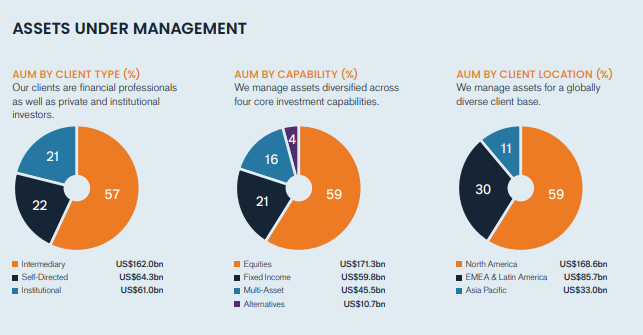
Source: Janus Henderson, Annual Report 2022, 24/3/23
Revenue for a funds management business is directly related to funds under management and funds under management is determined by two things: net inflows and outflows and investment performance. The former tends to be influenced by the later.
As with many active managers, the last few years have generally seen outflows for Janus Henderson. Active managers have been under pressure world wide as passive funds management products, like index funds and Exchange Traded Funds (ETFs), experience very strong growth.
The second component, investment performance has been quite good. Over the last three years 68% of their funds under management have achieved performance levels in excess of their benchmarks.
At the end of 2021 funds under management were $US432 billion and declined to $US282 billion by the end of 2022. They have now rebounded to $US322 billion. This decline in funds under management has led to revenue falling from $2.8 billion in 2021 to a forecast of $1.9 billion in 2023.
So why does it rank so highly?
It is classified as a Super Stock as it scores highly across all three factors.

The Quality score is boosted by solid operating margins of almost 20% as well as strong cash flow. The Value score is supported by a low forecast PE ratio of 11.5, along with Price to Book Value of 1 and a dividend yield of 5.9% (unfranked). And the Momentum Rank reflects increasing forecasts for EPS along with the relative strength in the share price over 6 months and a year.
Looking at the peer group of fund managers listed on the ASX we can see that they all rank quite highly, driven by the Quality score.

Fund managers tend to score well on quality as they generally generate strong margins, good returns on investment and have zero or very little debt.

When comparing the valuations across the businesses, another useful metric is to compare the market capitalisation with the funds under management. On this metric, Janus compares very favourably with its peers as shown in the table below.
Mkt Cap $Am | FUM ($Ab) | Mkt Cap/FUM | |
Janus Henderson (ASX:JHG) | $ 6,818 | $ 500 | 1.4% |
GQG Partners (ASX:GQG) | $ 4,784 | $ 108 | 4.4% |
Perpetual (ASX:PPT) | $ 2,847 | $ 212 | 1.3% |
Magellan Financial (ASX:MFG) | $ 1,717 | $ 39 | 4.4% |
Platinum Asset Management (ASX:PTM) | $ 927 | $ 18 | 5.2% |
One of the big risks faced by fund managers can be key man risk. Magellan suffered heavily from the departure of its CEO, followed swiftly by founder and star fund manager Hamish Douglass and then Australian equities manager John Sevior. Some of the other fund managers also depend heavily on key people. The CEO of GQG owns almost 70% of the shares on issue. This is less of an issue for JHG. They have a large and diverse team spread across geographies and asset classes. Consequently their performance is more reliant on teams and processes rather than star individuals.
In the short run, the fortunes of a funds management firm sways with the markets, but long-term success relies on a sound investment process, and a well run business. Active managers have been under pressure, but they are unlikely to disappear. Markets would cease to function efficiently without them.
Of course, funds management businesses, like all financial services businesses, are built on trust. If confidence evaporates, the business can come under immense pressure. Many investors have learned the hard way of the risks associated with these businesses, but they can still be a very profitable business provided the risks are understood and you do not overpay.
Important Information: Stockopedia Ltd ABN 39 757 874 670 UK business registration number 0637267 (“Stockopedia”) is an Authorised Representative of Daylight Financial Group Pty Ltd ABN 77 633 984 773 (“DFGPL”) which is the holder of an Australian Financial Services Licence (AFS Licence No. 521404).
Information in this commentary is current as at date prepared unless otherwise stated. However, please bear in mind that investments can go up or down in value, and that past performance is not a reliable indicator of future performance. For more Important Information please refer to the Disclaimer section of this website.
This communication may contain general financial product advice. It has been prepared without taking into account your personal circumstances, and you should therefore consider its appropriateness in light of your objectives, financial circumstances and needs before acting on it.
If our advice relates to the acquisition or possible acquisition of a particular financial product, you should obtain a copy of and consider the Product Disclosure Statement (PDS) before making any decision.
Disclaimer
This is not financial advice. Our content is intended to be used and must be used for information and education purposes only. Please read our disclaimer and terms and conditions to understand our obligations.
1 comment
To evaluate JHG as a business you need to know (1) whether the teams and processes you mention make them a good steward of other people's money.
I completely agree that a shift back to skilled active managers will take place but they're extremely hard to pick - the trouble for average ones will be ongoing.
I'd expect the FUM to shift among your list of Aussie Fundies and to and from passive indexing over coming months and years as the proof of the pudding (1) will be in the eating.