The Week Ahead (19 Oct – 23 Oct): Tesla & Bloom Energy to Report as the AI Trade Wobbles

1. Market Recap
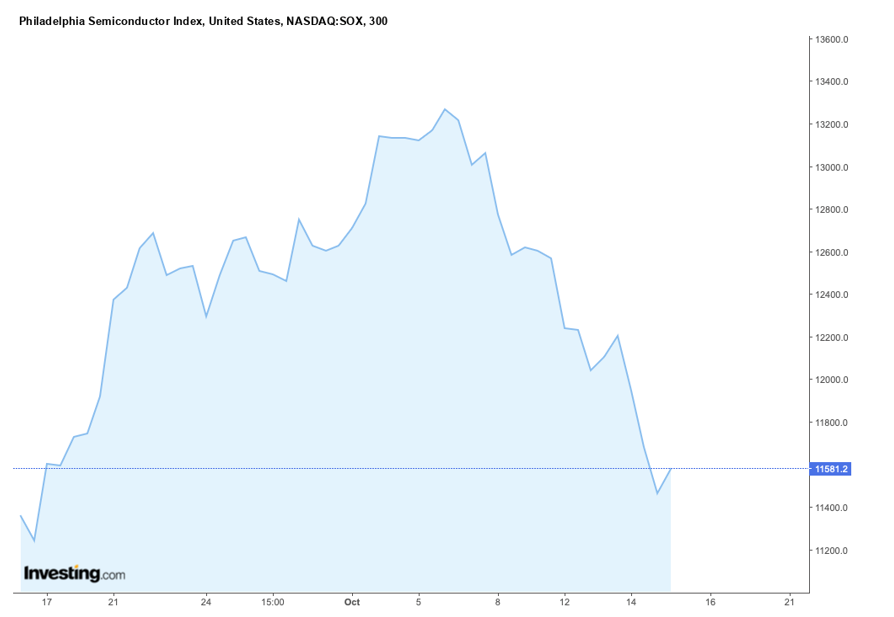
It has been a rough week for the AI trade – and if you had any exposure to semis, probably one of your worst in a while. We’d started the week with the Philadelphia semiconductor index already on a losing streak, and by Thursday it had fallen for seven sessions in a row. Nvidia’s record close of $239 on 6 October now looks a long way off.
The selling came in several legs. First, China’s leading DRAM maker ChangXin Memory Technologies (CXMT) announced progress on a new 4F² memory cell architecture, with its president saying the company aims to launch a DDR5 server product on it by the end of 2026. The architecture development is important because it uses a vertical transistor – shrinking the footprint. SK Hynix and Samsung led the selling, and the Kospi ended the week down 13.8%.
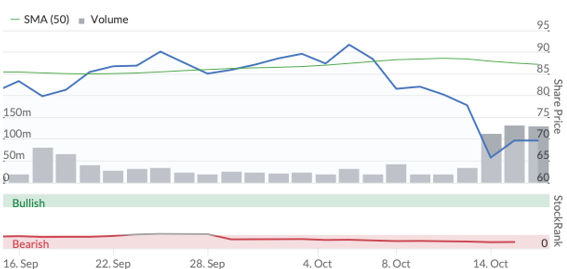
Then came financing. On Tuesday, the yield on CoreWeave's (NSQ:CRWV) 9.625% 2032 bonds started climbing and was sitting around 15% on Thursday – that’s distressed territory for a company that only sold the paper in June. Venture capitalist Chamath Palihapitiya posted the yield chart on X; Elon Musk replied “yikes”. Five-year credit default swaps on CoreWeave hit 1,194bp on Thursday, which implies a better-than-even chance of default over five years. The shares fell 15.5% on Wednesday alone.
Then a reversal. CoreWeave fell as much as 9.5% on Thursday morning before Jensen Huang, speaking in Stockholm, told Bloomberg that “CoreWeave’s strength is improving every day… I’m optimistic. Their cost of capital is actually decreasing” – while adding that Nvidia, which owns around 10%, doesn’t need to backstop it. The stock closed up 5.9% representing an intraday swing of 15%. Some may note this isn’t what a healthy market looks like – it looks more like forced selling and leveraged positioning.
Broadcom’s Hock Tan didn’t help either, likening investor enthusiasm for AI to a “casino” and adding that frontier labs like OpenAI are still losing money.
Results from TSMC and Anthropic couldn’t steady things. TSMC’s Q3 was a beat on revenue and earnings but gross margin slipped 130bp on the 2nm ramp and the ADRs fell 1.8%. Anthropic told investors at a Wednesday event that Q3 revenue was $16.8 billion, up around 45% on the quarter, and that it was cash-flow positive ahead of an IPO now pencilled in for November. It’s reportedly targeting $100 billion ARR by the end of the year.
[Chart: Philadelphia Semiconductor Index (SOX), past month. Source: Investing.com]
[Chart: CoreWeave share price, past month. Source: Stockopedia]
All of this happened against hot data. September US CPI rose 3.7% year-on-year against expectations of 3.6%, with core at 2.6% against 2.5%. On the month, headline was in line at 0.6%, but core came in at 0.3% versus 0.2% expected. No surprises in that energy was a major source of inflation -- energy rose 5.2% on the month and gasoline 9%. Thursday’s PPI was worse: 1.3% on the month, the biggest rise since March 2022. The inflation data revived talk of a hike at the 27–28 October FOMC -- Fed chair Warsh has avoided commentary.
And yet bond yields fell. The 10-year Treasury nearly reached 5.33% after CPI on Wednesday, then dropped to 5.06% on Thursday – its lowest since 23 September. This appeared to reflect money coming out of equities and into duration -- a haven trade. The 30-year followed, from 5.6% at the start of the week to 5.42%.
BlackRock’s Rick Rieder put it like this on Thursday: “Just like the weather, inflation can still act erratically at times.” His take is that the direction of travel on inflation “should turn more positive”, but that “inflation is still running hotter than desired”, and he “would slowly add to real rates on significant back-ups, particularly at the front end of the yield curve” – while staying “committed to the notion that diversified income with moderate interest rate exposure is the right disposition for fixed income portfolios today, rather than taking on large amounts of interest rate risk.”
His boss also made headlines this week. On Wednesday, Larry Fink warned that a moratorium on data centres – now a live issue in the midterm campaign – would tip the US into recession. “If we have a moratorium of some sort in this country, we will be in a recession,” he said. “So much of our economy is based on the buildout of this capex.” Or as Bloomberg’s Tom Keene has pointed out more than once, strip out the AI build-out and the rest of the US economy is flat out on its back.
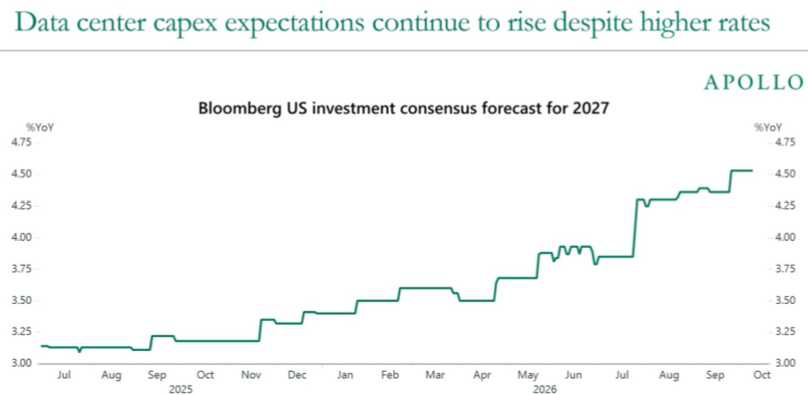
For now, the spending forecast is very much intact. Apollo’s Torsten Slok published a chart this week showing the Bloomberg consensus forecast for 2027 US investment growth has risen from around 3.1% in July 2025 to 4.5% now, despite higher rates.
[Chart: Bloomberg US investment consensus forecast for 2027. Source: Apollo]
The wider backdrop:
- Iran, the Houthis and the oil spread: there is no ceasefire and no scheduled talks. Trump said last week that the US “will not be attacking Iran at any time prior to the Midterm Elections” on 3 November. This week he added that the war would end after them. Meanwhile the Houthis have been getting through Saudi defences: missile strikes on Riyadh’s King Khalid airport and on Wednesday a strike on Aramco’s headquarters in Dhahran. The result: Brent sits around $105–106 while WTI is near $96–97; the spread was $13.85 on Monday versus $4 in July – the gap is price of the risk at sea, with tanker rates running several times higher than before the war. An end to the war still represents a major catalyst for equities.
- French debt hasn’t gone away: the OAT–Bund spread is at 135bp, off the 150bp seen on 5 October (the widest since 2011), and the French 10-year briefly topped 5% – the highest since 2002. Christine Lagarde has said the ECB’s tools “carry clear conditions” and that for France “the primary and first solution lies at home… it has to do with fiscal policies.” With the presidential election in April, France is a story worth watching.
- UK – the calm before the Budget: August GDP came in at +0.1% against expectations of a 0.1% fall, with 3m/3m growth of 0.7%. The IMF upgraded its UK 2026 growth forecast to 1.3% and said UK borrowing would fall by around 4 points of GDP by 2031, the biggest improvement in the G7. The FTSE 100 closed Thursday at 10,840 – the economic forecast, modest weakening of the pound, and Chancellor John Healey’s comments about the budget may all have contributed to this.
Here’s what we can look forward to next week:
2. Economic Calendar
No major central-bank decisions next week: the Fed is in blackout ahead of the 27–28 October FOMC, and the ECB (29 Oct), Bank of Canada (28 Oct) and Bank of Japan (30 Oct) all meet the week after. For the UK, Tuesday’s labour market data and Wednesday’s inflation and public finances prints are among the last big official releases before the Autumn Budget on 28 October. All times BST (UK time).
| Date | Time | Region | Release |
|---|---|---|---|
Monday 19 Oct |
03:00 |
China |
Q3 GDP, September industrial production & retail sales |
Tuesday 20 Oct |
07:00 |
UK |
Labour market – unemployment, average earnings (3m to August) |
18:00 |
UK |
BoE’s Megan Greene speech, LSE |
|
Wednesday 21 Oct |
07:00 |
UK |
CPI (September) – sets benefit uprating, feeds triple lock |
07:00 |
UK |
Public sector finances (September) |
|
14:00 |
UK |
BoE Governor Andrew Bailey, OMFIF fireside chat |
|
18:00 |
US |
20-year Treasury auction |
|
Thursday 22 Oct |
13:30 |
US |
Initial jobless claims |
15:00 |
Eurozone |
Flash consumer confidence (October) |
|
Friday 23 Oct |
00:01 |
UK |
GfK consumer confidence (October) |
07:00 |
UK |
Retail sales (September) |
|
09:00 / 09:30 |
Eurozone / UK |
Flash PMIs (October) |
|
15:00 |
US |
University of Michigan consumer sentiment (final, October) |
3. Macro Theme Deep-Dives
Two Years In: Is This Another 1873?
We are now two years into the AI infrastructure boom, according to Liaquat Ahamed, the Pulitzer Prize-winning author of Lords of Finance and a former fund manager, who spoke to Bloomberg on Thursday evening about his new book, 1873: The Rothschilds, the First Great Depression, and the Making of the Modern World. His subject is the American railroad boom, and his argument is that infrastructure booms tend to last two to four years. The railways got built, but many of the people who financed them were wiped out.
Ahamed explained the parallel when the book was released in June. The seven big AI spenders – Amazon, Microsoft, Alphabet, Meta, Oracle, OpenAI and Anthropic – are projected to spend “$800 billion to $1 trillion a year”, and the funding has been migrating from cash flow to debt, private credit and special-purpose vehicles, which makes it “more vulnerable in a downturn”. “I have seen numbers like these before,” he wrote in Fortune. “They did not end well.” And: “The line between visionary investment and ruinous excess is invisible until after you have crossed it. We may have already crossed it.”
It was a narrative that fitted the week just gone. Jay Cooke’s bank failed in 1873 because it had financed the Northern Pacific on borrowed money. CoreWeave has $35.6 billion of debt, had $640 million in net interest expenses in a single quarter, and has a $104 billion backlog at the end of June that only pays out if the customers at the other end keep spending.
But the counter-narrative is just as strong. HSBC’s Max Kettner is among the most bullish of bulls, pointing to strong earnings growth and relative valuations. And investment expectations keep being revised up – Apollo’s chart above shows 2027 investment forecasts have risen steadily for fifteen months.
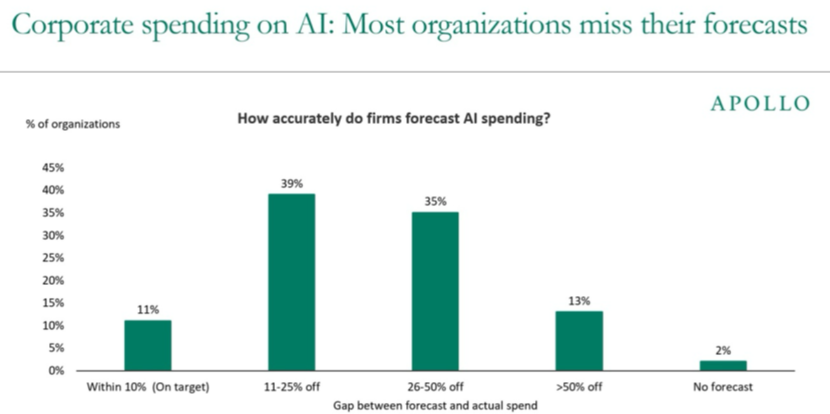
Apollo also published this survey of 396 organisations, and it shows that only 11% forecast their AI spending to within 10% of what they actually spent. 39% were 11–25% off, 35% were 26–50% off and 13% were more than 50% out. Corporate AI budgets are not being planned; they’re being discovered. In other words, it’s why demand keeps surprising, but it’s also why nobody can model where it stops.
[Chart: How accurately do firms forecast AI spending? Source: Mavvrik/Benchmarkit via Apollo]
UK Data into the Budget
Next week brings the last big UK data before John Healey’s first Budget on 28 October. The September CPI number matters most: it sets April’s benefit uprating and feeds the state pension triple lock. Meanwhile Tuesday’s jobs data and Wednesday’s public finances will frame the Chancellor’s headroom.
In recent months, the forecasts have improved: the IMF expects 1.3% growth in 2026 and the biggest fall in borrowing in the G7. Clearly energy is the risk. Gas is at its highest since December 2022, and Cornwall Insight forecasts a 16% rise in January’s price cap. The Bank of England’s Megan Greene speaks on Tuesday evening and Governor Andrew Bailey on Wednesday afternoon.
4. Companies Reporting
| Date | UK Trading Updates & AGMs | UK Financial Results | International Financial Results |
|---|---|---|---|
Monday 19 Oct |
South32 (LON:S32) (Q1 operations) |
ITM Power (LON:ITM) (Finals), Tristel (LON:TSTL) (Finals), Beeks Financial Cloud (LON:BKS) (Finals) |
Fifth Third (NSQ:FITB), Steel Dynamics (NSQ:STLD) |
Tuesday 20 Oct |
Anglo American (LON:AAL) (Q3 production), Bunzl (LON:BNZL) (Q3 TS), GB Group (LON:GBG) (TS), Sabre Insurance (LON:SBRE) (TS), Gear4music (LON:G4M) (TS), Trifast (LON:TRI) (TS), XP Power (LON:XPP) (TS) |
BP Marsh & Partners (LON:BPM) (Interims) |
GE Aerospace (NYQ:GE), RTX (NYQ:RTX), General Motors (NYQ:GM), Northrop Grumman (NYQ:NOC), Netflix (NSQ:NFLX) |
Wednesday 21 Oct |
Segro (LON:SGRO) (Q3 TS), Fresnillo (LON:FRES) (Q3 production), Hochschild Mining (LON:HOC) (Q3 production), Aberdeen Group (LON:ABDN) (Q3 TS), Quilter (LON:QLT) (Q3 TS), Liontrust (LON:LIO) (TS), PensionBee (LON:PBEE) (Q3 TS), Halfords (LON:HFD) (TS) |
Gelion (LON:GELN) (Finals), Sanderson Design (LON:SDG) (Interims) |
Tesla (NSQ:TSLA) (Q3), Meta Platforms (NSQ:META) (Q3), IBM (NYQ:IBM) (Q3), Texas Instruments (NSQ:TXN) (Q3), Lam Research (NSQ:LRCX) (Q3), SAP (ETR:SAP) (Q3) |
Thursday 22 Oct |
Rentokil Initial (LON:RTO) (Q3 TS), RELX (LON:REL) (Q3 TS), London Stock Exchange Group (LON:LSEG) (Q3 TS), InterContinental Hotels (LON:IHG) (Q3 TS), Pearson (LON:PSON) (Q3 TS), Inchcape (LON:INCH) (Q3 TS), AJ Bell (LON:AJB) (FY TS), IG Group (LON:IGG) (Q1 TS), Rathbones (LON:RAT) (Q3 TS), Renishaw (LON:RSW) (Q1 TS), Auction Technology Group (LON:ATG) (FY TS), Foxtons (LON:FOXT) (Q3 TS), Hunting (LON:HTG) (TS) |
Barclays (LON:BARC) (Q3), J Sainsbury (LON:SBRY) (Interims), Bloomsbury Publishing (LON:BMY) (Interims) |
Bloom Energy (NYQ:BE) (Q3), Roche (SWX:ROG) (Q3 sales), L’Oréal (EPA:OR) (Q3), Procter & Gamble (NYQ:PG) (Q1), Lockheed Martin (NYQ:LMT) (Q3), Western Digital (NSQ:WDC) |
Friday 23 Oct |
evoke (LON:EVOK) (Q3 TS) |
American Express (NYQ:AXP) (Q3) |
As usual, let us know via the comments if you think we’ve missed anything of note.
5. Stock Deep-Dives
With the US doing the moving and the UK doing the holding, both of this week’s names are American. It’s also a big week for US earnings, and I’ve tried to focus on two of the most consequential ones.
Tesla (NSQ:TSLA)
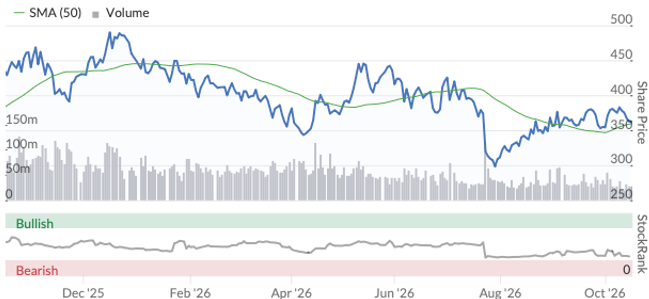
Tesla reports Q3 2026 after Wednesday’s close. The shares closed Thursday at $362.44 – 27% below their 52-week high of $498.83 and down around 18% this year – on 170x forward earnings, a Stockopedia Quality Rank of 84 and a Value Rank of 2.
The deliveries are already known. Tesla delivered 486,532 vehicles in Q3 against a company-compiled consensus of 461,974 – a beat of nearly 25,000 – though that is 2.1% below the record 497,099 a year earlier, which was flattered by buyers pulling forward ahead of the expiry of the US tax credit. Production was 464,391, so inventory was drawn down for a second straight quarter.
Consensus for the quarter is revenue of roughly $27.8–27.9 billion (down around 1% year-on-year) and EPS of $0.43–0.46 with 18 downward revisions in the last 90 days and just four upward.
Things to watch:
- Margins versus volume: the delivery beat came on the back of heavy incentives, notably in China, where domestic retail sales still fell. Will that be reflected in margins?
- The SpaceX question: on Wednesday Barclays’ Dan Levy published a note arguing a Tesla–SpaceX combination “could be announced” before Tesla’s annual meeting, which Barclays expects before 6 December. Barclays sees SpaceX as the likelier acquirer in an all-stock deal. Nothing has been proposed, but Thursday night’s Roadster demo – held at SpaceX’s Waco site and using SpaceX thrusters – feels like an excuse to bring the companies closer together.
- Robotaxi and Optimus: Tesla says more than 300 Cybercabs are now serving Austin, an eight-fold increase in a month, with unsupervised operation in Austin, Dallas, Houston and Miami. Meanwhile, the Optimus programme is ramping up. At Fremont, where Model S/X production ended in May, an Optimus production line is being installed.
[Chart: TSLA share price. Source: Stockopedia]
Bloom Energy (NYQ:BE)
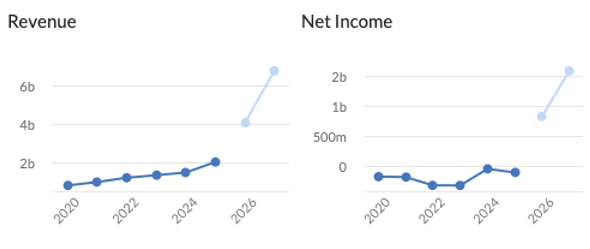
Bloom Energy reports Q3 2026 after Thursday’s close. This is a picks-and-shovels play that, depending on the day, is up roughly 2,000% over two years. The company makes solid-oxide fuel cells that give data centres on-site power without waiting years for a grid connection, and the numbers have gone vertical. Revenue for the six months to 30 June rose to $1.82 billion from $727 million. Q2 revenue was $1,065 million, up 165%. Full-year guidance has been raised twice.
Consensus for Q3 is revenue of $1.06-1.07 billion (up around 106% year-on-year) and EPS of around $0.69-0.71 – although the estimate has come down about 4% in the last month. Bloom has beaten in each of the last four quarters. Stockopedia has it as a Speculative High Flyer, with a Momentum Rank of 95 and a Value Rank of 2, on 52x forward earnings and a forward PEG of 1.
Things to watch:
- Who’s paying: two customers accounted for around 44% and 21% of revenue in the first half, and one customer for about 73% in Q2 alone. Major agreements include Oracle (up to 2.8GW), AEP (up to 1GW) and a $25 billion Brookfield financing framework. CoreWeave and Nebius are also customers. This week’s question is whether the neocloud end of that list can still fund its orders.
- Project risk: Oracle’s force-majeure notice to Project Jupiter’s developer in September, over power and permitting, is worth watching: Bloom says its contract is intact and Oracle says the project is on schedule, but delivery timing is a results-call question.
- Backlog disclosure: Bloom last gave a backlog figure at the end of 2025 (around $6 billion product, around $20 billion including service). An update would go a long way with a market that this week decided it wants to see the orders, not the gigawatts of “visibility”.
[Chart: BE revenue, net income, EPS. Source: Stockopedia]
Disclaimer
This is not financial advice. Our content is intended to be used and must be used for information and education purposes only. Please read our disclaimer and terms and conditions to understand our obligations.

8 comments
The most revealing comparison: 1873 and today's AI infrastructure
In September 1873, the American investment bank Jay Cooke & Co. collapsed after becoming heavily involved in financing the Northern Pacific Railway.
The railway was a genuine economic development, but the financing was unsustainable. When investors withdrew their support, the company could no longer obtain sufficient capital.
The consequences spread through the banking system and helped produce a prolonged economic depression.
Compare that with today's neocloud industry:
Nineteenth-century railways
Railway tracks and stations
Huge construction expenditure
Borrowing against future passenger and freight revenue
Competing railway lines created excess capacity
Railway bonds became difficult to refinance
Railways survived, but many shareholders lost money
Modern neocloud companies
Data centres and GPUs
Huge computing infrastructure expenditure
Borrowing against future AI computing revenue
Competing data centres could create excess capacity
AI infrastructure debt could become difficult to refinance
AI infrastructure may thrive even if individual companies fail
There is one difference that makes me particularly cautious about neocloud valuations.
Railway tracks could remain useful for a century. Nvidia GPUs might become economically outdated within a few years.
That means neocloud companies may have considerably less time to recover their original investment.
The historical lesson is that a revolutionary technology does not guarantee good returns for the shareholders financing its development.
Indeed, the railway industry ultimately transformed the world, despite enormous losses for many of its original investors.
That's brilliant, piersmahoney. Thanks for sharing. I couldn't agree more.
I'd add that neoclouds have these 3-5 year contracts that provide visibility, but cost of inputs and capital are eroding any returns. But those contracts exist because neoclouds fill a capacity gap for hyperscalers. There's definitely a thesis that hyperscalers won't need that capacity in 5 years.
History tells me there is often a big crisis (bubble) every 20 years. The next crisis is due soon... The Bank of England has issued plenty of warnings.
Very comprehensive round up, thank you.
James, as someone who doesn’t follow the AI trade, I found that summary especially useful and interesting. Thank you!
Thanks James! FYI Sanderson Design (LON:SDG) reported last week.
Since writing, SpaceX have announced they will report on Tuesday
excellent piece of analysis Thaks James