The Week Ahead (24-28 Feb): Rolls Royce, Nvidia, China

This week, European equities continued their strong start to the year, outpacing their US counterparts for the first time in over a decade. The STOXX 600 notched further record highs mid-week, fueled by strong performances across banking, energy, and defence stocks.
In particular, Europe’s defence sector has surged on expectations of increased military spending, with names like BAE Systems (LON:BA.) and Rheinmetall AG (ETR:RHM) posting double-digit gains before retreating slightly. It seems that investors, who have long been sceptical of the continent’s growth prospects, are beginning to recognise the relative value on offer compared to a seemingly stretched US market.
Across the Atlantic, Meta Platforms (NSQ:META) has been the clear leader of the Magnificent Seven this year, with its shares up nearly 16%. Apple and Tesla have struggled, though, with some initial cracks starting to appear. All eyes will now be on NVIDIA (NSQ:NVDA), the last to report, as it prepares to release its full-year results on Wednesday.
After an extended period of U.S. stock market dominance, we may be seeing some early signs of capital being rotated elsewhere - whether into European equities, Japanese stocks, or, more controversially, Chinese markets.
China’s stock market has been on a tear after a tough few years. The Hang Seng is up nearly 20% year-to-date, with heavyweights like Alibaba Holding (NYQ:BABA), PDD Holdings (NSQ:PDD), and BYD Co (PNK:BYDDY) leading the charge. Alibaba has been at the forefront of China’s stock market resurgence, surging 70% year to date and outpacing many of its peers.
Temu owner, Pinduoduo, has also leveraged its cost-conscious appeal to expand market share and BYD continues to dominate the EV space. Even Baidu (NSQ:BIDU), often overshadowed in the AI race, has gained renewed attention.
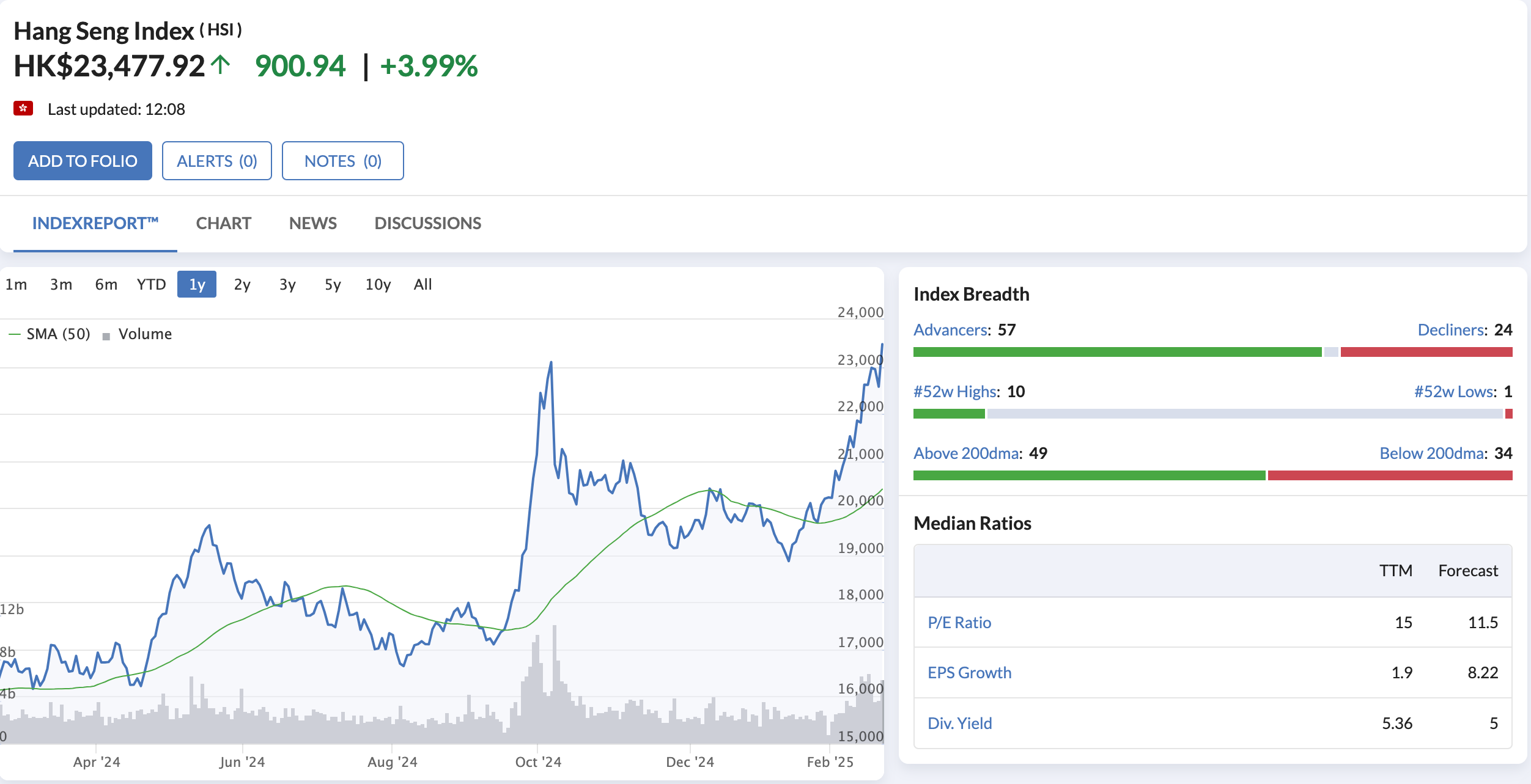
For the brave, China offers undeniable value. The region remains very cheap relative to its long-term potential (forecast P/E of 11.5 for the Hang Seng), but structural risks persist.
Geopolitical tensions, unpredictable regulation, and ongoing (deflationary) economic challenges mean investors must tread carefully. I’ve personally dabbled in Alibaba shares over the years, seeing potential in its entrenched e-commerce dominance and cloud computing ambitions. But even here, plenty of patience is required—regulatory uncertainty and a perceived lack of visibility into what’s actually going on make Chinese equities a notoriously volatile bet.
It would be interesting to hear any thoughts in the comments on investing in China, or any emerging markets that you think are worth considering. With Europe making a strong case, and China presenting an intriguing risk-reward profile, 2025 could be shaping up to be an inflection point for global investors.
In the UK, a wave of full-year results is set to roll in next week, spanning a wide range of sectors. Industrials like Rolls-Royce, IAG, IMI, and Morgan Sindall will report, as will financial heavyweights such as the London Stock Exchange, Aviva, and St. James’s Place. Healthcare names like Haleon and Hikma Pharmaceuticals will also shed some light on their performances in 2024.
Economic Calendar
Monday 24th | ||
09:00 | Germany | IFO Business Climate |
Tuesday 25th | ||
07:00 | Germany | GDP Growth Rates |
11:00 | UK | CBI Distributive Trades |
Wednesday 26th | ||
07:00 | Germany | GfK Consumer Confidence |
12:00 | US | MBA Mortgage Applications |
Thursday 27th | ||
13:30 | US | GDP Growth Rate |
13:30 | US | Durable Goods Orders |
Friday 28th | ||
07:00 | UK | Nationwide Housing Prices |
07:00 | Germany | Retail Sales |
07:00 | Germany | Unemployment Rate |
13:30 | US | Core PCE Price Index |
Companies Reporting
UK Trading Updates | UK Financial Results | International Financial Results | |
Monday 24 Feb | ME International | ||
Tuesday 25 Feb | Jadestone Energy | Smith & Nephew Croda International Unite Group Bank of Georgia | Home Depot |
Wednesday 26 Feb | Seeing Machines | Hikma Pharmaceuticals ConvaTec Group Weir Aston Martin Lagonda | Nvidia |
Thursday 27 Feb | Rolls Royce Haleon Aviva Taylor Wimpey Ocado Serco St James’s Place Howden Joinery Hiscox | Dell | |
Friday 28 Feb | International Airlines Group Rightmove IMI Spectris Benchmark Holdings | Allianz BASF |
Rolls-Royce: FY 2024 Results
Few stocks in the FTSE 100 have managed to turn things around quite like Rolls Royce. The engineering giant, once synonymous with high-quality aerospace technology, found itself on the ropes during the pandemic. But a combination of post-pandemic tailwinds, aggressive restructuring by an excellent management team, and robust free cash flow generation has seen the share price more than quintuple within two years.
Rolls Royce has even accelerated its progress over the past 12 months, making it a standout performer among UK large caps and delivering gains more reminiscent of high-flying US stocks. The company managed to outpace the FTSE All-Share by a staggering 72% over the past year, highlighting its strong momentum characteristics.
With full-year results for FY24 set to be released on 27 February, investor expectations are high. The company’s turnaround story has been remarkable, but its valuation has also soared to new heights. The question remains: is there still upside left, or has the market already priced in the good news?

Cash Flow Transformation
The biggest shift in Rolls Royce’s investment case has been its cash flow generation. Long-term service agreements (LTSAs) have been somewhat of a game changer for the company. These contractual arrangements between Rolls Royce and airline operators mean that they pay for engine maintenance based on usage rather than making large upfront payments for individual repairs.
These agreements have facilitated a steadier stream of revenues based on flight hours logged by Rolls Royce’s engines, thereby creating much more predictable cash flows for the business. It’s important to remember that Rolls Royce makes quite little from selling these engines themselves, so the LTSAs have been crucial to transforming profitability. The recovery in air travel and increased large engine flying hours have already reached 102% of 2019 levels by Q3 2024.
Reducing the dependence on new engine sales and creating a strong recurring revenue base have made Rolls Royce a different beast altogether. With a growing installed base of widebody engines—critical for long-haul travel—Rolls Royce benefits from an expanding aftermarket business, where high-margin servicing drives better returns. The additional benefit is that as a fleet ages, more engines will enter a higher maintenance phase, providing a further boost to cash flows.
These contracts have been excellent at turning past engine sales into future profits. Free cash flow is now expected to land at the upper end of the £2.1bn–£2.2bn guidance range for 2024, a stark contrast to the cash burn seen in previous years.

Source: Rolls Royce H1 2024 Results Presentation
Profitability on the Rise
Underlying operating profit is set to come in at £2.1bn–£2.3bn for 2024, benefiting from improved efficiency across the business. As discussed, in Civil Aerospace, Rolls Royce has shifted its focus towards high-margin aftermarket services rather than the lower-margin new engine sales. In 2023, nearly two-thirds of the £1.5bn increase in Civil Aerospace operating profit came from the aftermarket segment. This change in dynamic should continue supporting earnings growth over the coming years.
While Civil Aerospace has been the star of Rolls Royce’s recovery story, its Defence division continues to provide stability—and is one that is increasingly well-positioned for growth. The business, which supplies engines and propulsion systems for military aircraft, naval vessels, and land-based defence applications, is benefiting from rising global defence budgets and heightened geopolitical tensions.
Rolls Royce Defence has secured key contract wins that provide long-term revenue visibility. Among the most significant is the multi-billion-dollar deal to supply F130 engines for the U.S. Air Force’s B-52 fleet as well as on the UK’s next-generation nuclear submarine program, which will see Rolls-Royce’s nuclear propulsion expertise play a critical role in national security.

Source: Rolls Royce H1 2024 Results Presentation
A structural shift in global defence spending has likely strengthened the division’s outlook. European nations are under increasing pressure to ramp up their military budgets, driven by geopolitical instability and concerns over NATO’s future. US President, Donald Trump, has been calling for an increase in NATO’s spending target from 2% to 5% of GDP.
In Denmark, for example, defence spending is now set to rise by over 70%, while Italy and France are also pledging more resources to military programmes over the coming years.
Regardless of the final outcome, the direction of travel is clear: defence budgets across Europe are rising, and Rolls Royce is well-positioned to benefit as a key supplier to major Western military programs.
The Power Systems division, while less profitable and more cyclical, is also seeing strong demand in the data centre and governmental segments.
Operational Turnaround Under New Management
Since taking the helm in January 2023, Tufan Erginbilgic’s leadership has been instrumental in reshaping Rolls Royce’s fortunes. His focus on tight cost controls, non-core divestments, and cultural transformation has reshaped the company’s financial profile.
Indeed, a key barometer of improving fundamental momentum and financial health, the Piotroski F-Score, sees Rolls Royce score an excellent 7/9. This highlights the company’s improving profitability, efficiency, leverage and liquidity metrics.

Tufan has also astutely guided the company into new markets, such as small modular reactors (SMR) to expand into nuclear energy, sustainable aviation for reducing carbon emissions, and unique power systems for AI data centre-driven infrastructure expansion.
Its small modular reactor (SMR) programme probably remains the most intriguing wildcard. Although still in early development, securing government backing or commercial contracts could provide a fresh catalyst for growth. Interestingly, the company has been selected as the preferred supplier for the Czech Republic’s SMR programme and has been shortlisted in the UK Government's competition to select and contract providers of our new nuclear power fleet.
The shift in focus to play to the company’s core strengths, whilst developing the foundations for high-growth areas that align with global megatrends, has been key to the company’s turnaround efforts.
A ‘New Era’ of Shareholder Returns?
With improving free cash flows, Rolls Royce has reinstated its dividend payouts, which was a key milestone for investors. The company has signalled a payout ratio of 30%, targeting a sustainable, yet progressive dividend policy.
At the current share price, the dividend yield may not seem like much (less than 1%), but there is ample dividend cover and potential to initiate other forms of returns.
Share buybacks are rumoured to be on the table. As many industry peers initiate large-scale buyback programmes, such as BAE Systems, Melrose Industries, Qinetiq and Safran, it may be up to Rolls Royce to now follow suit.
JPMorgan has suggested that the record-free cash flows being generated in the European aviation & defence industries have potentially ushered in a "new era" of share buybacks.
Potential for Further Upside?
Some analysts believe Rolls-Royce still has room to run. Panmure Gordon recently raised its price target from 665p to 820p, arguing that Rolls-Royce’s valuation multiple could re-rate closer to European and U.S. aerospace peers like Safran.
Morgan Stanley is also optimistic, keeping an overweight rating on the shares and raising the target price to 700p.
However, the valuation is where things get a bit tricky. At 631p, Rolls-Royce is trading at a forward P/E ratio of over 30x based on 2025 consensus EPS of 21p. That’s a steep multiple, even for a business with improving fundamentals and rapidly growing profits.
A forward price-to-earnings growth (PEG) ratio of 2.1 hints that any signs of growth rates faltering could be punished by the markets.

If Rolls-Royce fails to maintain its profit growth trajectory (especially with its outlook to 2027) or faces unexpected cost pressures, there could be a sharp correction.
Citi actually recently downgraded the stock from Buy to Neutral, citing concerns that it’s now approaching ‘fair value.’
Supply Chain Risks
Like many industrial companies, Rolls Royce is still navigating supply chain disruptions from the pandemic. While these have eased compared to previous years, higher inventory levels and working capital pressures remain areas to watch.
One of the biggest challenges lies in the availability of critical components—particularly castings, forgings, and high-value aerospace materials. Any delays or bottlenecks in sourcing these parts can slow production, affecting deliveries and aftermarket services.
Another area of concern is labour shortages and wage inflation, which have affected suppliers across the aerospace sector.
The company has been good, so far, at maintaining strong relationships with its suppliers to ensure production stability, but any hiccups here could weigh on earnings.
Recent Director Sales
One of the best signals that Rolls-Royce was very undervalued came in the second quarter of 2022, when an initial wave of aggressive insider buying started. Several directors made substantial purchases—known as ‘cluster buys’—which continued until mid-2024, reinforcing confidence in the company’s turnaround.
However, more recently, insider activity has shifted the other way. Since mid-2024, the scale of the director purchases has significantly declined, and the largest transactions have been sales. While directors sell for various reasons, a trend reversal in insider activity is always worth monitoring. It doesn’t necessarily indicate a loss of confidence, but it could suggest a shift in sentiment that investors should keep an eye on.

Delivering on long-term targets
While the 2024 guidance is well understood, the real test will be whether Rolls-Royce can hit its medium-term targets. Management has set a goal of £2.8bn–£3.1bn in annual free cash flow by 2027, alongside continued margin expansion. Achieving this will require both strong execution and favourable market conditions.
One key question is whether the civil aerospace aftermarket can continue its rapid growth. The post-pandemic surge has been a major tailwind, but at some point, growth rates will normalise. Rolls-Royce also faces competition from independent MRO (maintenance, repair, and overhaul) providers, which could cap pricing power over time.
With such a sharp run-up in the share price, Rolls-Royce needs to deliver a strong set of results and a confident outlook to justify its current valuation. There are several key things to watch out for:
FY24 Free Cash Flow: Likely to land at the top end of guidance (£2.1bn–£2.2bn). Investors will want to see if management upgrades the 2025 FCF target (currently £2.6bn).
Operating Profit: Expected to be at the higher end of the £2.1bn–£2.3bn range.
Dividends/Share Buybacks: A 5.2p dividend is expected, but any additional capital return (such as a buyback) could be a catalyst for further upside.
2025 Guidance: Current analyst estimates point to £2.6bn in FCF and £2.6bn in operating profit. If management raises these figures, it would be a very promising sign.
Mid-Term Targets: Any commentary on progress towards the 2027 FCF target (£2.8bn–£3.1bn) will be closely watched.
Balance Sheet: To see whether the company has moved into a net cash position, or will do so next year.
Supply Chain and Cost Updates: Investors will want reassurance that supply chain constraints are manageable and that inflationary pressures are not eroding margins.
Conclusion
Under Tufan’s tutelage, Rolls-Royce has executed an extraordinary turnaround, shifting from a company in survival mode to a cash-generating aerospace leader. The combination of strong aftermarket revenues, cost efficiencies, improving profitability and a foray into new high-growth markets makes for a compelling investment case.

However, at nearly 30x forward earnings, expectations are now sky-high. While there may still be room for upside, particularly if the company raises 2025 guidance, the risk-reward balance is not as compelling as it was a year ago. Sometimes, you simply have to pay over the odds for quality, though.
Disclaimer
This is not financial advice. Our content is intended to be used and must be used for information and education purposes only. Please read our disclaimer and terms and conditions to understand our obligations.

15 comments
A stunning set of full-year results from Rolls-Royce Holdings (LON:RR.) this morning, with a number of notable 'beats' when it comes to operating profits and free cash flows. A few highlights include:
- Underlying operating profit surged to £2.5bn (compared to the expectation of a figure close to £2.3bn).
- Free cash flow generation hit £2.4 billion (also well in excess of the £2.1bn-£2.2bn expected).
- Balance sheet strengthened from £1.95bn net debt position in 2023 to a £475m net cash position this year.
- 2025 guidance upgraded to include £2.7bn-£2.9bn operating profit and £2.7bn-£2.9bn free cash flow, reaching Capital Markets Day goals two years early.
- 2028 medium-term guidance upgrades to reach £3.6bn-£3.9bn operating profit, £4.2bn-£4.5bn free cash flow, and 18%-21% return on capital.
- The rumoured share buyback was indeed true, with the company committing to buying back £1 billion worth of shares this year.
Shareholders will be delighted with the update this morning, as Tufan and the team continue to deliver on Rolls-Royce's turnaround. The shares are currently up 14% in early trade.
Rolls-Royce Holdings (LON:RR.) results out this morning. Looks like a beat on all key points you raised Keelan. Excellent write up by the way, most informative.
Excellent RR. write up…Thankyou …..I have held Rolls Royce since they were about 80p….Why ??well they were going up from about 50pi-ish (from memory) and walking back from school I would often go past the 4 Rolls Royce cars owned by Slade which were parked round the corner from our house …and they evoked a sense of personal success and financial attainment and a high quality….So when able I grabbed a few shares ….and a few more at 109p…..I did top slice a few at 250p but as they keep going up why sell…So the chance of a dividend payout is icing on the cake….and I will hang on in there as I think their SMR programme and more efficient engine progress is exciting……
The interview clip put up by OX is well worth watching ….Thanks
Aviva (LON:AV.) reporting on Thursday. Amanda Blanc has done a superb job so far, selling off non-core assets and focusing on the domestic market plus Ireland and Canada. +7% dividend and the StockReport says it is fully covered. Will be interesting to hear the latest on the acquisition of Direct Line Insurance (LON:DLG), with apparently a willingness to do more on that front:
https://tinyurl.com/44ybk4me
Insurance is boring but if it's good enough for Warren!
Feb 22 (Reuters) - Warren Buffett's Berkshire Hathaway BRKa.N on Saturday posted its third straight record annual operating profit, bolstered by large increases in underwriting earnings and investment income in its insurance businesses.
Operating profit rose 27% to $47.44 billion in 2024 from $37.35 billion a year earlier.
Fourth-quarter operating profit also set a record, rising 71% to $14.53 billion, or about $1,010 per Class A share, from $8.48 billion a year earlier, reflecting gains in its insurance operations and from foreign currency changes.
Quarterly net income totaled $19.69 billion, or $13,695 per average equivalent share, as the value of Berkshire's holdings in Apple AAPL.O, American Express AXP.N and other stocks increased. For the year, net income totaled $89 billion.
Rolls-Royce Holdings (LON:RR.) I hold. Great write up Keelan providing plenty of information. I also enjoyed your write up on Jet2 (LON:JET2) which I ended up taking a position.
Interesting article I have this year brought some Alibaba Holding (NYQ:BABA) and JD.Com (NSQ:JD) with the former doing very well so far but conscious these can be very volatile. Hoping for positive results this week.
Good review, but I do wonder a little about the cult of Tufan.
An awful lot of things have gone his way and people forget about the 7 years of hard yards put in by the less dramatic, but (in my view, having met him in his ARM days) the very competent Warren East, who did well to provide Tufan with any platform at all, let alone a burning platform.
Tufan can't claim credit for much of the following:
- The strong US$
- Recovery in flying hours post-COVID
- Overcoming the Trent 1000 durability issues
- Resolving in 2017 a very awkward situation with the Serious Fraud Office (a mere £671m in fines paid globally...)
- Rolls Royce being better placed with Airbus while Boeing shot itself in both feet
- Positioning in wide-body over narrow-body
- Pratt & Whitney's geared turbofan problems grounding fleets
- A revival in the prospects for nuclear power
- The odd invasion here & there driving the need for defence spending
Plus you have to appreciate how the accounting works on Rolls-Royce Holdings (LON:RR.) maintenance contracts. If you supply an engine for 5 years the EBITDA gets recognised in the P&L in Year 5, so you can get the appearance of profitability lagging cashflow.
Getting your engine onto a programme like the A350 and ensuring you do so profitably involves a decade of work rather than years, and the engineers should take the credit rather than any of the CEOs....
In the end, making engines for civil aerospace is a very risky business - you are pushing the limits of metallurgy and you've got to presume that there will be hiccups and dead ends with every generation of new engine, so every decade you put the entire balance sheet at risk....(I'm exaggerating slightly), and that is difficult to fully capture in a DCF model, where you attempt to smooth the risk over many years by bumping the discount rate a little.
I’m a big bull on Chinese equities, as they are one of the most pessimistically priced equities in the world with one of the highest risk premiums. Given this level of pricing, even with almost no EPS growth you can earn a normal risk premium over bonds.
See below comparison of US vs China required EPS growth to earn normal risk premium:
Excellent write up on Rolls Royce. Well done Keelan.
A good way to invest in China is via the Investment Trusts Fidelity China Special Situations (LON:FCSS) and Jpmorgan China Growth & Income (LON:JCGI) . Both are stiil trading at (albeit narrowing) discounts. Both see coverage on the Investment Trusts on Stockopedia.
The Hang Seng index is on a roll and is up over 20% year to date. The Shanghai index has lagged so far, and is only up 6% year to date. Unfortunately both the Chinese Trusts only have a small percentage of their portfolio in the Hang Seng.
Fidelity China Special Situations (LON:FCSS) and Jpmorgan China Growth & Income (LON:JCGI) are both up over 20% year to date.
As for other Emerging Markets a must one to check out is Vietnam, a fast growing market that could well get promotion from frontier market to full Emerging Market status this year. All 3 Vietnam Trusts are worth considering. I.e VietNam Holding (LON:VNH) VinaCapital Vietnam Opportunity Fund (LON:VOF) and Vietnam Enterprise Investments (LON:VEIL)
If wanting to know a lot more about the very convincing investment case for Vietnam, it’s a good idea to start with the detailed monthly updates from these Trusts, especially so the ones from VietNam Holding (LON) and VinaCapital Vietnam Opportunity Fund (LON:VOF)
I’ve held both of them for most of this Century and they’ve done very well but there should be a lot more upside to come. . VietNam Holding (LON:VNH) is only on a small discount, but VinaCapital Vietnam Opportunity Fund (LON:VOF) is on a very wide 23% discount.
Again Vietnam and the Vietnam Trusts have been covered on the Investment Trust threads.
Agree with Ken, a good way to invest in China is via closed ended investment trusts. All 3 China trusts have good one year share price performance records:
SP performance over one year is mainly due to improving underlying NAVs:
Rather than discounts narrowing:
Re: discounts, looking at the detail a bit more, Baillie Gifford China Growth Trust (LON:BGCG), Fidelity China Special Situations (LON:FCSS) and Jpmorgan Global Growth & Income (LON:JGGI) have all narrowed so far in 2025 by approx +6%, +5% and +7% respectively.
Still don't trust Chinese government policy making though!
I still hold VietNam Holding (LON:VNH), wish I hadn't sold back some of my shares back in the 2021 tender offer, as the NAV and the SP have both generally continued higher. The January investor report was issued this last week:
https://tinyurl.com/ys9jh8xr
Vietnam has a current growth rate of +7% (presumably the overused "GDP" rather than "GDP per capita" but wouldn't the UK like to have this number!). Positive noises on construction, domestic consumption and tourism. Will the Vietnam stock exchange move from "Frontier" to "Emerging" this year ? Maybe. Hopefully.
The top 10 accounts for approx 65% of the trust.
Any downsides for VietNam Holding (LON:VNH) ? Do some of the valuations look a little stretched ? Plus the mkt cap of the trust is not growing as not enough shares are being issued; maybe that will change with the expected move from Frontier to Emerging Market.
Something for the weekend sir? I ALWAYS learn something from the maestro !
Thank you Ox for posting that video, I am a long term fan of Mr Bolton as well.
Always a pleasure!
I see investing in China a little like crypto, I allocate enough to be along for the ride and not miss out but if it goes to 0 or trades sideways then it won't have much impact on my portfolio.
Hard to be disappointed with such low expectations!