The Week Ahead (5 – 9 Oct): FOMC Minutes, UK House Prices, Pepsi, Tesco, Next15

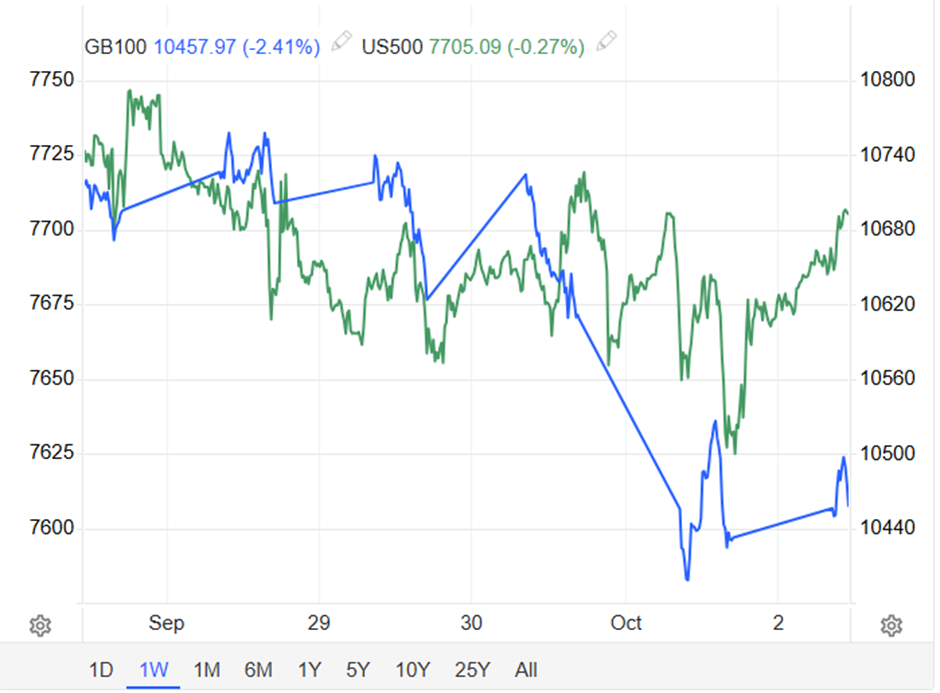
It's been a bad week for UK large caps, with the FTSE 100 down by a couple of per cent:
[All charts in this section: Trading Economics]
Much of the focus this week has been on the rise in long-dated gilts, with the UK 30-Year rising above 6% this week:
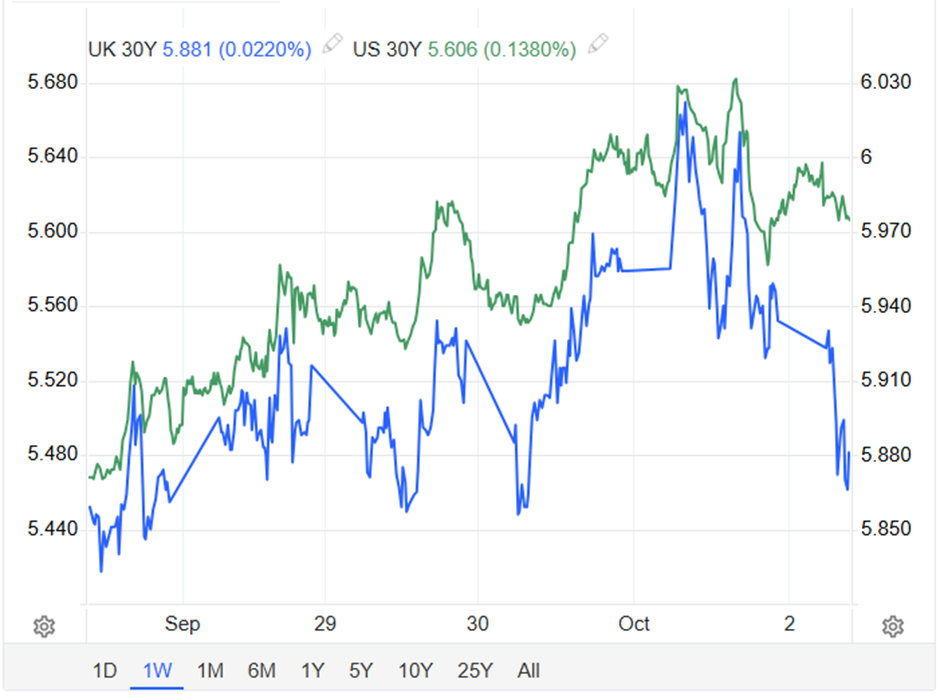
However, the UK long-dated gilt yield has since retreated, whereas the US has retained its recent rise. The UK 30-year yield remains above the US. However, if rising bond yields drove the UK stock market sell-off, we may be in for a recovery next week, as traders buy the bond yield retreat.
Here's what we can look forward to next week:
Economic Calendar
Monday 5 October |
||
06:00 |
Japan |
Consumer Confidence |
15:00 |
United States |
ISM Services PMI |
Tuesday 6 October |
||
13:30 |
United States |
Balance of Trade |
21:30 |
United States |
API Crude Oil Stocks |
Wednesday 7 October |
||
07:00 |
Germany |
Industrial Production |
07:00 |
UK |
Lloyds House Price Index |
12:00 |
United States |
MBA Mortgage Rate |
15:30 |
United States |
EIA Crude Oil Stocks |
19:00 |
United States |
FOMC Minutes |
Thursday 8 October |
||
07:00 |
Germany |
Balance of Trade |
07:00 |
UK |
RICS House Price Balance |
12:30 |
Euro Area |
ECB Monetary Policy Meeting Accounts |
13:30 |
United States |
Continuing Claims Initial Jobless Claims |
15:00 |
United States |
U. of Michigan Confidence (Prelim) |
Friday 9 October |
||
FOMC Minutes
At the last FOMC meeting, the Fed raised rates for the first time since 2023, lifting the federal funds target range from 3.50–3.75% to 3.75–4.00% in a unanimous 12-0 vote. It was also new Chair Kevin Warsh's first rate decision. The dot plot showed 16 of 19 participants expecting at least one more hike before year-end, and officials nudged their inflation forecasts up. Markets initially rallied on the decision but reversed during Warsh's press conference, with the S&P 500 falling to six-week lows and the 10-year Treasury yield pushing toward 5%.
Warsh has deliberately pulled back from Powell-era forward guidance; he's said he wants a Fed that "talks less and says more". This stance has made the written minutes an unusually important source of signal, since they're the fullest record of the committee's actual reasoning.
While a 12-0 decision is clearly unanimous, it can still mask real disagreement on magnitude or timing; minutes may reveal whether some members pushed for a larger move or wanted to wait. They will reveal how much weight members put on the Iran conflict and the oil-price spike versus underlying domestic inflation trends in justifying the hike. Plus the reasoning behind the 16-of-19 hike expectation.
UK House Prices
I've been saying for a while now that the housing market data has been confusing me. There seems to be a mismatch between the doom and gloom reported by UK housebuilders and what the House Price Indices are telling us.
That mismatch started to be resolved in August with the now-named Lloyds House Price Index slipping negative YoY:
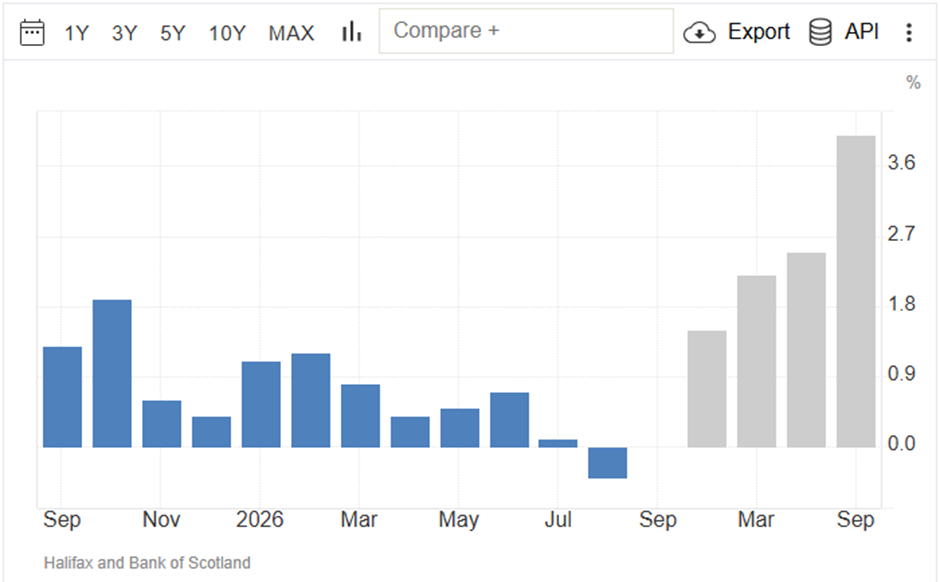
Forecasts are for this to be an aberration, with the index flat when September's numbers are released on Wednesday, followed by a gradual recovery. I am far from convinced, given the impact of higher UK bond rates on fixed mortgage rates.
This view is supported by the negative RICS balance, suggesting more surveyors are seeing price falls in their area than price rises. Although, to be fair, this has been on an improving trend and didn't drop as low as the last period of reported house price falls in 2023:
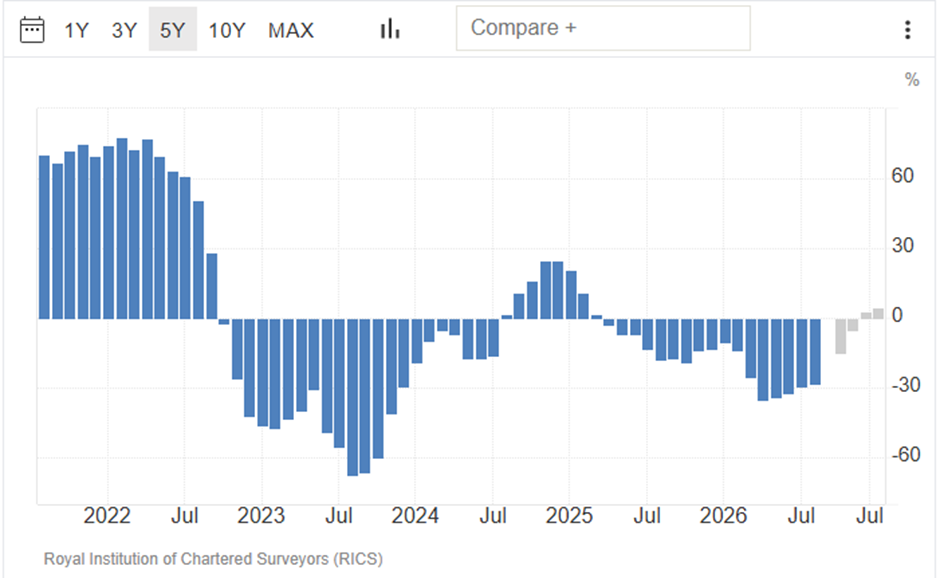
We get updated figures for the RICS balance on Thursday, which will either confirm the improving but still negative trend or show that more pain is coming for the sector.
Companies Reporting
| Date | UK Trading Updates & AGMs | UK Financial Results | International Financial Results (S&P 500) |
|---|---|---|---|
Monday 5 October |
Polar Capital Technology Trust (LON:PCT) (AGM) |
||
Tuesday 6 October |
Gateley (Holdings) (LON:GTLY) (AGM) Henderson Smaller Companies Investment Trust (LON:HSL) (AGM) |
Lamb Weston Holdings (NYQ:LW) (Q1) RPM International (NYQ:RPM) (Q1) Constellation Brands (NYQ:STZ) (Q2) |
|
Wednesday 7 October |
Hollywood Bowl (LON:BOWL) (TS) Goodwin (LON:GDWN) (AGM) Hostelworld (LON:HSW) (TS) |
Netcall (LON:NET) (Finals) |
Applied Digital (NSQ:APLD) (Q1) Levi Strauss & Co (NYQ:LEVI) (Q3) |
Thursday 8 October |
Foresight group (LON:FSG) (TS) Intercede (LON:IGP) (TS) Rank (LON:RNK) (AGM) Unite (LON:UTG) (TS) |
Next 15 (LON:NFG) (Interims) Tesco (LON:TSCO) (Interims) Volution (LON:FAN) (Finals) |
FAST RETAILING (TYO:9983) (Japan) (Finals) Helen of Troy (NSQ:HELE) (Q2) PepsiCo (NSQ:PEP) (Q3) Seven & i Holdings (TYO:3382) (Interims) |
Friday 9 October |
GSTechnologies (LON:GST) (AGM) |
Delta Air Lines (NYQ:DAL) (Q3) Tryg A/S (CPH:TRYG) (Denmark) (Q3) |
After the mad rush for companies to get results released before the end of September, we now have a very quiet week for UK reporting. In the US, this is the ramp-up into CY Q3 earnings season, with the banks and mega-caps starting the following week.
As usual, let us know if you think we've missed anything.
PepsiCo (NSQ:PEP)
The company comes into Q3 reporting under pressure. Several analysts have cut price targets just this week, on the back of weaker 2027 expectations:
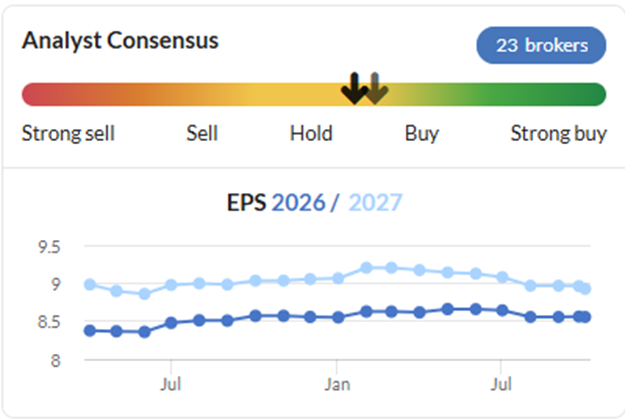
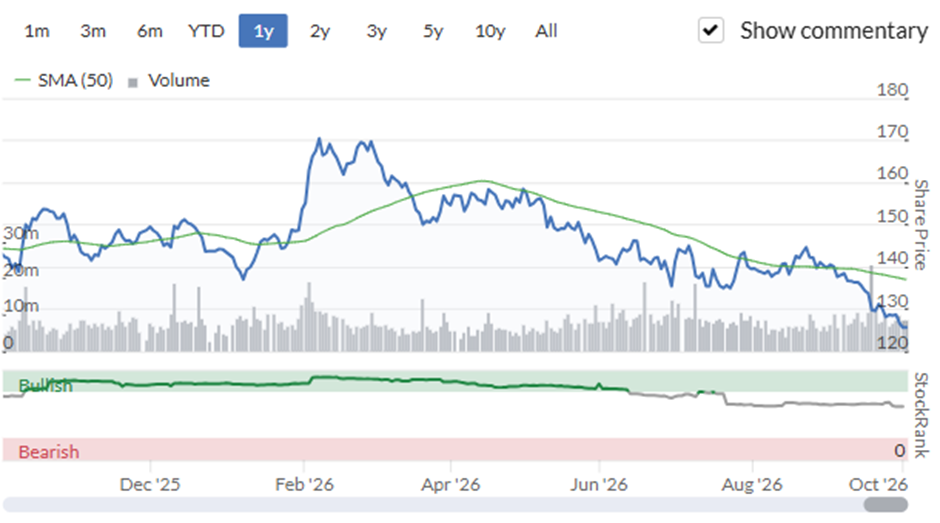
This has been reflected in the share price:
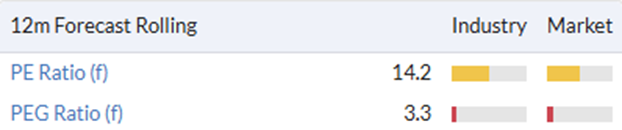
Earnings are still expected to grow, but at around the medium-term rate of just 5-6% CAGR, which makes the company look expensive on a PEG ratio, despite recent price falls:
The core problem is Frito-Lay performance in North America. Earlier in 2026, management had guided for Frito-Lay volume growth for the first time in two years. However, that optimism has since faded. Performance has stayed lacklustre despite ingredient reformulation, packaging changes, higher marketing spend and lower prices, and JPMorgan now says the recovery "appears to have stalled following the first quarter." H1 PepsiCo Foods North America revenue was up only slightly, with the modest volume growth essentially explained by an acquisition rather than organic strength.
Guidance on this segment will be a key factor to watch, along with the impact of price increases and cost savings on the FY27 outlook.
Tesco (LON:TSCO)
Tesco reports interim results for the six months to the end of August on Thursday. The central question that's been dogging the stock since summer is: can Tesco's market-share winning streak survive much tougher year-on-year comparisons?
FY2025/26 was an exceptional year for Tesco. UK market share reached 28.5%, group sales (ex-VAT/fuel) rose 4.3%, and the group gained more than 120 basis points of share over three years, with its December 2025 share hitting the highest level in over a decade.
Pricing initiatives, such as ALDI Price Match and an expanded Finest range, have driven that success. Plus, online and convenience have been standout growth channels, with UK online sales growth around 11%.
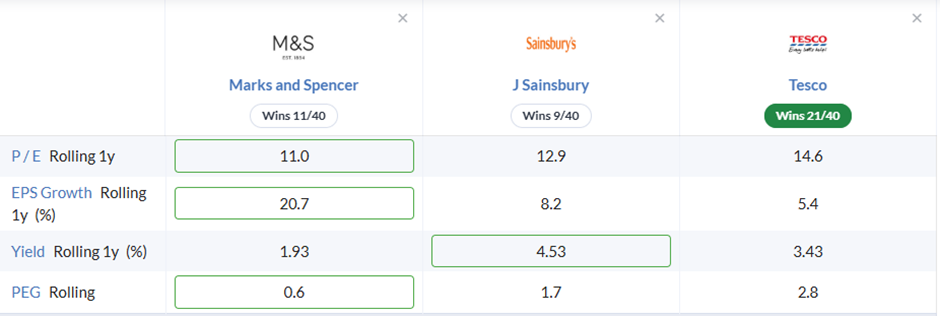
The problem is that the company is becoming a victim of its own success, and comps are getting harder. Tesco now trades at a premium to listed peers, despite weaker short-term growth characteristics:
No change expected to the full-year adjusted operating profit guidance of £3.0–3.3bn. The key watch is whether management's commentary gives confidence in sustaining margins while continuing to invest heavily in price and value. This strategy has clearly prioritised market share over near-term margin expansion, and investors will want reassurance that it's still paying off rather than just compressing profitability.
Next 15 (LON:NFG)
Investors in this communications company have been on quite the journey since the company announced they had major issues with their Mach49 acquistion in 2024:
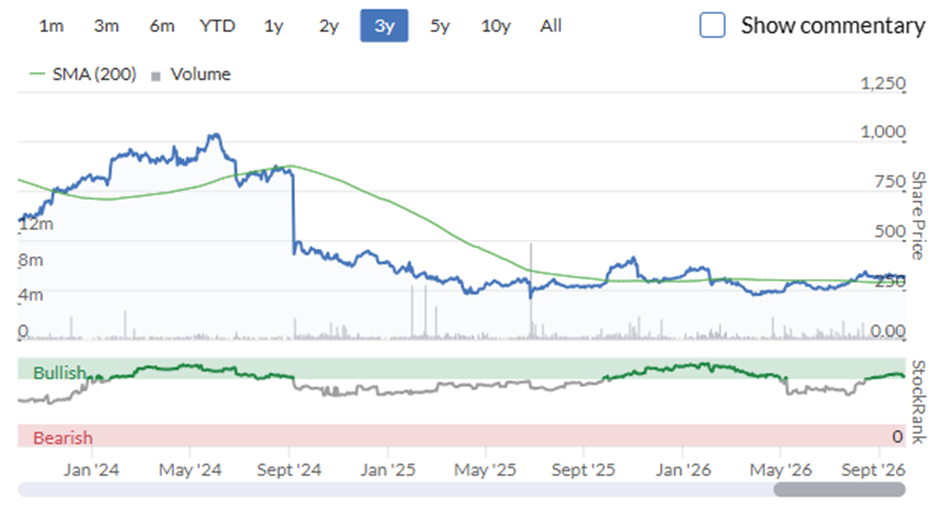
The share price has staged a modest recovery from April lows, but that bounce back has faced several false dawns.
EPS is forecast to recover, which puts them on a rather modest P/E of around 7:
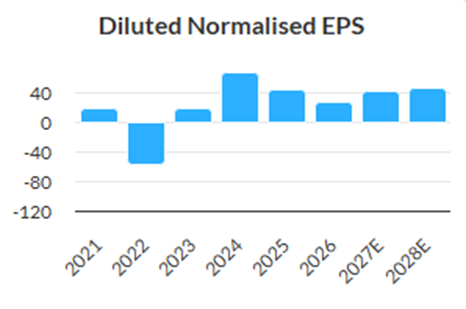
However, I've been critical in the past of the scale of adjustments required to make these numbers. In the FY to January, they booked £27.5m in exceptional acquisition accounting costs, £10.9m in restructuring, £2m in deal costs, and £3.2m in losses on disposals. Mach49 cost them an additional £16.4m. Investors will want these to be materially lower in the upcoming interims to have any faith in the numbers.
While overall debt levels don't look too bad at around £124m compared to a £300m+ market cap, there is £69.8m in deferred and contingent consideration due from past acquisitions, and £11.7m of provisions on the balance sheet. The contingent liability is from arbitration over the Mach49 earnout, which Next 15 disputes and has counterclaimed against. An outcome is possible in the first half of the next fiscal year, so investors will be looking for updates on timing or provisioning.
Needless to say, few tangible assets back this. An AGM Trading Statement said that the company had a "strong balance sheet" and was trading in line. However, it was notably short on figures. Seeing the actual debt levels and other liabilities on Thursday will be key to determining how strong that balance sheet actually is. Investors will also want to see that in-line statement reiterated, together with progress on the simplification strategy around further disposals or portfolio pruning.
Disclaimer
This is not financial advice. Our content is intended to be used and must be used for information and education purposes only. Please read our disclaimer and terms and conditions to understand our obligations.

4 comments
Loss aversion tends to be pretty high in the housing market, with many people not accepting that the market is going down. So they refuse to chneg their asking price, or at least not enough to make a sale, and houses just sit there, on the market but not selling. Of course with inflation running at 4%, it doesn't take many years of flat prices for that to be a real fall, but everyone focuses on the nominal price.
In such a scenario, houisng transactions tend to collapse. There are a couple of indicators for this. The BOE track mortgage applications, which tends to be forward looking, as people apply before they move:
So this looks weak, but not as low as 2023.
Then we get government/LR data for actual transactions:
This tends to be backwards looking and driven by tax considerations, but again doesn't look disastrous.
At the back of my mind is the idea if housebuilders and building supplies companies are doing this badly in an environment where most of the data says that housing is doing ok, how bad would they get if current higher mortgage rates and energy squeeze causes some real housing market pain?
Re Next 15 (LON:NFG) I hold. Thank you for making clear some of the numbers to watch.
The core of their business is on trend (helping AI companies market/sell their products). The trouble at Mach49 (working with startup ventures) did not seem to hit customer confidence in their core businesses.
The stock rank is gradually rising (78) but we are waiting for an announcement that confirms/indicates their troubles are behind them. Richard Griffiths has increased his holding to 15% (converting financial instruments to holdings). This is a hefty investment on Next 15 (LON:NFG) from someone who has a good track record.
Forward PE of 7 should rise if investor confidence returns.
It should be worth watching the reaction this week. Could go either way.
Hi Mark. Very useful update thank you. I agree on the property market paradox. It would be interesting to see the total value and number of transactions versus last year. I suspect we are in the early stages where sellers are refusing to accept losses (or below peak prices).
Whilst yields remain high I can't see the property market turning around. The help to buy announcement won't make much difference IMO. House prices as a multiple of average salary are too high with interest rates at 6%. Either yields or house prices need to come down (or wait for average salaries to go up).
Housing market. - I live in a coastal town in the South West. Population circa 20,000.
Five years ago the average number of houses for sale on Rightmove for the entire town was about 80 properties which varied slightly depending on time of the year.
Not including properties under offer etc. there are now 450.
I appreciate that there are many that are second homes or Airbnb's but all the same they are not selling.
Matey has just sold his house that he lives in after two and a half years on the market.
The usual 16 year property cycle crash as highlighted by the economist Fred Harrison is overdue.!