The Week Ahead: Inflation | Banks | Retail | US Tax Forms

Hi, and welcome to The Week Ahead, your destination for what's coming up this week in large cap and international stocks.
This week is the calm before the storm, with Q1 reporting season for most global stocks starting next week. However, we are still getting a few US companies that are managing to update us on how their 2024 has started.
Coming up this week…
Date |
Big UK earnings |
US company reporting |
EU company reporting |
Economic announcements |
Monday - 15 Apr |
Mitie (TS) |
Goldman Sachs (Q1) |
US Retail Sales |
|
Tuesday - 16 Apr |
B&M (TS) |
Bank of America (Q1) |
LVMH (Q1) |
US Housing Starts |
Wednesday - 17 Apr |
Saga (Finals) |
US Bancorp (Q1) |
UK CPI |
|
Thursday - 18 Apr |
Centamin (Q1) |
Netflix (Q1) |
Danone (Q1) |
US Jobless Initial Claims |
Friday - 19 Apr |
American Express (Q1) |
Sodexo (Q1) |
UK Retail Sales |
Inflation
The eyes of many UK investors will be on the UK CPI figures released on Wednesday. Last week, US CPI data came in surprisingly hot at 0.4% for March. This gives a 3.5% year-on-year rise, the biggest gain in six months. Some economists had argued that recent strength had been due to businesses raising prices at the start of the year. The rise in March puts pay to this idea, and in response, markets moved to price in the first cut in interest rates in September instead of May. Given that US equity markets had been strong recently in anticipation of a near-term cut, they reacted negatively to the news.
Here's the March UK CPI fan chart from the OBR:
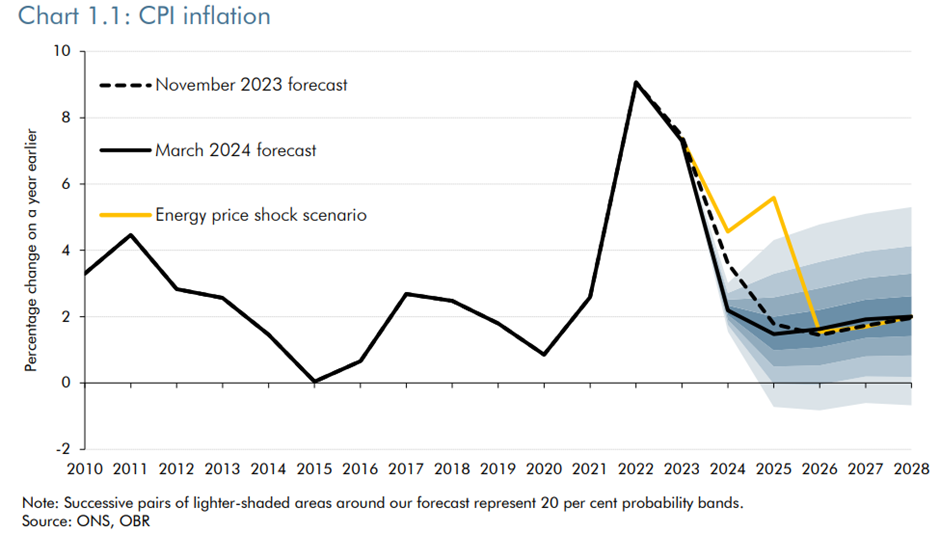
They commented that:
Alongside easing inflationary pressures, market participants now expect a sharper fall in interest rates than in the autumn. Bank Rate is expected to fall more steeply this year from its current peak of 5.25 per cent to 4.2 per cent in the final quarter of 2024.
The next BoE Rate Decision won't be until 9 May. However, given the US inflation data, investors will be wary of UK CPI and may start to price similar trends.
Banks
In the US, it is the investment banks that get their Q1 results out first. With Goldman Sachs reporting on Monday, and Bank of America, Morgan Stanley and Bank of New York Mellon on Tuesday. Credit card company American Express rounds off the week on Friday. As the stock comparison tool shows, this is one area of a rather frothy US market that looks reasonably valued:

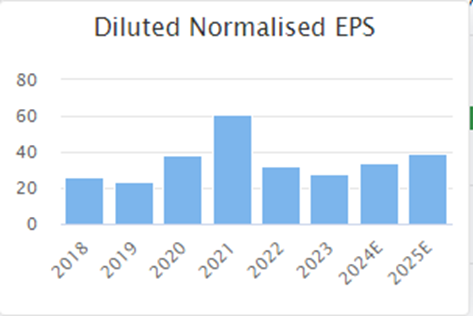
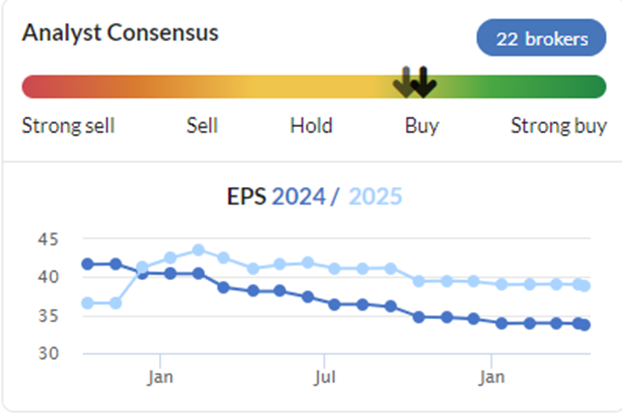
But despite US equity markets being much stronger than the UK, these companies' results have been surprisingly surprisingly lacklustre of late and forecasts for this year and next are only expected to show a modest improvement. For example, here is the EPS for Goldman:
And here is the broker consensus trend:
Morgan Stanley looks very similar:
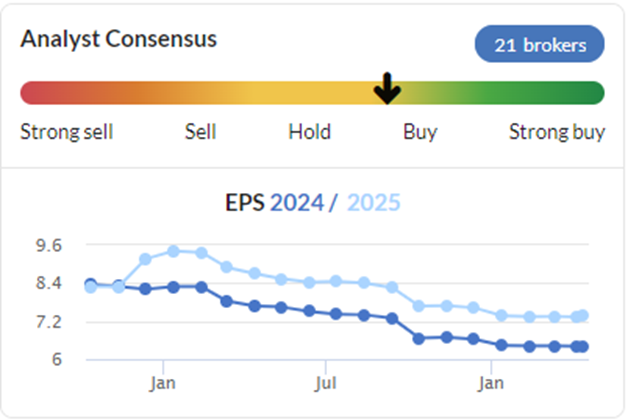
Despite trading at a discount to many US mega-caps, investors will likely want to see tangible signs that this trend is reversing before considering the investment banking sector any further.
Retail
With US retail sales data announced on Monday and UK numbers on Friday, investors will be looking for signs that the current retail malaise is ending. Looking at the value figures alone may give the impression that things aren't too bad. However, in a world of higher recent inflation, this masks a decline in volume, which means that retailers have been less profitable. Here's the UK:
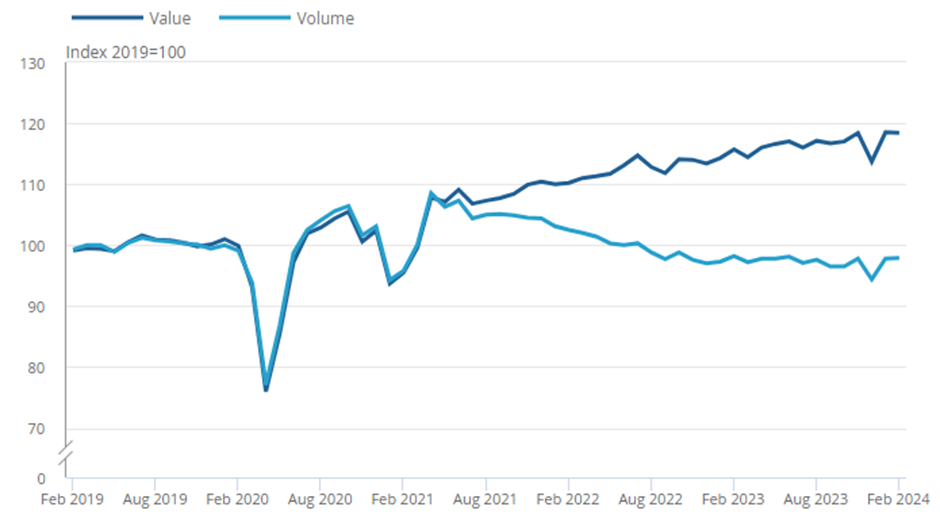
US data doesn't split out value and volume of retail sales, but the trend is similar:
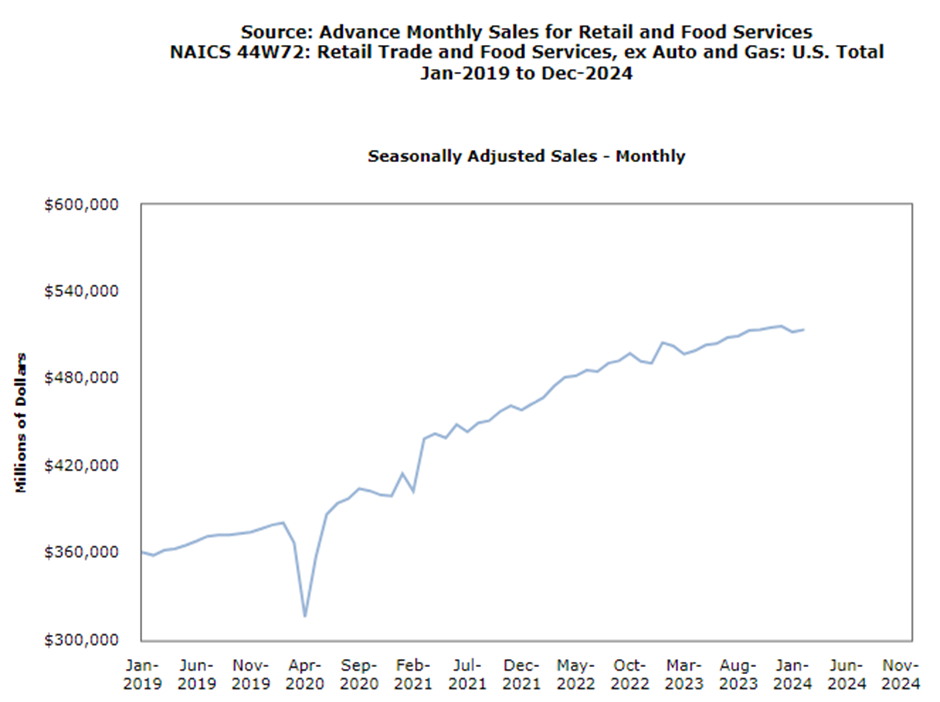
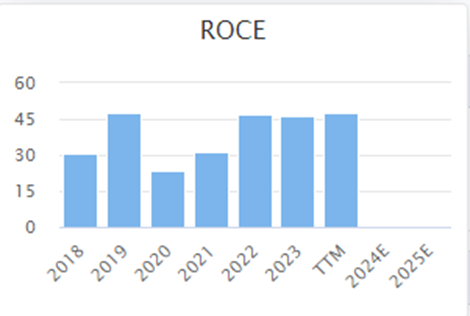
This decline doesn't seem to be as broad-based, though. Quality operators, such as Next (LON:NXT), are bucking the trend and have recently hit all-time highs. This week, another quality operator, Dunelm (LON:DNLM) , will report its Q3 trading on Thursday. This company has maintained a wonderful Return on Capital over the last five years:
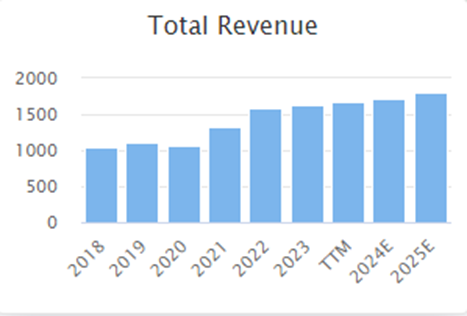
And this has undoubtedly delivered shareholder value as revenue has grown at a 9% CAGR over the last five years:
However, forward EPS growth is forecast to be lacklustre:
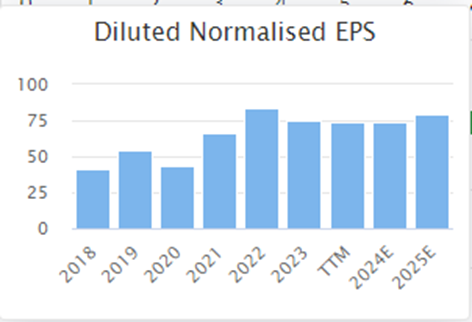
This makes the current P/E of almost 15 look expensive. Investors will be looking for signs of a strengthening retail outlook and for these forecasts to be beaten to justify holding on.
It is often said that luxury retailers don't behave in the same way as the rest. French-listed LVMH, owner of Louis Vuitton, who will release Q1 sales figures on Tuesday, is a case in point. They have grown revenue by 13% CAGR and EPS by 19% CAGR over the last five years:
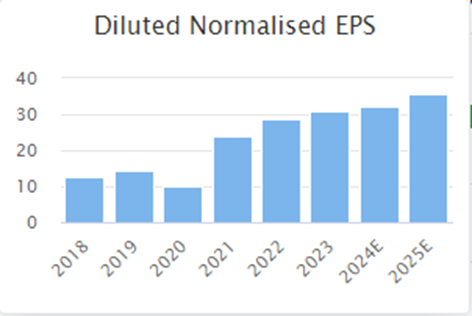
Like their products, investors are paying a high price to own the best. In this case, a forward P/E of around 25. Sometimes, it is worth shelling out to own the best. The performance here is significantly better than the likes of Burberry or Capri Holdings (owner of Michael Kors). Still, a rating such as this leaves little room for any disappointment, so investors will be checking these sales figures carefully to ensure everything remains on track.
US Tax Forms
With the strong recent US market, new tax year, and Q1 results starting to come in, many investors will be considering investing state-side. As well as the cost of FX charges, which many brokers make a very good margin on, is is worth considering the tax implications of doing so. The US charges a withholding tax on dividends. However, by filling in a form known as a W-8BEN, investors can reduce the withholding tax rates from 30% to 15%, or to 0% for shares held in a SIPP. Investors simply have to declare that they are not US tax residents.
Many brokers won't allow investors to buy US shares without filling in a W-8BEN, but it is worth checking that you have this in place. Once submitted, the form is valid for three years. The withholding tax also applies to US-domiciled but UK-listed shares, too. So, even if you don't intend to buy US-listed stocks, it can be worth having the form in place. When a US-domiciled company has a tender offer, there is another form that needs to be filled in to avoid a withholding tax called a Section 302 "Certification of Treatment of Tender Payment" form. This is a lot less well known by UK brokers, and you may find that you need to contact your broker about providing this rather than them contacting you. Given that the impact may be a 30% reduction in any payment, it is always worth double-checking this.
All this means that investors who have a SIPP are almost always better off buying US shares in that. Otherwise, 15% of all dividends will be lost in tax. SIPPs typically allow multicurrency accounts, too, which ISAs don't. This means that dividends, or proceeds from sales or tender offers, get paid in $US and can remain there to be re-invested into US shares. The alternative is that the broker converts these back to sterling. FX charges for this conversion by brokers are usually around the 1% level. When an investor re-invests these funds into US shares, the broker will charge the FX conversion fee again. Over many transactions, this can add up to a significant fiscal drag. By keeping funds in $US, investors avoid this.
Have a great investing week!
Disclaimer
This is not financial advice. Our content is intended to be used and must be used for information and education purposes only. Please read our disclaimer and terms and conditions to understand our obligations.

8 comments
Interesting to see the headlines of a takeover offer for International Distributions Services (LON:IDS) from Czech billionaire Daniel Křetínský yesterday.
The initial offer of 320p per share has been rejected, but it appears that further negotiations may be taking place. The Royal Mail owners' shares were up by 29% yesterday as a result.
The world is clearly waking up to the value on offer in the UK markets right now. Feels like there's a takeover offer for UK plc every other day at the moment!
Mark, this is SO valuable! I have a US dollar IBrokers general account with W8 (cause they tell you to get it! But my broker for my Diversified Energy account (uk) has not been so helpful.I will now apply. Also, the SIPP info was news to me. I am so pleased I finally bought Stocko, having um'd and are'd for years!
"The withholding tax also applies to US-domiciled but UK-listed shares, too."
How can you tell if a share is us-domiciled in stockopedia?
I look at the map and address, see Somero Enterprises (LON:SOM)
Yes, I don't think there is a foolproof way of checking, but this is the sort of thing is a clue that it is likley:
Not specifically on Stockopedia but on your broker site, the ISIN Number for the Share will start "US"
For example,
Somero Enterprises (LON:SOM) USU834501038
Spectra Systems (LON:SPSY) US84756T1060
in contrast to GB shares eg Vodafone (LON:VOD) GB00BH4HKS39
Excellent roundup thanks.
Great article. Although I have filled in a W8BEN form, it was good to get a full explanation of why. Also I didn't know about the further tax benefits of holding in a SIPP. Thanks!