TPFG: reassuring FY update from a resilient quality growth stock

(Please note I have a long position in Property Franchise (LON:TPFG))
Remember Brexit? Life seemed so much simpler back then.
To the 2020 stock market investor, robust business models and strong balance sheets reign supreme. Financially sound, high quality operators should be able to withstand the storm and be better positioned to pick up the pieces, once all is said and done.
I would argue that Property Franchise (LON:TPFG) is one such safe, high quality operator that has a fair chance of emerging from this lockdown in a position of relative strength.
TPFG operates a franchise model focused on residential lettings and property management services. There are similar listed operations - such as M Winkworth and Belvoir Group - all of them small and illiquid but looking like good value on the face of it.
TPFG is on my mind because it updated the market on its full year results a couple of days ago. I consider these results below.
Small, cash-generative companies with growing recurring revenue streams, long histories of above average returns on capital, and plenty of growth opportunities in fragmented markets usually trade at a punchy share price premium.
Not so with TPFG. This micro-cap Super Stock continues to figure well according to Stockopedia’s rankings:
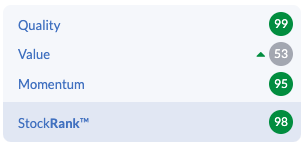
Perhaps TPFG’s name and operations are so mundane that people just can’t bear to think about them for any length of time. Peter Lynch was a fan of finding companies with boring names, or companies that do dull things, precisely because others often overlook them. You could argue TPFG, with its prosaic name and property lettings and management operations, is both.
Could that be an opportunity? Here are some of TPFG’s Quality stats:
- Five year gross margin: 92.23%
- Five year operating margin: 39.01%
- Five year average return on equity: 27.6%
- Long term average return on capital: 22.25%
- QM Rank: 99
Those are top tier long term profitability averages - When you find companies that generate those kinds of figures, it is worth tracking their trading and understanding their business models.
Growth over five years at TPFG has been similarly encouraging. These are compound annual growth rates over the five years to FY18:
- Revenue: 22.1%
- Operating profit: 37.8%
- Net profit 39.9%
- Normalised earnings per share: 22.1%
These averages will come down once official FY19 figures are released (more on this below). Nevertheless, TPFG appears to be a high quality micro cap that has been steadily growing its revenue and profits at an encouraging clip for years.
If you take a view that TPFG’s property franchise business will bounce back to FY19 levels over the next one to two years (admittedly some are now developing gloomier outlooks), then the group’s adjusted FY19 earnings per share figure of 16.2p puts TPFG shares on an adjusted historic PE ratio of just 8.95 times with an FY18 yield of 5.8%.
Why so cheap?
Do note though that TPFG is currently suspending dividend payments in line with a lot of the market… The above figures are purely to illustrate what TPFG could earn and pay out to shareholders should conditions revert to previous levels. I think there is a decent chance of this happening with TPFG.
Although I don’t have the quote to hand, I recall management saying the group has managed to grow revenue and profits every year since incorporation in 1986. This includes the dotcom bubble of the millennium and the great financial crash of ‘08. I’ll try to dig it out myself when I get a second. Certainly, every six-month period since listing in 2013 has shown an improvement on the prior period.
This is a positive in terms of management’s ability to navigate these unprecedented circumstances. That track record of unbroken growth might soon go out the window, but I feel like TPFG will at least be able to find its way through this tricky period.
If you do assume TPFG can return to, and ultimately surpass, historic levels of earnings and payments to shareholders, then 8.95 times FY19 adjusted earnings looks like a good price to pay for a high quality, cash generative, growing company sensibly managed for the long term.
On numbers and valuation alone, TPFG ticks a lot of boxes. It currently qualifies for seven Guru Screens spread across value, growth, momentum and quality.

Safety: surviving the lockdown
Given the backdrop of a pandemic lockdown, however, we need to ask questions about how this will affect operators like TPFG - one of the largest property franchises in the UK.
To refresh, the company now owns six brands that operate across the UK:
- Martin & Co: a national lettings focused brand
- EweMove: a national, digitally enabled, hybrid sales and lettings brand
- CJ Hole: a full-service estate agency serving the West Country for 151 years
- Ellis & Co: a full-service estate agency serving London for 168 years
- Parkers: a full-service estate agency serving the M4 corridor for 70 years
- Whitegates: a full-service estate agency serving the Midlands and North of England for 40 years
There is currently a nation-wide game of “hot potato” going on in terms of footing the lockdown bill. When push comes to shove, the government will protect its voters. Employees cannot work so they are getting help until they can get their jobs back. Employers then say they will go bust and there will be no jobs to come back to, so they too get help. What, then, will the landlords say?
The concern for landlords is that they are in the part of the economy that ends up with the hot potato when the music stops. Even then, though, they will need skilled and experienced lettings operators to manage their properties.
Another threat to TPFG’s model is online operators that are currently driving down margins. This is something to keep an eye on, but the market is so fragmented that I think TPFG can continue to grow despite this headwind due to its franchise model and the added value it can provide to its network.
Business model, cash flow and liquidity
So, how well prepared is TPFG for this lockdown? The group is significantly changing how it operates until conditions normalise:
In terms of specific actions being taken, TPFG is:
- temporarily suspending minimum Management Service Fees (MSF) thresholds for franchisees, so that group revenue is directly linked to franchisee revenue,
- temporarily waiving franchisees' National Marketing Fund contributions,
- focusing on securing revenue and cash flow,
- Furloughing staff,
- Reducing board salaries and suspending bonuses,
- Pausing new growth initiatives,
- Suspending the final dividend in anticipation of acquisition opportunities
Given these proactive measures, I think TPFG could be better placed than many to weather this lockdown.
It has high margins and a low cost base relative to revenues. This gives it some vital breathing room. The Group is also cash generative and benefits from the majority of group revenue being recurring in nature.
The net cash inflow from operating activities in 2019 was £4.7m (2018: £4.5m) as the Group continued to generate strong operating cash inflows.
The net cash outflow from investing activities was just £0.7m (£0.1m spent on its CRM system, £0.4m of acquisition support to franchisees under the assisted acquisitions program and £0.2m lent to Mark Graves to buyout Auxilium Partnership from his partner).
This makes for very strong free cash flow conversion.
The Group had cash balances of £4.0m at 31 December 2019 (2018: £3.9m) and no bank debt (2018: £1.6m). It has a revolving cash facility of £5m with Barclays to help with operating costs and to take advantage of acquisition opportunities as they arise.
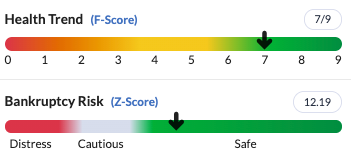
Its Piotroski F-Score also points to this being a financially healthy company:
Balance sheet: small but strong
Management likes to say it has a strong balance sheet. The truth is more nuanced than that.
TPFG has a very light balance sheet - while there are no huge liabilities or capital risks, neither are there many tangible assets to underwrite equity value.
Goodwill and intangibles make up some 70% of the group’s £21m of total assets. However, the group’s prudent lack of financial liabilities means that net tangible asset value still comes out at a respectable £2.57m, or 9.6p per share. TPFG’s strong net cash position also means that it has a net current asset value (current assets - total liabilities) of £1.66m or 6.42p per share.
The group is low cost and has no debt, £4m of cash, and a £5m revolving credit facility at Barclays.
Management
Although current CEO Ian Wilson is now stepping down, he has been at the helm for a long time and, listening to webcasts and reading management comments, I do get a sense that this company is prudently run for the long term and with a sense of stewardship.
Management appears to be aligned with shareholders and is focused on creating value for owners. Wilson himself is a c5% shareholder in the company. The CEO succession has been well-flagged to shareholders and is not being rushed. I see no reason why TPFG’s pro-shareholder culture should change with the incoming CEO.
COVID-19 conclusion
The business is also heavily weighted towards lettings and within that it is heavily weighted towards revenue from its portfolio of tenanted managed properties. When all is said and done, I believe TPFG has the finances, liquidity, management, and franchise network strength to be in a position to build momentum and to seize commercial opportunities when conditions become more predictable.
Management itself says:
The impact of the Government's preventative measures for COVID-19 will make life much more difficult for landlords who do not benefit from the professional assistance of an agent and we believe that there is scope to increase our managed portfolio significantly in future years.
2019 P.C. (pre-COVID-19): an ancient history lesson
Given the month we’ve just endured, talking about 2019 trading conditions feels about as relevant in the short term as discussing the property sales and lettings markets of ancient Rome. I assume we will return to 2019 conditions at some point, though, in which case digging through these results is still useful.
For TPFG, FY19 was a year of political uncertainty, of operational consolidation, of mitigating the government’s new tenant fee ban, and of downward pressure on estate agency fees as hybrid models fought for market share.
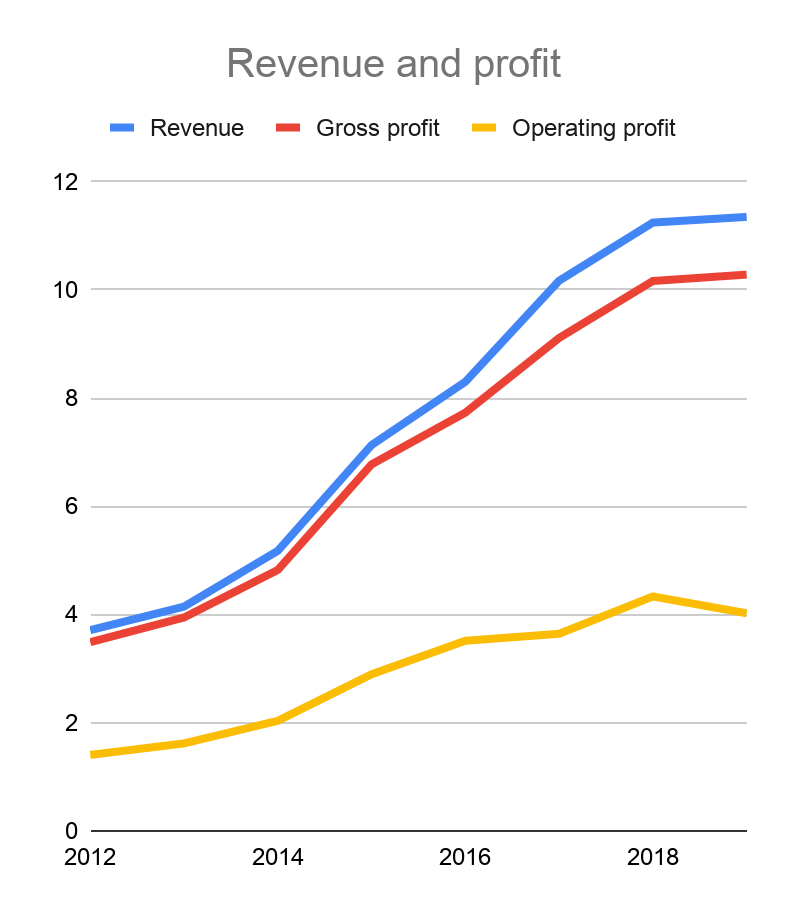
Here are the financial highlights for FY19:
- Group revenue +1.8% to £11.4m
- Management service fees (recurring revenue) +3% to £9.7m (69% lettings; 30% sales; 1% financial services)
- Adjusted EBITDA +5% to £3.5m
- Operating margin steady at 39%
- Profit before tax -7% to £4m
- Balance sheet net cash up to £4m
FY19 was a tricky year that did not match up to historic growth rates. It was a busy, bitty year in which the group defended market share, strengthened its balance sheet, and made plans for the future.
The drop in operating profit is a result of an increased share based payment charge. The company adjusts its figures and strips this charge out. For now, I leave it in - it is a cost, so let’s include it.
Current trading and outlook
Putting COVID-19 to one side, I see the above as steady (if not spectacular) progress.
When you have built up the kind of track record TPFG has and trade on an undemanding valuation, then one slow year is not a huge cause for concern. It’s a totally different situation to Fever-Tree (covered here), which trades on a premium growth rating of c20 times FY19 earnings.
The important thing is management’s comments on trading and outlook. TPFG expects revenue to be reasonably resilient in the lockdown:
All our franchisees' high street premises have closed, with property management and client accounting activities being carried out by home-based staff using cloud-based software. At the behest of the Government, all estate agency activity is effectively suspended, temporarily. Revenue at the franchisee level from the portfolio of tenanted managed properties was £3.8m in February representing circa £15k of recurring income per trading office (excluding EweMove), which we expect to prove substantially resilient in the coming months.
… With the Group facing a very challenging trading environment we have focused all of our efforts on intensive support to our franchisees, which at this time largely takes the form of advice and guidance rather than tactical financial assistance. We have also been working hard to negotiate with suppliers on franchisees' behalf. Under the leadership of incoming CEO Gareth Samples, the Board's focus in the period ahead will be on navigating the challenges this unprecedented situation brings and supporting our network. Over the longer term we have the utmost confidence that the strength of our franchise model and clear strategy means that we are well positioned to resume a growth trajectory and to add value for all our stakeholders."
Financial services and growth strategy
With the launch of its new Financial Services division, TPFG can now generate broker mortgage products, life assurance and general insurance business across its leads and franchise network. This really could be a substantial driver of future growth.
Financial services is a logical extension to TPFG’s core franchise business and should be something of an open goal going forwards. The group already generates a high volume of buyer leads with its franchise network, (circa 92,000 annually).
While acquisitive growth has been postponed here as well, TPFG should be able to develop this potentially high margin division and ensure franchisees have better access to attractive financial products.
Conclusion
Positives
- Sensible management
- Healthy cash position, poised to take advantage of market weakness
- Resilient - growing level of recurring revenue
Negatives
- Small, illiquid micro cap
- Property sales and rental market likely to come under pressure
- Hard to quantify the lockdown risk
Over the longer term TPFG aims to expand its market share of UK property sales and lettings through acquisition at both the corporate and franchisee level. It plans to do the same with its new Financial Services division.
Understandably, these ambitions are temporarily on ice. Nobody knows what the property sales and rental market will look like in the short term. Probably not great. What’s more, this is a micro cap with a 48% free float - liquidity will be a concern for some and it is not a stock to hop in and out of.
The group has no debt, a strong balance sheet, and lots of cash headroom. It is heavily weighted towards lettings, with a good chunk of recurring income streams. The Company also remains strongly cash generative.
There is a clear strategy here, with investment decisions and shareholder value driven by a focus on managed properties, operating margins and return on capital employed. There’s every chance that TPFG’s lean franchise model can help it outperform competitors, increase market share and deliver increased value for all stakeholders in the immediate and longer term.
What do others think? Right now, TPFG looks like a solid “quality at a reasonably price” candidate. But is that the right play in these rapidly changing markets? Or are you finding better risk:reward opportunities elsewhere?
Disclaimer
This is not financial advice. Our content is intended to be used and must be used for information and education purposes only. Please read our disclaimer and terms and conditions to understand our obligations.

5 comments
Hello Jack,
Good article as usual.....I have been letting property since 1987 , and unlike many people who have been in any area of business for 33 years ...I do not consider myself an expert.
So do not consider me or the comments that follow those of an expert....I am not an expert, and have met many so called experts in the property letting and sales market ..I have met some of the people from Martin & Co, CJ Hole and Parkers , in the area of lettings and sales but have never been convinced as a portfolio landlord to use their services.
My view for what it is worth is detailed below:
A- When I prepare my property for letting, I assume my tenant is called Wendy, she is about 30 ish in age and is discerning , she wants a property in good condition but wants to make it her home.
B- I only ever use small independent letting agents which are locally based to where my property is and the letting agent must be a woman...I have met too many bullshit men in the letting business who do not know there arse from their elbow....only small owner operators for me ....
C- I am prepared to accept a lower market rent for a good tenant , than a higher rent for a questionable tenant.
D- The property letting market will suffer short term problems due to Covid 19 and I am ready to do what I can to help my tenants , should they find themselves in a difficult position.’...but I need an agent who is contactable and nimble and prepared to respond to my texts 7 days a week....TPFG...try texting them 7 days a week.
E-I have lived through downturns in the 70’s, 80.s 90’s 2008 and beyond and Covid 19 is on another scale but many people before Covid who were looking to buy property , will now find the mortgage market frozen for a long time to come...Lenders are going to be risk adverse and 90% or even 80% mortgages will be unavailable for sometime....so the alternative if Wendy wants a place on her own, ....it’s going to be renting...a nice 2 bed flat costing around £550 per month in a nice area of town , with parking outside and within walking distance of town.
F- TPFG...We all have a limited amount s of cash and where we deploy that cash, with so many choices in front of us is daunting , because some companies are going to survive and their share price will do just fine...other surviving companies will have rocketing share prices....I know where I want to deploy my cash and it’s not in boring staid companies like TPFG..which look good on paper and on the rankings.
TPFG might get more amateur landlords money but they will never get mine as there are better companies to deploy my cash with...and better agents to manage my properties with.
Once again a good article Jack but TPFG is in my view one to avoid as I fear their cash reserves might not be deep enough to get them through this crisis ....intact.
Thanks for taking the time, Tony
It's always worthwhile hearing a considered counter argument. Particularly one based on 33 years of first hand experience...
In fact, right now, it's probably more important than ever to be listening to alternative opinions.
Property Franchise (LON:TPFG) revenue leans much more towards lettings than sales. Even so, we might well be in for a period of people struggling to pay rent. It is hard to predict how this all shakes out, but I feel that given the group's high margins and flexible low cost base, TPFG can at least survive as its burn rate should be very low.
You have a point re. where to deploy cash in these markets. I'm relaxing some of my own criteria so that I have a better chance of finding the really exceptional risk:reward candidates that this market creates.
Unlike many other businesses selling products/ services of human desire rather than necessity I suspect the demand for accommodation will continue. It will probably take time for house sale confidence to return but the letting market should be open as usual.
But will it if people lose their jobs, plenty of empty properties around where I live now. Also many may not be able to pay the rent. Universities are closed so less people will be letting. I don’t think the letting market did very well in the last recession, also property prices fell.
“Nobody knows what the property sales and rental market will look like in the short term”......yes we do...dire....with no doubt.