Tricorn (TCN): Full year results

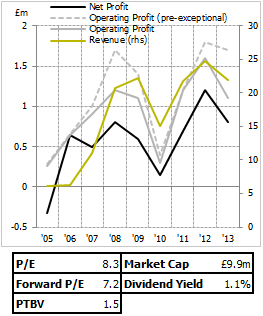 Tricorn, a member of the portfolio for a few weeks now - and rather happily up ~15% in that time, though that statistic isn't worth much given the absurd volatility of shares this small - released their preliminary results for 2013 yesterday. It's probably fair to say the results were slightly better than expected, beating forecasts by a decent amount; make of that what you will. In more absolute terms, revenue declined by 12% while underlying operating profit stayed roughly the same, at £1.7m. I've updated the graph on the right to show the new figures, and also the valuation box beneath.
In many ways, these results in themselves are sort of less interesting than they might usually be; we look at results to tell us about what has happened with the business over the last year, to try and figure out where things are going and if they are performing as they have done historically. Given the amount of change that's happened at Tricorn, though, this is less the case here. The US acquisition relatively late in the year, as well as the expansion into a Chinese manufacturing facility that was ongoing means that the real crunch time is the next couple of years, not this one. This morning I spoke to Mike Wellburn and Phil Lee, CEO and FD, about the figures and that sort of theme - of a changing business - was something Mike was rather keen to emphasise. He was very much talking about the US and China as being transformational and talking about the effect that will have on the business in the near future.
This is still clearly true, though it's obvious that that strategy doesn't come without risk. I note that this year's revenues don't fully reflect the loss of that significant Rolls-Royce contract in November, and given that revenues are already down 10%, that's more of an obvious headwind for the UK bits of the business as well. The company did well to maintain operating profit given that revenue fall, though, and the directors attributed that to (and noted they were continuing with) the usual 'rightsizing', keeping costs in line etc. I say usual since it's a bit of a universal management cliche, but more often than not it's a failed endeavour, so success here makes a pleasant change.
Given the scale of the acquisition and expansion Tricorn have undertaken, though, that RR contract becomes slightly less significant. The US operations, bought piecemeal at below book cost out of receivership and subsequently restructured (they didn't buy head office and only one of the 2 factories, for instance) could quite conceivably account for more than a quarter of group revenues in the next couple of years, and the China plant is slightly larger in scale, though doesn't have all the intangible infrastructure in place that you'd get when buying a business. That likely pushes back the payback somewhat. It doesn't seem an exaggeration to say that the company could quite easily double revenues in the next few years given the scale of investment, though.
The CEO was also keen to point out the more synergistic advantages of being a global company - particularly when their customers are enormous worldwide businesses. Considering the UK, the US and China as separate segments, each detached, will likely prove harsh if customers see a benefit in sourcing parts from one company all over the world. People like simple, rationalised supply chains. If Tricorn (LON:TCN) can sufficiently differentiate themselves in this regard, it's a clear competitive advantage; a better offering for their customers.
One thing that did become apparent when looking at the slides and speaking to the directors was the scale of the spare capacity in the business; there's enormous room to grow in the US operations, the new Chinese operations and, judging by revenue declines on the UK capital base, there's also room for volumes to come up here, too. The capex requirement to get this going doesn't seem to be enormous - the question more becomes if Tricorn can find the work. That's clearly a more difficult question for an outsider to answer; if the business struggles to win new custom, or more volume from their existing blue-chip OEM customer base, the value is less clearly realised. Customer concentration here is high - a function of the business model, and comes with both negatives; the loss of one customer can be particularly damaging and positives; customer relationships and the way Tricorn works alongside them is arguably part of what makes the way they operate tick. Tricorn do earn good returns on capital - more than you would expect from a more commoditised manufacturer, for instance, so it's obviously working. Whether it will continue to do so into the future or the ravages of competition will drag it down is a critical question.
I'm not concerned about the debt situation (which is fairly low) since the bulk of investment and expense on the two new plants is behind us. The company has no term debt and doesn't seem like it will need any barring any more big acquisition opportunities - which the CEO didn't rule out, though did note it would have to be a good opportunity, like the US deal at substantially below book.
All in all, the results don't change a huge amount. It's by no means a risk-free prospect; while management are confident of the business strategy they're executing, I don't think I've ever spoken to a director who isn't - after all, they wouldn't be doing it if they didn't believe in it! You have to have a degree of faith in the plan going forward, and Tricorn suffers from all the usual questions related to small caps - it's illiquid and small caps tend to be more volatile operationally, for instance.
In exchange for that, you get the potential for significant growth at hardly an expensive price. No selling here then; they'll be staying in the portfolio.
Disclaimer
This is not financial advice. Our content is intended to be used and must be used for information and education purposes only. Please read our disclaimer and terms and conditions to understand our obligations.
No comments yet
No one has commented here yet! Why not be the first one?