Two cheap rerating opportunities: Sigmaroc and Billington

I have been busy conducting field research into the returning pub industry (I see Paul has been doing the same!).
Last night I went out for a pint with a colleague to experience first-hand the new world of sanitizer gels, staggered entries, and table service. It turns out the lady that served us was the pub tenant - she said the unit had opened on the 4th of July and was currently tracking at around 60-65% of last year’s sales.
This must be a good initial result. She also said the name of the game for now is short-term survival, with longer term hopes pinned on a normalisation of trade into 2021. I wish all the best to these small business owners and I think she can make that happen. It could be a rough ride though, with many still on furlough.
Does anybody have any similar stories, or is it still too early to venture out?
There are other parts of the economy where shares have been similarly hit. In some cases it is fair but other deratings might present an opportunity for investors. We’ve heard Boris Johnson, in full hard hat mode, repeating another three-word slogan recently like a newfound toy: ‘Build, build, build!’
Additionally, the UK Transport Secretary has said that ‘nearly £2bn’ of extra spending has been allocated to fund infrastructure projects to ensure the UK can ‘bounce back’ from the coronavirus crisis
Is this hot air or are we set for an infrastructure spending boom to kickstart the economy? And if the latter, which stocks might benefit? It seems reasonable to anticipate some expansionary fiscal policies.
On that note, I’ve taken a look at two stocks with infrastructure exposure: Sigmaroc (LON:SRC) and Billington Holdings (LON:BILN).
Sigmaroc (LON:SRC) - quality obscured by acquisitions
Market cap: £105.3m
Enterprise value: £155.1m
Style: Turnaround
1y relative strength: +13.5%
Sigmaroc is a rapidly developing company. Since 2016, there have been nine acquisitions.
In these instances, the StockRanks can miss out on the company-specific story, and I think that might be happening here. Note how the Quality Rank drags down the overall StockRank down.
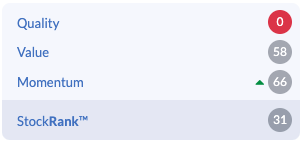
There are legitimate concerns here but it also reflects harshly on a company that is led by an experienced management team busily assembling a portfolio of high quality construction assets.
SRC is the Channel Islands market leader (Ronez), has precast concrete activities in England (PPG), quarrying businesses in Wales and has just bought a major stone and aggregates player in Belgium.
This latest acquisition is SRC’s biggest and could facilitate further expansion into Europe.
My building knowledge just about extends to flatpack Ikea furniture, but quarries are interesting as they are hard to replicate and come pre-loaded with barriers to entry. By my count, SRC has 11 quarries (as well as other integrated operations):
- Ronez - two quarries, one in Jersey and another in Guernsey,
- South West - six quarries in Wales,
- Benelux - three quarries in Belgium, including CdH (more on that below).
As Peter Lynch says: ‘I’d much rather own a local rock pit than own Twentieth Century-Fox, because a movie company competes with other movie companies, and the rock pit has a niche.’
Competitors can’t just move in and create more quarries. It’s a potentially valuable niche. But there’s more to SRC than rock pits - management is assembling a vertically integrated collection of platforms, meaning additional acquisitions should be able to realise benefits quickly from SRC’s existing integration.
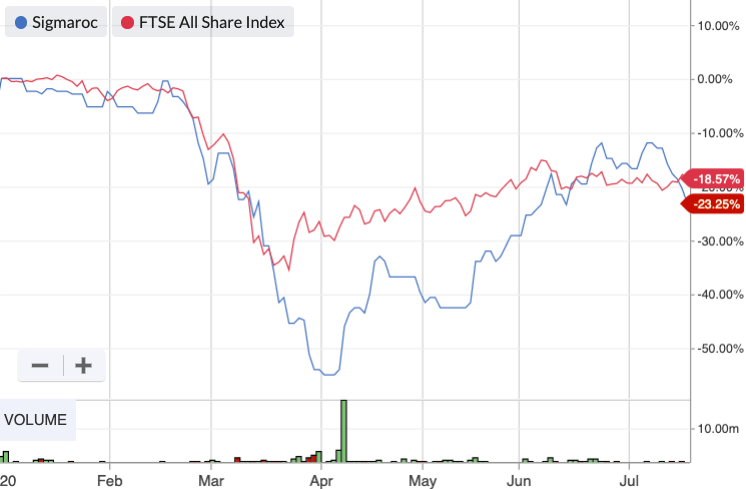
SRC’s shares tanked in March. Since then, there has been a rebound but shares are now drifting back down and are once again underperforming the market YTD.
In my view that is not a fair reflection of operational performance and a rerating would be justified.
SRC’s most recent update to the market on the 9th of June talks up its ‘resilient trading’ across the first five months of 2020, and a return to normal operating levels since May. Breaking this down:
- SRC generated £42m of revenue (84% of revenue for the same period last year, pro forma),
- Group revenues tracked at 60% in April and recovered to 98% in May, and
- The group has been EBITDA positive for each month this year.
Although the group continues to have a net debt position, this looks manageable at c2x underlying EBITDA. It is something to keep an eye on, though.
This kind of roll up is not a free ticket to share price gains. It’s fraught with execution and integration risk. That said, the Sigmaroc team is proving its ability here.
CEO and co-founder Max Vermorken et al acquired an AIM cash shell (Messaging International) in September 2016. Since IPO in 2017, the team has made nine acquisitions, all of which are asset-backed with strong market shares in mainly regional markets.
Here are the most notable purchases so far:
- January 2017 - listing on AIM and acquisition of Ronez for £45m (9x EV/EBITDA)
- October 2017 - acquired Allen Concrete for £13m (6.3x EV EBITDA)
- December 2017 - acquired Poundfield for £10m (6.8x EV/EBITDA)
- January 2019 - acquired CCP for £12m (5.9x EV/EBITDA)
- April 2019 - acquired GD Harries for £29m (7.6x EV/EBITDA)
- October 2019 - acquired Carrières du Hainaut for £71m (6.8x EV/EBITDA)
That’s £180m of acquisitions over the past three years or so at a weighted EV/EBITDA of 7.4x. Together, you could argue the value of these assets are enhanced yet SRC’s market cap is just £105m (albeit with a £50m net debt position).
The group’s most recent acquisition activity in Belgium looks particularly promising.
Belgium: first steps into Europe
In October 2019, SRC acquired Carrières du Hainaut (CdH), located 25 miles from Brussels, for £71m.
This is the biggest stone quarry in Europe and dates back to 1888. It is the leading supplier of Bluestone (c15% of extracted material) but the quarry also extracts and processes 2.0m tonnes per annum of construction aggregates.
Bluestone is a high-value, high-margin stone prized for its colour and durability. CdH has a 50% global share and is the lowest-cost producer.
There is further opportunity in the other 85% of aggregates as well. These are currently extracted by a third party at a loss to CdH, so taking aggregates back in-house could boost earnings materially.
Meanwhile, the acquisition could be a great springboard from which to build a Europe-focused business.
This process has already started with SigmaRoc purchasing a 49% stake in Stone Holdings, a small Belgian aggregates producer, for a cash consideration of €0.7m. Stone has two quarries near Huy, about 50 miles from Soignies, as well as a wharf and a contracting business focused on armour rock for river and sea defence work.
Risks
The obvious flag here is SRC’s non-existent Quality Rank. Put simply, it pays the price for low Z and F Scores, an increasing net debt position, and low returns on capital. But if you look at the StockRank over time, you can see it shoots up at various points:

This might indicate that SRC’s true value is obscured by acquisitions. Underneath all the activity, I think there’s a good chance management is building a high quality heavy construction materials platform underpinned by unique assets with barriers to entry.
F-score fails
Statutory net profit has fallen year-on-year from £3.62m to £1.73m, but only after some £6m of exceptional charges (compared to £1.6m in the prior year).
Note 11 of the group’s FY19 Annual Report breaks these costs down:
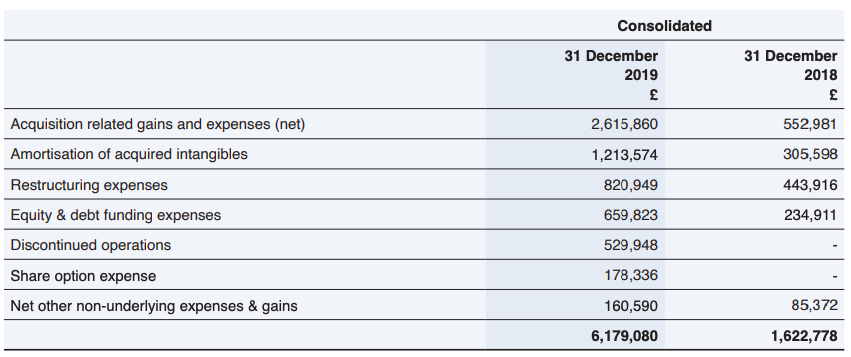
These costs are expected given that this year alone SRC has acquired four businesses (CCP, GDH, Stone and CDH) for a combined enterprise value of approximately £112m and proforma EBITDA of approximately £17m.
Additionally, restructuring expenses incurred today (cost-cutting, etc.) will pave the way for increased profits in future.
That said, underlying net profit figures of £7.9m for 2019 and £5.2m for 2018 makes for return on asset figures of (£7.9m/£208m) 3.8% and (£5.2m/£84m) 6.2% respectively. So on this measure, SRC is still less profitable than it was last year given its expanding asset base.
Long term debt has also notably increased amid all the acquisitions. Meanwhile shares in issue have gone up (although the group continues to increase book value per share). This makes me wary, but I’m also impressed by the portfolio of assets management has so far assembled.
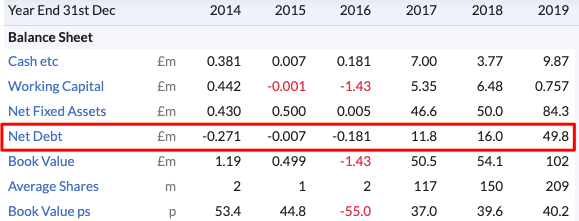
It looks like the group is struggling to generate free cash flow and its liquidity metrics have weakened as it constructs its platform of businesses:
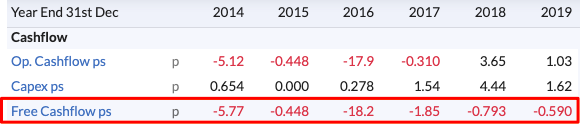
Meanwhile the Z-Score also flags up liquidity and profitability concerns.
I don’t want to dismiss these flags, but I also think we are yet to fully see the benefits of acquisitions come through. If management can successfully integrate and expand its operations, then today’s metrics stand to change and the StockRank could increase in future.
Conclusion and valuation
Sigmaroc is the story of an experienced management team executing a clear strategy of acquiring unique, cash-generative assets in niche markets that produce heavy construction materials.
At just over 9x forecast 2021 earnings, there could be value here, especially if you think the impact of COVID will necessitate an increase in infrastructure spending.
Once the dust settles and all nine acquisitions are fully integrated with synergies being realised, it might become apparent that this company is undervalued.
SigmaRoc has a strong portfolio of assets with leading local market positions and so far management has proven adept at unlocking value. It has an option to acquire the remaining 60% of GH, which would be earnings enhancing, and it is well placed for further expansion into Europe.
One that might be worth a closer look at 40p. Head over to the Directors Dealings page and you’ll see frequent buying activity at levels as high as 50p at the start of the year - so you would be looking at a 25% share price gain just to get back to that level.
DYOR, but on the face of it that seems like a reasonable short term target to me.
Billington (LON:BILN) - bullet proof balance sheet
Market cap: £38.2m
Enterprise value: £21.9m
Style: Contrarian
1y relative strength: +11.6%
Billington Holdings (LON:BILN) is another stock that has been unfairly hammered. I looked at it previously in more depth (here) and came away impressed not just with management’s execution, but also the honest tone of its updates over many years through the market cycle.
In the group’s 2019 Annual Report, it said that ‘the Covid-19 outbreak has inevitably led to some reductions in volumes across the Group although more prevalently in our easi-edge, hoard-it and Peter Marshall Steel Stairs businesses’ but also: ‘whilst the ultimate outcome is uncertain, Billington is in a strong position to navigate the difficulties ahead and remain a significant player in the structural steel and safety solutions markets.’
It's a cautious but confident tone.
The share price has underperformed since March on little volume but this company is a quality operator with a bullet proof balance sheet.
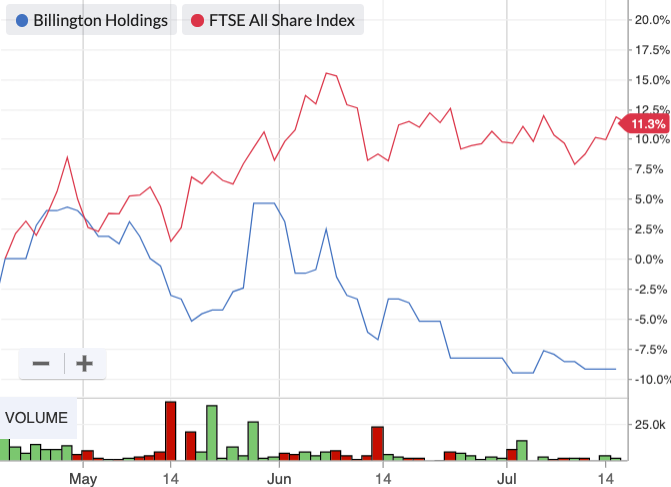
In weaker markets, often the strong get stronger while the weaker leave the stage. Who knows what’s next in terms of a second wave, returns to partial lockdown, etc. but if we do manage a controlled return to normality a rerating could be on the cards here.
I’m wary of FY20 forecast data here, but even on a trailing twelve month basis BILN looks cheap:
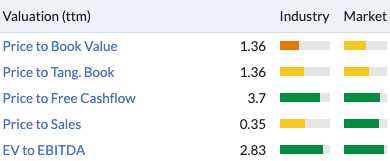
Last year was a bumper year for the company, true. But if you take the average five-year EPS of 30.94p, that gives a PE ratio of 9.5x - still cheap even on that basis, and that dilutes the great operational strides BILN has taken over the past couple of years in particular.
Conclusion and valuation
Given the £108m of FY19 sales and the strong balance sheet, I’m not sure this one should be in micro cap territory.
Stockopedia hits the nail on the head, classifying BILN as a Contrarian stock - plenty of Quality and Value on display here for those that can afford to wait:
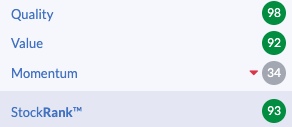
If we write off the FY20 forecasts and push them out to FY21, that still values BILN at 8.9x forecast net profit. Take this with a pinch of salt - but then you also have net cash of £16.2m as of the last balance sheet date. That’s 50% of today’s market cap in net cash.
Billington Structures is operating at 100% capacity with many major construction sites operational (with appropriate safety measures put in place) and demanding deliveries. Safety Solutions has been operating at reduced levels but this could improve as activity returns.
It’s far from guaranteed and I don’t want to dismiss the possibility of some big reset in the fight against COVID, but management has modeled some extremely pessimistic forecasts (the reality since then has proven to be far more forgiving) and has passed these tests comfortably.
The spread is punchy at 339bps but BILN’s balance sheet is very strong.
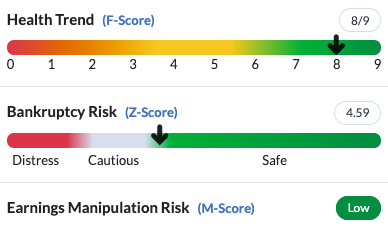
FY20 will most likely not match up to 2019 but the company is well prepared to weather the storm and any weakness in its areas of business represents a long term market share opportunity in my view.
With exposure to data centres, online fulfilment warehouses, and large infrastructure projects, the market may be unduly pessimistic on BILN’s prospects - so at 295p and with a strong balance sheet to boot, BILN could be a good contrarian value bet on a normalisation of economic activity and increase in infrastructure projects over the next two years or so.
Disclaimer
This is not financial advice. Our content is intended to be used and must be used for information and education purposes only. Please read our disclaimer and terms and conditions to understand our obligations.

4 comments
I'd suggest that Billington Holdings (LON:BILN) is unlikely to make any progress until a somewhat overdue trading update is released to reassure existing/potential investors that all is in reasonable shape, even if the balance sheet looks solid. The chart looks pretty poor to me at the mo, with share price and MVAs all very negative.
On the pub question, we run a group of 9 pubs in Belfast. We reopened 7 of them on 3rd July (the other two were nightclub/ Late Night Venues and we couldn't see any point). The results are extremely mixed in the first couple of weeks. We have three outlets with suburban locations that are large with great outdoor areas. Sales in these venues are actually up on last year and I expect that to continue. Another smaller local venue without a good outside space is doing OK (around 85% of LY). These four outlets all have a strong food offering.
However, the other 3 bars are in student or city center locations and are running at roughly 40% of last years sales. I expect them to continue to be poor going forward. Tourism, office workers, retail shoppers and students are all MIA and that is what our town centers rely on. This is going to take a long time to return. As much as I can, I'm looking at the physical locations of my investments these days. This is especially true when it comes to pubs where if your customer has to rely on taxi/ public transport to get there (drink driving laws being what they are), they probably aren't going to come.
I do hold Billington Holdings (LON:BILN) and will stay with it until the share price returns to January levels, in the meantime I should like to see the dividend re-instated which would help.