Using Breadth Indicators to Help Timing of Trades/Investments

Breadth indicator discussed: % of Stocks Above Key Moving Averages for 20-day, 50-day & 200-day.
The three charts posted are for the S&P 500 (SPX) vs % of Stocks Above Key Moving Averages mentioned above.
From a breadth standpoint, the market is mean reverting in nature, as can be seen via the charts below (please right click and open in new tab to enlarge).
An important concept is 'the market' oscillates from overbought readings to oversold readings and vice versa (mean reverting).
Why is this usual information? Two main reasons:
(1) A rising tide lifts all boats, and
(2) Swimming against the current is hard!
The way I think about it is when oversold readings occur the market has 'room to run' to the upside. When in overbought territory, it's likely there is little 'running room' left.
Now for some mental complexity, one has to think about rising tides and currents across three different durations being short, intermediate, and long-term.
(1) Short-term: 20-day reading,
(2) Intermediate-term: 50-day reading, and
(3) Long-term: 200-day reading.
Another way to think about the above is how much running room to the upside is likely left across the different durations.
For example, the intermediate and long-term readings might be oversold and about to 'raise all boats', however, the short-term trend is overbought and going to create a current.
Before looking at the charts below it's important to know the overbought and oversold readings, these are:
>75% of stocks above a moving average = overbought (red shading)
<25% of stocks above a moving average = oversold (green shading)
The charts below are lined up for the SPX over the indicator to show what the market did and readings at those times. Focus on tops and bottoms and correlations.
Chart 1: S&P 500 % of Stocks Above 20-Day Moving Average 2022/23
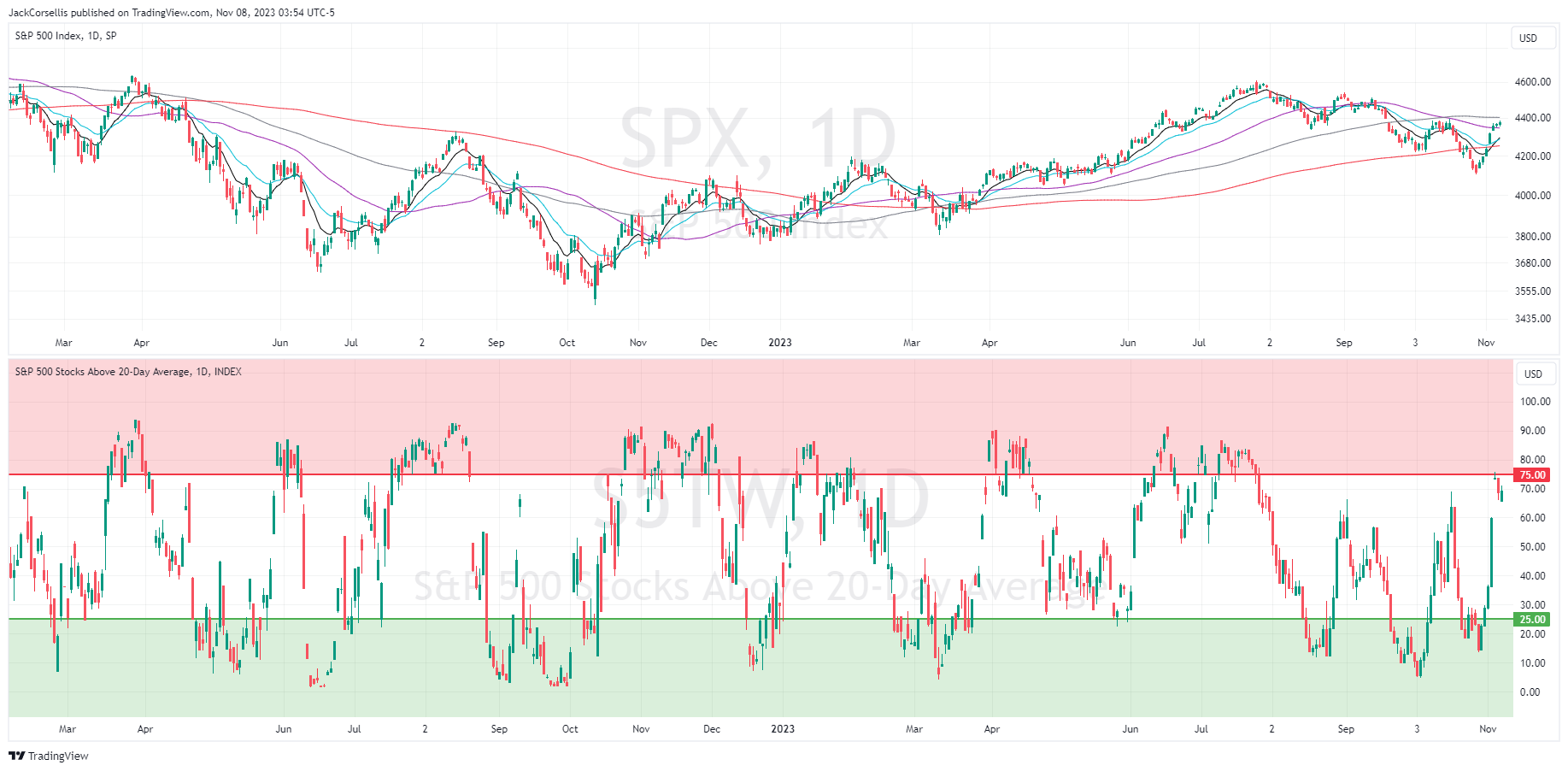
Chart 2: S&P 500 % of Stocks Above 50-Day Moving Average 2022/23
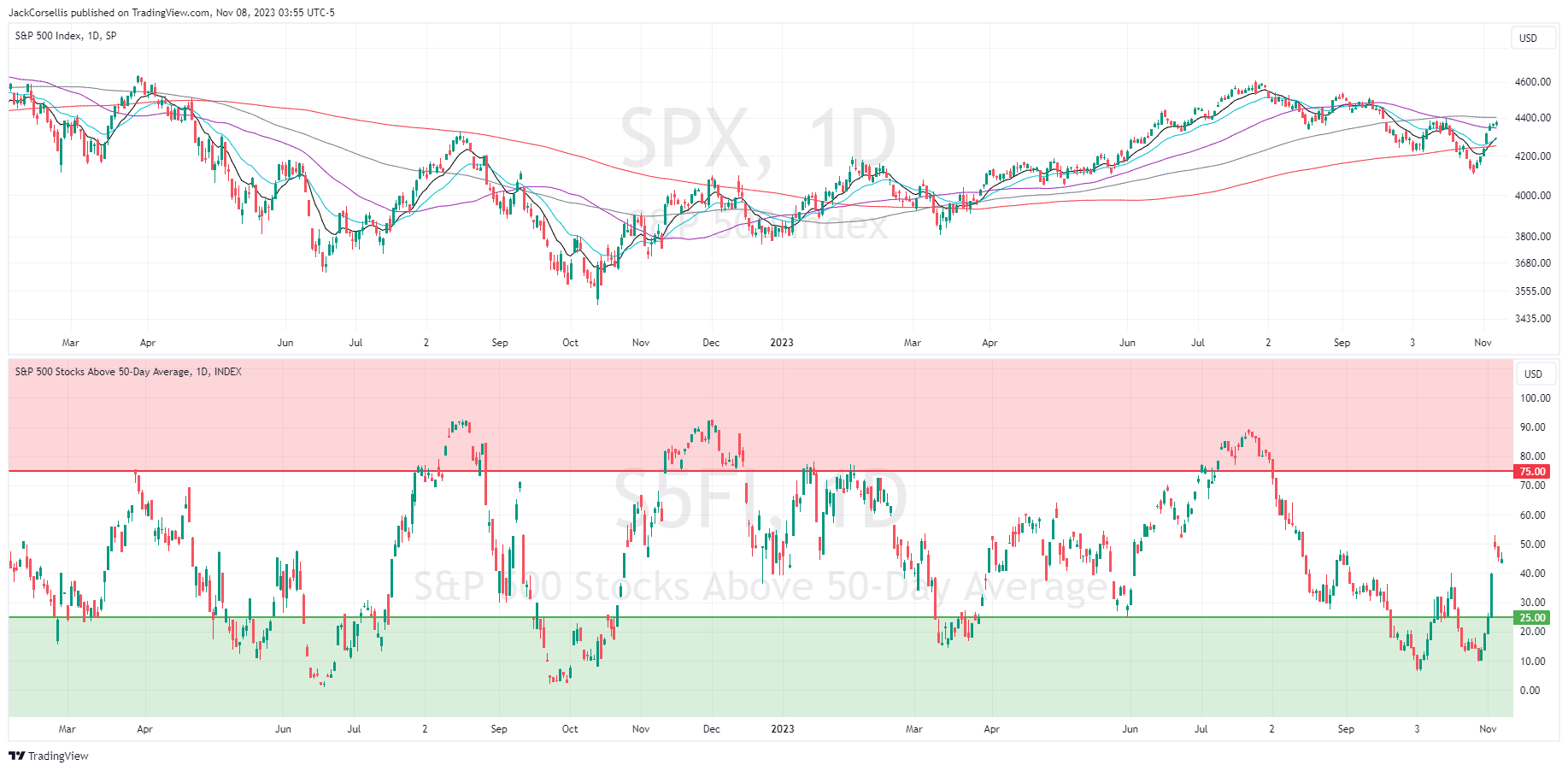
Chart 3: S&P 500 % of Stocks Above 200-Day Moving Average 2022/23
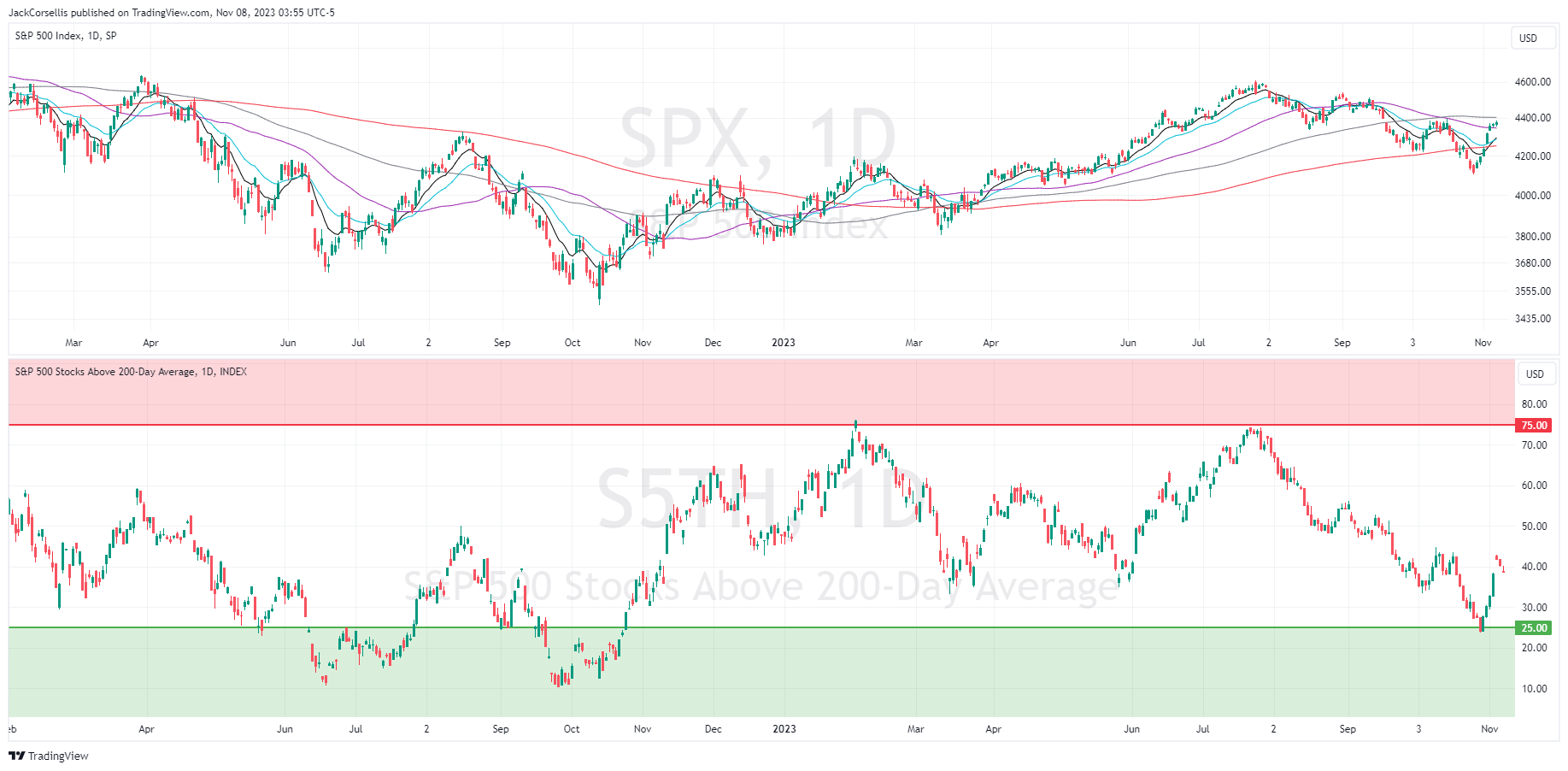
The short-term moving averages are closer to the price action, therefore, more overbought and oversold readings will occur. I give more weight to the longer-term readings, such as the 200-day moving average reading going overbought/oversold, but aware of all readings.
I conduct this same analysis for the % of stocks above key MAs for the Nasdaq 100 and Nasdaq Composite on a daily basis.
How do I use this information in my own trading?
I've found the better times to be entering new positions is when all three indicators are near oversold levels. It goes back to the upside 'running room' point and the proverbial rising tide lifting all boats. The better trading periods this year, for US markets, have been months following March and June, please note the readings at those times. The more difficult trading environment was from July this year onwards, again please note the readings especially for the 50-day and 200-day moving averages at this time.
With my stock selection I put a significant emphasis on relative strength. When the market moves from overbought to oversold indicator readings, which are the stocks that resist the downwards pull of the market building constructive basing patterns - Cup with Handles, Darvas Boxes, Flags, Triangles, Pennants, Wedges, VCPs etc.
My experience is these stand a greater chance of appreciating once the market mean reverts and heads from oversold territory to overbought.
This relative strength point can also be applied to sectors and groups as well as stocks to further aid in identifying leadership.
So the concept is this, I want to be allocating capital to leading stocks when the market indicates it likely has plenty of running room to the upside across multiple durations.
As an intermediate-term trend follower, I then use selling rules/guidelines to help with my decisions of when to scale out of positions.
Is this single indicator a magic pill? Of course not. Overbought readings can stay overbought and oversold readings can become more oversold! However, I find it a useful tool in my analysis of stocks and also emotions of when to be patient. Timing is everything, as they say.
Jack
Disclaimer
This is not financial advice. Our content is intended to be used and must be used for information and education purposes only. Please read our disclaimer and terms and conditions to understand our obligations.
5 comments
Hi Jack
As a non user of charts except in the most rudimentary way, and as a non level 2 investor, how does one tell from the chart whether a stock is oversold or overbought. What indicators should I be looking for?
Hi Threepeat,
Thank you for the question. Firstly, I don't use level 2, I don't think it's necessary for swing trading.
A stock being oversold or overbought is a very different and subjective topic with no definitive answer, in my view.
What I'm referring to in the post is the % of stocks above or below a certain moving average being the 20-day, 50-day, and 200-day. It's a subjective exercise to determine what is oversold or overbought territory, however, my studies are that >75% is overbought and <25% is oversold. Of course, overbought can stay overbought and oversold can become more oversold.
A belief I have, again subjective, is the market will mean revert between oversold and overbought. If one looks at the charts posted, and/or conducts their own study, they'll likely see the correlation I'm mentioning.
It's not perfect, nothing is, but it gives me a better feel for the market.
Does that answer the question?
RSI or relative strength index is the way I decide whether a stock is oversold or not. Above 75 is overbought, below 25 is oversold.
I mix this with stochastic RSI. Stochastic (SRSI) isa more volatile RSI and highlights the current (Short term) move. When both are oversold it *could* be a buying opportunity, if both overbought it *could* be time to sell.
This is by no means a perfect formula and stocks can stay overbought for weeks and still go higher, or be oversold and still go lower.
I try to do my research in a company first, then the financials, try to look into the fundamentals and then finally check the chart to look for a buying area.
I too am a swing trader, so once ive done the above I will hopefully be buying the bottom when both SRSI and RSI and low and look to be go upwards.
You tube is your friend for help with charts and RSI/SRSI.
But never buy/sell just because a chart is high/low.
Hope this helps
Thank you for your interesting piece. I too attempt to time the market, but my market is the UK small caps. I do this by analysis of the daily numbers of advancing and declining shares in the outcome of four screen that I conduct every day. These screens are for Smaller cos, Larger Cos, Cheaper shares, More expensive shares. This also gives me information about which types of shares are currently doing better than others.
How long have you been using this approach? What is your typical holding period? How successful has your approach generally been for you?
Thank you. Interesting take on identifying where the relative strength is for market cap that you undertake, certainly harder on UK companies!
To answer your questions:
How long have you been using this approach?
In terms of looking at breadth indicators, years.
What is your typical holding period?
I'm an intermediate-term trend follower so much depends on the market environment. Assuming I don't get stopped out, usual holding period is weeks to months in good markets.
How successful has your approach generally been for you?
I'm pleased, but not going to share figures which can be construed as guarantees of any kind. From the dawn of the stock market being involved in the leaders of the day has been the best approach, in my view.