Using Buffett's principles to narrow the field of wonderful companies

In my last article, I analysed the company Luceco (LON:LUCE) using a framework that was based on the 100-baggers book. I picked Luceco because I already had some knowledge of the company, having recently researched it. However, which company to analyse next was less obvious. As of writing, my Buffett and Munger Screen generated 49 results, and my 100-baggers screen had 38 results, giving 85 unique possibilities.
The most obvious way to narrow down the field is to exclude the largest and smallest businesses. The largest businesses, such as Unilever (LON:ULVR) , are far less likely to be long-term multi-baggers. The smallest of businesses tend to be niche ones that will likely struggle to scale. Limiting the market cap range from £20m to £1bn should keep companies only in the most promising size range. In addition, some of the screen results are non-trading businesses such as funds or REITs. It makes sense to exclude these. This leaves 49 companies as potential high-return stocks.
From these candidates, the temptation is to pick some obvious investor favourites. However, popularity rarely generates great investment results, as Stockopedia founder Ed Page-Croft describes here. And many investors would have dismissed lighting and power products supplier Luceco out-of-hand, whereas the analysis of the numbers suggests that this is a quality company (although one without the operational leverage to really be a top-performing share.) So choosing the next company to deep-dive based on gut feeling is likely to be suboptimal, too.
In times of uncertainty, quality company investors can always turn to Buffett for the answer. His key observation was that:
Time is the friend of the wonderful company, the enemy of the mediocre.
So, if we have a wonderful company, this should be visible in the long-term results, even if it is currently facing a short-term setback. Conversely, poor businesses that happen to be facing a short-term boom should be able to be excluded from their weak long-term track record. Although the StockReport has five years of numbers, Stockopedia has ten years of data for the Balance Sheet, Income Statement and Cash Flow Statement on the Accounts page:
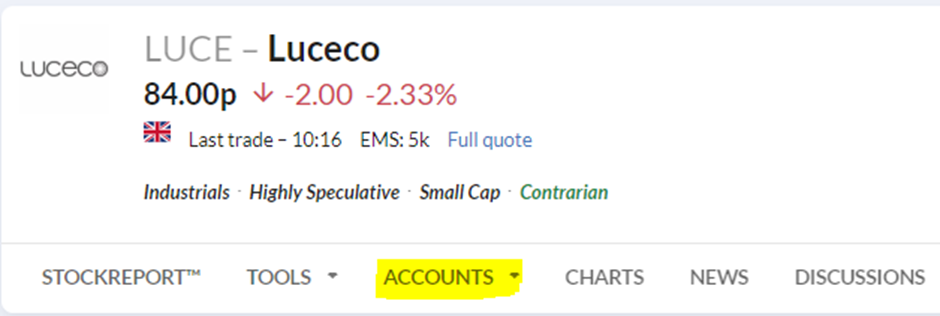
Not every company in these screens has been listed for ten years. Stockopedia includes pre-IPO figures for many companies from their listing prospectuses. However, this may still give limited data. I will exclude any companies that don’t have at least seven years of data. Then use these long-term figures and the 100-baggers framework of Moat, Runway, Operational Leverage and Cheap to narrow the field to the most interesting companies.
Moat
I once asked Buffet disciple and UK Buffetology fund manager Keith Ashworth-Lord what was the key quality he looked for in a company. He was unequivocal in his answer: a high and consistent Return on Equity. This is one of the best indicators that a company has a moat.
I can get the Net Income figure from the Income Statement section of the StockReport:

Likewise, the Balance Sheet section gives the Equity value:

And it is easy to divide one by the other to give the Return on Equity for each company for each year of the last decade and then take the average. Here are the top 20 companies from the screen results with the highest 10-year average ROE:

Investors may be led astray by a company that has had one great year, so they also care about consistency. One of the best ways to measure the variation of any data set is using a statistical measure called the Standard Deviation. A lower figure implies lower variation, which is what we would like to see. Here are the top 20 most consistent ROE companies on this measure:

One final check that investors may want to make is the trend of that ROE over time. Return on Equity tends to be mean-reverting, so looking at the trend prevents investing in a once-great company that has now had its moat breached. There are many ways to do this, and none is perfect. However, graphing the ROE over time and taking the slope of the line of best fit is probably as good as any. Here is the example of the company PayPoint (LON:PAY) :

And here are the top 20 companies from my list for ROE Trend:

These factors combined should help narrow down the field to companies that possess a long-term moat.
Runway
Possessing a sustainable competitive advantage only generates great returns for shareholders if a company has the opportunity to deploy additional capital to generate rapid sales growth. While the past is not always indicative of the future, a company that has a track record of high sales growth has at least demonstrated this ability in the past. Here is the compound annual growth rate in sales of the fastest-growing companies from my list:

Operational Leverage
Positive Operational Leverage is simply Net Income growing faster than sales. The easiest way to estimate this is to look at the ratio of the CAGR of Net Income to the CAGR of Sales:

Cheap
Finally, here are the top 20 highest earnings yield stocks from my list:

Prioritising Companies
In order to identify which companies are most interesting for future Stock Pitch articles, I will simply count up how many of the Top 20 lists each company makes. Only one company appears on all six Top 20 lists: Luceco (LON:LUCE) (Perhaps backing up my instinct to look at this company first, before I'd done this more long-term analysis). Three companies feature on five of the Top 20 lists: Polar Capital Holdings (LON:POLR) Best Of The Best (LON:BOTB) and M Winkworth (LON:WINK) . And a further eight companies are in the Top 20 for four of the criteria: 888 Holdings (LON:888) Tremor International (LON:TRMR) Focusrite (LON:TUNE) CMC Markets (LON:CMCX) Forterra (LON:FORT) Jupiter Fund Management (LON:JUP) Creightons (LON:CRL) Ferrexpo (LON:FXPO) . While I can already see that some of these companies may not fit the Buffet and Munger style of investing, this prioritised list should provide a fertile hunting ground for exceptional companies.
[Disclosure: Mark currently holds shares in Luceco (LON:LUCE) Sanderson Design (LON:SDG) and SCS (LON:SCS) ]
Disclaimer
This is not financial advice. Our content is intended to be used and must be used for information and education purposes only. Please read our disclaimer and terms and conditions to understand our obligations.

11 comments
Catching up on my reading and just wanted to add my thanks for such an informative and instructive article. So much I read about investing is recycled material which adds little, if anything, to my knowledge. This article had me saying to myself several times as I read it, ‘that’s an interesting idea I can adopt when I analyse possible investments’.
Hello Mark, like the other correspondents I am enjoying very much your articles so thank you to you and Stockopedia.
What I am about to say is my personal approach to investing I don’t want to imply any criticism of your methods or anyone elses – one of the things I truly love about investing is there are dozens of ways to be successful, not just mine.
I want to offer a couple of additional perspectives – again, I hope this comes over the right way as a positive contribution to the debate rather than any disagreement with your articles from which I have already learned a lot.
Low PE/High PE
Meyer had a brilliant catch phrase in his book; "good stocks are seldom friendless’" I love this slogan and repeat it every day when I sit down to do my investing.
Charlie Munger also made a similar point with his famous advice "If a business earns 6% on capital and you hold it for 40 years, you're not going to make much different than a 6% return - even if you originally buy it at a huge discount. Conversely, if a business earns 18% on capital over 20 or 30 years, you'll end up with a fine result - even if you initially pay an expensive looking price".
I once heard a podcast with a prominent US VC manager and he said he has a moto ‘if price is the only factor putting you off investing – go ahead and invest’. He said he learnt this from bitter experience of turning down a couple of what turned out to be huge opportunities because he thought they were over valued when he went to the pitch.
For me the message from these quotes is if you want to invest in companies that have the potential to multi-bag you have to be prepared to sometimes pay eye watering prices.
Paul Scott makes another good point on this; often multi-bagger companies beat their forecasts substantially – what this does is make them look artificially expensive in Stocko because Stocko is valuing them against low ball forecasts.
And finally some multibaggers choose not to make a profit (e.g. Amazon) and that accounting policy can distort screening factors like ROE and PE.
In conclusion whilst I accept your point about the importance of high ROE and low PE as a common thread between Buffet and Meyer I think there is a real danger in focussing on low PE companies that I might inadvertently screen out the true multi-baggers.
Time
Whilst it is logical to use a 5 or 7 year track record as a means of ‘sorting the wheat from the chaff’ in terms of defensible moat, again I think there are risks with this.
I have researched some of the companies on your list and know them well. I have a rule of thumb that if a company has been listed more than 3 – 6 years and not already marked itself out as a multi-bagger then it is unlikely ever to do so. Now before someone lists out 20 exceptions to that rule I want to stress that I know there are many exceptions – it’s just my own little signpost that I use and here’s why.
Companies know what investors are looking for and they give it to them – good ROE, Asset Value, Cashflow, Revenue Growth, Story, there are loads of companies that screen well and yet the years roll by and somehow although a share ‘should’ go up in value it never does. Or sometimes shares gradually creep up to a 150% gain over 3 years and then give it all back in one warning.
I think if companies are screening well on a 5 year track record then an investor is very unlikely to 100 bag on that type of share because either it is a journeyman in the manner I have just described, or if it is a real 100 bagger then it’s probably already 5 or 10 bagged by the time it crops up on the screen.
The time we use for our investing is capital in the same way that our money is. So to save me time I ignore most companies with a listed history of 10 years or more and instead I focus most of my research on new issues. Now as we all know most ipo’s are rubbish and that is a whole another story but nevertheless I think the new issue market is a good place to get in on multibaggers early. I look for good stocks that are floated at opportunistic prices and consolidate for a couple of years before getting into their stride or super stocks that jump to a premium and settle or keep going up. Most importantly I look at the reason a company has for ipo-ing.
Markets, Moats, CEOs
I once heard the guy behind Motley Fool say something like this ‘I don’t invest in ratios, I invest in Markets, Moats, CEOs’ – I’m paraphrasing him there.
I think one of the big plusses of multi-bagger coffee can investing is it doesn’t really lend itself to screening for the reasons I have outlined above. Instead it lends itself to a more qualitative and subjective style of investing where the investor uses his or her knowledge of the macro-global trends, quality of management etc to identify super long term investing opportunities that don’t necessarily screen well on quantative analysis.
Thanks again for the article and debate.
Excellent post HHR and one that underlines why I don’t think the screen has unearthed any future mega stocks. But I don’t necessarily hold the screen entirely to account for that - it’s as much about the pool you’re swimming in.
Really enjoyed this article - thank you. Markets, Moats and CEOs - a great example here being Ideagen. IDEA when listed never enjoyed a stellar, or even reasonable assessment on Stockopedia - as David Hornsby (the CEO for the great majority of the time it was listed) was regularly reminded of when being questioned at various Mello events. But the company, whilst being moderately successful at the screen level, had it all - the right market (thank you David for concentration of effort here), the moat (great developed in house and acquired technology), superb management with zero tolerance for politics and complacency, a constant thread of 'how can we better tomorrow than we are today' and great CEOs in David and then Ben. And... I almost forgot, regular shareholder (as in PIs) engagement.
Hi HHR,
Interesting thoughts, thanks for sharing, and I agree with most of what you say. Perhaps the only pushback I'd give is that even if finding wonderful companies can be done qualitatively, then it must show up in the numbers eventually, otherwise it simply isn't a wonderful company, merely a stock market bubble.
If you can successfully identify a great company early, with very little quantitative information, that is great, and you will clearly do very well from this. Most investors aren't able to do this, though. In fact, many investors mistake a short-term period of rapid sales growth, or even just a positive bit of news, as a sign of a great company, even if, in reality, it is not. Just look at the rise and fall of the share price for Iqe (LON:IQE) , for example.
The risk that the more quantitative investor faces is that by the time the numbers show that it is a wonderful company, the rating already reflects that. Now you are right that for truly great businesses, the fair value multiple can be quite high. But not always. And clearly, if you buy the same wonderful business on a P/E of 7 vs 70, you will have 10 times the return.
The market is actually really bad at pricing such businesses. It assumes that a single bad year or poor outlook completely overrides any previous success. Conversely, a bad business that happens to show a short period of strong earnings growth often gets bid up far above where it should.
Sometimes a business loses its edge. However, if a business has all the hallmarks of a wonderful business for the last decade - moat, runway and operational gearing - then it would seem unusual for this to disappear suddenly one year and never re-appear. However, it isn't unusual for the market to sell off a share because the short-term outlook is weak. This provides a similar opportunity to the one afforded to the investor who can qualitatively pick wonderful companies post-IPO.
So I am searching for this type of more established wonderful business, where it is showing up in the numbers. However, I am also not wanting to pay a very high multiple since I know this, on average, will reduce my return. So I limit the multiple. I am doing what Buffett did when he bought American Express - waiting for the sell-off on short-term market weakness or due to solvable problems.
So both approaches are perfectly valid - qualitative on little data, or quantitative based on long-term track records can both find wonderful businesses. At the end of the day, however investors do it, if they can find wonderful business and not overpay, they will do very well.
Mark
Dear Mark,
As Luceco has been such a disastrous investment since IPO some years ago for investors you need to address why it has failed even Buffett would not hold a loser this long
you could do this..?
we await your article with eager anticipation.
Dear Mark,
No offence but you learn most from your mistakes looking at your lists what strikes me with the exception of National Milk records and Spectra systems is the general lack of moat so if you are playing Buffett get on and play Buffett not just those bits of the menu that you can understand and measure
Hope this is helpful
keep those ideas coming please Mark. I'm really enjoying reading your articles.
Plenty of food for thought here. Thanks Mark. I hold five stocks which appear in these lists. High returns on capital employed should pay off in the long term.
Great observations Mark, thanks for putting in so much hard work. I hold SCS (LON:SCS) CML Microsystems (LON:CML) Forterra (LON:FORT) PayPoint (LON:PAY) Polar Capital Holdings (LON:POLR) Character (LON:CCT) and Tremor International (LON:TRMR) so will keep/add to these while chasing high dividend payers. Jam today, jam tomorrow maybe.