Using fundamentals to identify value opportunities – an introduction

In this series, I will show investors how to find and analyse new value investment opportunities. So what are these? Let's start with a definition:
A value opportunity is one where there is a perceived difference between the fundamental value of the underlying business and the price at which the market currently offers the investor the opportunity to purchase a share of that business.
Many investors will use additional tools in their stock selection. For example, they may conduct a balance sheet analysis to minimise the risk of bankruptcy or use charts to time their entry into a stock. However, such factors will always be secondary considerations that value investors use when they believe they have identified a significant difference between valuation and price. Conversely, a value investor will never buy into a company they believe to be overvalued, no matter how strong the management team or the stock's recent price action is.
The start of value investing
The idea that valuation should form a major part of choosing to invest in a business may seem pretty standard today, but it wasn't always the case. Benjamin Graham is often considered the father of Value Investing. When Graham and David Dodd wrote their 1934 book, Security Analysis, the market orthodoxy was that investors should choose their investments based on how revolutionary a company's idea was or how the chart looked. These factors often led to the manias, booms and busts.
For example, in the 1840s, there was a UK stock bubble known as the Railway Mania. Modern investors know the pattern by now. Railways were a genuinely new technology that excited investors. As speculators drove up the price of railway stocks, more and more money was invested in the sector. This led to many new companies being formed and raising capital to build new lines. 263 Railway companies were formed in 1846 alone. About a third never completed their lines, and some were fraudulent attempts to take advantage of the enthusiastic investor sentiment. Even those companies that saw their projects completed were not spared the brutal sell-off as the bubble burst. Ultimately, the UK gained a great deal from the development of the railways. However, in a pattern repeated in almost every technology bubble since, investors in the technology were not the ones to benefit.
Instead of joining in the manias, Ben Graham took advantage of them. By conducting a rigorous analysis of the accounting figures, he bought companies after their stock prices had collapsed for a fraction of their tangible assets. In his second book, The Intelligent Investor, Graham introduced the idea of a manic Mr Market – a business partner who would swing wildly in his opinion on the valuation of the enterprise. Some days, he would be in despair, and an investor could buy him out at a bargain price. Some days, he would be exuberant and offer far more than fair value. The level-headed investor who bought when Mr Market was depressive and sold when he was on top of the world did very well.
The writings of Graham, and in particular the concept of Mr Market, have inspired some of the greatest investors of all time to focus on valuation above all else. Although it is often possible to gauge Mr Market's general feelings, knowing what to buy from him and what to sell as his mood changes requires an estimate of what an individual business is worth.
The fundamentals of valuation
So what is a company worth? Surprisingly, the answer is unambiguous:
A company is worth the Net Present Value (NPV) of cash flows returned to shareholders via dividends or capital returns in the future.
This is known as a Discounted Cash Flow (DCF) Valuation. A company is only worth what it pays out to shareholders in its lifetime. The Net Present Value (NPV) reflects that the timing of those cash flows matters. Investors would rather have cash today than in the future. The reason is simple: we are all mortal. There is a point in the future where those cashflows are worthless to us, no matter how large they may be. The NPV discounts future cash flows back to today using a discount rate.
While a DCF can be a helpful tool for certain special situations, it has a number of issues when used for direct equity valuation. The first is that all of the value of a company is in its future returns to shareholders, which are highly uncertain. Many companies don't currently pay dividends at all, preferring to re-invest their capital to grow their future earnings and, therefore, dividends. For example, Warren Buffett's Berkshire Hathaway has never paid a dividend yet clearly has considerable value embedded in the operating business and equity stakes it owns. Even companies currently paying a dividend rarely pay out all of their free cash flow as dividends, with many also looking for opportunities to grow by re-investing that cash into other opportunities.
The second issue with using a DCF for valuation is that no one really knows what rate to discount those future cash flows. There are many theories out there, of which the Capital Asset Pricing Model (CAPM) is probably the most popular. The CAPM method uses a risk-adjusted cost of equity to determine the discount rate. The cost of equity is calculated by adding a risk premium to the risk-free rate, typically government bonds. The idea is sound. Owning a stock is more risky than a government bond, so investors should demand a higher rate of return for owning it. And the higher the risk, the higher the potential return should be. The question is, what does riskier mean? The classic CAPM would say that the only risk is higher volatility and that long-term volatility can be inferred from short-term historical volatility measures - quite a set of assumptions. The truth is that very few investors can come up with a reasonable estimate of the discount rate they should be using, let alone calculate an accurate one. Given that the present value of long-term cash flows is highly sensitive to the chosen discount rate, the temptation can be to choose a discount rate to back a prior held belief rather than generate a genuinely independent valuation.
In reality, a DCF is only likely to be useful in assessing the intrinsic value of a business in very limited scenarios, such as a commodity producer with a known production profile and short mine life. Instead, investors must turn to other valuation tools. Typically, these fall into two categories. The first is that an investor looks at the assets a business owns and invests based on this valuation. The second uses multiples, which compare the current price of the shares to past or future earnings or cash flow per share. In reality, these multiples are shorthands for discounted cash flow calculations under steady-state conditions. However, multiples have the added benefit of empirical evidence of outperformance behind them. Cheap stocks tend to outperform expensive stocks over the long term. I will look at ways to find value opportunities using either asset or multiple-based metrics in future articles in this series. In both cases, investors take advantage of the tendency for corporate performance to be mean reverting over the long term.
The power of mean reversion
Value investments rely on the power of capitalism to drive mean reversion in corporate results. It is tempting to think that there is something fundamentally great about the current successful, popular, and hence highly-rated companies. Equally, it may seem that there is something inherently terrible about the current unsuccessful and unpopular companies. However, this doesn't seem to be true. Successful companies in growing industries attract competitors. This additional competition eats into their high profit margins. Conversely, companies that currently generate poor returns are pushed by their owners to improve their efficiency, reduce their working capital, invest in better products, or shut down unprofitable business lines.
The market is very good at spotting which companies are growing quickly in the short term and which have weak or declining returns. It assigns a high rating to the fast growers and a low rating to the laggards. The problem is that these growth rates prove to be much shorter-lived than the market expects. The following chart from an article called Factors from Scratch by O'Shaughnessy Asset Management shows this effect for cheaply-rated stocks:
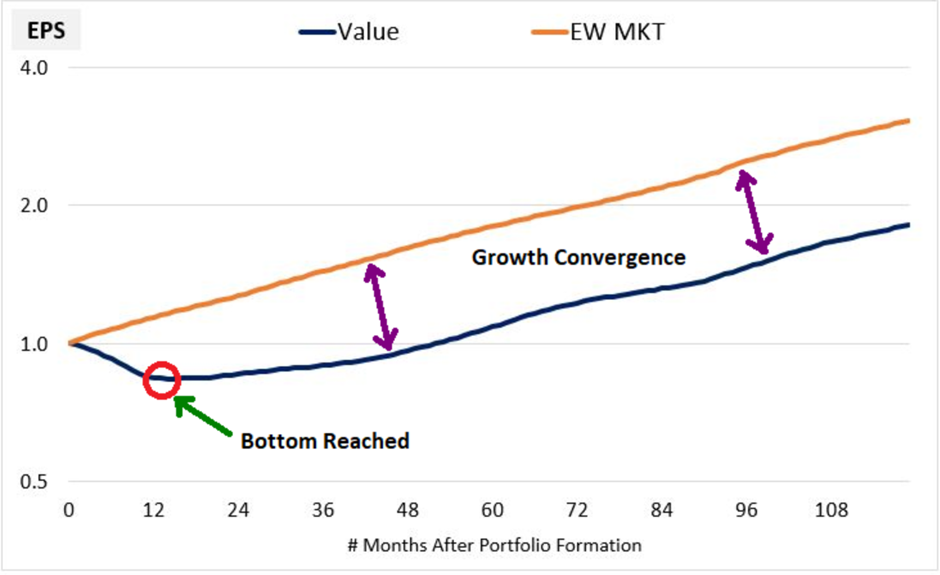
The EPS of the cheaply rated stocks does indeed fall in the near term. However, within a few years, the Value stocks are growing at the same rate as the market averages.
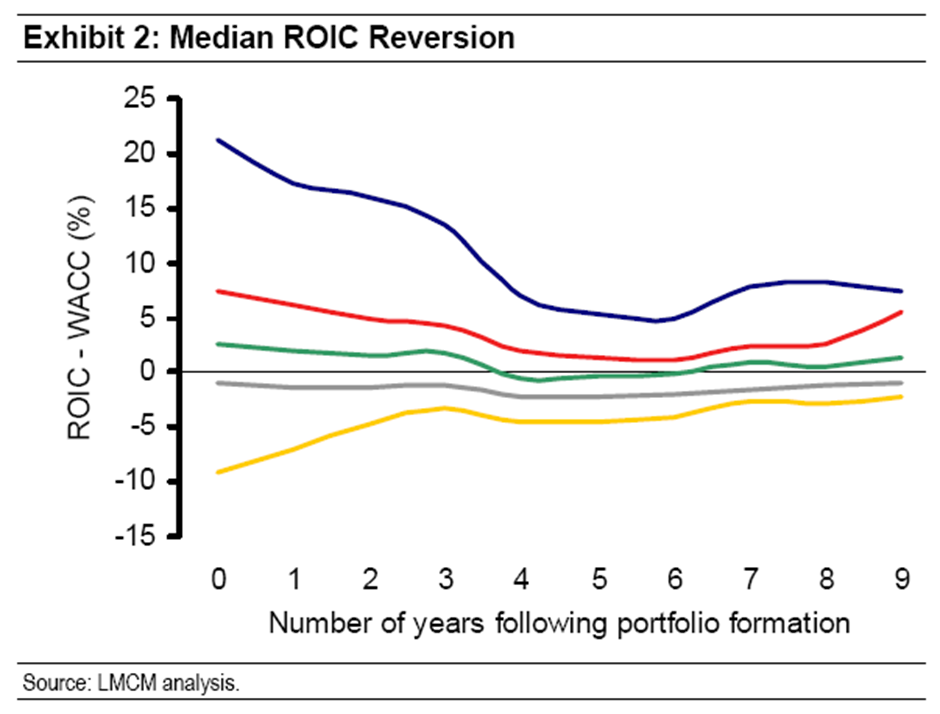
It is not just EPS that is mean-reverting. Companies that currently generate high returns on capital tend, on average, to see it decrease over time as competitors seek to share in those supra-normal profits. Conversely, companies that currently generate a poor return on their invested capital tend to see it increase over time. This is because they are pushed by their owners to improve their efficiency, reduce their working capital, invest in better products, or shut down unprofitable business lines. As a result, return on capital is one of the most mean-reverting series in finance, as the following graph from a Michael Mauboussin paper shows:
Being contrarian
In such cases, the challenge is not identifying cheap stocks but that the market screams that value investors are idiots for even considering such a stock. It may be that it is in a declining industry, has a terrible chart, or one of many other short-term concerns that have caused others to sell the stock. For this reason, value investors are often described as contrarian. They are willing to block out the noise and go against the crowd.
When it comes to identifying value opportunities, independent thinking is key. Tools such as the Stockopedia Stock Screener are useful because they allow investors to generate ideas without relying on the opinions of others. Likewise, the Stockopedia StockReport means that an investor can check out the initial investment case without being swayed by the excitement of the crowd.
In the next article in this series, I will examine one of the oldest ways of acting countercyclically and taking advantage of mean reversion: analysing a business's assets.
Disclaimer
This is not financial advice. Our content is intended to be used and must be used for information and education purposes only. Please read our disclaimer and terms and conditions to understand our obligations.

8 comments
Graham is always quoted as the "father of value investing" based upon his writing and supposed superior investment returns. However, I have never seen any account of his genius that provides proper audited records of his outperformance. I am somewhat sceptical but I doubt we will ever know for certain.
Thanks Mark, I look forward to the rest of the articles. Always learn a lot from your work.
David
Looking forward to reading this series Mark. Thanks for posting first part up.
Is there value in using DCF valuation to calculate the discount rate that the current market valuation implies?
If so, is there a quick way of getting an approximate answer?
As the article mentioned DCF is only useful for short life assets. The reason is that for a long term assets valuation swings wildly with only minor changes in the initial estimate of cash flows and discount rate. The problem is that forecasting out more than say 5 years is difficult/ impossible.
I think there can be some value in doing a DCF where an industry is in long term decline, but you really need to do some kind of scenario analysis so you get a range of values dependent on the rate of decline and a range of discount rates. It’s more about working out what the drivers of valuation are and if they are reasonable, rather than calculating one precise value that is taken as gospel.
DCF's are only as good as the information you put into them, hence DCF's with scenario analysis are really beneficial and help reduce the biases most investors inevitably build into their DCF models.
Thanks Mark. Your articles are great. Clear, concise, straightforward.