Value Investing in Europe: At an inflexion point?

It has been a tough time for value investors since the turn of the millennium. In many global markets, value has been the worst-performing factor, as quality, momentum, and growth traits have driven winning returns.
Seemingly undervalued stocks have become cheaper, while companies boasting good quality characteristics, rapid earnings growth, and strong share price momentum have been rewarded with increasingly stretched valuations. This is especially true in the US, where the rise of mega-cap stocks (especially those currently thriving under the collective moniker 'Magnificent 7’) have led the charge. The likes of Apple, Amazon and Tesla have seen their share prices rise over tenfold over the last decade.
But UK and European investors have struggled to find comparable opportunities, often seeking the proverbial needle in a haystack to replicate such gains.
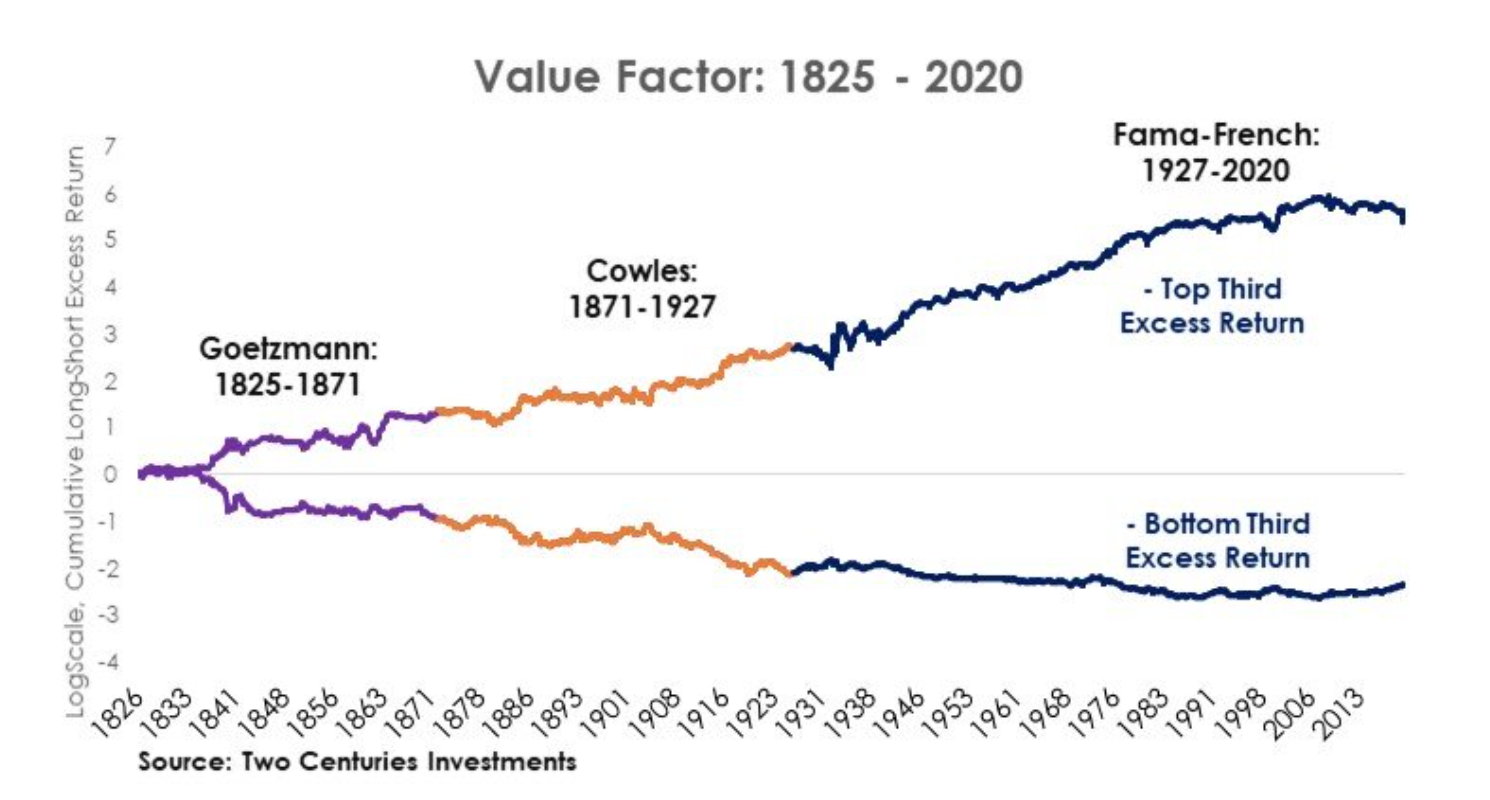
However, as with all market cycles, periods of dominance eventually come to an end. Over the long term, value investing has still proven to be one of the most reliable strategies. Research by Two Centuries Investments highlighted the impressive performance of the value factor over nearly two hundred years, where even the largest drawdowns proved to be temporary setbacks in a broader, significant, upward trend.
In an excellent 1998 study titled “Value versus Growth: The International Evidence,” Eugene Fama and Kenneth French (Fama & French) demonstrated that, between 1975 and 1995, value stocks outperformed growth stocks in 12 out of 13 major international markets. On average, low book-to-market portfolios delivered an annual return 7.68% higher than their high book-to-market counterparts.
Despite this historical outperformance, value stocks have struggled since the global financial crisis, with growth taking the lead. There have been rumours that the so-called value premium may have run its course, but history suggests that value could be poised for a comeback.
This article, which explores some of the themes in the value investing world today, will be the first in a series focused on value investing. This series will examine some of the financial ratios and metrics that can be used to assist investors in discovering value opportunities across the European markets. By traditional measures, these markets seem to offer the most fertile hunting grounds for those bargain seekers.
Europe’s Value Tilt
Stock markets across Europe, with their heavier weighting toward value stocks compared to the US, have really borne the brunt of this shift towards growth stocks. Unlike in the US, where growth-driven sectors have led the charge, Europe’s equity landscape has been dominated by industries less associated with rapid expansion.
Perhaps the closest index in Europe to the S&P 500 is the STOXX Europe 600 Index. The index tracks the performance of the continent’s largest companies across a range of sectors. It’s a useful gauge as Europe’s largest companies are represented here, such as Novo Nordisk, ASML, Nestle and AstraZeneca. You can see a breakdown of the sector and country coverage below.
Source: Stoxx Europe 600 Index


Source: Stoxx Europe 600 Index
Over the last decade, the S&P 500 has grown in value by over 182%, whereas the Stoxx 600 index has risen by 52% over that period. Arguably the key driver of this divergence lies in the sector composition of the different indices.
Source: S&P Global
The most striking difference is in the technology sector. The S&P 500 has a 31% weighting in IT stocks, thanks to the dominance of the US tech giants, while the Stoxx 600 has just a 7.9% weighting. This disparity helps to shed some light on how the US market has really capitalised from the explosive growth of tech companies over the last decade.

Meanwhile, the Stoxx 600 is concentrated in "old economy" sectors like Healthcare, Industrials, and Financials. While healthcare has shown resilience, sectors such as Industrials and Financials, making up a significant portion of the European index, lack the high-growth potential that has powered much of the U.S. stock market’s gains, even if the Banking sector in Europe has performed exceptionally well this year.
Value vs. The Other Factors
In 2023, the MSCI World Value Index, a good barometer for global value stocks, recorded its second-worst year on record relative to growth stocks, as measured by the MSCI World Growth Index. The chart below illustrates the significant underperformance of the value factor since the 2008 financial crisis.

But it is interesting to note that value stocks outperformed growth in five of the seven years following the Dot.com bubble. Given that current valuations are the most stretched they've been since that period, it could be a sign that the pendulum may swing back in favour of value over the coming years.
Similar results can be seen when we examine the data of our own StockRanks, which are based on the factors which drive market return. When examining the individual rank performance across Europe, it's evident that the Value Rank has significantly lagged behind both the Quality and Momentum Rank since performance tracking began in June 2013.
The top decile of Value Rank stocks has returned 182%, a respectable figure but notably lower than the top-performing Quality and Momentum Rank stocks, which have returned 255% and a staggering 450%, respectively.
This underperformance reflects the broader market trend over the past decade, where growth stocks, driven by momentum and high-quality business fundamentals, have been rewarded with higher valuations. In contrast, value stocks - typically characterised by low price-to-earnings, low price-to-free-cashflow or price-to-book ratios - have been left behind.
However, it’s important to note that while Value Rank stocks underperformed at the top end, they fared much better towards the lower deciles compared to their Quality and Momentum counterparts. This resilience in the lower ranks could be explained by the fact that deeply undervalued stocks often have a built-in margin of safety, limiting their downside risk.
Conversely, poor-quality or solely momentum-driven stocks can experience sharper declines during market downturns as their high valuations or weak fundamentals are exposed. This disparity suggests that while value has struggled in terms of absolute performance over the last decade, they may also offer more stability in the face of market volatility.
The lower performance volatility in value stocks may also imply that, although they haven’t delivered outsized gains like momentum stocks, they have held up better when market sentiment shifts or during corrections. As a result, value may be poised for stronger relative performance in more turbulent market environments, offering an attractive opportunity for those seeking some additional downside protection.
Record US valuations
Another commonly referenced metric for evaluating whether the U.S. stock market is over or undervalued is the Buffett Indicator. The Buffett Indicator simply takes the total value of the US stock market and divides this by the country’s GDP.
The indicator is currently at its highest value on record. The US stock market is currently valued at over 2 times the country’s GDP and roughly two standard deviations over its historical trend line.


Source: Current Market Valuation

This measure highlights the extreme levels of today’s market valuations across the pond. Although growth stocks and the US market may have some momentum left, the odds could be increasingly stacked against it as value stocks become more attractive in comparison.
Turning the tide
Despite the headlines, it’s not been all doom and gloom for investors in European markets. The Europe Stoxx 600 index is up 7.7% year to date and nearly 13% over the past year, defying the volatility of a politically charged election cycle across several European nations.
Q2 2024 GDP growth rose by 0.6% in the UK, and by 0.3% in the Eurozone. Inflation rates in Europe have also fallen faster than in the US, with the European Central Bank (ECB) being the first to initiate interest rate cuts in June 2024. Recent comments by members of the Bank of England (BOE) and ECB point to further rate cuts over the coming months, with the BOE expected to cut rates in November and December this year.
Source: Trading Economics
These macro moves are fundamental in creating some buoyancy in European stock markets again. Fund outflows, particularly in the UK, have notably affected equity markets. In May this year, UK equity fund outflows hit a record as investors pulled £1.8 billion.
A more positive macroeconomic outlook, with GDP growth, falling inflation and lower interest rates, will make Europe a more attractive investment destination once again. As optimism on growth starts to build, investors will start to build up equity valuations once more and fund inflows may start to shift from the US and more towards Europe again.


Value on offer
The widespread pessimism across Europe has created a uniquely attractive landscape for value investors. The graphic below highlights the disparity in valuations between the Stoxx Europe 600 and the US market.
European valuations, on average, are nearly 50% lower than those in the US. The average P/E ratio stands at 14.4 for the Stoxx 600, compared to 25.9 for the US market as a whole. Similarly, a P/B ratio of 2 in Europe is less than half of what investors are paying in the U.S.

In short, European equities remain exceptionally cheap. If we look at the forecast metrics for the individual indices across Europe, which you can access on Stockopedia via the indices page, you can also get a better idea of the value on offer by reviewing the median ratios.
S&P 500 (Forecast) | FTSE 100 (Forecast) | CAC 40 (Forecast) | DAX (Forecast) | |
P/E Ratio | 18.99 | 13.88 | 12.66 | 13.51 |
EPS Growth (%) | 11.31 | 10.88 | 9.77 | 13.15 |
Dividend Yield (%) | 2.12 | 3.39 | 3.62 | 3.46 |
Source: Stockopedia
We can see that the S&P 500 remains the most expensive benchmark (forecast P/E of 18.99) by quite some margin when compared to the leading UK, French and German indices. However, what’s striking is that you might expect the forecast growth in the U.S. to justify these higher valuations, but that’s not the case.
The FTSE 100 and CAC 40 have forecast EPS growth figures on par with the S&P 500, while the DAX even surpasses it. Moreover, the S&P 500 offers a modest 2.12% dividend yield, significantly lower than the 3.39% and above seen in European indices. This shows a glimpse of what the European stock markets may have to offer once sentiment starts to improve.
A Historical perspective
If we also take a look at the current market valuations vs their historical averages, we have further evidence of the current discounts available. Take the FTSE All-Share, for example, which is trading at a forward P/E of 12.5 (as of September 19, 2024). This is not only below its historical average of around 13.9, but also significantly lower than the elevated levels seen at the turn of the century. In fact, the FTSE All-Share is now trading near its most attractive P/E ratio since 2009.
Source: Finimize
Once again, if we head over to the indices page on Stockopedia, we can see that the median forecast P/E ratio is cheap, but forecast EPS growth is actually quite high, at 13%. It’s rare to see such valuations other than in market conditions such as the global financial crisis.


A quick note on sectors
I always find it useful to go through the sector pages on Stockopedia to get a better idea of where the most attractive opportunities lie. You might know that Europe has plenty of value on offer, but where are these opportunities hiding exactly?

In Europe, we can see that the cheapest stocks can be found in the Energy, Financials, Utilities and Consumer Cyclicals industries. This could offer better hunting grounds for value investors if they believe the fundamental outlook for the sector is sound.
With proper due diligence, these beaten-down sectors could provide significant upside potential as market conditions stabilise and sentiment shifts back toward cyclical recovery and economic growth.
The banking sector across Europe has been one of the best performers in 2024, despite its lowly valuation multiples. The Euro Stoxx Banks index has even outperformed the Nasdaq over the last 3 years. This highlights that remarkable opportunities do exist, sometimes in the least expected places, if you're willing to dig deep enough.
Source: M&G Investments
Conclusion
Value investing has always been a contrarian approach, requiring patience, discipline, and a certain willingness to go against the grain. It's also been tough decade for value investors as the broader market favoured growth and momentum, with flashy tech giants and high-flying stocks capturing all the attention. Yet, this is precisely why value investing can be rewarding: it thrives in environments where others overlook or dismiss certain opportunities.

Right now, Europe offers an interesting setup for value investors. Valuations across European markets are significantly lower than those in the US. Fidelity recently published an article clearly highlighting that Europe, and not the US, was the place to shop for value stocks. The MCSI Europe has over 3 times the number of stocks trading on a PE of less than 10 than the S&P 500.
The current low P/E ratios, combined with promising EPS growth projections and a promising macroeconomic outlook backed by interest rate cuts, suggest that European stocks are ripe for a turnaround.
There might be further relative pain for value investors, especially as the Fed cut rates by 50bps on the 18th of September 2024. However, history shows that cycles do change, and value investing has a proven track record of delivering over the long term.

Given the strong performance of European equities in recent months, it could be a sign that the winds are starting to shift and that Europe’s markets, despite their challenges, are offering value that is hard to ignore. The key is to stick to the fundamentals, trust the process, and be prepared to weather the short-term noise.
Over the coming weeks, we will be talking through valuation metrics in more detail, which can be used to identify unique value opportunities across European markets. Stay tuned!
Disclaimer
This is not financial advice. Our content is intended to be used and must be used for information and education purposes only. Please read our disclaimer and terms and conditions to understand our obligations.
8 comments
Thanks for your interesting article Keelan Will look forward to your future articles on looking for value opportunities and while Europe does indeed have many problems there are still good companies there
The USA dominates tech and the make up of the SP500 in your graph is very telling
The one thing you need in Value investing is patience as the great man said
The stock market is a device to transfer money from the ‘impatient’ to the ‘patient’.”
Warren Buffett,
Chairman, Berkshire Hathaway
Hi
Worthy of note if looking at opportunities in German stocks.
He Keelan
A really excellent write up. Many thanks.
I invest in US, UK and Europe, but of late my funds have tended to drift away from UK and Europe towards US (mainly tech, semiconductors and AI) for obvious reasons.
However I now also feel it is time I returned to looking at UK and Europe in detail.
In just the past couple of weeks I have noticed quite a few attractive options in Sweden, as well as some of the EU countries.
I really like how you made use of some interesting macro, market and industry stats in support of your analysis and I will attempt to apply a similar discipline to my next screenings of UK and Europe.
Thanks again for such a useful and educational posting.
Regards
Howard
Excellent well written article.
Something that is not mentioned enough on the site is risk management. Value stocks are usually low risk propositions because they have already been beaten up. As always it pays to diversify across asset classes, stocks and also investment styles and factors. Value provides ballast to a portfolio and reduces risk.
As Buffett said, rule number one of investing is "dont lose money", this is much more likely if you are a value investor.
Hi Epitychia,
Thank you for your comment.
You're absolutely right. When we see mean reversions, momentum and growth stocks are often the hardest hit. Exposure to the value factor and a margin of safety helps to reduce this risk.
Momentum/growth exposure is important but must be managed, ideally with other factor/asset/style exposure, as you say.
I also like Buffet's second rule of thumb for investing: "Rule No.2 is never forget Rule No.1"!
Hope you have a nice weekend.
Best,
Keelan
As Buffett said, rule number one of investing is "dont lose money", this is much more likely if you are a value investor.
Which is ironic because Buffett, taken into the context of the full quote, was extolling the virtues of value investing:
"The first rule of an investment is don't lose. And the second rule of an investment is don't forget the first rule, and that's all the rules there are. I mean if you buy things for far below what they're worth, and you buy a group of them, you basically don't lose money."
Over the years I've come to marvel at the way people can interpret this quote to mean whatever investment philiosphy they happen to believe it. My favourite was the poster who took it to mean you should never hold a stock that was in the red, so they were constantly selling stocks that were in the red.In general the rule #1 quote should be read in conjunction with "One investment rule at Berkshire has not and will not change: Never risk permanent loss of capital".
As he also wrote in the Berkshire Hathaway 2023 letter to shareholders:
"In most years – indeed in most decades – our caution will likely prove to be unneeded behavior – akin to an insurance policy on a fortress-like building thought to be fireproof. But Berkshire does not want to inflict permanent financial damage – quotational shrinkage for extended periods can’t be avoided"
My bold - the point being that the price of the assets Berkshire holds can indeed fall, for extended periods of time, but the quality of the assets means there's never any chance of a permanent (and therefore unrecoverable) loss of capital.
Perhaps this can all be summed up as - don't buy crap, don't buy blind and don't buy a story. A proper value stocks would meet all of those requirements, albeit it make take a long time to realise the value.
timarr
Some really good thoughts on Warren Buffett there I love that video clip something every investor/person should play to himself every week
We have all studied Buffet but none of us have come anywhere near his investing success
This article on Europe is well timed for me as I started to invest in Continental Shares about 5 years ago and have been quite pleased with the results including companies such as Monclar I have though found doing research difficult for ordinary investors like myself
Really enjoyed the above article very helpful thank you