Vertu Motors (VTU): Going to plan

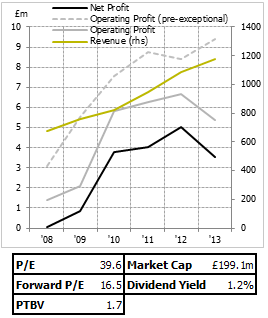 Vertu Motors (LON:VTU) released their half year figures last week, and the market was pretty happy with them - shares were up 10% on the news. This isn't a massive figure in itself, but Vertu's shares have done rather well for the portfolio in the period I've been holding them - they're up about 50% since my June purchase. The car dealership sector is one I'm quite familiar with - before Vertu, I had held Lookers (a larger listed competitor) since the portfolio began. Those shares had booked me roughly a 100% gain in the 2 years I held, and it was off the back of a longer-than-usual sectoral look that I decided to plump for Vertu.
After a 50% price increase, I think another evaluation is wise. You'd either needed to have pencilled in a large mispricing to begin with, or have seen a sizable improvement in the group's prospects, to feel as comfortable now as you did when you bought. Neither of those things are impossible, but I like to err on the side of prudence - and as I take a pretty hands off approach to managing my portfolio, I don't mind taking the chance to refresh my memory every now and then.
I should say to begin with that if the table to the right makes Vertu look significantly more expensive than usual, that's to be expected. Vertu raised £50m in the year and invested in new dealerships having already spent their existing resources and with a decent amount of inbuilt growth anyway. Last year's earnings figure is irrelevant in the sense of a price to earnings. The PTBV figure, though, isn't irrelevant. That figure gives us the intuition as to the valuation of the group.
The asset story
When I bought into Vertu, I bought in at a PTBV of about 1. That is to say, every pound you paid for the business bought you a pound of tangible assets. The investment thesis then was pretty simple - the management team, by virtue of their strategy, are sitting on a business which looks like it's underperforming. They're buying underperforming dealerships cheaply, and spending the next couple of years turning them around, both by managing the businesses better and as a consequence of being part of a larger group and the efficiencies that brings. Returns on capital should be expected to be low, then; but they should also be expected to improve naturally over time, as long as the group is doing what it says on the tin.
That story does appear to be coming true. Should the company perform similarly in the second half of this year, returns on capital will be closer to 10% - this is a company that's earned between 4 and 6.5% over the last 6 years.
I don't think the large increase in revenues and profits at the group is a surprise at all - it was a matter of time, nothing more. I do, though, suspect the group's ability to buy dealerships really cheaply - as they were able to during the recession when everything was a bit more constrained - is coming to an end. Their purchase of Land Rover dealerships, for instance, appear to occupy more of a strategic narrative than one of a turnaround situation. In that sense, I think the remainder of the improvement in operating performances is going to happen over the rest of this year and maybe next, depending on how long it takes to turn around their tail of dealerships.
This is all confused a little by the fact that the sector as a whole is seeing massive post-recession growth. This is something that was probably always on the cards as automotive purchases are easy to defer by remain, for most people, a necessary one at one point or another. Service arrangements and the whole aftersales shebang has a lot of interesting read-throughs for the listed dealership groups. How much this benefits Vertu themselves depends on how competitive the sector is, really, and how volume growth will translate to lower margins. If that is the case, Vertu (because of their high revenue, low margin operating structure already) are probably in a better position than their competitors.
The limitations
Buy a company which earns 5% on its capital simply as a consequence of strategy, wait for it to earn 10% on its capital and then watch as it rerates. That bit was simple. The harder bit comes now - what's next for Vertu, and how do we value it? Part of the problem comes about because the 'capital' side of the return on capital equation isn't quite as obvious or rock-solid as we might like it to be. Property on book, for instance, is valued at what they paid for less accumulated depreciation. If they bought underperforming dealerships, will they have paid fair value for the property, or will they have received a discount? What is fair value for a car dealership?
Now I think I have to take a more nuanced approach with the valuation of Vertu, then, though I suspect the improving RoC story is one that'll continue to be relevant. Operating profit this year looks like it'll come in at around £18m, which should feed through to about £14m of post-tax profit. This puts the group on a P/E of about 13, which isn't particularly cheap or expensive.
There are probably still a few more low-hanging fruit with respect to improvements in profitability in the next few years, though how much of this is deferred probably depends on how much they want to continue acquiring. They haven't shown a desire to slow down.
My biggest concern is that the company now deviates from the strategy it employed during the recession - buy underperforming dealerships and turn them around. Buy cheap. It's simple, and it's intellectually appealing since it's the same thing I'm trying to do as an investor. Their last acquisition - the one they had to raise equity for - was for a cash consideration of £31m, £17.4m of which got booked as goodwill. This is clearly not 'cheap' on an asset basis. It might not be cheap on a projected cash flow basis, either; the board say it 'diversifies and balances the portfolio', which is a phrase which worries me a little as sounding like it can justify expensive purchases.
Looking at the documentation that came with that acquisition does soothe my fears, though. The acquired business earnt £3.9m in operating profit in the year before acquisition and was 'on track to grow profitability in the current year'. That's a P/E of ~10, which isn't particularly expensive. Perhaps I should give management a bit more credit given how well they executed the previous strategy. You don't have to pencil in many synergies to make this a pretty good deal, though it's obviously a very different kettle of fish from buying a loss-making operation on the basis you can get it cheaply and start churning out a profit a few years down the road.
Conclusion
I'm not as bullish as I was, mostly because part of the story I saw has come true, and the price has risen as a result. While it's never going to be a huge compounder - car dealerships are competitive, so returns will never be stratospheric - I still like the sector. I need to take a second look at Pendragon, though, who posted their half year results and completed a potentially interesting refinancing I didn't think about enough last time.
Disclaimer
This is not financial advice. Our content is intended to be used and must be used for information and education purposes only. Please read our disclaimer and terms and conditions to understand our obligations.
No comments yet
No one has commented here yet! Why not be the first one?