Where are the UK’s quality compounders?

Earlier this week I published an article about implementing a compounding quality strategy. It’s a subject I am passionate about as I love to scour the markets for quality companies and constantly seek stocks which allow me to invest with Warren Buffett’s famous mantra in mind: “Our favourite holding period is forever”.
But the article sparked an interesting conversation, on a topic which is a perpetual concern to quality investors: does the UK have enough quality companies to build a well diversified portfolio based on the principles of compounding?
My first hunch is that the answer to that question is ‘no’.
I run a screen which aims to identify high quality large caps using the following metrics:
- 5yr average ROCE: greater than 15%
- 5yr average operating marketing: top 20% of market
- Cash return on investment: greater than 10%
- Net gearing: lower than the market average
- Market capitalisation: greater than £10bn
If I restrict that screen to just the UK market, I am normally faced with the following outcome…

Opening up the screen to the European market takes my current possible selection up to eight stocks.

And in the US, the choices are even more plentiful with 32 companies qualifying for my screen. This are the 10 largest.

These results hint at one of the major problems that quality investors have when they hunt for stocks in the UK: scale.
Is the UK too small for compounding quality companies?
The screen I have used above limits stock selection only to companies with a market capitalisation of over £10bn. In the UK that does present a challenge because there aren’t that many companies which grow that big. Even without all of the quality metrics, only 41 British stocks qualify for my screen. By comparison, the US has 529 stocks worth over £10bn and Europe has 253.
The reason I restrict my selection is that scale is important for compounding quality businesses. These are stocks which investors seek to buy and hold forever. If they are restricted by the potential size of their market, how can they continue compounding indefinitely?
This is the problem facing two of the UK’s highest quality stocks, which appear in my screen if I remove the size restriction: Games Workshop and Bioventix.
Bioventix produces sheep monoclonal antibodies for use in diagnostic machines. Its products are much revered in the market in which it operates and its business model lends itself to whopping margins and magnificent returns for investors. But the global antibody market is not unlimited and the sheep monoclonal portion of that, while growing, is not enormous. What’s more, Bioventix operates out of a relatively small factory in Farnham meaning its scope is somewhat limited.
Similarly Games Workshop has built a suite of products which are beloved by the gaming enthusiasts who make up its target market. But how big is that market? Not big enough for the company to keep compounding indefinitely. There has been talk about Games Workshop’s Warhammer games being turned into a Netflix production or a high resolution video game. These ventures offer exciting scope for growth, but Games Workshop would only be providing the brand for the larger companies to take to consumers.
Is the UK too short-sighted for quality compounders?
The second scale problem facing companies listed on the UK market is their potential to end up as takeover targets.
In the 90s and early 2000s, freely available capital and loose regulations made British brands very attractive to foreign buyers. Many companies were bought to be integrated into larger foreign peers, while others were acquired by private equity and loaded up with debt.
Takeover rules in Britain are still far less stringent than they are in other countries and the UK remains the second most attractive country in Europe for foreign direct investment, according to a survey by consultancy firm EY.
Tech companies and, more recently video game companies, have been readily snapped up by foreign peers before they have reached their full potential in the UK.
What’s the deal with dividends?
I have a bit of a complex about dividends. I hate it when companies like Vodafone and BT spend billions every year returning ‘profits’ to their shareholders when those profits have relied on increasingly expensive borrowing. ‘Get your balance sheet and growth prospects in line before you start paying your investors,’ is my opinion on the matter.
But my opinion is pretty unpopular among UK investors. Many want the income boost that comes from high yielding stocks and if the companies that pay those dividends are reliable and high quality, all the better.
But has that focus on returning money to shareholders stumped growth? And could returns have been greater if these companies focused on reinvesting their profits in themselves rather than returning the money to shareholders? Perhaps.
Next is a good example of this phenomenon in action. There is no doubt that the retailer is a well-run, high quality operator which has delivered decent returns for its shareholders. But when Next has an especially profitable year, it uses those excess profits to buyback and cancel shares. This is great for investors who end up holding a larger proportion of the stock and Next shares tend to get a boost every time the company completes a buyback. But could the money have been better spent on growing the business? Could Next have had more success replicating its successful model overseas if it had spent some of its excess profits internally rather than on buybacks?
Next’s shareholders don’t complain about the returns the company has generated over the long term. But I wouldn’t say that Next qualifies for true quality compounding status.
A British business that bucks the trend
All this being said my quest for British compounding quality has not been in vain.
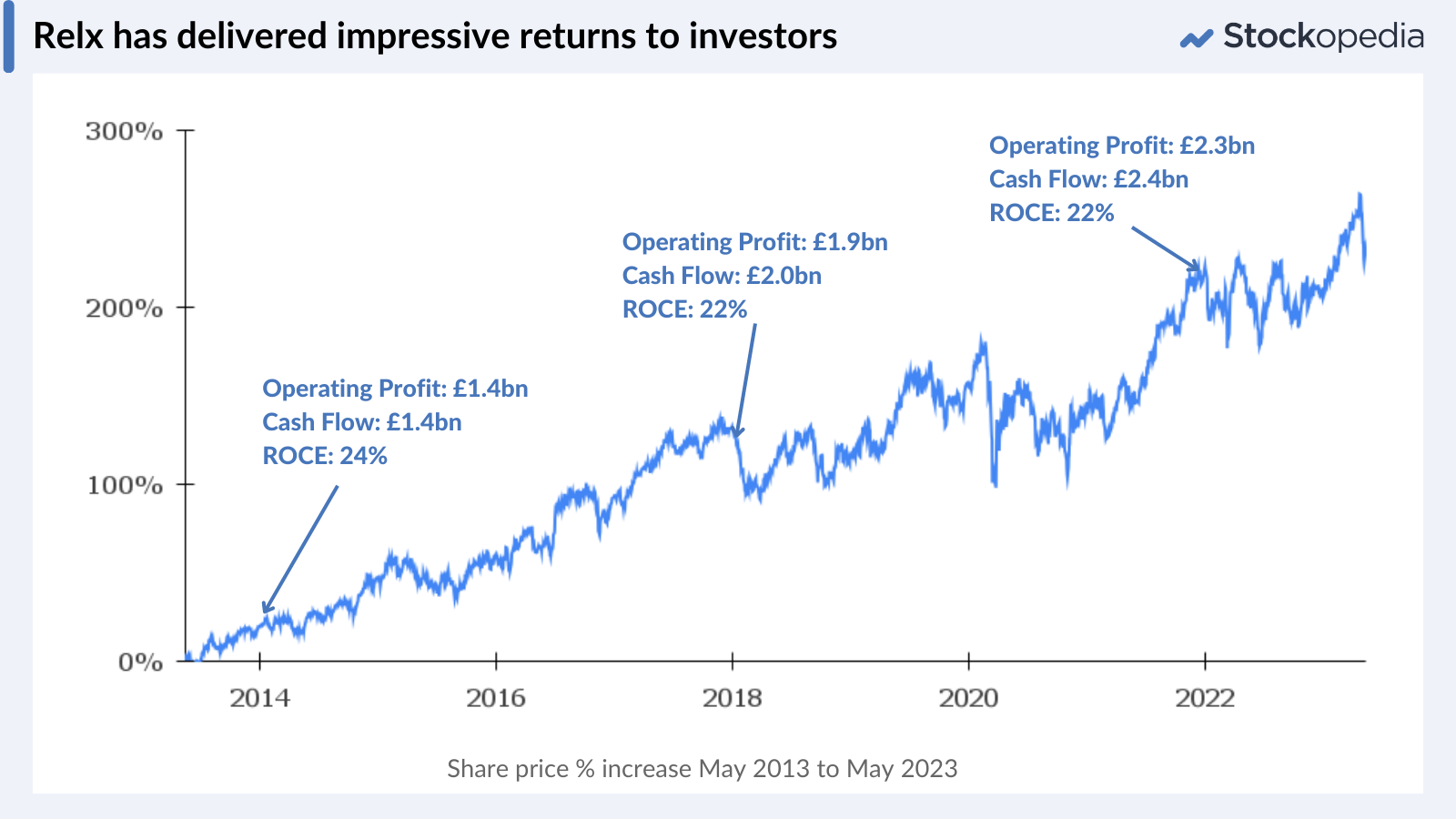
Relx is an information business with operating branches which span written journals, event organisation and data analytics. The company has customers all over the world who rely on its services and pay regular, reliable subscription to the the company. This business model lends itself to strong operating margins which have averaged 26% over the last five years.
There has been some discussion about the potential benefit (or threat) of artificial intelligence to the Relx business model. But consensus seems to suggest that data providers like Relx are well placed to benefit from the rising scope of AI models. Indeed, in February the company bought an AI business to bolster its patent classification services - part of the legal branch of operations.
This acquisition is a good example of Relx’s position as a quality compounder. Management has a good track record of reinvesting the group’s profits into earnings-boosting opportunities. Subsequently, the group’s return on capital employed consistently exceeds 20%.
Relx fails on my screen because of its high gearing, which currently stands at 160% - well above the threshold that makes it a ‘cause for concern’. It is worth noting that Relx pays a larger chunck of its dividend in the first half of the year, meaning gearing is always slightly higher. But still, the figure is worth keeping an eye on, especially if the costs of servicing that debt start to rise.
The diversification problem
Overall Relx ticks the boxes for quality compounding and I am a satisfied owner of the shares. But a portfolio of one is not enough, even if Relx does have a suitably diverse business model. But while there are few British companies that I am as comfortable with as Relx, there is quality to be unearthed, especially for investors with a long-term mindset.
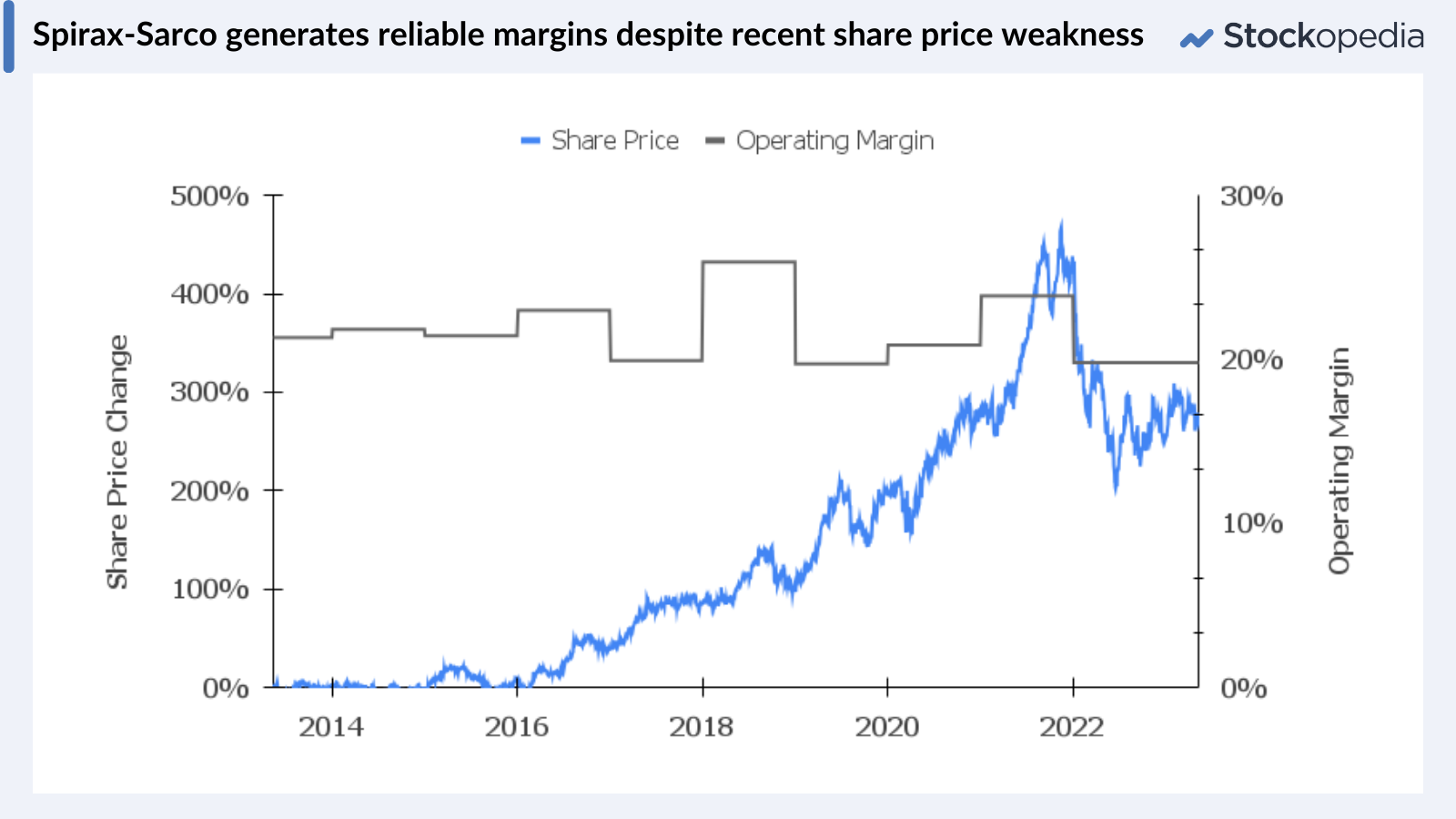
Spirax-Sarco and Halma are good examples of this. In the last few years, turbulence in their end markets has disrupted the share price. But over the long term they have generated impressive, reliable returns for shareholders.
But to ensure proper diversity, I tend to look overseas for my quality compounders. I like Sage in the UK, but it pales in comparison to its larger peer in the US, Intuit, so I would rather own that. Burberry is a quality operator, but its peers in Europe including LVMH and Hermes have greater scale. And then there is the software sector which supports business models which appeal to quality investors. Adobe has been my favourite stock for some time. It’s a company with the classic Silcon Valley ‘founded out of a shed’ back story, but it’s been profitable since 1983 (the year after it was founded) and, so far, has never failed to deliver.
And so, to answer the question which started this article: can you build a portfolio of quality compounders in the UK? My opinion is yes (and Roland has put together a screen to help you do so), but why would you, when the quality stocks of Europe and the US are more accessible to private investors than they have ever been before?
Compounding Quality: The patient investor’s guide to stock market success
Disclaimer
This is not financial advice. Our content is intended to be used and must be used for information and education purposes only. Please read our disclaimer and terms and conditions to understand our obligations.
20 comments
BVXP only produces a few grams of antibodies in its lab - it also earns royalty income - so it's growth is far from limited by its small number of staff or (new) lab. Also, unlike many firms, it benefits from an extremely capital light business model that doesn't require a large reinvestment of development capital; hence the fantastic margins, cash conversion and dividend pay-out.
BVXP is in the race to develop what is the holy grail in future diagnostic tests - an early test for Alzheimer's - which could be a 'block-buster' in revenue terms. Still at an early stage, but the published research is highly positive - their academic collaborators at the University of Gothenburg have a 50+ research team just on this project.
BVXP is also pioneering use of their diagnostic testing for the biomonitoring of people's exposure to pollution. This is, somewhat surprisingly, a novel area which does present it with challenges in developing the market once they have developed an effective PCR test.
Nothing guaranteed on the success of the new initiatives of course, but the current business is growing steadily (Troponin Test roll-out) and highly profitable.
So, the UK has some very exciting potential multi-bagger growth compounders such as BVXP.
Hi Megan
BTW, how will RELX's digital publishing, advertising & data analytics businesses be impacted once generative AI (eg ChatGPT) is fully rolled out?
Thanks
How will RELX's digital publishing, advertising & data analytics businesses be impacted once generative AI (eg ChatGPT) is fully rolled out?
I really don't think anyone knows, Paul. But the weight of opinion is that data providers, as owners of the source IP for learning, should be able to use AI to embed further into their clients' processes. The alternative is that they become disrupted. And I guess different data houses will fall into one or other camp depending on their efficacy in managing the transition.
Thank you for this excellent article, I very much agree with your concerns. In particular the institutional preference for dividends is entirely at odds with the need to invest for growth, and seems to indicate a mindset that simply does not trust growth. A recent example has been CentralNic (LON:CNIC) where an aggressive (and in my mind, successful) bid to reach global scale by debt and stock based acquisition has been reined in by the market. The company’s new CEO seems to have been pressured to reduce debt and pay an completely irrelevant dividend from cash derived from the successful previous policy.
UK companies lack scale and the institutions do not seem to have the necessary winning culture to achieve it. In so many industries we have observed that “playing safe” is not safe!
There is a difference between quality and growth. For me quality is a high profitability business, that has a strong moat, so it is consistent and reliably profitable, making it a long term hold. Asking for it to have high growth as well is asking too much. Therefore the profits should go back to the shareholders who can compound their money elsewhere.
Also not sure why there is a £10bn cut off. Small companies can be quality businesses, in fact it is more likely that they will be. Growth is frequently bought by having low margins, so large behemoths usually sell commodity type products.
Growth is frequently bought by having low margins, so large behemoths usually sell commodity type products.
In the UK maybe. Tell that to Microsoft, Alphabet and Nvidia - or a hundred other international firms with market caps ten times £10bn, from healthcare, to quality industrials, to luxury stocks, to data platforms. The problem is the location, not the size.
There are a number of U.K. stocks that have compounded v well over the years…including my largest holding Goodwin (LON:GDWN) to pick one not entirely at random, I also hold Games Workshop (LON:GAW) as my number 2 holding as their addressable universe is vast imho…& they’re only now touching on mainstream with the Amazon Warhammer TV series
GAW’s total market opportunity is no smaller than any of the big media or toy companies. Sure, for now, they concentrate on sci fi and fantasy but there’s no reason why they can’t expand that in the future. And think about it this way, Wizards of the Coast are just about the only thing keeping Hasbro afloat, investors don’t seem to think WotC are limited.
No position on GAW but I do have a lot of their products. My avatar would be of a space marine but the Stocko avatar cropper doesn’t (or at least didn’t) work properly.
The reason for excluding Bioventix isn’t scale. It’s the fact that such a high proportion of profits are paid out in dividends - the very opposite of re-investing for growth.
Another great article. I currently invest through Etoro but often they do not have access to the stocks I want to buy. Any suggestions for another platform, particularly with access to Australian shares?
Have a look Interactive Brokers (NSQ:IBKR), I don't know about Australian shares but that have wide coverage of other markets and their fees are very reasonable. You can do a trial. I will be opening an ISA with them soon.
Adobe (NSQ:ADBE) don't pay dividends either.
Fundsmith did hold Intuit (NSQ:INTU) until last year but sold it due mounting losses, has since bought Adobe (NSQ:ADBE).
Games Workshop (LON:GAW) are in talks with Amazon, if this develops then it could be a big deal.
fundsmith has also since sold Adobe! (NSQ:ADBE)
Really, so much for holding for a long time. I see they bought some Procter & Gamble Co (NYQ:PG).
yes, a very short holding period indeed! they sold it around the time of their acquisition of Figma for $20B(!)
a deal that is now being probed by regulators as they (Adobe (NSQ:ADBE)) essentially bought out one of their upcoming and growing rivals
Fundsmith got that a bit wrong, Adobe (NSQ:ADBE) are up around 40% since they sold. I do hold some Fundsmith but it has been disappointing recently. Sold most of my Adobe (NSQ:ADBE) now.
With regard to Bioventix, I would agree with the article that the global antibody is not unlimited but the subsector in which Bioventix works, i.e. monoclonal antibodies for diagnostic reagent is worth about $8 billion per year and growing in double digit percentage figures each year. Of course, not all parts of this market can be addressed by sheep monoclonal antibodies but I think Bioventix's growth is limited by the company's conservative strategy rather than the overall size of its markets (hence the high profitability).
Megan, There are still problems buying overseas stocks, not available and dealing/forex fees are high, also there can be issues with tax on dividends.
Even LVMH Moet Hennessy Louis Vuitton SE (EPA:MC) is not available on some platforms such as IG. Can buy on HL but £12 plus 1% forex.
Why does LVMH Moet Hennessy Louis Vuitton SE (EPA:MC) not qualify for your screen?
Coverage of foreign stocks on Stockopedia is almost non existent.
I did have the European region, for a while, but it is quite expensive, if you don't buy many European shares and even on HL quite a few were not available and IG is much worse.
I do hold Adobe (NSQ:ADBE) but it has not done very well, almost halved from peak around 18 months ago.
I looked Sage (LON:SGE) and it compares quite well with Intuit (NSQ:INTU) apart from size, the ROCE figures were ahead for the last year, surprised no one has taken over.
Why does it have to be over 10bn, I agree most of out large caps are not very good, I only hold some because of income, such as Shell (LON:SHEL) BP (LON:BP.) Aviva (LON:AV.) and Legal & General (LON:LGEN).
We are being spoilt this week with some outstanding articles. Thanks again Megan - another screen for me to play with. And for the record, I totally agree with this sentiment,
“I have a bit of a complex about dividends. I hate it when companies like Vodafone and BT spend billions every year returning ‘profits’ to their shareholders when those profits have relied on increasingly expensive borrowing. ‘Get your balance sheet and growth prospects in line before you start paying your investors,’ is my opinion on the matter.”
I think you write off Next's Share Buy Back policy too readily. They set out some clear guidance on this in their FY Report & Accounts / results in 2013 Pages 13-15 . Hopefully you can see the image below extracted from there or see the link above for the full details.