Why the UK stock market continues to be takeover central

There is an undeniable trend in UK markets for takeovers of listed companies, and it is easy to see why. Of the roughly 800 UK stocks with a positive EBITDA, the median EV/EBITDA is 10 versus 15 for the 3000 such companies in the US market. There are some fundamental reasons for this mismatch in valuation.
Pension Fund Flows
One of the biggest reasons for this disparity is a dramatic shift away from UK Equities being owned by UK Pension funds. The Capital Markets Industry Taskforce (CMIT) reports that this is due to two trends. Firstly, UK pension funds have shifted away from owning equities into bonds, as this chart from CMIT shows:
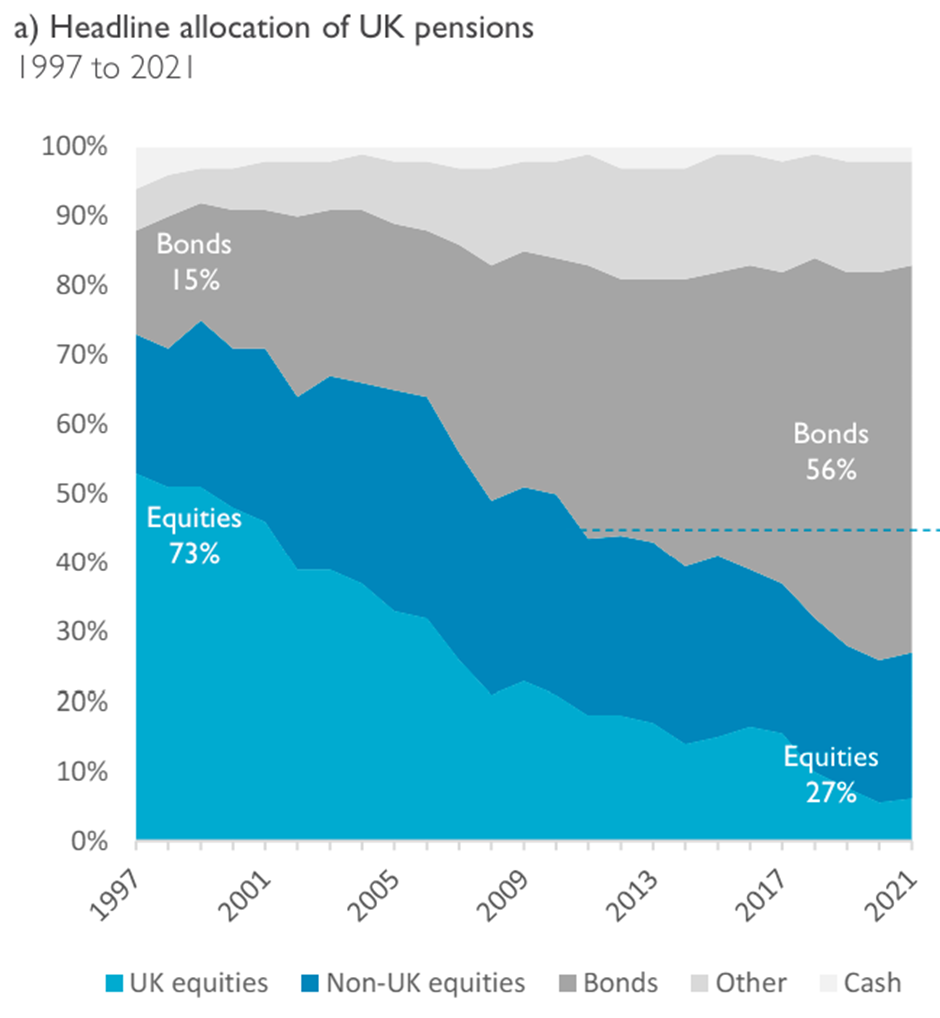
This is primarily because Defined Benefit pension funds, almost all of which are now closed to further accrual, have been de-risking, which involves selling equities and buying bonds.
Secondly, pension funds have increasingly been given a global mandate when investing in all assets, including equities. Defined contribution schemes, which are now the norm, tend to offer their members global trackers rather than UK trackers. This makes logical sense for clients. However, the knock-on impact on UK equity allocation is stark. With the proportion of assets invested in non-UK equities remaining reasonably constant, the shift to bonds has almost entirely come at the cost of UK equity allocation. This has dropped from over 50% in 1997 to around 6% in 2021. Such a shift cannot occur without impacting valuations.
Retail Fund Flows
With pension funds net sellers over the last few decades, the record of retail investors taking up the slack is mixed. Unfortunately, we are a flighty bunch. Here are the cumulative retail flows to UK equity funds over the last decade from The Investment Association:
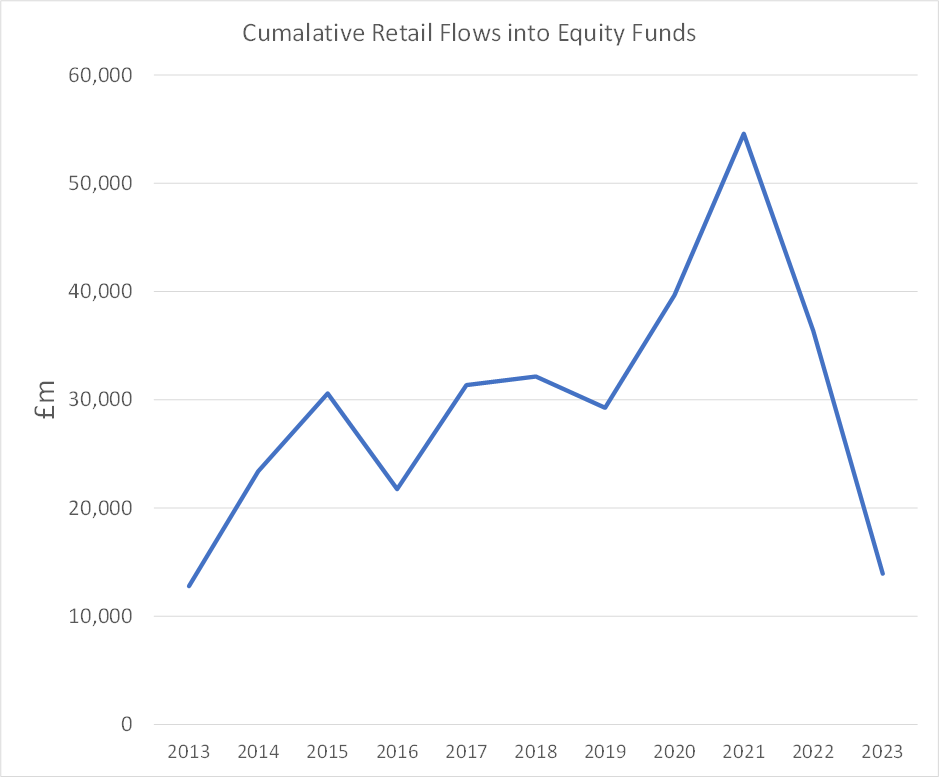
These rose significantly between 2013 and 2015 and again in 2020 and 2021. However, 2022 and 2023 have been terrible and given back almost all the cumulative inflows over the previous decade. The data so far for 2024 isn't looking any better, with £1.8bn of outflows in January & February.
Part of this may be the logical response to pension funds' selling. No one wants to step in front of a freight train. However, this has been a multidecade trend that didn't stop retail inflows into equity funds a few years ago. The recent net outflows appear to be largely short-term sentiment-driven.
With this backdrop, it is easy to see why companies are not listing in the UK, and those already listed are succumbing to takeover offers. Institutional sellers have little incentive to fight a takeover with a fairly standard 30% premium, even if it is priced off recent lows. As well as a short-term boost to performance, it gives them the liquidity to meet the fund redemption. Normally, I am pretty sanguine about this state of affairs. As a long-term investor, valuation shines through eventually, and cash-generative businesses either pay generous dividends or are themselves acquirers of cheap rivals. Alternatively, many companies are engaging in share buybacks, taking advantage of their own low prices to compound higher future EPS growth. However, there are some worrying trends. More companies are delisting because the benefits of being a listed entity no longer outweigh the costs. Some companies have a tender offer at a premium following delisting, as Quarto recently did. However, many simply disappear, or only offer a heavily discounted way out for investors who don't want to hold unlisted stocks. Whatever happens, minority shareholders rarely get a high valuation for their shares in these situations.
Some commentators worry about the long-term impact of companies leaving the UK, leaving investors with insufficient quality companies to consider investing in. I think these concerns may be overblown. Almost everything in financial markets is subject to cyclical behaviour. The recent outperformance of US markets attracts more capital, which drives further outperformance. However, this can only continue for so long, and at some point, this will reverse, and the capital will flow in the other direction. I am almost certain that at some point in the future, European equity markets will significantly outperform US ones, and the headline writers will now focus on how the US market is the "sick man". At this point, IPOs will return to the UK markets. Of course, I have no idea when this might happen; it's just that the many similar market cycles in the past suggest that it will. Until it does, European markets, particularly the UK, will likely see many more takeovers.
Types of Takeovers
There are two types of takeovers that may be received in the UK: an Offer or a Scheme or Arrangement. With an offer, the acquirer only needs to reach 50% acceptance to take control of the company. However, it can still remain a listed entity with minority shareholders unless they receive 75% of the shares accepting the offer, at which point they can delist. Minority holders can remain in the unlisted equity. However, if the acquirer gets 90% acceptance, they can force the remaining holders to sell out. In reality, there are some aggressive actions that an acquirer can use to encourage the holdouts to capitulate. Delisting is common but may also be accompanied by rights issues or similar. Forced with the option of putting fresh capital into an unlisted stock with no guarantee of returns any time soon and no say in how the business is run, at this point, most holders simply take the cash.
With a scheme of arrangement, the scheme is approved by a court, at which point 100% of shares are owned by the acquirer. However, for the court to grant these schemes, 75% of the shares must have voted in favour. This gives certainty of control but requires a higher acceptance level to succeed. Acquirers can choose to switch from a scheme to an offer if they don't think they will get the votes but still want control of the business.
Takeovers in the UK are regulated by the Takeover Panel. The Takeover Code, which they enforce, makes anyone who acquires more than 30% of the shares of a public company make a mandatory offer for the rest of the shares at the highest price they paid in the previous six months. They also stop an acquirer who chooses not to make an offer from returning within six months with another offer (unless someone else steps in with an interest.) It is worth noting that companies listed but not domiciled in the UK, such as Somero Enterprises (LON:SOM) , are not subject to the Takeover Code.
Controlling Shareholders
Having a large shareholder can be both a blessing and a curse regarding takeovers. If one shareholder owns more than 25% of the shares, they can block a takeover via a scheme of arrangement. A shareholder, or concert party that owns more than 50% can block any type of offer. In reality, any large stake probably acts as a blocker to corporate action. This is especially true for smaller companies where individual investors may not always vote their shares. This means that an acquirer needs to make an offer sufficiently attractive to this large shareholder. When we see takeovers with large premiums, say 100%+, this is usually due to the presence of a controlling shareholder who knows what the company is worth. However, a company takeover with a controlling shareholder is rarer because the acquirer still needs to believe they are getting a bargain.
It helps to get a full price if there are one or more industry bidders rather than a Private Equity fund wanting to gear up the company and re-list it in the future. An industry bidder can often extract synergies that make the combined business more valuable to them. While minority holders are often disappointed with the premium paid by Private Equity, these sorts of situations may provide reasonable exit prices. In a depressed market, even a modest premium may be good news as it provides an immediate, if not full, return. In undervalued markets, these proceeds can easily be invested into other bargain stocks.
The Data
With this in mind, I thought it would be interesting to look at recent takeovers to see if any other patterns emerge. Despite the recent number of offers in the UK market, it can be hard to get data on takeovers. The reason is that acquired shares disappear from databases such as Stockopedia or Google Finance once delisted. It becomes hard to see the premiums and valuations paid unless one trawls old news articles. Instead, I have to focus on currently active takeovers or recently failed offers since a list of these is available for the Takeover Panel.
I have ignored companies where they have put themselves up for sale, but no one has made an offer yet, such as Benchmark Holdings (LON:BMK) or Equals (LON:EQLS) , as there are no details to work with, and these situations with keen sellers tend to get minimal premiums. These are the rest:
Company |
Offeror |
Type |
Cash/Equity/Mix |
Premium on Announcement |
Recomended/Ongoing/Rejected |
musicMagpie plc |
BT Group plc and Aurelius Group |
PE |
Cash |
N/A |
Ongoing |
FireAngel Safety Technology Group plc |
Siterwell Electronics Co. |
Industry |
Cash |
252% |
Recommended |
SmartSpace Software plc |
Sign in Solutions Inc. |
Industry |
Cash |
169% |
Recommended |
STM Group plc |
Jambo SRC Limited |
Industry |
Cash |
118.20% |
Recommended |
Centaur Media plc |
WPEF IX Holding Cooperatief W.A. |
PE |
Cash |
N/A |
Ongoing |
TClarke plc |
Regent Acquisitions Limited |
Industry |
Cash |
28% |
Recommended |
Accrol Group Holdings plc |
The Navigator Company, SA. |
Industry |
Cash |
11.80% |
Recommended |
Gresham Technologies plc |
funds managed or advised by STG Partners, LLC |
PE |
Cash |
26.90% |
Recommended |
Shanta Gold Limited |
ETC Holdings (Mauritius) Limited |
Industry |
Cash |
6.72% |
Recommended |
Kin & Carta |
funds advised by BC Partners |
PE |
Cash |
66.70% |
Recommended |
Lok'n Store Group plc |
Shurgard Self Storage Ltd |
Industry |
Cash |
15.90% |
Recommended |
Mattioli Woods plc |
funds managed by Pollen Street Capital Limited |
PE |
Cash |
34% |
Recommended |
Currys |
Elliot Advisors |
PE |
Cash |
31.90% |
Rejected |
Tyman plc |
Quanex Building Products Corporation |
Industry |
Mix |
35.10% |
Recommended |
Wincanton plc |
GXO Logistics, Inc. |
Industry |
Cash |
104% |
Recommended |
UK Commercial Property REIT Limited |
Tritax Big Box REIT plc |
Industry |
Share |
N/A |
Ongoing |
Spirent Communications plc |
Viavi Solutions Inc. & Keysight Technologies Inc. |
Industry |
Cash |
61.40% |
Recommended |
Hipgnosis Songs Fund Limited |
Alchemy Copyrights, LLC, trading as Concord |
Industry |
Cash |
32.20% |
Recommended |
Network International Holdings plc |
funds managed by Brookfield Asset Management Ltd |
PE |
Cash |
64% |
Recommended |
Redrow plc |
Barratt Developments plc |
Industry |
Share |
27.20% |
Recommended |
Direct Line |
Ageas SA/NV |
Industry |
Mix |
42.80% |
Rejected |
International Distributions Services plc |
EP Corporate Group a.s. |
PE |
Cash |
N/A |
Rejected |
Virgin Money UK plc |
Nationwide Building Society |
Industry |
Cash |
38% |
Recommended |
Darktrace plc |
funds managed and/or advised by Thoma Bravo, LP. |
PE |
Cash |
20% |
Recommended |
DS Smith plc |
International Paper Company |
Industry |
Share |
48% |
Ongoing |
Anglo American plc |
BHP Group Limited |
Industry |
Share |
N/A |
Rejected |
Size Doesn't Matter
The market cap of the acquired companies is surprisingly large, given that smaller companies tend to have lower ratings at the moment. A third of the companies with a recommended offer have an acquirer paying over £1b. However, some of the acquisitions are for microcaps. When searching for takeover targets, it seems size does not impede an offer being made.
Sectors and Industry
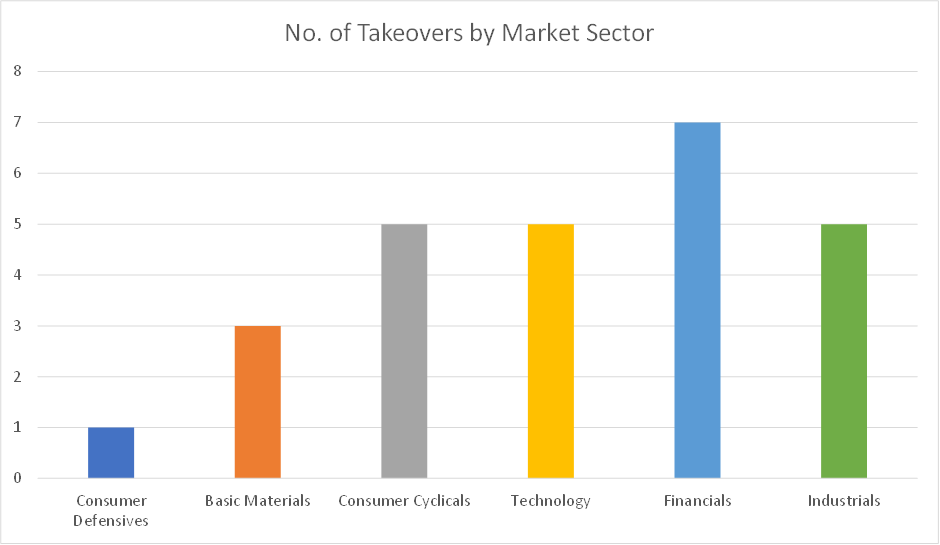
When it comes to market sectors, the greatest number of recent UK takeovers were of financial companies:
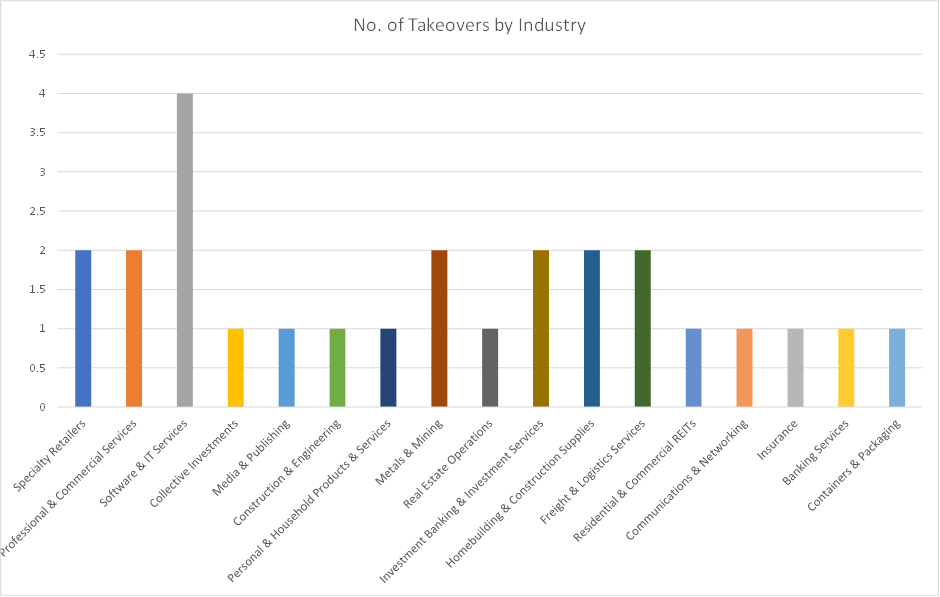
When we drill down to specific industries, buying software companies is the most popular, but really, it could be any industry:
Premiums
The average premium paid for a recommended takeover was 62%. Microcaps tend to get a much higher premium.
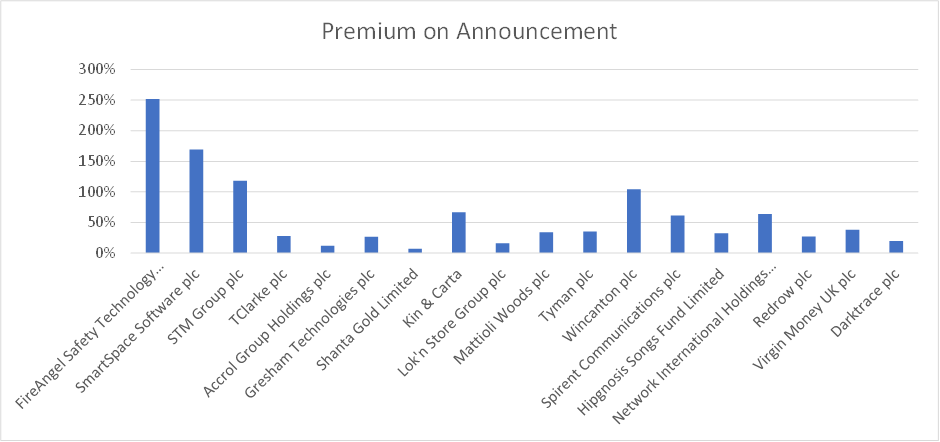
For companies over £100m market cap, the average premium is still 39%.
Whether the buyer was an industry player or Private Equity mattered, too. The average industry buyer paid a 69% premium versus a 43% premium paid by Private Equity.
The vast majority of recommended takeovers were for cash. Understandably, being only willing to pay shares, or a mix of shares and cash, made a deal more likely to be rejected.
Overall, these figures surprised me. Industry buyers were often willing to pay large premiums in cash. Shareholders perhaps have little complaint about industry consolidation, although they may be more concerned when Private Equity gets involved.
Valuation
Again, it seems that a high valuation is not necessarily an impediment to an offer being made. Darktrace (LON:DARK) being a takeover target surprised me, given its high rating, accounting treatment of sales and marketing, and the history of its founders. However, it shows how hard it is to predict the next candidate.
Most companies that recently attracted bid interest are not like Darktrace. They tend to be cheaply rated on either EV/EBITDA or Price to Free Cash Flow before receiving an approach.
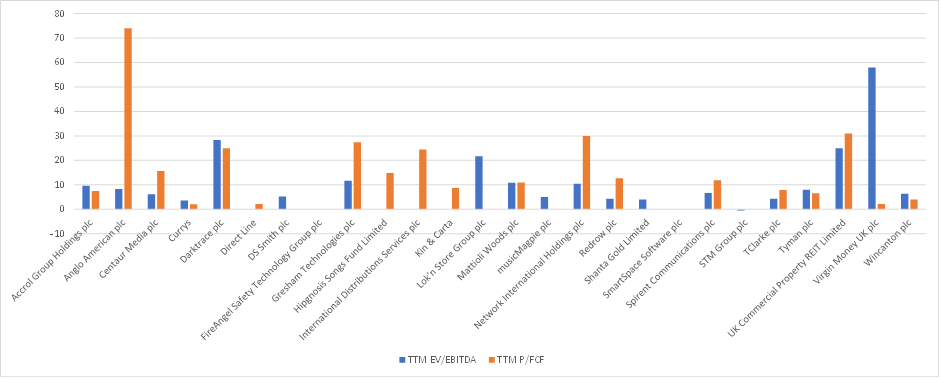
As with any stock market investment, investors do better on average by buying cheaply. If investors buy good quality, cheap companies, they will likely do well, whether through a takeover or a longer-term re-rating.
Disclaimer
This is not financial advice. Our content is intended to be used and must be used for information and education purposes only. Please read our disclaimer and terms and conditions to understand our obligations.

15 comments
Thanks Mark. Very educational so a lot I didn't know
Nice work Mark the figures are stark, something needs to change. We need a proper Conservative Government, take a risk get a reward like it used to be. The near demise of CGT, divs hammered just sends the wrong message, its all so disappointing we have been badly let down. I'm also BTL owner it seems like they are trying to get rid of decent private landlords, why ?
They are hammering all small businesses, including landlords, because they seem to favour the corporations. Government policy is increasingly driven by the corporate sector and pressure groups not the actual citizens that vote for them.
To my mind it would be beneficial if the UK government would take a carrot and stick approach to encourage UK pension funds to hold UK shares. This could be done in a tapered fashion so that the higher the percentage of the funds assets which were shares, the more benefit the fund would receive. I'm not talking about a massive switch away from bonds, but rather an attempt to move to a slightly more balanced situation. Does anyone now how other countries deal with this?
All very interesting but has anyone told The Pensions Regulator. It's not that DB schemes wanted to have less in equities. The Regulator has effectively bullied everyone into the same derisking journey. I think pension schemes would laugh at the total lack of joined-up thinking if tax relief was conditional on investing in UK equities.
NK104 I do agree that the government needs to have some joined up thinking about this.
the government needs to have some joined up thinking about this
Never going to happen (with any government)
Very good article.
I wonder also if the ageing population factors into the move to Bonds, because unless corrected pension providers will tend to use the 'glide path' to switching from theoretically riskier equity into bonds, as the pension holder creeps towards retirement age.
Much has been made of this recently suggesting it is denying ageing pension holders from boosting their holding from racier equity returns.
The banana skin in 2022 though Trident was most of the bonds on the glide path were long dated gilts/corperates that lost 15-20% plus over the year, its become aparant to me that if you want to get into bonds you should be in short dated especially with the yield curve inverted at the moment so the compression uplift to price should also come at the short end.
With regards to long dated bonds again personal opinion is you might as well be invested in equities rather than that area as the risk is similar but the upside far less.
Fabulous piece Mark. Much I didn't know.
Thank you.
Excellent report. Anecdotally a lot of takeovers seem to be with firms that have a stock rank in the 80s, unfortunately I usually only invest in companies with a 90+ rank. So I have missed out on these takeovers.
Thanks. Shows how hard it is to predict which specific companies will be taken over. I wonder if having a 90+ StockRank is likely to require reasonable Momentum. In most cases, acquirers pounce when the share price is weak and the two rarely overlap.
I would imagine a good few of the takeover targets have something wrong with them that purchasers think they can improve. Tclarke (LON:CTO) had been pointed out previously as having excessive director costs and fancy headquarters. Strip those out and they could be a 90+.
"Despite the recent number of offers in the UK market, it can be hard to get data on takeovers. The reason is that acquired shares disappear from databases such as Stockopedia or Google Finance once delisted"
This has been discussed many times before and I think is seen as a shortcoming. If Stockopedia wants to do similar takeover analysis again in the future, it might be useful to manually save a stockreport of the target company on the day of a proposed takeover?
Same for any increased offer etc.
Excellent report. Thank you